
CSM Geophysics Program Paul Sava Department of Geophysics
- Slides: 36
CSM Geophysics Program Paul Sava Department of Geophysics Colorado School of Mines
Geophysics: an applied and interdisciplinary science
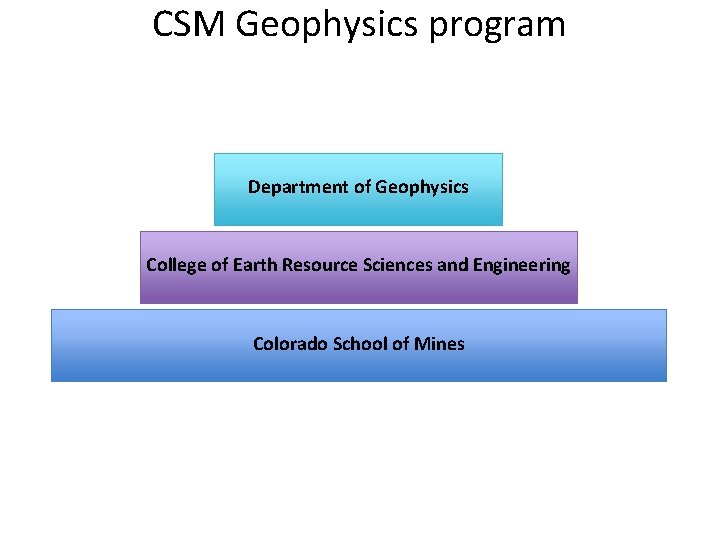
CSM Geophysics program Department of Geophysics College of Earth Resource Sciences and Engineering Colorado School of Mines
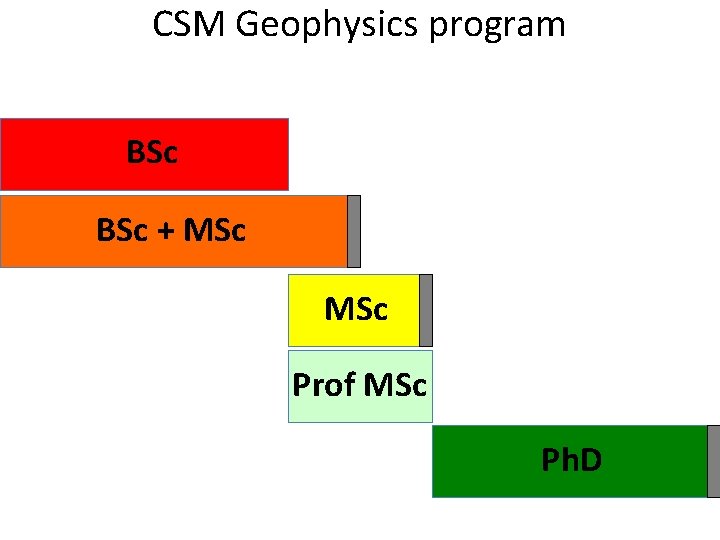
CSM Geophysics program BSc + MSc Prof MSc Ph. D
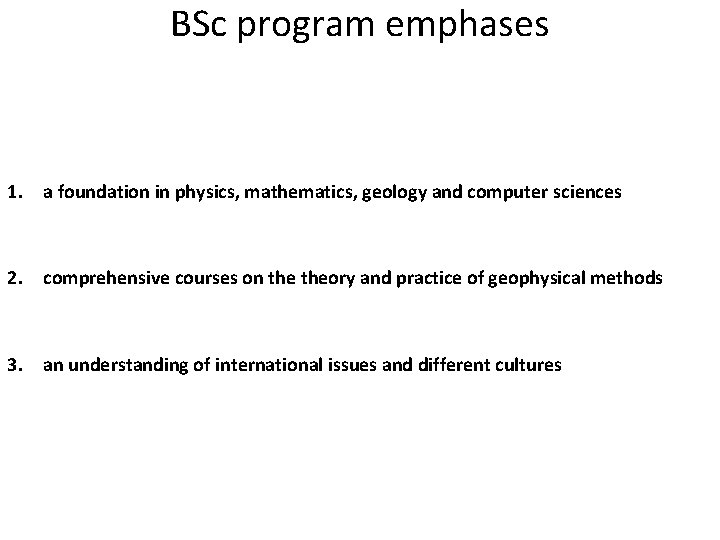
BSc program emphases 1. a foundation in physics, mathematics, geology and computer sciences 2. comprehensive courses on theory and practice of geophysical methods 3. an understanding of international issues and different cultures
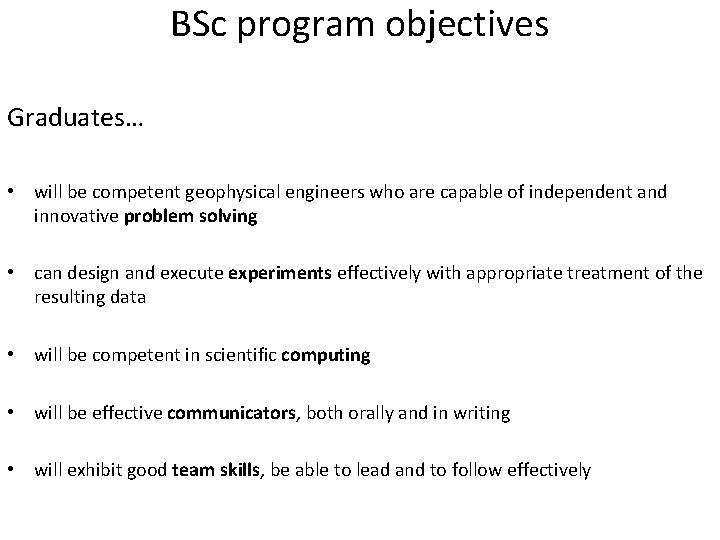
BSc program objectives Graduates… • will be competent geophysical engineers who are capable of independent and innovative problem solving • can design and execute experiments effectively with appropriate treatment of the resulting data • will be competent in scientific computing • will be effective communicators, both orally and in writing • will exhibit good team skills, be able to lead and to follow effectively
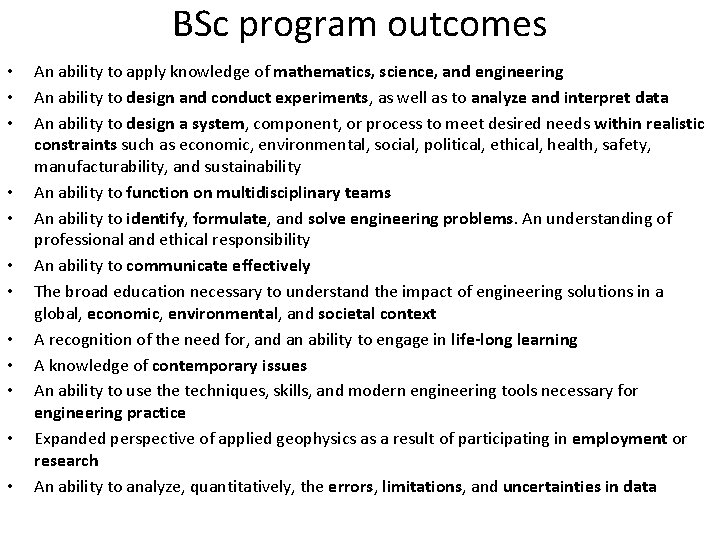
BSc program outcomes • • • An ability to apply knowledge of mathematics, science, and engineering An ability to design and conduct experiments, as well as to analyze and interpret data An ability to design a system, component, or process to meet desired needs within realistic constraints such as economic, environmental, social, political, ethical, health, safety, manufacturability, and sustainability An ability to function on multidisciplinary teams An ability to identify, formulate, and solve engineering problems. An understanding of professional and ethical responsibility An ability to communicate effectively The broad education necessary to understand the impact of engineering solutions in a global, economic, environmental, and societal context A recognition of the need for, and an ability to engage in life-long learning A knowledge of contemporary issues An ability to use the techniques, skills, and modern engineering tools necessary for engineering practice Expanded perspective of applied geophysics as a result of participating in employment or research An ability to analyze, quantitatively, the errors, limitations, and uncertainties in data
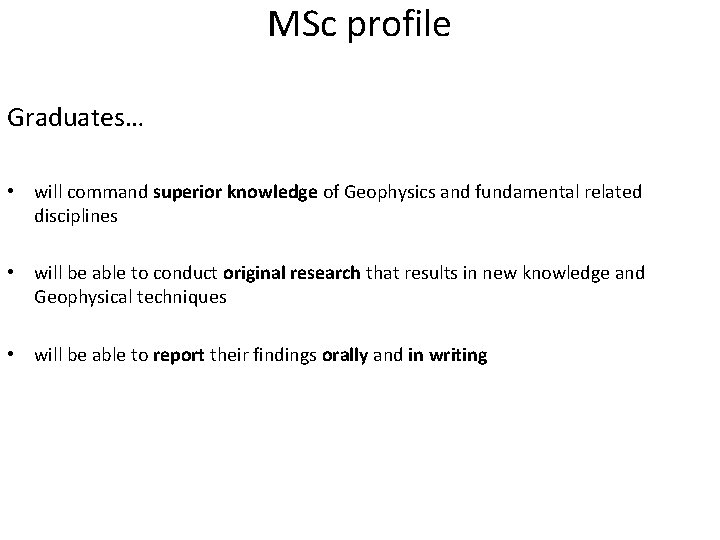
MSc profile Graduates… • will command superior knowledge of Geophysics and fundamental related disciplines • will be able to conduct original research that results in new knowledge and Geophysical techniques • will be able to report their findings orally and in writing
Ph. D profile Graduates… • will command superior knowledge of Geophysics and fundamental related disciplines • will independently be able to conduct research leading to significant new knowledge and Geophysical techniques • will be able to report their findings orally and in writing
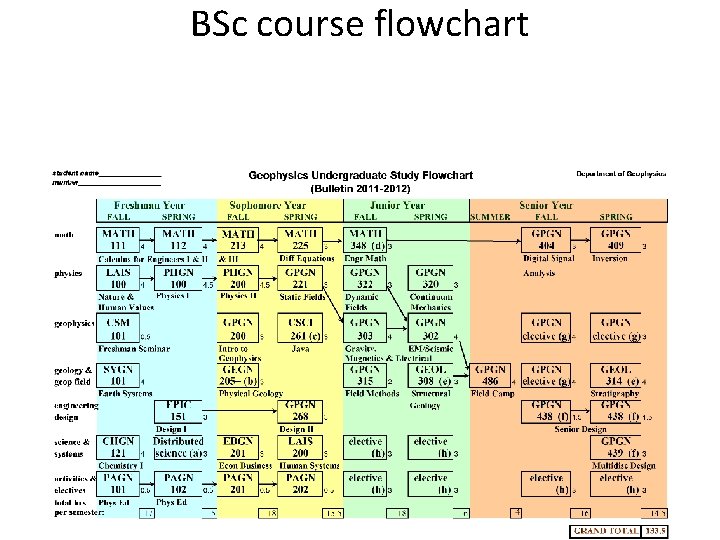
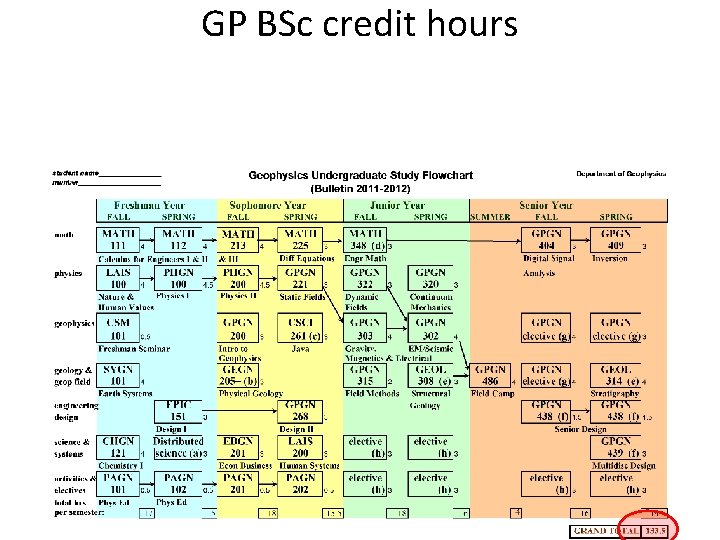
BSc course flowchart
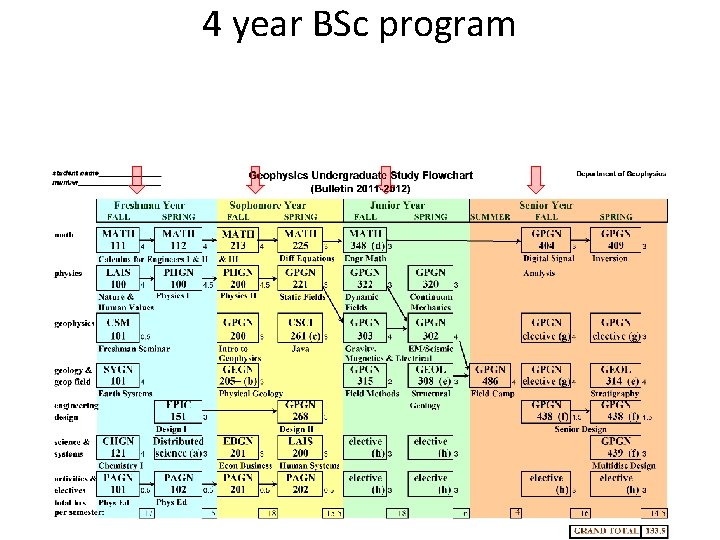
4 year BSc program
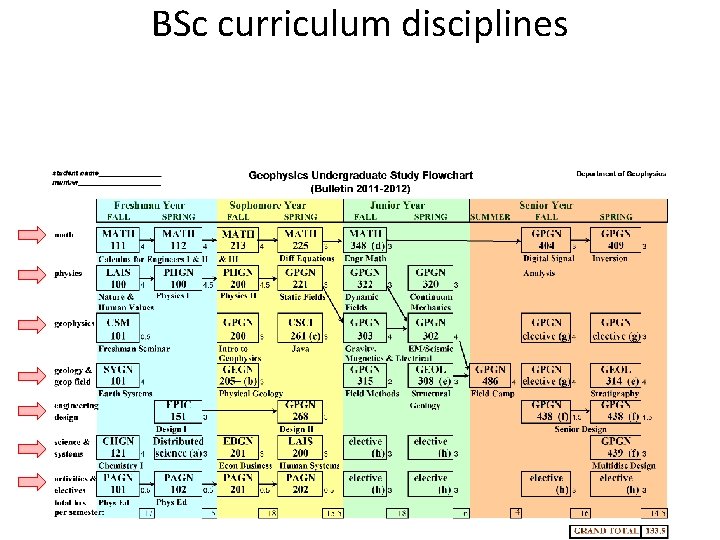
BSc curriculum disciplines
GP BSc credit hours
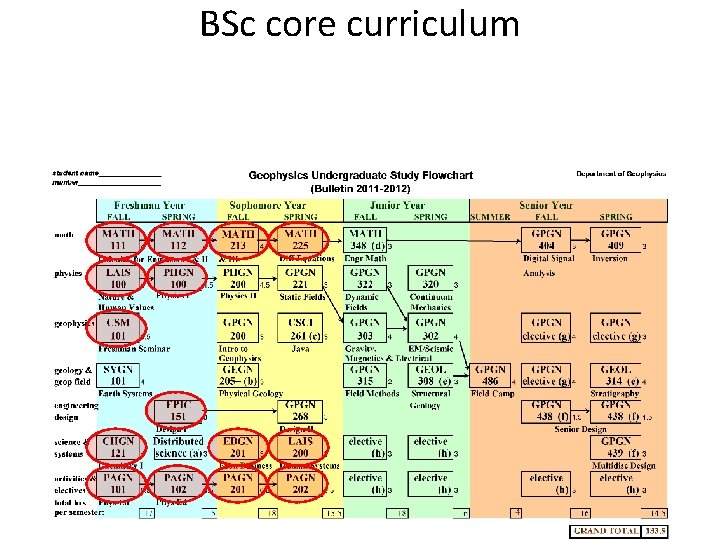
BSc core curriculum
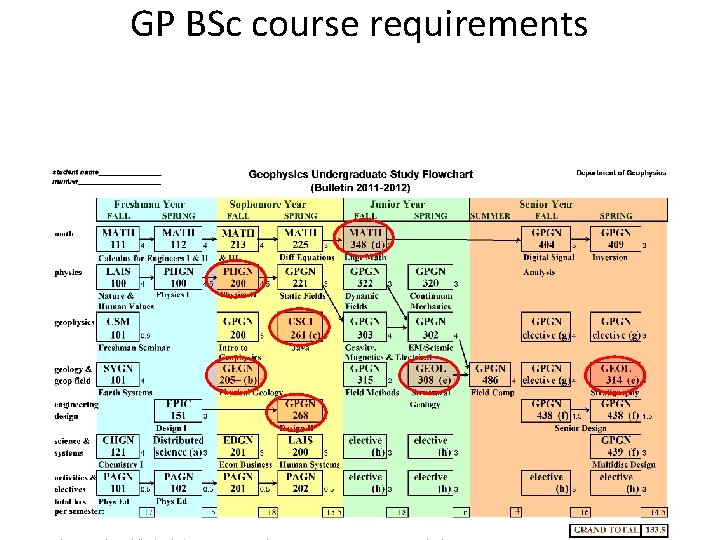
GP BSc course requirements
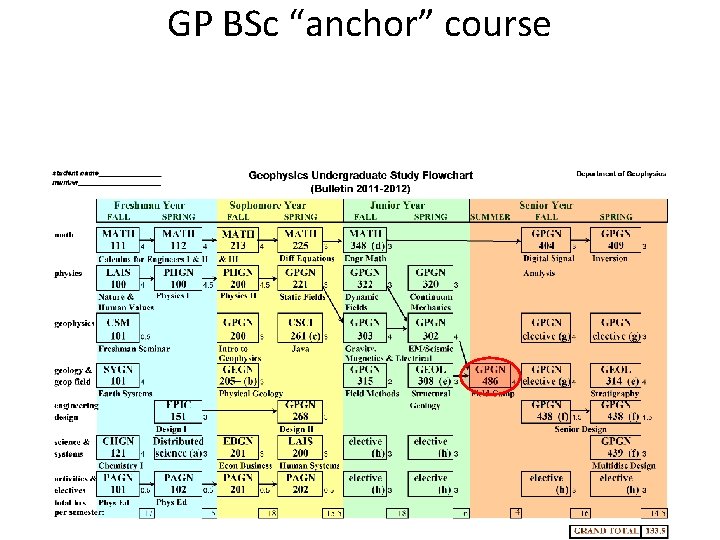
GP BSc “anchor” course
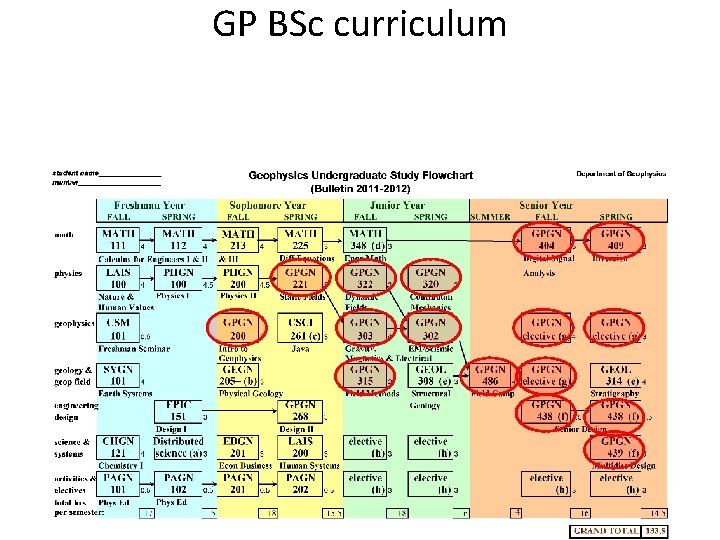
GP BSc curriculum
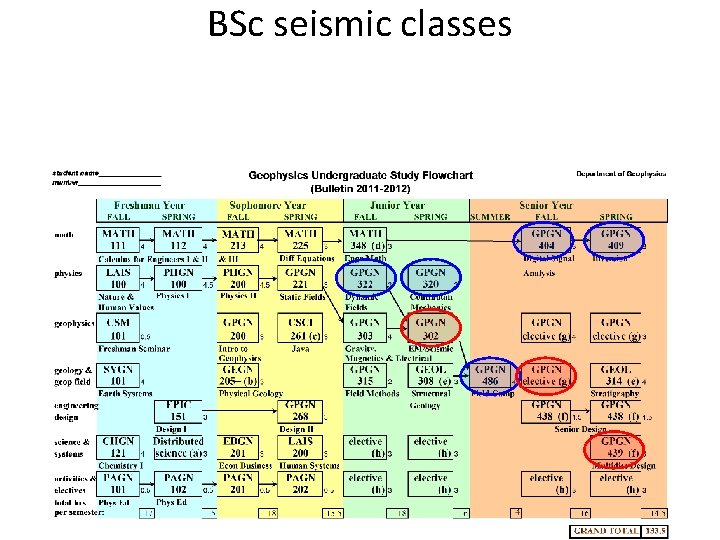
BSc seismic classes
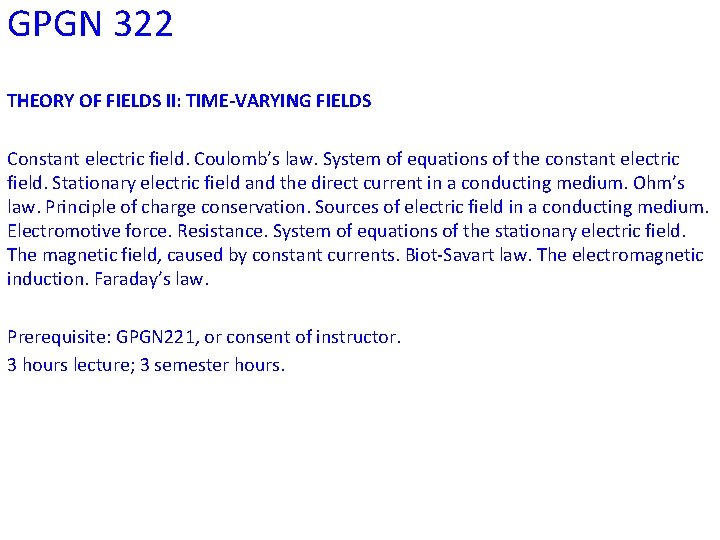
GPGN 322 THEORY OF FIELDS II: TIME-VARYING FIELDS Constant electric field. Coulomb’s law. System of equations of the constant electric field. Stationary electric field and the direct current in a conducting medium. Ohm’s law. Principle of charge conservation. Sources of electric field in a conducting medium. Electromotive force. Resistance. System of equations of the stationary electric field. The magnetic field, caused by constant currents. Biot-Savart law. The electromagnetic induction. Faraday’s law. Prerequisite: GPGN 221, or consent of instructor. 3 hours lecture; 3 semester hours.
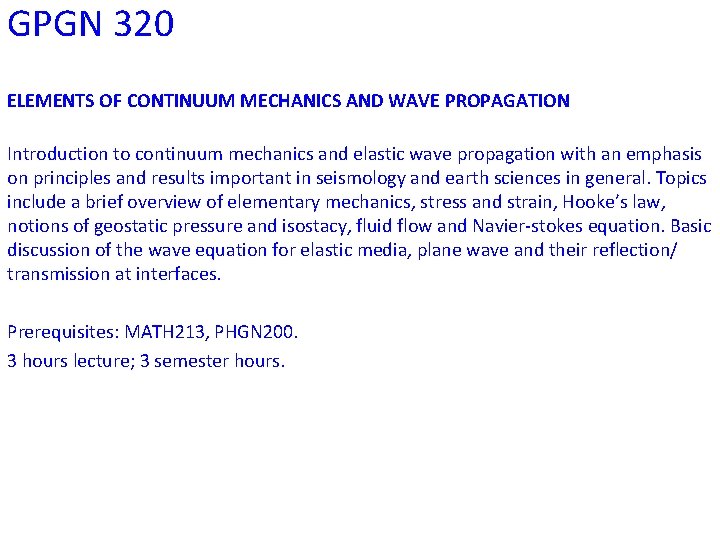
GPGN 320 ELEMENTS OF CONTINUUM MECHANICS AND WAVE PROPAGATION Introduction to continuum mechanics and elastic wave propagation with an emphasis on principles and results important in seismology and earth sciences in general. Topics include a brief overview of elementary mechanics, stress and strain, Hooke’s law, notions of geostatic pressure and isostacy, fluid flow and Navier-stokes equation. Basic discussion of the wave equation for elastic media, plane wave and their reflection/ transmission at interfaces. Prerequisites: MATH 213, PHGN 200. 3 hours lecture; 3 semester hours.
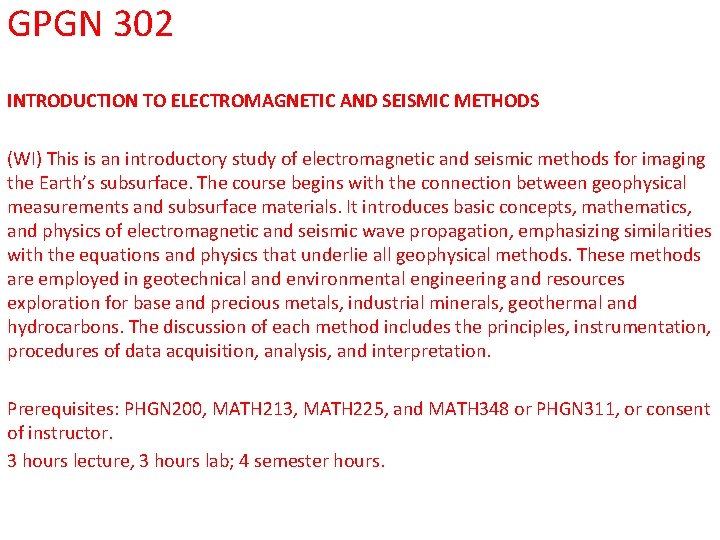
GPGN 302 INTRODUCTION TO ELECTROMAGNETIC AND SEISMIC METHODS (WI) This is an introductory study of electromagnetic and seismic methods for imaging the Earth’s subsurface. The course begins with the connection between geophysical measurements and subsurface materials. It introduces basic concepts, mathematics, and physics of electromagnetic and seismic wave propagation, emphasizing similarities with the equations and physics that underlie all geophysical methods. These methods are employed in geotechnical and environmental engineering and resources exploration for base and precious metals, industrial minerals, geothermal and hydrocarbons. The discussion of each method includes the principles, instrumentation, procedures of data acquisition, analysis, and interpretation. Prerequisites: PHGN 200, MATH 213, MATH 225, and MATH 348 or PHGN 311, or consent of instructor. 3 hours lecture, 3 hours lab; 4 semester hours.
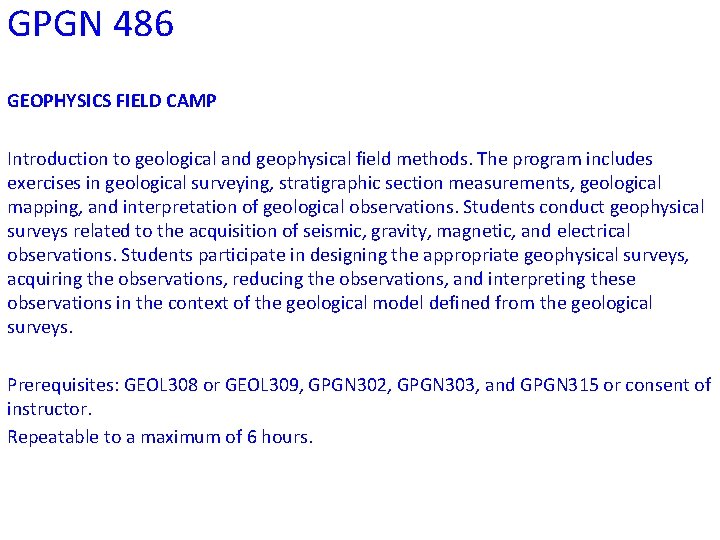
GPGN 486 GEOPHYSICS FIELD CAMP Introduction to geological and geophysical field methods. The program includes exercises in geological surveying, stratigraphic section measurements, geological mapping, and interpretation of geological observations. Students conduct geophysical surveys related to the acquisition of seismic, gravity, magnetic, and electrical observations. Students participate in designing the appropriate geophysical surveys, acquiring the observations, reducing the observations, and interpreting these observations in the context of the geological model defined from the geological surveys. Prerequisites: GEOL 308 or GEOL 309, GPGN 302, GPGN 303, and GPGN 315 or consent of instructor. Repeatable to a maximum of 6 hours.
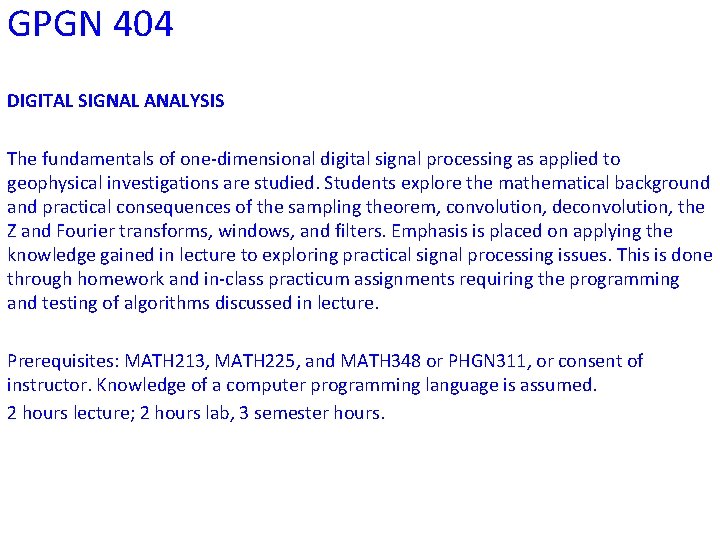
GPGN 404 DIGITAL SIGNAL ANALYSIS The fundamentals of one-dimensional digital signal processing as applied to geophysical investigations are studied. Students explore the mathematical background and practical consequences of the sampling theorem, convolution, deconvolution, the Z and Fourier transforms, windows, and filters. Emphasis is placed on applying the knowledge gained in lecture to exploring practical signal processing issues. This is done through homework and in-class practicum assignments requiring the programming and testing of algorithms discussed in lecture. Prerequisites: MATH 213, MATH 225, and MATH 348 or PHGN 311, or consent of instructor. Knowledge of a computer programming language is assumed. 2 hours lecture; 2 hours lab, 3 semester hours.
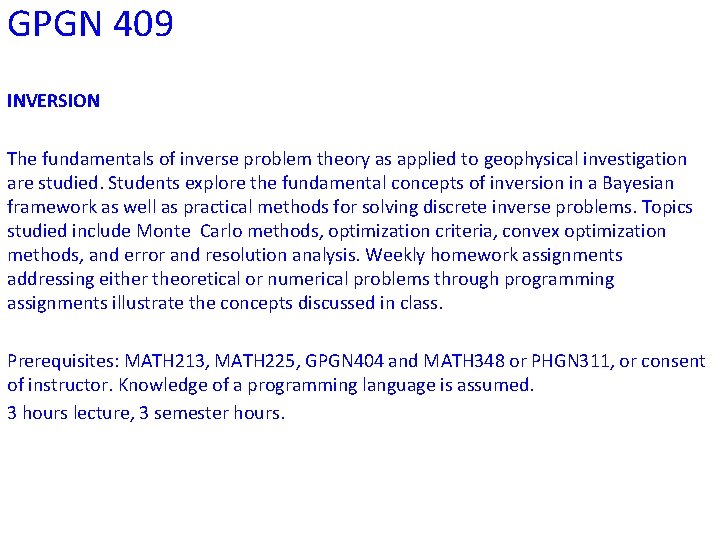
GPGN 409 INVERSION The fundamentals of inverse problem theory as applied to geophysical investigation are studied. Students explore the fundamental concepts of inversion in a Bayesian framework as well as practical methods for solving discrete inverse problems. Topics studied include Monte Carlo methods, optimization criteria, convex optimization methods, and error and resolution analysis. Weekly homework assignments addressing either theoretical or numerical problems through programming assignments illustrate the concepts discussed in class. Prerequisites: MATH 213, MATH 225, GPGN 404 and MATH 348 or PHGN 311, or consent of instructor. Knowledge of a programming language is assumed. 3 hours lecture, 3 semester hours.
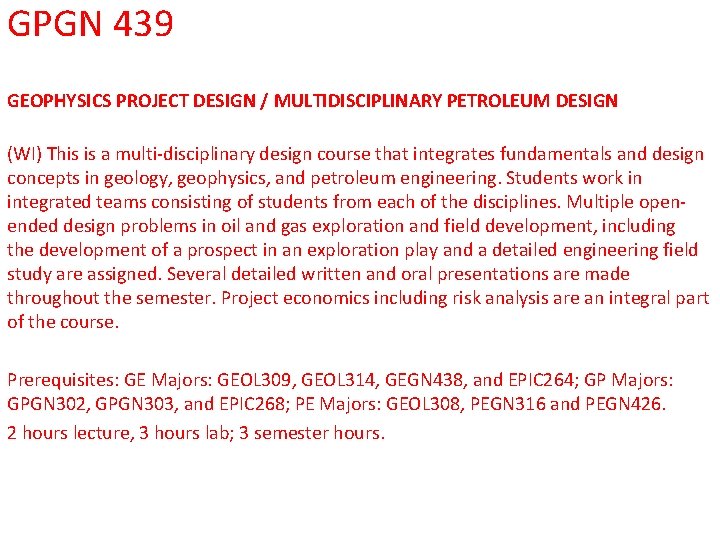
GPGN 439 GEOPHYSICS PROJECT DESIGN / MULTIDISCIPLINARY PETROLEUM DESIGN (WI) This is a multi-disciplinary design course that integrates fundamentals and design concepts in geology, geophysics, and petroleum engineering. Students work in integrated teams consisting of students from each of the disciplines. Multiple openended design problems in oil and gas exploration and field development, including the development of a prospect in an exploration play and a detailed engineering field study are assigned. Several detailed written and oral presentations are made throughout the semester. Project economics including risk analysis are an integral part of the course. Prerequisites: GE Majors: GEOL 309, GEOL 314, GEGN 438, and EPIC 264; GP Majors: GPGN 302, GPGN 303, and EPIC 268; PE Majors: GEOL 308, PEGN 316 and PEGN 426. 2 hours lecture, 3 hours lab; 3 semester hours.
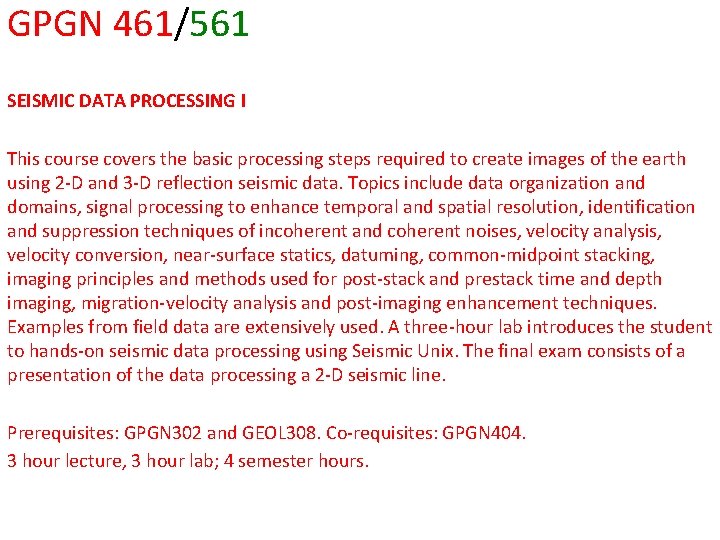
GPGN 461/561 SEISMIC DATA PROCESSING I This course covers the basic processing steps required to create images of the earth using 2 -D and 3 -D reflection seismic data. Topics include data organization and domains, signal processing to enhance temporal and spatial resolution, identification and suppression techniques of incoherent and coherent noises, velocity analysis, velocity conversion, near-surface statics, datuming, common-midpoint stacking, imaging principles and methods used for post-stack and prestack time and depth imaging, migration-velocity analysis and post-imaging enhancement techniques. Examples from field data are extensively used. A three-hour lab introduces the student to hands-on seismic data processing using Seismic Unix. The final exam consists of a presentation of the data processing a 2 -D seismic line. Prerequisites: GPGN 302 and GEOL 308. Co-requisites: GPGN 404. 3 hour lecture, 3 hour lab; 4 semester hours.
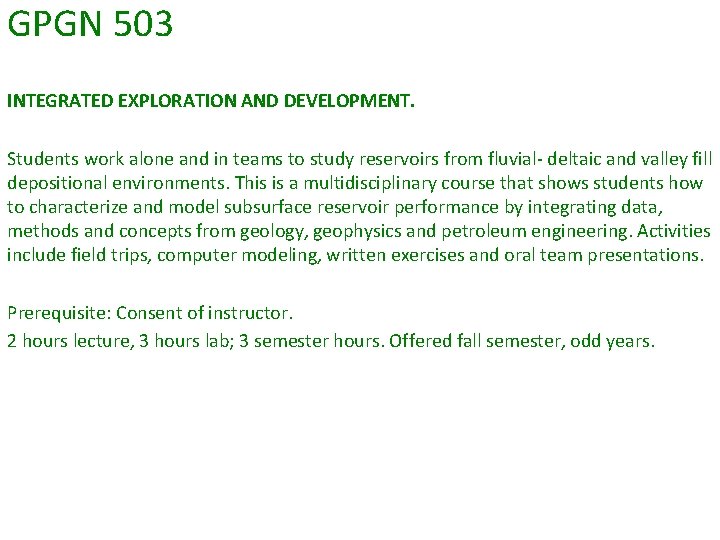
GPGN 503 INTEGRATED EXPLORATION AND DEVELOPMENT. Students work alone and in teams to study reservoirs from fluvial- deltaic and valley fill depositional environments. This is a multidisciplinary course that shows students how to characterize and model subsurface reservoir performance by integrating data, methods and concepts from geology, geophysics and petroleum engineering. Activities include field trips, computer modeling, written exercises and oral team presentations. Prerequisite: Consent of instructor. 2 hours lecture, 3 hours lab; 3 semester hours. Offered fall semester, odd years.
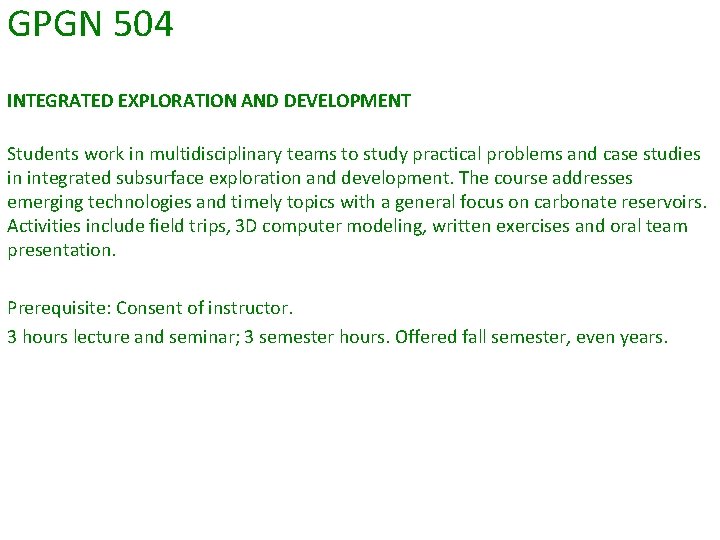
GPGN 504 INTEGRATED EXPLORATION AND DEVELOPMENT Students work in multidisciplinary teams to study practical problems and case studies in integrated subsurface exploration and development. The course addresses emerging technologies and timely topics with a general focus on carbonate reservoirs. Activities include field trips, 3 D computer modeling, written exercises and oral team presentation. Prerequisite: Consent of instructor. 3 hours lecture and seminar; 3 semester hours. Offered fall semester, even years.
GPGN 535 GEOPHYSICAL COMPUTING. A survey of computer programming skills most relevant to geophysical data processing, visualization and analysis. Skills enhanced include effective use of multiple programming languages, data structures, multicore systems, and computer memory hierarchies. Problems addressed include multidimensional geophysical image processing, geophysical data acquired at scattered locations, finite-difference approximations to partial differential equations, and other computational problems encountered in research by students. Prerequisites: Experience programming in Java, C, C++ or Fortran. 3 hours lecture, 3 credit hours.
GPGN 552 INTRODUCTION TO SEISMOLOGY Introduction to basic principles of elasticity including Hooke’s law, equation of motion, representation theorems, and reciprocity. Representation of seismic sources, seismic moment tensor, radiation from point sources in homogeneous isotropic media. Boundary conditions, reflection/transmission coefficients of plane waves, plane- wave propagation in stratified media. Basics of wave propagation in attenuative media, brief description of seismic modeling methods. Prerequisite: GPGN 461 or consent of instructor. 3 hours lecture; 3 semester hours.
GPGN 553 INTRODUCTION TO SEISMOLOGY This course is focused on the physics of wave phenomena and the importance of wave-theory results in exploration and earthquake seismology. Includes reflection and transmission problems for spherical waves, methods of steepest descent and stationary phase, point- source radiation in layered isotropic media, surface and non-geometrical waves. Discussion of seismic modeling methods, fundamentals of wave propagation in anisotropic and attenuative media. Prerequisite: GPGN 552 or consent of instructor. 3 hours lecture; 3 semester hours. Offered spring semester, even years.
LICM 501 PROFESSIONAL ORAL COMMUNICATION A five-week course which teaches the fundamentals of effectively preparing and presenting messages. "Hands-on" course emphasizing short (5 - and 10 -minute) weekly presentations made in small groups to simulate professional and corporate communications. Students are encouraged to make formal presentations that relate to their academic or professional fields. Extensive instruction in the use of visuals. Presentations are rehearsed in class two days prior to the formal presentations, all of which might be video-taped and carefully evaluated. Prerequisites: none 1 hour lecture/lab; 1 semester hour.
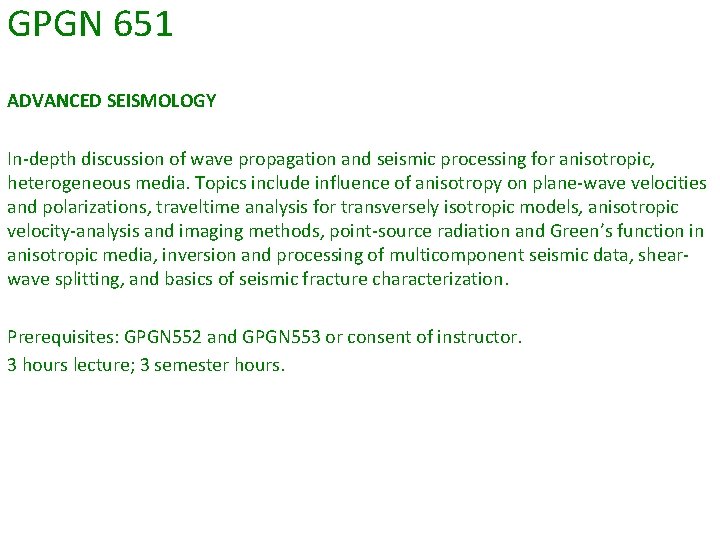
GPGN 651 ADVANCED SEISMOLOGY In-depth discussion of wave propagation and seismic processing for anisotropic, heterogeneous media. Topics include influence of anisotropy on plane-wave velocities and polarizations, traveltime analysis for transversely isotropic models, anisotropic velocity-analysis and imaging methods, point-source radiation and Green’s function in anisotropic media, inversion and processing of multicomponent seismic data, shearwave splitting, and basics of seismic fracture characterization. Prerequisites: GPGN 552 and GPGN 553 or consent of instructor. 3 hours lecture; 3 semester hours.
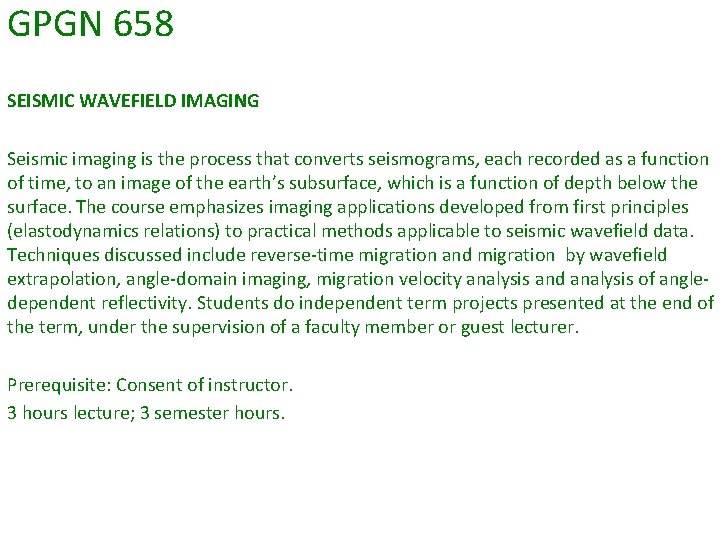
GPGN 658 SEISMIC WAVEFIELD IMAGING Seismic imaging is the process that converts seismograms, each recorded as a function of time, to an image of the earth’s subsurface, which is a function of depth below the surface. The course emphasizes imaging applications developed from first principles (elastodynamics relations) to practical methods applicable to seismic wavefield data. Techniques discussed include reverse-time migration and migration by wavefield extrapolation, angle-domain imaging, migration velocity analysis and analysis of angledependent reflectivity. Students do independent term projects presented at the end of the term, under the supervision of a faculty member or guest lecturer. Prerequisite: Consent of instructor. 3 hours lecture; 3 semester hours.
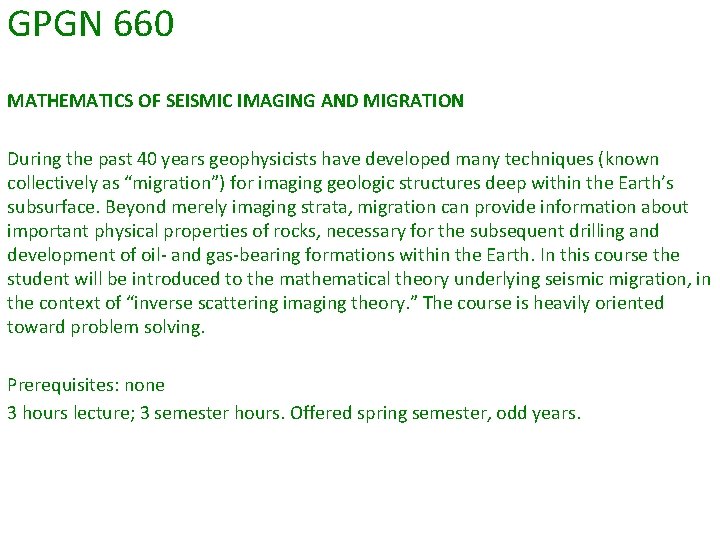
GPGN 660 MATHEMATICS OF SEISMIC IMAGING AND MIGRATION During the past 40 years geophysicists have developed many techniques (known collectively as “migration”) for imaging geologic structures deep within the Earth’s subsurface. Beyond merely imaging strata, migration can provide information about important physical properties of rocks, necessary for the subsequent drilling and development of oil- and gas-bearing formations within the Earth. In this course the student will be introduced to the mathematical theory underlying seismic migration, in the context of “inverse scattering imaging theory. ” The course is heavily oriented toward problem solving. Prerequisites: none 3 hours lecture; 3 semester hours. Offered spring semester, odd years.