
CSL 718 VLIW Software Driven ILP Hardware Support
- Slides: 23
CSL 718 : VLIW - Software Driven ILP Hardware Support for Exposing ILP at Compile Time 3 rd Apr, 2006 Anshul Kumar, CSE IITD
Outline Discussed so far: • Compiler Support for Exposing and Exploiting ILP What is to be discussed: • Hardware Support for Exposing ILP at Compile Time Anshul Kumar, CSE IITD 2
Hardware Support • Conditional or predicated instructions – Can be used to eliminate branches – Control dependence is converted into data dependence – Useful in hardware as well as software intensive approaches for ILP • Compiler speculation with hardware support – Support for preserving the exception behavior – Support for reordering loads and stores Anshul Kumar, CSE IITD 3
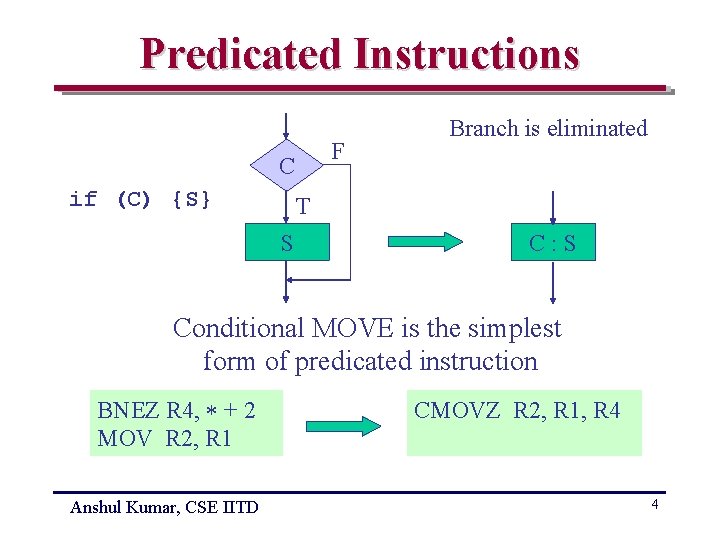
Predicated Instructions F C if (C) {S} Branch is eliminated T S C: S Conditional MOVE is the simplest form of predicated instruction BNEZ R 4, + 2 MOV R 2, R 1 Anshul Kumar, CSE IITD CMOVZ R 2, R 1, R 4 4
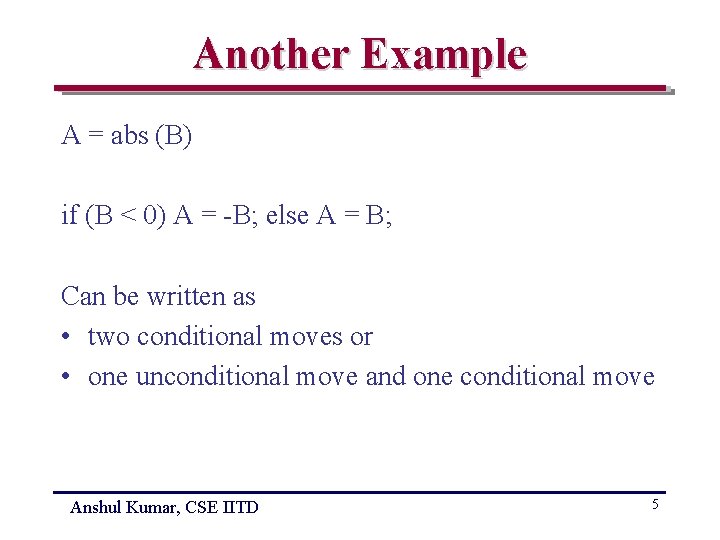
Another Example A = abs (B) if (B < 0) A = -B; else A = B; Can be written as • two conditional moves or • one unconditional move and one conditional move Anshul Kumar, CSE IITD 5
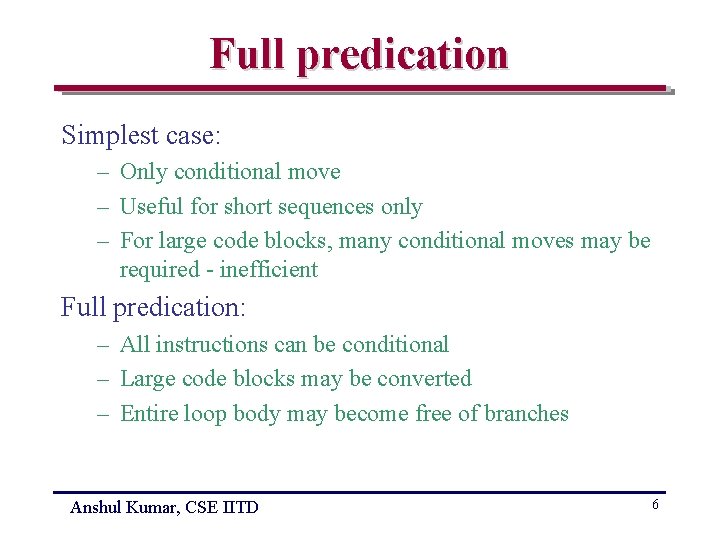
Full predication Simplest case: – Only conditional move – Useful for short sequences only – For large code blocks, many conditional moves may be required - inefficient Full predication: – All instructions can be conditional – Large code blocks may be converted – Entire loop body may become free of branches Anshul Kumar, CSE IITD 6
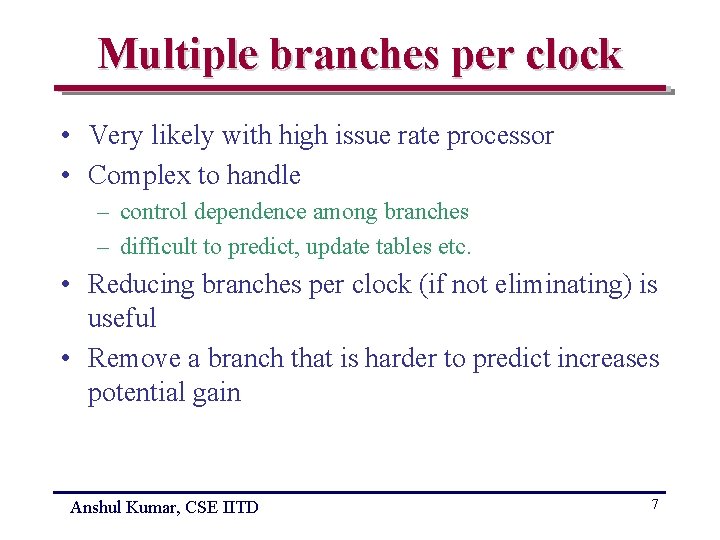
Multiple branches per clock • Very likely with high issue rate processor • Complex to handle – control dependence among branches – difficult to predict, update tables etc. • Reducing branches per clock (if not eliminating) is useful • Remove a branch that is harder to predict increases potential gain Anshul Kumar, CSE IITD 7
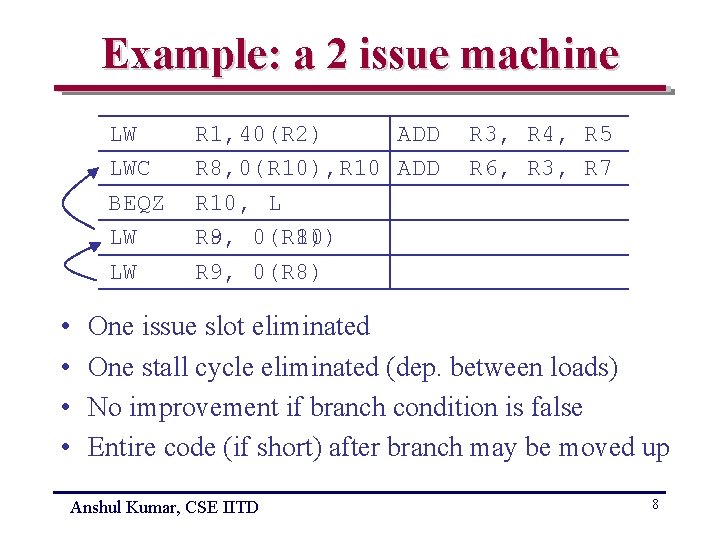
Example: a 2 issue machine LW LWC BEQZ LW LW • • ADD R 1, 40(R 2) R 8, 0(R 10), R 10 ADD R 10, L R 9, 0(R 10) 0(R 8) R 8, R 9, 0(R 8) R 3, R 4, R 5 R 6, R 3, R 7 One issue slot eliminated One stall cycle eliminated (dep. between loads) No improvement if branch condition is false Entire code (if short) after branch may be moved up Anshul Kumar, CSE IITD 8
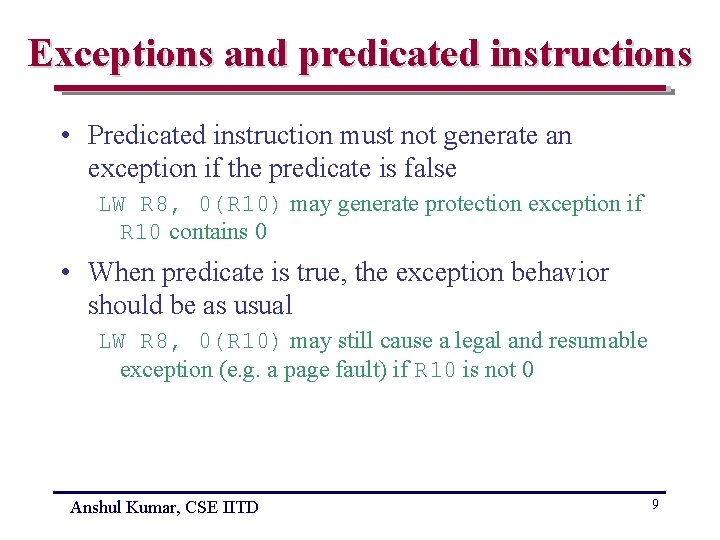
Exceptions and predicated instructions • Predicated instruction must not generate an exception if the predicate is false LW R 8, 0(R 10) may generate protection exception if R 10 contains 0 • When predicate is true, the exception behavior should be as usual LW R 8, 0(R 10) may still cause a legal and resumable exception (e. g. a page fault) if R 10 is not 0 Anshul Kumar, CSE IITD 9
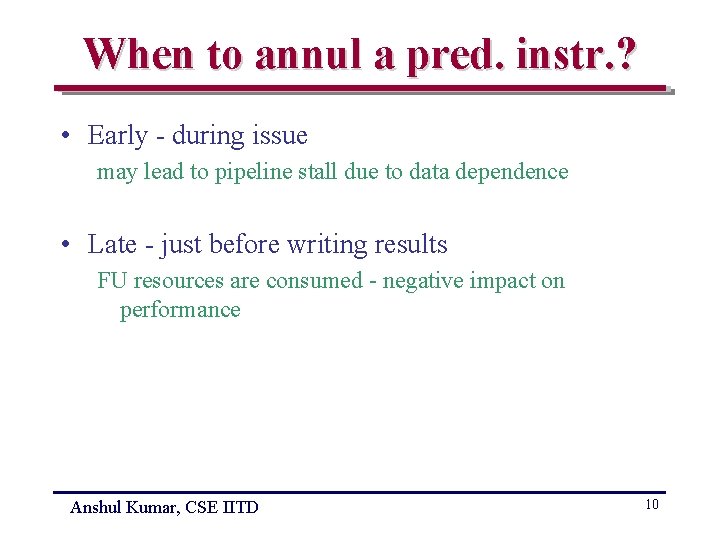
When to annul a pred. instr. ? • Early - during issue may lead to pipeline stall due to data dependence • Late - just before writing results FU resources are consumed - negative impact on performance Anshul Kumar, CSE IITD 10
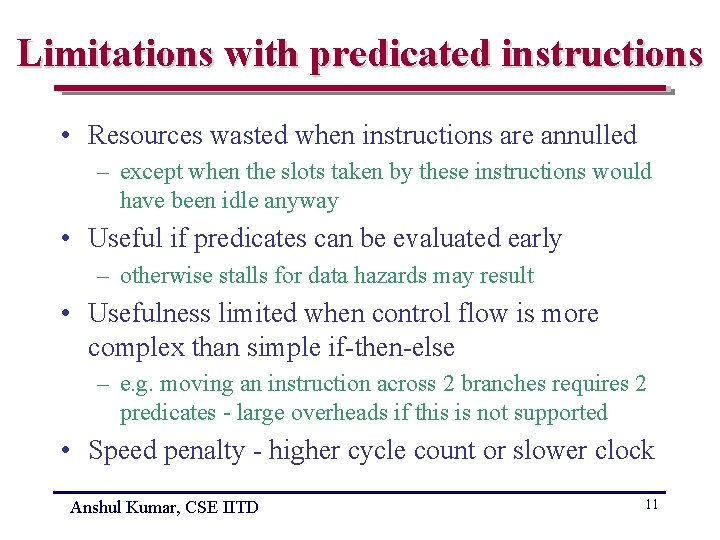
Limitations with predicated instructions • Resources wasted when instructions are annulled – except when the slots taken by these instructions would have been idle anyway • Useful if predicates can be evaluated early – otherwise stalls for data hazards may result • Usefulness limited when control flow is more complex than simple if-then-else – e. g. moving an instruction across 2 branches requires 2 predicates - large overheads if this is not supported • Speed penalty - higher cycle count or slower clock Anshul Kumar, CSE IITD 11
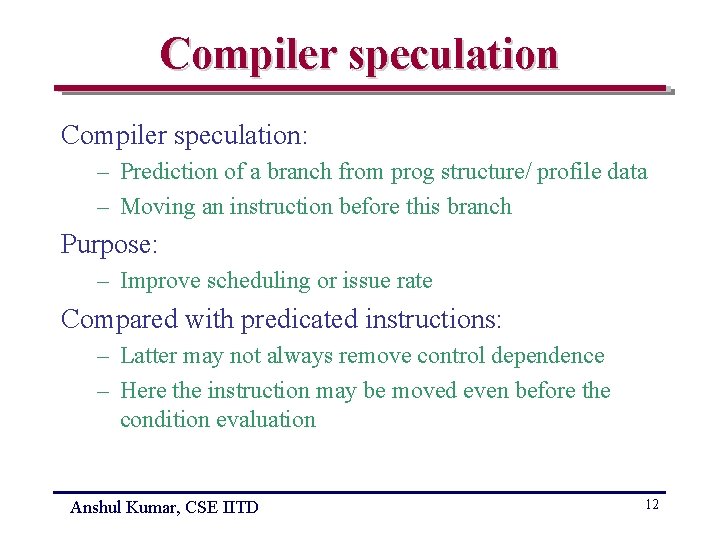
Compiler speculation: – Prediction of a branch from prog structure/ profile data – Moving an instruction before this branch Purpose: – Improve scheduling or issue rate Compared with predicated instructions: – Latter may not always remove control dependence – Here the instruction may be moved even before the condition evaluation Anshul Kumar, CSE IITD 12
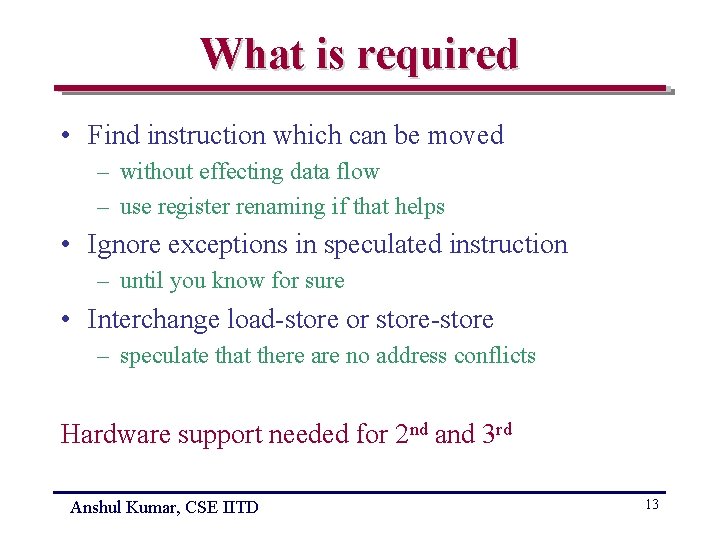
What is required • Find instruction which can be moved – without effecting data flow – use register renaming if that helps • Ignore exceptions in speculated instruction – until you know for sure • Interchange load-store or store-store – speculate that there are no address conflicts Hardware support needed for 2 nd and 3 rd Anshul Kumar, CSE IITD 13
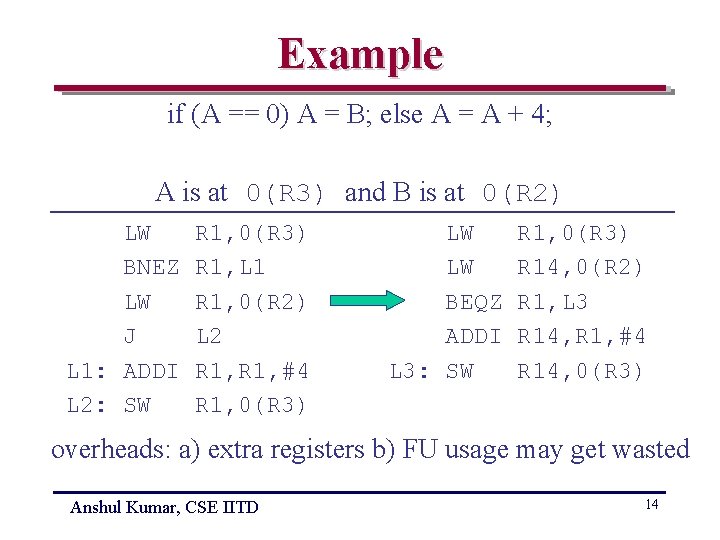
Example if (A == 0) A = B; else A = A + 4; A is at 0(R 3) and B is at 0(R 2) LW BNEZ LW J L 1: ADDI L 2: SW R 1, 0(R 3) R 1, L 1 R 1, 0(R 2) L 2 R 1, #4 R 1, 0(R 3) LW LW BEQZ ADDI L 3: SW R 1, 0(R 3) R 14, 0(R 2) R 1, L 3 R 14, R 1, #4 R 14, 0(R 3) overheads: a) extra registers b) FU usage may get wasted Anshul Kumar, CSE IITD 14
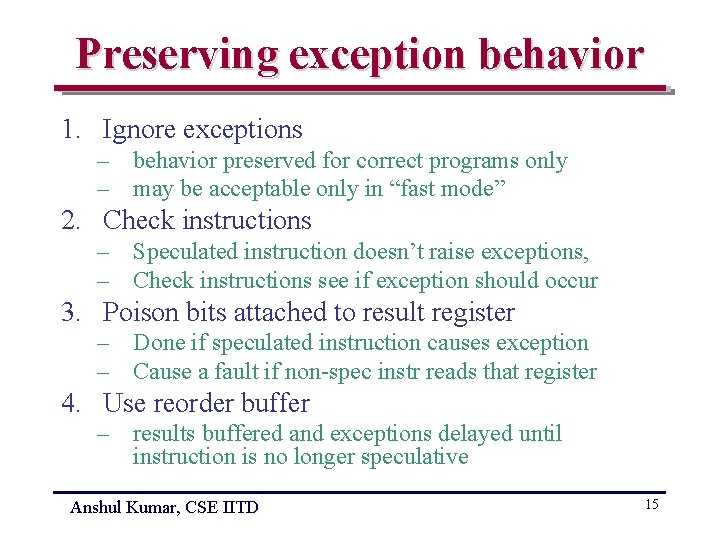
Preserving exception behavior 1. Ignore exceptions – behavior preserved for correct programs only – may be acceptable only in “fast mode” 2. Check instructions – Speculated instruction doesn’t raise exceptions, – Check instructions see if exception should occur 3. Poison bits attached to result register – Done if speculated instruction causes exception – Cause a fault if non-spec instr reads that register 4. Use reorder buffer – results buffered and exceptions delayed until instruction is no longer speculative Anshul Kumar, CSE IITD 15
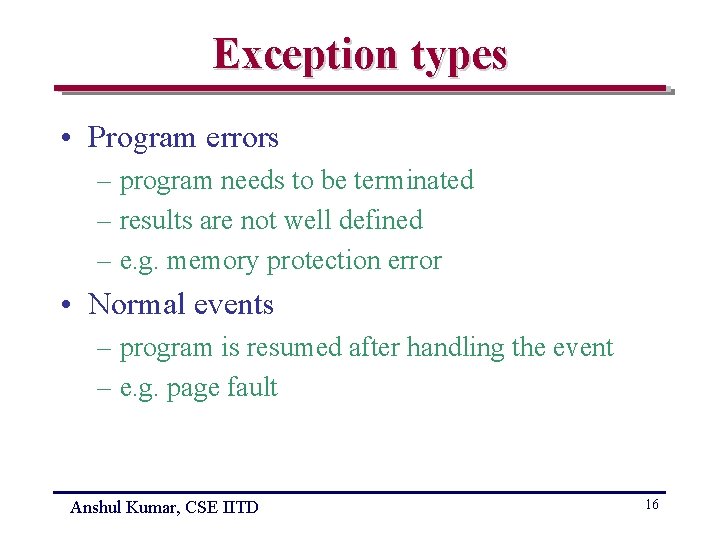
Exception types • Program errors – program needs to be terminated – results are not well defined – e. g. memory protection error • Normal events – program is resumed after handling the event – e. g. page fault Anshul Kumar, CSE IITD 16
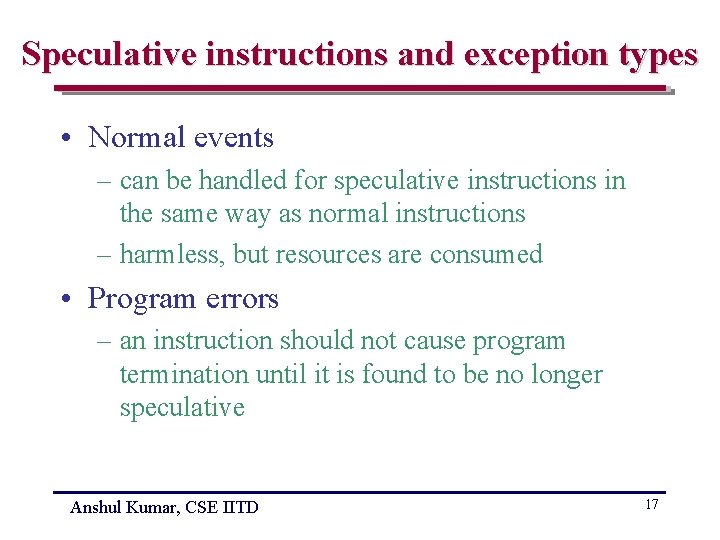
Speculative instructions and exception types • Normal events – can be handled for speculative instructions in the same way as normal instructions – harmless, but resources are consumed • Program errors – an instruction should not cause program termination until it is found to be no longer speculative Anshul Kumar, CSE IITD 17
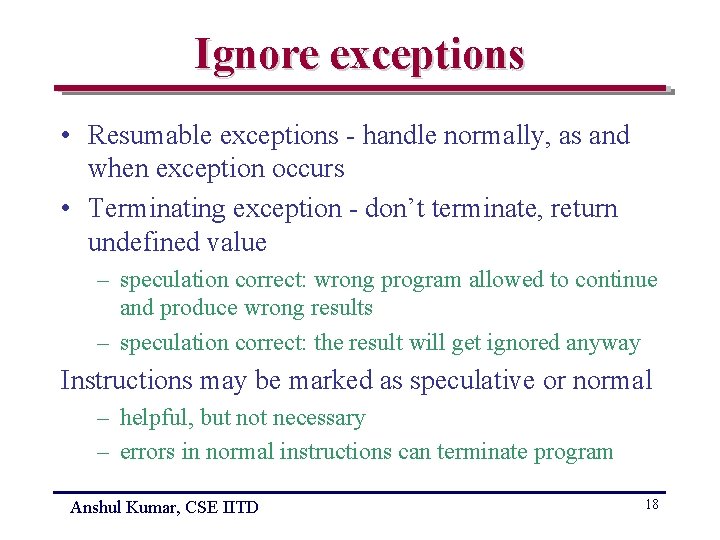
Ignore exceptions • Resumable exceptions - handle normally, as and when exception occurs • Terminating exception - don’t terminate, return undefined value – speculation correct: wrong program allowed to continue and produce wrong results – speculation correct: the result will get ignored anyway Instructions may be marked as speculative or normal – helpful, but not necessary – errors in normal instructions can terminate program Anshul Kumar, CSE IITD 18
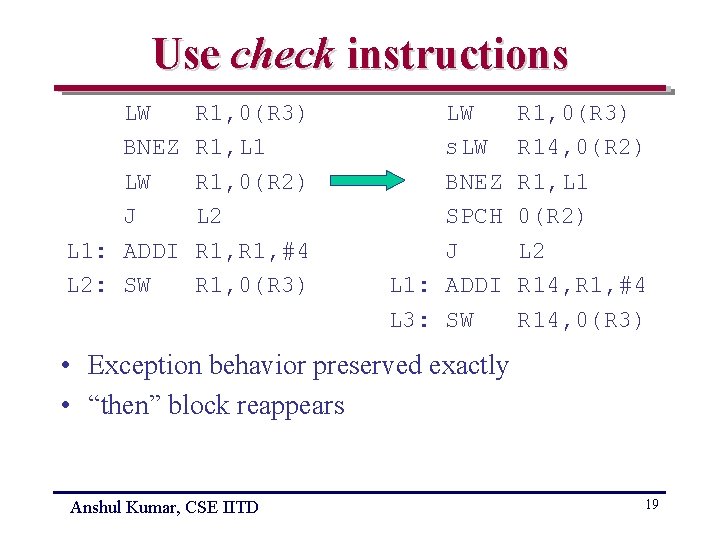
Use check instructions LW BNEZ LW J L 1: ADDI L 2: SW R 1, 0(R 3) R 1, L 1 R 1, 0(R 2) L 2 R 1, #4 R 1, 0(R 3) LW s. LW BNEZ SPCH J L 1: ADDI L 3: SW R 1, 0(R 3) R 14, 0(R 2) R 1, L 1 0(R 2) L 2 R 14, R 1, #4 R 14, 0(R 3) • Exception behavior preserved exactly • “then” block reappears Anshul Kumar, CSE IITD 19
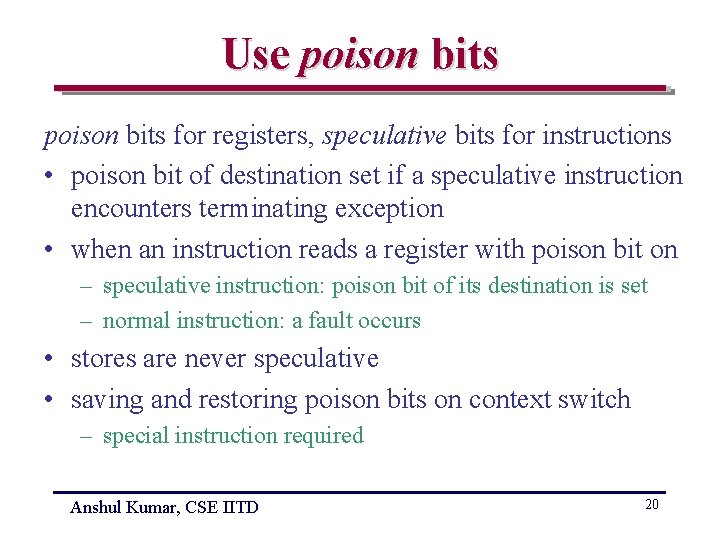
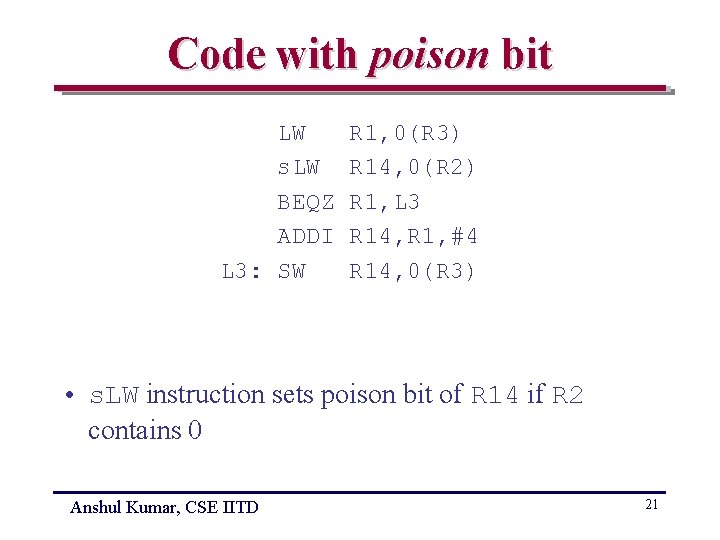
Use poison bits for registers, speculative bits for instructions • poison bit of destination set if a speculative instruction encounters terminating exception • when an instruction reads a register with poison bit on – speculative instruction: poison bit of its destination is set – normal instruction: a fault occurs • stores are never speculative • saving and restoring poison bits on context switch – special instruction required Anshul Kumar, CSE IITD 20
Code with poison bit LW s. LW BEQZ ADDI L 3: SW R 1, 0(R 3) R 14, 0(R 2) R 1, L 3 R 14, R 1, #4 R 14, 0(R 3) • s. LW instruction sets poison bit of R 14 if R 2 contains 0 Anshul Kumar, CSE IITD 21
Use reorder buffer • Reorder buffer as in superscalar processor • instructions marked as speculative • remember how many branches (usually not more than 1) it moved across and what branch action compiler assumed • alternative: original location marked by a sentinel indicates that the results can be committed Anshul Kumar, CSE IITD 22
Memory reference speculation • Move load up across a store • no problem if absence of address clash can be checked statically • otherwise, mark the instruction as speculative - it saves the address • address examined on subsequent stores - a conflict means speculation failed • a special instruction is kept at the original location of load - can take care of relaod when speculation fails - may require a fix-up sequence as well Anshul Kumar, CSE IITD 23