
CSISF Estimating Wireless Channel State Using CSI Sampling
- Slides: 1
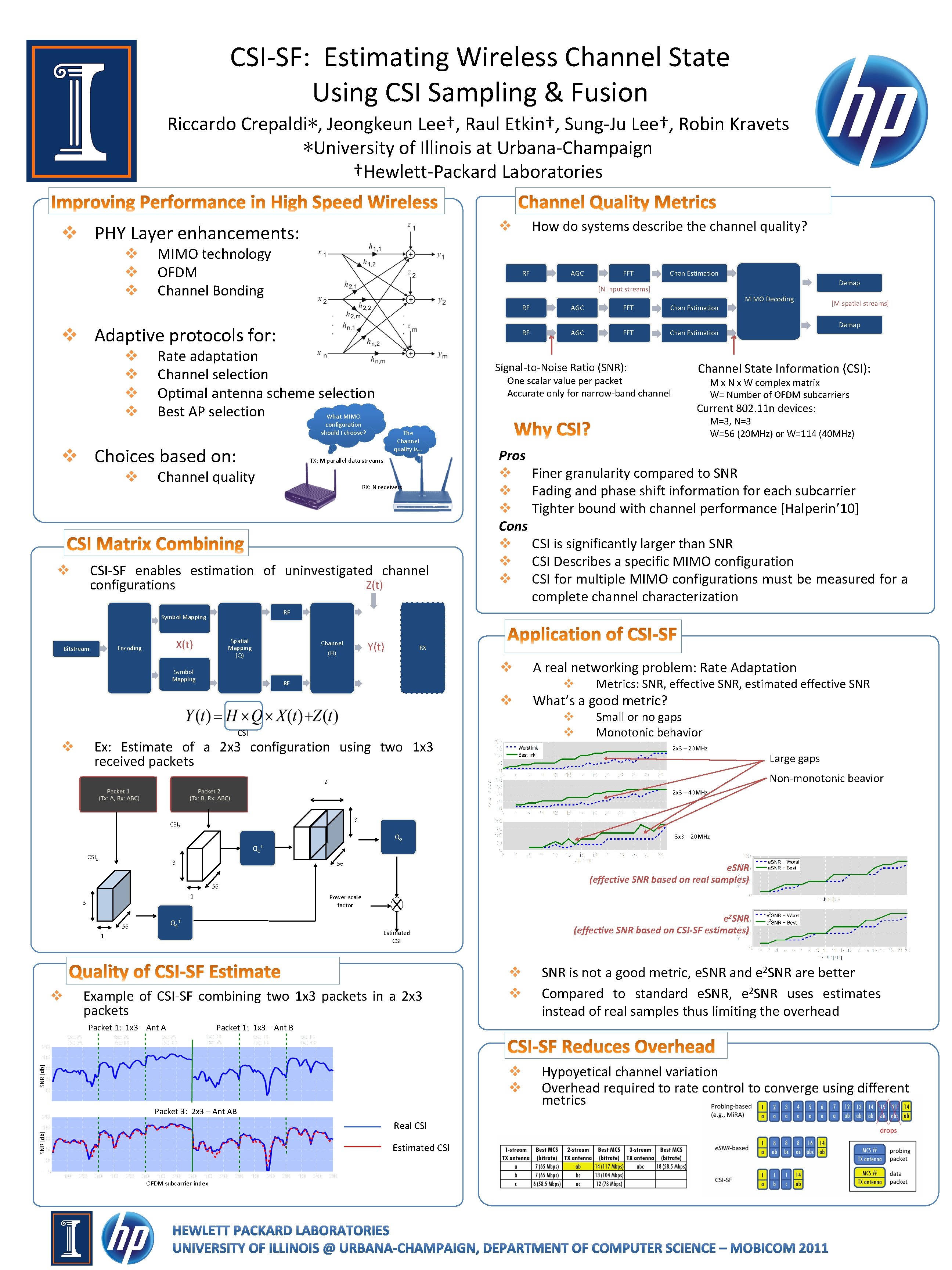
CSI-SF: Estimating Wireless Channel State Using CSI Sampling & Fusion Riccardo Crepaldi∗, Jeongkeun Lee†, Raul Etkin†, Sung-Ju Lee†, Robin Kravets ∗University of Illinois at Urbana-Champaign †Hewlett-Packard Laboratories v PHY Layer enhancements: v v v How do systems describe the channel quality? v MIMO technology OFDM Channel Bonding RF v Adaptive protocols for: RF Rate adaptation Channel selection Optimal antenna scheme selection Best AP selection What MIMO v Choices based on: The Channel quality is… RX: N receivers Spatial Mapping (Q) X(t) Encoding Channel Y(t) (H) FFT Chan Estimation [M spatial streams] Demap Chan Estimation Channel State Information (CSI): M x N x W complex matrix W= Number of OFDM subcarriers M=3, N=3 W=56 (20 MHz) or W=114 (40 MHz) Pros v Finer granularity compared to SNR v Fading and phase shift information for each subcarrier v Tighter bound with channel performance [Halperin’ 10] Cons v CSI is significantly larger than SNR v CSI Describes a specific MIMO configuration v CSI for multiple MIMO configurations must be measured for a complete channel characterization RX v Symbol Mapping A real networking problem: Rate Adaptation v RF v Ex: Estimate of a 2 x 3 configuration using two 1 x 3 received packets Metrics: SNR, effective SNR, estimated effective SNR What’s a good metric? v v CSI v AGC FFT MIMO Decoding RF Symbol Mapping Bitstream Demap Current 802. 11 n devices: CSI-SF enables estimation of uninvestigated channel Z(t) configurations v Chan Estimation One scalar value per packet Accurate only for narrow-band channel TX: M parallel data streams Channel quality AGC Signal-to-Noise Ratio (SNR): configuration should I choose? v FFT [N Input streams] RF v v AGC Small or no gaps Monotonic behavior 2 x 3 – 20 MHz Large gaps Non-monotonic beavior 2 2 x 3 – 40 MHz 3 CSI 2 Q 2 3 x 3 – 20 MHz Q 1 † CSI 1 3 56 e. SNR (effective SNR based on real samples) 56 1 3 Q 1 56 Power scale factor Estimated CSI 1 v e 2 SNR (effective SNR based on CSI-SF estimates) † Example of CSI-SF combining two 1 x 3 packets in a 2 x 3 packets Packet 3: 2 x 3 – Ant AB SNR [db] Real CSI Estimated CSI OFDM subcarrier index SNR is not a good metric, e. SNR and e 2 SNR are better Compared to standard e. SNR, e 2 SNR uses estimates instead of real samples thus limiting the overhead v v Hypoyetical channel variation Overhead required to rate control to converge using different metrics Packet 1: 1 x 3 – Ant B SNR [db] Packet 1: 1 x 3 – Ant A v v