
CSI 3131 Summer 2016 Principles of Operating Systems

- Slides: 11
CSI 3131 Summer 2016 Principles of Operating Systems Instructor: Dr. Nathalie Japkowicz E-mail: nat@site. uottawa. ca Office: STE 5029 Office Hours: n In person: u Monday 11: 30 am-1: 00 pm n On Skype: By arrangement n Teaching Assistant (TA) for the course: u TBA
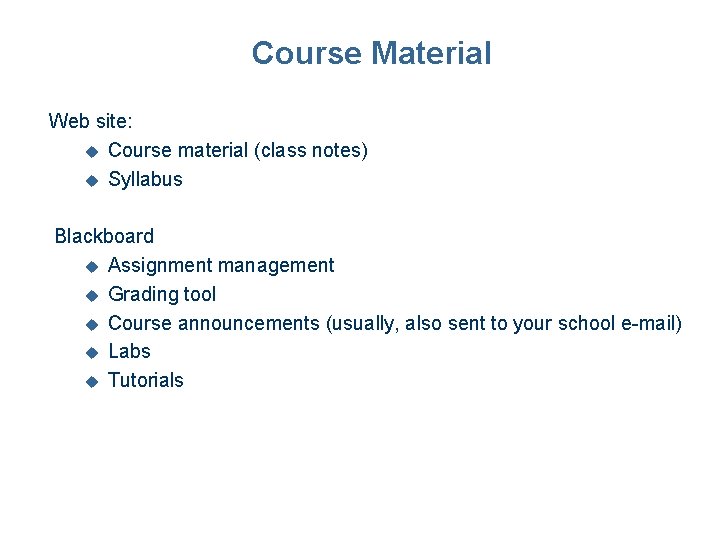
Course Material Web site: u Course material (class notes) u Syllabus Blackboard u Assignment management u Grading tool u Course announcements (usually, also sent to your school e-mail) u Labs u Tutorials
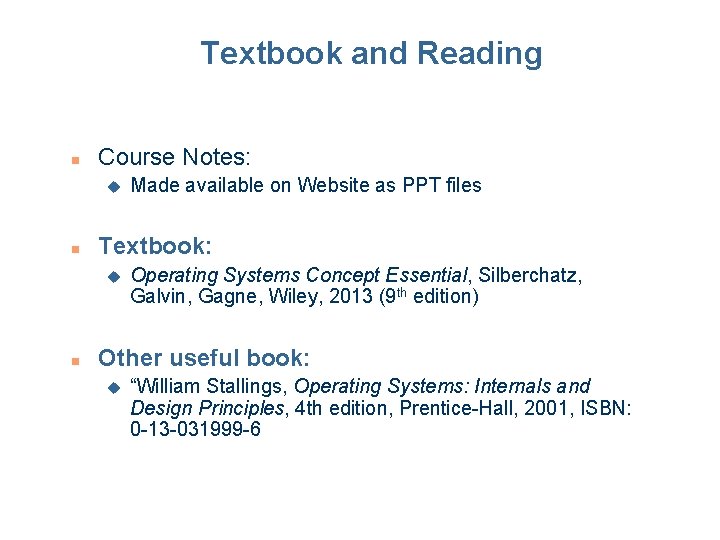
Textbook and Reading n Course Notes: u n Textbook: u n Made available on Website as PPT files Operating Systems Concept Essential, Silberchatz, Galvin, Gagne, Wiley, 2013 (9 th edition) Other useful book: u “William Stallings, Operating Systems: Internals and Design Principles, 4 th edition, Prentice-Hall, 2001, ISBN: 0 -13 -031999 -6
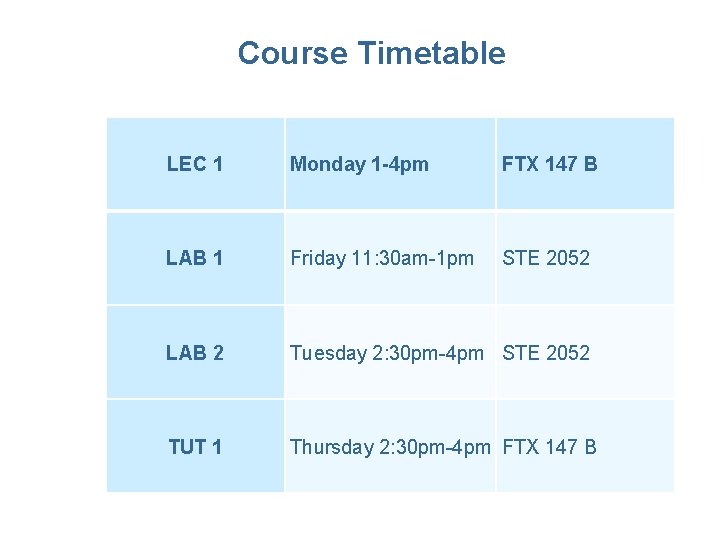
Course Timetable LEC 1 Monday 1 -4 pm FTX 147 B LAB 1 Friday 11: 30 am-1 pm STE 2052 LAB 2 Tuesday 2: 30 pm-4 pm STE 2052 TUT 1 Thursday 2: 30 pm-4 pm FTX 147 B
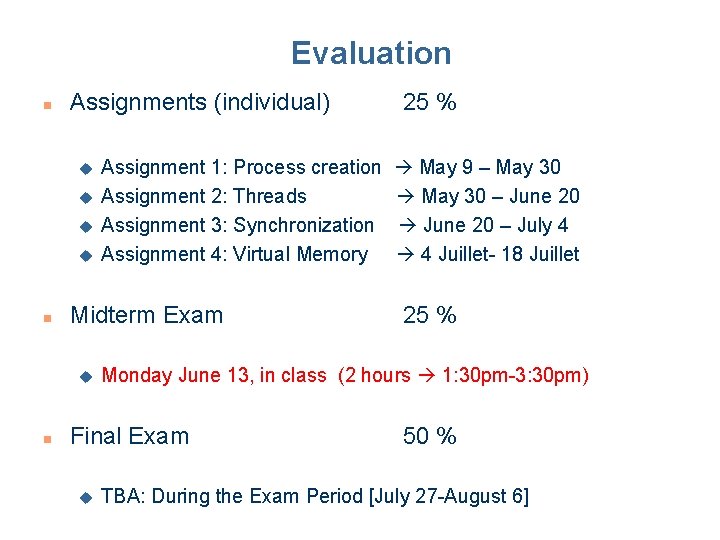
Evaluation n Assignments (individual) u u n Midterm Exam u n Assignment 1: Process creation Assignment 2: Threads Assignment 3: Synchronization Assignment 4: Virtual Memory May 9 – May 30 – June 20 – July 4 4 Juillet- 18 Juillet 25 % Monday June 13, in class (2 hours 1: 30 pm-3: 30 pm) Final Exam u 25 % 50 % TBA: During the Exam Period [July 27 -August 6]
Course Organization Questions?
Course Objectives You are expected to u u u learn basic concepts and principles behind the design of operating systems get exposed to the problems operating systems designers face, explore the tradeoffs and solutions to these problems see how are these issues solved in practice in real operating systems be able to apply these concepts and techniques in relevant circumstances get some hands-on experience programming OS type problems (process creation, inter-process-communications, process synchronization, mutual exclusion, deadlock avoidance)
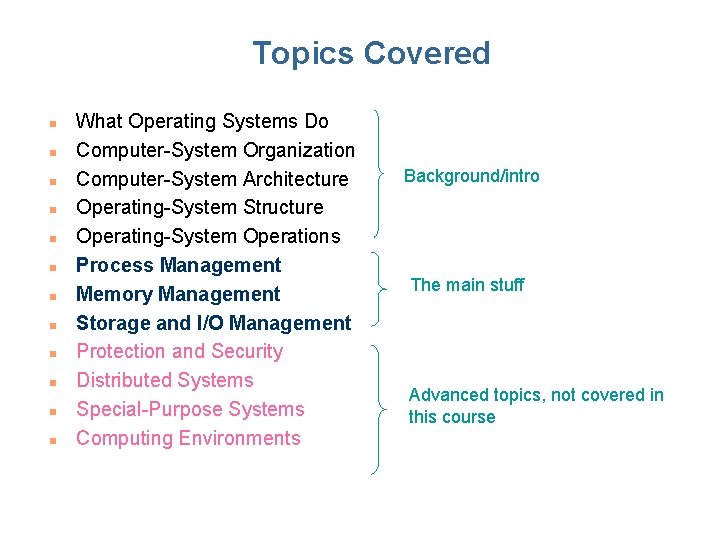
Topics Covered n n n What Operating Systems Do Computer-System Organization Computer-System Architecture Operating-System Structure Operating-System Operations Process Management Memory Management Storage and I/O Management Protection and Security Distributed Systems Special-Purpose Systems Computing Environments Background/intro The main stuff Advanced topics, not covered in this course
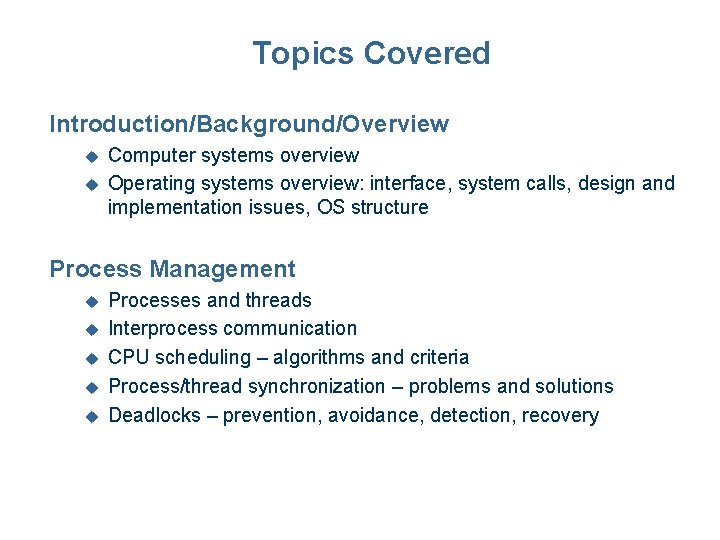
Topics Covered Introduction/Background/Overview u u Computer systems overview Operating systems overview: interface, system calls, design and implementation issues, OS structure Process Management u u u Processes and threads Interprocess communication CPU scheduling – algorithms and criteria Process/thread synchronization – problems and solutions Deadlocks – prevention, avoidance, detection, recovery
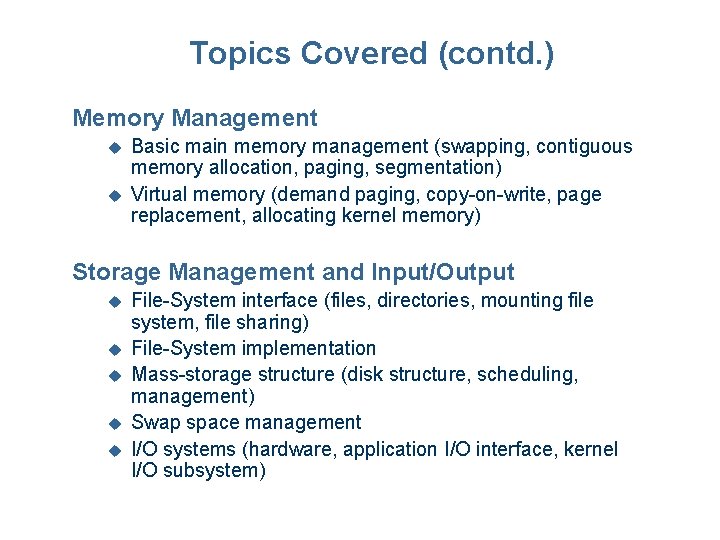
Topics Covered (contd. ) Memory Management u u Basic main memory management (swapping, contiguous memory allocation, paging, segmentation) Virtual memory (demand paging, copy-on-write, page replacement, allocating kernel memory) Storage Management and Input/Output u u u File-System interface (files, directories, mounting file system, file sharing) File-System implementation Mass-storage structure (disk structure, scheduling, management) Swap space management I/O systems (hardware, application I/O interface, kernel I/O subsystem)
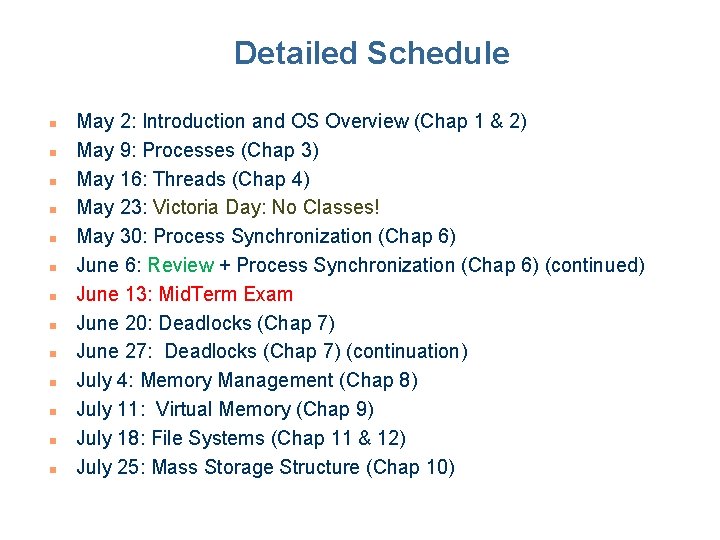
Detailed Schedule n n n n May 2: Introduction and OS Overview (Chap 1 & 2) May 9: Processes (Chap 3) May 16: Threads (Chap 4) May 23: Victoria Day: No Classes! May 30: Process Synchronization (Chap 6) June 6: Review + Process Synchronization (Chap 6) (continued) June 13: Mid. Term Exam June 20: Deadlocks (Chap 7) June 27: Deadlocks (Chap 7) (continuation) July 4: Memory Management (Chap 8) July 11: Virtual Memory (Chap 9) July 18: File Systems (Chap 11 & 12) July 25: Mass Storage Structure (Chap 10)