
CSEP 521 Applied Algorithms Lecture 6 Randomized Primality
- Slides: 29
CSEP 521: Applied Algorithms Lecture 6 Randomized Primality Testing Richard Anderson January 21, 2021
Announcements • Today is the 21 st day of the 21 st year of the 21 st century
Primality Testing • Miller-Rabin test demonstrated importance of randomized algorithm • Break through result in 1980 • Depends on number theory (maybe a senior ugrad class) • But much of the algorithm can be appreciated without theory • The key concept is that of a witness • If something is true, a witness always says TRUE • If something is false, a witness says TRUE with probability less than ½
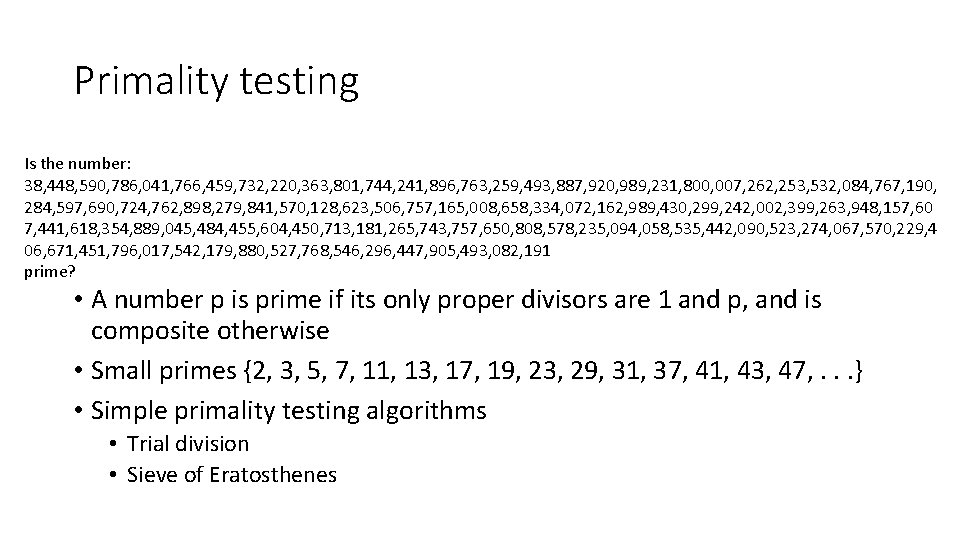
Primality testing Is the number: 38, 448, 590, 786, 041, 766, 459, 732, 220, 363, 801, 744, 241, 896, 763, 259, 493, 887, 920, 989, 231, 800, 007, 262, 253, 532, 084, 767, 190, 284, 597, 690, 724, 762, 898, 279, 841, 570, 128, 623, 506, 757, 165, 008, 658, 334, 072, 162, 989, 430, 299, 242, 002, 399, 263, 948, 157, 60 7, 441, 618, 354, 889, 045, 484, 455, 604, 450, 713, 181, 265, 743, 757, 650, 808, 578, 235, 094, 058, 535, 442, 090, 523, 274, 067, 570, 229, 4 06, 671, 451, 796, 017, 542, 179, 880, 527, 768, 546, 296, 447, 905, 493, 082, 191 prime? • A number p is prime if its only proper divisors are 1 and p, and is composite otherwise • Small primes {2, 3, 5, 7, 11, 13, 17, 19, 23, 29, 31, 37, 41, 43, 47, . . . } • Simple primality testing algorithms • Trial division • Sieve of Eratosthenes
Why prime testing is important: cryptography • RSA public key encryption • Relies on factoring “being hard”, N = pq where p and q are prime • Recommendation is that N is 2048 bits with p and q roughly 1024 bits • 1024 bits is roughly 300 digits • Need a way to generate “random primes” • Guess and check
Complexity of number problems • Run time based on size of input • Input N has size Log 2 N • Polynomial time corresponds to polynomial in the size of the number • Runtime polynomial in N is exponential in the number of bits
Bignum computation • Arithmetic computation on large numbers – hundreds or thousands or millions of digits • Run time expressed as a function of the number of digits • Addition of two n-bit numbers: O(n) • Multiplication of two n-bit numbers: O(n 2) or O(n 3/2) or O(n loglog n) • Bignum arithmetic implemented by storing numbers in an array of ints • 1024 bit number would require an array of 32 ints
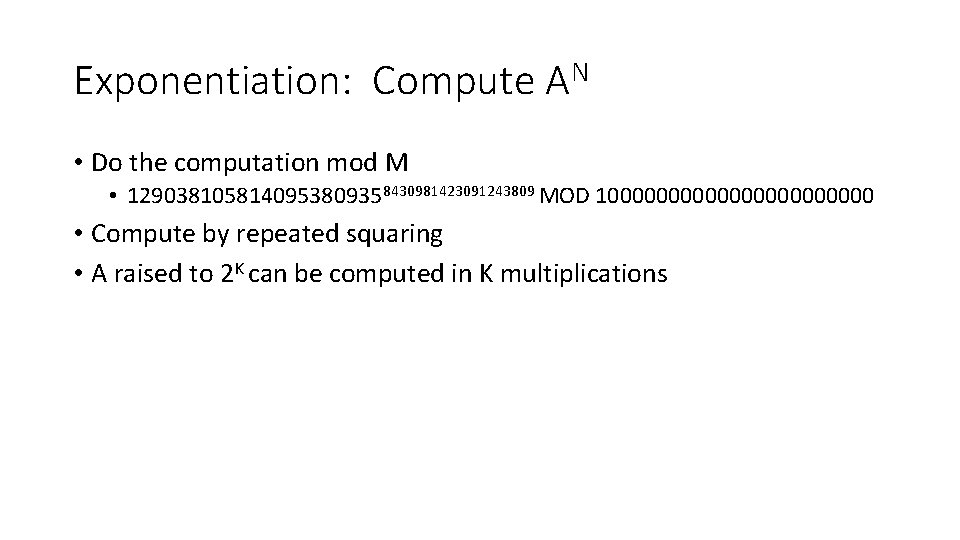
Exponentiation: Compute AN • Do the computation mod M • 1290381058140953809358430981423091243809 MOD 100000000000 • Compute by repeated squaring • A raised to 2 K can be computed in K multiplications
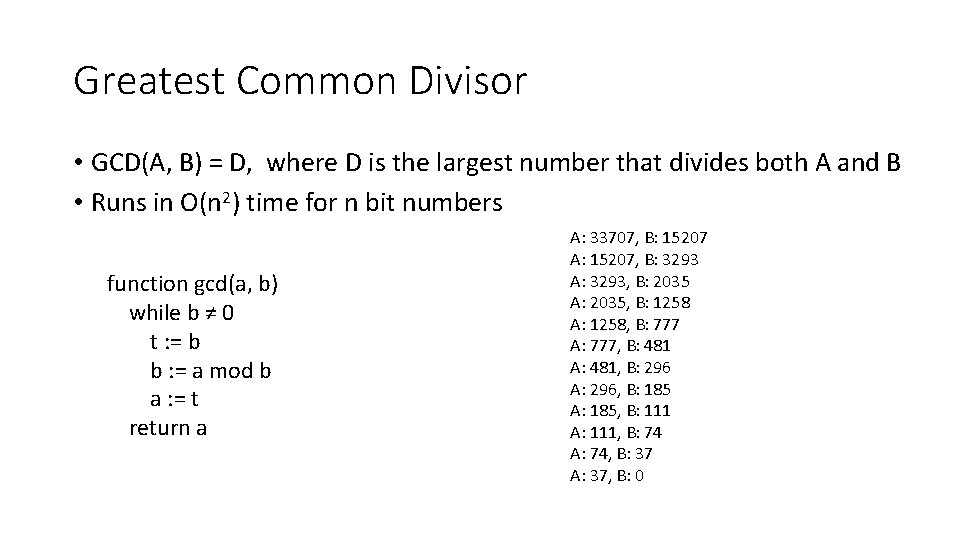
Greatest Common Divisor • GCD(A, B) = D, where D is the largest number that divides both A and B • Runs in O(n 2) time for n bit numbers function gcd(a, b) while b ≠ 0 t : = b b : = a mod b a : = t return a A: 33707, B: 15207 A: 15207, B: 3293 A: 3293, B: 2035 A: 2035, B: 1258 A: 1258, B: 777 A: 777, B: 481 A: 481, B: 296 A: 296, B: 185 A: 185, B: 111 A: 111, B: 74 A: 74, B: 37 A: 37, B: 0
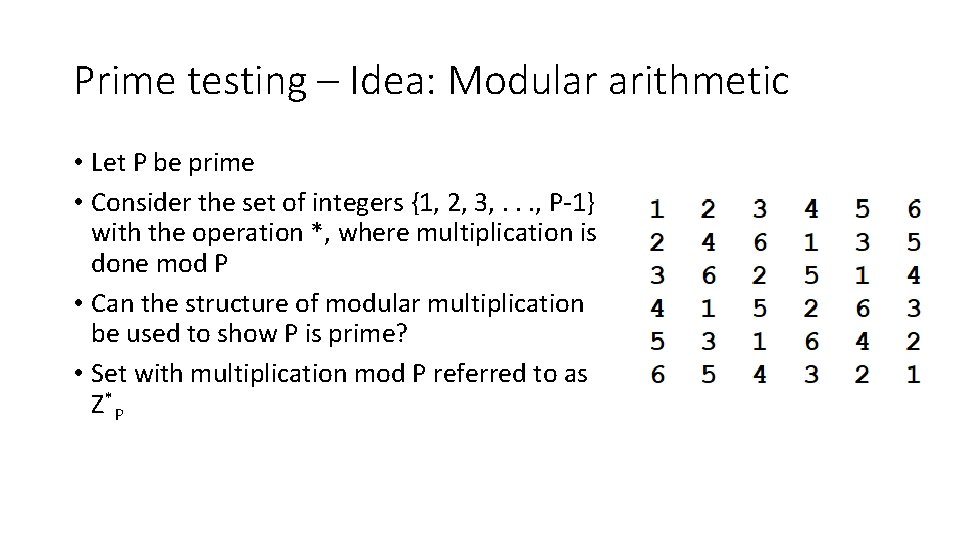
Prime testing – Idea: Modular arithmetic • Let P be prime • Consider the set of integers {1, 2, 3, . . . , P-1} with the operation *, where multiplication is done mod P • Can the structure of modular multiplication be used to show P is prime? • Set with multiplication mod P referred to as Z *P
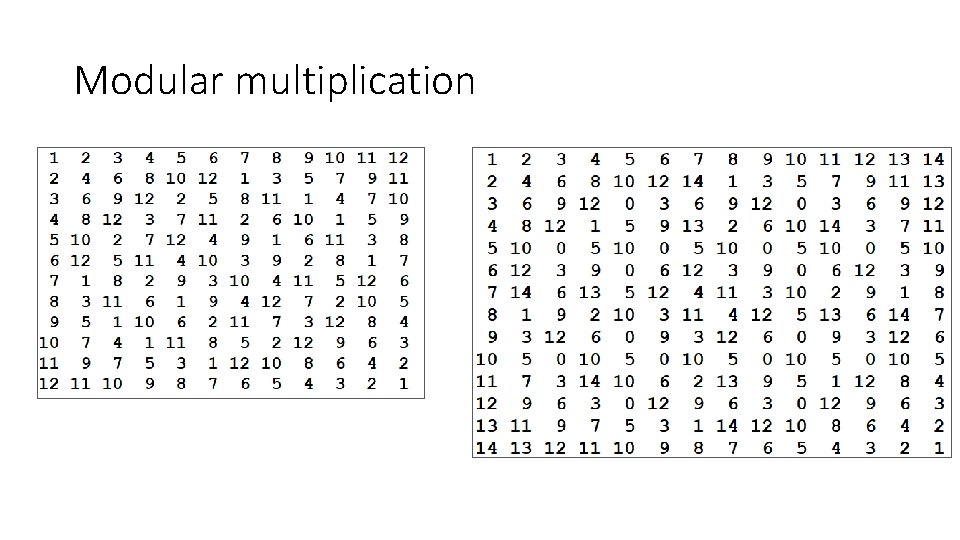
Modular multiplication
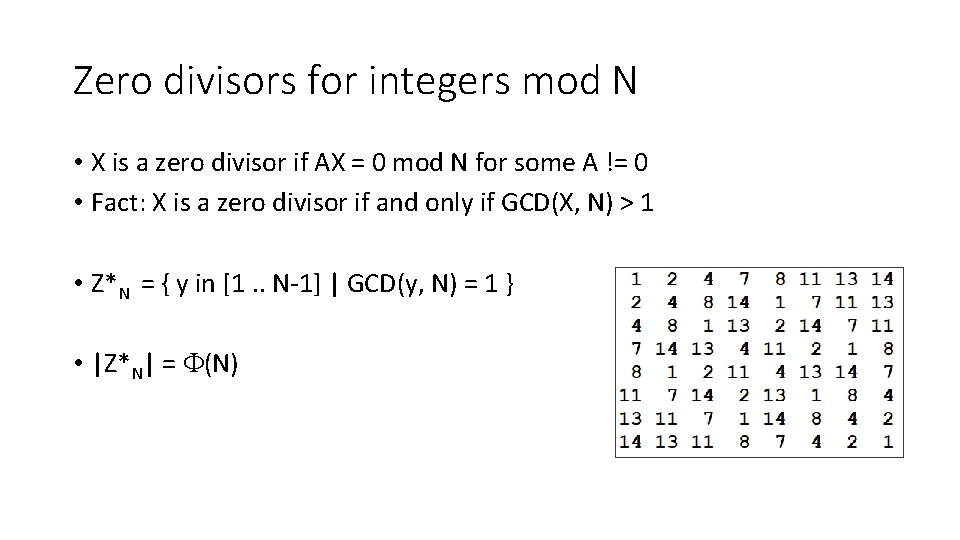
Zero divisors for integers mod N • X is a zero divisor if AX = 0 mod N for some A != 0 • Fact: X is a zero divisor if and only if GCD(X, N) > 1 • Z*N = { y in [1. . N-1] | GCD(y, N) = 1 } • |Z*N| = (N)
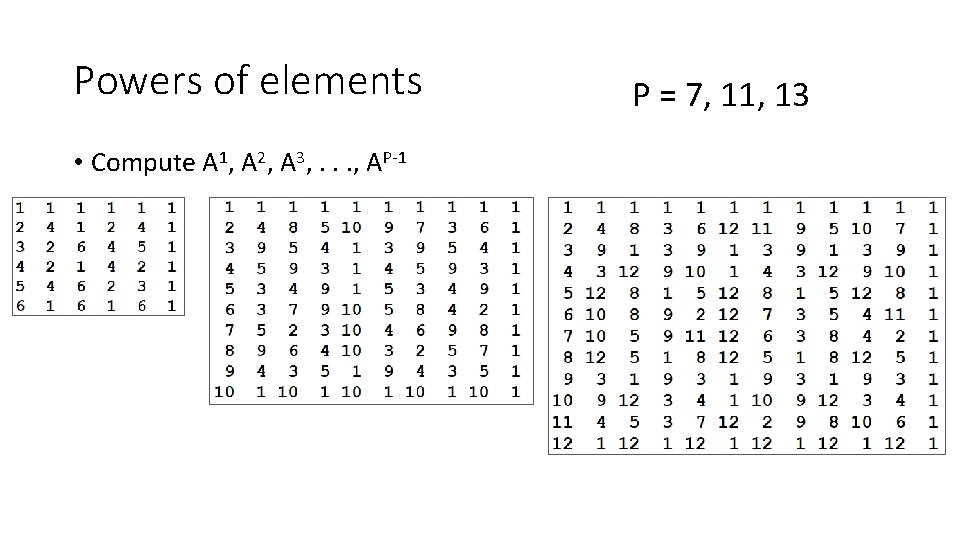
Powers of elements • Compute A 1, A 2, A 3, . . . , AP-1 P = 7, 11, 13
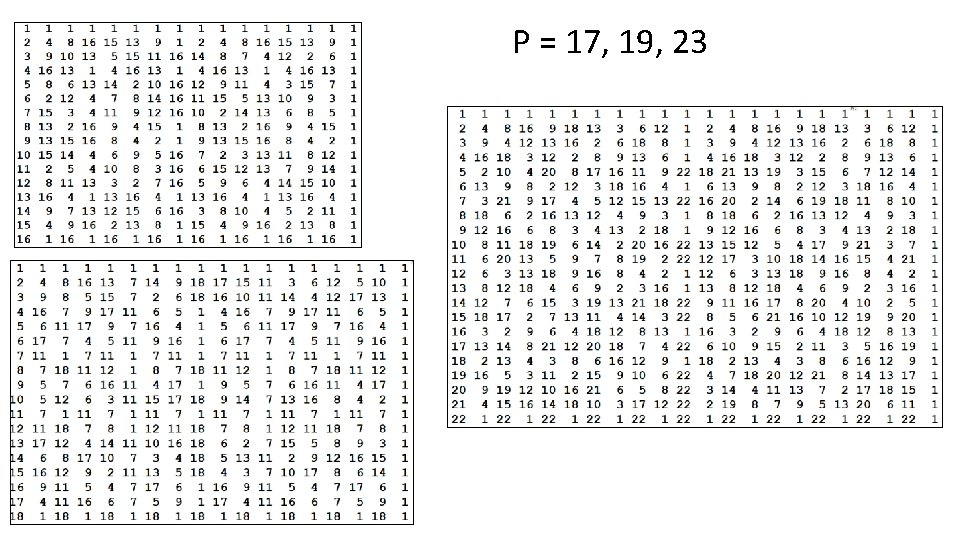
P = 17, 19, 23
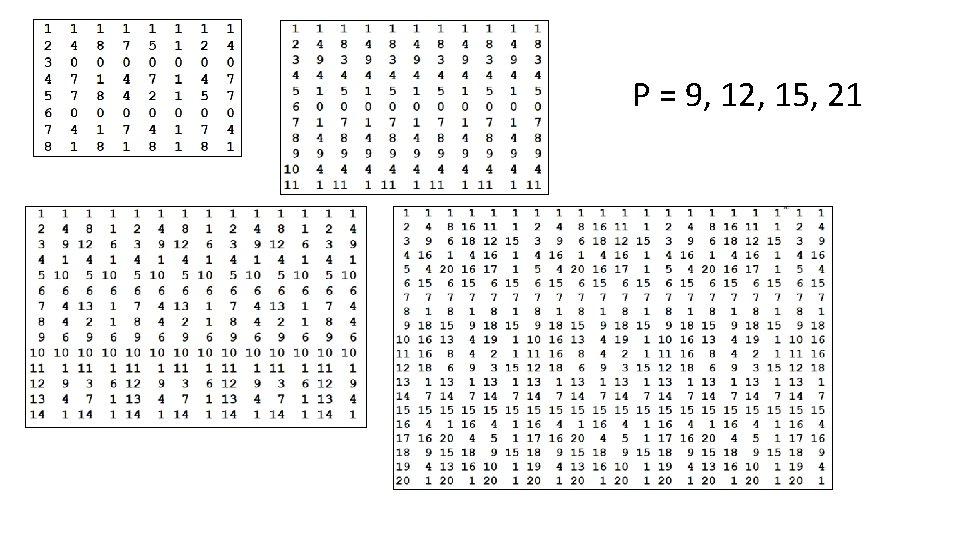
P = 9, 12, 15, 21
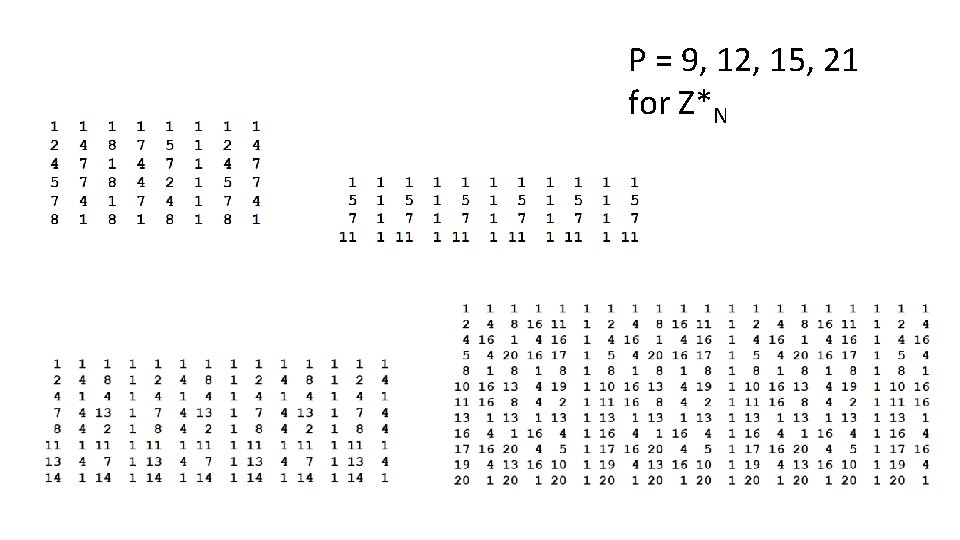
P = 9, 12, 15, 21 for Z*N
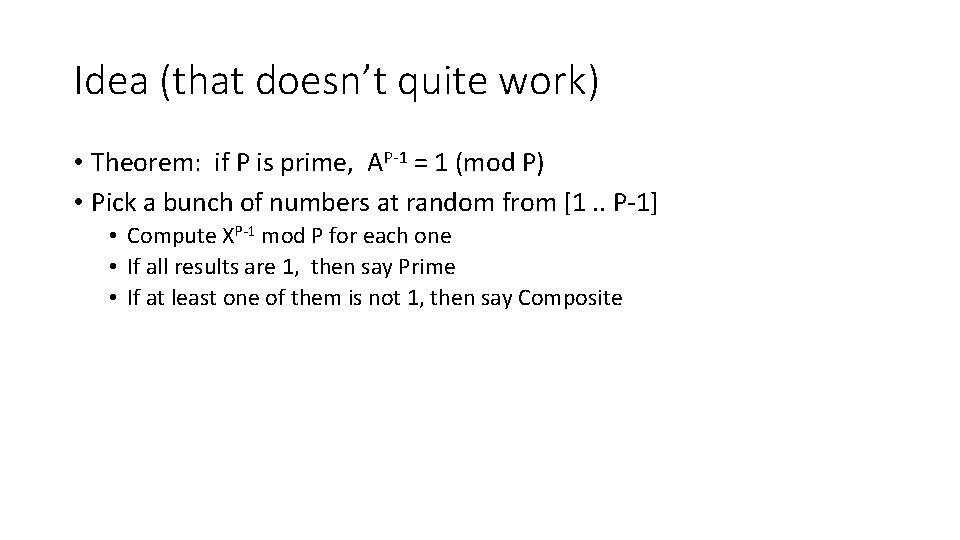
Idea (that doesn’t quite work) • Theorem: if P is prime, AP-1 = 1 (mod P) • Pick a bunch of numbers at random from [1. . P-1] • Compute XP-1 mod P for each one • If all results are 1, then say Prime • If at least one of them is not 1, then say Composite
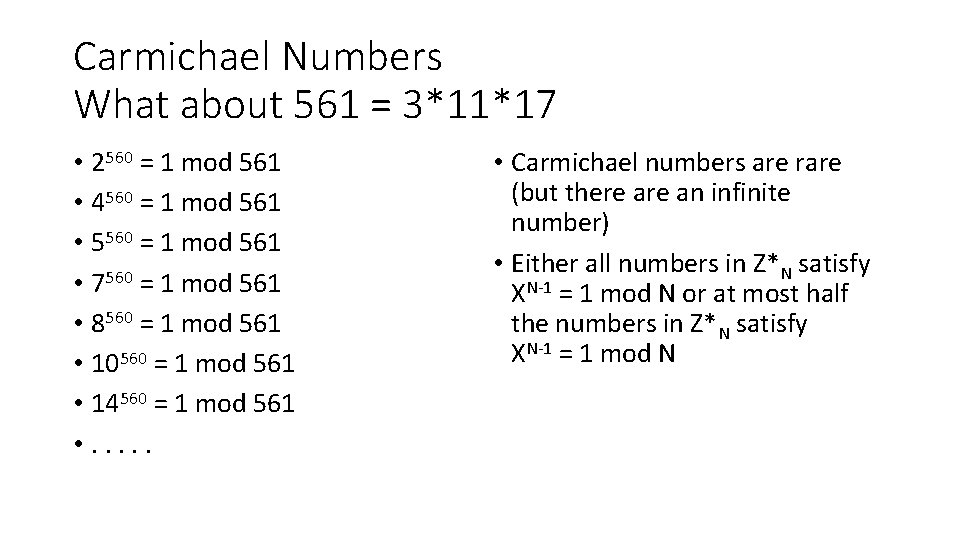
Carmichael Numbers What about 561 = 3*11*17 • 2560 = 1 mod 561 • 4560 = 1 mod 561 • 5560 = 1 mod 561 • 7560 = 1 mod 561 • 8560 = 1 mod 561 • 10560 = 1 mod 561 • 14560 = 1 mod 561 • . . . • Carmichael numbers are rare (but there an infinite number) • Either all numbers in Z*N satisfy XN-1 = 1 mod N or at most half the numbers in Z*N satisfy XN-1 = 1 mod N
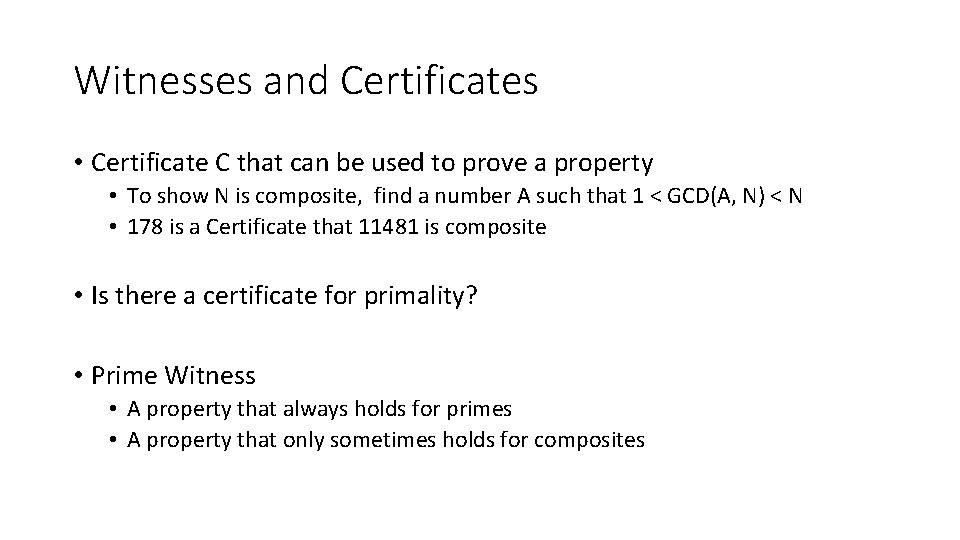
Witnesses and Certificates • Certificate C that can be used to prove a property • To show N is composite, find a number A such that 1 < GCD(A, N) < N • 178 is a Certificate that 11481 is composite • Is there a certificate for primality? • Prime Witness • A property that always holds for primes • A property that only sometimes holds for composites
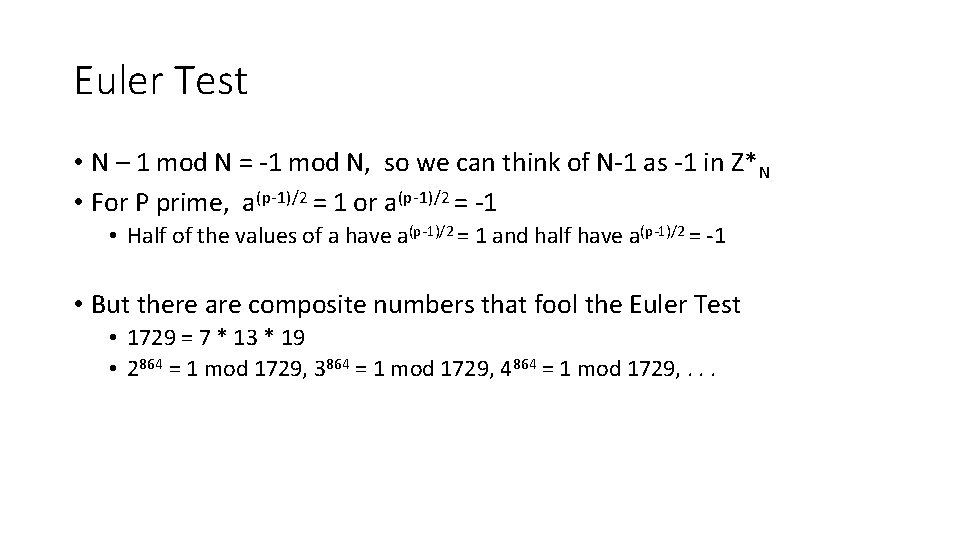
Euler Test • N – 1 mod N = -1 mod N, so we can think of N-1 as -1 in Z*N • For P prime, a(p-1)/2 = 1 or a(p-1)/2 = -1 • Half of the values of a have a(p-1)/2 = 1 and half have a(p-1)/2 = -1 • But there are composite numbers that fool the Euler Test • 1729 = 7 * 13 * 19 • 2864 = 1 mod 1729, 3864 = 1 mod 1729, 4864 = 1 mod 1729, . . .
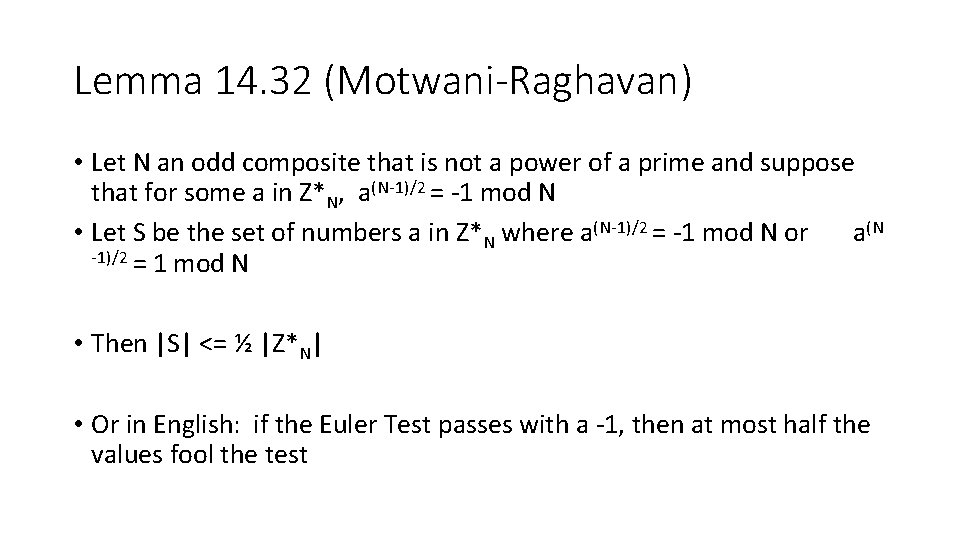
Lemma 14. 32 (Motwani-Raghavan) • Let N an odd composite that is not a power of a prime and suppose that for some a in Z*N, a(N-1)/2 = -1 mod N • Let S be the set of numbers a in Z*N where a(N-1)/2 = -1 mod N or a(N -1)/2 = 1 mod N • Then |S| <= ½ |Z*N| • Or in English: if the Euler Test passes with a -1, then at most half the values fool the test
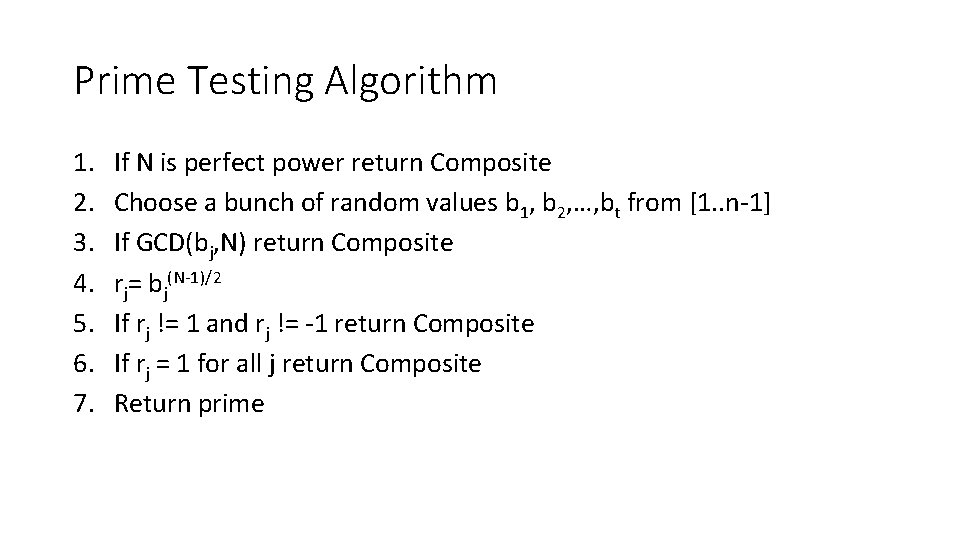
Prime Testing Algorithm 1. 2. 3. 4. 5. 6. 7. If N is perfect power return Composite Choose a bunch of random values b 1, b 2, …, bt from [1. . n-1] If GCD(bj, N) return Composite rj= bj(N-1)/2 If rj != 1 and rj != -1 return Composite If rj = 1 for all j return Composite Return prime
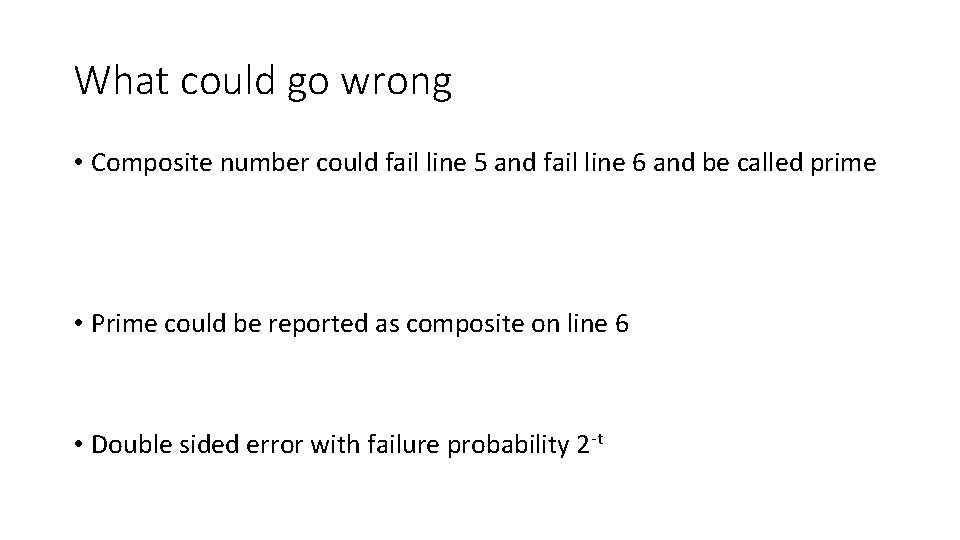
What could go wrong • Composite number could fail line 5 and fail line 6 and be called prime • Prime could be reported as composite on line 6 • Double sided error with failure probability 2 -t
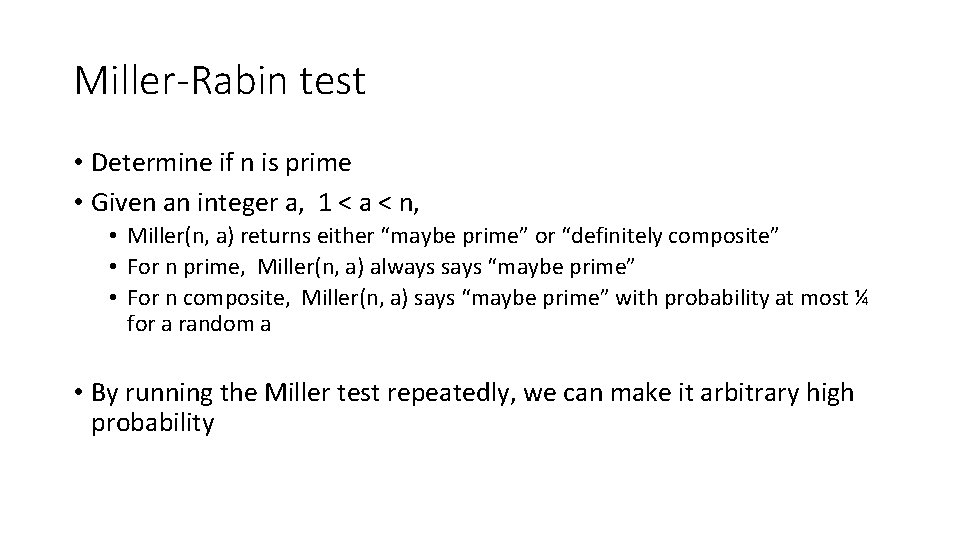
Miller-Rabin test • Determine if n is prime • Given an integer a, 1 < a < n, • Miller(n, a) returns either “maybe prime” or “definitely composite” • For n prime, Miller(n, a) always says “maybe prime” • For n composite, Miller(n, a) says “maybe prime” with probability at most ¼ for a random a • By running the Miller test repeatedly, we can make it arbitrary high probability
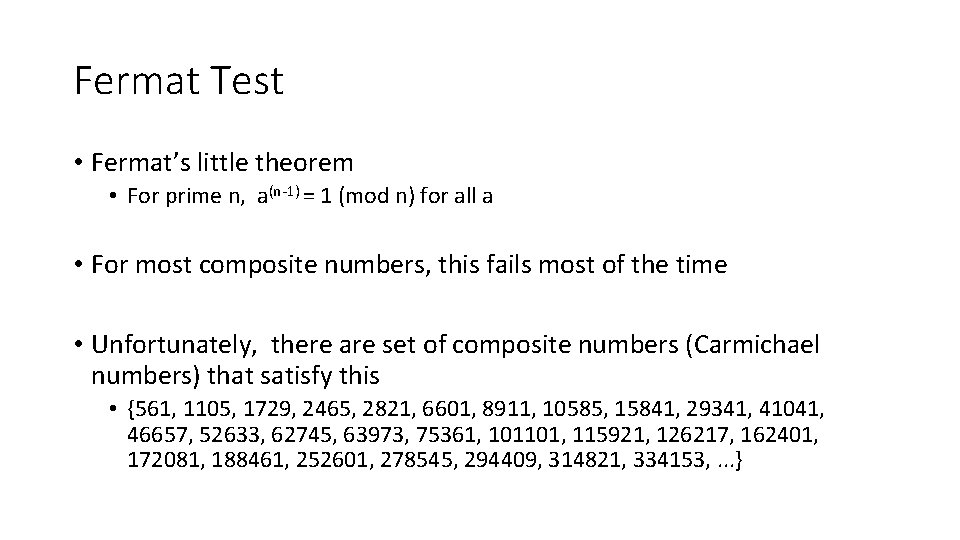
Fermat Test • Fermat’s little theorem • For prime n, a(n-1) = 1 (mod n) for all a • For most composite numbers, this fails most of the time • Unfortunately, there are set of composite numbers (Carmichael numbers) that satisfy this • {561, 1105, 1729, 2465, 2821, 6601, 8911, 10585, 15841, 29341, 41041, 46657, 52633, 62745, 63973, 75361, 101101, 115921, 126217, 162401, 172081, 188461, 252601, 278545, 294409, 314821, 334153, . . . }
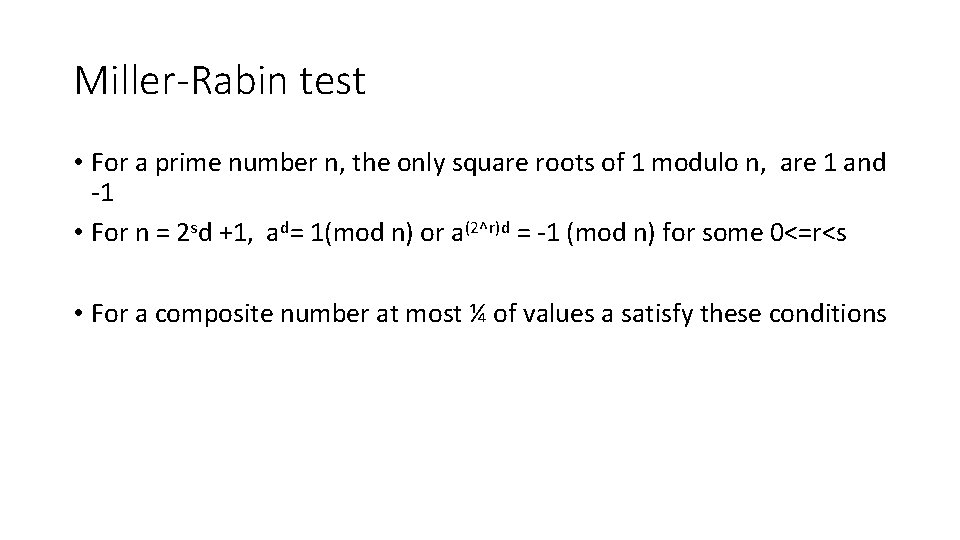
Miller-Rabin test • For a prime number n, the only square roots of 1 modulo n, are 1 and -1 • For n = 2 sd +1, ad= 1(mod n) or a(2^r)d = -1 (mod n) for some 0<=r<s • For a composite number at most ¼ of values a satisfy these conditions
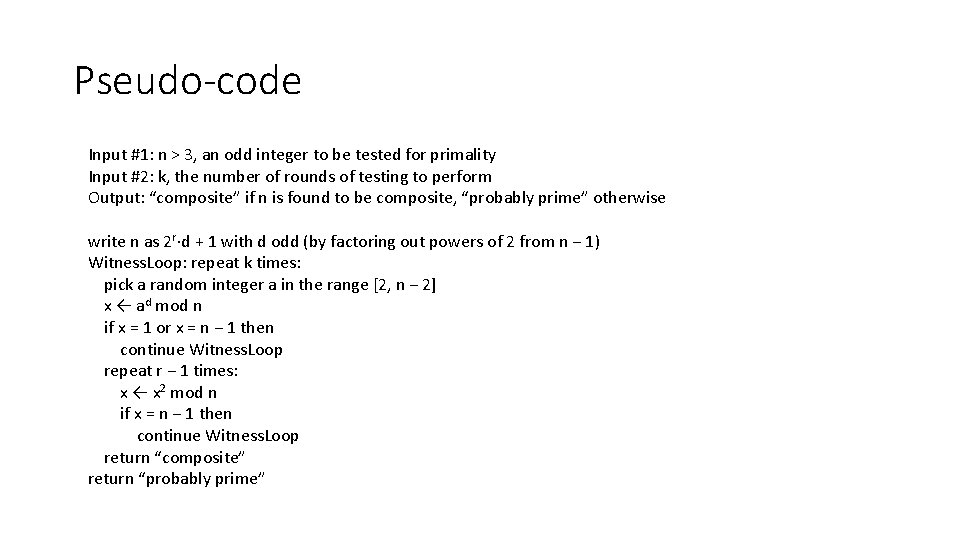
Pseudo-code Input #1: n > 3, an odd integer to be tested for primality Input #2: k, the number of rounds of testing to perform Output: “composite” if n is found to be composite, “probably prime” otherwise write n as 2 r·d + 1 with d odd (by factoring out powers of 2 from n − 1) Witness. Loop: repeat k times: pick a random integer a in the range [2, n − 2] x ← ad mod n if x = 1 or x = n − 1 then continue Witness. Loop repeat r − 1 times: x ← x 2 mod n if x = n − 1 then continue Witness. Loop return “composite” return “probably prime”
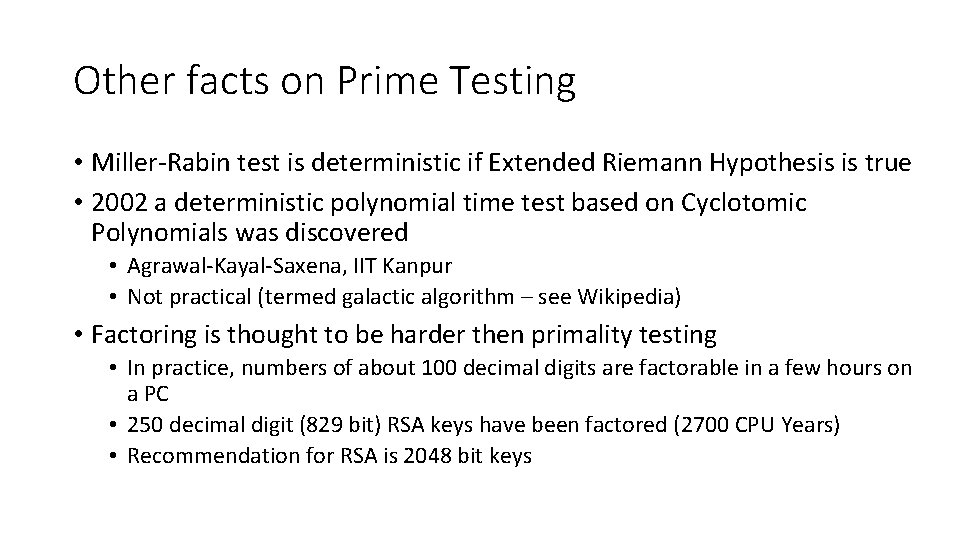
Other facts on Prime Testing • Miller-Rabin test is deterministic if Extended Riemann Hypothesis is true • 2002 a deterministic polynomial time test based on Cyclotomic Polynomials was discovered • Agrawal-Kayal-Saxena, IIT Kanpur • Not practical (termed galactic algorithm – see Wikipedia) • Factoring is thought to be harder then primality testing • In practice, numbers of about 100 decimal digits are factorable in a few hours on a PC • 250 decimal digit (829 bit) RSA keys have been factored (2700 CPU Years) • Recommendation for RSA is 2048 bit keys
RSA • RSA key is a number n=pq, where p and q are prime • How do you generate random primes of 300 digits? • Generate random number of 300 digits and test if they are prime • Of course, there are simple tricks to avoid small divisors • Prime number theorem: Probability of a random number less than N is prime is about 1/log N (Natural logarithm) • For 300 digits, this is about 1 in 690