
CSEP 521 Applied Algorithms Lecture 4 Randomized Algorithms
- Slides: 30
CSEP 521: Applied Algorithms Lecture 4 Randomized Algorithms Richard Anderson January 14, 2021
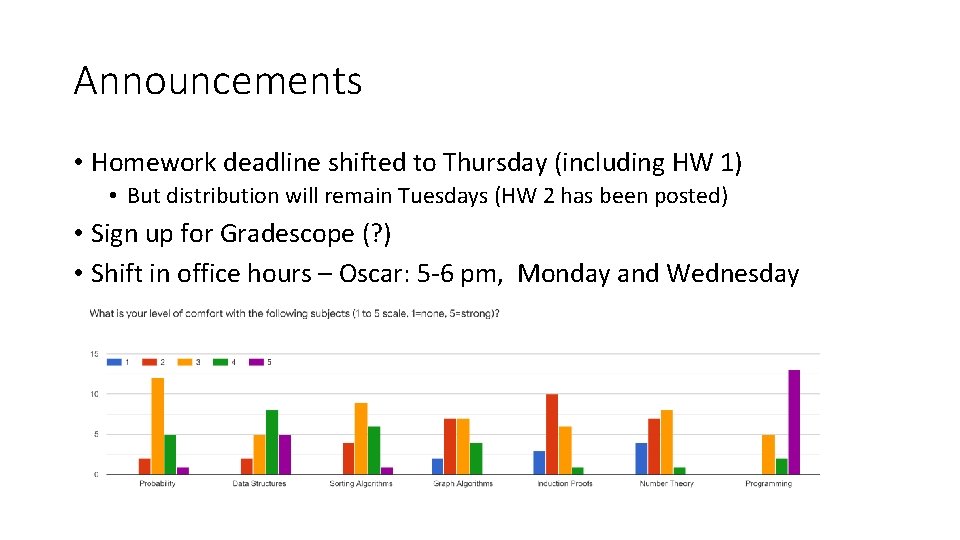
Announcements • Homework deadline shifted to Thursday (including HW 1) • But distribution will remain Tuesdays (HW 2 has been posted) • Sign up for Gradescope (? ) • Shift in office hours – Oscar: 5 -6 pm, Monday and Wednesday
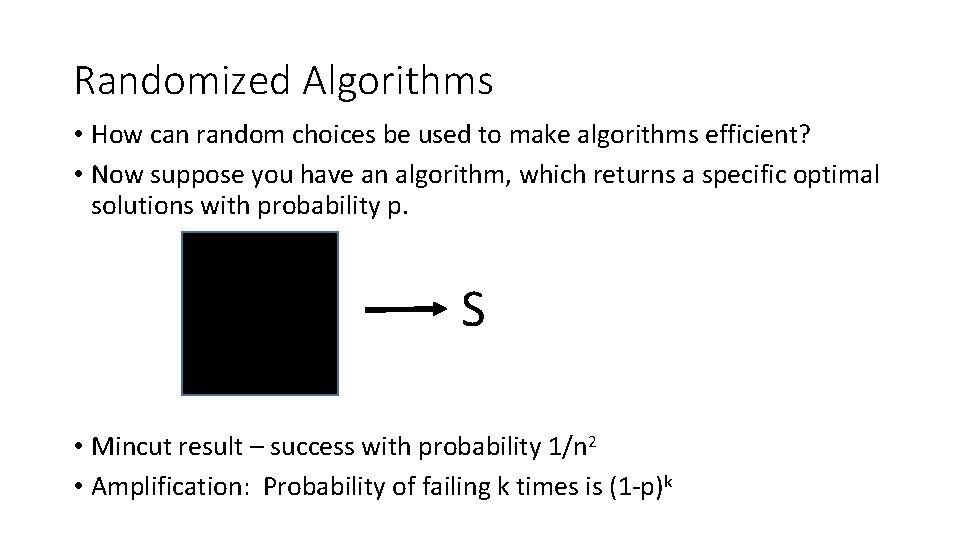
Randomized Algorithms • How can random choices be used to make algorithms efficient? • Now suppose you have an algorithm, which returns a specific optimal solutions with probability p. S • Mincut result – success with probability 1/n 2 • Amplification: Probability of failing k times is (1 -p)k
Using randomization to remove structure • Many problems perform well on random data, but specific well structured data can cause poor behavior • Example, binary search trees • In practice, bad case data can be natural • Sorting nearly ordered lists • Planar partition for parallel line segments • Randomization can very likely hide the bad cases • Prefer to deal with random data than a deterministic adversary
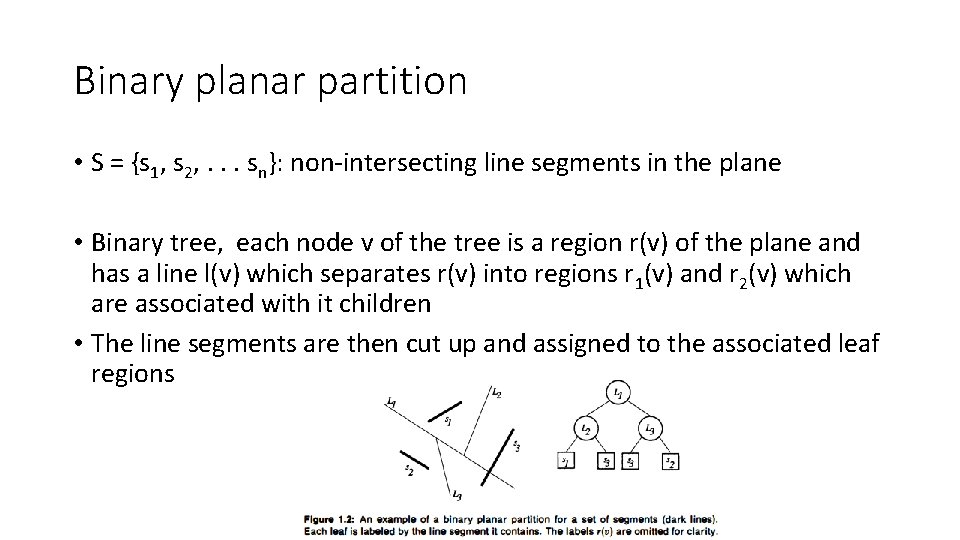
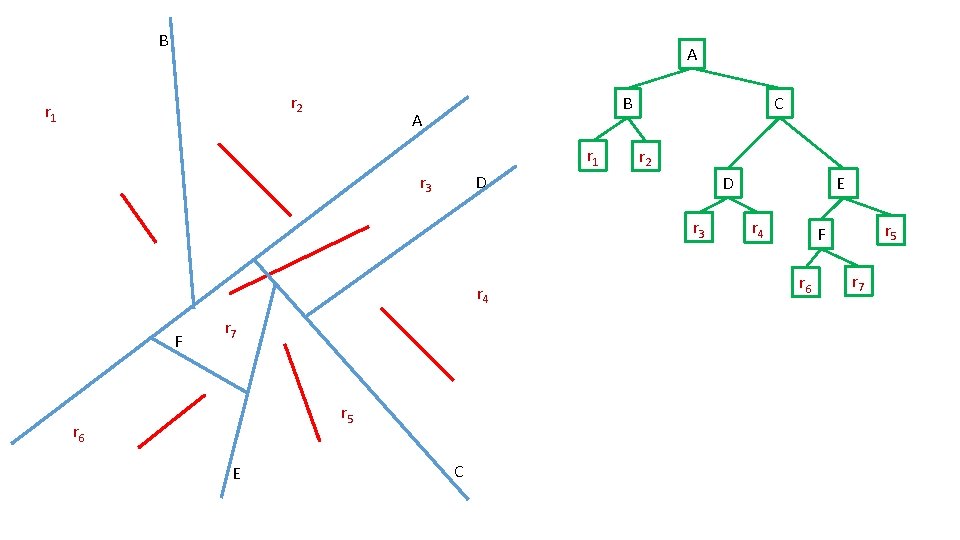
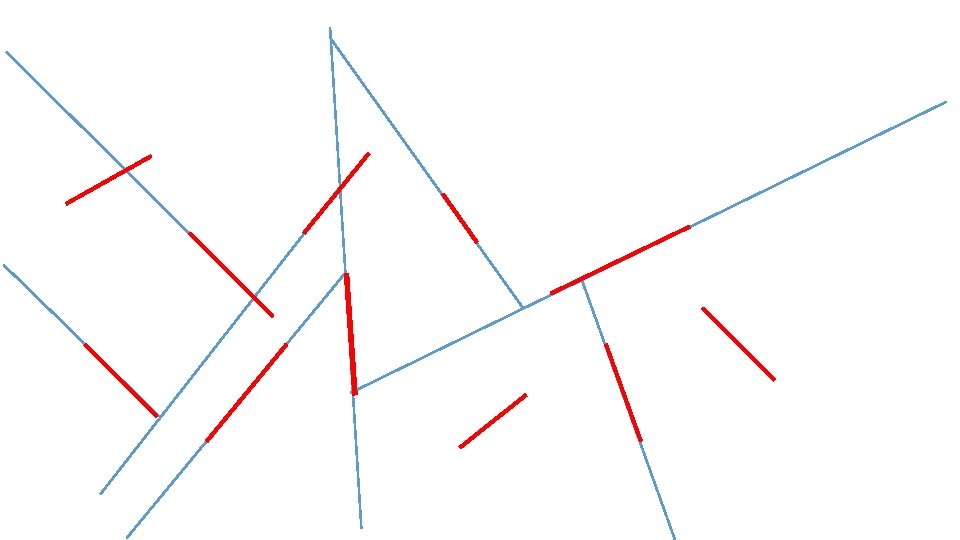
Binary planar partition • S = {s 1, s 2, . . . sn}: non-intersecting line segments in the plane • Binary tree, each node v of the tree is a region r(v) of the plane and has a line l(v) which separates r(v) into regions r 1(v) and r 2(v) which are associated with it children • The line segments are then cut up and assigned to the associated leaf regions
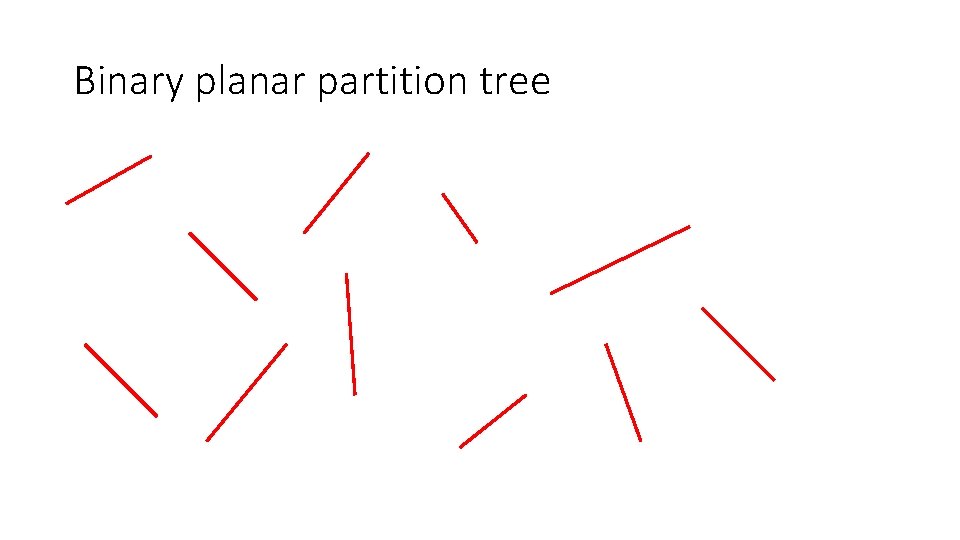
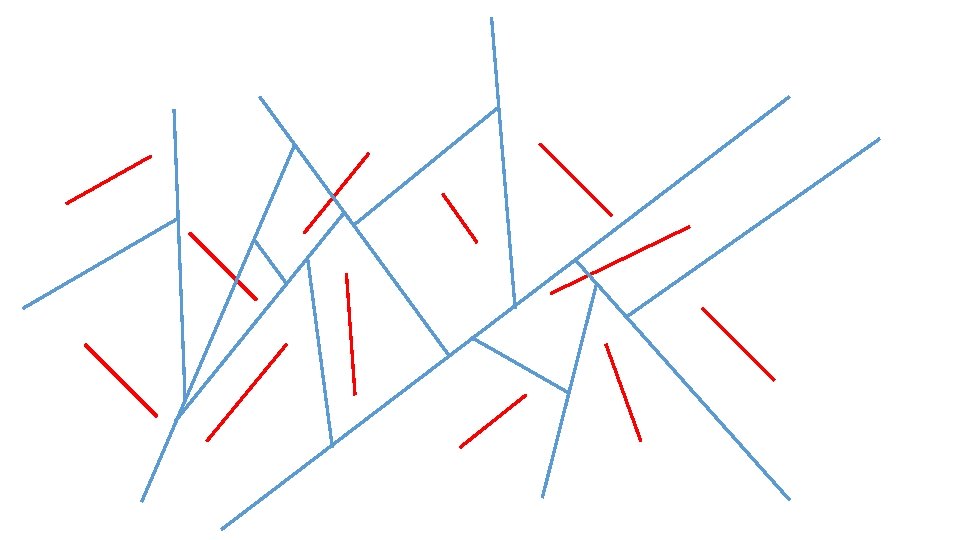
Binary planar partition tree
B A r 2 r 1 B A r 1 r 3 C r 2 D D r 3 r 4 F r 7 r 5 r 6 E C E r 4 r 5 F r 6 r 7
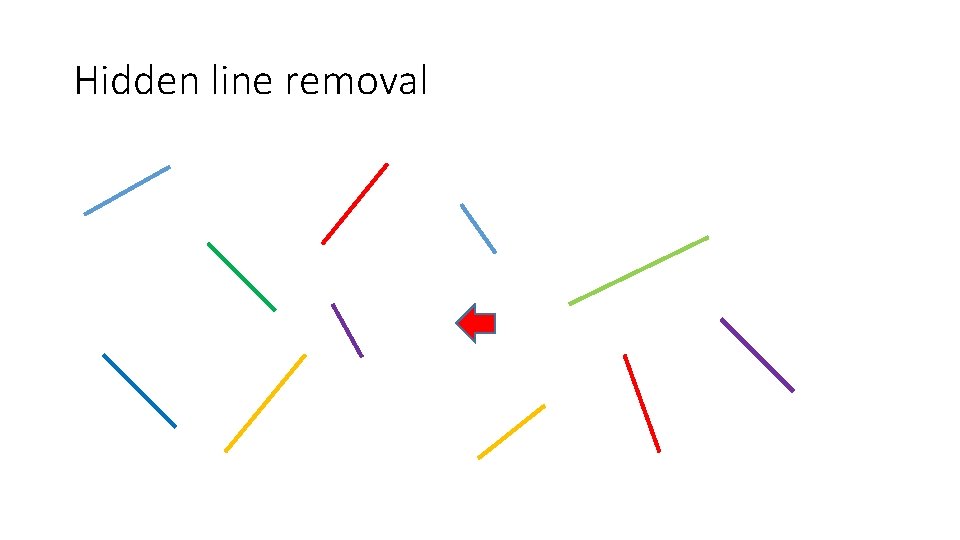
Hidden line removal
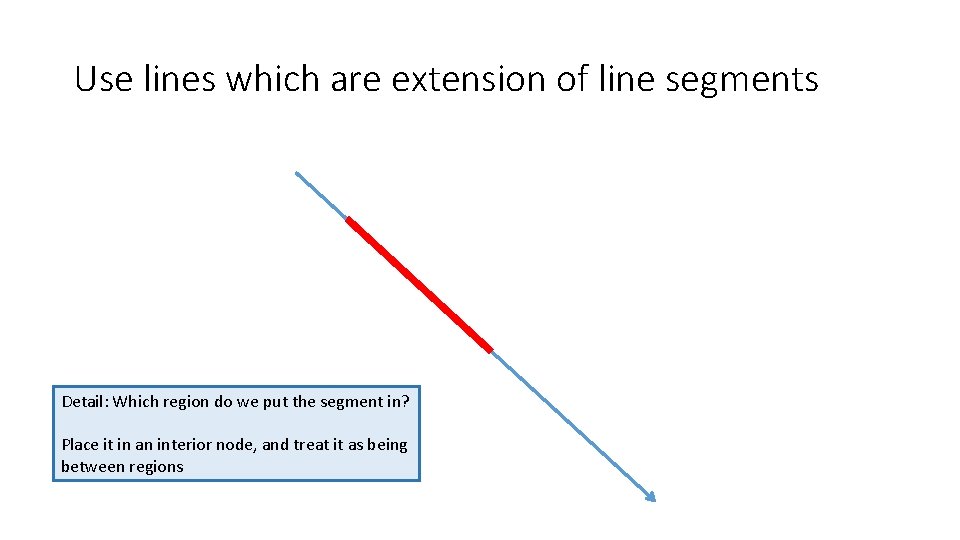
Use lines which are extension of line segments Detail: Which region do we put the segment in? Place it in an interior node, and treat it as being between regions
Motivation: hidden surface elimination • 2 -D Version, draw the line segments visible from any point in space • Painters algorithm: draw the lines from back to front in viewing direction • Tree traversal algorithm. Determine which side of the line you are on for each node. Traverse the subtree on the other side of the line, then the subtree on your side of the line • Run time is proportional to the size of the tree • Tree size O(n)? O(n log n)? O(n 2)?
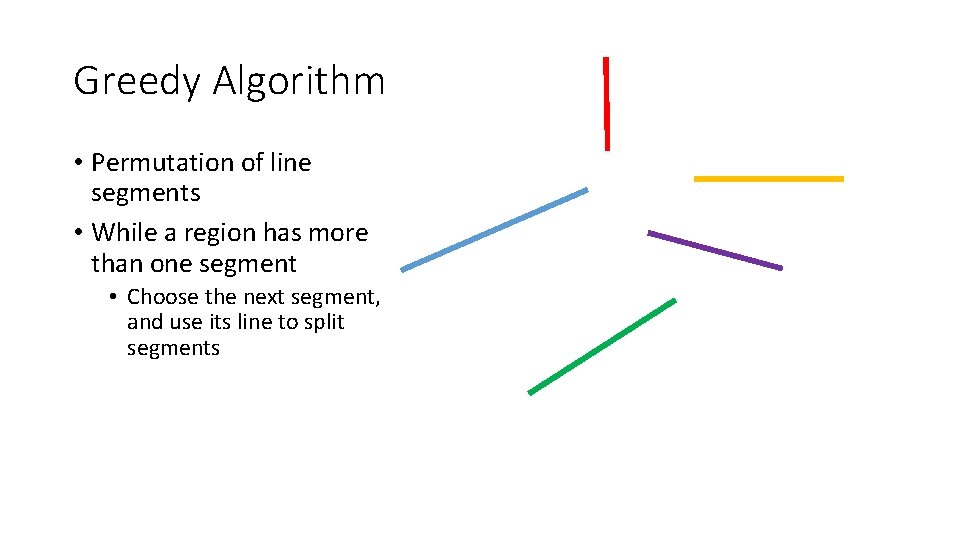
Greedy Algorithm • Permutation of line segments • While a region has more than one segment • Choose the next segment, and use its line to split segments
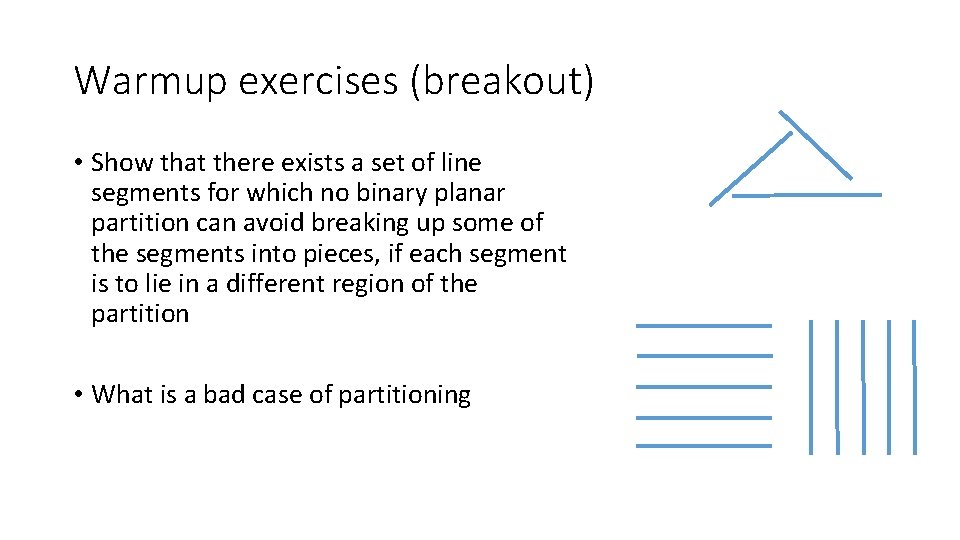
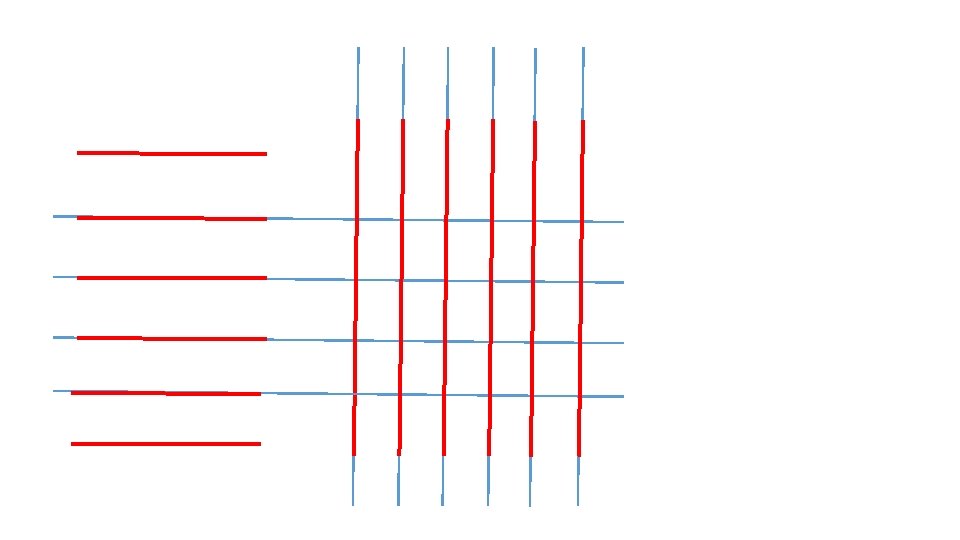
Warmup exercises (breakout) • Show that there exists a set of line segments for which no binary planar partition can avoid breaking up some of the segments into pieces, if each segment is to lie in a different region of the partition • What is a bad case of partitioning
Random algorithm • Choose the segments in a random order • Result: Expected number of partitions is O(n log n)
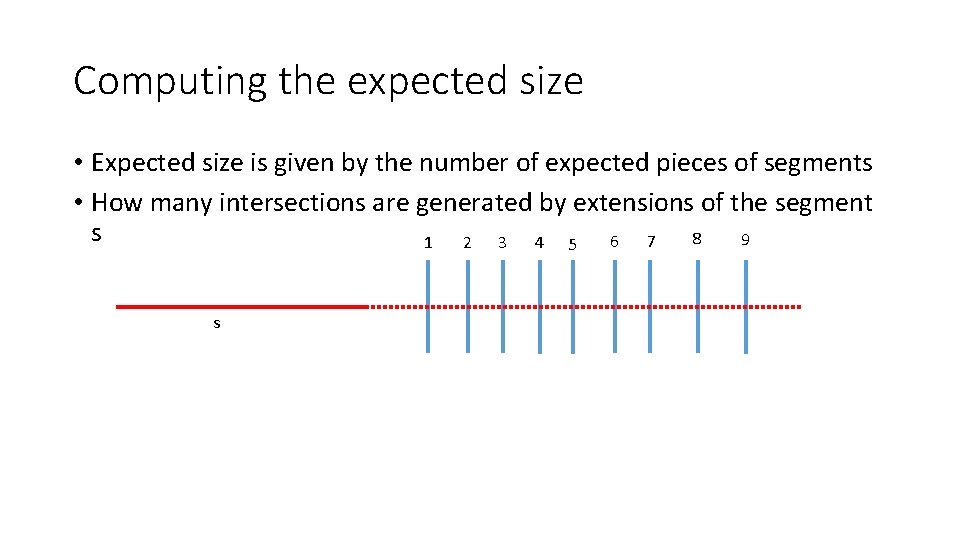
Computing the expected size • Expected size is given by the number of expected pieces of segments • How many intersections are generated by extensions of the segment s 8 9 6 7 1 2 3 4 5 s
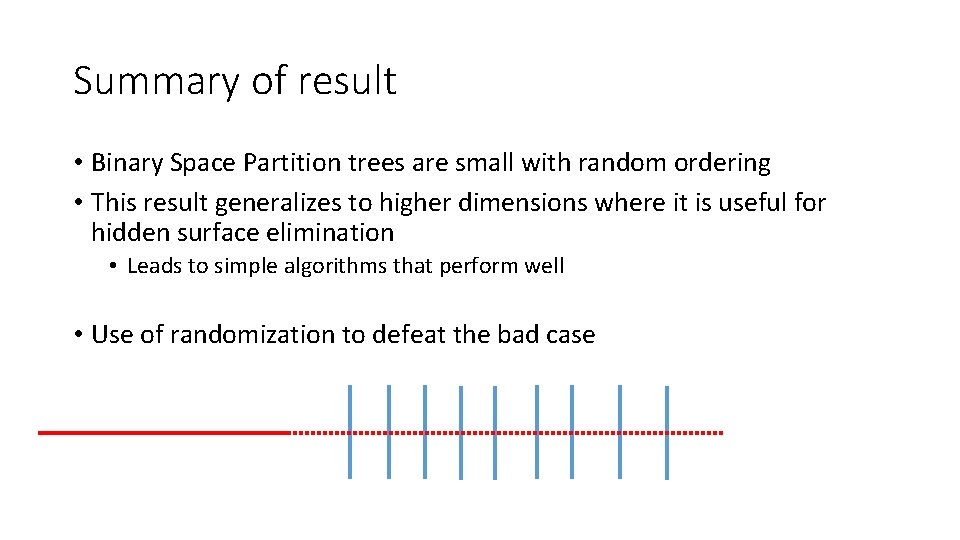
Summary of result • Binary Space Partition trees are small with random ordering • This result generalizes to higher dimensions where it is useful for hidden surface elimination • Leads to simple algorithms that perform well • Use of randomization to defeat the bad case
Breakout question • Suppose that you have an application that requires unique IDs for data elements, and you generate 128 bit keys by a random • Does this make your application a randomized/probabilistic process? • What are the failure modes? • How would you analyze the probability of failure? • What is an acceptable probability of failure?
Primality Testing • Miller-Rabin test demonstrated importance of randomized algorithm • Break through result in 1980 • Depends on number theory (maybe a senior ugrad class) • But much of the algorithm can be appreciated without theory • Key concept is that of a witness • If something is true, a witness always says TRUE • If something is false, a witness says TRUE with probability less than ½
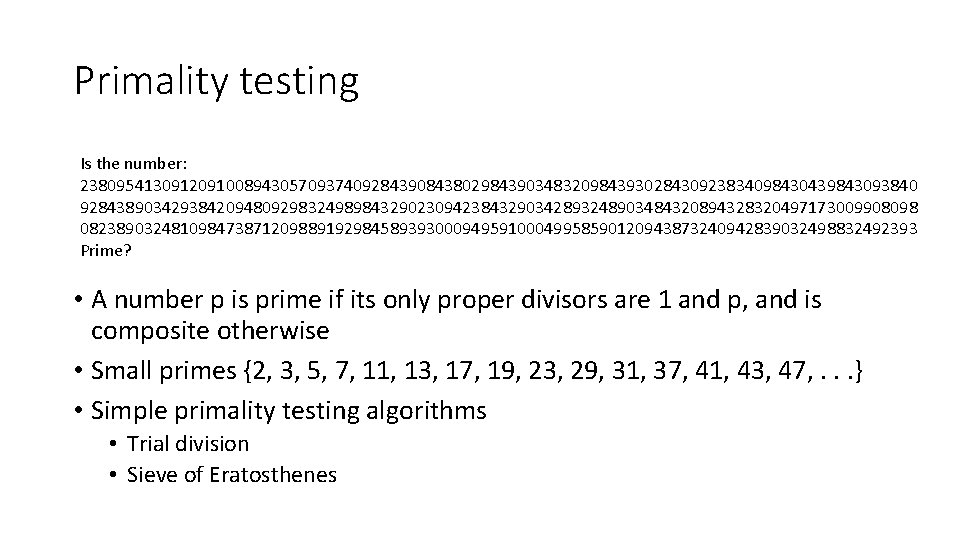
Primality testing Is the number: 23809541309120910089430570937409284390843802984390348320984393028430923834098430439843093840 92843890342938420948092983249898432902309423843290342893248903484320894328320497173009908098 08238903248109847387120988919298458939300094959100049958590120943873240942839032498832492393 Prime? • A number p is prime if its only proper divisors are 1 and p, and is composite otherwise • Small primes {2, 3, 5, 7, 11, 13, 17, 19, 23, 29, 31, 37, 41, 43, 47, . . . } • Simple primality testing algorithms • Trial division • Sieve of Eratosthenes
Bignum computation • Arithmetic computation on very large numbers – thousands of digits • Run time expressed as a function of the number of digits • Addition of two N-bit numbers: O(n) • Multiplication of two n-bit numbers: O(n 2) or O(n 3/2) or O(n loglog n) • Primality testing algorithms (testing if n is prime), generally perform operations mod n • Computing ax mod n can be done with O(log x) multiplications
Proving numbers are prime • Important to do this for cryptography • Central component for RSA cryptography – number N = pq where p and q are secret primes • Need a way to generate “random primes”
Witnesses and Certificates • Certificate C that can be used to prove a property • To show N is composite, find a number A such that 1 < GCD(A, N) < N • 178 is a Certificate that 11481 is composite • Is there a certificate for primality? • Witness • A property that always holds for primes • A property that only sometimes holds for composites
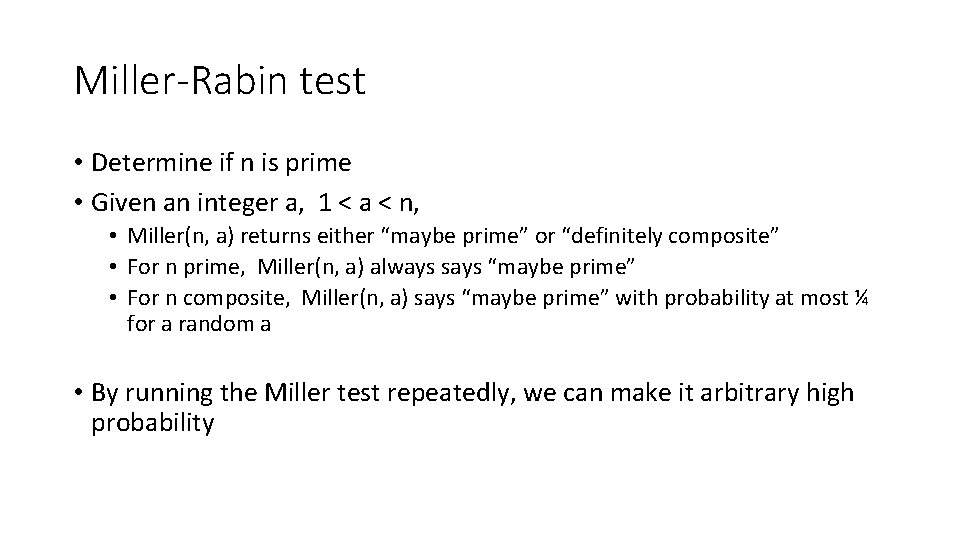
Miller-Rabin test • Determine if n is prime • Given an integer a, 1 < a < n, • Miller(n, a) returns either “maybe prime” or “definitely composite” • For n prime, Miller(n, a) always says “maybe prime” • For n composite, Miller(n, a) says “maybe prime” with probability at most ¼ for a random a • By running the Miller test repeatedly, we can make it arbitrary high probability
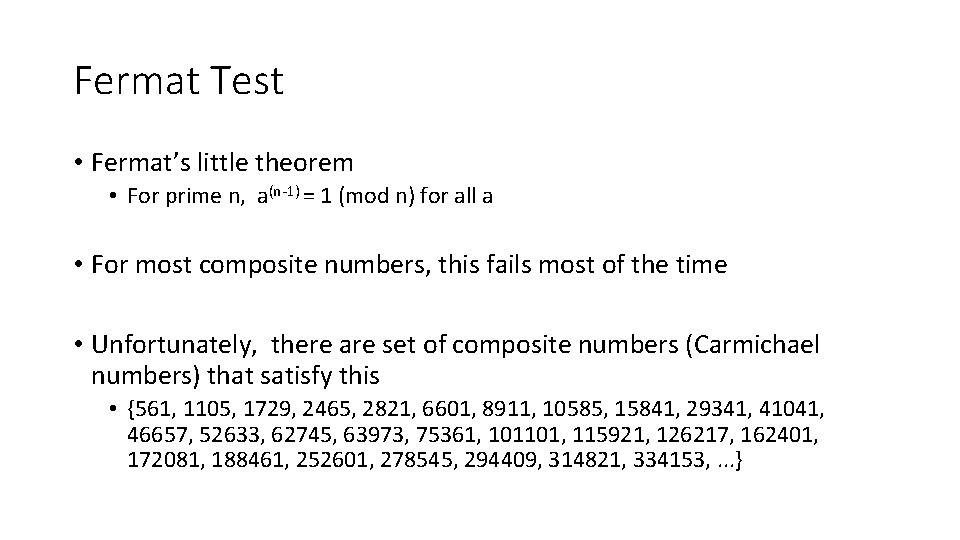
Fermat Test • Fermat’s little theorem • For prime n, a(n-1) = 1 (mod n) for all a • For most composite numbers, this fails most of the time • Unfortunately, there are set of composite numbers (Carmichael numbers) that satisfy this • {561, 1105, 1729, 2465, 2821, 6601, 8911, 10585, 15841, 29341, 41041, 46657, 52633, 62745, 63973, 75361, 101101, 115921, 126217, 162401, 172081, 188461, 252601, 278545, 294409, 314821, 334153, . . . }
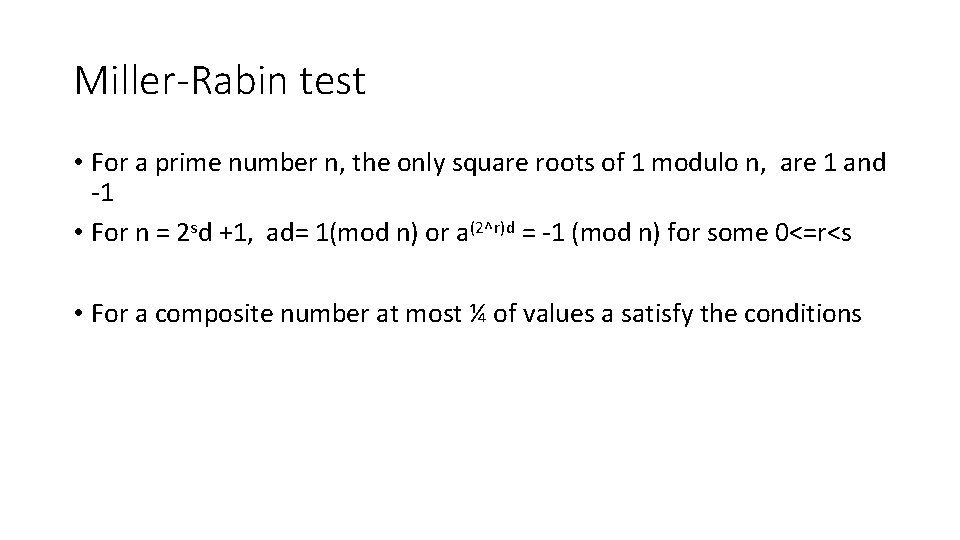
Miller-Rabin test • For a prime number n, the only square roots of 1 modulo n, are 1 and -1 • For n = 2 sd +1, ad= 1(mod n) or a(2^r)d = -1 (mod n) for some 0<=r<s • For a composite number at most ¼ of values a satisfy the conditions
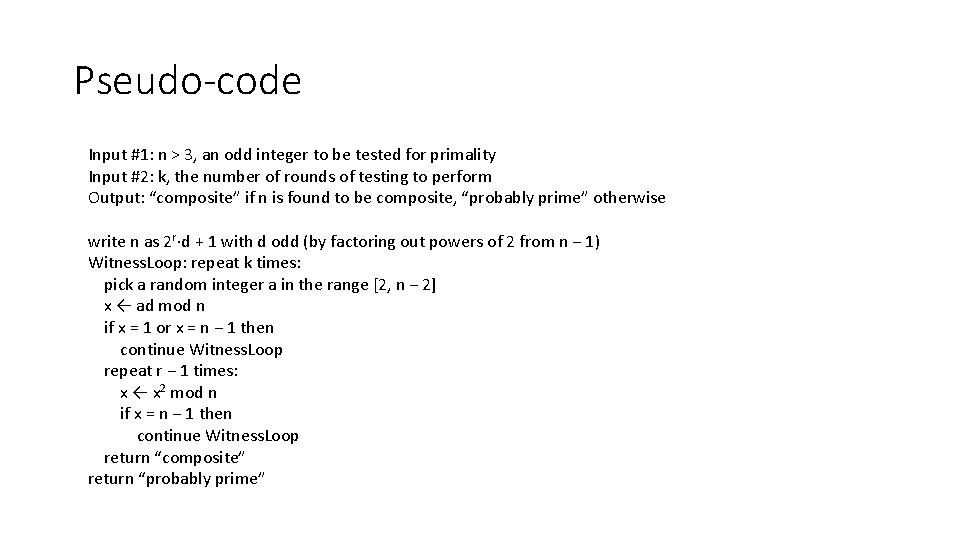
Pseudo-code Input #1: n > 3, an odd integer to be tested for primality Input #2: k, the number of rounds of testing to perform Output: “composite” if n is found to be composite, “probably prime” otherwise write n as 2 r·d + 1 with d odd (by factoring out powers of 2 from n − 1) Witness. Loop: repeat k times: pick a random integer a in the range [2, n − 2] x ← ad mod n if x = 1 or x = n − 1 then continue Witness. Loop repeat r − 1 times: x ← x 2 mod n if x = n − 1 then continue Witness. Loop return “composite” return “probably prime”
Other facts on Prime Testing • Miller-Rabin test is deterministic if Extended Riemann Hypothesis is true • 2002 a deterministic polynomial time test based on Cyclotomic Polynomials was discovered • Agrawal-Kayal-Saxena, IIT Kanpur • Not practical (termed galactic algorithm – see Wikipedia) • Factoring is thought to be harder then primality testing • In practice, numbers of about 100 decimal digits are factorable in a few hours on a PC • 250 decimal digit (829 bit) RSA keys have been factored (2700 CPU Years) • Recommendation for RSA is 2048 bit keys
RSA • RSA key is a number n=pq, where p and q are prime • How do you generate random primes of 300 digits? • Generate random number of 300 digits and test if they are prime • Of course, there are simple tricks to avoid small divisors • Prime number theorem: Probability of a random number less than N is prime is about 1/log N (Natural logarithm) • For 300 digits, this is about 690