
CSEE 217 GPU Architecture and Parallel Programming Lectures

![Loading Input Tile m N[m*TILE_WIDTH+ty][Col] N[(m*TILE_WIDTH+ty) * Width + Col] d_M d_P Pdsub …](https://slidetodoc.com/presentation_image_h2/f672bc3c6a526d2d3b32e28a1227d982/image-36.jpg "Loading Input Tile m N[m*TILE_WIDTH+ty][Col] N[(m*TILE_WIDTH+ty) * Width + Col] d_M d_P Pdsub …")

- Slides: 44
CS/EE 217 GPU Architecture and Parallel Programming Lectures 4 and 5: Memory Model and Locality © David Kirk/NVIDIA and Wen-mei W. Hwu, 2007 -2013 1
Objective • To learn to efficiently use the important levels of the CUDA memory hierarchy – Registers, shared memory, global memory – Tiled algorithms and barrier synchronization 2
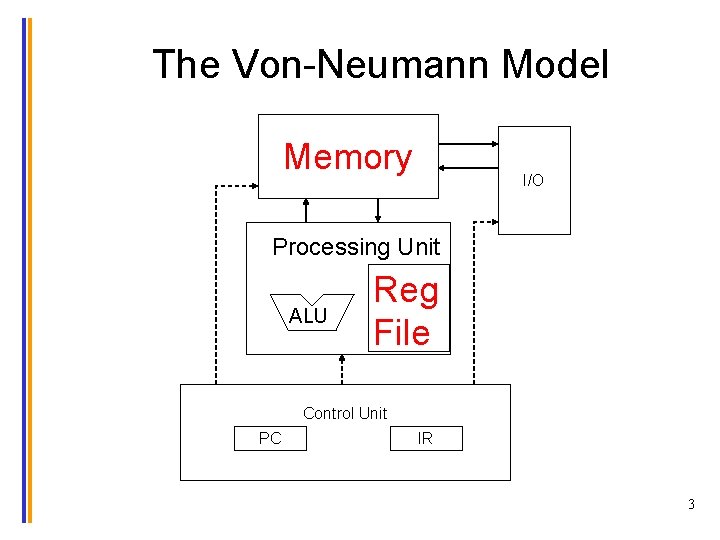
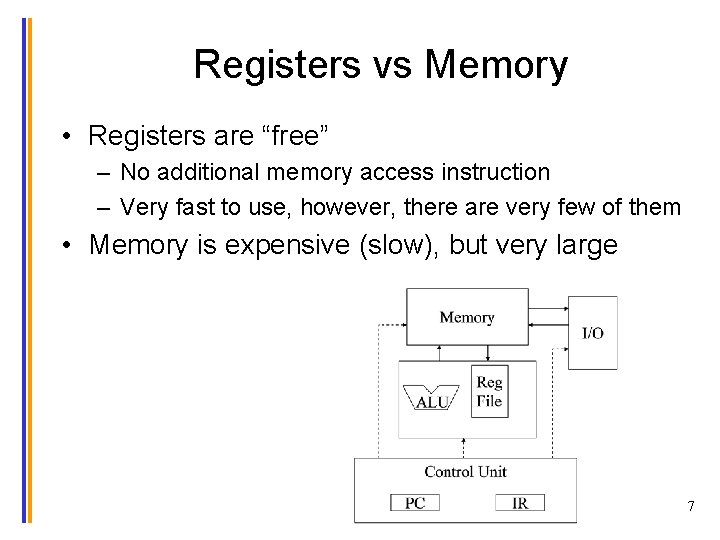
The Von-Neumann Model Memory I/O Processing Unit ALU Reg File Control Unit PC IR 3
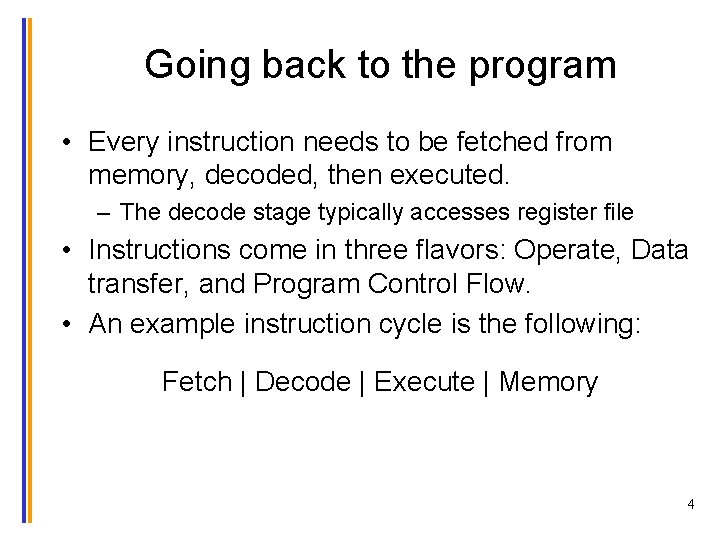
Going back to the program • Every instruction needs to be fetched from memory, decoded, then executed. – The decode stage typically accesses register file • Instructions come in three flavors: Operate, Data transfer, and Program Control Flow. • An example instruction cycle is the following: Fetch | Decode | Execute | Memory 4
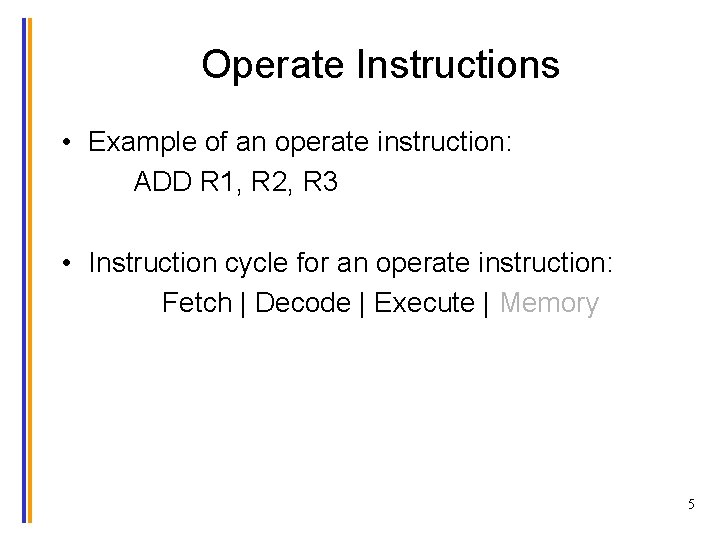
Operate Instructions • Example of an operate instruction: ADD R 1, R 2, R 3 • Instruction cycle for an operate instruction: Fetch | Decode | Execute | Memory 5
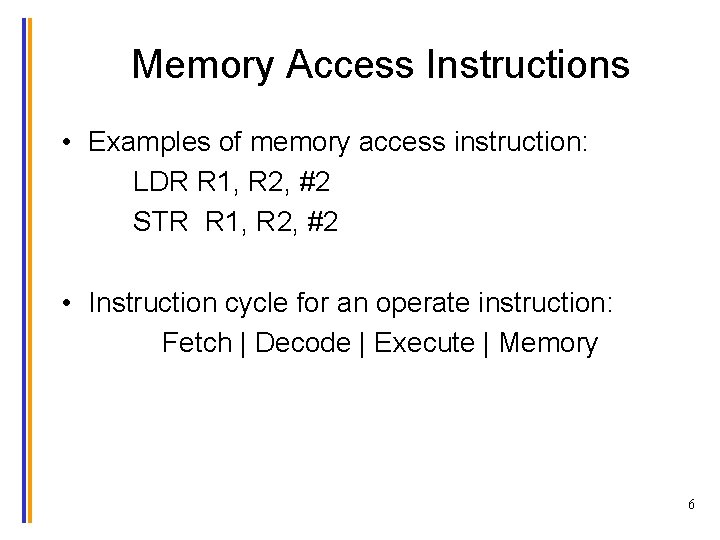
Memory Access Instructions • Examples of memory access instruction: LDR R 1, R 2, #2 STR R 1, R 2, #2 • Instruction cycle for an operate instruction: Fetch | Decode | Execute | Memory 6
Registers vs Memory • Registers are “free” – No additional memory access instruction – Very fast to use, however, there are very few of them • Memory is expensive (slow), but very large 7
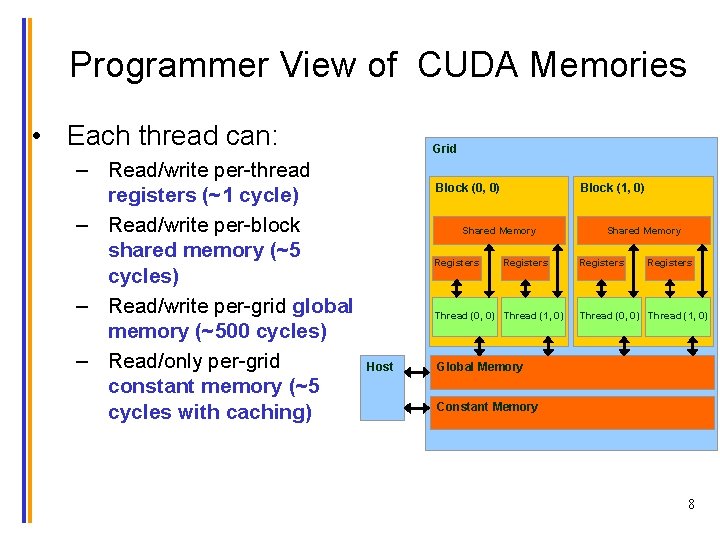
Programmer View of CUDA Memories • Each thread can: – Read/write per-thread registers (~1 cycle) – Read/write per-block shared memory (~5 cycles) – Read/write per-grid global memory (~500 cycles) – Read/only per-grid constant memory (~5 cycles with caching) Grid Block (0, 0) Block (1, 0) Shared Memory Registers Thread (0, 0) Thread (1, 0) Host Shared Memory Registers Thread (0, 0) Thread (1, 0) Global Memory Constant Memory 8
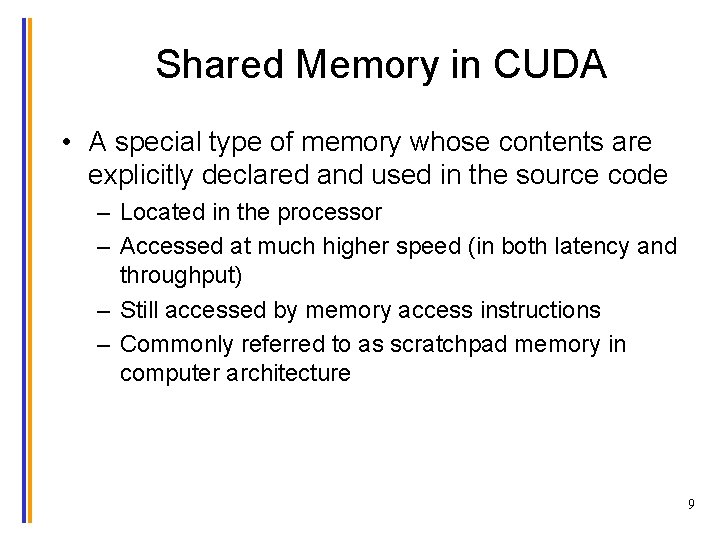
Shared Memory in CUDA • A special type of memory whose contents are explicitly declared and used in the source code – Located in the processor – Accessed at much higher speed (in both latency and throughput) – Still accessed by memory access instructions – Commonly referred to as scratchpad memory in computer architecture 9
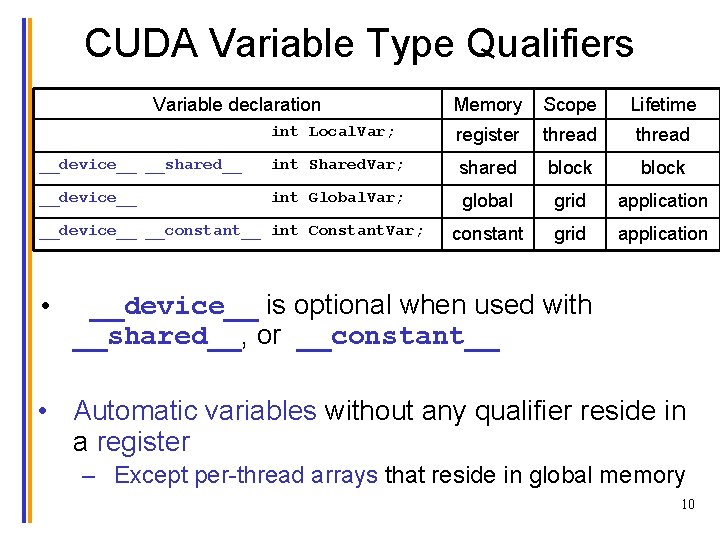
CUDA Variable Type Qualifiers Variable declaration Memory Scope Lifetime int Local. Var; register thread __device__ __shared__ int Shared. Var; shared block __device__ int Global. Var; global grid application constant grid application __device__ __constant__ int Constant. Var; • __device__ is optional when used with __shared__, or __constant__ • Automatic variables without any qualifier reside in a register – Except per-thread arrays that reside in global memory 10
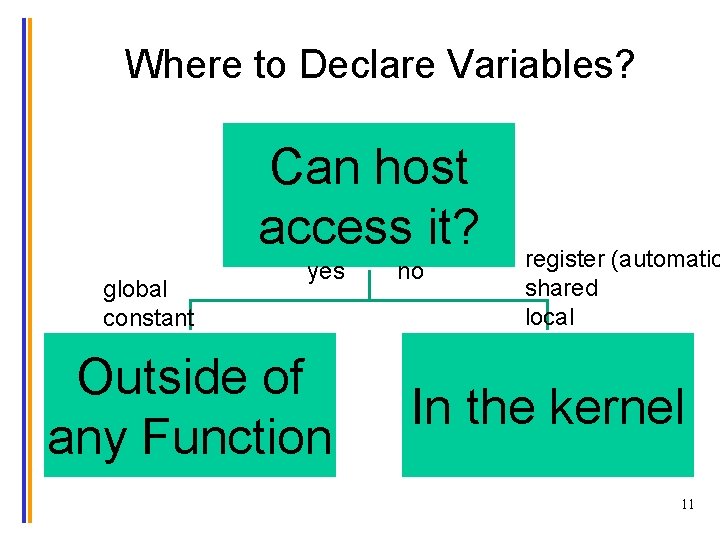
Where to Declare Variables? Can host access it? global constant yes Outside of any Function no register (automatic shared local In the kernel 11
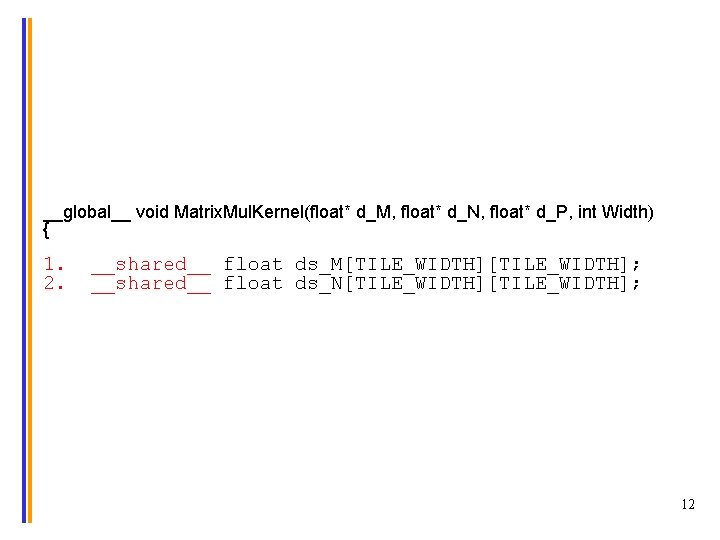
__global__ void Matrix. Mul. Kernel(float* d_M, float* d_N, float* d_P, int Width) { 1. 2. __shared__ float ds_M[TILE_WIDTH]; __shared__ float ds_N[TILE_WIDTH]; 12
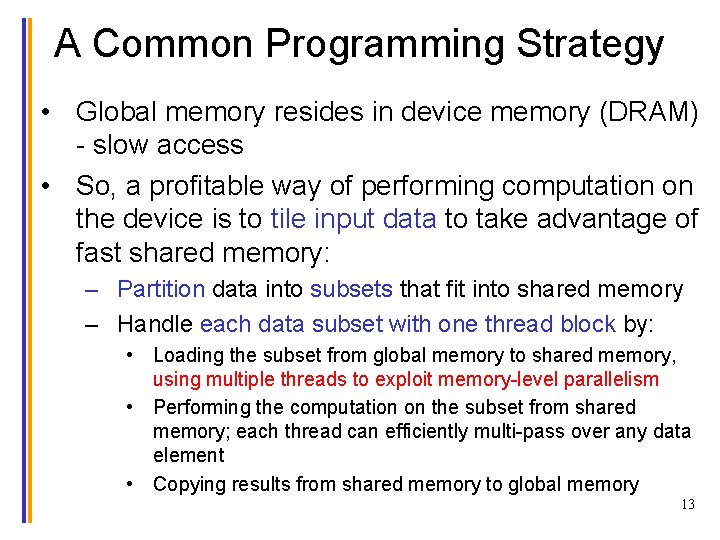
A Common Programming Strategy • Global memory resides in device memory (DRAM) - slow access • So, a profitable way of performing computation on the device is to tile input data to take advantage of fast shared memory: – Partition data into subsets that fit into shared memory – Handle each data subset with one thread block by: • Loading the subset from global memory to shared memory, using multiple threads to exploit memory-level parallelism • Performing the computation on the subset from shared memory; each thread can efficiently multi-pass over any data element • Copying results from shared memory to global memory 13
Matrix-Matrix Multiplication using Shared Memory 14
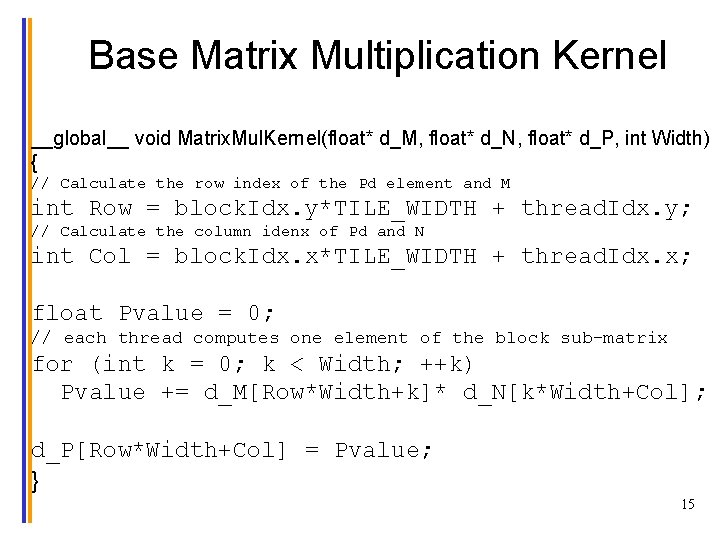
Base Matrix Multiplication Kernel __global__ void Matrix. Mul. Kernel(float* d_M, float* d_N, float* d_P, int Width) { // Calculate the row index of the Pd element and M int Row = block. Idx. y*TILE_WIDTH + thread. Idx. y; // Calculate the column idenx of Pd and N int Col = block. Idx. x*TILE_WIDTH + thread. Idx. x; float Pvalue = 0; // each thread computes one element of the block sub-matrix for (int k = 0; k < Width; ++k) Pvalue += d_M[Row*Width+k]* d_N[k*Width+Col]; d_P[Row*Width+Col] = Pvalue; } 15
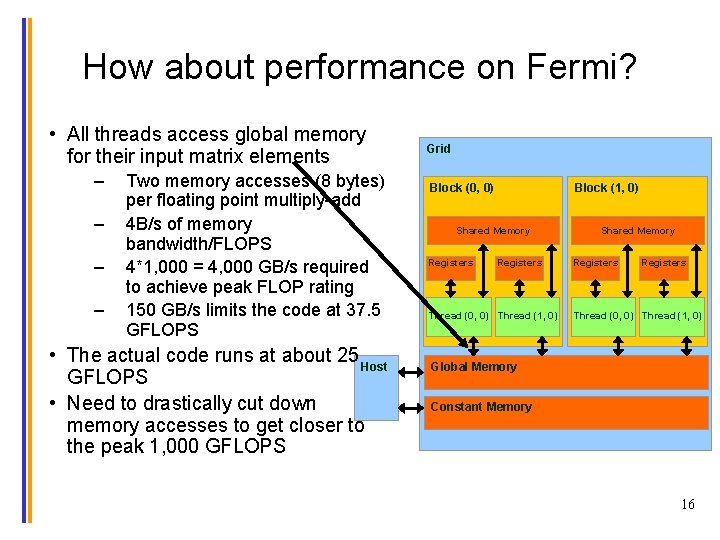
How about performance on Fermi? • All threads access global memory for their input matrix elements – – Two memory accesses (8 bytes) per floating point multiply-add 4 B/s of memory bandwidth/FLOPS 4*1, 000 = 4, 000 GB/s required to achieve peak FLOP rating 150 GB/s limits the code at 37. 5 GFLOPS • The actual code runs at about 25 Host GFLOPS • Need to drastically cut down memory accesses to get closer to the peak 1, 000 GFLOPS Grid Block (0, 0) Block (1, 0) Shared Memory Registers Thread (0, 0) Thread (1, 0) Global Memory Constant Memory 16
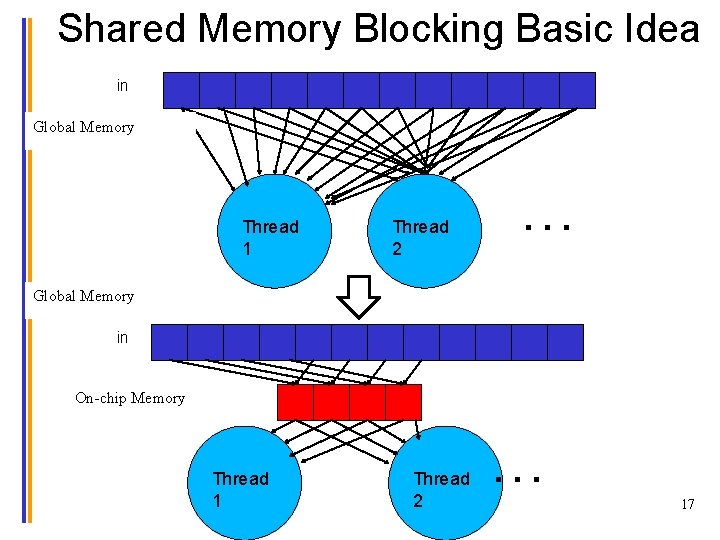
Shared Memory Blocking Basic Idea in Global Memory Thread 1 Thread 2 … Global Memory in On-chip Memory Thread 1 Thread 2 … 17
Basic Concept of Blocking/Tiling • In a congested traffic system, significant reduction of vehicles can greatly improve the delay seen by all vehicles – Carpooling for commuters – Blocking/Tiling for global memory accesses • drivers = threads, • cars = data 18
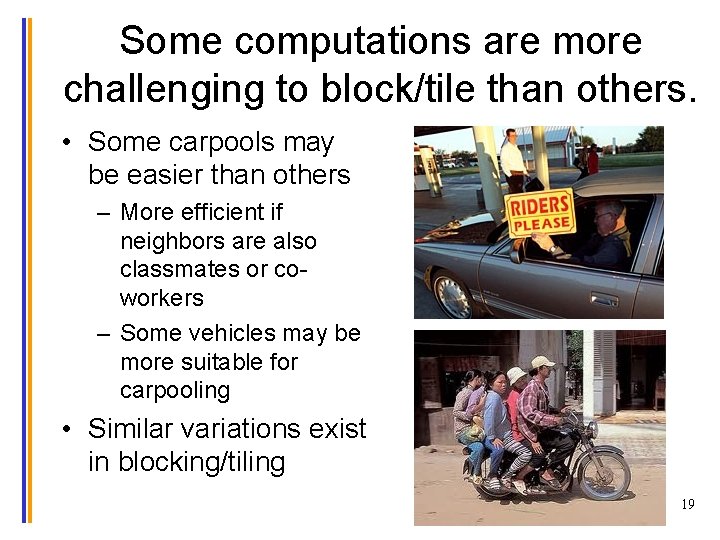
Some computations are more challenging to block/tile than others. • Some carpools may be easier than others – More efficient if neighbors are also classmates or coworkers – Some vehicles may be more suitable for carpooling • Similar variations exist in blocking/tiling 19
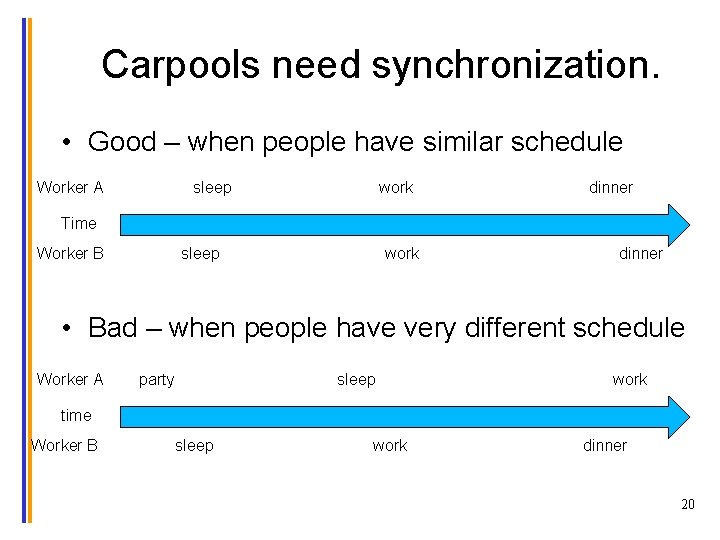
Carpools need synchronization. • Good – when people have similar schedule Worker A sleep work dinner Time Worker B sleep work dinner • Bad – when people have very different schedule Worker A party sleep work time Worker B sleep work dinner 20
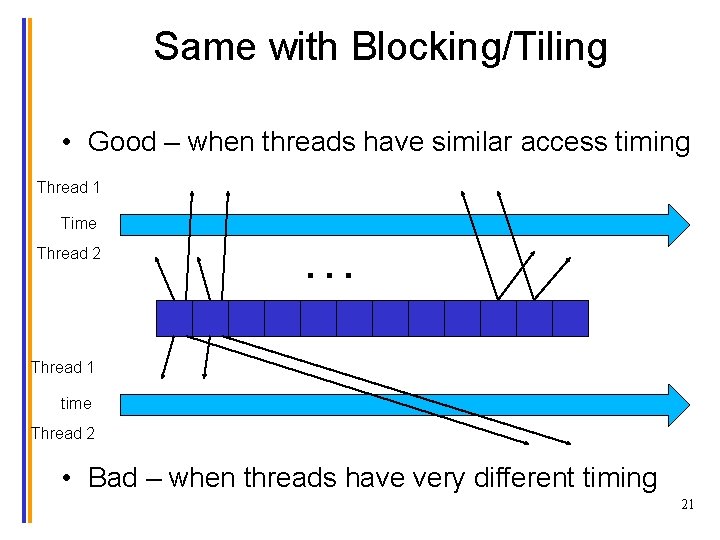
Same with Blocking/Tiling • Good – when threads have similar access timing Thread 1 Time Thread 2 … Thread 1 time Thread 2 • Bad – when threads have very different timing 21
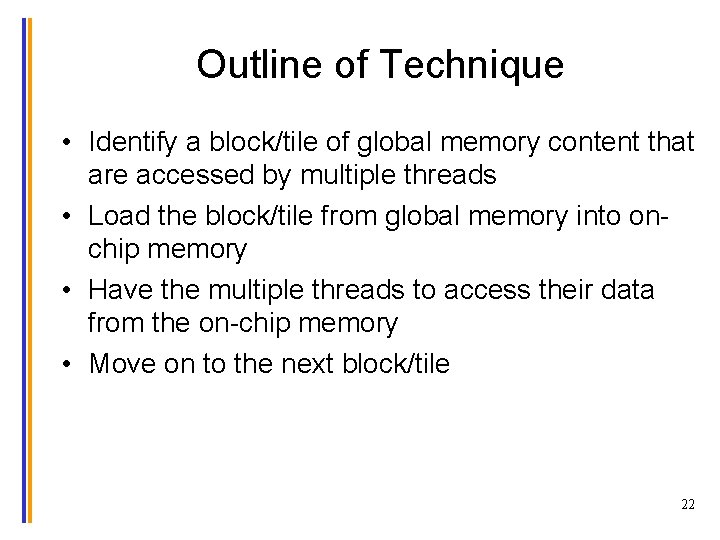
Outline of Technique • Identify a block/tile of global memory content that are accessed by multiple threads • Load the block/tile from global memory into onchip memory • Have the multiple threads to access their data from the on-chip memory • Move on to the next block/tile 22
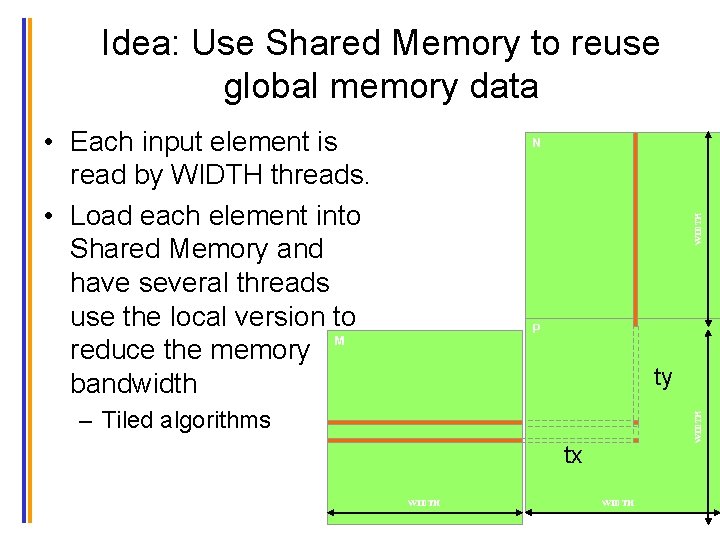
Idea: Use Shared Memory to reuse global memory data • Each input element is read by WIDTH threads. • Load each element into Shared Memory and have several threads use the local version to reduce the memory M bandwidth WIDTH N P ty WIDTH – Tiled algorithms tx WIDTH 23
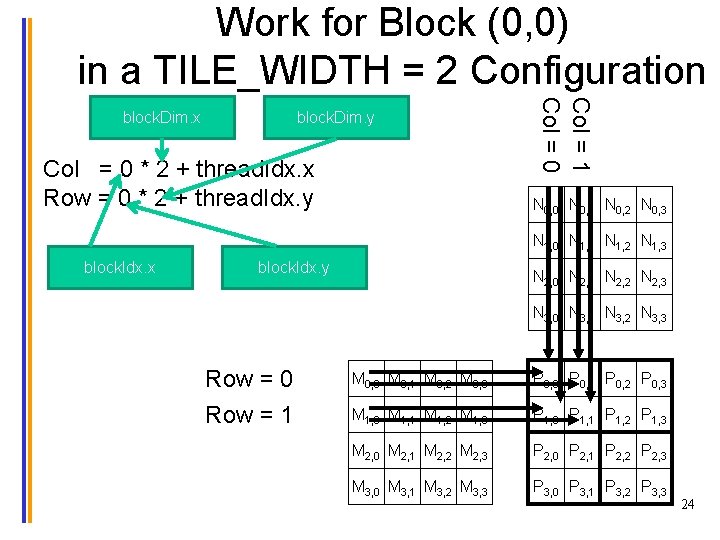
Work for Block (0, 0) in a TILE_WIDTH = 2 Configuration block. Dim. y Col = 0 * 2 + thread. Idx. x Row = 0 * 2 + thread. Idx. y Col = 1 Col = 0 block. Dim. x N 0, 0 N 0, 1 N 0, 2 N 0, 3 N 1, 0 N 1, 1 N 1, 2 N 1, 3 block. Idx. x block. Idx. y N 2, 0 N 2, 1 N 2, 2 N 2, 3 N 3, 0 N 3, 1 N 3, 2 N 3, 3 Row = 0 Row = 1 M 0, 0 M 0, 1 M 0, 2 M 0, 3 P 0, 0 P 0, 1 P 0, 2 P 0, 3 M 1, 0 M 1, 1 M 1, 2 M 1, 3 P 1, 0 P 1, 1 P 1, 2 P 1, 3 M 2, 0 M 2, 1 M 2, 2 M 2, 3 P 2, 0 P 2, 1 P 2, 2 P 2, 3 M 3, 0 M 3, 1 M 3, 2 M 3, 3 P 3, 0 P 3, 1 P 3, 2 P 3, 3 24
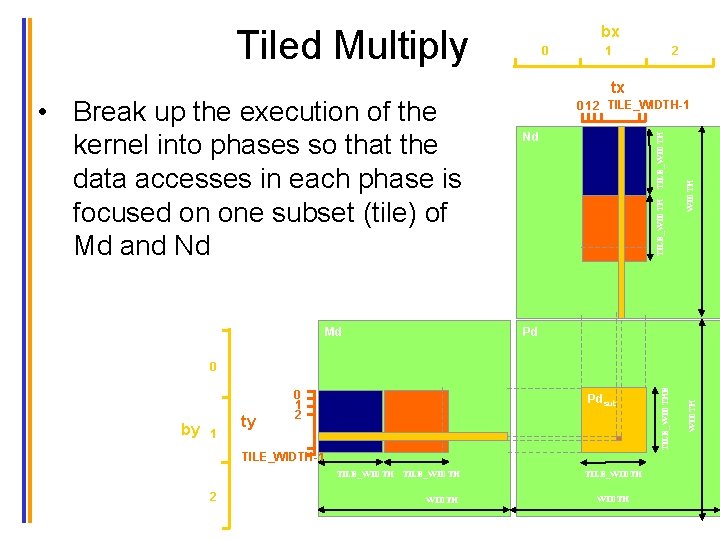
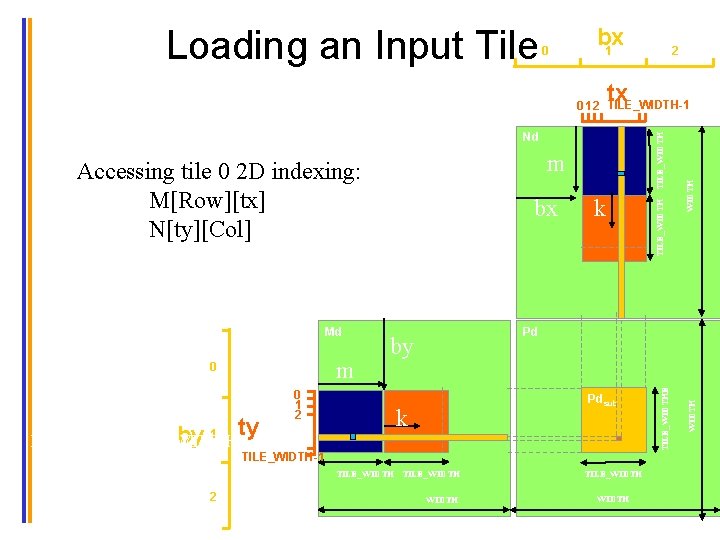
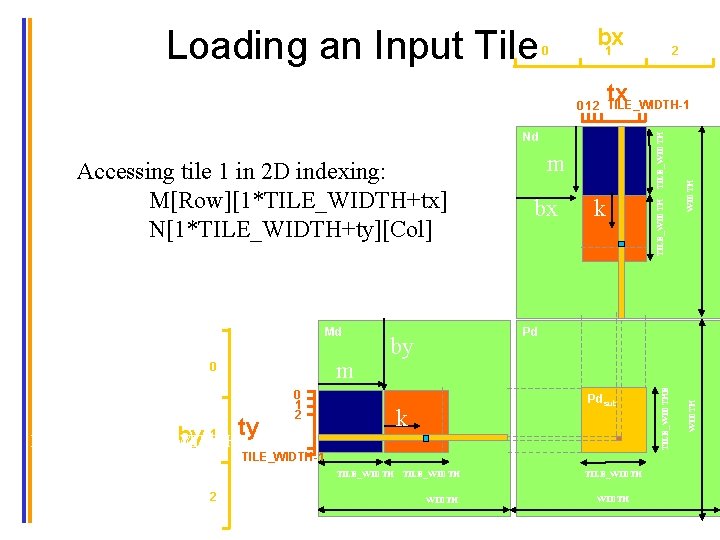
bx Tiled Multiply Md 1 2 tx TILE_WIDTH Nd WIDTH 0 1 2 TILE_WIDTH-1 TILE_WIDTH • Break up the execution of the kernel into phases so that the data accesses in each phase is focused on one subset (tile) of Md and Nd 0 Pd 1 ty Pdsub TILE_WIDTH-1 TILE_WIDTH 2 WIDTH by 0 1 2 TILE_WIDTHE 0 TILE_WIDTH 25
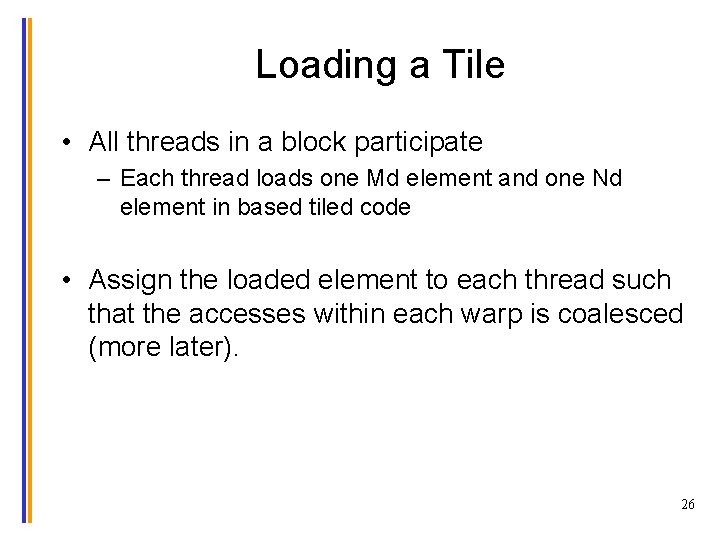
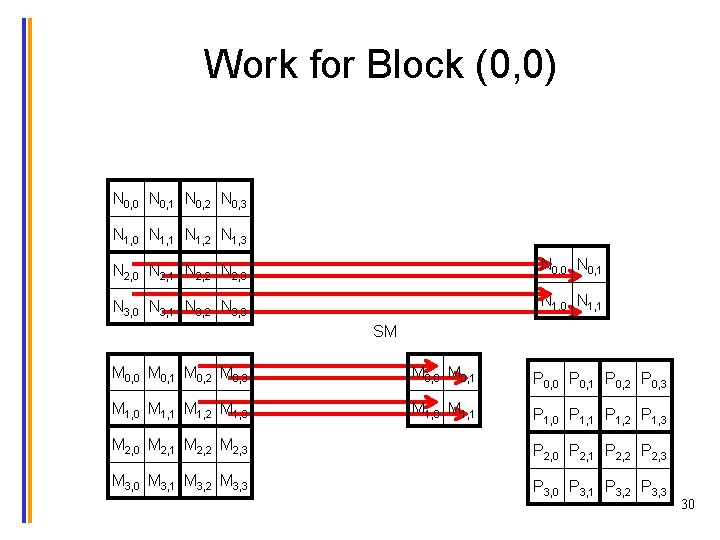
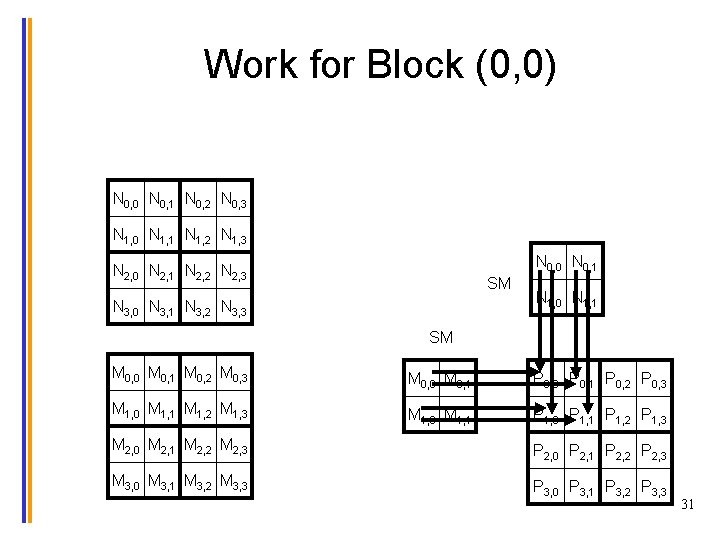
Loading a Tile • All threads in a block participate – Each thread loads one Md element and one Nd element in based tiled code • Assign the loaded element to each thread such that the accesses within each warp is coalesced (more later). 26
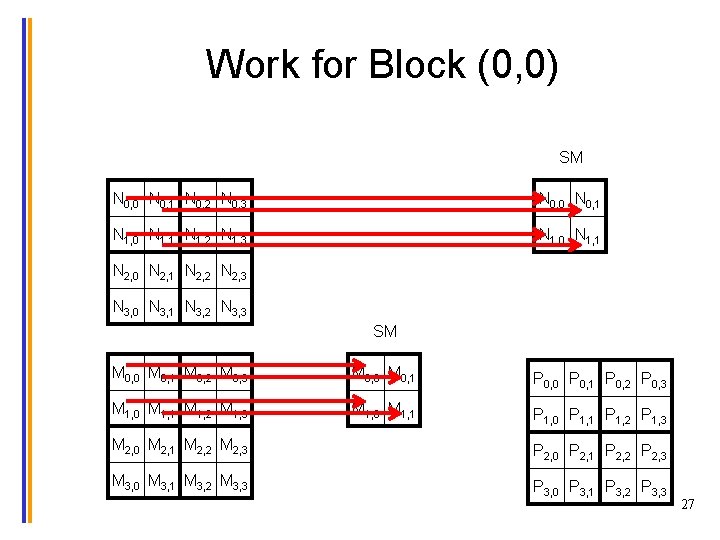
Work for Block (0, 0) SM N 0, 0 N 0, 1 N 0, 2 N 0, 3 N 0, 0 N 0, 1 N 1, 0 N 1, 1 N 1, 2 N 1, 3 N 1, 0 N 1, 1 N 2, 0 N 2, 1 N 2, 2 N 2, 3 N 3, 0 N 3, 1 N 3, 2 N 3, 3 SM M 0, 0 M 0, 1 M 0, 2 M 0, 3 M 0, 0 M 0, 1 P 0, 0 P 0, 1 P 0, 2 P 0, 3 M 1, 0 M 1, 1 M 1, 2 M 1, 3 M 1, 0 M 1, 1 P 1, 0 P 1, 1 P 1, 2 P 1, 3 M 2, 0 M 2, 1 M 2, 2 M 2, 3 P 2, 0 P 2, 1 P 2, 2 P 2, 3 M 3, 0 M 3, 1 M 3, 2 M 3, 3 P 3, 0 P 3, 1 P 3, 2 P 3, 3 27
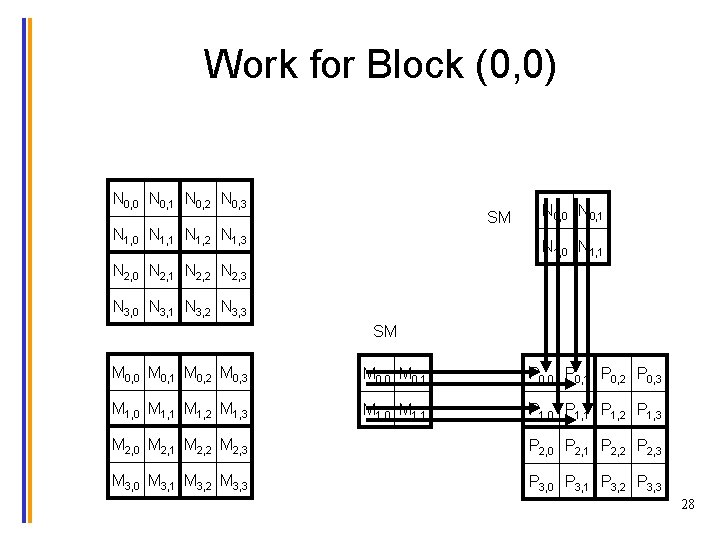
Work for Block (0, 0) N 0, 0 N 0, 1 N 0, 2 N 0, 3 SM N 1, 0 N 1, 1 N 1, 2 N 1, 3 N 0, 0 N 0, 1 N 1, 0 N 1, 1 N 2, 0 N 2, 1 N 2, 2 N 2, 3 N 3, 0 N 3, 1 N 3, 2 N 3, 3 SM M 0, 0 M 0, 1 M 0, 2 M 0, 3 M 0, 0 M 0, 1 P 0, 0 P 0, 1 P 0, 2 P 0, 3 M 1, 0 M 1, 1 M 1, 2 M 1, 3 M 1, 0 M 1, 1 P 1, 0 P 1, 1 P 1, 2 P 1, 3 M 2, 0 M 2, 1 M 2, 2 M 2, 3 P 2, 0 P 2, 1 P 2, 2 P 2, 3 M 3, 0 M 3, 1 M 3, 2 M 3, 3 P 3, 0 P 3, 1 P 3, 2 P 3, 3 28
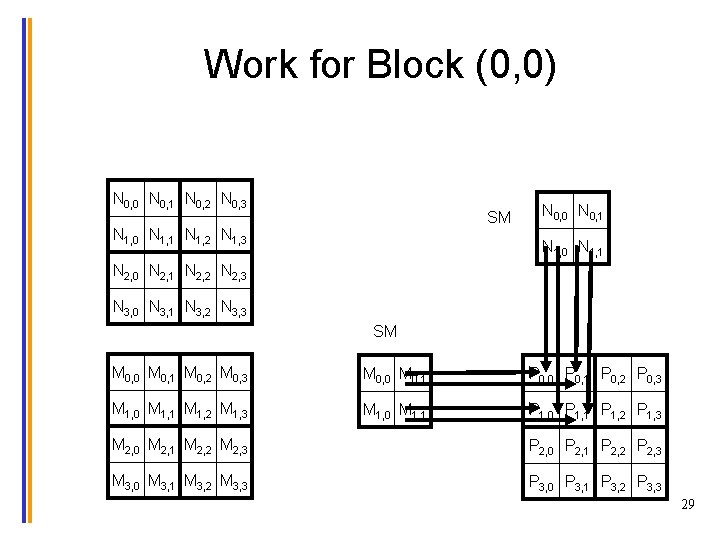
Work for Block (0, 0) N 0, 0 N 0, 1 N 0, 2 N 0, 3 SM N 1, 0 N 1, 1 N 1, 2 N 1, 3 N 0, 0 N 0, 1 N 1, 0 N 1, 1 N 2, 0 N 2, 1 N 2, 2 N 2, 3 N 3, 0 N 3, 1 N 3, 2 N 3, 3 SM M 0, 0 M 0, 1 M 0, 2 M 0, 3 M 0, 0 M 0, 1 P 0, 0 P 0, 1 P 0, 2 P 0, 3 M 1, 0 M 1, 1 M 1, 2 M 1, 3 M 1, 0 M 1, 1 P 1, 0 P 1, 1 P 1, 2 P 1, 3 M 2, 0 M 2, 1 M 2, 2 M 2, 3 P 2, 0 P 2, 1 P 2, 2 P 2, 3 M 3, 0 M 3, 1 M 3, 2 M 3, 3 P 3, 0 P 3, 1 P 3, 2 P 3, 3 29
Work for Block (0, 0) N 0, 0 N 0, 1 N 0, 2 N 0, 3 N 1, 0 N 1, 1 N 1, 2 N 1, 3 N 2, 0 N 2, 1 N 2, 2 N 2, 3 N 0, 0 N 0, 1 N 3, 0 N 3, 1 N 3, 2 N 3, 3 N 1, 0 N 1, 1 SM M 0, 0 M 0, 1 M 0, 2 M 0, 3 M 0, 0 M 0, 1 P 0, 0 P 0, 1 P 0, 2 P 0, 3 M 1, 0 M 1, 1 M 1, 2 M 1, 3 M 1, 0 M 1, 1 P 1, 0 P 1, 1 P 1, 2 P 1, 3 M 2, 0 M 2, 1 M 2, 2 M 2, 3 P 2, 0 P 2, 1 P 2, 2 P 2, 3 M 3, 0 M 3, 1 M 3, 2 M 3, 3 P 3, 0 P 3, 1 P 3, 2 P 3, 3 30
Work for Block (0, 0) N 0, 0 N 0, 1 N 0, 2 N 0, 3 N 1, 0 N 1, 1 N 1, 2 N 1, 3 N 0, 0 N 0, 1 N 2, 0 N 2, 1 N 2, 2 N 2, 3 SM N 3, 0 N 3, 1 N 3, 2 N 3, 3 N 1, 0 N 1, 1 SM M 0, 0 M 0, 1 M 0, 2 M 0, 3 M 0, 0 M 0, 1 P 0, 0 P 0, 1 P 0, 2 P 0, 3 M 1, 0 M 1, 1 M 1, 2 M 1, 3 M 1, 0 M 1, 1 P 1, 0 P 1, 1 P 1, 2 P 1, 3 M 2, 0 M 2, 1 M 2, 2 M 2, 3 P 2, 0 P 2, 1 P 2, 2 P 2, 3 M 3, 0 M 3, 1 M 3, 2 M 3, 3 P 3, 0 P 3, 1 P 3, 2 P 3, 3 31
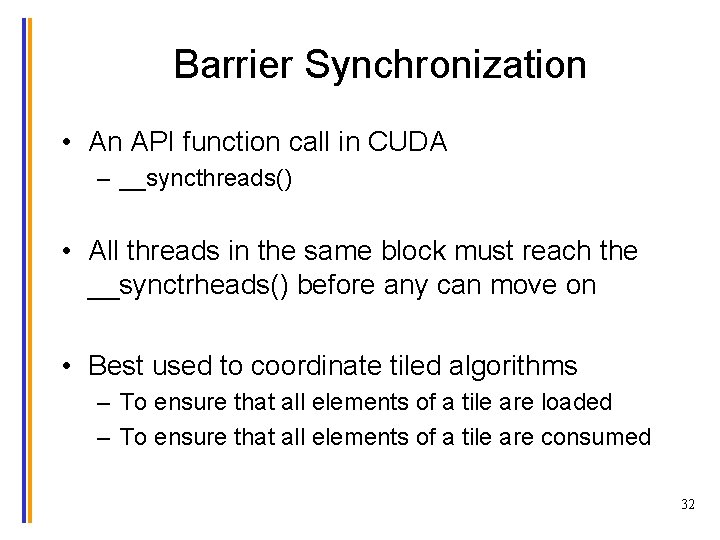
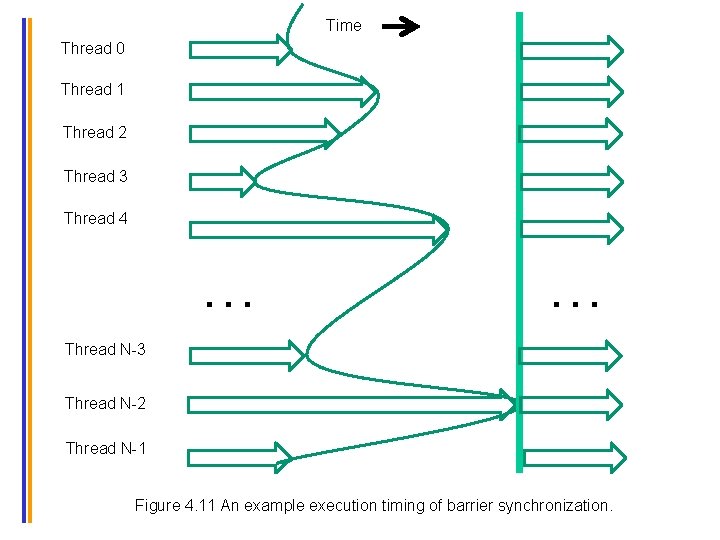
Barrier Synchronization • An API function call in CUDA – __syncthreads() • All threads in the same block must reach the __synctrheads() before any can move on • Best used to coordinate tiled algorithms – To ensure that all elements of a tile are loaded – To ensure that all elements of a tile are consumed 32
Time Thread 0 Thread 1 Thread 2 Thread 3 Thread 4 … … Thread N-3 Thread N-2 Thread N-1 Figure 4. 11 An example execution timing of barrier synchronization.
Loading an Input Tile 0 bx 1 2 tx Pd by Pdsub k TILE_WIDTH-1 TILE_WIDTH 2 WIDTH ty by Row = by * TILE_WIDTH +ty 1 0 1 2 k TILE_WIDTHE m 0 bx TILE_WIDTH m Accessing tile 0 2 D indexing: M[Row][tx] N[ty][Col] Md TILE_WIDTH Nd WIDTH 0 1 2 TILE_WIDTH-1 TILE_WIDTH 34
Loading an Input Tile 0 bx 1 2 tx ty by Row = by * TILE_WIDTH +ty 1 0 1 2 k Pd by Pdsub k TILE_WIDTH-1 TILE_WIDTH 2 WIDTH m 0 bx TILE_WIDTHE Md m TILE_WIDTH Accessing tile 1 in 2 D indexing: M[Row][1*TILE_WIDTH+tx] N[1*TILE_WIDTH+ty][Col] TILE_WIDTH Nd WIDTH 0 1 2 TILE_WIDTH-1 TILE_WIDTH 35
Loading Input Tile m N[m*TILE_WIDTH+ty][Col] N[(m*TILE_WIDTH+ty) * Width + Col] d_M d_P Pdsub … TILE_WIDTH WIDTH m*TILE_WIDTHE Row WIDTH … M[Row][m*TILE_WIDTH+tx] M[Row*Width + m*TILE_WIDTH + tx] TILE_WIDTH d_N TILE_WIDTH Col m*TILE_WIDTH However, M and N are dynamically allocated and can only use 1 D indexing:
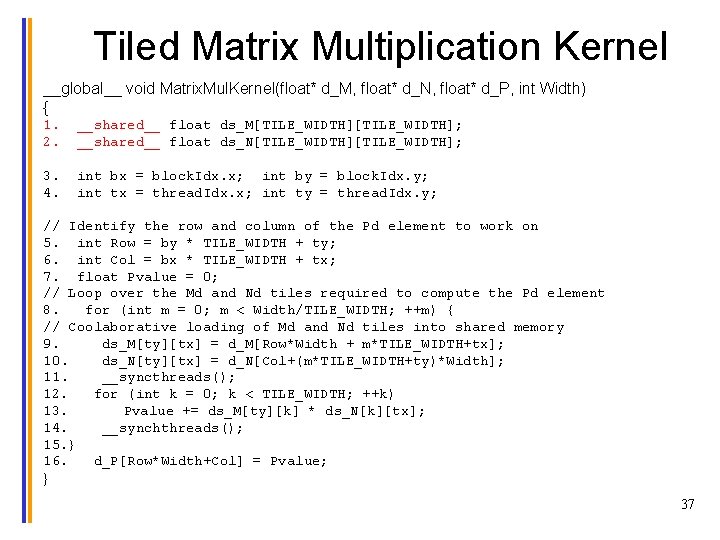
Tiled Matrix Multiplication Kernel __global__ void Matrix. Mul. Kernel(float* d_M, float* d_N, float* d_P, int Width) { 1. 2. __shared__ float ds_M[TILE_WIDTH]; __shared__ float ds_N[TILE_WIDTH]; 3. 4. int bx = block. Idx. x; int by = block. Idx. y; int tx = thread. Idx. x; int ty = thread. Idx. y; // Identify the row and column of the Pd element to work on 5. int Row = by * TILE_WIDTH + ty; 6. int Col = bx * TILE_WIDTH + tx; 7. float Pvalue = 0; // Loop over the Md and Nd tiles required to compute the Pd element 8. for (int m = 0; m < Width/TILE_WIDTH; ++m) { // Coolaborative loading of Md and Nd tiles into shared memory 9. ds_M[ty][tx] = d_M[Row*Width + m*TILE_WIDTH+tx]; 10. ds_N[ty][tx] = d_N[Col+(m*TILE_WIDTH+ty)*Width]; 11. __syncthreads(); 12. for (int k = 0; k < TILE_WIDTH; ++k) 13. Pvalue += ds_M[ty][k] * ds_N[k][tx]; 14. __synchthreads(); 15. } 16. d_P[Row*Width+Col] = Pvalue; } 37
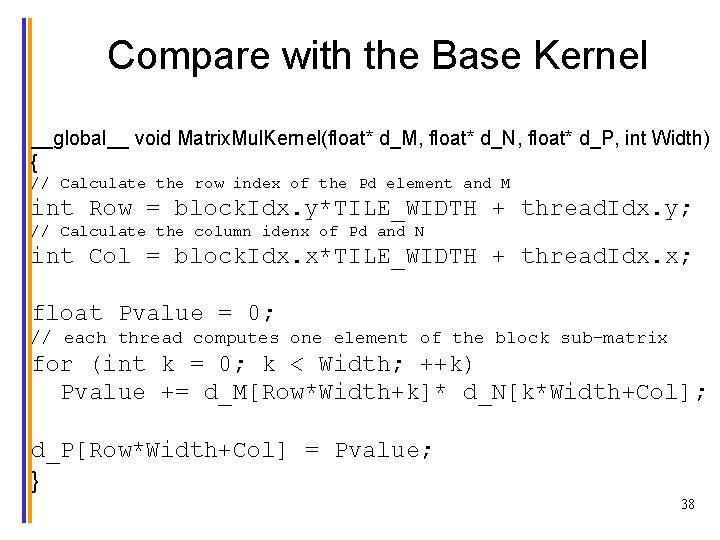
Compare with the Base Kernel __global__ void Matrix. Mul. Kernel(float* d_M, float* d_N, float* d_P, int Width) { // Calculate the row index of the Pd element and M int Row = block. Idx. y*TILE_WIDTH + thread. Idx. y; // Calculate the column idenx of Pd and N int Col = block. Idx. x*TILE_WIDTH + thread. Idx. x; float Pvalue = 0; // each thread computes one element of the block sub-matrix for (int k = 0; k < Width; ++k) Pvalue += d_M[Row*Width+k]* d_N[k*Width+Col]; d_P[Row*Width+Col] = Pvalue; } 38
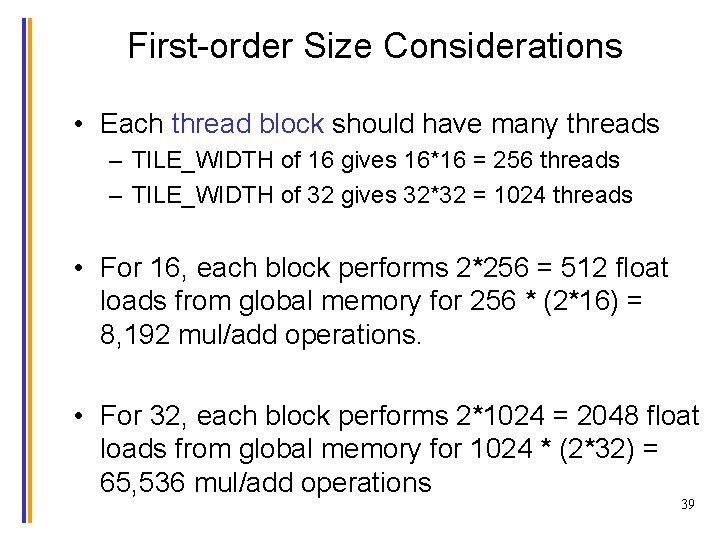
First-order Size Considerations • Each thread block should have many threads – TILE_WIDTH of 16 gives 16*16 = 256 threads – TILE_WIDTH of 32 gives 32*32 = 1024 threads • For 16, each block performs 2*256 = 512 float loads from global memory for 256 * (2*16) = 8, 192 mul/add operations. • For 32, each block performs 2*1024 = 2048 float loads from global memory for 1024 * (2*32) = 65, 536 mul/add operations 39
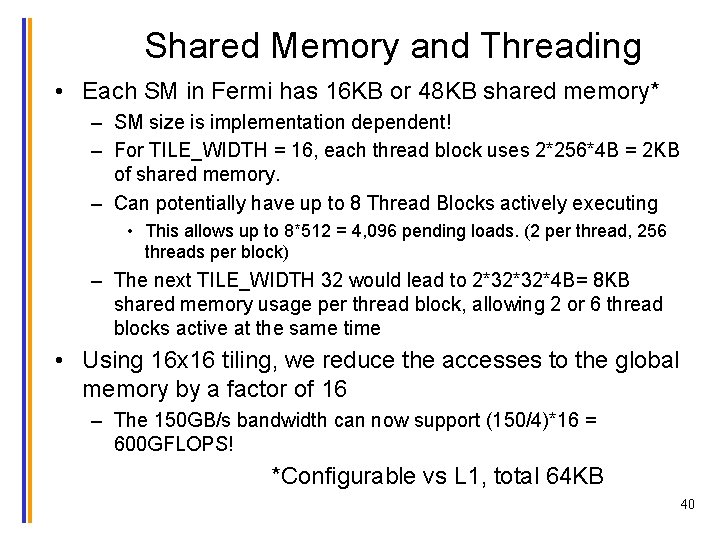
Shared Memory and Threading • Each SM in Fermi has 16 KB or 48 KB shared memory* – SM size is implementation dependent! – For TILE_WIDTH = 16, each thread block uses 2*256*4 B = 2 KB of shared memory. – Can potentially have up to 8 Thread Blocks actively executing • This allows up to 8*512 = 4, 096 pending loads. (2 per thread, 256 threads per block) – The next TILE_WIDTH 32 would lead to 2*32*32*4 B= 8 KB shared memory usage per thread block, allowing 2 or 6 thread blocks active at the same time • Using 16 x 16 tiling, we reduce the accesses to the global memory by a factor of 16 – The 150 GB/s bandwidth can now support (150/4)*16 = 600 GFLOPS! *Configurable vs L 1, total 64 KB 40
Boundary conditions • What to do if the matrix size is not a multiple of width? – Tricky problem, lets work through an example • Too many boundary checks can cause control divergence and overhead • Something that you have to work through for lab 2 – I’ll start a piazza discussion on the topic 41
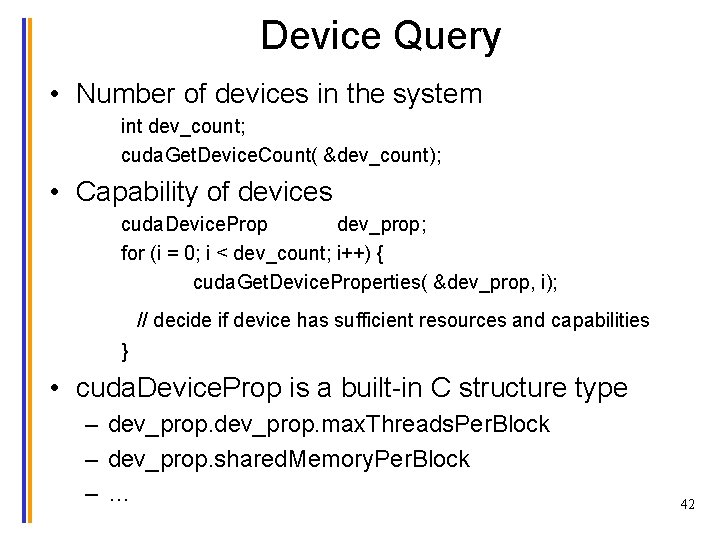
Device Query • Number of devices in the system int dev_count; cuda. Get. Device. Count( &dev_count); • Capability of devices cuda. Device. Prop dev_prop; for (i = 0; i < dev_count; i++) { cuda. Get. Device. Properties( &dev_prop, i); // decide if device has sufficient resources and capabilities } • cuda. Device. Prop is a built-in C structure type – dev_prop. max. Threads. Per. Block – dev_prop. shared. Memory. Per. Block –… 42
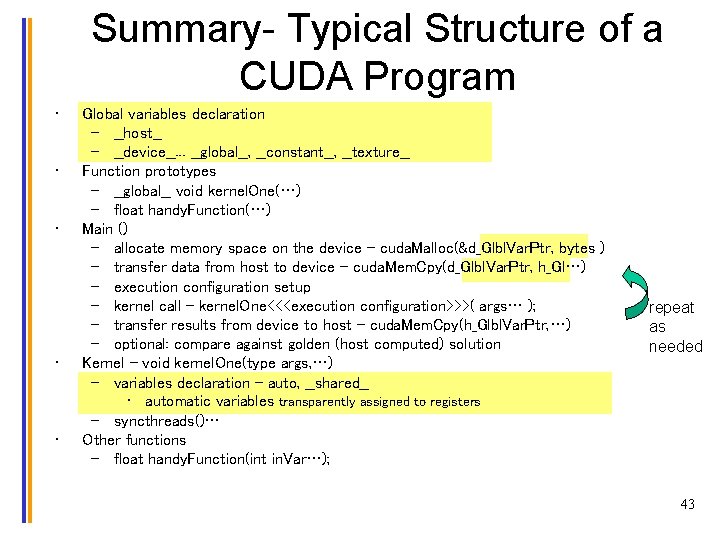
Summary- Typical Structure of a CUDA Program • • • Global variables declaration – __host__ – __device__. . . __global__, __constant__, __texture__ Function prototypes – __global__ void kernel. One(…) – float handy. Function(…) Main () – allocate memory space on the device – cuda. Malloc(&d_Glbl. Var. Ptr, bytes ) – transfer data from host to device – cuda. Mem. Cpy(d_Glbl. Var. Ptr, h_Gl…) – execution configuration setup – kernel call – kernel. One<<<execution configuration>>>( args… ); – transfer results from device to host – cuda. Mem. Cpy(h_Glbl. Var. Ptr, …) – optional: compare against golden (host computed) solution Kernel – void kernel. One(type args, …) – variables declaration - auto, __shared__ • automatic variables transparently assigned to registers – syncthreads()… Other functions – float handy. Function(int in. Var…); repeat as needed 43
ANY MORE QUESTIONS? READ CHAPTER 5! 44