
CSE 6341 Programming Languages Neelam Soundarajan Computer Sc
- Slides: 22
CSE 6341 Programming Languages Neelam Soundarajan Computer Sc. & Eng. Dreese Labs 579 e-mail: neelam@cse
Outline n Main Topic: n n n Ways to formally define syntax and semantics of PLs Plus … a bit about programming methodologies Tentative Schedule: n n n Attribute grammars: 3 weeks Operational Semantics (including Lisp & its interpreter): 3. 5 weeks Axiomatic Semantics: 3. 5 weeks Denotational Semantics: 1 week Other topics: ? ? Exams etc. : 0. 5 week CSE 6341
References Unfortunately, no good books for the course. Mainly depend on slides, class discussions, your notes. Repeat: Slides are NOT class notes; slides are just bulletpoints DO NOT miss classes. Some useful references: 1. Formal specification of programming languages, F. Pagan 2. Formal syntax and semantics of programming languages, Kurtz and Slonnegar 3. Lisp 1. 5 programmer’s manual, Mc. Carthy and others Copies of all on reserve in the Sc. /Eng. Library CSE 6341
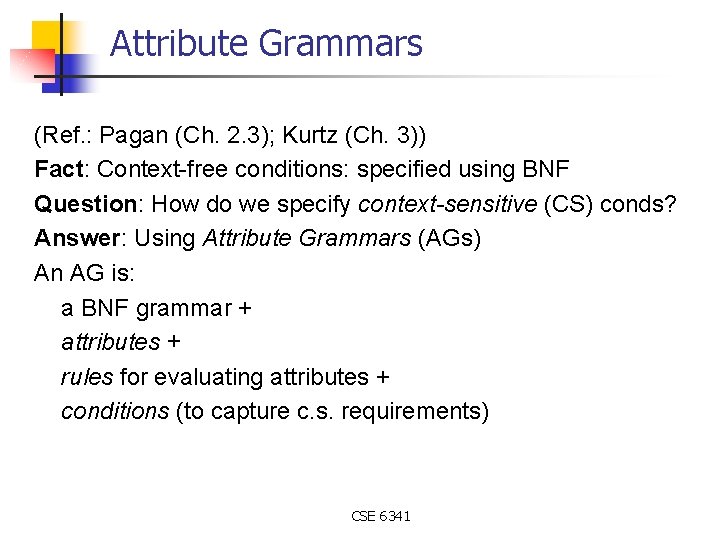
Attribute Grammars (Ref. : Pagan (Ch. 2. 3); Kurtz (Ch. 3)) Fact: Context-free conditions: specified using BNF Question: How do we specify context-sensitive (CS) conds? Answer: Using Attribute Grammars (AGs) An AG is: a BNF grammar + attributes + rules for evaluating attributes + conditions (to capture c. s. requirements) CSE 6341
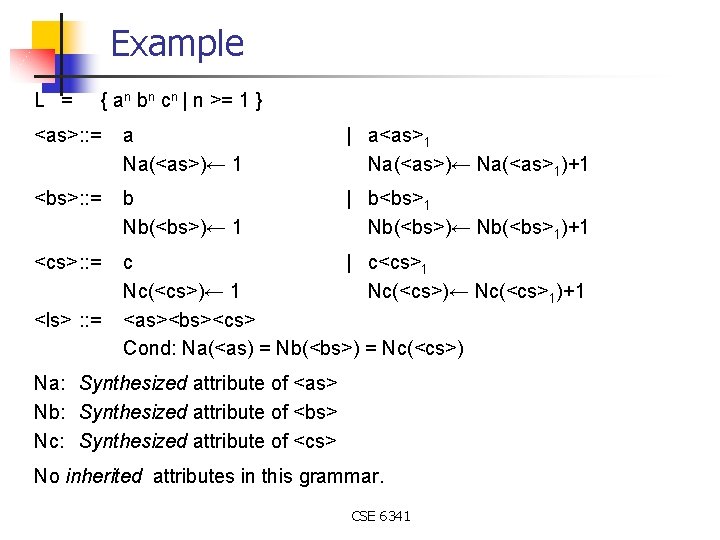
Example L = { an bn cn | n >= 1 } <as>: : = a Na(<as>)← 1 | a<as>1 Na(<as>)← Na(<as>1)+1 <bs>: : = b Nb(<bs>)← 1 | b<bs>1 Nb(<bs>)← Nb(<bs>1)+1 <cs>: : = c | c<cs>1 Nc(<cs>)← Nc(<cs>1)+1 <as><bs><cs> Cond: Na(<as) = Nb(<bs>) = Nc(<cs>) <ls> : : = Na: Synthesized attribute of <as> Nb: Synthesized attribute of <bs> Nc: Synthesized attribute of <cs> No inherited attributes in this grammar. CSE 6341
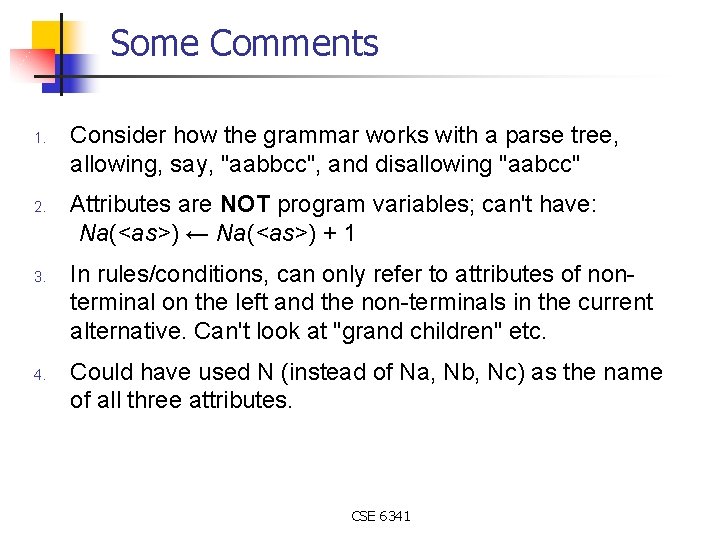
Some Comments 1. 2. 3. 4. Consider how the grammar works with a parse tree, allowing, say, "aabbcc", and disallowing "aabcc" Attributes are NOT program variables; can't have: Na(<as>) ← Na(<as>) + 1 In rules/conditions, can only refer to attributes of nonterminal on the left and the non-terminals in the current alternative. Can't look at "grand children" etc. Could have used N (instead of Na, Nb, Nc) as the name of all three attributes. CSE 6341
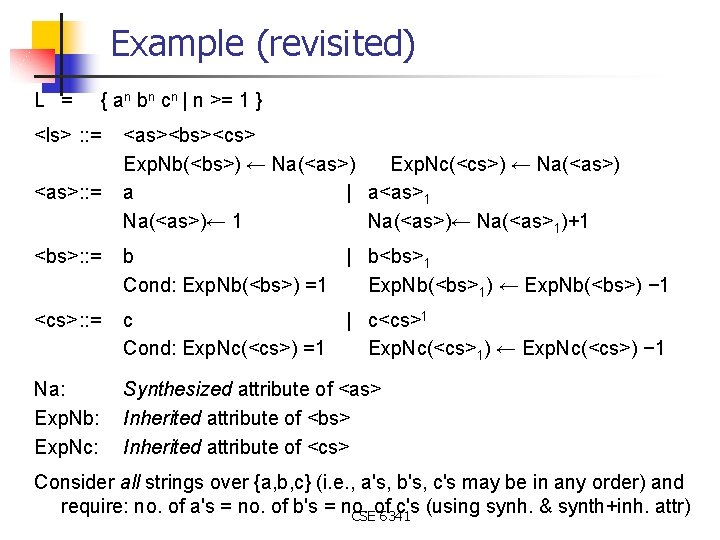
Example (revisited) L = { an bn cn | n >= 1 } <ls> : : = <as><bs><cs> Exp. Nb(<bs>) ← Na(<as>) Exp. Nc(<cs>) ← Na(<as>) a | a<as>1 Na(<as>)← Na(<as>1)+1 <bs>: : = b | b<bs>1 Cond: Exp. Nb(<bs>) =1 Exp. Nb(<bs>1) ← Exp. Nb(<bs>) − 1 <cs>: : = c | c<cs>1 Cond: Exp. Nc(<cs>) =1 Exp. Nc(<cs>1) ← Exp. Nc(<cs>) − 1 Na: Exp. Nb: Exp. Nc: Synthesized attribute of <as> Inherited attribute of <bs> Inherited attribute of <cs> Consider all strings over {a, b, c} (i. e. , a's, b's, c's may be in any order) and require: no. of a's = no. of b's = no. of c's (using synh. & synth+inh. attr) CSE 6341
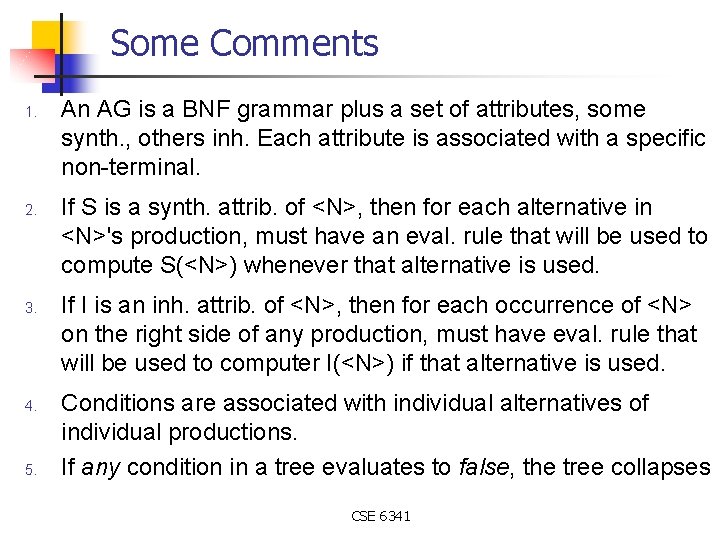
Some Comments 1. 2. 3. 4. 5. An AG is a BNF grammar plus a set of attributes, some synth. , others inh. Each attribute is associated with a specific non-terminal. If S is a synth. attrib. of <N>, then for each alternative in <N>'s production, must have an eval. rule that will be used to compute S(<N>) whenever that alternative is used. If I is an inh. attrib. of <N>, then for each occurrence of <N> on the right side of any production, must have eval. rule that will be used to computer I(<N>) if that alternative is used. Conditions are associated with individual alternatives of individual productions. If any condition in a tree evaluates to false, the tree collapses CSE 6341
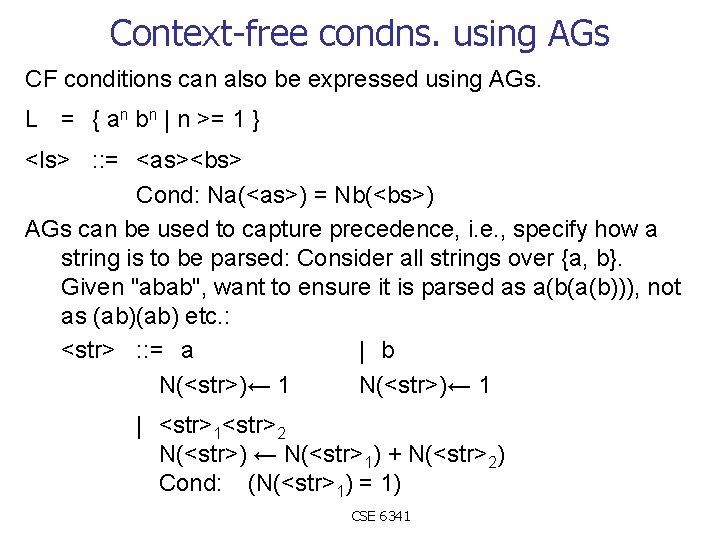
Context-free condns. using AGs CF conditions can also be expressed using AGs. L = { an bn | n >= 1 } <ls> : : = <as><bs> Cond: Na(<as>) = Nb(<bs>) AGs can be used to capture precedence, i. e. , specify how a string is to be parsed: Consider all strings over {a, b}. Given "abab", want to ensure it is parsed as a(b(a(b))), not as (ab) etc. : <str> : : = a | b N(<str>)← 1 | <str>1<str>2 N(<str>) ← N(<str>1) + N(<str>2) Cond: (N(<str>1) = 1) CSE 6341
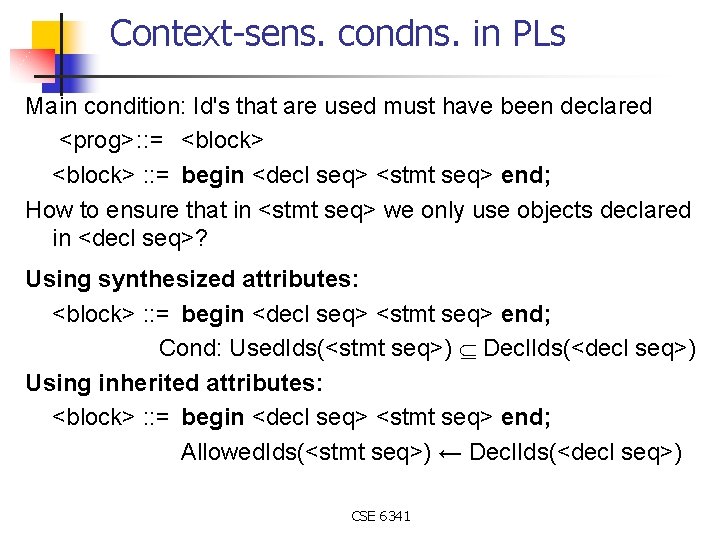
Context-sens. condns. in PLs Main condition: Id's that are used must have been declared <prog>: : = <block> : : = begin <decl seq> <stmt seq> end; How to ensure that in <stmt seq> we only use objects declared in <decl seq>? Using synthesized attributes: <block> : : = begin <decl seq> <stmt seq> end; Cond: Used. Ids(<stmt seq>) Decl. Ids(<decl seq>) Using inherited attributes: <block> : : = begin <decl seq> <stmt seq> end; Allowed. Ids(<stmt seq>) ← Decl. Ids(<decl seq>) CSE 6341
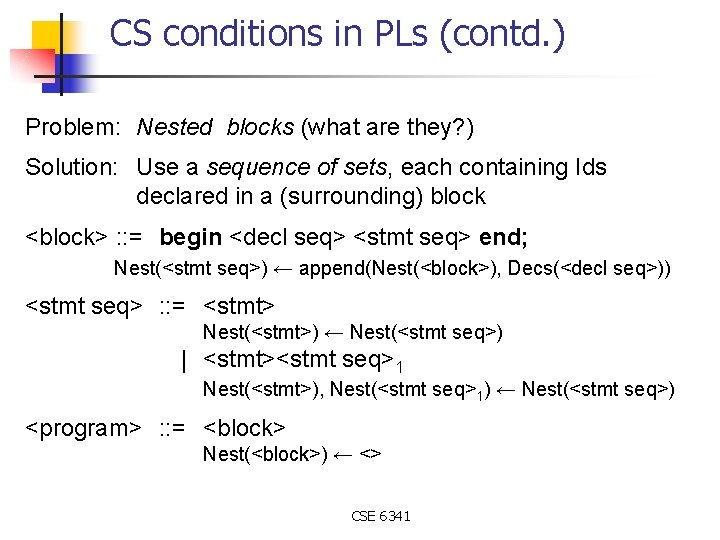
CS conditions in PLs (contd. ) Problem: Nested blocks (what are they? ) Solution: Use a sequence of sets, each containing Ids declared in a (surrounding) block <block> : : = begin <decl seq> <stmt seq> end; Nest(<stmt seq>) ← append(Nest(<block>), Decs(<decl seq>)) <stmt seq> : : = <stmt> Nest(<stmt>) ← Nest(<stmt seq>) | <stmt><stmt seq>1 Nest(<stmt>), Nest(<stmt seq>1) ← Nest(<stmt seq>) <program> : : = <block> Nest(<block>) ← <> CSE 6341
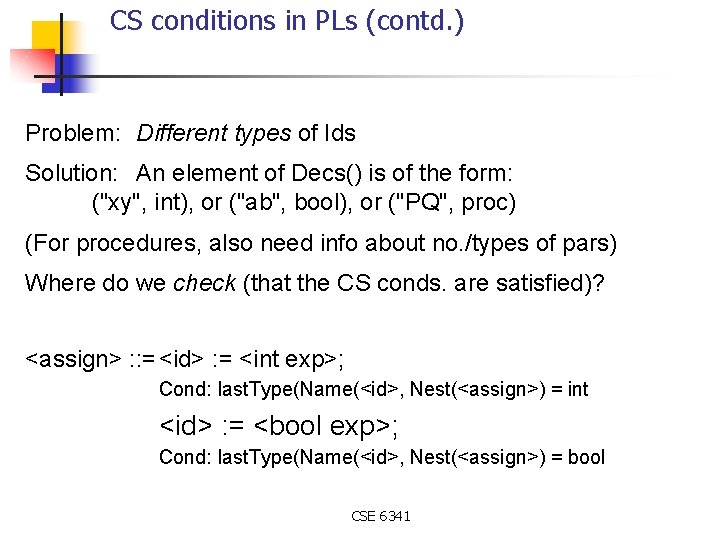
CS conditions in PLs (contd. ) Problem: Different types of Ids Solution: An element of Decs() is of the form: ("xy", int), or ("ab", bool), or ("PQ", proc) (For procedures, also need info about no. /types of pars) Where do we check (that the CS conds. are satisfied)? <assign> : : =<id> : = <int exp>; Cond: last. Type(Name(<id>, Nest(<assign>) = int <id> : = <bool exp>; Cond: last. Type(Name(<id>, Nest(<assign>) = bool CSE 6341
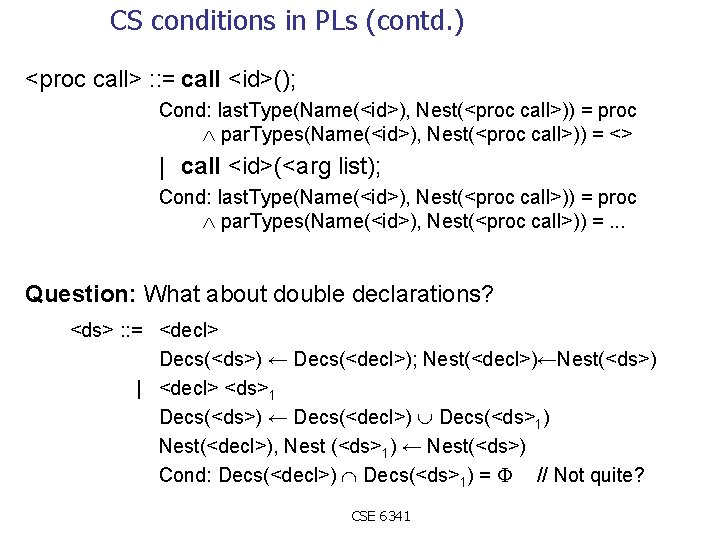
CS conditions in PLs (contd. ) <proc call> : : = call <id>(); Cond: last. Type(Name(<id>), Nest(<proc call>)) = proc par. Types(Name(<id>), Nest(<proc call>)) = <> | call <id>(<arg list); Cond: last. Type(Name(<id>), Nest(<proc call>)) = proc par. Types(Name(<id>), Nest(<proc call>)) =. . . Question: What about double declarations? <ds> : : = <decl> Decs(<ds>) ← Decs(<decl>); Nest(<decl>)←Nest(<ds>) | <decl> <ds>1 Decs(<ds>) ← Decs(<decl>) Decs(<ds>1) Nest(<decl>), Nest (<ds>1) ← Nest(<ds>) Cond: Decs(<decl>) Decs(<ds>1) = // Not quite? CSE 6341
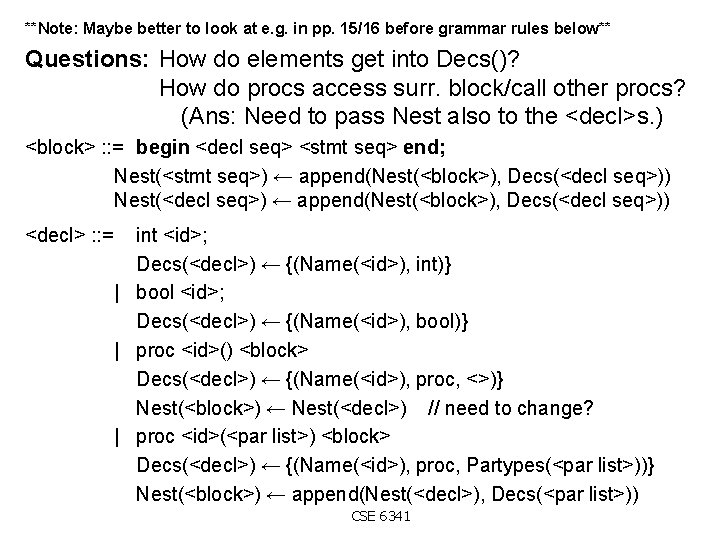
**Note: Maybe better to look at e. g. in pp. 15/16 before grammar rules below** Questions: How do elements get into Decs()? How do procs access surr. block/call other procs? (Ans: Need to pass Nest also to the <decl>s. ) <block> : : = begin <decl seq> <stmt seq> end; Nest(<stmt seq>) ← append(Nest(<block>), Decs(<decl seq>)) Nest(<decl seq>) ← append(Nest(<block>), Decs(<decl seq>)) <decl> : : = int <id>; Decs(<decl>) ← {(Name(<id>), int)} | bool <id>; Decs(<decl>) ← {(Name(<id>), bool)} | proc <id>() <block> Decs(<decl>) ← {(Name(<id>), proc, <>)} Nest(<block>) ← Nest(<decl>) // need to change? | proc <id>(<par list>) <block> Decs(<decl>) ← {(Name(<id>), proc, Partypes(<par list>))} Nest(<block>) ← append(Nest(<decl>), Decs(<par list>)) CSE 6341
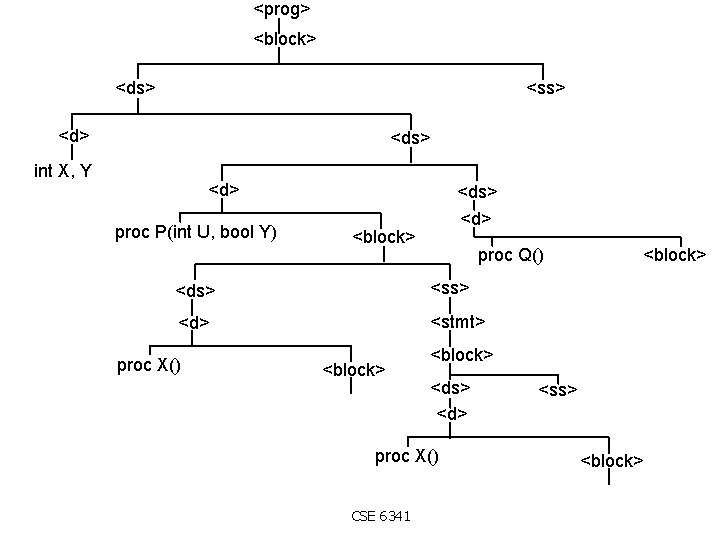
<prog> <block> <ds> <ss> <ds> int X, Y <d> proc P(int U, bool Y) <ds> <d> <block> proc Q() <ds> <ss> <d> <stmt> proc X() <block> <ds> <d> proc X() CSE 6341 <block> <ss> <block>
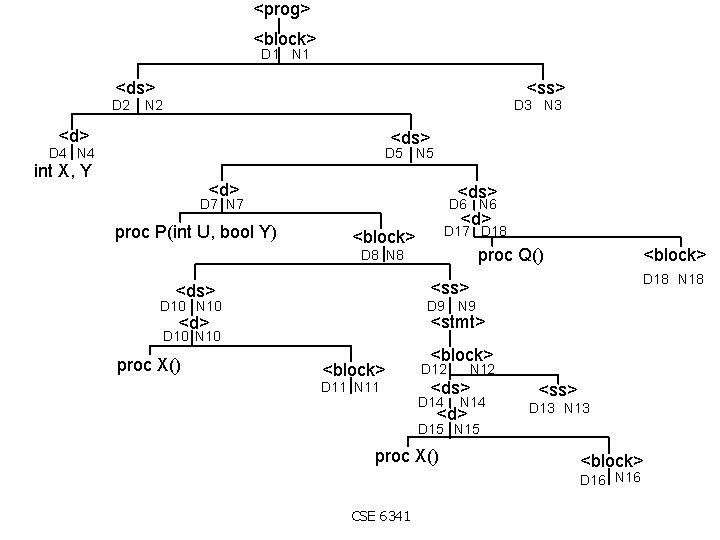
<prog> <block> D 1 N 1 <ds> D 2 <ss> N 2 D 3 N 3 <d> <ds> D 5 N 5 D 4 N 4 int X, Y <d> <ds> <d> D 7 N 7 proc P(int U, bool Y) D 6 N 6 D 17 D 18 <block> proc Q() D 8 N 8 D 18 N 18 <ss> <ds> D 9 N 9 D 10 N 10 <stmt> <d> D 10 N 10 proc X() <block> D 11 N 11 <block> D 12 N 12 <ds> N 14 <d> D 14 <ss> D 13 N 13 D 15 N 15 proc X() <block> D 16 N 16 CSE 6341
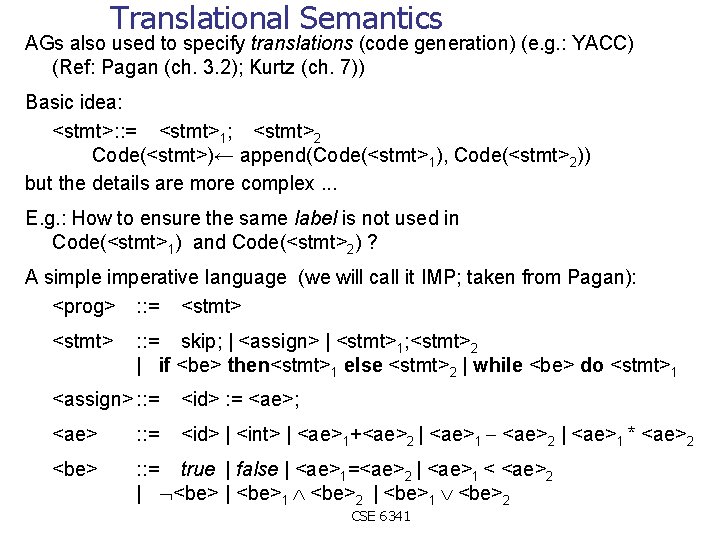
Translational Semantics AGs also used to specify translations (code generation) (e. g. : YACC) (Ref: Pagan (ch. 3. 2); Kurtz (ch. 7)) Basic idea: <stmt>: : = <stmt>1; <stmt>2 Code(<stmt>)← append(Code(<stmt>1), Code(<stmt>2)) but the details are more complex. . . E. g. : How to ensure the same label is not used in Code(<stmt>1) and Code(<stmt>2) ? A simple imperative language (we will call it IMP; taken from Pagan): <prog> : : = <stmt> : : = skip; | <assign> | <stmt>1; <stmt>2 | if <be> then<stmt>1 else <stmt>2 | while <be> do <stmt>1 <assign> : : = <id> : = <ae>; <ae> : : = <id> | <int> | <ae>1+<ae>2 | <ae>1 * <ae>2 <be> : : = true | false | <ae>1=<ae>2 | <ae>1 < <ae>2 | <be>1 <be>2 CSE 6341
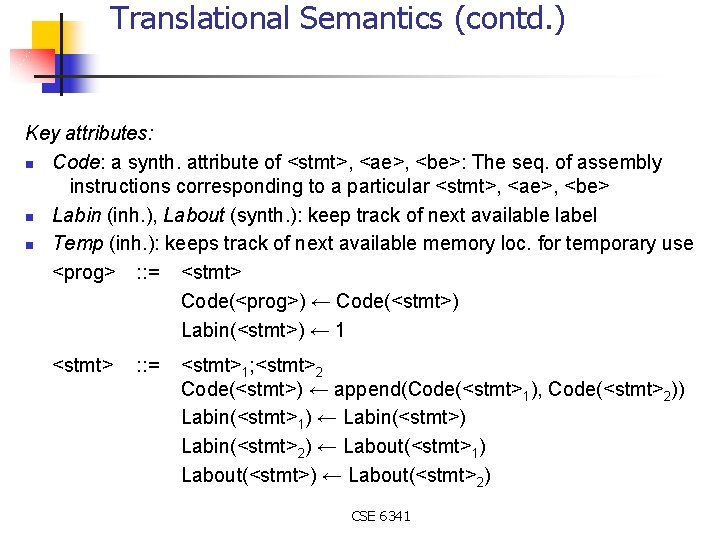
Translational Semantics (contd. ) Key attributes: n Code: a synth. attribute of <stmt>, <ae>, <be>: The seq. of assembly instructions corresponding to a particular <stmt>, <ae>, <be> n Labin (inh. ), Labout (synth. ): keep track of next available label n Temp (inh. ): keeps track of next available memory loc. for temporary use <prog> : : = <stmt> Code(<prog>) ← Code(<stmt>) Labin(<stmt>) ← 1 <stmt> : : = <stmt>1; <stmt>2 Code(<stmt>) ← append(Code(<stmt>1), Code(<stmt>2)) Labin(<stmt>1) ← Labin(<stmt>) Labin(<stmt>2) ← Labout(<stmt>1) Labout(<stmt>) ← Labout(<stmt>2) CSE 6341
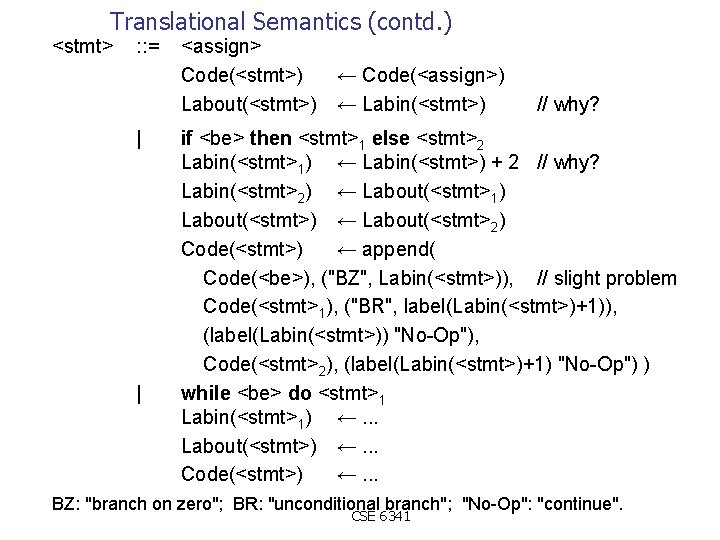
Translational Semantics (contd. ) <stmt> : : = | | <assign> Code(<stmt>) Labout(<stmt>) ← Code(<assign>) ← Labin(<stmt>) // why? if <be> then <stmt>1 else <stmt>2 Labin(<stmt>1) ← Labin(<stmt>) + 2 // why? Labin(<stmt>2) ← Labout(<stmt>1) Labout(<stmt>) ← Labout(<stmt>2) Code(<stmt>) ← append( Code(<be>), ("BZ", Labin(<stmt>)), // slight problem Code(<stmt>1), ("BR", label(Labin(<stmt>)+1)), (label(Labin(<stmt>)) "No-Op"), Code(<stmt>2), (label(Labin(<stmt>)+1) "No-Op") ) while <be> do <stmt>1 Labin(<stmt>1) ←. . . Labout(<stmt>) ←. . . Code(<stmt>) ←. . . BZ: "branch on zero"; BR: "unconditional branch"; "No-Op": "continue". CSE 6341
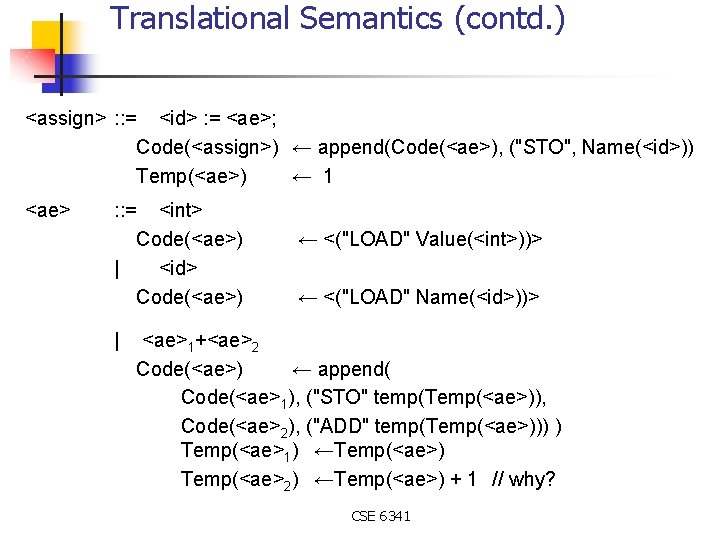
Translational Semantics (contd. ) <assign> : : = <id> : = <ae>; Code(<assign>) ← append(Code(<ae>), ("STO", Name(<id>)) Temp(<ae>) ← 1 <ae> : : = <int> Code(<ae>) | <id> Code(<ae>) | ← <("LOAD" Value(<int>))> ← <("LOAD" Name(<id>))> <ae>1+<ae>2 Code(<ae>) ← append( Code(<ae>1), ("STO" temp(Temp(<ae>)), Code(<ae>2), ("ADD" temp(Temp(<ae>))) ) Temp(<ae>1) ←Temp(<ae>) Temp(<ae>2) ←Temp(<ae>) + 1 // why? CSE 6341
Static Scope (Algol, Pascal, C, C++, . . . ) Entities accessible in a procedure: Entities declared in that procedure + Entities declared in the “surrounding” procedure (less those with name conflicts) + Entities declared in procedure surrounding the surrounding procedure +. . . Visualize: Each procedure is a box whose sides are one-way mirrors: you can look out of the box, but you can’t look into a box Some languages are not quite static scope but are close. CSE 6341
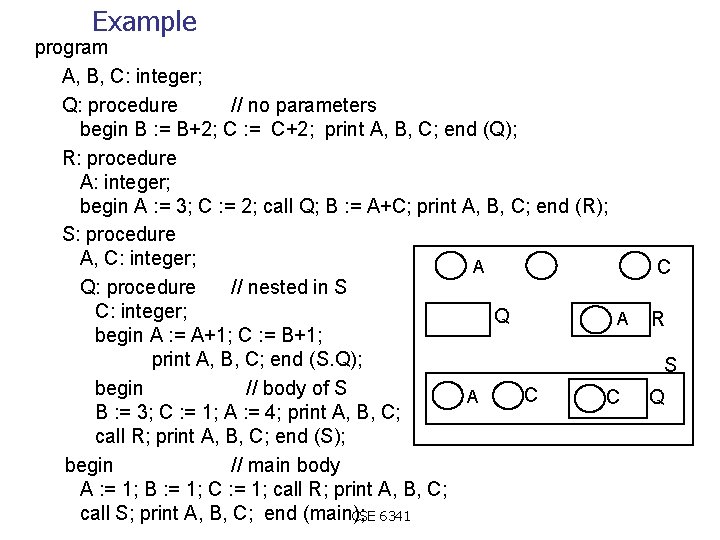
Example program A, B, C: integer; Q: procedure // no parameters begin B : = B+2; C : = C+2; print A, B, C; end (Q); R: procedure A: integer; begin A : = 3; C : = 2; call Q; B : = A+C; print A, B, C; end (R); S: procedure A, C: integer; A Q: procedure // nested in S C: integer; Q A begin A : = A+1; C : = B+1; print A, B, C; end (S. Q); begin // body of S C A C B : = 3; C : = 1; A : = 4; print A, B, C; call R; print A, B, C; end (S); begin // main body A : = 1; B : = 1; C : = 1; call R; print A, B, C; call S; print A, B, C; end (main); CSE 6341 C R S Q