
CSE 583 Programming Languages David Notkin 25 January
![A few quick, minor examples map f [] = [] map f (x: :](https://slidetodoc.com/presentation_image_h2/2e42ea1e842c23d14dc33c3b9d42322b/image-43.jpg "A few quick, minor examples map f [] = [] map f (x: :")
![quicksort [] quicksort (x: xs) quicksort [y [x] ++ quicksort [y = [] =](https://slidetodoc.com/presentation_image_h2/2e42ea1e842c23d14dc33c3b9d42322b/image-45.jpg "quicksort [] quicksort (x: xs) quicksort [y [x] ++ quicksort [y = [] =")
![Easy to construct arithmetic sequences l l [1. . 8] [2, 4. . ]](https://slidetodoc.com/presentation_image_h2/2e42ea1e842c23d14dc33c3b9d42322b/image-46.jpg "Easy to construct arithmetic sequences l l [1. . 8] [2, 4. . ]")
![Examples ints_from n = n : ints_from (n+1) --same as [n. . ] nats](https://slidetodoc.com/presentation_image_h2/2e42ea1e842c23d14dc33c3b9d42322b/image-51.jpg "Examples ints_from n = n : ints_from (n+1) --same as [n. . ] nats")
- Slides: 68
CSE 583: Programming Languages David Notkin 25 January 2000 notkin@cs. washington. edu http: //www. cs. washington. edu/education/courses/583
Functional programming: 2+ weeks l Scheme – Gives a strong, language-based foundation for functional programming – May be mostly review for some of you l Some theory – Theoretical foundations and issues in functional programming l ML – A modern basis for discussing key issues in functional programming University of Washington • CSE 583 • D. Notkin © 2000 2
Tonight: a final set of topics on functional languages l ML types – user-defined datatypes, variant records, recursive types, polymorphic types, exceptions, streams, … l Haskell – lazy evaluation • purely side-effect free, infinite lists – type classes for added flexibility in polymorphism University of Washington • CSE 583 • D. Notkin © 2000 3
Then, with luck, on to types University of Washington • CSE 583 • D. Notkin © 2000 4
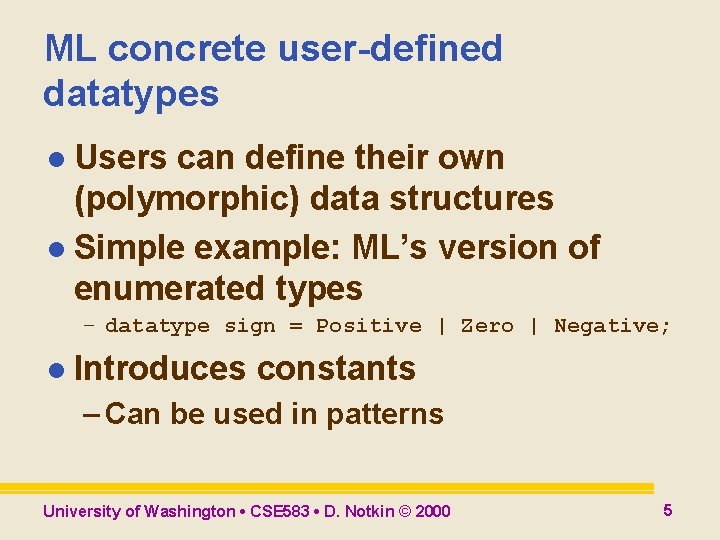
ML concrete user-defined datatypes l Users can define their own (polymorphic) data structures l Simple example: ML’s version of enumerated types – datatype sign = Positive | Zero | Negative; l Introduces constants – Can be used in patterns University of Washington • CSE 583 • D. Notkin © 2000 5
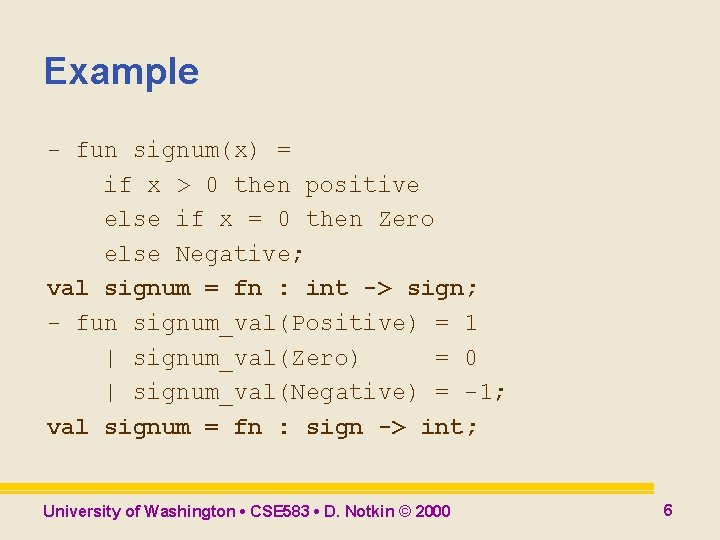
Example - fun signum(x) = if x > 0 then positive else if x = 0 then Zero else Negative; val signum = fn : int -> sign; - fun signum_val(Positive) = 1 | signum_val(Zero) = 0 | signum_val(Negative) = -1; val signum = fn : sign -> int; University of Washington • CSE 583 • D. Notkin © 2000 6
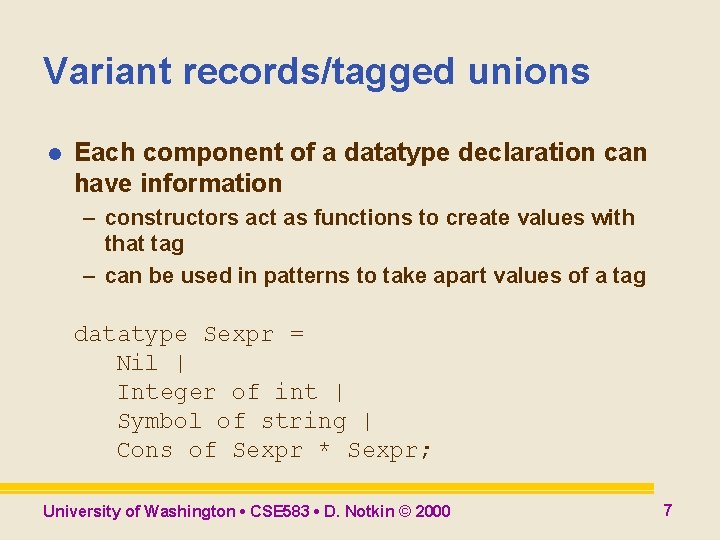
Variant records/tagged unions l Each component of a datatype declaration can have information – constructors act as functions to create values with that tag – can be used in patterns to take apart values of a tag datatype Sexpr = Nil | Integer of int | Symbol of string | Cons of Sexpr * Sexpr; University of Washington • CSE 583 • D. Notkin © 2000 7
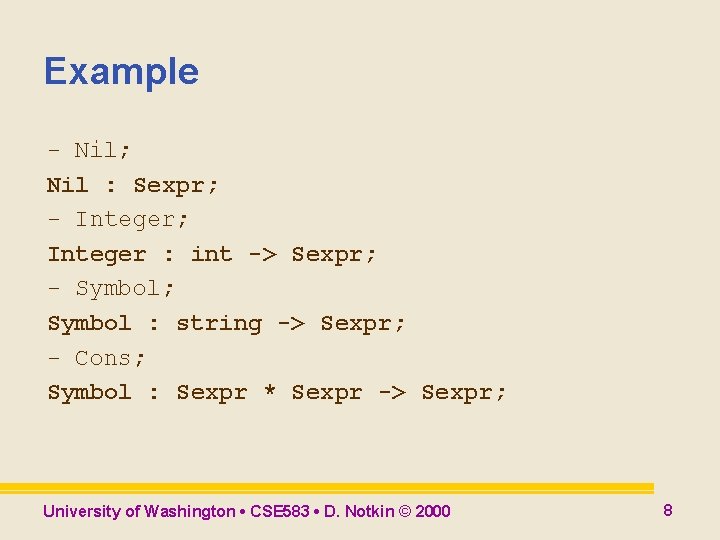
Example - Nil; Nil : Sexpr; - Integer; Integer : int -> Sexpr; - Symbol; Symbol : string -> Sexpr; - Cons; Symbol : Sexpr * Sexpr -> Sexpr; University of Washington • CSE 583 • D. Notkin © 2000 8
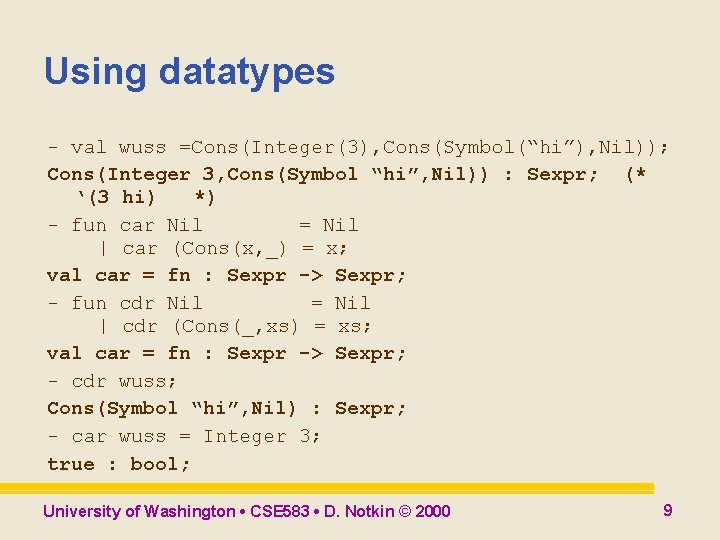
Using datatypes - val wuss =Cons(Integer(3), Cons(Symbol(“hi”), Nil)); Cons(Integer 3, Cons(Symbol “hi”, Nil)) : Sexpr; (* ‘(3 hi) *) - fun car Nil = Nil | car (Cons(x, _) = x; val car = fn : Sexpr -> Sexpr; - fun cdr Nil = Nil | cdr (Cons(_, xs) = xs; val car = fn : Sexpr -> Sexpr; - cdr wuss; Cons(Symbol “hi”, Nil) : Sexpr; - car wuss = Integer 3; true : bool; University of Washington • CSE 583 • D. Notkin © 2000 9
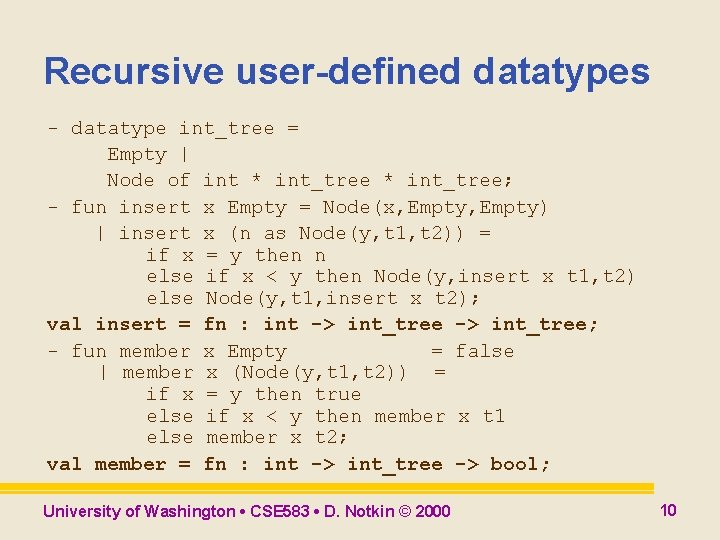
Recursive user-defined datatypes - datatype int_tree = Empty | Node of int * int_tree; - fun insert x Empty = Node(x, Empty) | insert x (n as Node(y, t 1, t 2)) = if x = y then n else if x < y then Node(y, insert x t 1, t 2) else Node(y, t 1, insert x t 2); val insert = fn : int -> int_tree; - fun member x Empty = false | member x (Node(y, t 1, t 2)) = if x = y then true else if x < y then member x t 1 else member x t 2; val member = fn : int -> int_tree -> bool; University of Washington • CSE 583 • D. Notkin © 2000 10
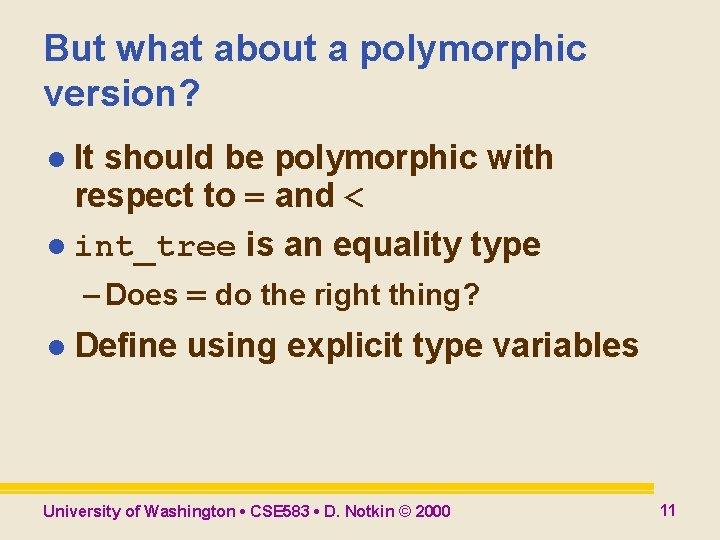
But what about a polymorphic version? l It should be polymorphic with respect to = and < l int_tree is an equality type – Does = do the right thing? l Define using explicit type variables University of Washington • CSE 583 • D. Notkin © 2000 11
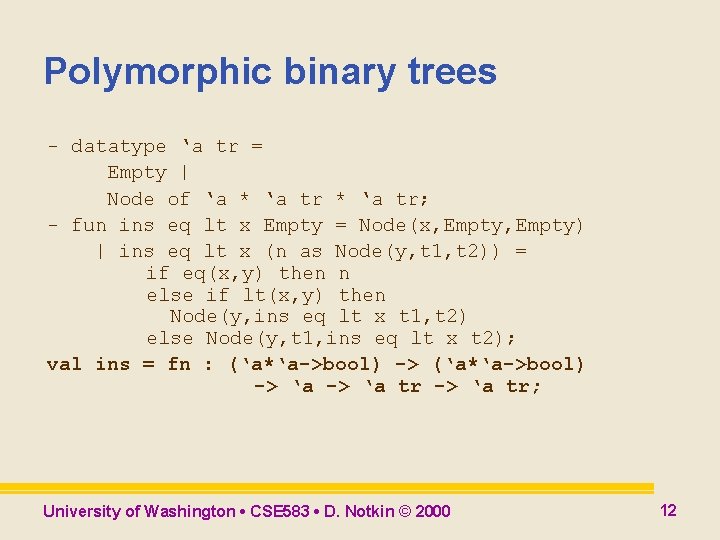
Polymorphic binary trees - datatype ‘a tr = Empty | Node of ‘a * ‘a tr; - fun ins eq lt x Empty = Node(x, Empty) | ins eq lt x (n as Node(y, t 1, t 2)) = if eq(x, y) then n else if lt(x, y) then Node(y, ins eq lt x t 1, t 2) else Node(y, t 1, ins eq lt x t 2); val ins = fn : (‘a*‘a->bool) -> ‘a tr; University of Washington • CSE 583 • D. Notkin © 2000 12
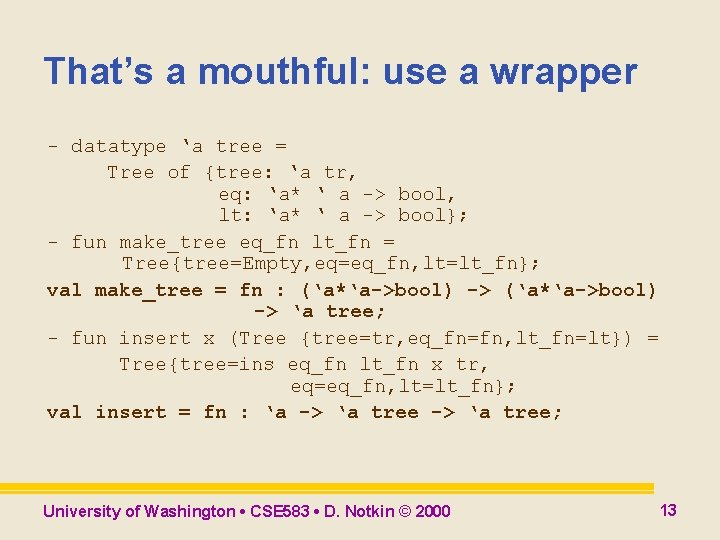
That’s a mouthful: use a wrapper - datatype ‘a tree = Tree of {tree: ‘a tr, eq: ‘a* ‘ a -> bool, lt: ‘a* ‘ a -> bool}; - fun make_tree eq_fn lt_fn = Tree{tree=Empty, eq=eq_fn, lt=lt_fn}; val make_tree = fn : (‘a*‘a->bool) -> ‘a tree; - fun insert x (Tree {tree=tr, eq_fn=fn, lt_fn=lt}) = Tree{tree=ins eq_fn lt_fn x tr, eq=eq_fn, lt=lt_fn}; val insert = fn : ‘a -> ‘a tree; University of Washington • CSE 583 • D. Notkin © 2000 13
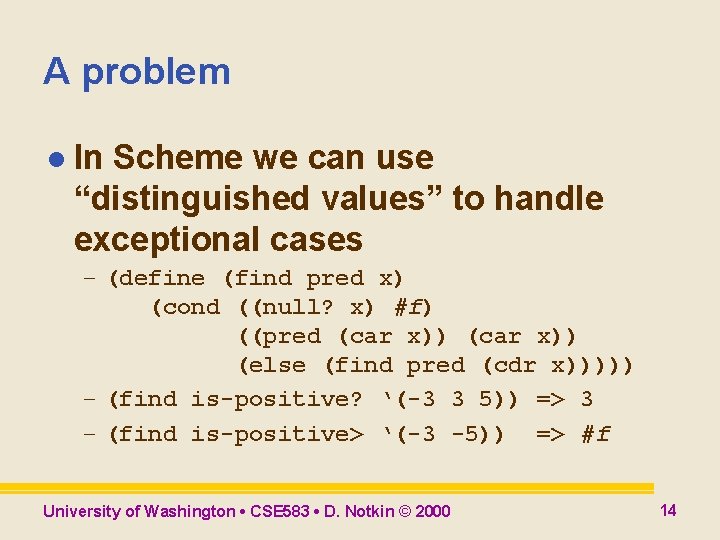
A problem l In Scheme we can use “distinguished values” to handle exceptional cases – (define (find pred x) (cond ((null? x) #f) ((pred (car x)) (else (find pred (cdr x))))) – (find is-positive? ‘(-3 3 5)) => 3 – (find is-positive> ‘(-3 -5)) => #f University of Washington • CSE 583 • D. Notkin © 2000 14
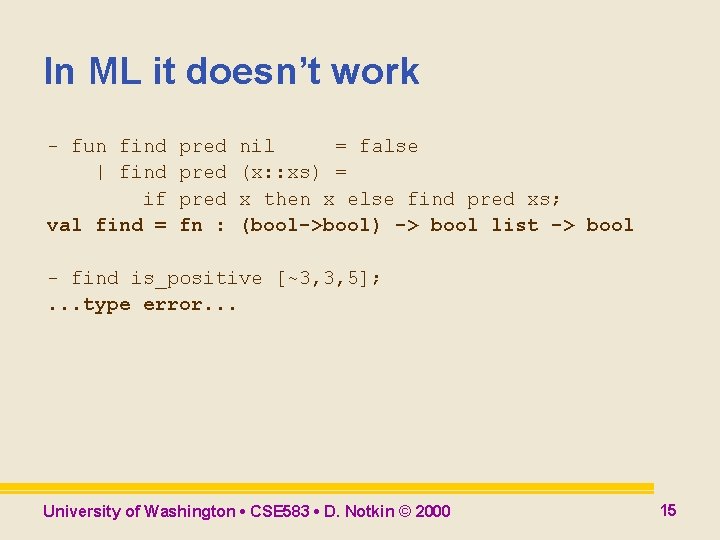
In ML it doesn’t work - fun find pred | find pred if pred val find = fn : nil = false (x: : xs) = x then x else find pred xs; (bool->bool) -> bool list -> bool - find is_positive [~3, 3, 5]; . . . type error. . . University of Washington • CSE 583 • D. Notkin © 2000 15
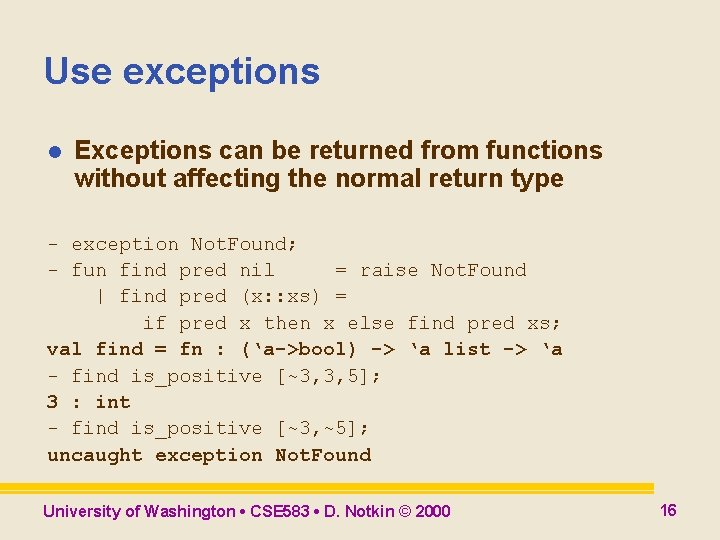
Use exceptions l Exceptions can be returned from functions without affecting the normal return type - exception Not. Found; - fun find pred nil = raise Not. Found | find pred (x: : xs) = if pred x then x else find pred xs; val find = fn : (‘a->bool) -> ‘a list -> ‘a - find is_positive [~3, 3, 5]; 3 : int - find is_positive [~3, ~5]; uncaught exception Not. Found University of Washington • CSE 583 • D. Notkin © 2000 16
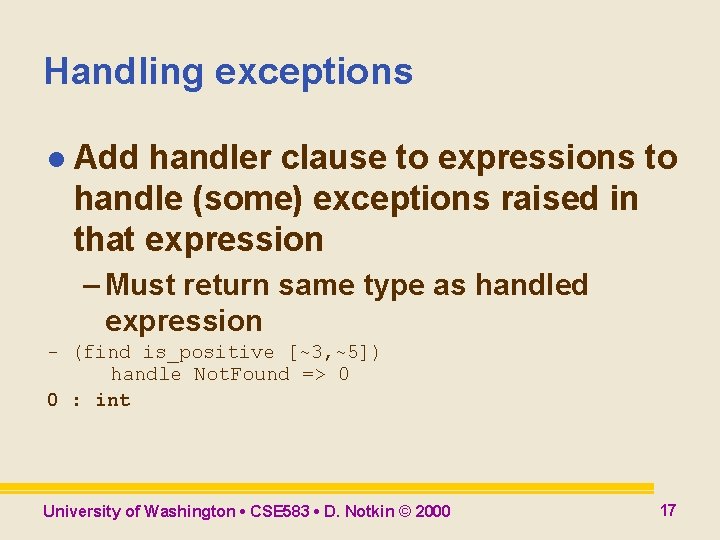
Handling exceptions l Add handler clause to expressions to handle (some) exceptions raised in that expression – Must return same type as handled expression - (find is_positive [~3, ~5]) handle Not. Found => 0 0 : int University of Washington • CSE 583 • D. Notkin © 2000 17
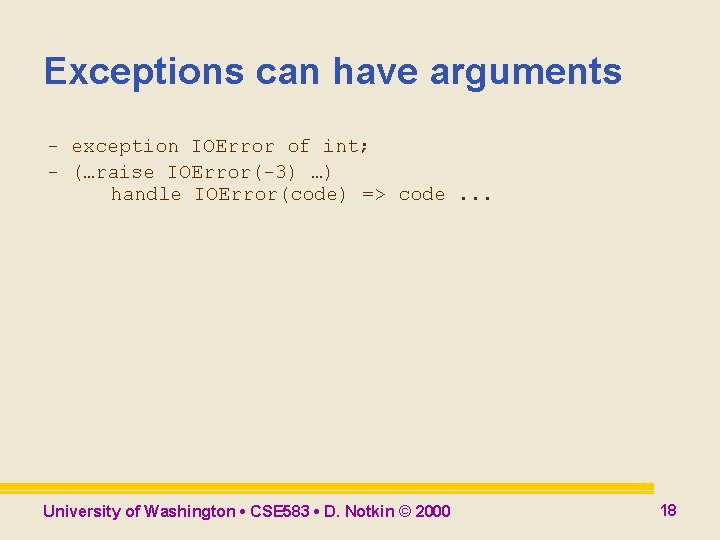
Exceptions can have arguments - exception IOError of int; - (…raise IOError(-3) …) handle IOError(code) => code. . . University of Washington • CSE 583 • D. Notkin © 2000 18
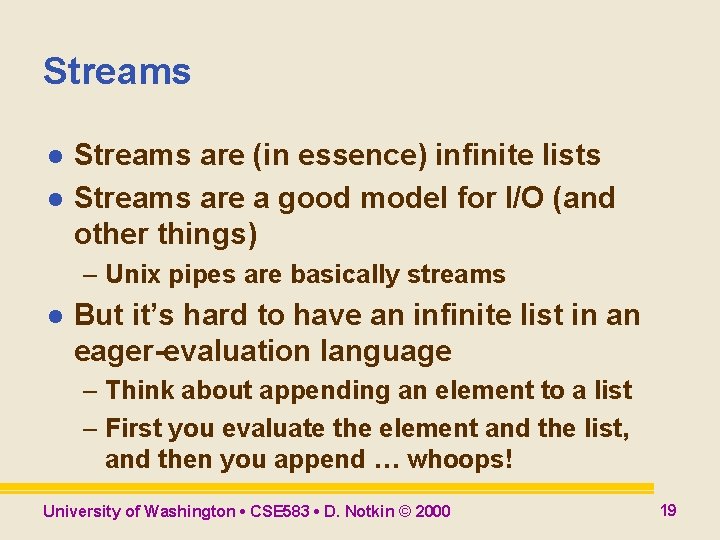
Streams l l Streams are (in essence) infinite lists Streams are a good model for I/O (and other things) – Unix pipes are basically streams l But it’s hard to have an infinite list in an eager-evaluation language – Think about appending an element to a list – First you evaluate the element and the list, and then you append … whoops! University of Washington • CSE 583 • D. Notkin © 2000 19
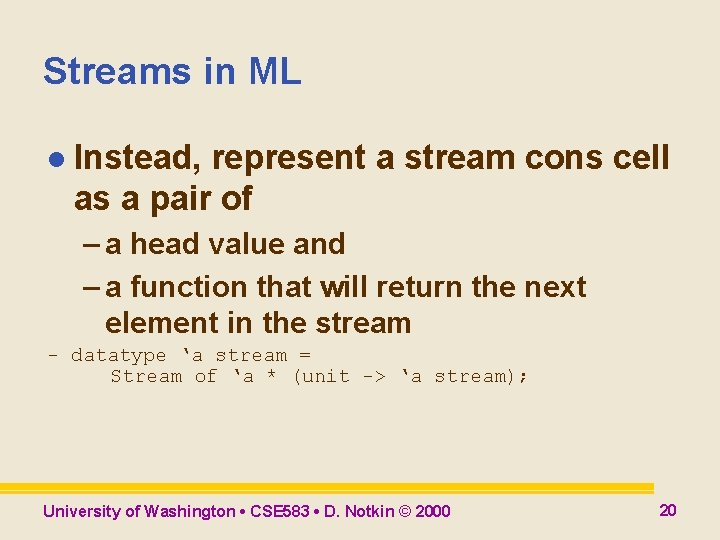
Streams in ML l Instead, represent a stream cons cell as a pair of – a head value and – a function that will return the next element in the stream - datatype ‘a stream = Stream of ‘a * (unit -> ‘a stream); University of Washington • CSE 583 • D. Notkin © 2000 20
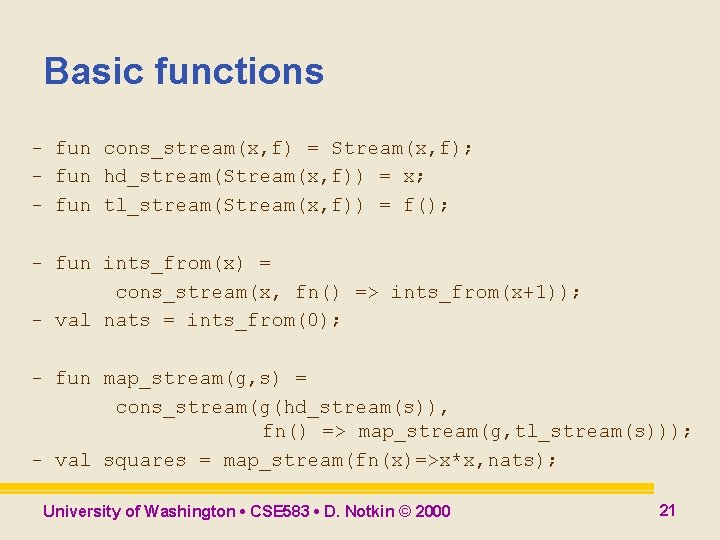
Basic functions - fun cons_stream(x, f) = Stream(x, f); - fun hd_stream(Stream(x, f)) = x; - fun tl_stream(Stream(x, f)) = f(); - fun ints_from(x) = cons_stream(x, fn() => ints_from(x+1)); - val nats = ints_from(0); - fun map_stream(g, s) = cons_stream(g(hd_stream(s)), fn() => map_stream(g, tl_stream(s))); - val squares = map_stream(fn(x)=>x*x, nats); University of Washington • CSE 583 • D. Notkin © 2000 21
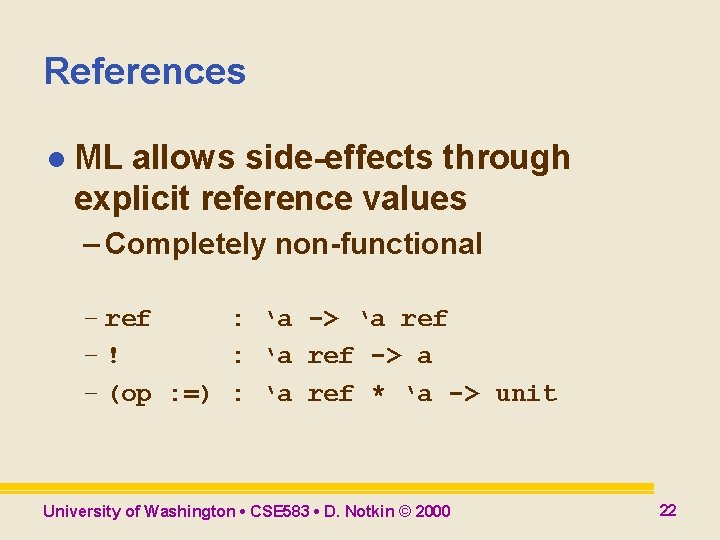
References l ML allows side-effects through explicit reference values – Completely non-functional – ref : ‘a -> ‘a ref –! : ‘a ref -> a – (op : =) : ‘a ref * ‘a -> unit University of Washington • CSE 583 • D. Notkin © 2000 22
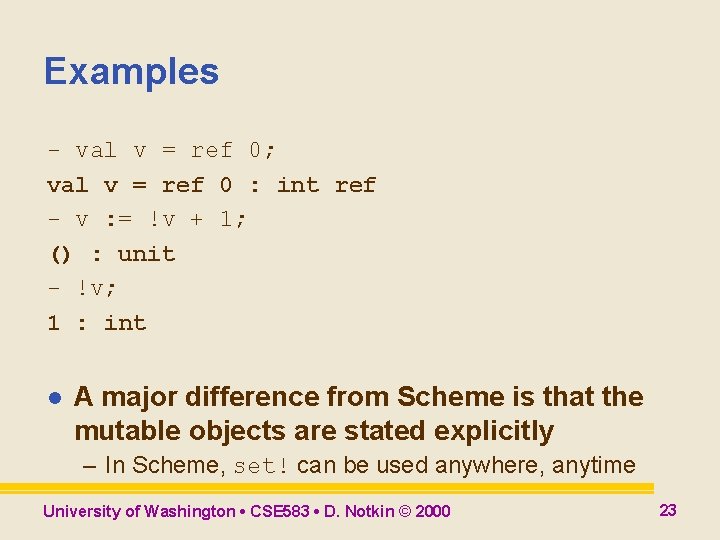
Examples - val v = ref 0; val v = ref 0 : int ref - v : = !v + 1; () : unit - !v; 1 : int l A major difference from Scheme is that the mutable objects are stated explicitly – In Scheme, set! can be used anywhere, anytime University of Washington • CSE 583 • D. Notkin © 2000 23
Modules were cool, but they exposed their representation l datatypes – Helped with pattern matching, etc. l ML modules support encapsulated abstract data types – hidden operations, values, types, and some kinds of polymorphism University of Washington • CSE 583 • D. Notkin © 2000 24
Note l The module system in ML is clearly intended to try to make the language more industrial strength and feasible for practical use l A challenge is balancing the software engineering needs with the type system in ML University of Washington • CSE 583 • D. Notkin © 2000 25
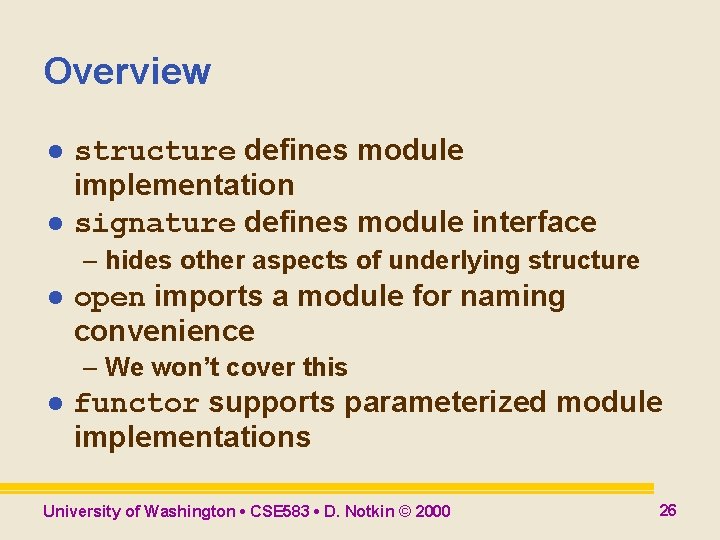
Overview l l structure defines module implementation signature defines module interface – hides other aspects of underlying structure l open imports a module for naming convenience – We won’t cover this l functor supports parameterized module implementations University of Washington • CSE 583 • D. Notkin © 2000 26
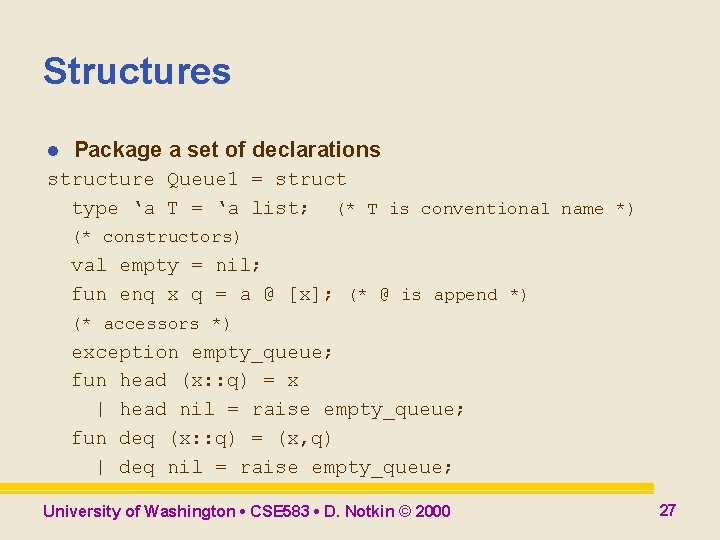
Structures l Package a set of declarations structure Queue 1 = struct type ‘a T = ‘a list; (* T is conventional name *) (* constructors) val empty = nil; fun enq x q = a @ [x]; (* @ is append *) (* accessors *) exception empty_queue; fun head (x: : q) = x | head nil = raise empty_queue; fun deq (x: : q) = (x, q) | deq nil = raise empty_queue; University of Washington • CSE 583 • D. Notkin © 2000 27
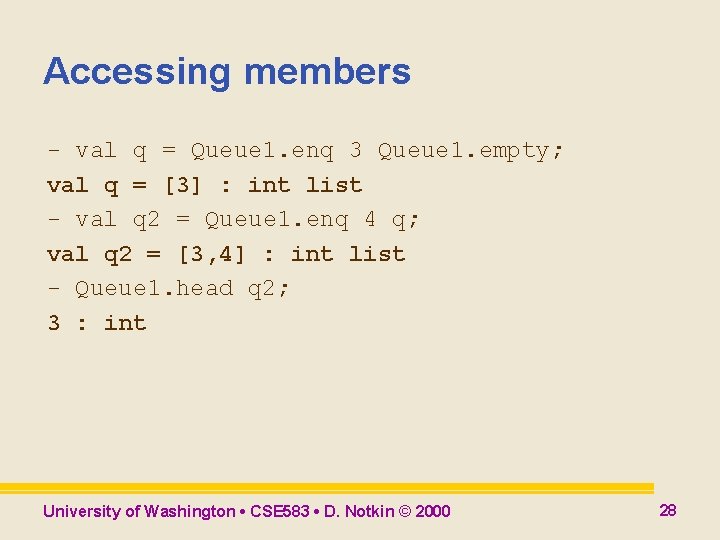
Accessing members - val q = Queue 1. enq 3 Queue 1. empty; val q = [3] : int list - val q 2 = Queue 1. enq 4 q; val q 2 = [3, 4] : int list - Queue 1. head q 2; 3 : int University of Washington • CSE 583 • D. Notkin © 2000 28
Signatures l Construct for encapsulating representations l Define a public external interface with signature l Then apply the signature to restrict the interface to a structure University of Washington • CSE 583 • D. Notkin © 2000 29
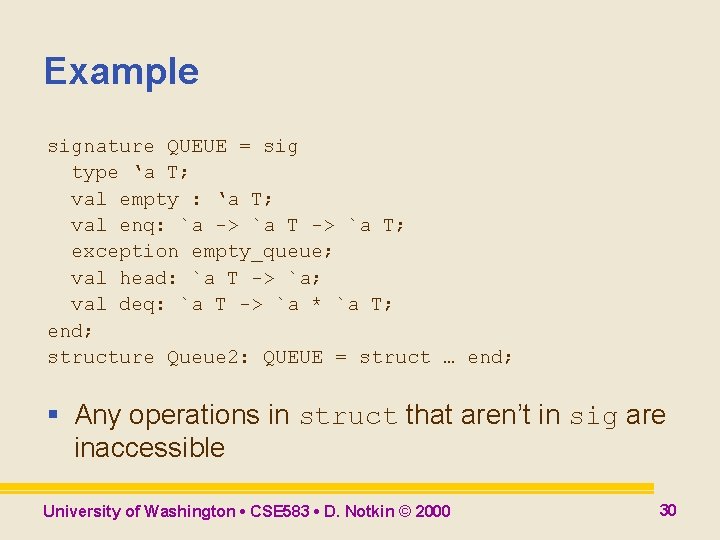
Example signature QUEUE = sig type ‘a T; val empty : ‘a T; val enq: `a -> `a T; exception empty_queue; val head: `a T -> `a; val deq: `a T -> `a * `a T; end; structure Queue 2: QUEUE = struct … end; § Any operations in struct that aren’t in sig are inaccessible University of Washington • CSE 583 • D. Notkin © 2000 30
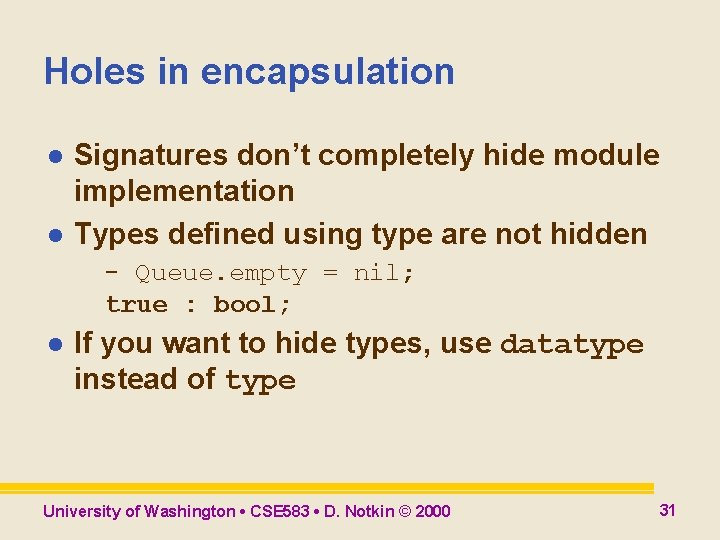
Holes in encapsulation l l Signatures don’t completely hide module implementation Types defined using type are not hidden - Queue. empty = nil; true : bool; l If you want to hide types, use datatype instead of type University of Washington • CSE 583 • D. Notkin © 2000 31
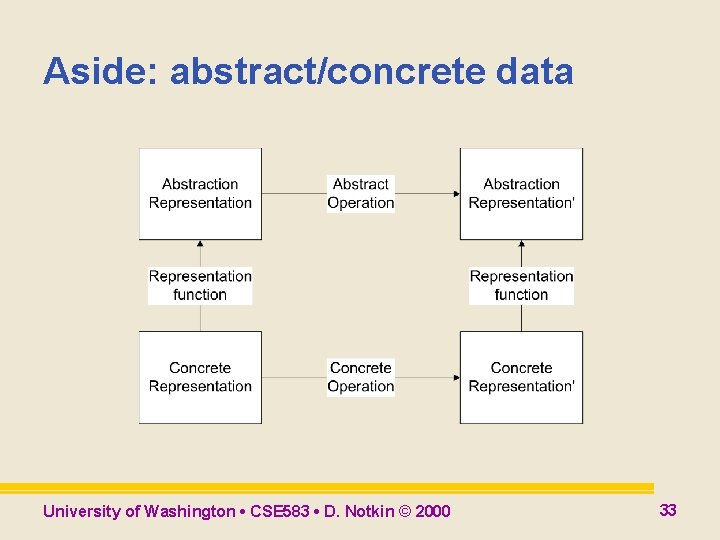
Another hole l l l Built-in equality (=) function operates over the representation, not the abstraction That is, two values that are abstractly the same can be revealed to be different using = There are various proposals to try to fix these holes in ML University of Washington • CSE 583 • D. Notkin © 2000 32
Aside: abstract/concrete data University of Washington • CSE 583 • D. Notkin © 2000 33
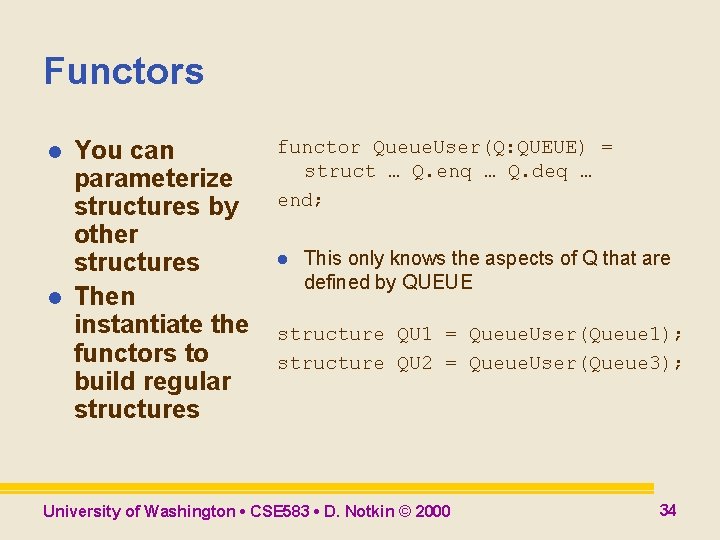
Functors l l You can parameterize structures by other structures Then instantiate the functors to build regular structures functor Queue. User(Q: QUEUE) = struct … Q. enq … Q. deq … end; l This only knows the aspects of Q that are defined by QUEUE structure QU 1 = Queue. User(Queue 1); structure QU 2 = Queue. User(Queue 3); University of Washington • CSE 583 • D. Notkin © 2000 34
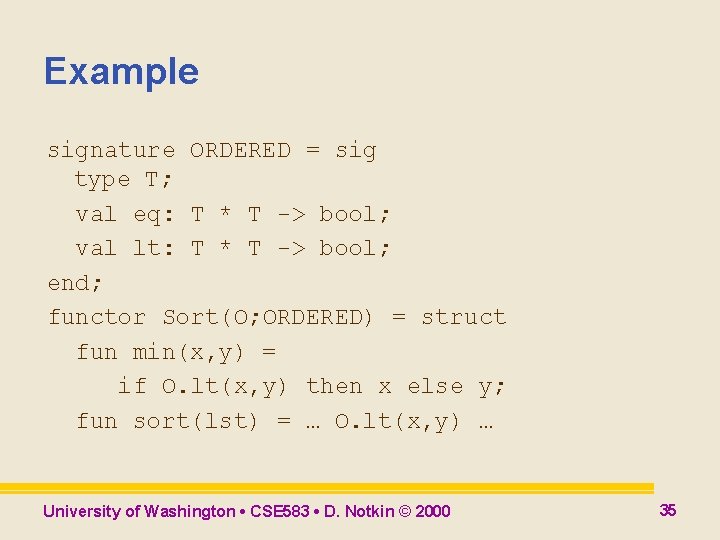
Example signature ORDERED = sig type T; val eq: T * T -> bool; val lt: T * T -> bool; end; functor Sort(O; ORDERED) = struct fun min(x, y) = if O. lt(x, y) then x else y; fun sort(lst) = … O. lt(x, y) … University of Washington • CSE 583 • D. Notkin © 2000 35
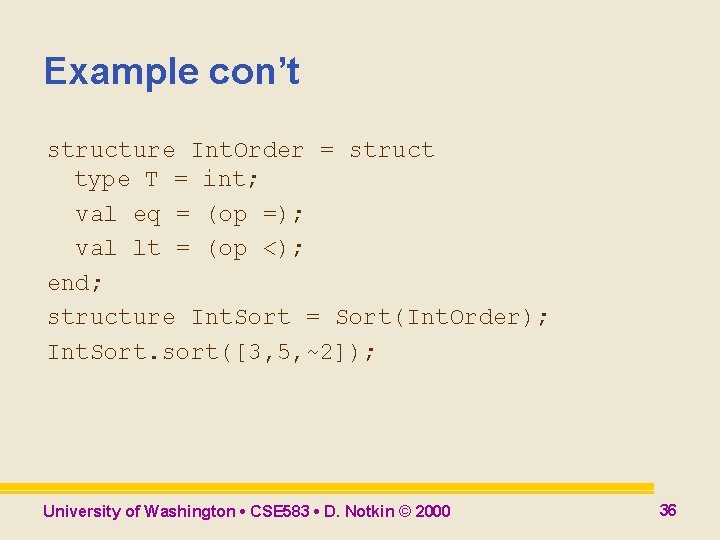
Example con’t structure Int. Order = struct type T = int; val eq = (op =); val lt = (op <); end; structure Int. Sort = Sort(Int. Order); Int. Sort. sort([3, 5, ~2]); University of Washington • CSE 583 • D. Notkin © 2000 36
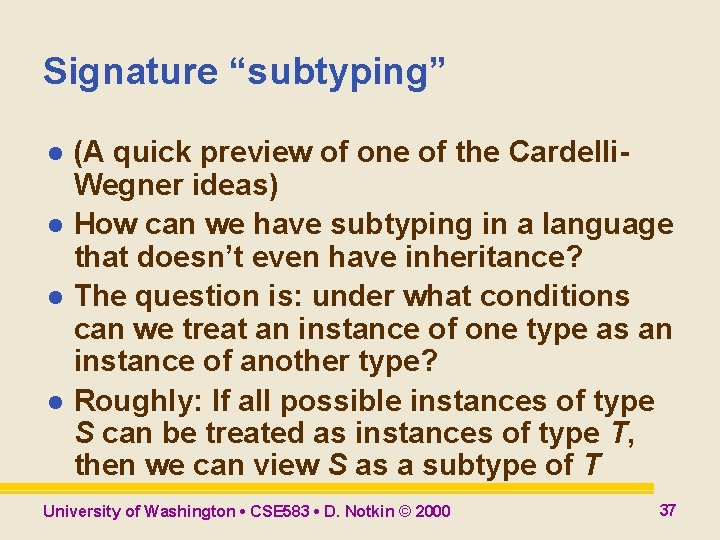
Signature “subtyping” l l (A quick preview of one of the Cardelli. Wegner ideas) How can we have subtyping in a language that doesn’t even have inheritance? The question is: under what conditions can we treat an instance of one type as an instance of another type? Roughly: If all possible instances of type S can be treated as instances of type T, then we can view S as a subtype of T University of Washington • CSE 583 • D. Notkin © 2000 37
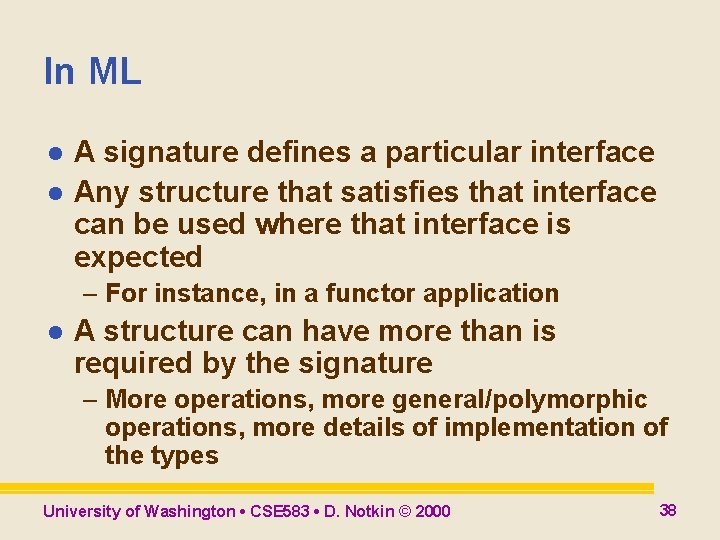
In ML l l A signature defines a particular interface Any structure that satisfies that interface can be used where that interface is expected – For instance, in a functor application l A structure can have more than is required by the signature – More operations, more general/polymorphic operations, more details of implementation of the types University of Washington • CSE 583 • D. Notkin © 2000 38
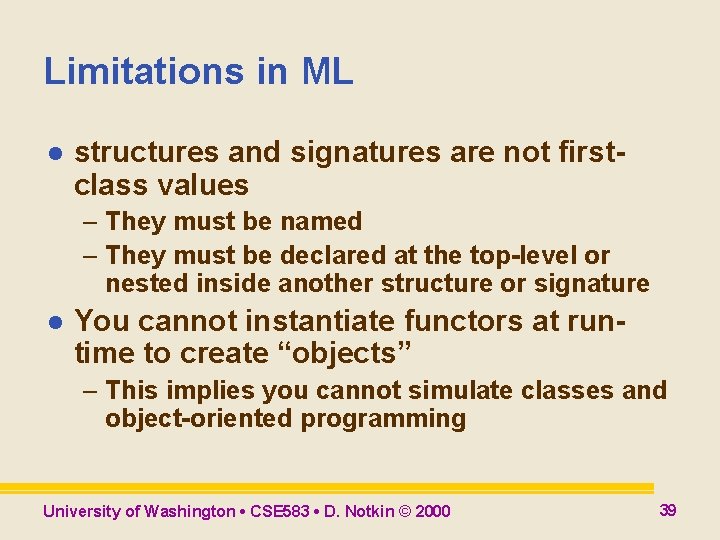
Limitations in ML l structures and signatures are not firstclass values – They must be named – They must be declared at the top-level or nested inside another structure or signature l You cannot instantiate functors at runtime to create “objects” – This implies you cannot simulate classes and object-oriented programming University of Washington • CSE 583 • D. Notkin © 2000 39
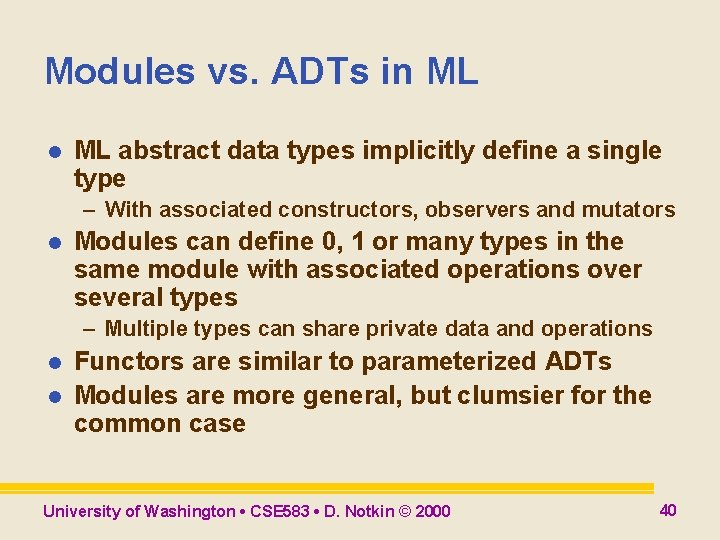
Modules vs. ADTs in ML l ML abstract data types implicitly define a single type – With associated constructors, observers and mutators l Modules can define 0, 1 or many types in the same module with associated operations over several types – Multiple types can share private data and operations l l Functors are similar to parameterized ADTs Modules are more general, but clumsier for the common case University of Washington • CSE 583 • D. Notkin © 2000 40
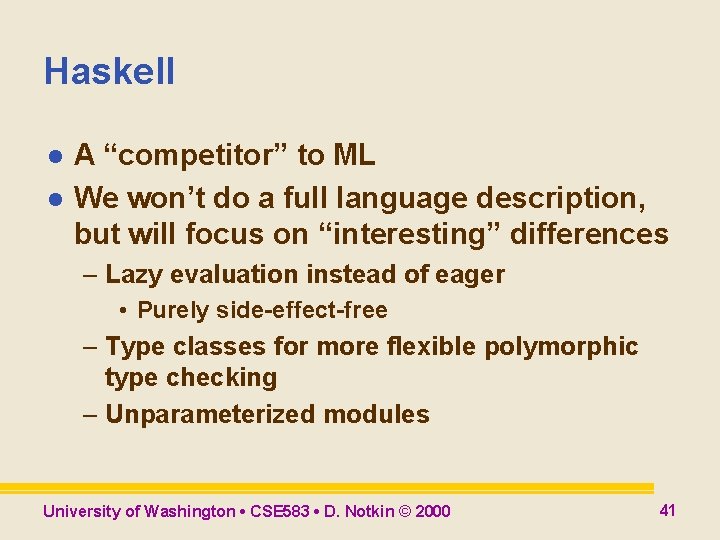
Haskell l l A “competitor” to ML We won’t do a full language description, but will focus on “interesting” differences – Lazy evaluation instead of eager • Purely side-effect-free – Type classes for more flexible polymorphic type checking – Unparameterized modules University of Washington • CSE 583 • D. Notkin © 2000 41
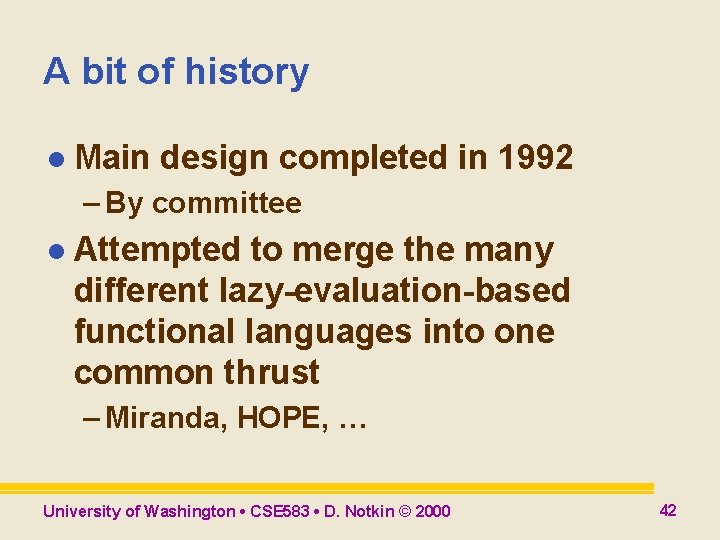
A bit of history l Main design completed in 1992 – By committee l Attempted to merge the many different lazy-evaluation-based functional languages into one common thrust – Miranda, HOPE, … University of Washington • CSE 583 • D. Notkin © 2000 42
A few quick, minor examples map f [] = [] map f (x: : xs) = f x : map f xs <<fn>> : : (a->b) -> [a] -> [b] lst = map square [3, 4, 5] [9, 16, 25] : : [Int] (3, 4, x y -> x+y) (3, 4, <<fn>>) : (Int, Int->Int) University of Washington • CSE 583 • D. Notkin © 2000 43
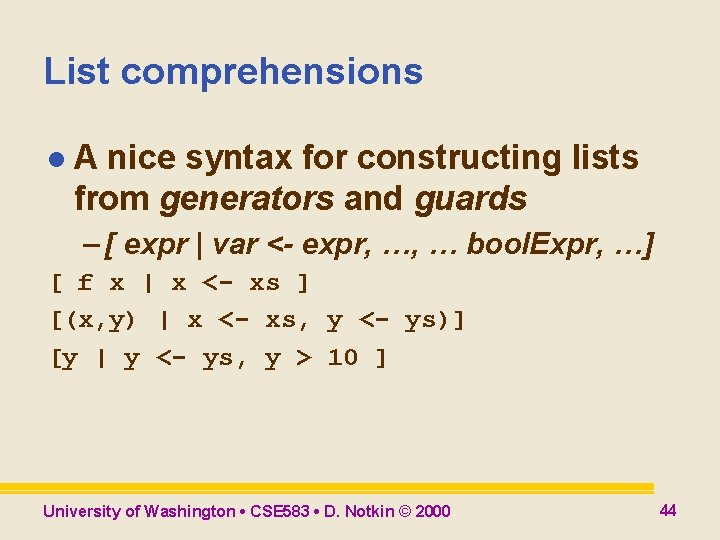
List comprehensions l. A nice syntax for constructing lists from generators and guards – [ expr | var <- expr, …, … bool. Expr, …] [ f x | x <- xs ] [(x, y) | x <- xs, y <- ys)] [y | y <- ys, y > 10 ] University of Washington • CSE 583 • D. Notkin © 2000 44
quicksort [] quicksort (x: xs) quicksort [y [x] ++ quicksort [y = [] = | y <- xs, y < x] ++ | y <- xs, y >= University of Washington • CSE 583 • D. Notkin © 2000 x] 45
Easy to construct arithmetic sequences l l [1. . 8] [2, 4. . ] [1. . ] ----- [1, 2, 3, 4, 5, 6, 7, 8] [2, 4, 6, 8, 10, 12, …] [1, 2, 3, 4, 5, 6, 7, …] University of Washington • CSE 583 • D. Notkin © 2000 46
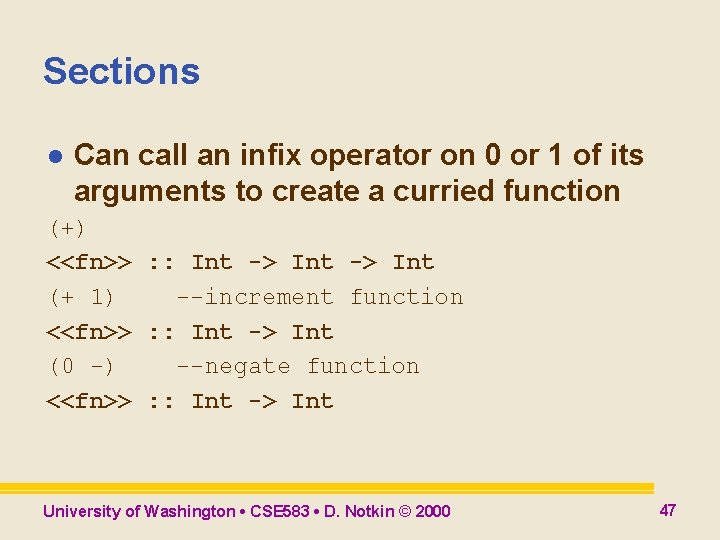
Sections l Can call an infix operator on 0 or 1 of its arguments to create a curried function (+) <<fn>> : : Int -> Int (+ 1) --increment function <<fn>> : : Int -> Int (0 -) --negate function <<fn>> : : Int -> Int University of Washington • CSE 583 • D. Notkin © 2000 47
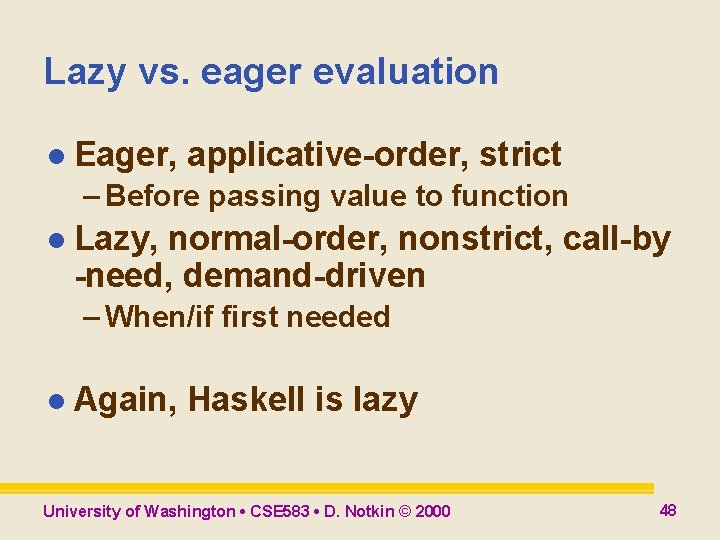
Lazy vs. eager evaluation l Eager, applicative-order, strict – Before passing value to function l Lazy, normal-order, nonstrict, call-by -need, demand-driven – When/if first needed l Again, Haskell is lazy University of Washington • CSE 583 • D. Notkin © 2000 48
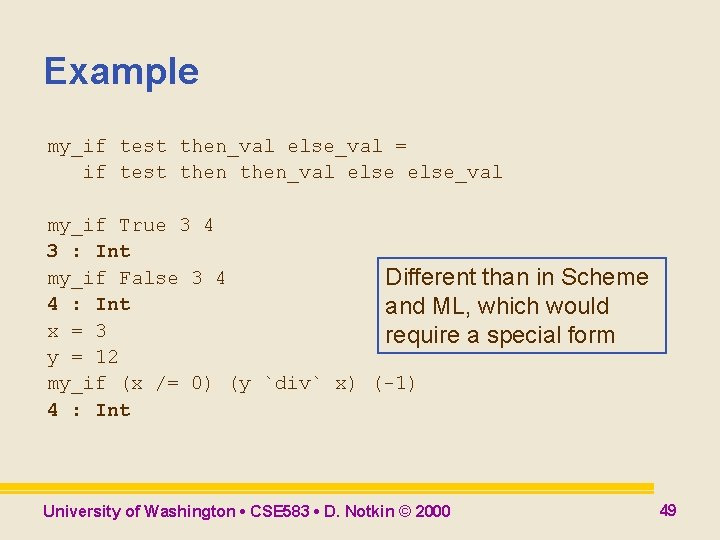
Example my_if test then_val else_val = if test then_val else_val my_if True 3 4 3 : Int my_if False 3 4 Different than in Scheme 4 : Int and ML, which would x = 3 require a special form y = 12 my_if (x /= 0) (y `div` x) (-1) 4 : Int University of Washington • CSE 583 • D. Notkin © 2000 49
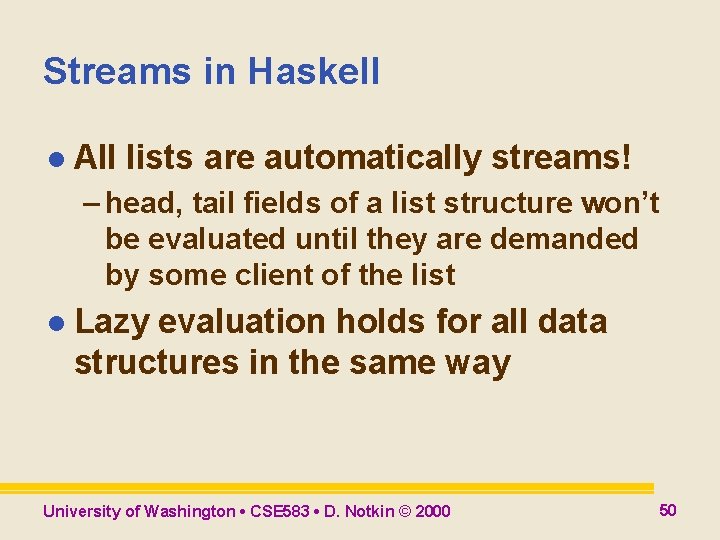
Streams in Haskell l All lists are automatically streams! – head, tail fields of a list structure won’t be evaluated until they are demanded by some client of the list l Lazy evaluation holds for all data structures in the same way University of Washington • CSE 583 • D. Notkin © 2000 50
Examples ints_from n = n : ints_from (n+1) --same as [n. . ] nats = ints_from 0; squares = map (^2) nats [0, 1, 4, 9, 16, 25…] fibs = 0 : 1 : [a+b | (a, b) <- zip fibs (tail fibs)] [0, 1, 1, 2, 3, 5, 8, 13, 21, 34, 55, …] University of Washington • CSE 583 • D. Notkin © 2000 51
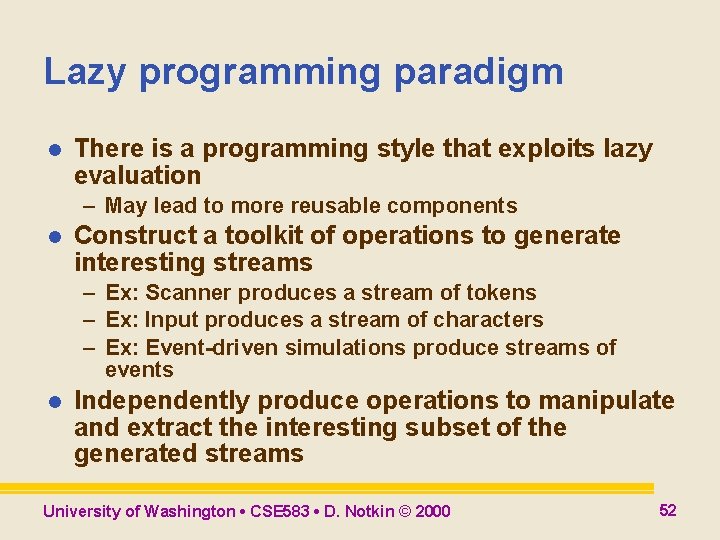
Lazy programming paradigm l There is a programming style that exploits lazy evaluation – May lead to more reusable components l Construct a toolkit of operations to generate interesting streams – Ex: Scanner produces a stream of tokens – Ex: Input produces a stream of characters – Ex: Event-driven simulations produce streams of events l Independently produce operations to manipulate and extract the interesting subset of the generated streams University of Washington • CSE 583 • D. Notkin © 2000 52
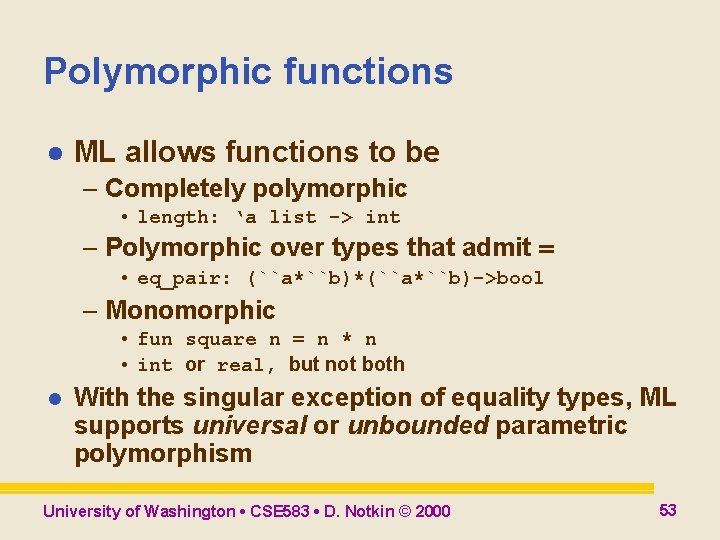
Polymorphic functions l ML allows functions to be – Completely polymorphic • length: ‘a list -> int – Polymorphic over types that admit = • eq_pair: (``a*``b)*(``a*``b)->bool – Monomorphic • fun square n = n * n • int or real, but not both l With the singular exception of equality types, ML supports universal or unbounded parametric polymorphism University of Washington • CSE 583 • D. Notkin © 2000 53
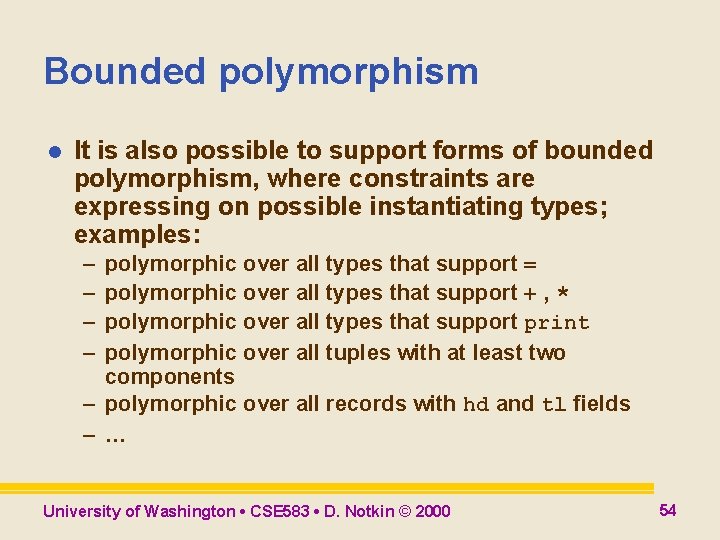
Bounded polymorphism l It is also possible to support forms of bounded polymorphism, where constraints are expressing on possible instantiating types; examples: – – polymorphic over all types that support = polymorphic over all types that support + , * polymorphic over all types that support print polymorphic over all tuples with at least two components – polymorphic over all records with hd and tl fields – … University of Washington • CSE 583 • D. Notkin © 2000 54
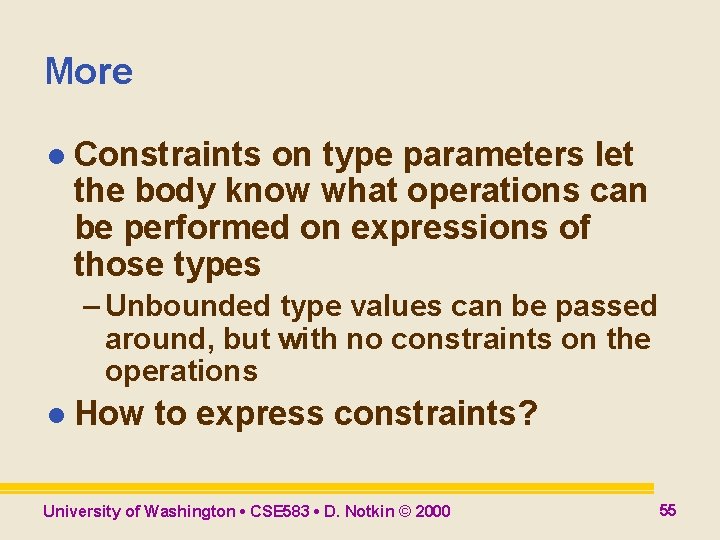
More l Constraints on type parameters let the body know what operations can be performed on expressions of those types – Unbounded type values can be passed around, but with no constraints on the operations l How to express constraints? University of Washington • CSE 583 • D. Notkin © 2000 55
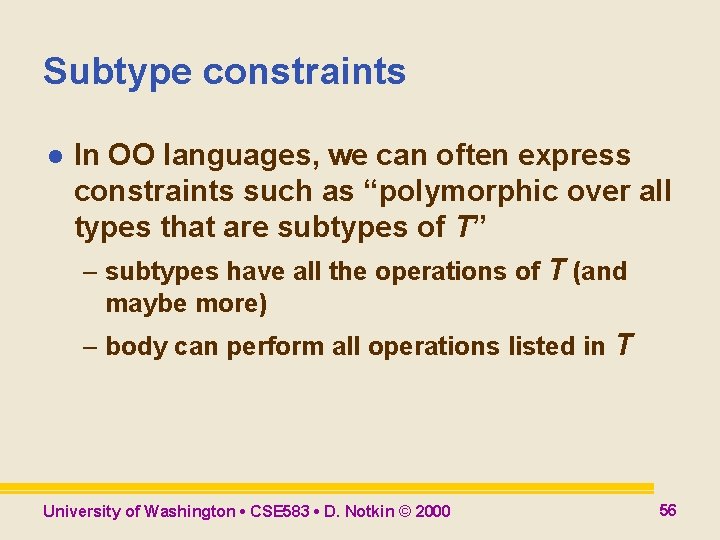
Subtype constraints l In OO languages, we can often express constraints such as “polymorphic over all types that are subtypes of T” – subtypes have all the operations of T (and maybe more) – body can perform all operations listed in T University of Washington • CSE 583 • D. Notkin © 2000 56
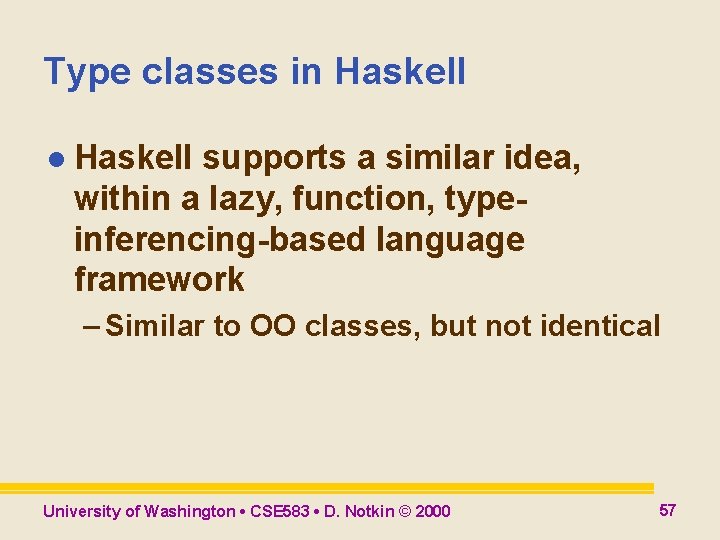
Type classes in Haskell l Haskell supports a similar idea, within a lazy, function, typeinferencing-based language framework – Similar to OO classes, but not identical University of Washington • CSE 583 • D. Notkin © 2000 57
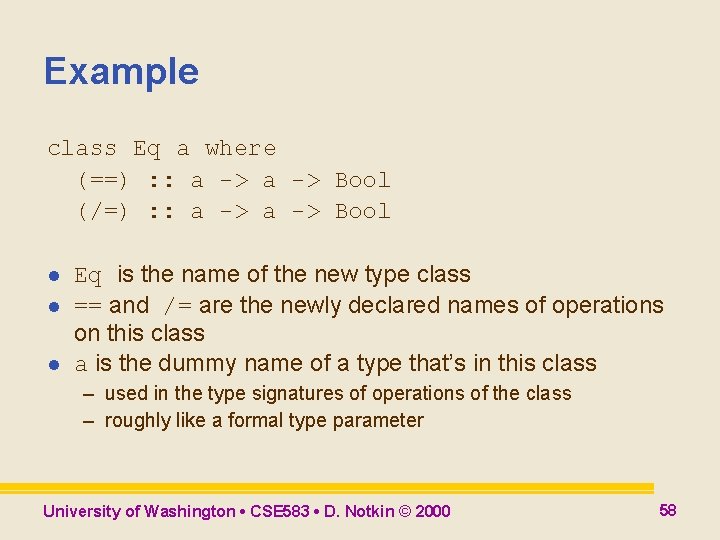
Example class Eq a where (==) : : a -> Bool (/=) : : a -> Bool l Eq is the name of the new type class == and /= are the newly declared names of operations on this class a is the dummy name of a type that’s in this class – used in the type signatures of operations of the class – roughly like a formal type parameter University of Washington • CSE 583 • D. Notkin © 2000 58
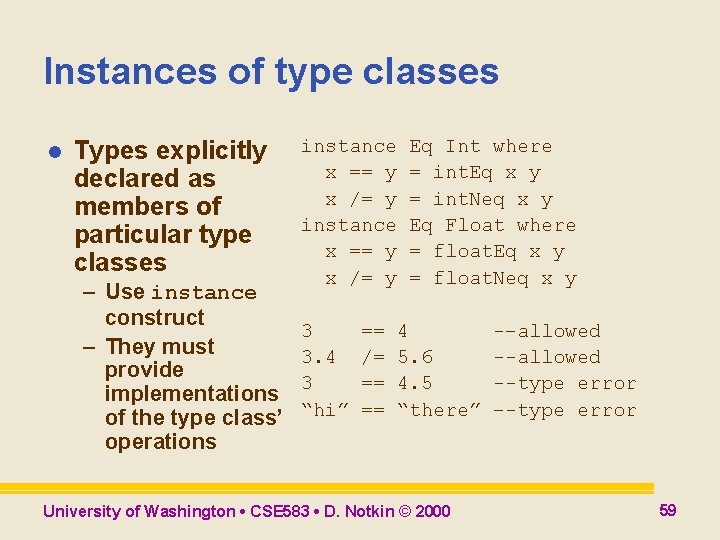
Instances of type classes l Types explicitly declared as members of particular type classes – Use instance construct – They must provide implementations of the type class’ operations instance x == y x /= y 3 3. 4 3 “hi” == /= == == Eq Int where = int. Eq x y = int. Neq x y Eq Float where = float. Eq x y = float. Neq x y 4 5. 6 4. 5 “there” University of Washington • CSE 583 • D. Notkin © 2000 -–allowed --type error –-type error 59
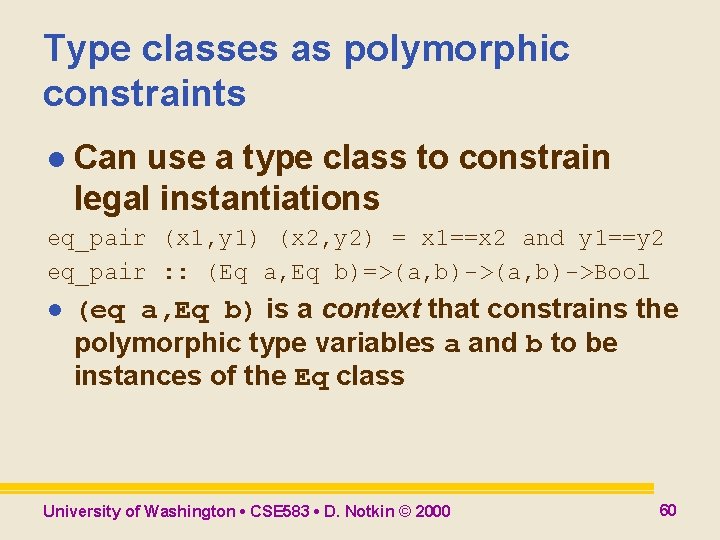
Type classes as polymorphic constraints l Can use a type class to constrain legal instantiations eq_pair (x 1, y 1) (x 2, y 2) = x 1==x 2 and y 1==y 2 eq_pair : : (Eq a, Eq b)=>(a, b)->Bool l (eq a, Eq b) is a context that constrains the polymorphic type variables a and b to be instances of the Eq class University of Washington • CSE 583 • D. Notkin © 2000 60
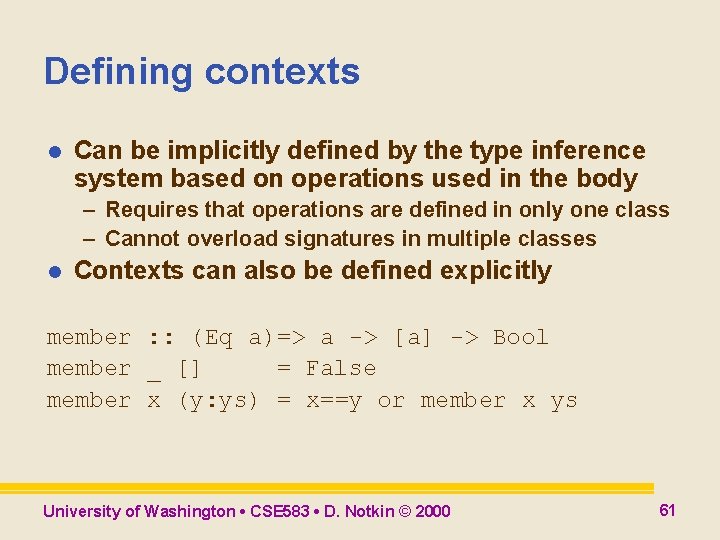
Defining contexts l Can be implicitly defined by the type inference system based on operations used in the body – Requires that operations are defined in only one class – Cannot overload signatures in multiple classes l Contexts can also be defined explicitly member : : (Eq a)=> a -> [a] -> Bool member _ [] = False member x (y: ys) = x==y or member x ys University of Washington • CSE 583 • D. Notkin © 2000 61
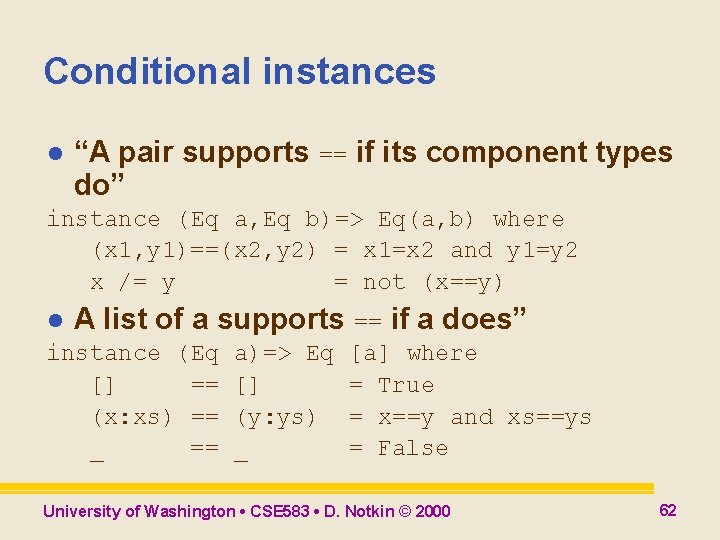
Conditional instances l “A pair supports == if its component types do” instance (Eq a, Eq b)=> Eq(a, b) where (x 1, y 1)==(x 2, y 2) = x 1=x 2 and y 1=y 2 x /= y = not (x==y) l A list of a supports == if a does” instance (Eq a)=> Eq [a] where [] == [] = True (x: xs) == (y: ys) = x==y and xs==ys _ == _ = False University of Washington • CSE 583 • D. Notkin © 2000 62
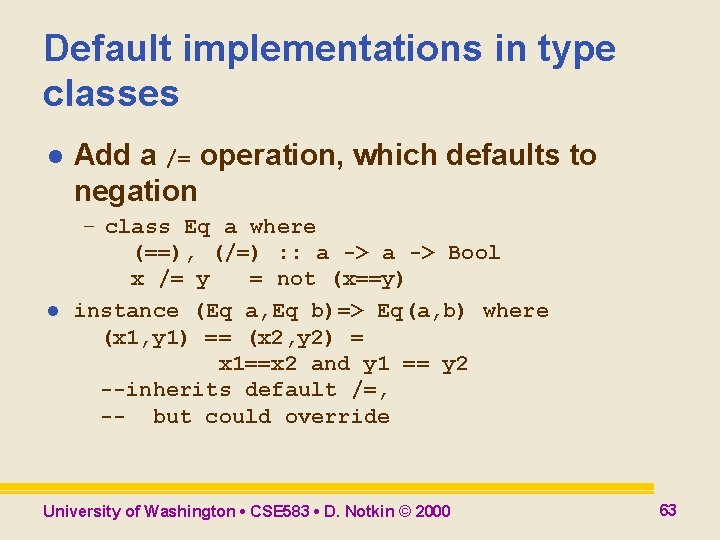
Default implementations in type classes l l Add a /= operation, which defaults to negation – class Eq a where (==), (/=) : : a -> Bool x /= y = not (x==y) instance (Eq a, Eq b)=> Eq(a, b) where (x 1, y 1) == (x 2, y 2) = x 1==x 2 and y 1 == y 2 --inherits default /=, -- but could override University of Washington • CSE 583 • D. Notkin © 2000 63
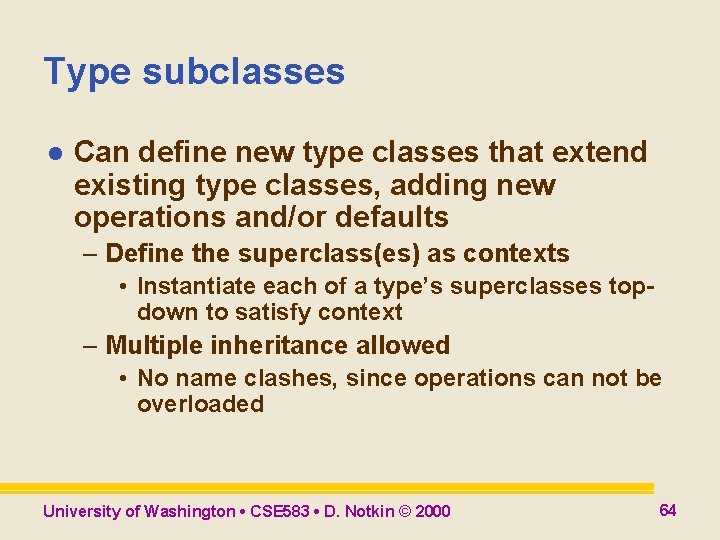
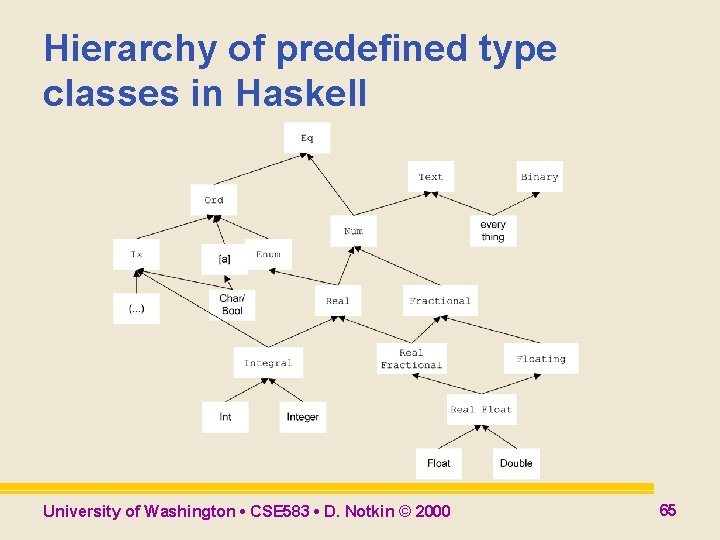
Type subclasses l Can define new type classes that extend existing type classes, adding new operations and/or defaults – Define the superclass(es) as contexts • Instantiate each of a type’s superclasses topdown to satisfy context – Multiple inheritance allowed • No name clashes, since operations can not be overloaded University of Washington • CSE 583 • D. Notkin © 2000 64
Hierarchy of predefined type classes in Haskell University of Washington • CSE 583 • D. Notkin © 2000 65
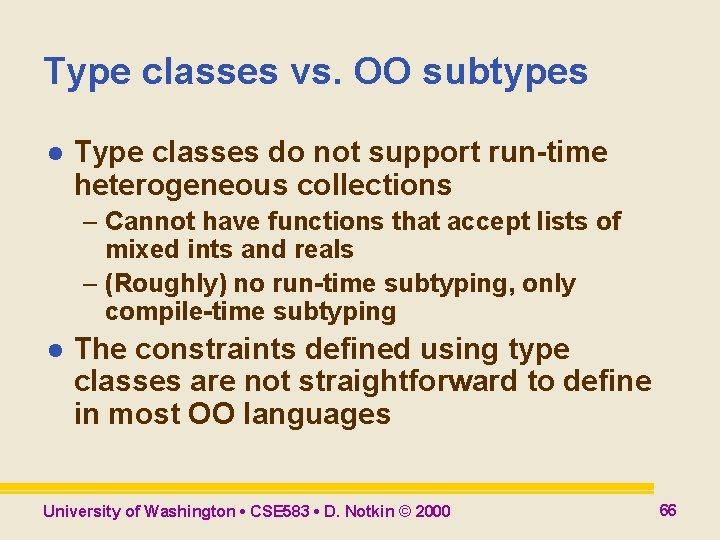
Type classes vs. OO subtypes l Type classes do not support run-time heterogeneous collections – Cannot have functions that accept lists of mixed ints and reals – (Roughly) no run-time subtyping, only compile-time subtyping l The constraints defined using type classes are not straightforward to define in most OO languages University of Washington • CSE 583 • D. Notkin © 2000 66
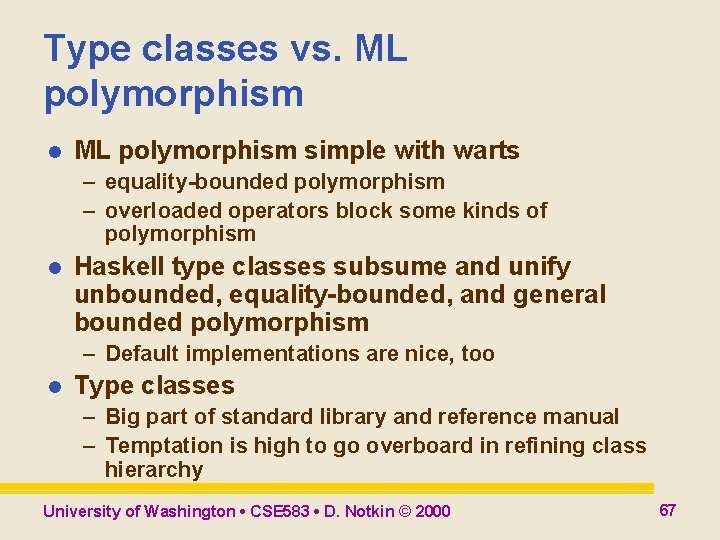
Type classes vs. ML polymorphism l ML polymorphism simple with warts – equality-bounded polymorphism – overloaded operators block some kinds of polymorphism l Haskell type classes subsume and unify unbounded, equality-bounded, and general bounded polymorphism – Default implementations are nice, too l Type classes – Big part of standard library and reference manual – Temptation is high to go overboard in refining class hierarchy University of Washington • CSE 583 • D. Notkin © 2000 67
Whew l Next week, on to some more discussion of types l Leading into object-oriented programming languages l Watch for a new assignment and some readings University of Washington • CSE 583 • D. Notkin © 2000 68