
CSE 544 Lecture 7 XQuery Relational Algebra Monday
CSE 544: Lecture 7 XQuery, Relational Algebra Monday, 4/22/02 1
XQuery • Based on Quilt (which is based on XML-QL) • http: //www. w 3. org/XML/Query • XML Query data model – Similar to the XPath data model, more complete 2
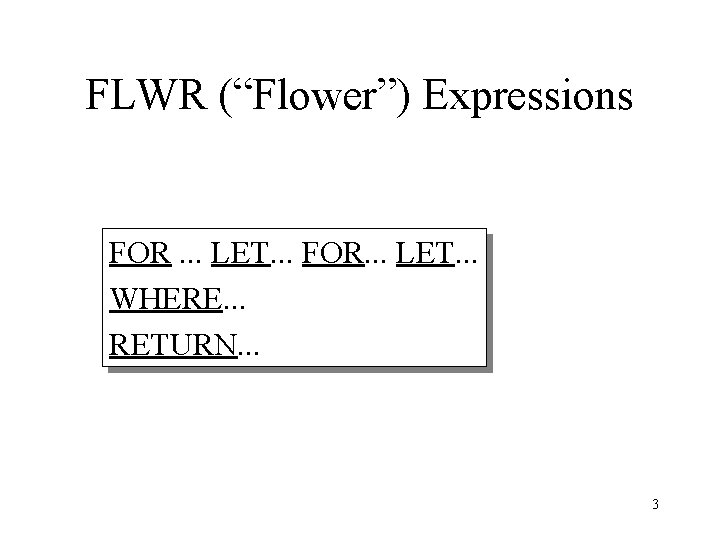
FLWR (“Flower”) Expressions FOR. . . LET. . . WHERE. . . RETURN. . . 3
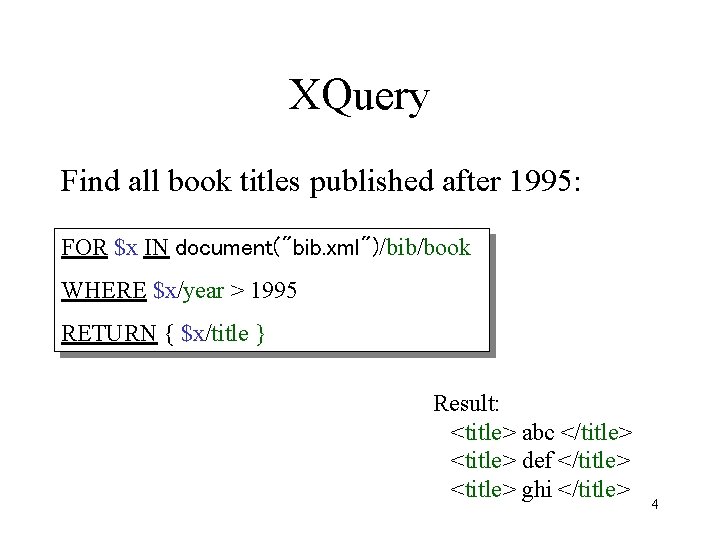
XQuery Find all book titles published after 1995: FOR $x IN document("bib. xml")/bib/book WHERE $x/year > 1995 RETURN { $x/title } Result: <title> abc </title> <title> def </title> <title> ghi </title> 4
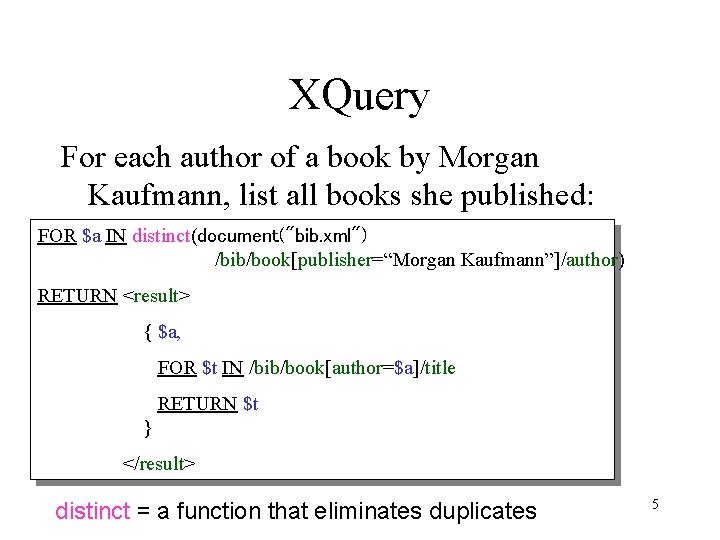
XQuery For each author of a book by Morgan Kaufmann, list all books she published: FOR $a IN distinct(document("bib. xml") /bib/book[publisher=“Morgan Kaufmann”]/author) RETURN <result> { $a, FOR $t IN /bib/book[author=$a]/title RETURN $t } </result> distinct = a function that eliminates duplicates 5
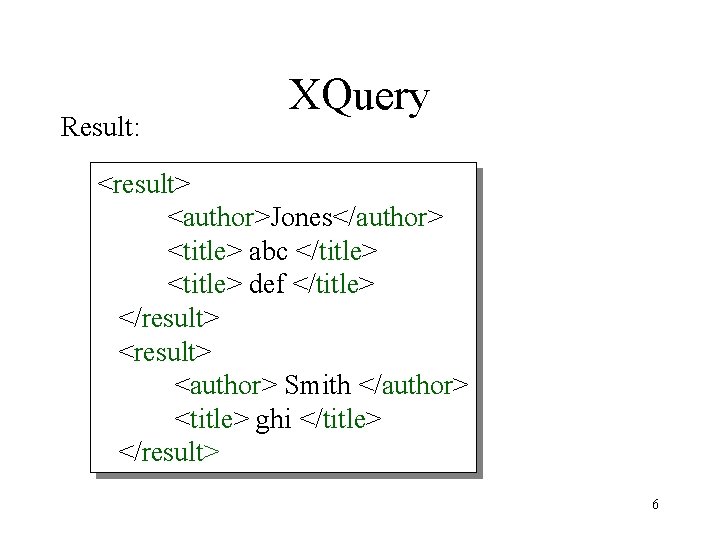
Result: XQuery <result> <author>Jones</author> <title> abc </title> <title> def </title> </result> <author> Smith </author> <title> ghi </title> </result> 6
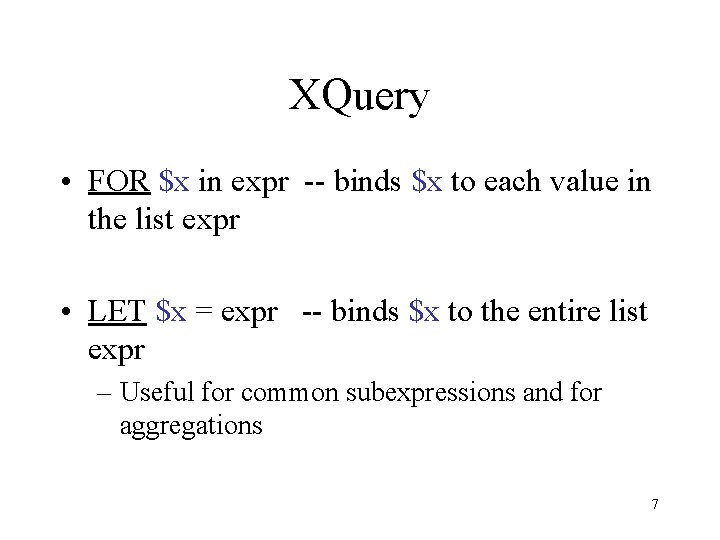
XQuery • FOR $x in expr -- binds $x to each value in the list expr • LET $x = expr -- binds $x to the entire list expr – Useful for common subexpressions and for aggregations 7
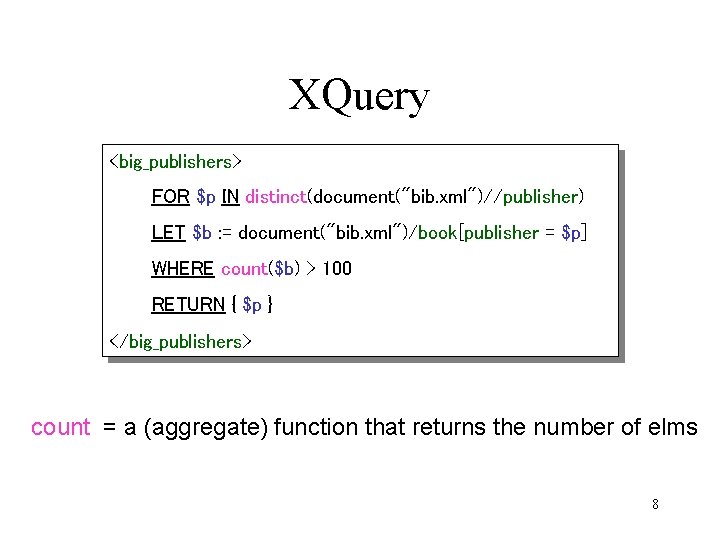
XQuery <big_publishers> FOR $p IN distinct(document("bib. xml")//publisher) LET $b : = document("bib. xml")/book[publisher = $p] WHERE count($b) > 100 RETURN { $p } </big_publishers> count = a (aggregate) function that returns the number of elms 8
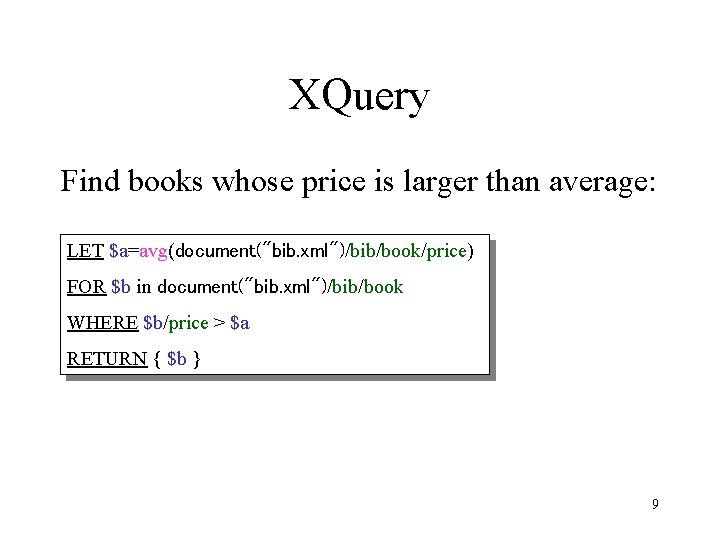
XQuery Find books whose price is larger than average: LET $a=avg(document("bib. xml")/bib/book/price) FOR $b in document("bib. xml")/bib/book WHERE $b/price > $a RETURN { $b } 9
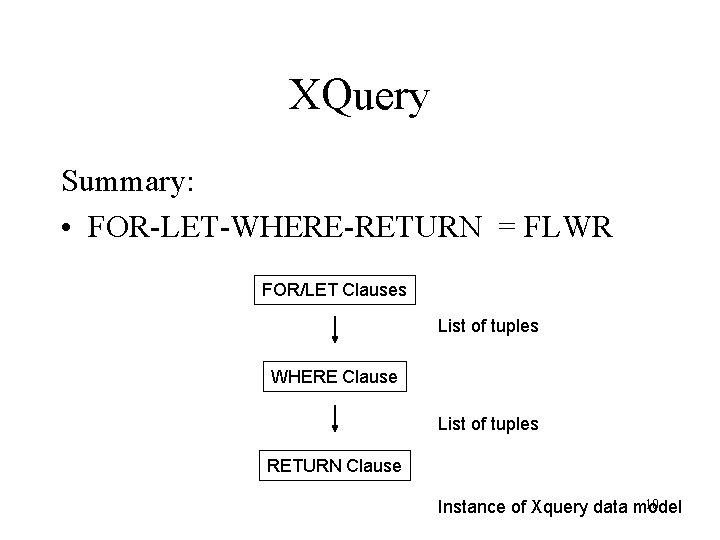
XQuery Summary: • FOR-LET-WHERE-RETURN = FLWR FOR/LET Clauses List of tuples WHERE Clause List of tuples RETURN Clause 10 Instance of Xquery data model
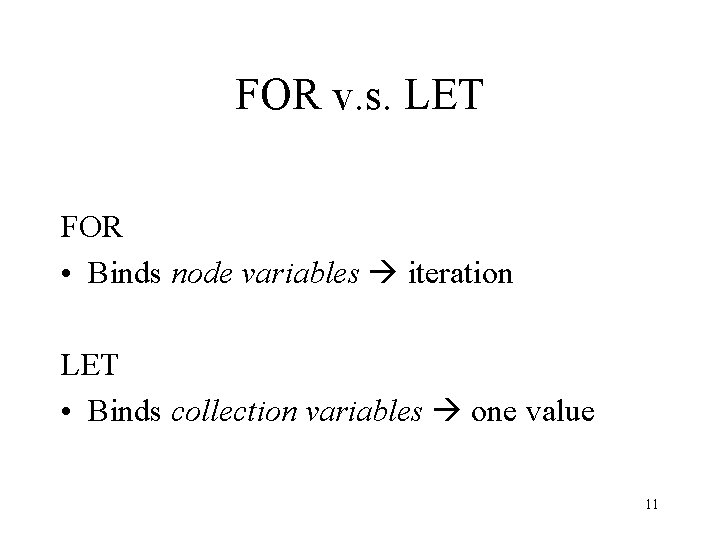
FOR v. s. LET FOR • Binds node variables iteration LET • Binds collection variables one value 11
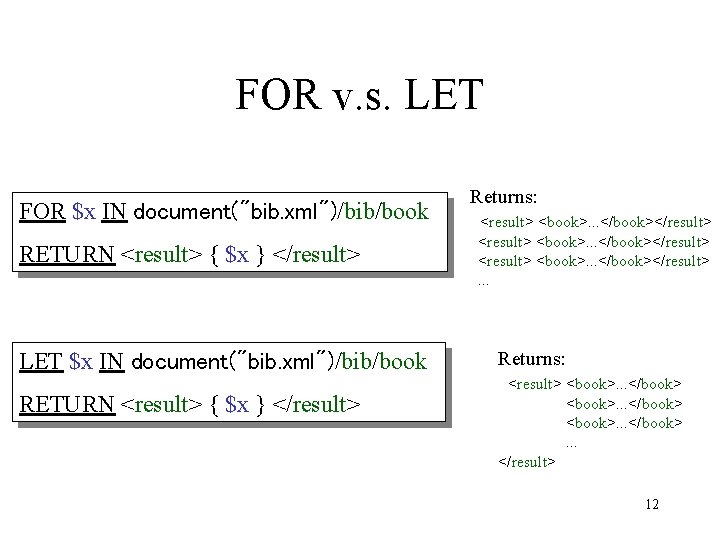
FOR v. s. LET FOR $x IN document("bib. xml")/bib/book RETURN <result> { $x } </result> LET $x IN document("bib. xml")/bib/book RETURN <result> { $x } </result> Returns: <result> <book>. . . </book></result>. . . Returns: <result> <book>. . . </book> <book>. . . </result> 12
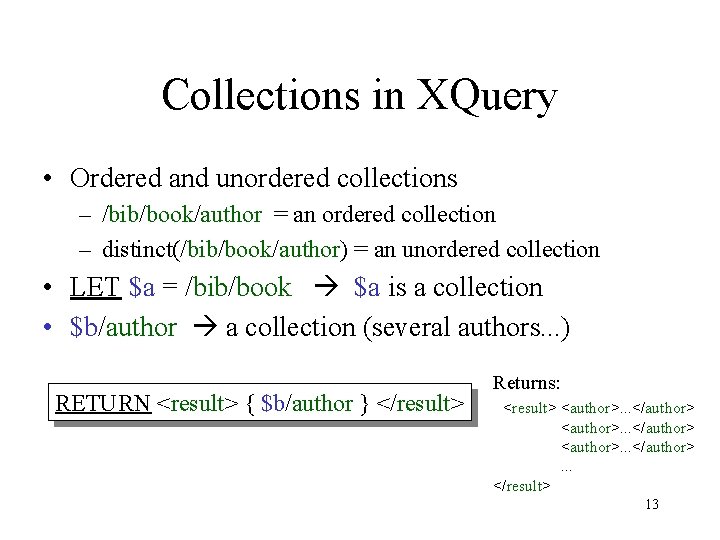
Collections in XQuery • Ordered and unordered collections – /bib/book/author = an ordered collection – distinct(/bib/book/author) = an unordered collection • LET $a = /bib/book $a is a collection • $b/author a collection (several authors. . . ) RETURN <result> { $b/author } </result> Returns: <result> <author>. . . </author> <author>. . . </result> 13
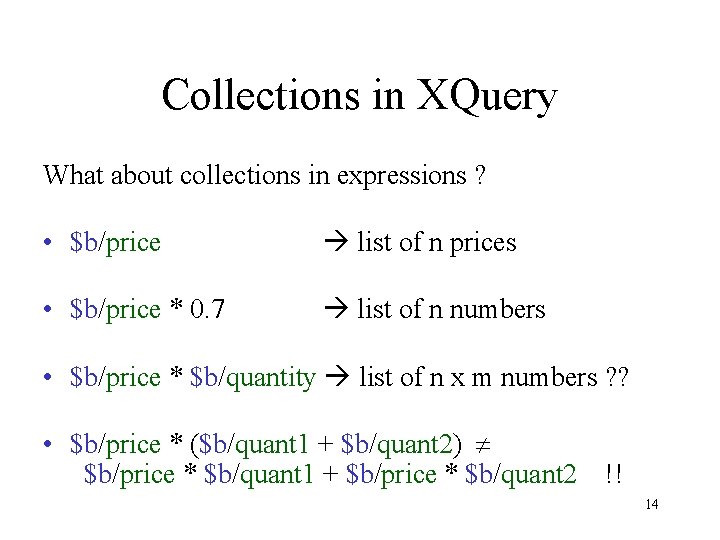
Collections in XQuery What about collections in expressions ? • $b/price list of n prices • $b/price * 0. 7 list of n numbers • $b/price * $b/quantity list of n x m numbers ? ? • $b/price * ($b/quant 1 + $b/quant 2) $b/price * $b/quant 1 + $b/price * $b/quant 2 !! 14
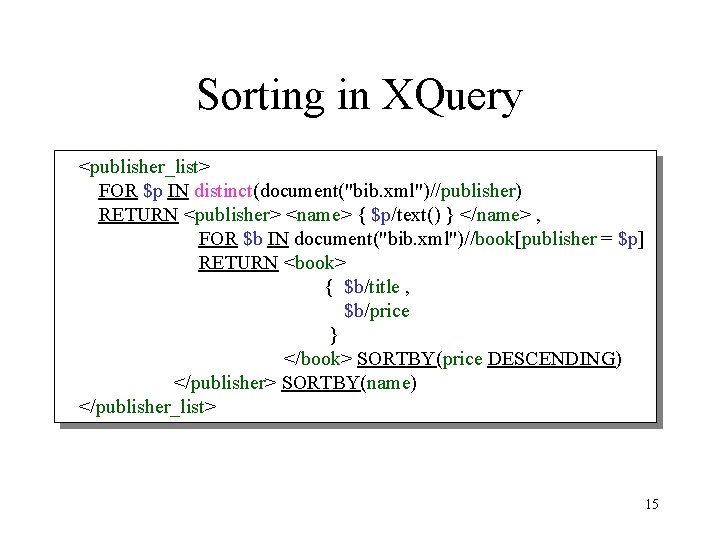
Sorting in XQuery <publisher_list> FOR $p IN distinct(document("bib. xml")//publisher) RETURN <publisher> <name> { $p/text() } </name> , FOR $b IN document("bib. xml")//book[publisher = $p] RETURN <book> { $b/title , $b/price } </book> SORTBY(price DESCENDING) </publisher> SORTBY(name) </publisher_list> 15
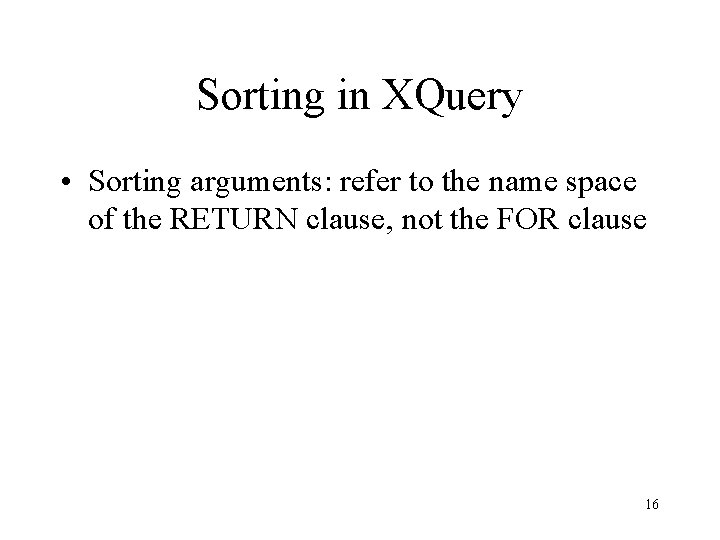
Sorting in XQuery • Sorting arguments: refer to the name space of the RETURN clause, not the FOR clause 16
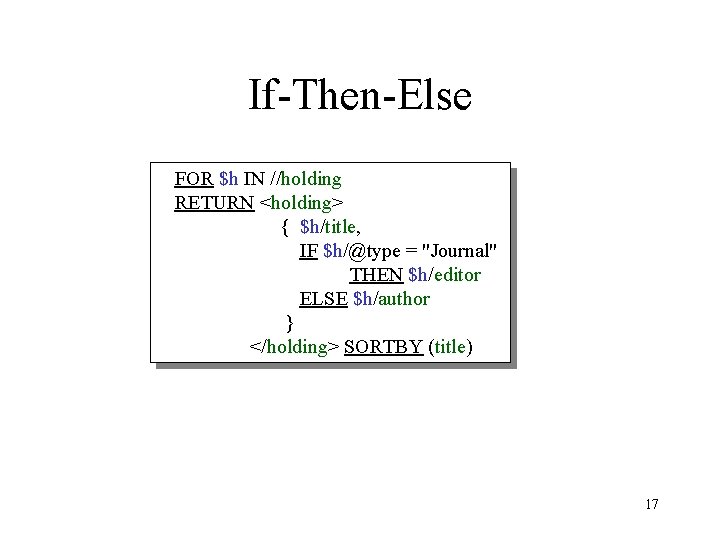
If-Then-Else FOR $h IN //holding RETURN <holding> { $h/title, IF $h/@type = "Journal" THEN $h/editor ELSE $h/author } </holding> SORTBY (title) 17
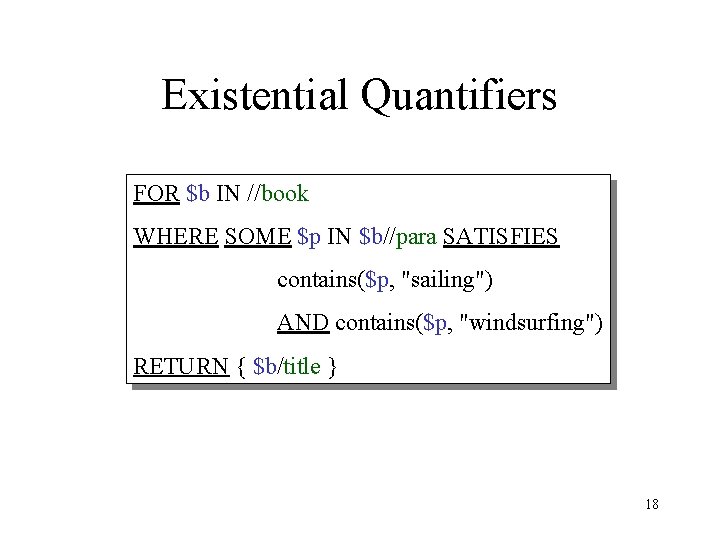
Existential Quantifiers FOR $b IN //book WHERE SOME $p IN $b//para SATISFIES contains($p, "sailing") AND contains($p, "windsurfing") RETURN { $b/title } 18
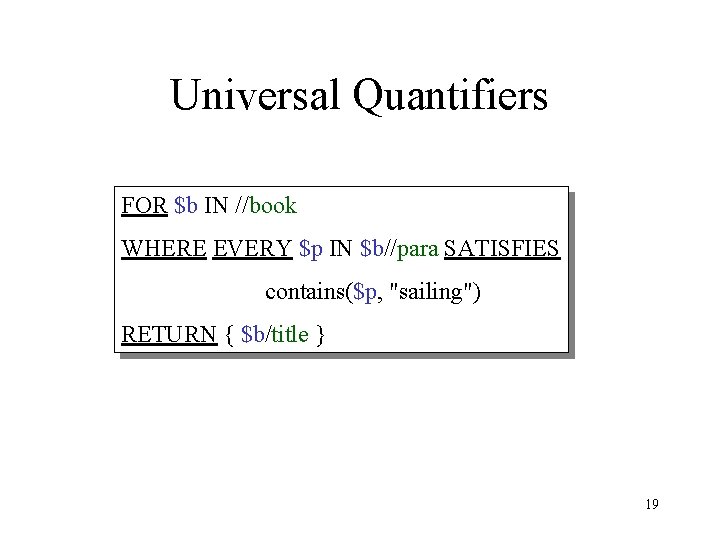
Universal Quantifiers FOR $b IN //book WHERE EVERY $p IN $b//para SATISFIES contains($p, "sailing") RETURN { $b/title } 19
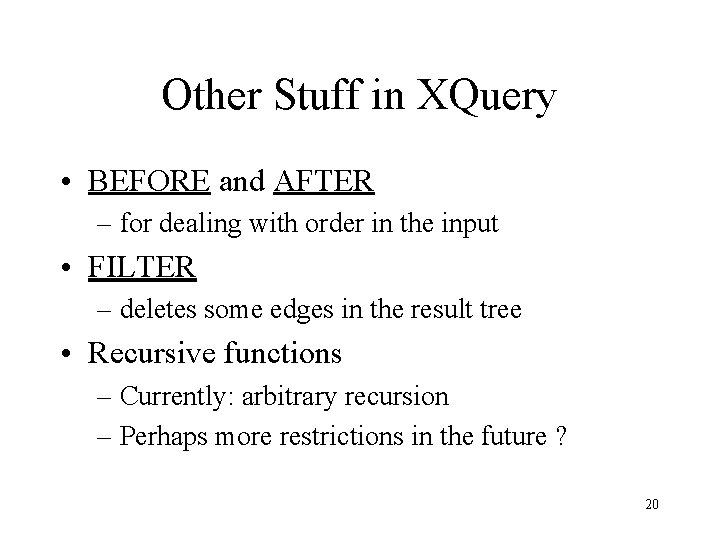
Other Stuff in XQuery • BEFORE and AFTER – for dealing with order in the input • FILTER – deletes some edges in the result tree • Recursive functions – Currently: arbitrary recursion – Perhaps more restrictions in the future ? 20
Foundations of Database Systems • Why is theory important ? • Roadmap to database theory in CSE 544 – Relational algebra (today) – First order logic (a. k. a. relational calculus) – Conjunctive queries and datalog 21
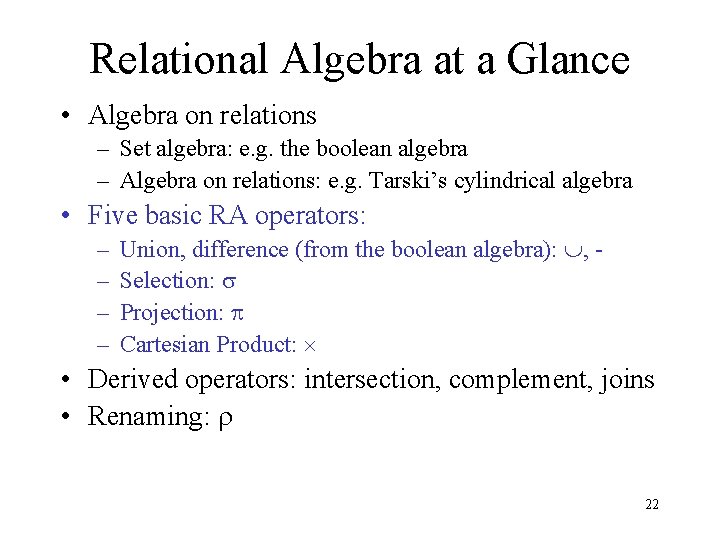
Relational Algebra at a Glance • Algebra on relations – Set algebra: e. g. the boolean algebra – Algebra on relations: e. g. Tarski’s cylindrical algebra • Five basic RA operators: – – Union, difference (from the boolean algebra): , Selection: s Projection: p Cartesian Product: • Derived operators: intersection, complement, joins • Renaming: r 22
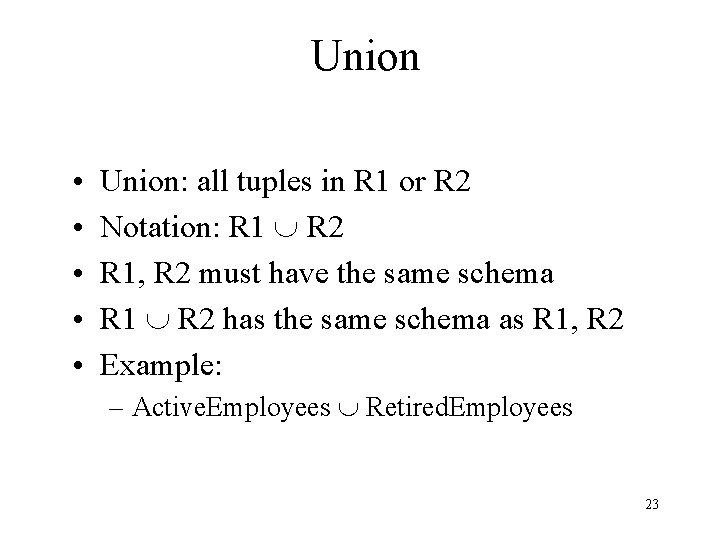
Union • • • Union: all tuples in R 1 or R 2 Notation: R 1 R 2 R 1, R 2 must have the same schema R 1 R 2 has the same schema as R 1, R 2 Example: – Active. Employees Retired. Employees 23
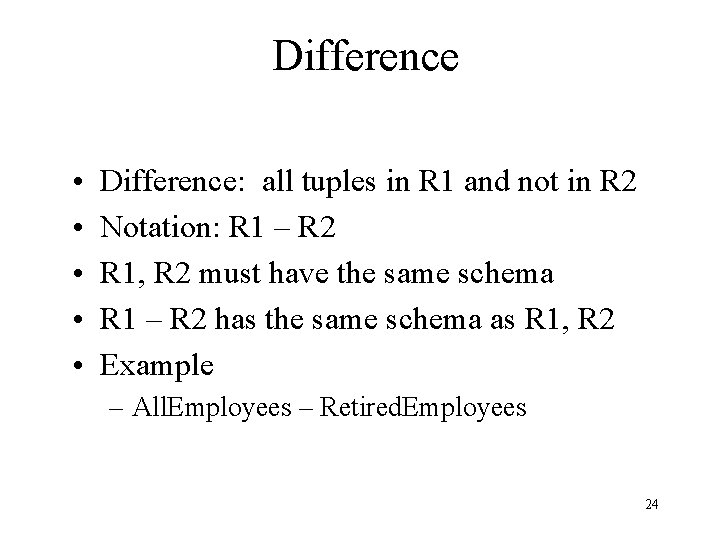
Difference • • • Difference: all tuples in R 1 and not in R 2 Notation: R 1 – R 2 R 1, R 2 must have the same schema R 1 – R 2 has the same schema as R 1, R 2 Example – All. Employees – Retired. Employees 24
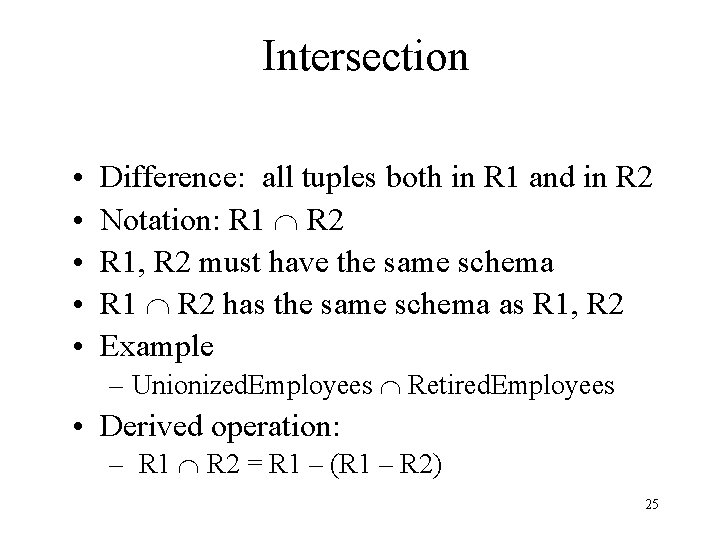
Intersection • • • Difference: all tuples both in R 1 and in R 2 Notation: R 1 R 2 R 1, R 2 must have the same schema R 1 R 2 has the same schema as R 1, R 2 Example – Unionized. Employees Retired. Employees • Derived operation: – R 1 R 2 = R 1 – (R 1 – R 2) 25
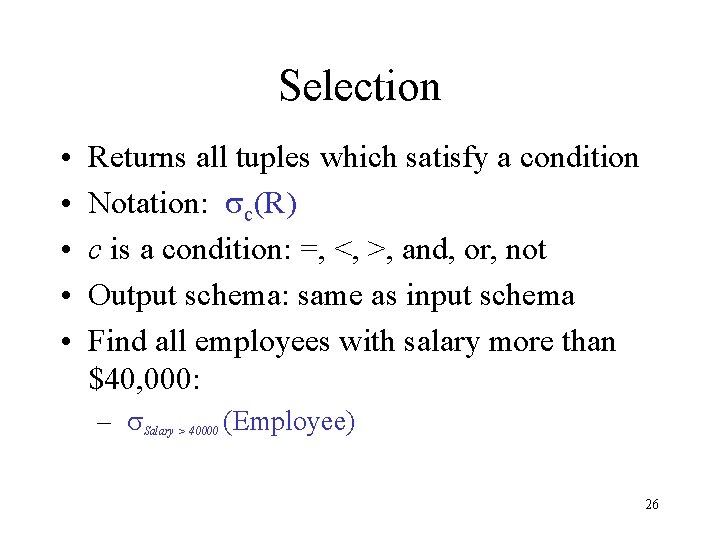
Selection • • • Returns all tuples which satisfy a condition Notation: sc(R) c is a condition: =, <, >, and, or, not Output schema: same as input schema Find all employees with salary more than $40, 000: – s. Salary > 40000 (Employee) 26
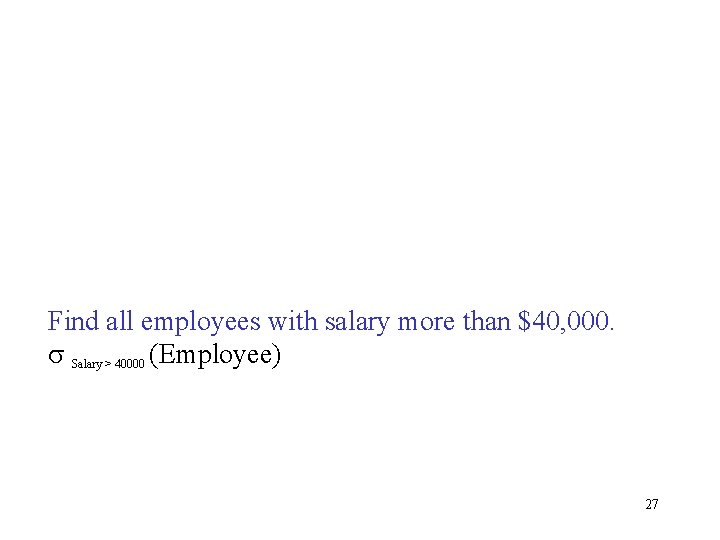
Find all employees with salary more than $40, 000. s Salary > 40000 (Employee) 27
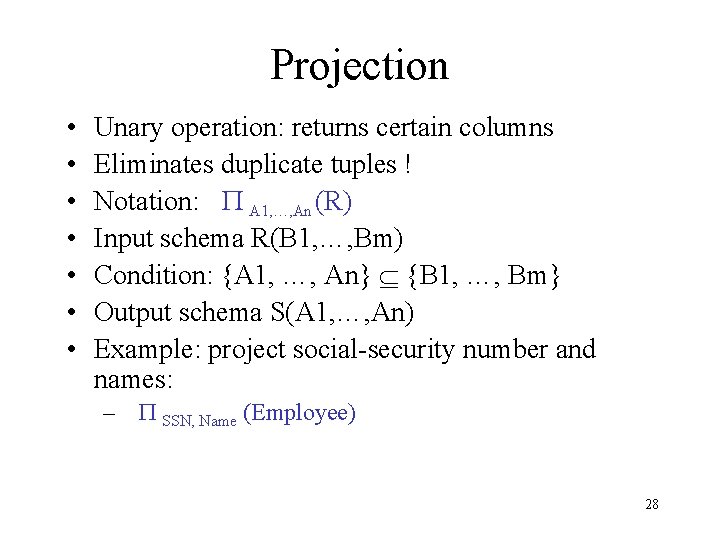
Projection • • Unary operation: returns certain columns Eliminates duplicate tuples ! Notation: P A 1, …, An (R) Input schema R(B 1, …, Bm) Condition: {A 1, …, An} {B 1, …, Bm} Output schema S(A 1, …, An) Example: project social-security number and names: – P SSN, Name (Employee) 28

P SSN, Name (Employee) 29
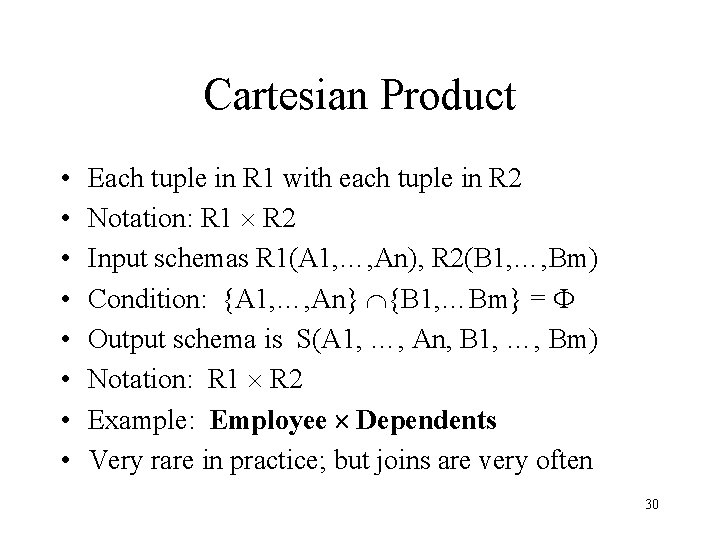
Cartesian Product • • Each tuple in R 1 with each tuple in R 2 Notation: R 1 R 2 Input schemas R 1(A 1, …, An), R 2(B 1, …, Bm) Condition: {A 1, …, An} {B 1, …Bm} = F Output schema is S(A 1, …, An, B 1, …, Bm) Notation: R 1 R 2 Example: Employee Dependents Very rare in practice; but joins are very often 30
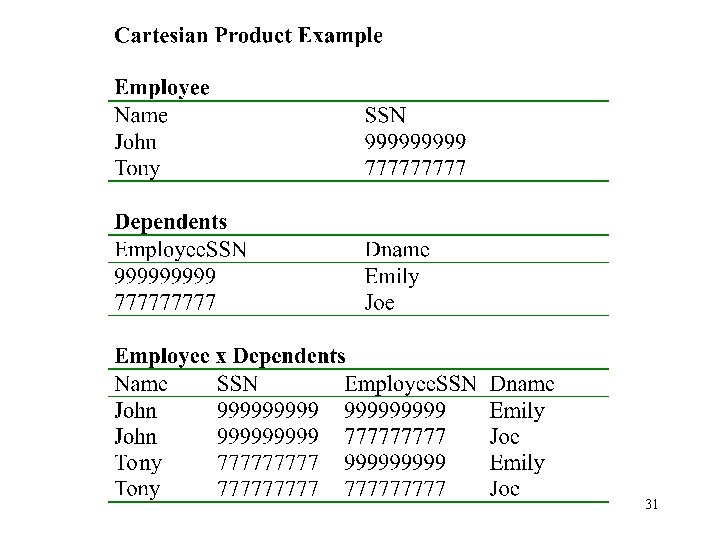
31
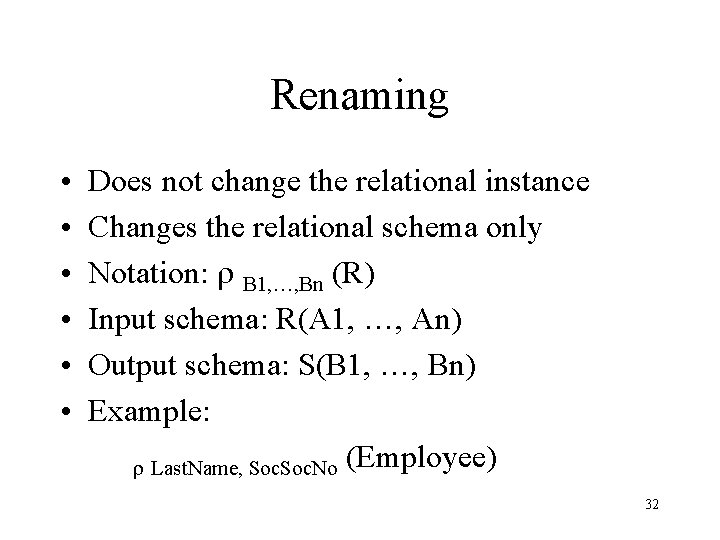
Renaming • • • Does not change the relational instance Changes the relational schema only Notation: r B 1, …, Bn (R) Input schema: R(A 1, …, An) Output schema: S(B 1, …, Bn) Example: r Last. Name, Soc. No (Employee) 32
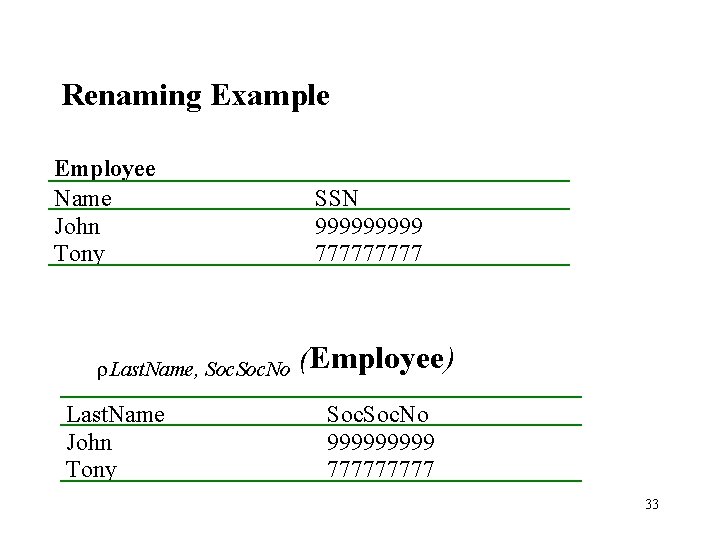
Renaming Example Employee Name John Tony r. Last. Name, Soc. No Last. Name John Tony SSN 99999 77777 (Employee) Soc. No 99999 77777 33
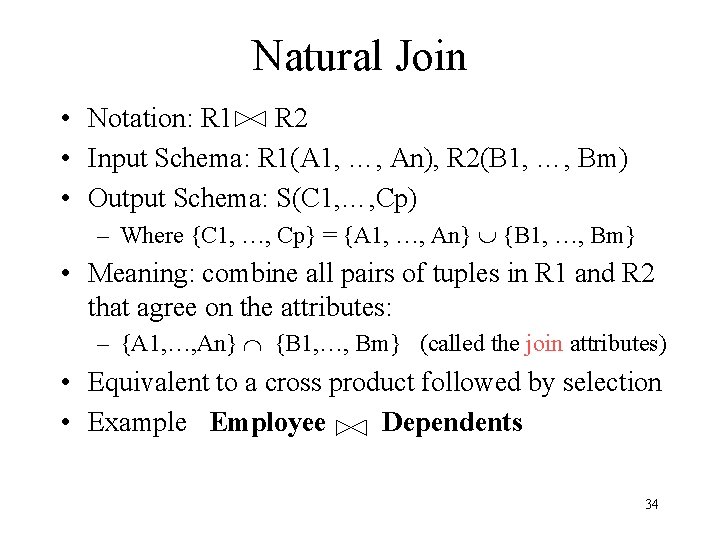
Natural Join • Notation: R 1 R 2 • Input Schema: R 1(A 1, …, An), R 2(B 1, …, Bm) • Output Schema: S(C 1, …, Cp) – Where {C 1, …, Cp} = {A 1, …, An} {B 1, …, Bm} • Meaning: combine all pairs of tuples in R 1 and R 2 that agree on the attributes: – {A 1, …, An} {B 1, …, Bm} (called the join attributes) • Equivalent to a cross product followed by selection • Example Employee Dependents 34
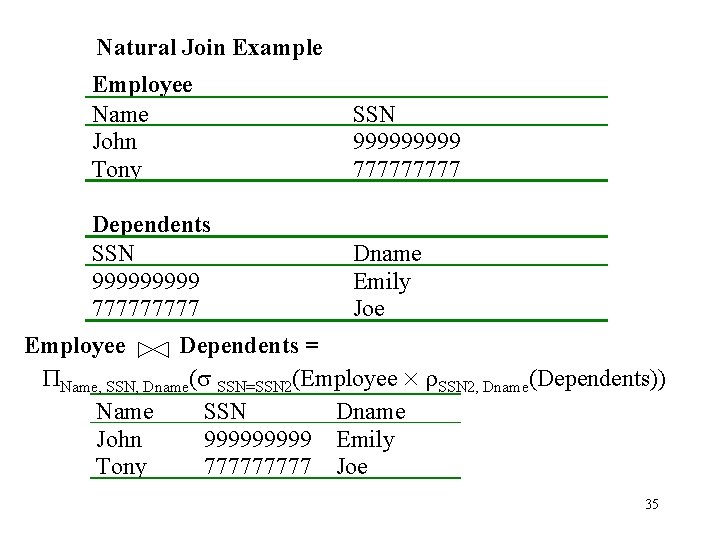
Natural Join Example Employee Name John Tony SSN 99999 77777 Dependents SSN 99999 77777 Dname Emily Joe Employee Dependents = PName, SSN, Dname(s SSN=SSN 2(Employee r. SSN 2, Dname(Dependents)) Name SSN Dname John 99999 Emily Tony 77777 Joe 35
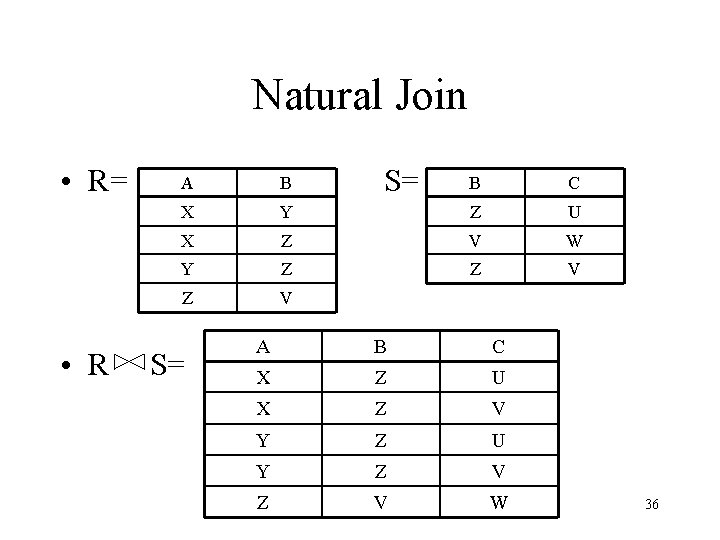
Natural Join • R= • R A B X S= B C Y Z U X Z V W Y Z Z V S= A B C X Z U X Z V Y Z U Y Z V W 36
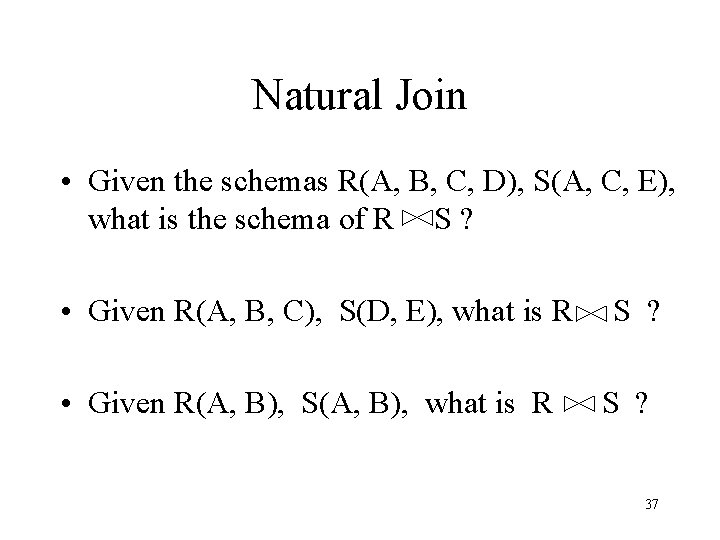
Natural Join • Given the schemas R(A, B, C, D), S(A, C, E), what is the schema of R S ? • Given R(A, B, C), S(D, E), what is R • Given R(A, B), S(A, B), what is R S ? 37
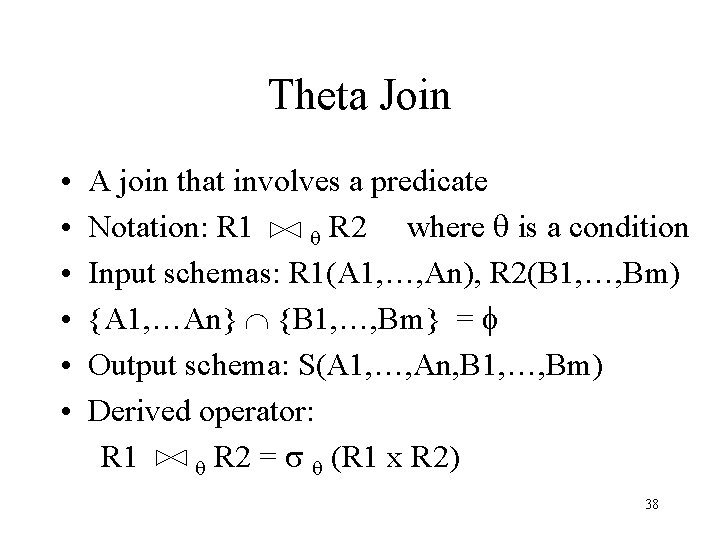
Theta Join • • • A join that involves a predicate Notation: R 1 where q is a condition q R 2 Input schemas: R 1(A 1, …, An), R 2(B 1, …, Bm) {A 1, …An} {B 1, …, Bm} = f Output schema: S(A 1, …, An, B 1, …, Bm) Derived operator: R 1 q R 2 = s q (R 1 x R 2) 38
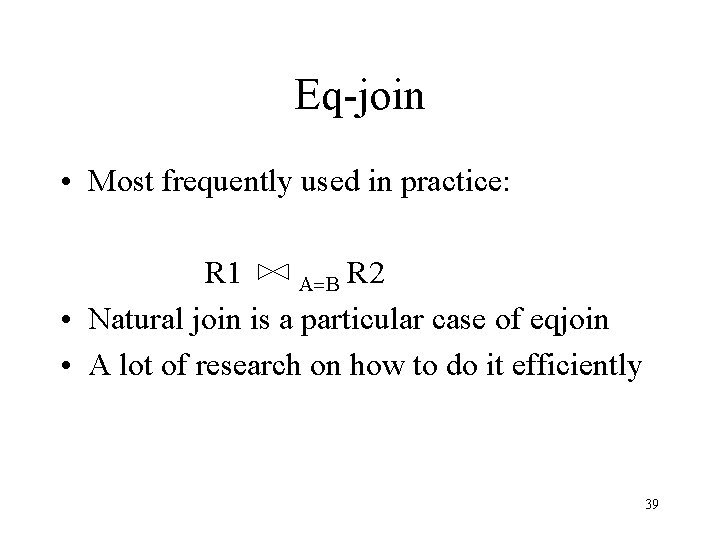
Eq-join • Most frequently used in practice: R 1 A=B R 2 • Natural join is a particular case of eqjoin • A lot of research on how to do it efficiently 39
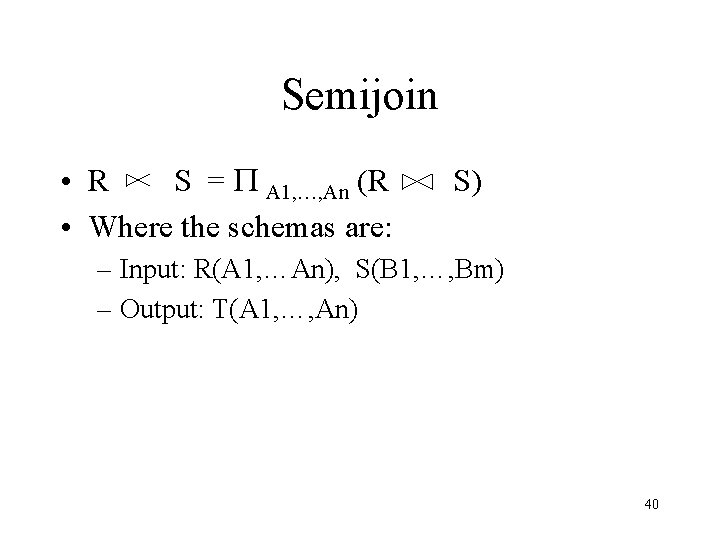
Semijoin • R S = P A 1, …, An (R • Where the schemas are: S) – Input: R(A 1, …An), S(B 1, …, Bm) – Output: T(A 1, …, An) 40
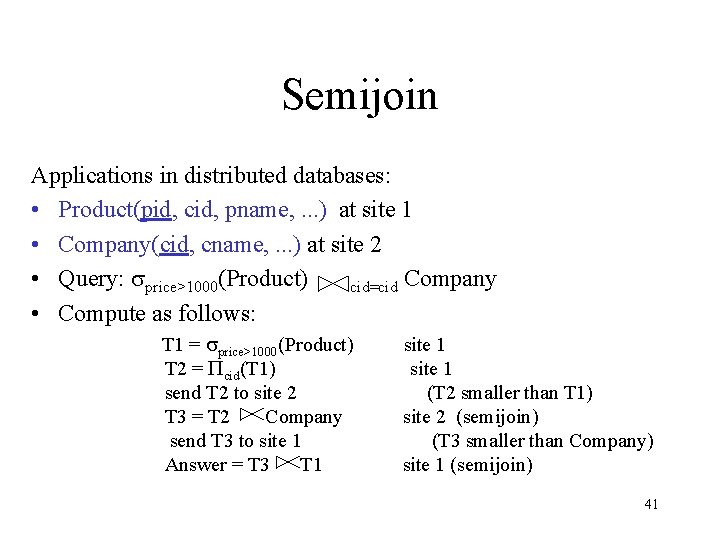
Semijoin Applications in distributed databases: • Product(pid, cid, pname, . . . ) at site 1 • Company(cid, cname, . . . ) at site 2 • Query: sprice>1000(Product) cid=cid Company • Compute as follows: T 1 = sprice>1000(Product) T 2 = Pcid(T 1) send T 2 to site 2 T 3 = T 2 Company send T 3 to site 1 Answer = T 3 T 1 site 1 (T 2 smaller than T 1) site 2 (semijoin) (T 3 smaller than Company) site 1 (semijoin) 41
Relational Algebra Summary • Five basic operators, many derived • Combine operators in order to construct queries: relational algebra expressions, usually shown as trees 42
- Slides: 42