
CSE 541 Differentiation Roger Crawfis Numerical Differentiation The

- Slides: 36
CSE 541 - Differentiation Roger Crawfis
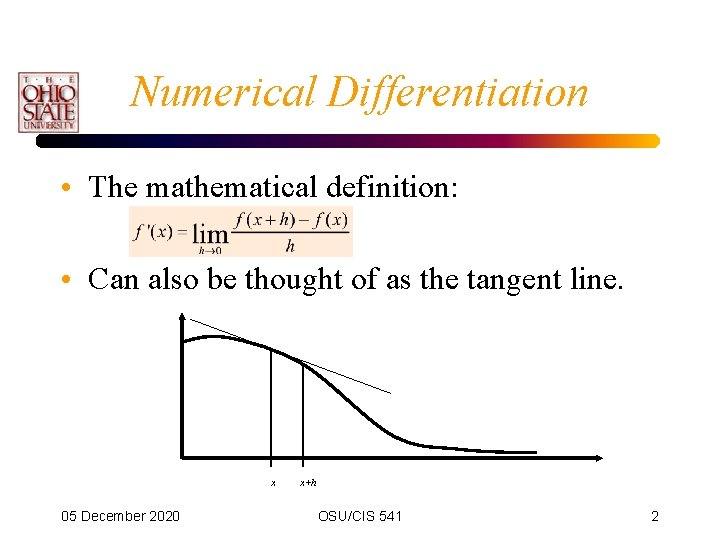
Numerical Differentiation • The mathematical definition: • Can also be thought of as the tangent line. x 05 December 2020 x+h OSU/CIS 541 2
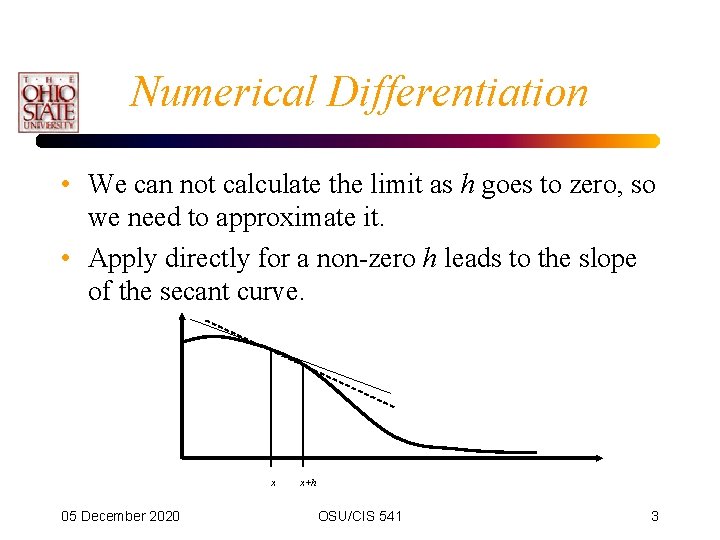
Numerical Differentiation • We can not calculate the limit as h goes to zero, so we need to approximate it. • Apply directly for a non-zero h leads to the slope of the secant curve. x 05 December 2020 x+h OSU/CIS 541 3
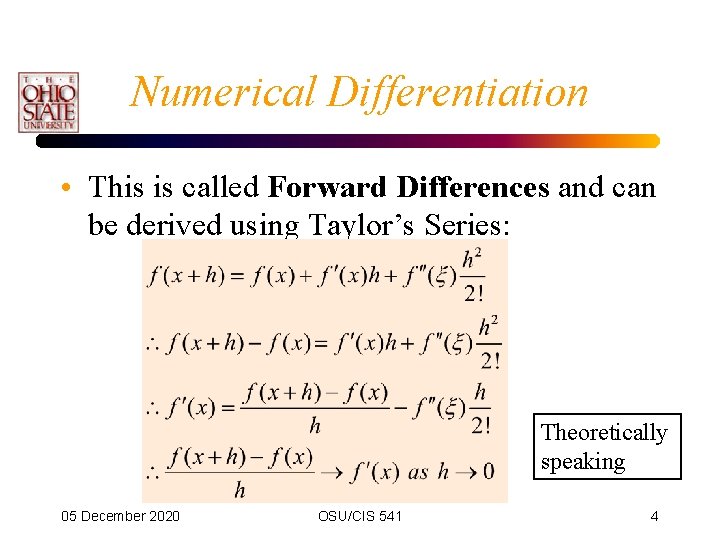
Numerical Differentiation • This is called Forward Differences and can be derived using Taylor’s Series: Theoretically speaking 05 December 2020 OSU/CIS 541 4
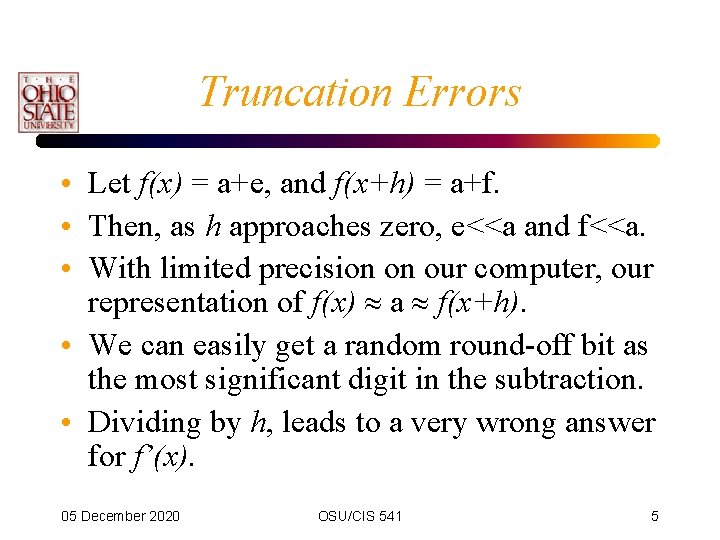
Truncation Errors • Let f(x) = a+e, and f(x+h) = a+f. • Then, as h approaches zero, e<<a and f<<a. • With limited precision on our computer, our representation of f(x) a f(x+h). • We can easily get a random round-off bit as the most significant digit in the subtraction. • Dividing by h, leads to a very wrong answer for f’(x). 05 December 2020 OSU/CIS 541 5
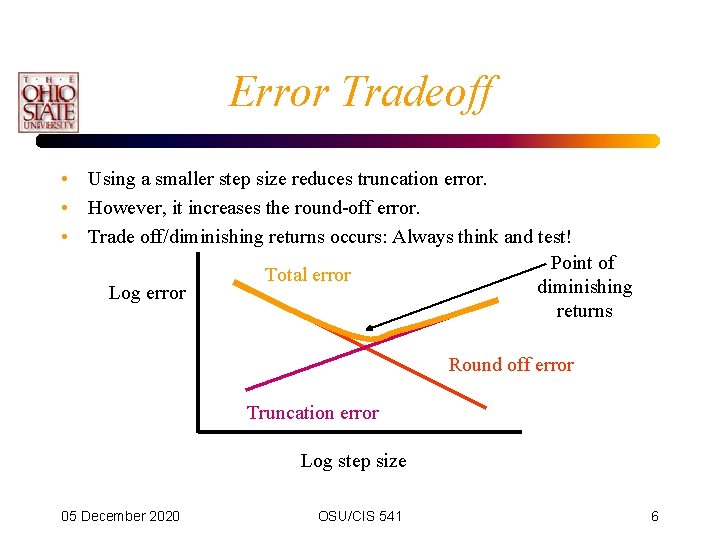
Error Tradeoff • Using a smaller step size reduces truncation error. • However, it increases the round-off error. • Trade off/diminishing returns occurs: Always think and test! Point of Total error diminishing Log error returns Round off error Truncation error Log step size 05 December 2020 OSU/CIS 541 6
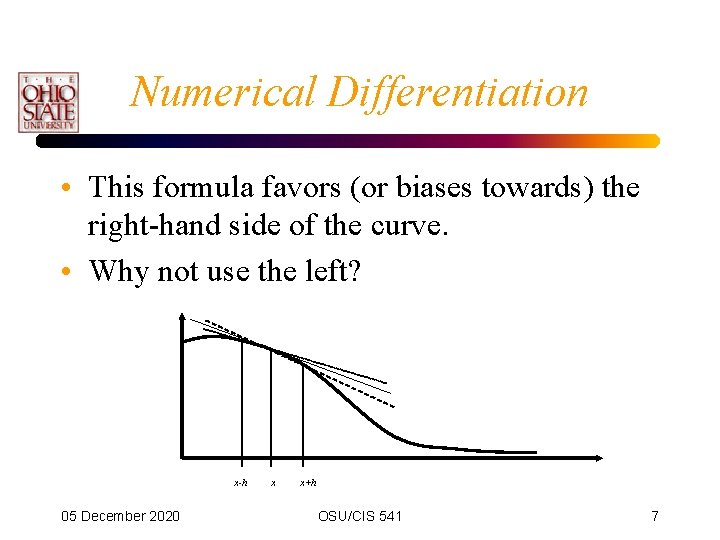
Numerical Differentiation • This formula favors (or biases towards) the right-hand side of the curve. • Why not use the left? x-h 05 December 2020 x x+h OSU/CIS 541 7
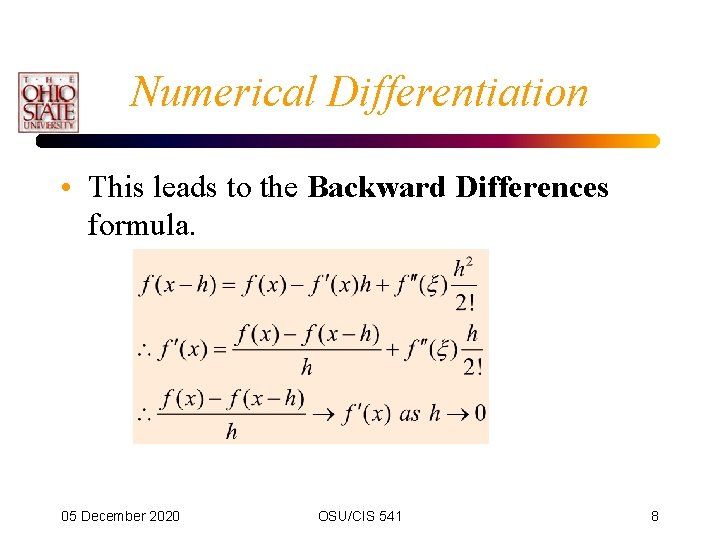
Numerical Differentiation • This leads to the Backward Differences formula. 05 December 2020 OSU/CIS 541 8
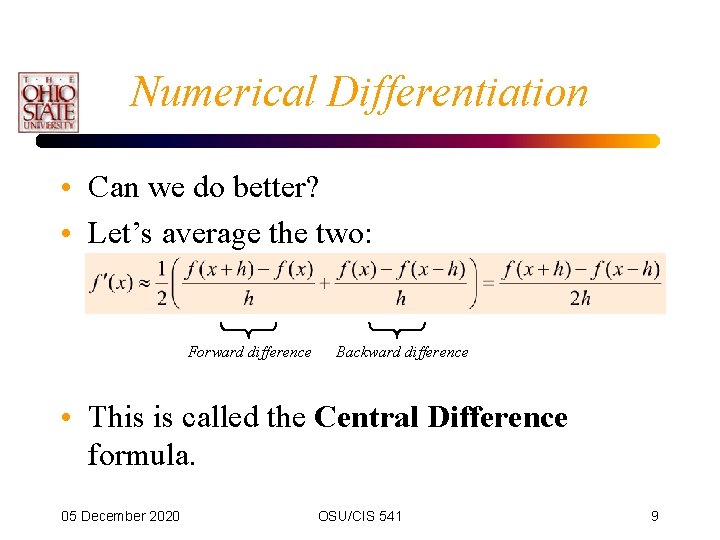
Numerical Differentiation • Can we do better? • Let’s average the two: Forward difference Backward difference • This is called the Central Difference formula. 05 December 2020 OSU/CIS 541 9
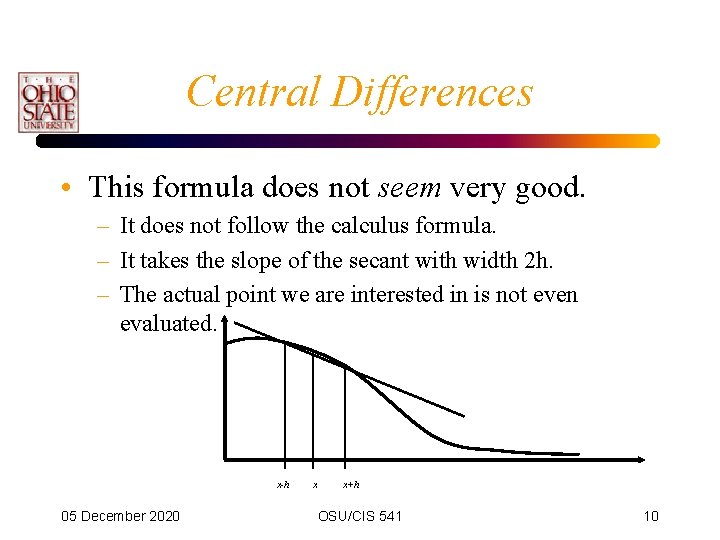
Central Differences • This formula does not seem very good. – It does not follow the calculus formula. – It takes the slope of the secant with width 2 h. – The actual point we are interested in is not even evaluated. x-h 05 December 2020 x x+h OSU/CIS 541 10
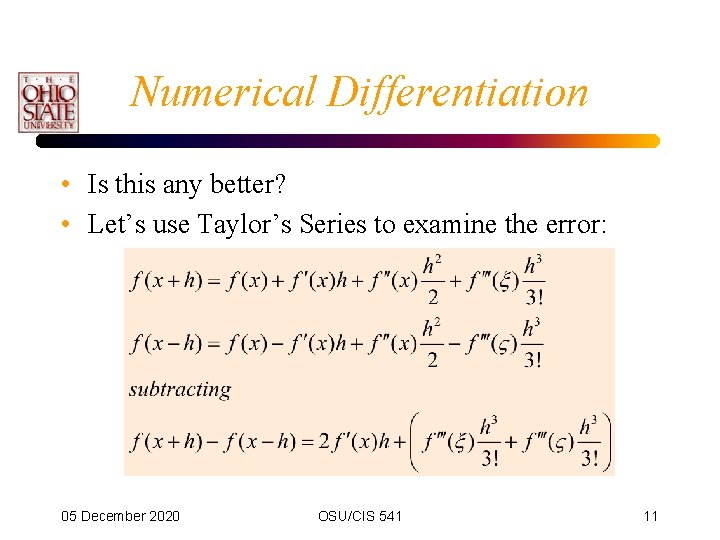
Numerical Differentiation • Is this any better? • Let’s use Taylor’s Series to examine the error: 05 December 2020 OSU/CIS 541 11
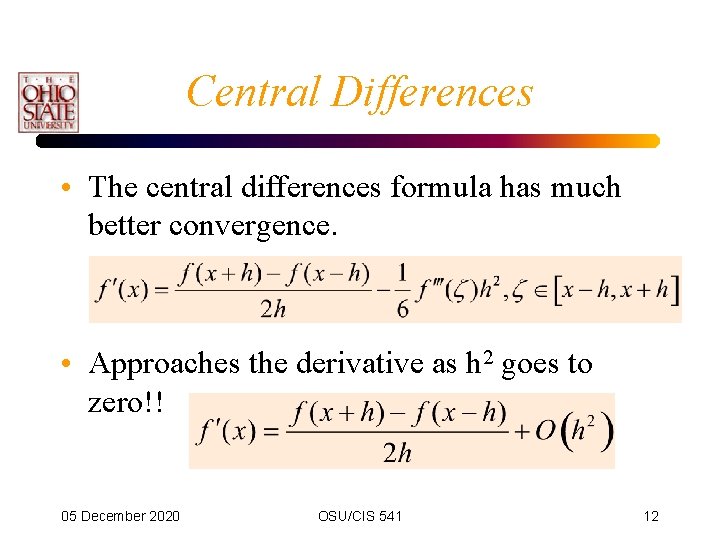
Central Differences • The central differences formula has much better convergence. • Approaches the derivative as h 2 goes to zero!! 05 December 2020 OSU/CIS 541 12
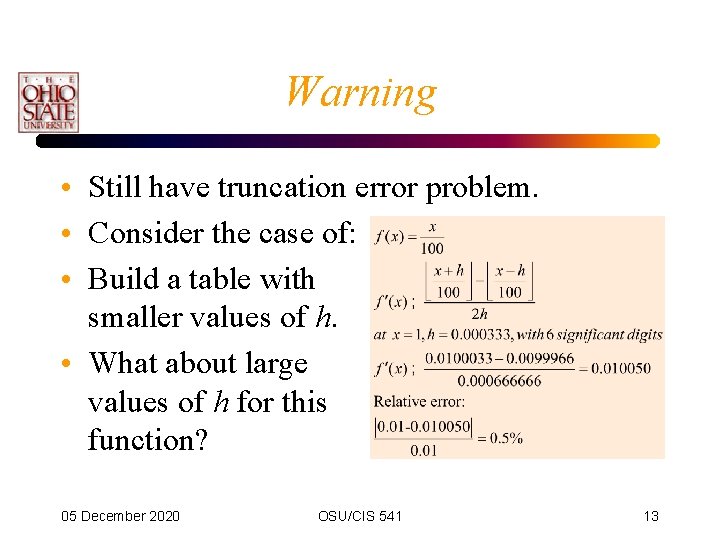
Warning • Still have truncation error problem. • Consider the case of: • Build a table with smaller values of h. • What about large values of h for this function? 05 December 2020 OSU/CIS 541 13
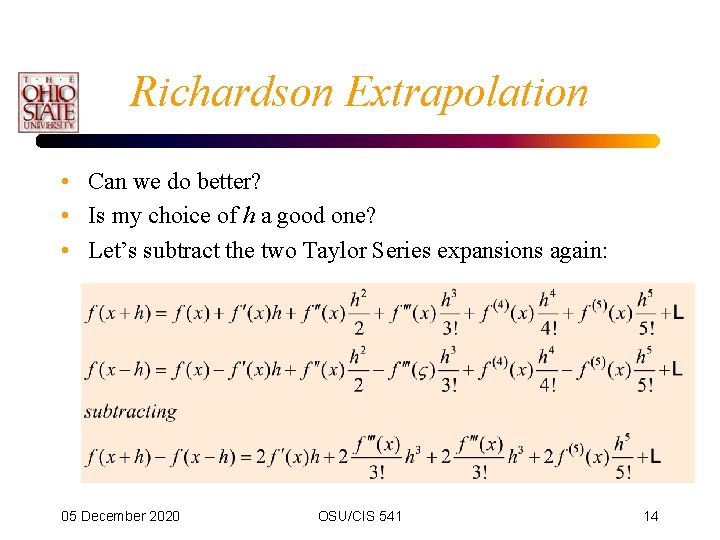
Richardson Extrapolation • Can we do better? • Is my choice of h a good one? • Let’s subtract the two Taylor Series expansions again: 05 December 2020 OSU/CIS 541 14
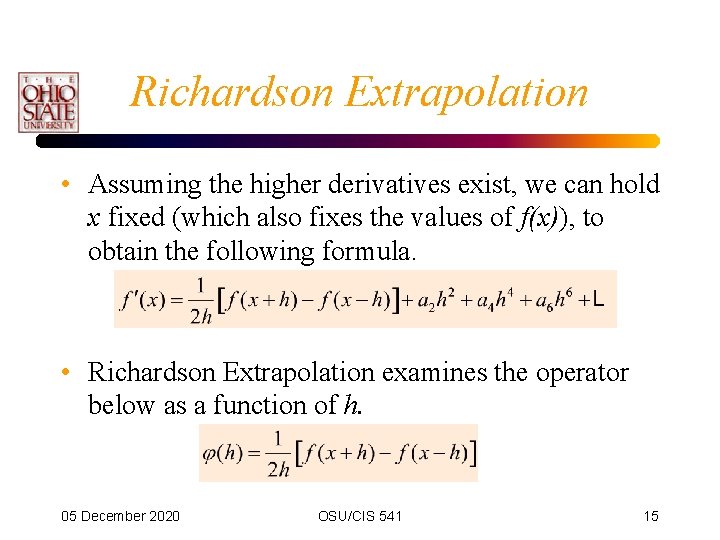
Richardson Extrapolation • Assuming the higher derivatives exist, we can hold x fixed (which also fixes the values of f(x)), to obtain the following formula. • Richardson Extrapolation examines the operator below as a function of h. 05 December 2020 OSU/CIS 541 15
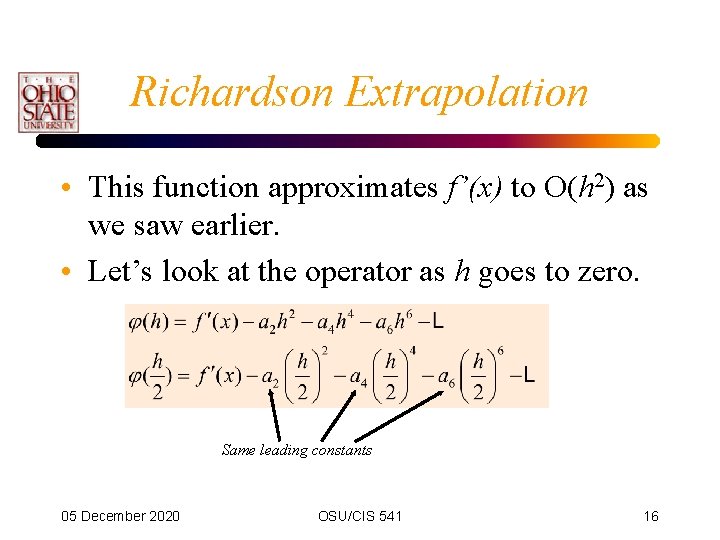
Richardson Extrapolation • This function approximates f’(x) to O(h 2) as we saw earlier. • Let’s look at the operator as h goes to zero. Same leading constants 05 December 2020 OSU/CIS 541 16
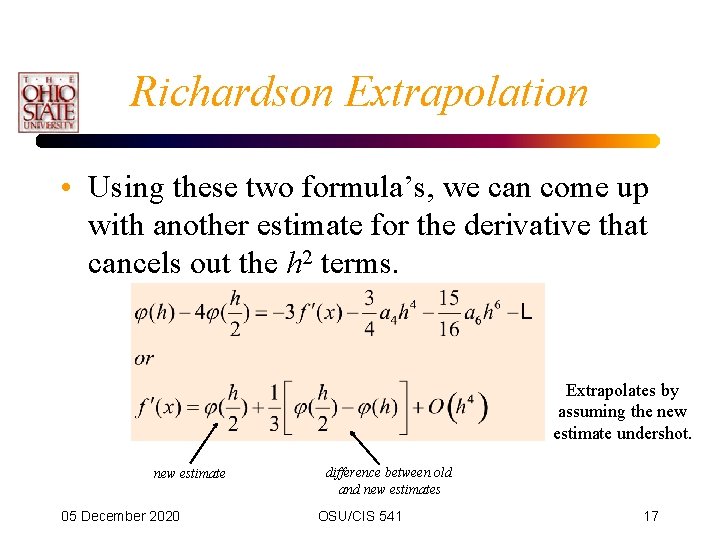
Richardson Extrapolation • Using these two formula’s, we can come up with another estimate for the derivative that cancels out the h 2 terms. Extrapolates by assuming the new estimate undershot. new estimate 05 December 2020 difference between old and new estimates OSU/CIS 541 17
Richardson Extrapolation • If h is small (h<<1), then h 4 goes to zero much faster than h 2. • Cool!!! • Can we cancel out the h 6 term? – Yes, by using h/4 to estimate the derivative. 05 December 2020 OSU/CIS 541 18
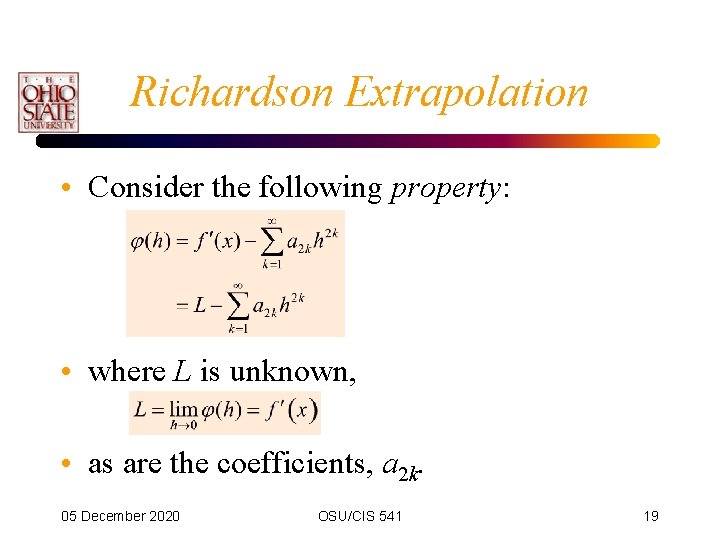
Richardson Extrapolation • Consider the following property: • where L is unknown, • as are the coefficients, a 2 k. 05 December 2020 OSU/CIS 541 19
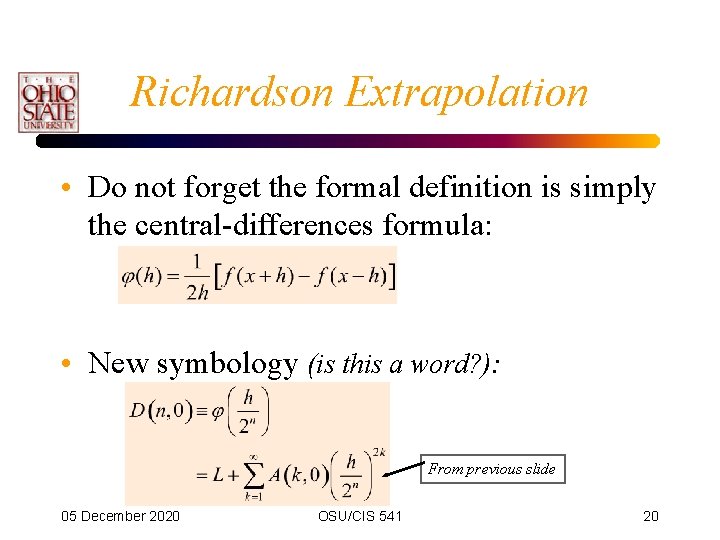
Richardson Extrapolation • Do not forget the formal definition is simply the central-differences formula: • New symbology (is this a word? ): From previous slide 05 December 2020 OSU/CIS 541 20
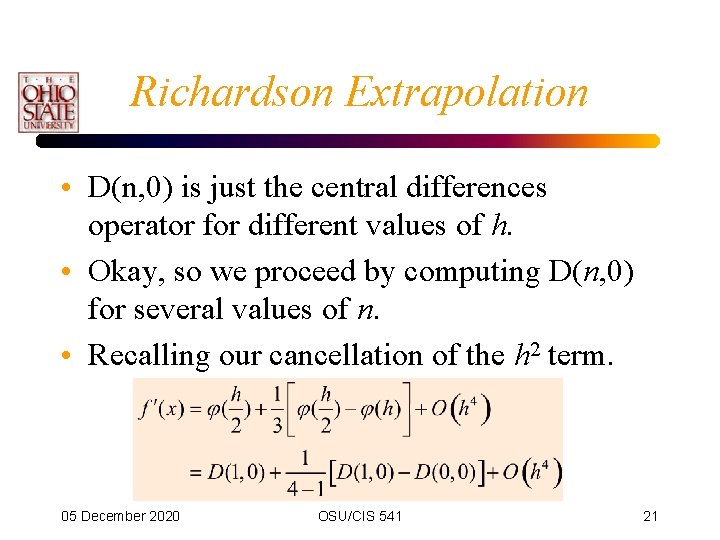
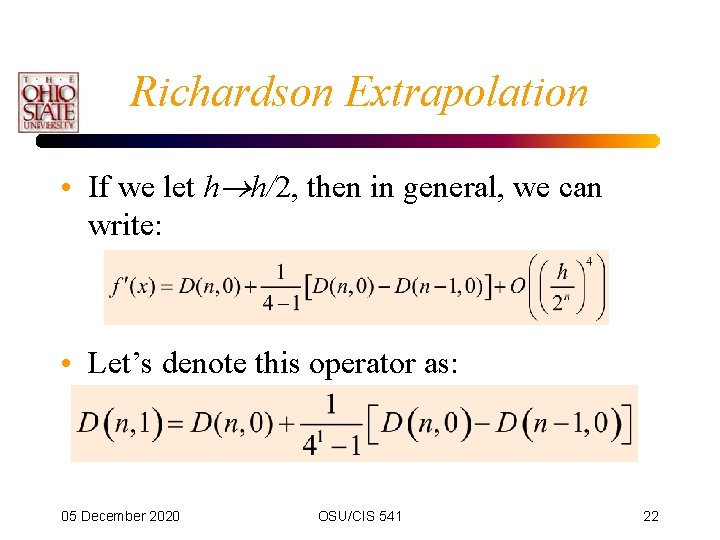
Richardson Extrapolation • D(n, 0) is just the central differences operator for different values of h. • Okay, so we proceed by computing D(n, 0) for several values of n. • Recalling our cancellation of the h 2 term. 05 December 2020 OSU/CIS 541 21
Richardson Extrapolation • If we let h h/2, then in general, we can write: • Let’s denote this operator as: 05 December 2020 OSU/CIS 541 22
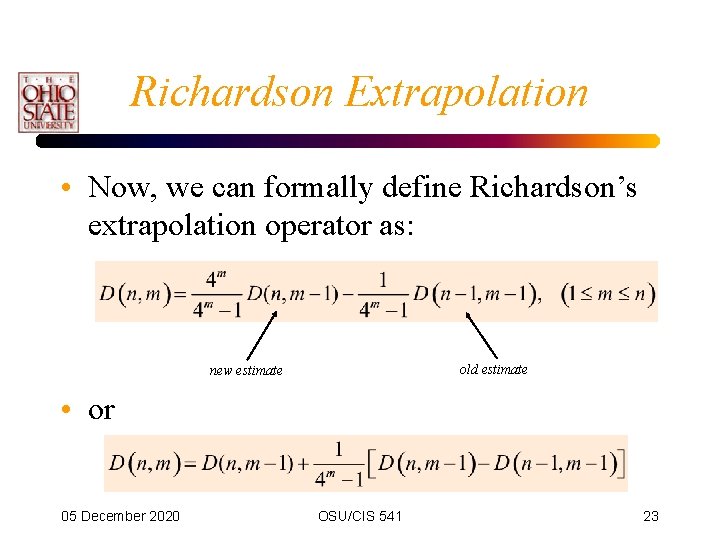
Richardson Extrapolation • Now, we can formally define Richardson’s extrapolation operator as: old estimate new estimate • or 05 December 2020 OSU/CIS 541 23
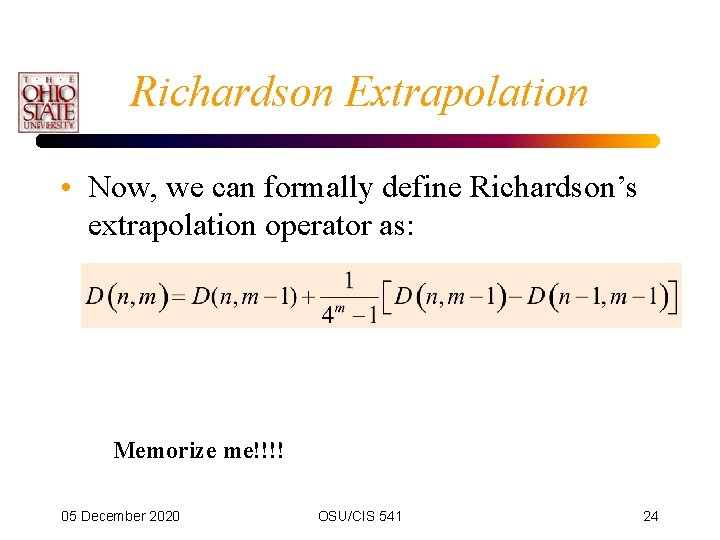
Richardson Extrapolation • Now, we can formally define Richardson’s extrapolation operator as: Memorize me!!!! 05 December 2020 OSU/CIS 541 24
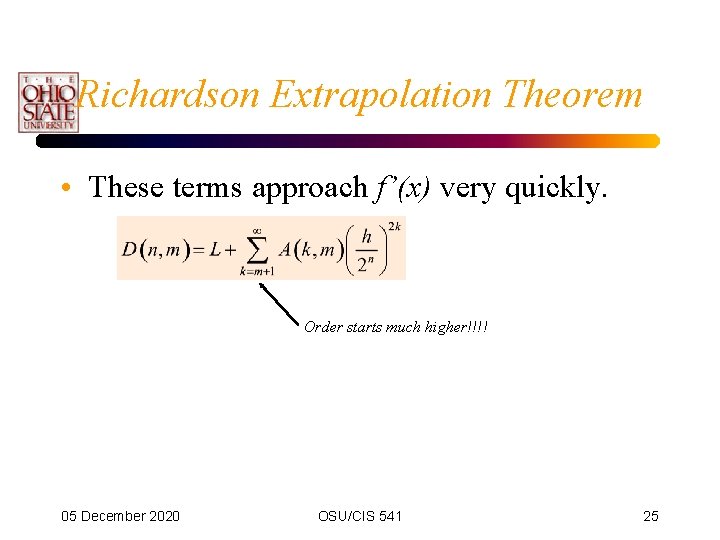
Richardson Extrapolation Theorem • These terms approach f’(x) very quickly. Order starts much higher!!!! 05 December 2020 OSU/CIS 541 25
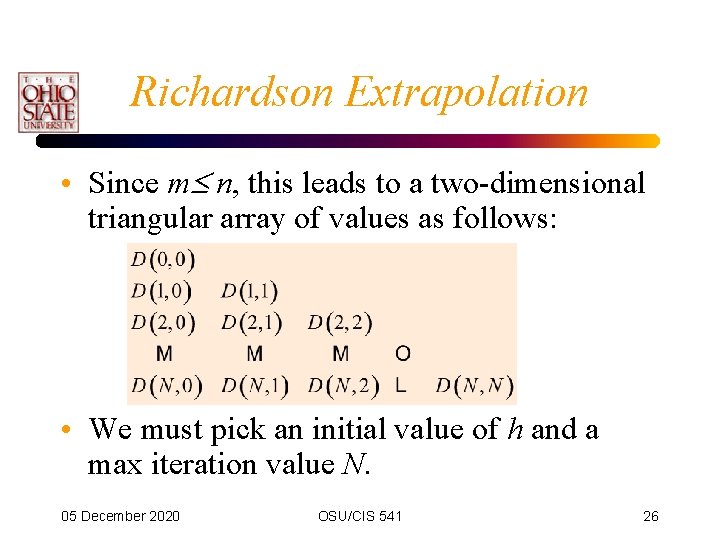
Richardson Extrapolation • Since m n, this leads to a two-dimensional triangular array of values as follows: • We must pick an initial value of h and a max iteration value N. 05 December 2020 OSU/CIS 541 26
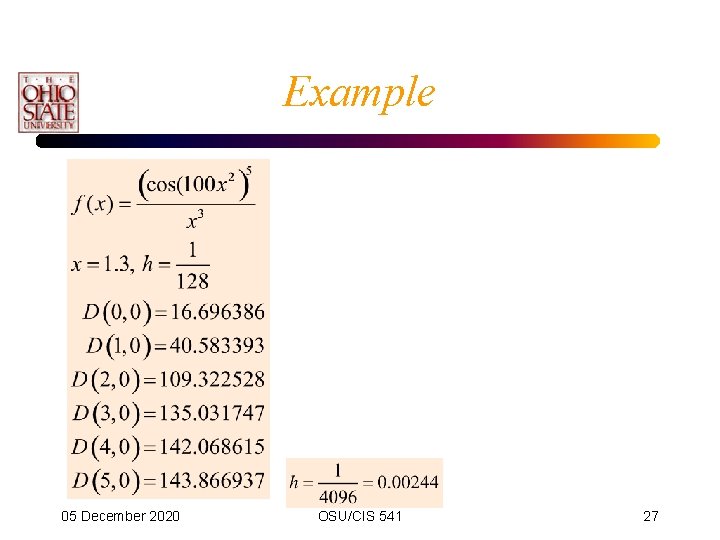
Example 05 December 2020 OSU/CIS 541 27
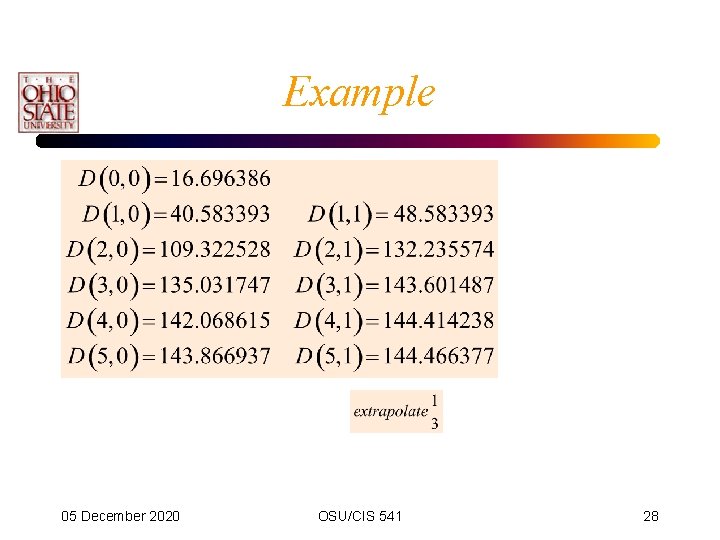
Example 05 December 2020 OSU/CIS 541 28
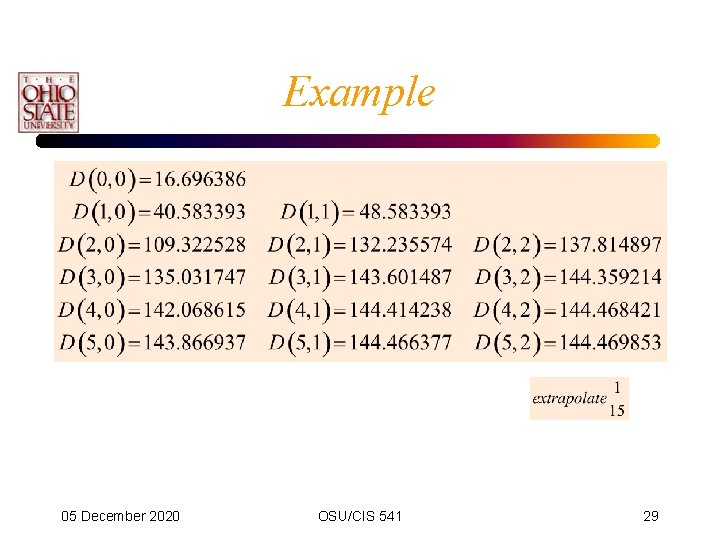
Example 05 December 2020 OSU/CIS 541 29
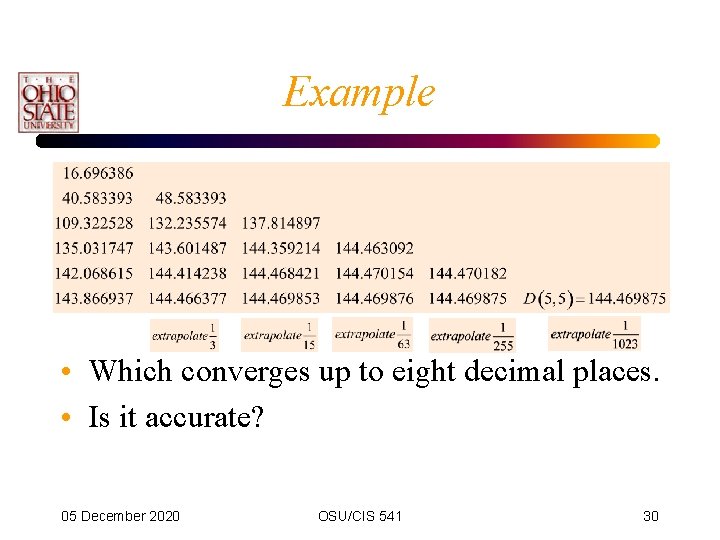
Example • Which converges up to eight decimal places. • Is it accurate? 05 December 2020 OSU/CIS 541 30
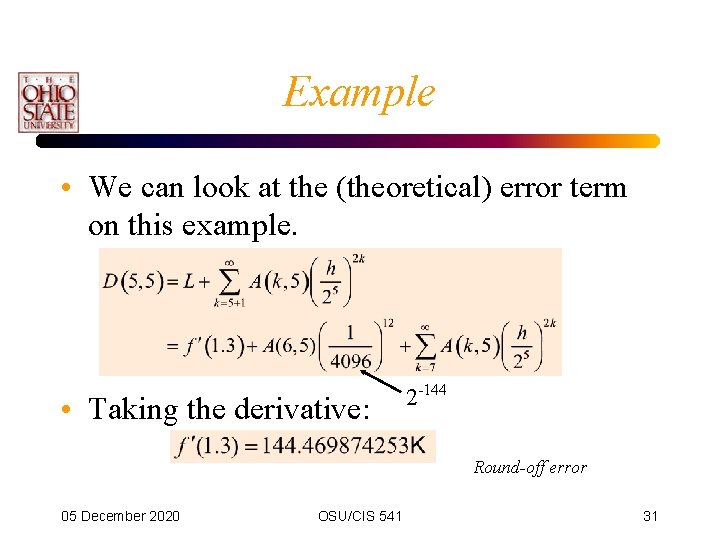
Example • We can look at the (theoretical) error term on this example. • Taking the derivative: 2 -144 Round-off error 05 December 2020 OSU/CIS 541 31
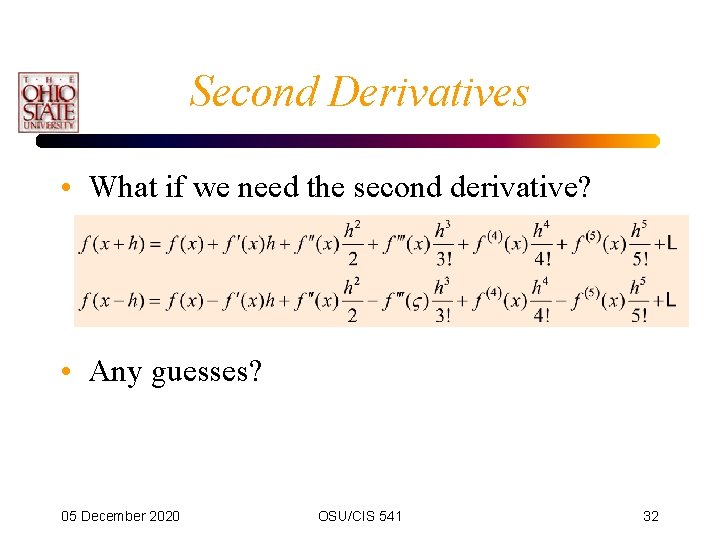
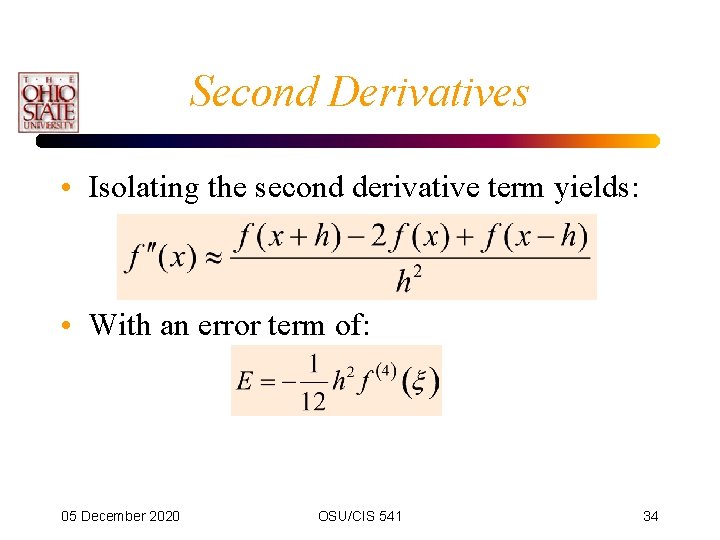
Second Derivatives • What if we need the second derivative? • Any guesses? 05 December 2020 OSU/CIS 541 32
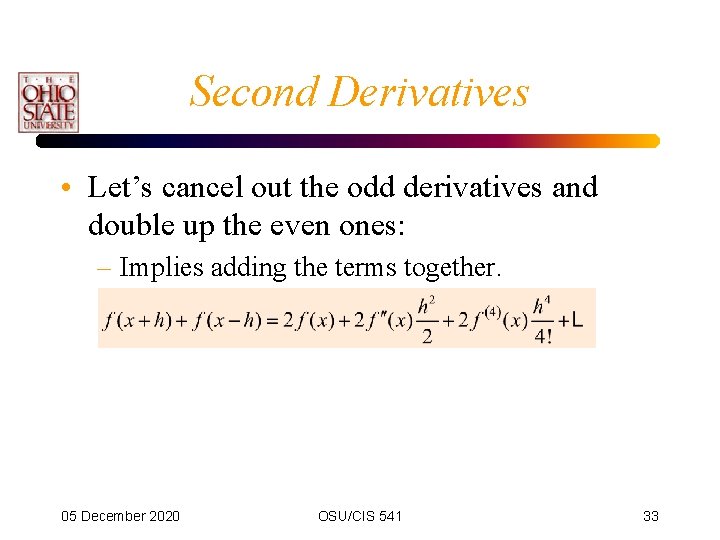
Second Derivatives • Let’s cancel out the odd derivatives and double up the even ones: – Implies adding the terms together. 05 December 2020 OSU/CIS 541 33
Second Derivatives • Isolating the second derivative term yields: • With an error term of: 05 December 2020 OSU/CIS 541 34
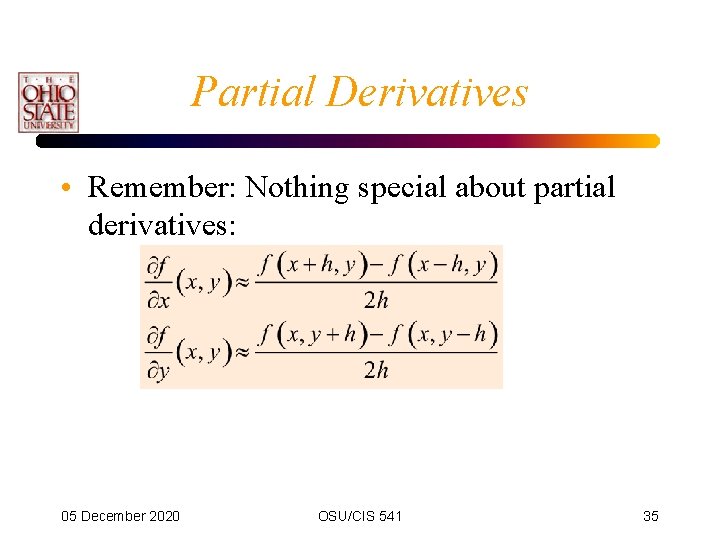
Partial Derivatives • Remember: Nothing special about partial derivatives: 05 December 2020 OSU/CIS 541 35
Calculating the Gradient • For lab 2, you need to calculate the gradient. • Just use central differences for each partial derivative. • Remember to normalize it (divide by its length). 05 December 2020 OSU/CIS 541 36