
CSE 5243 INTRO TO DATA MINING Cluster Analysis
- Slides: 68
CSE 5243 INTRO. TO DATA MINING Cluster Analysis: Basic Concepts and Methods Huan Sun, CSE@The Ohio State University 09/28/2017 Slides adapted from UIUC CS 412, Fall 2017, by Prof. Jiawei Han
Chapter 10. Cluster Analysis: Basic Concepts and Methods 2 Cluster Analysis: An Introduction Partitioning Methods Hierarchical Methods Density- and Grid-Based Methods Evaluation of Clustering Summary
Clustering Algorithms 3 K-means and its variants Hierarchical clustering Density-based clustering
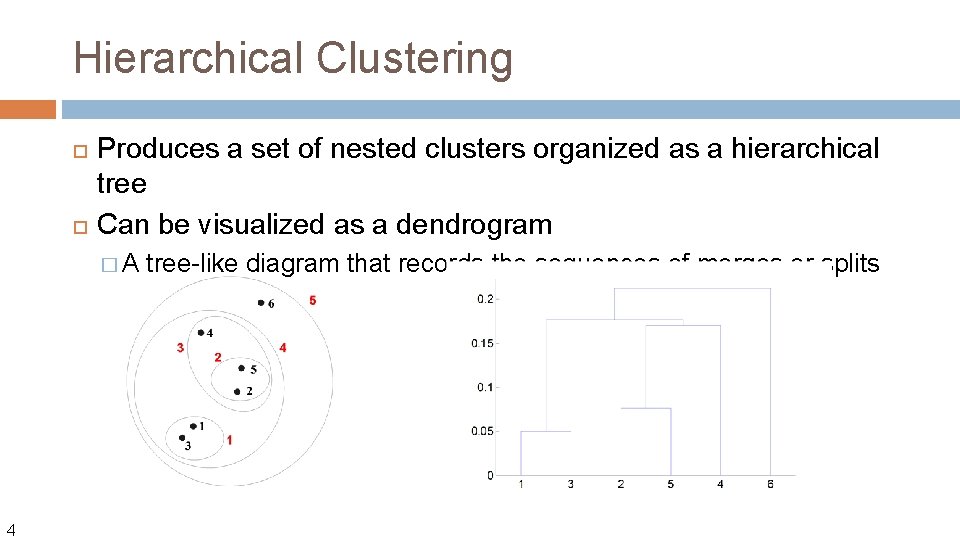
Hierarchical Clustering Produces a set of nested clusters organized as a hierarchical tree Can be visualized as a dendrogram �A 4 tree-like diagram that records the sequences of merges or splits
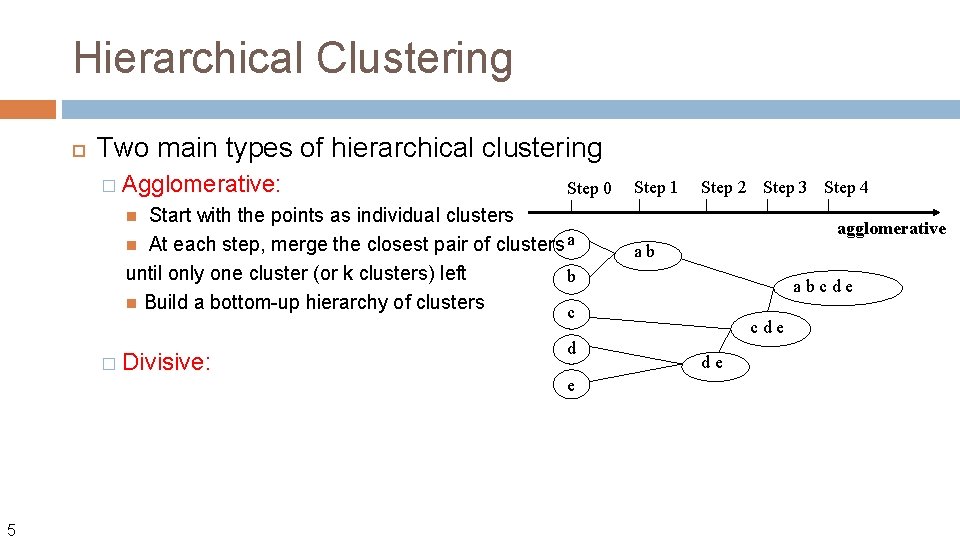
Hierarchical Clustering Two main types of hierarchical clustering � Agglomerative: Step 0 Start with the points as individual clusters At each step, merge the closest pair of clusters a until only one cluster (or k clusters) left b Build a bottom-up hierarchy of clusters c Step 1 Step 2 Step 3 Step 4 � Divisive: 5 d e agglomerative ab abcde de
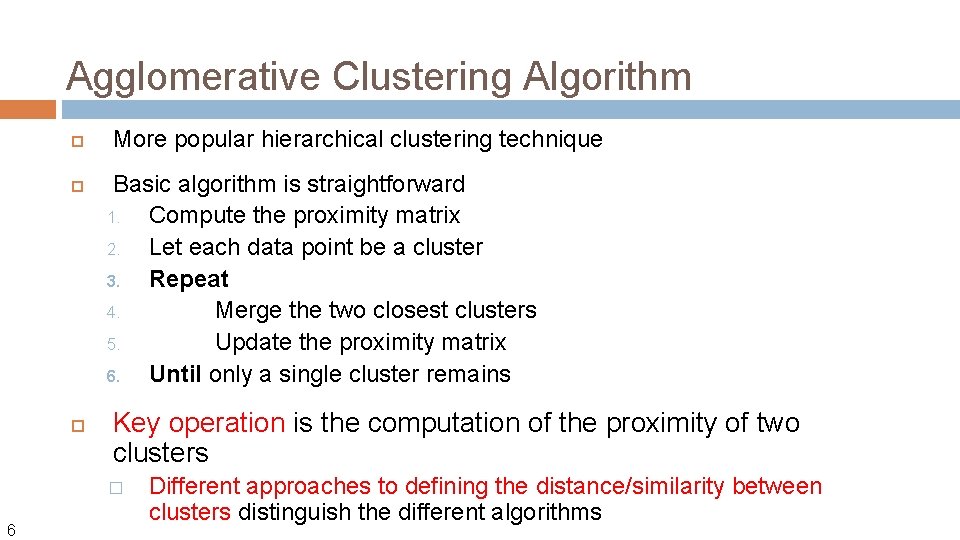
Agglomerative Clustering Algorithm More popular hierarchical clustering technique Basic algorithm is straightforward 1. Compute the proximity matrix 2. Let each data point be a cluster 3. Repeat 4. Merge the two closest clusters 5. Update the proximity matrix 6. Until only a single cluster remains Key operation is the computation of the proximity of two clusters � 6 Different approaches to defining the distance/similarity between clusters distinguish the different algorithms
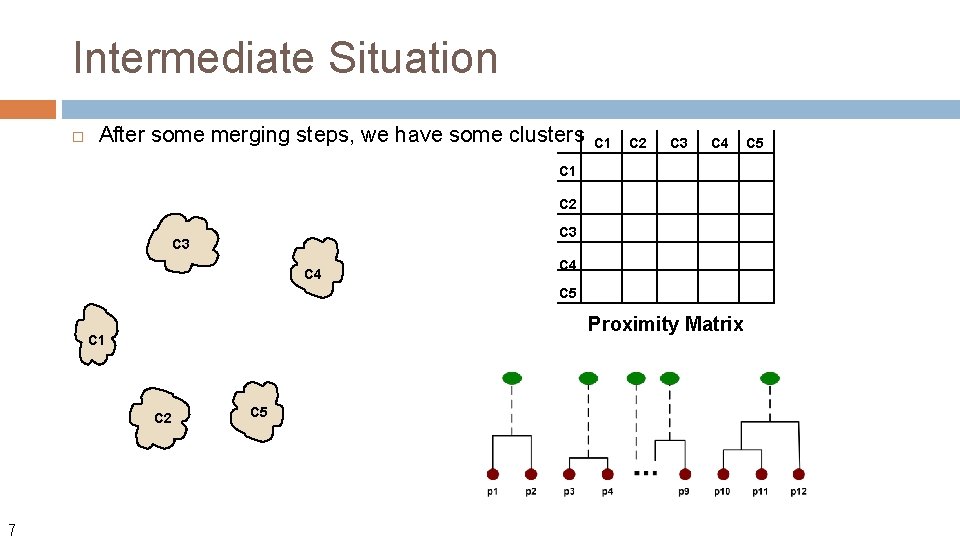
Intermediate Situation After some merging steps, we have some clusters C 1 C 2 C 3 C 4 C 5 Proximity Matrix C 1 C 2 7 C 5
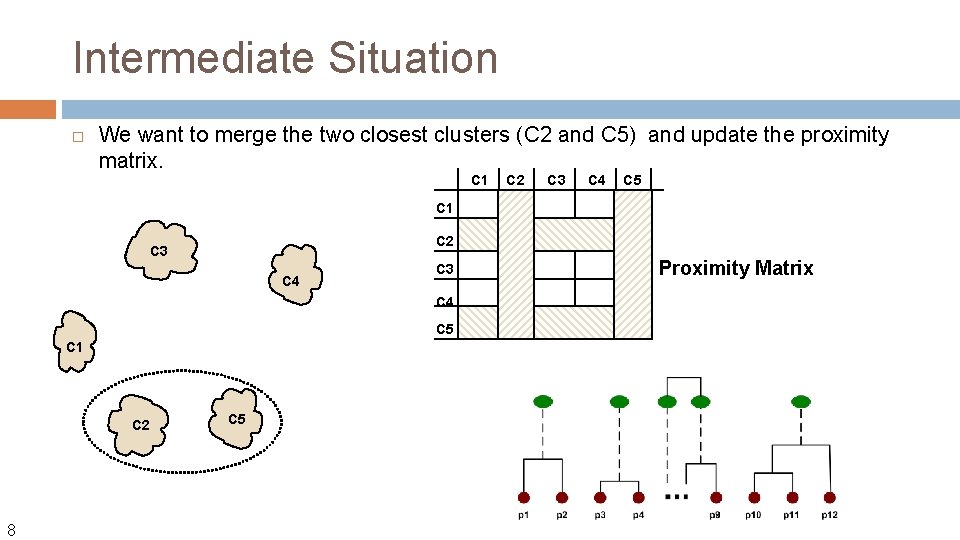
Intermediate Situation We want to merge the two closest clusters (C 2 and C 5) and update the proximity matrix. C 1 C 2 C 3 C 4 C 5 C 1 C 2 8 C 5 Proximity Matrix
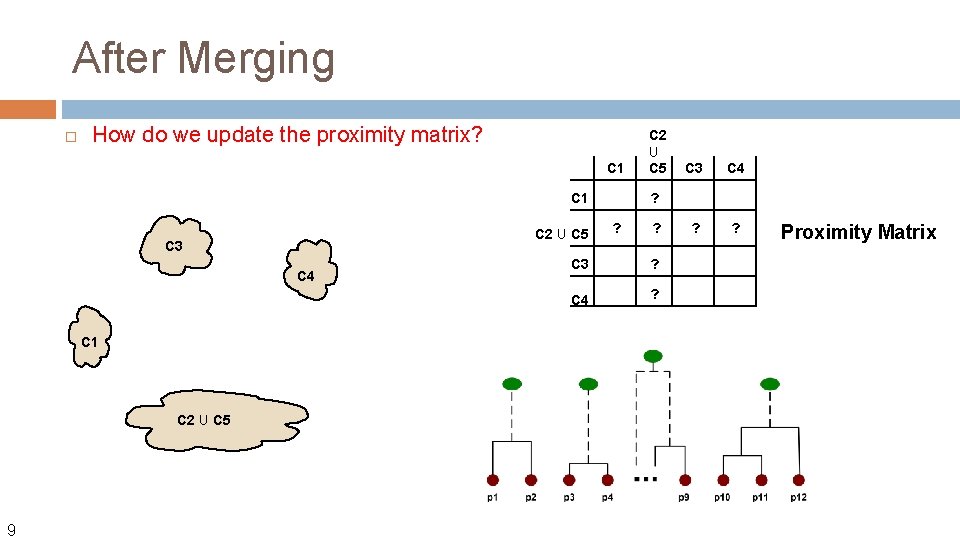
After Merging How do we update the proximity matrix? C 1 C 2 U C 5 C 3 C 4 C 1 C 2 U C 5 9 C 2 U C 5 C 3 C 4 ? ? ? C 3 ? C 4 ? Proximity Matrix
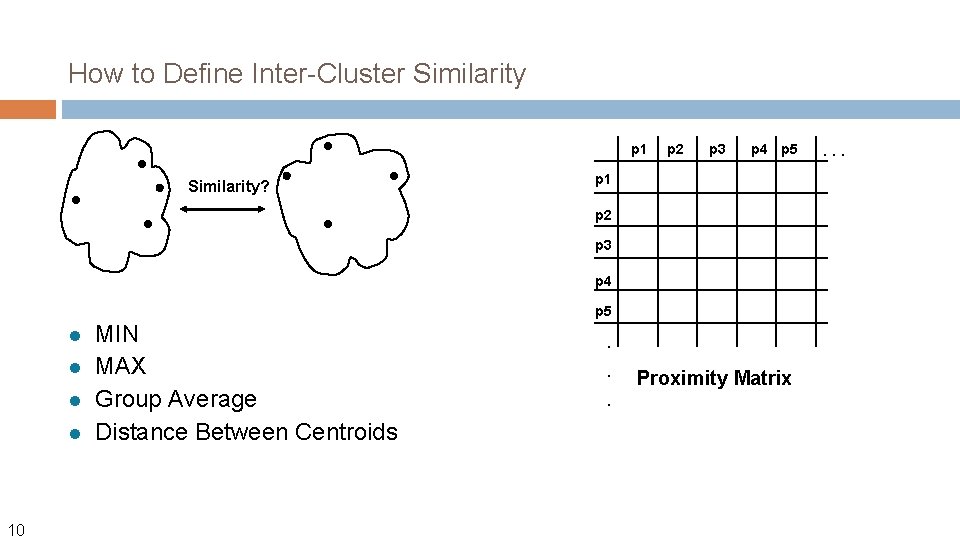
How to Define Inter-Cluster Similarity p 1 Similarity? p 2 p 3 p 4 p 5 p 1 p 2 p 3 p 4 p 5 l l 10 MIN MAX Group Average Distance Between Centroids . . . Proximity Matrix . . .
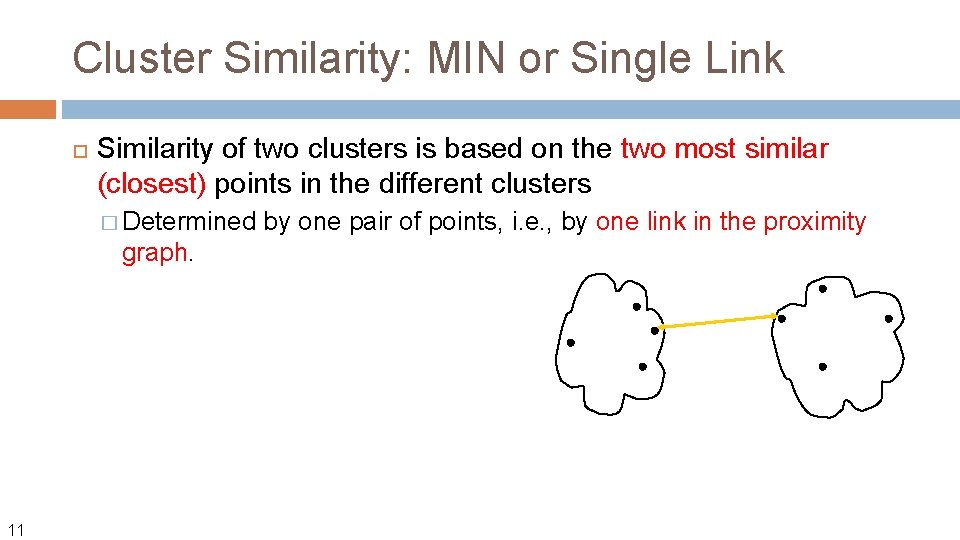
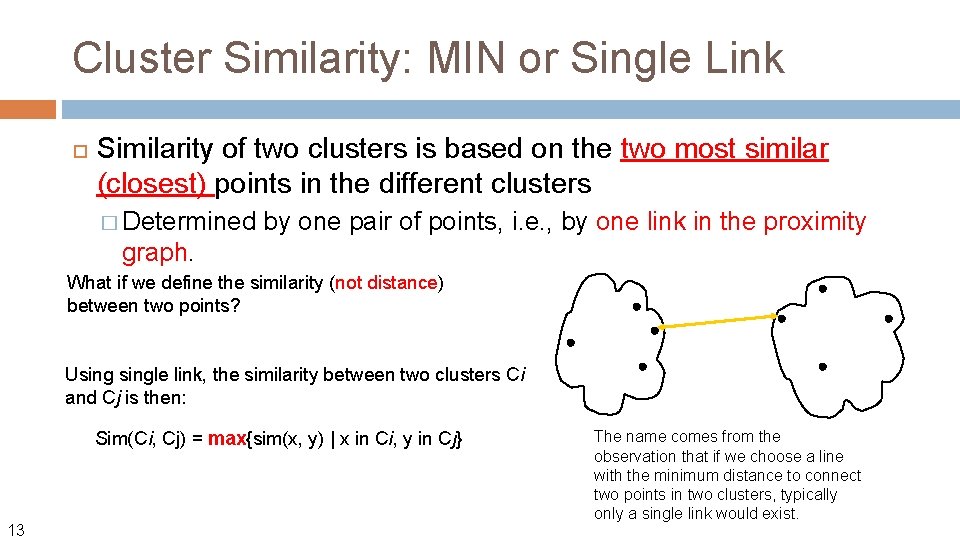
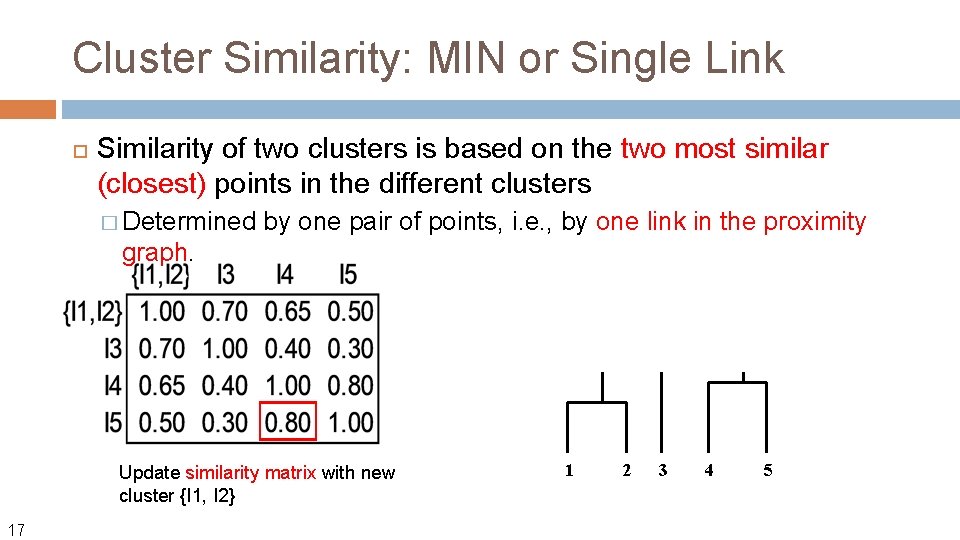
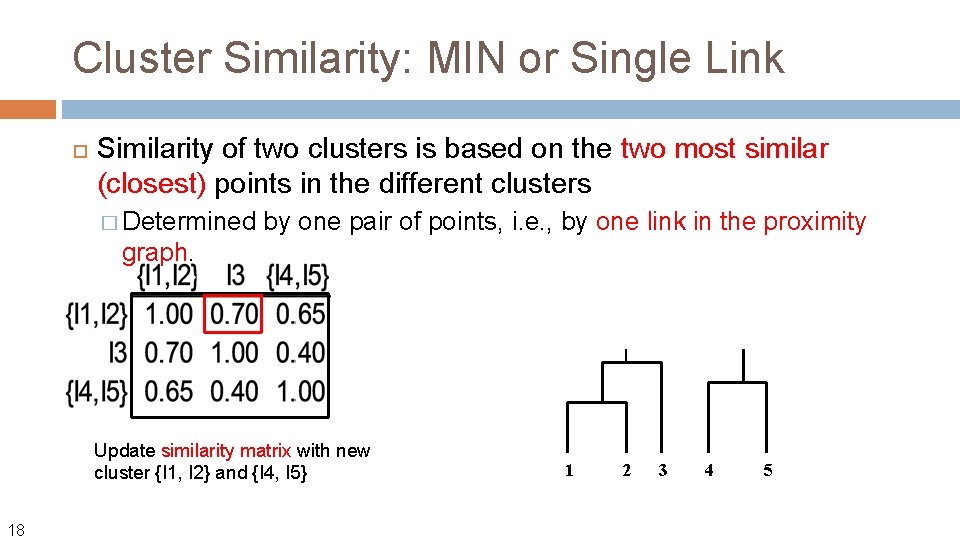
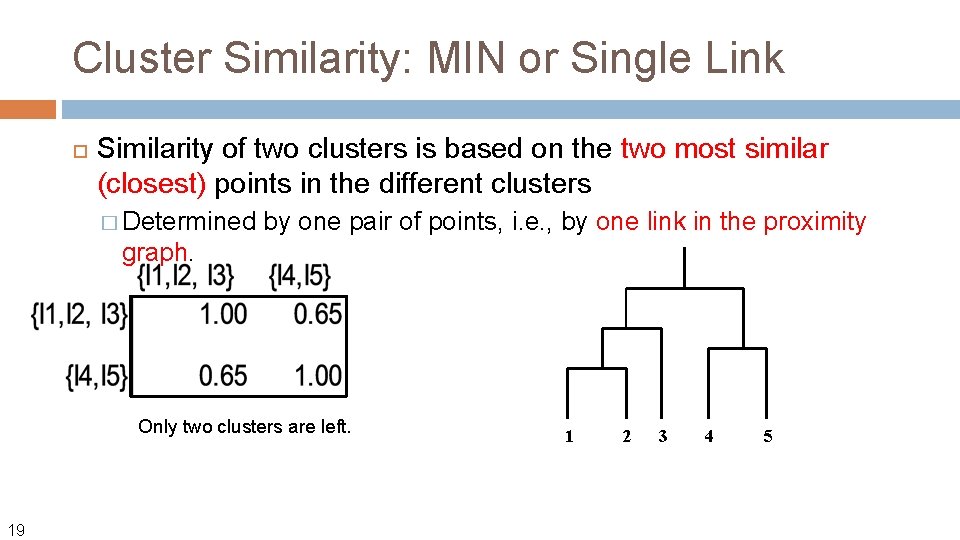
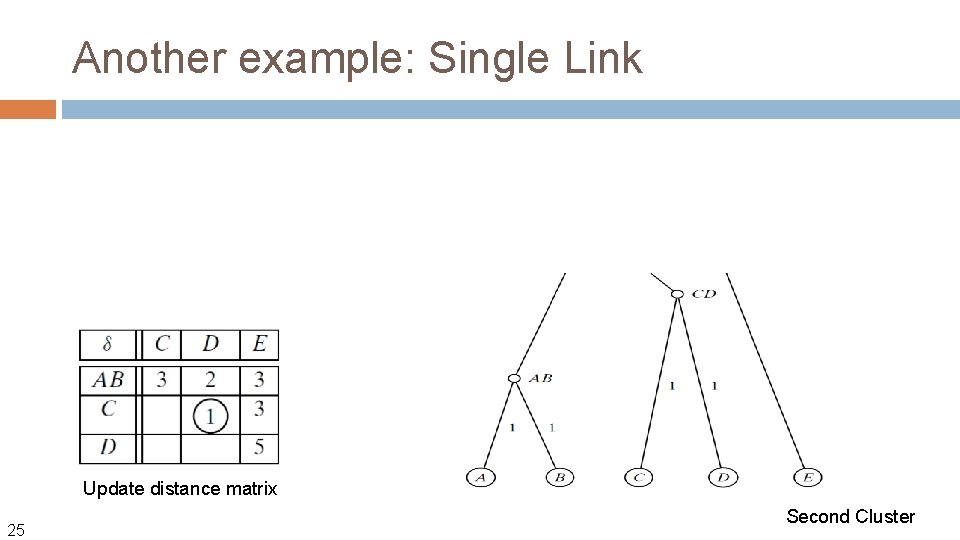
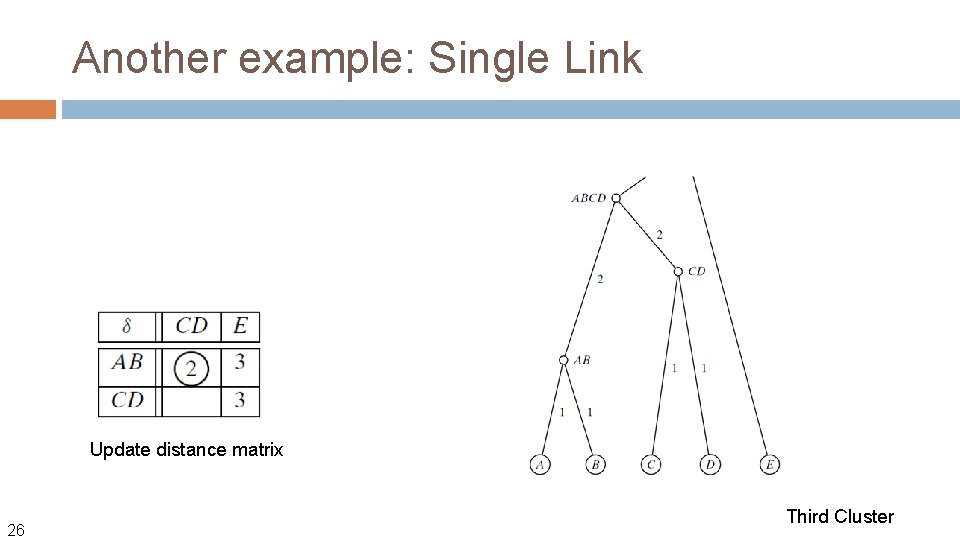
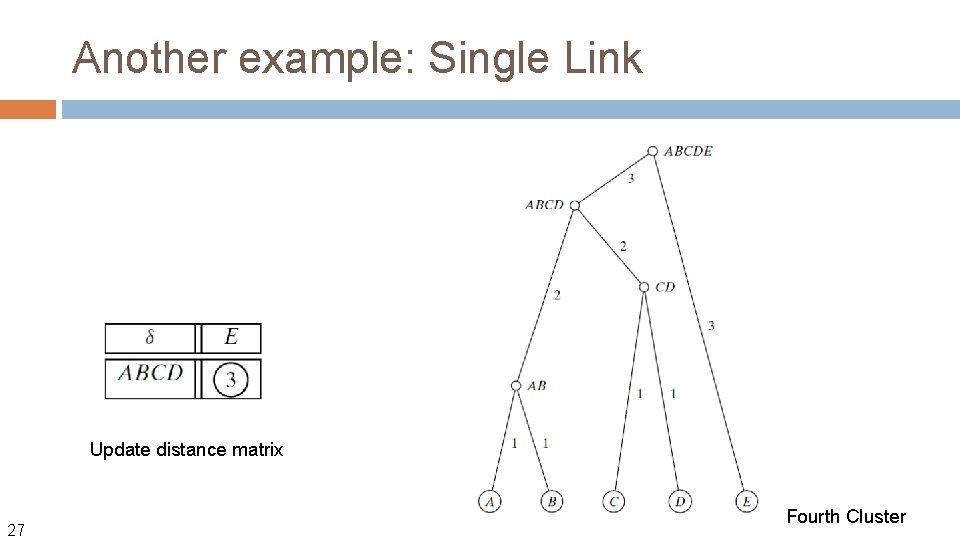
Cluster Similarity: MIN or Single Link Similarity of two clusters is based on the two most similar (closest) points in the different clusters � Determined graph. 11 by one pair of points, i. e. , by one link in the proximity
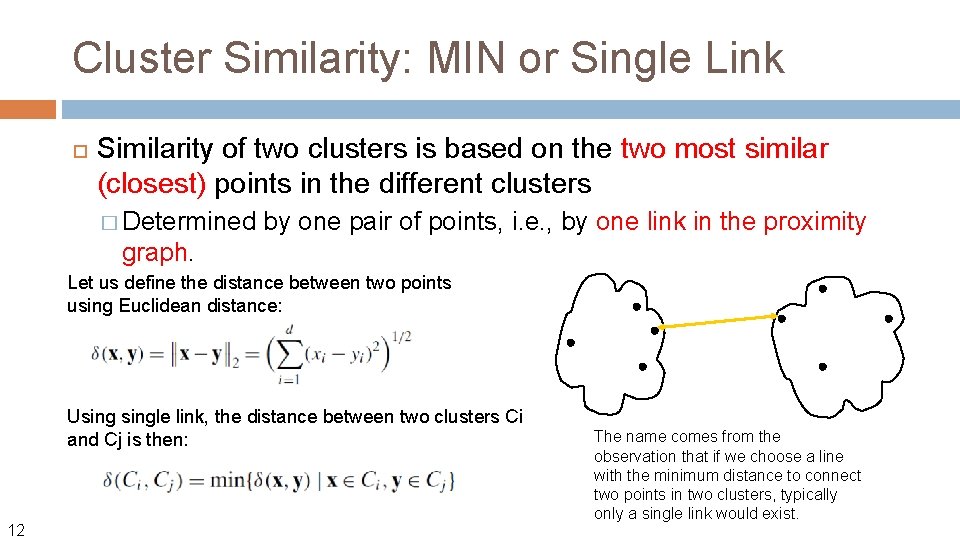
Cluster Similarity: MIN or Single Link Similarity of two clusters is based on the two most similar (closest) points in the different clusters � Determined by one pair of points, i. e. , by one link in the proximity graph. Let us define the distance between two points using Euclidean distance: Usingle link, the distance between two clusters Ci and Cj is then: 12 The name comes from the observation that if we choose a line with the minimum distance to connect two points in two clusters, typically only a single link would exist.
Cluster Similarity: MIN or Single Link Similarity of two clusters is based on the two most similar (closest) points in the different clusters � Determined by one pair of points, i. e. , by one link in the proximity graph. What if we define the similarity (not distance) between two points? Usingle link, the similarity between two clusters Ci and Cj is then: Sim(Ci, Cj) = max{sim(x, y) | x in Ci, y in Cj} 13 The name comes from the observation that if we choose a line with the minimum distance to connect two points in two clusters, typically only a single link would exist.
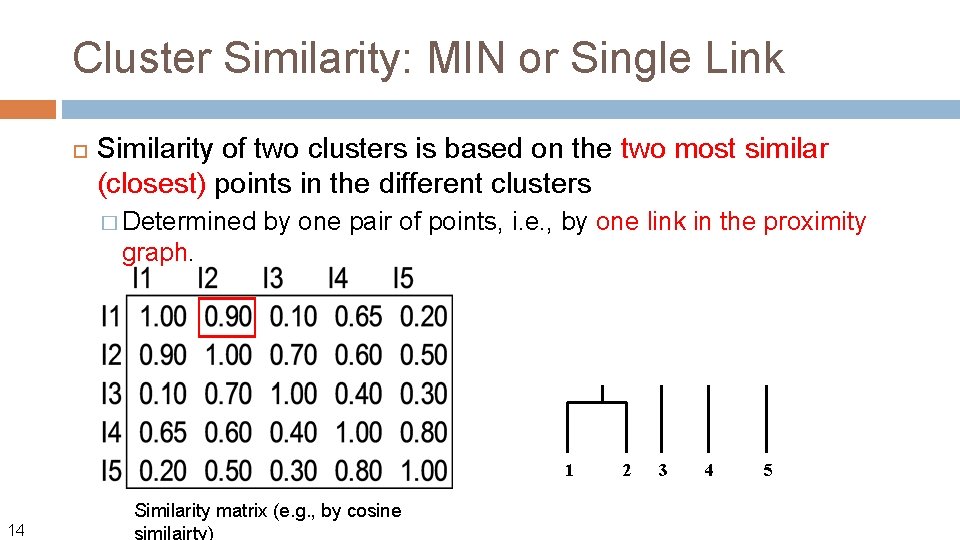
Cluster Similarity: MIN or Single Link Similarity of two clusters is based on the two most similar (closest) points in the different clusters � Determined by one pair of points, i. e. , by one link in the proximity graph. 1 14 Similarity matrix (e. g. , by cosine similairty) 2 3 4 5
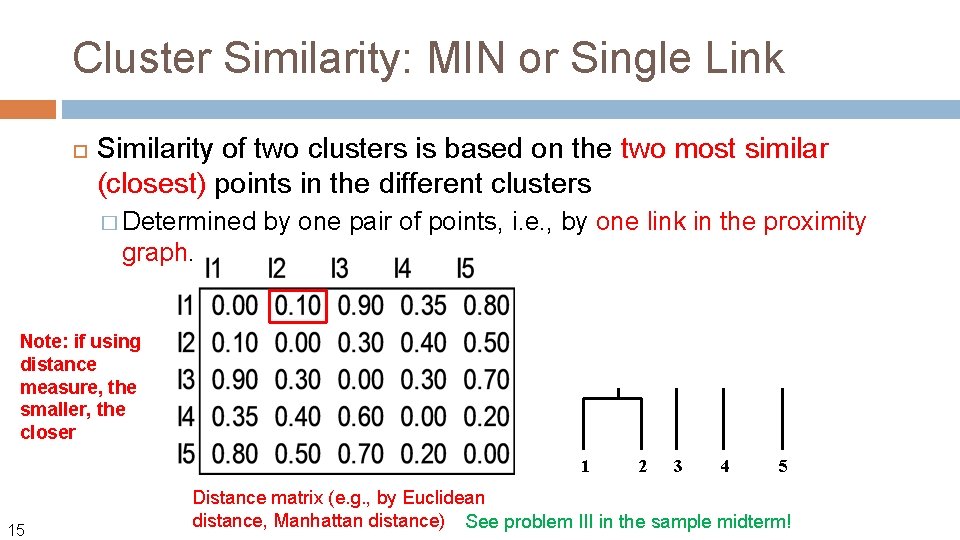
Cluster Similarity: MIN or Single Link Similarity of two clusters is based on the two most similar (closest) points in the different clusters � Determined by one pair of points, i. e. , by one link in the proximity graph. Note: if using distance measure, the smaller, the closer 1 15 2 3 4 5 Distance matrix (e. g. , by Euclidean distance, Manhattan distance) See problem III in the sample midterm!
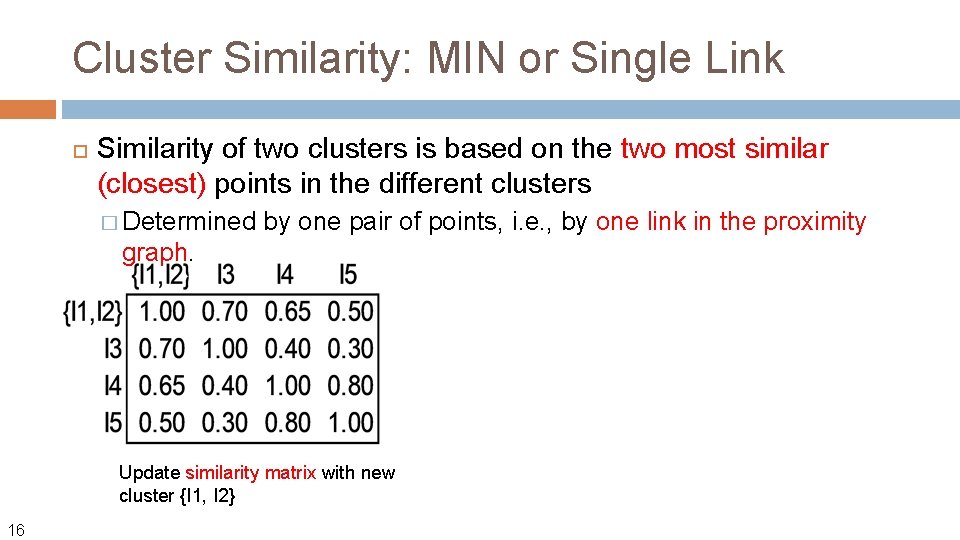
Cluster Similarity: MIN or Single Link Similarity of two clusters is based on the two most similar (closest) points in the different clusters � Determined by one pair of points, i. e. , by one link in the proximity graph. Update similarity matrix with new cluster {I 1, I 2} 16
Cluster Similarity: MIN or Single Link Similarity of two clusters is based on the two most similar (closest) points in the different clusters � Determined by one pair of points, i. e. , by one link in the proximity graph. Update similarity matrix with new cluster {I 1, I 2} 17 1 2 3 4 5
Cluster Similarity: MIN or Single Link Similarity of two clusters is based on the two most similar (closest) points in the different clusters � Determined by one pair of points, i. e. , by one link in the proximity graph. Update similarity matrix with new cluster {I 1, I 2} and {I 4, I 5} 18 1 2 3 4 5
Cluster Similarity: MIN or Single Link Similarity of two clusters is based on the two most similar (closest) points in the different clusters � Determined by one pair of points, i. e. , by one link in the proximity graph. Only two clusters are left. 19 1 2 3 4 5
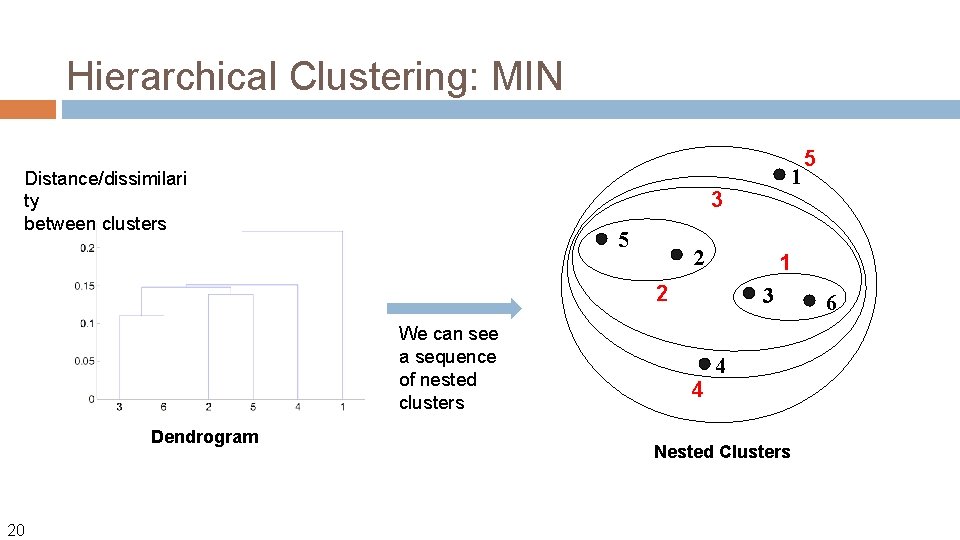
Hierarchical Clustering: MIN Distance/dissimilari ty between clusters 3 5 2 1 2 We can see a sequence of nested clusters Dendrogram 20 1 3 4 5 4 Nested Clusters 6
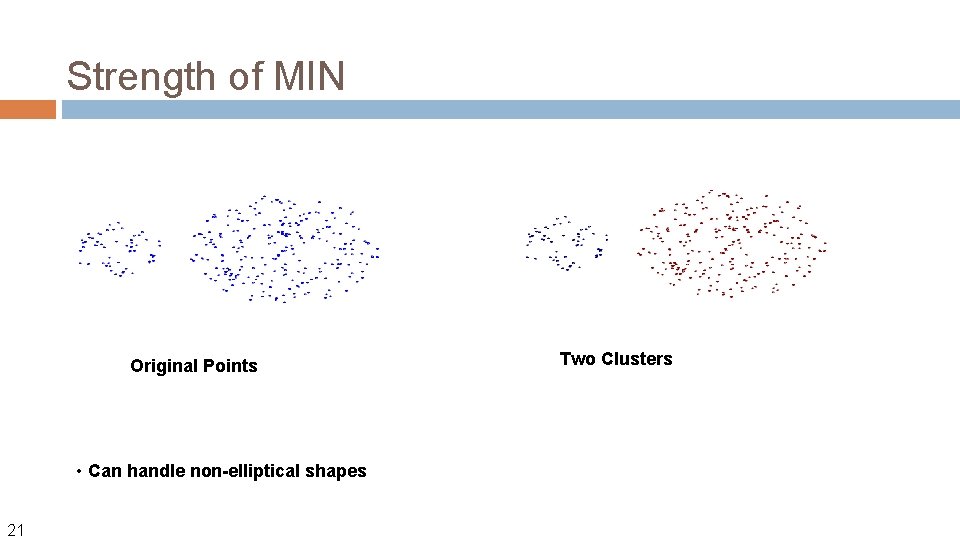
Strength of MIN Original Points • Can handle non-elliptical shapes 21 Two Clusters
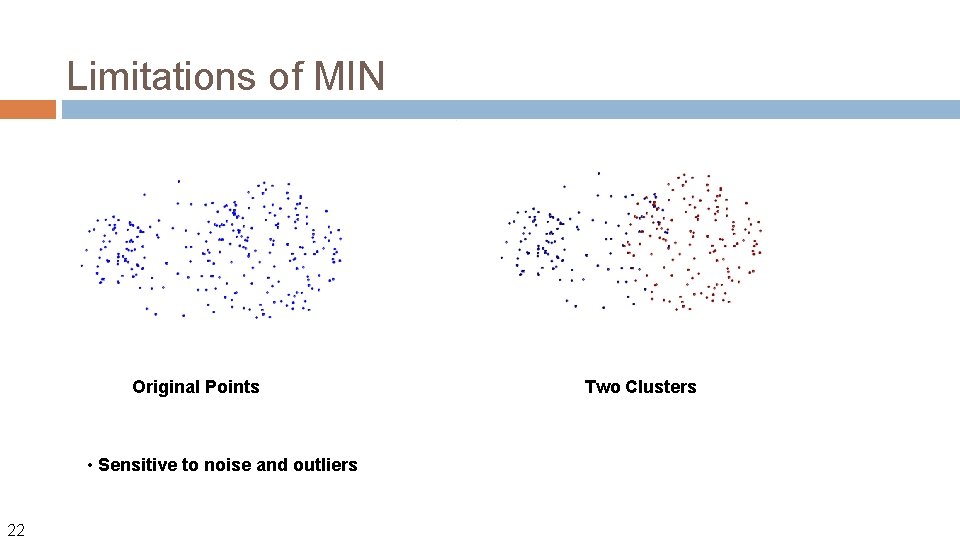
Limitations of MIN Original Points • Sensitive to noise and outliers 22 Two Clusters
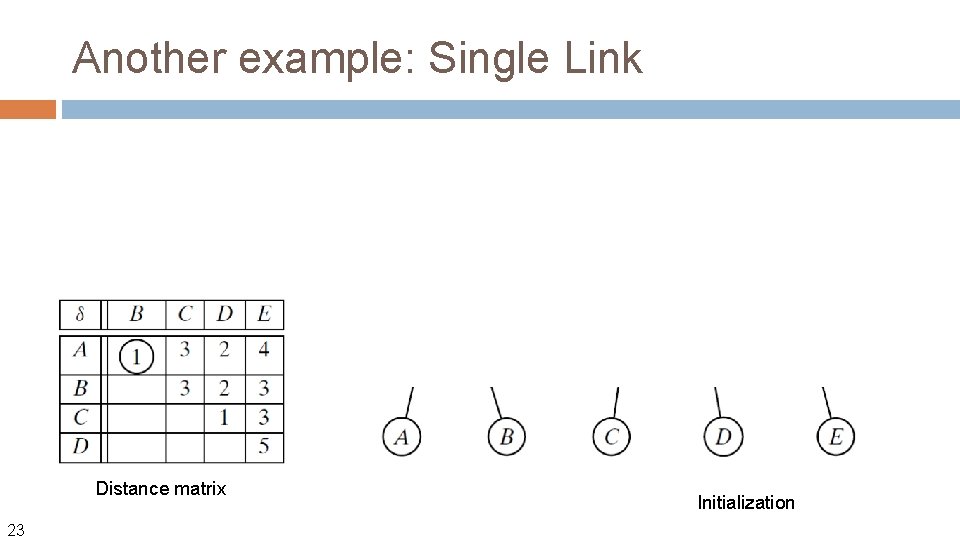
Another example: Single Link Distance matrix 23 Initialization
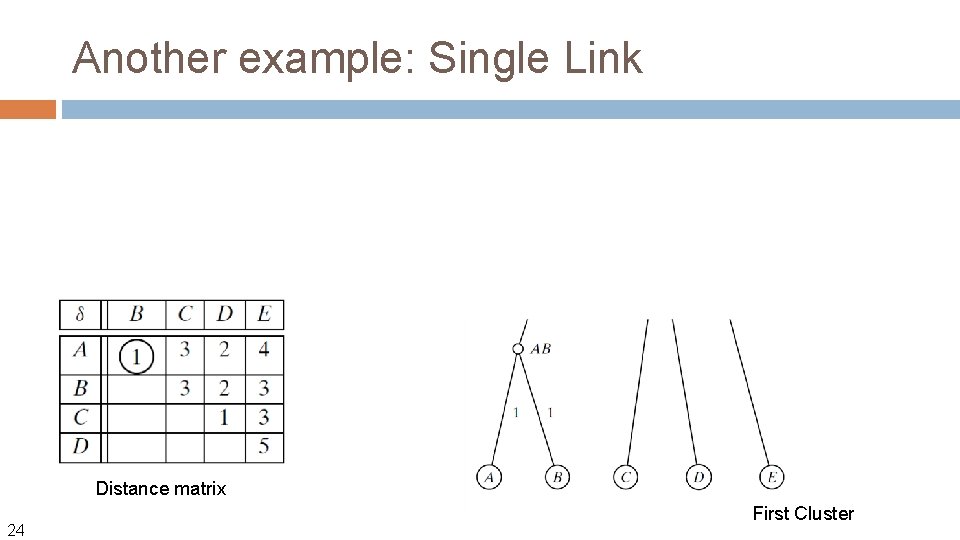
Another example: Single Link Distance matrix 24 First Cluster
Another example: Single Link Update distance matrix 25 Second Cluster
Another example: Single Link Update distance matrix 26 Third Cluster
Another example: Single Link Update distance matrix 27 Fourth Cluster
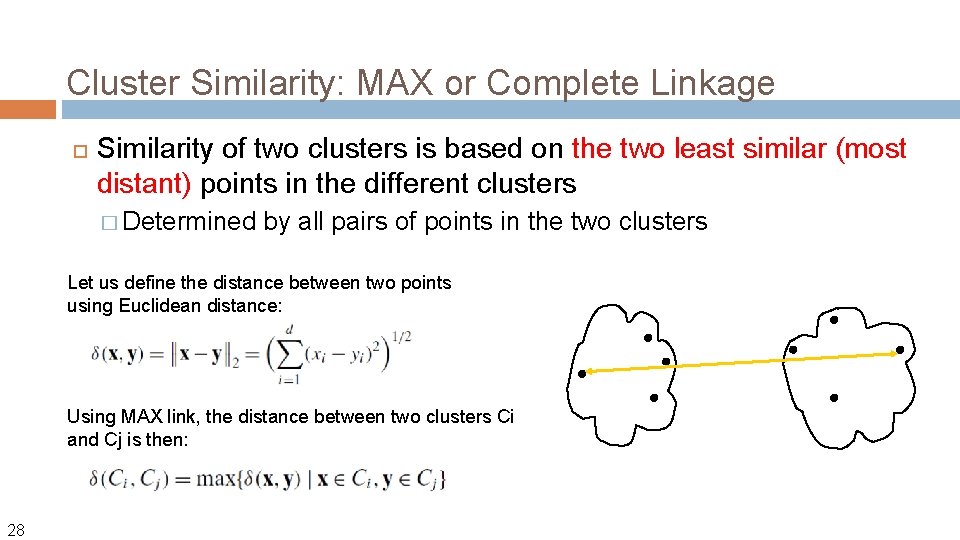
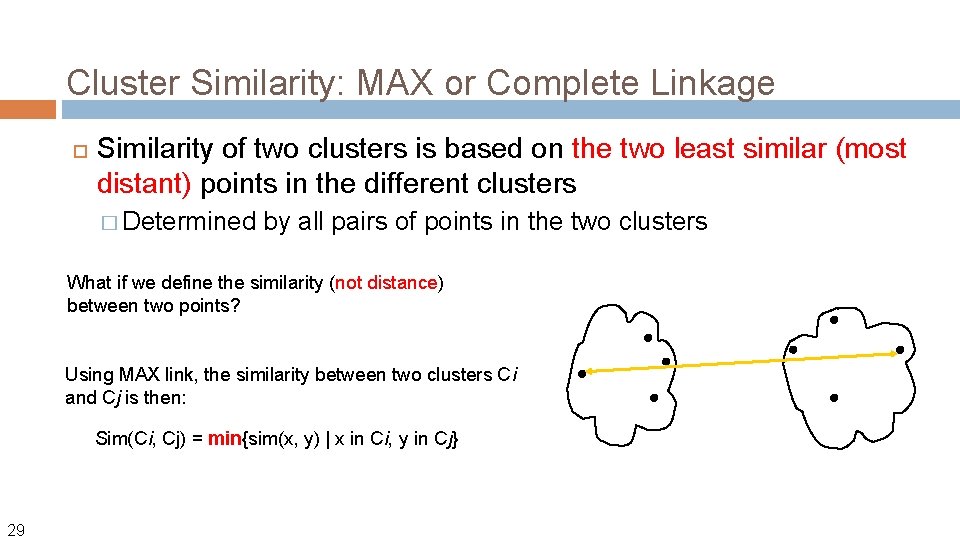
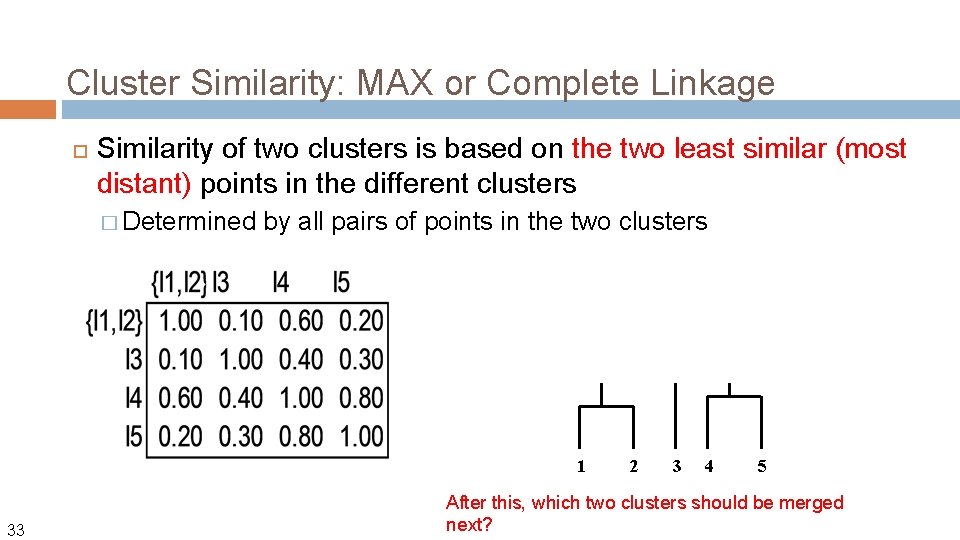
Cluster Similarity: MAX or Complete Linkage Similarity of two clusters is based on the two least similar (most distant) points in the different clusters � Determined by all pairs of points in the two clusters Let us define the distance between two points using Euclidean distance: Using MAX link, the distance between two clusters Ci and Cj is then: 28
Cluster Similarity: MAX or Complete Linkage Similarity of two clusters is based on the two least similar (most distant) points in the different clusters � Determined by all pairs of points in the two clusters What if we define the similarity (not distance) between two points? Using MAX link, the similarity between two clusters Ci and Cj is then: Sim(Ci, Cj) = min{sim(x, y) | x in Ci, y in Cj} 29
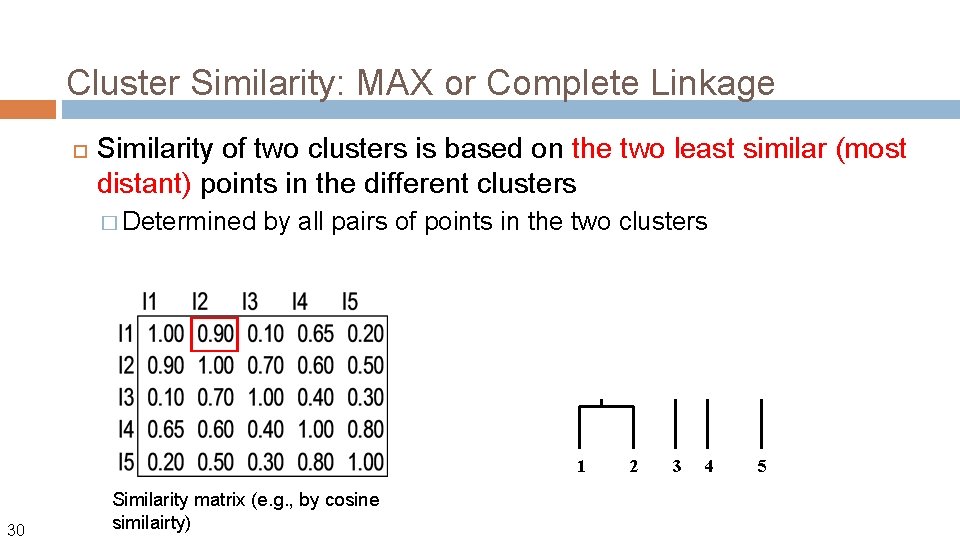
Cluster Similarity: MAX or Complete Linkage Similarity of two clusters is based on the two least similar (most distant) points in the different clusters � Determined by all pairs of points in the two clusters 1 30 Similarity matrix (e. g. , by cosine similairty) 2 3 4 5
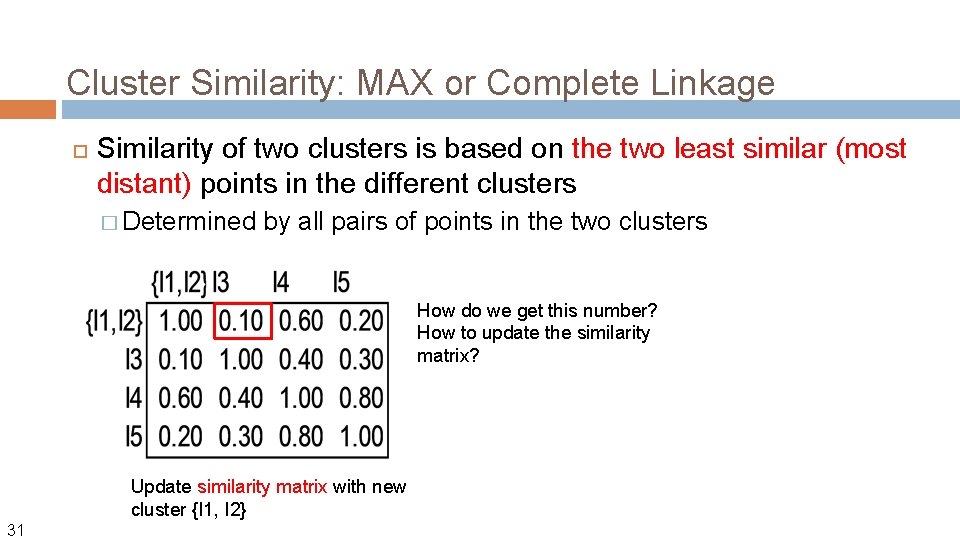
Cluster Similarity: MAX or Complete Linkage Similarity of two clusters is based on the two least similar (most distant) points in the different clusters � Determined by all pairs of points in the two clusters How do we get this number? How to update the similarity matrix? Update similarity matrix with new cluster {I 1, I 2} 31
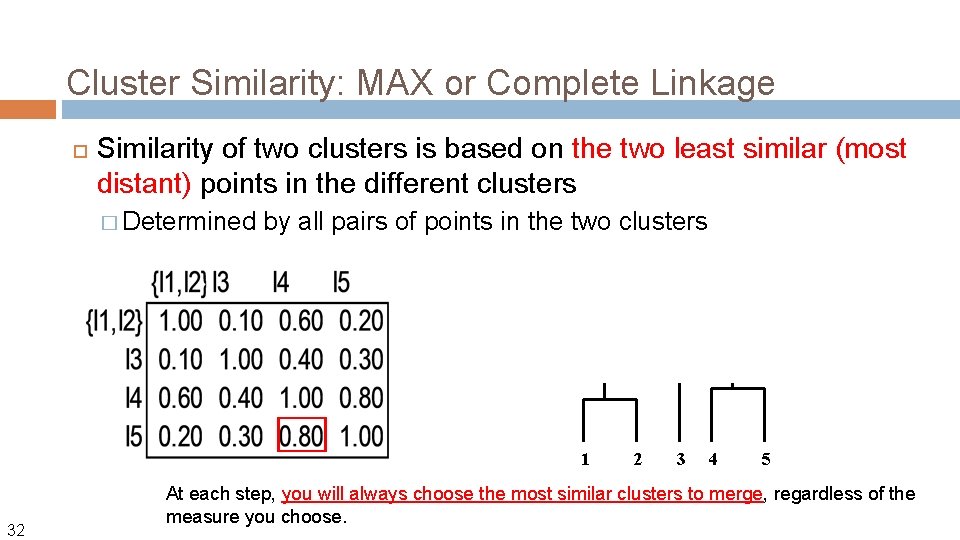
Cluster Similarity: MAX or Complete Linkage Similarity of two clusters is based on the two least similar (most distant) points in the different clusters � Determined by all pairs of points in the two clusters 1 32 2 3 4 5 At each step, you will always choose the most similar clusters to merge, regardless of the measure you choose.
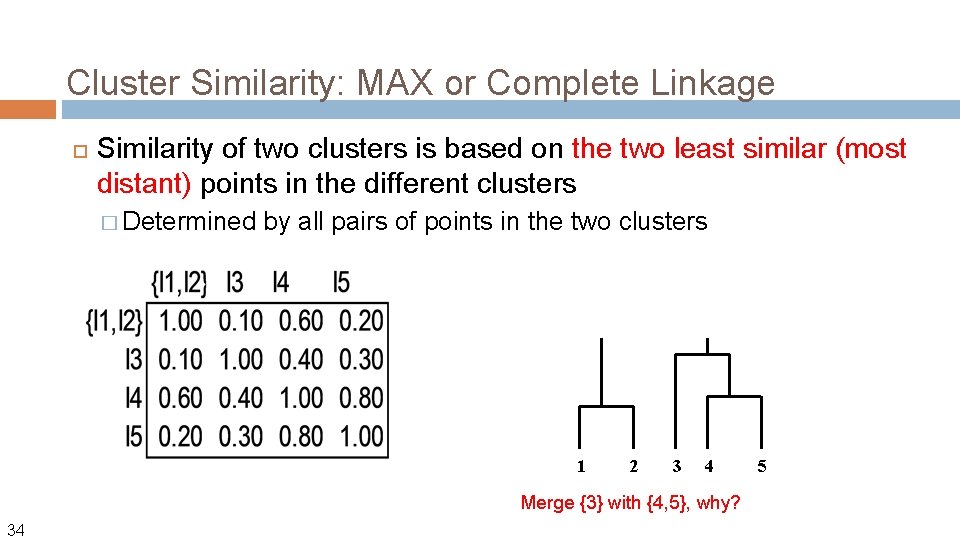
Cluster Similarity: MAX or Complete Linkage Similarity of two clusters is based on the two least similar (most distant) points in the different clusters � Determined by all pairs of points in the two clusters 1 33 2 3 4 5 After this, which two clusters should be merged next?
Cluster Similarity: MAX or Complete Linkage Similarity of two clusters is based on the two least similar (most distant) points in the different clusters � Determined by all pairs of points in the two clusters 1 2 3 4 Merge {3} with {4, 5}, why? 34 5
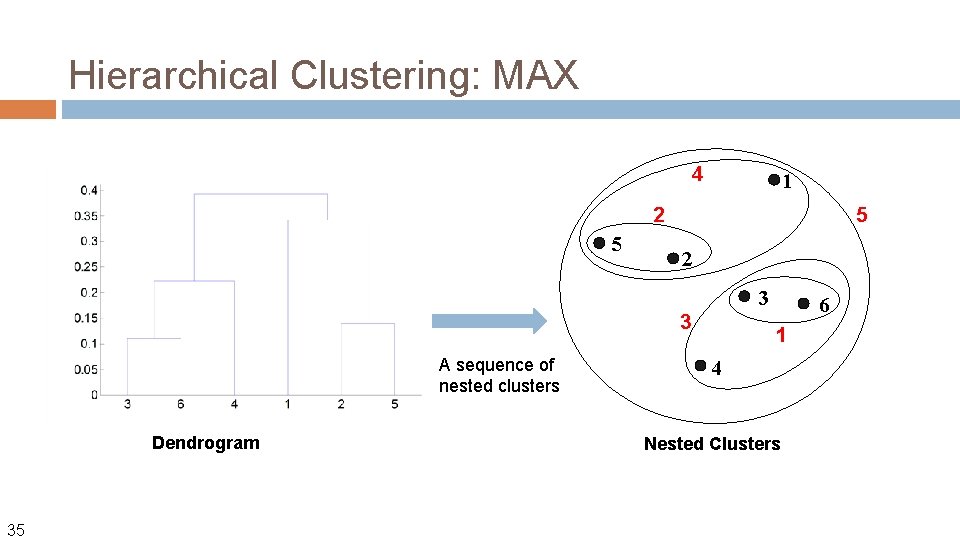
Hierarchical Clustering: MAX 4 1 2 5 5 2 3 3 A sequence of nested clusters Dendrogram 35 6 1 4 Nested Clusters
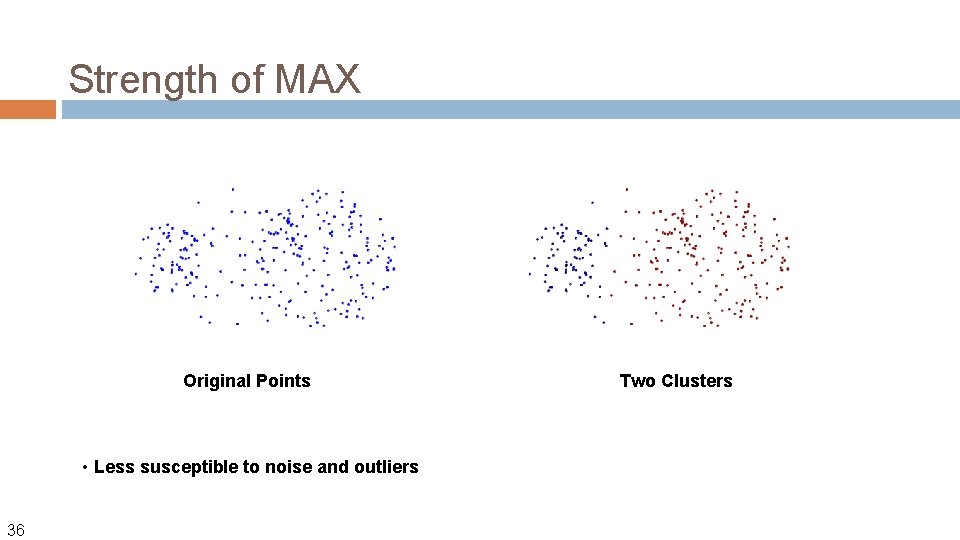
Strength of MAX Original Points • Less susceptible to noise and outliers 36 Two Clusters
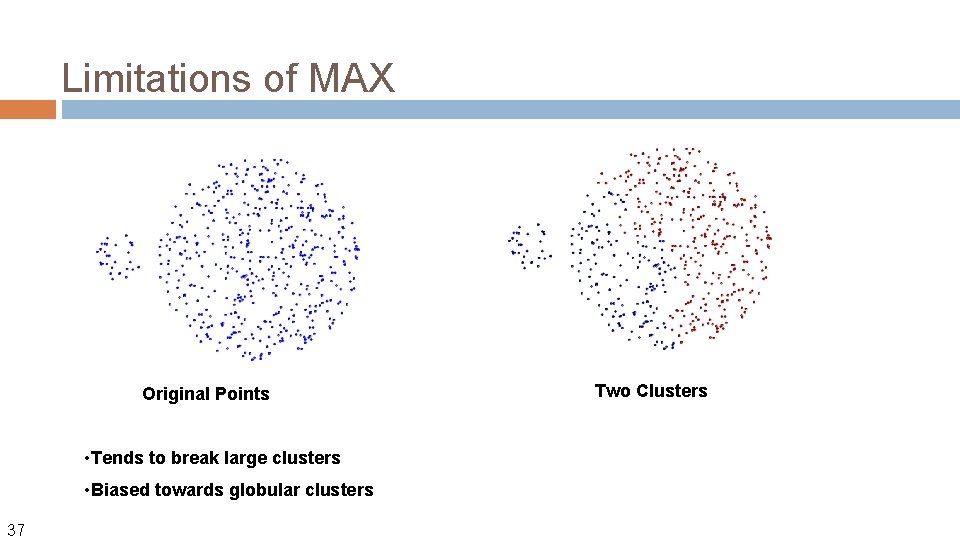
Limitations of MAX Original Points • Tends to break large clusters • Biased towards globular clusters 37 Two Clusters
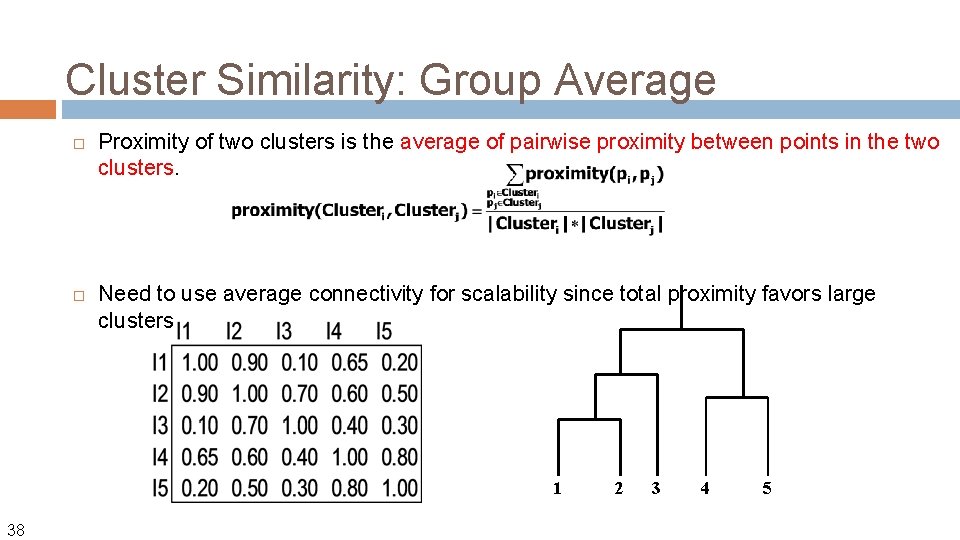
Cluster Similarity: Group Average Proximity of two clusters is the average of pairwise proximity between points in the two clusters. Need to use average connectivity for scalability since total proximity favors large clusters 1 38 2 3 4 5
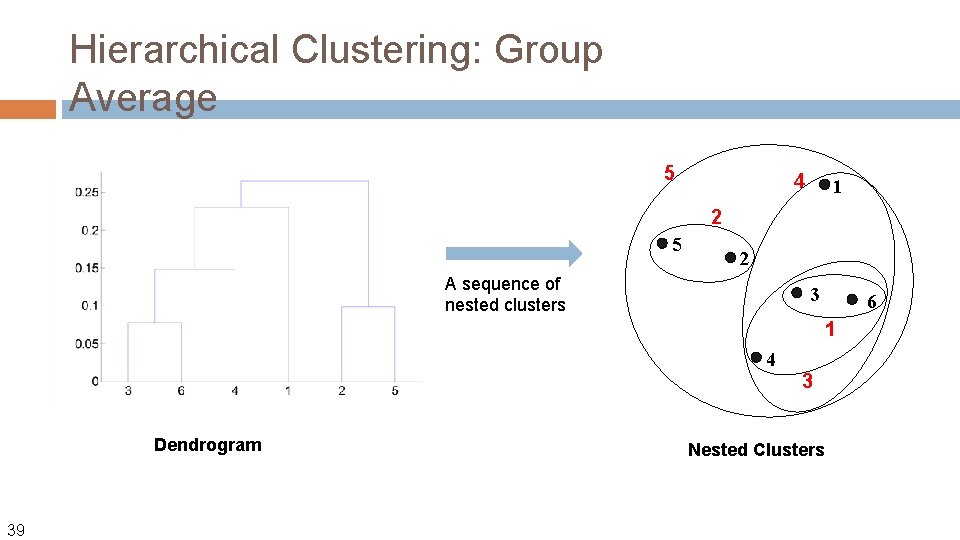
Hierarchical Clustering: Group Average 5 4 1 2 5 2 A sequence of nested clusters 3 6 1 4 Dendrogram 39 3 Nested Clusters
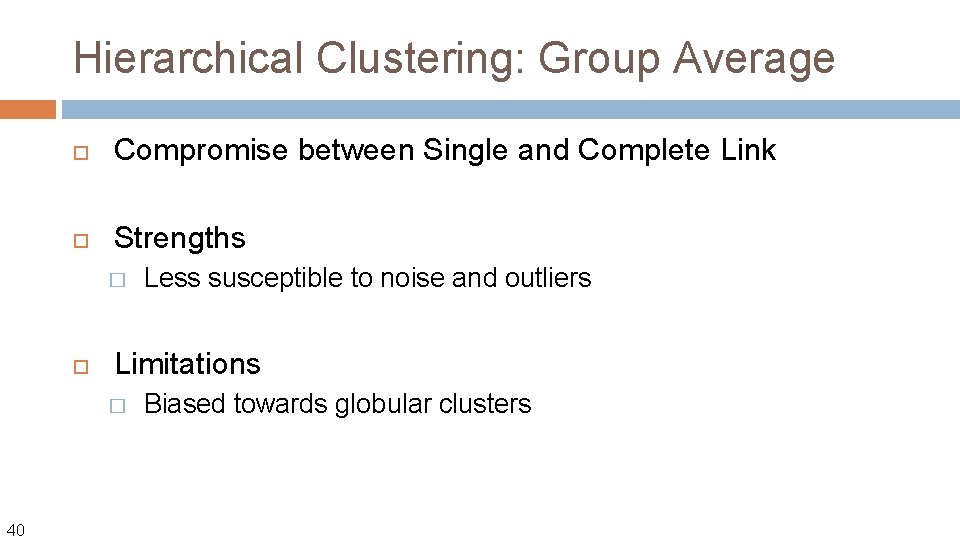
Hierarchical Clustering: Group Average Compromise between Single and Complete Link Strengths � Limitations � 40 Less susceptible to noise and outliers Biased towards globular clusters
Hierarchical Clustering: Time and Space requirements O(N 2) space since it uses the proximity matrix. �N is the number of points. O(N 3) time in many cases � There are N steps and at each step the size, N 2, proximity matrix must be updated and searched � Complexity can be reduced to O(N 2 log(N) ) time for some approaches 41
Hierarchical Clustering: Problems and Limitations Once a decision is made to combine two clusters, it cannot be undone No objective function is directly minimized Different schemes have problems with one or more of the following: � Sensitivity to noise and outliers � Difficulty handling different sized clusters and convex shapes � Breaking large clusters 42
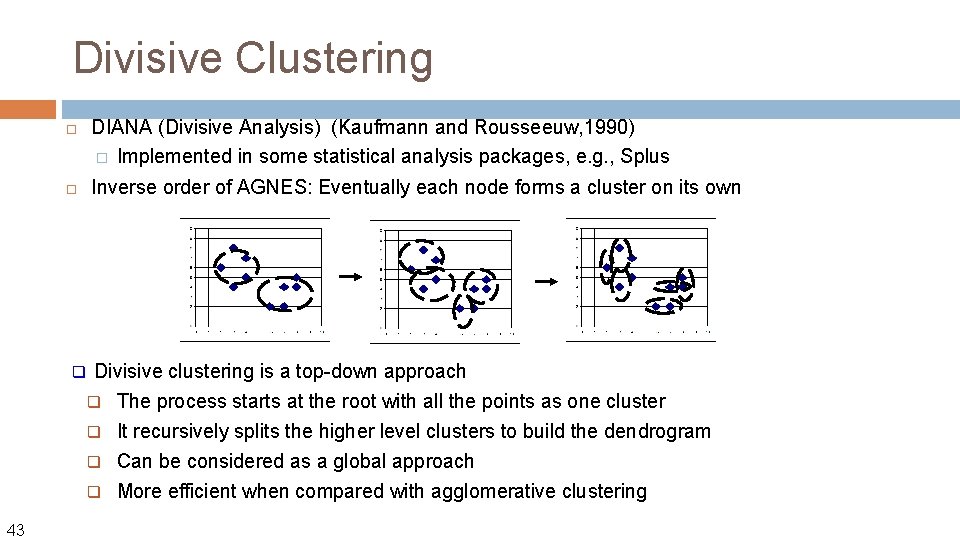
Divisive Clustering q DIANA (Divisive Analysis) (Kaufmann and Rousseeuw, 1990) � Implemented in some statistical analysis packages, e. g. , Splus Inverse order of AGNES: Eventually each node forms a cluster on its own Divisive clustering is a top-down approach q The process starts at the root with all the points as one cluster It recursively splits the higher level clusters to build the dendrogram q Can be considered as a global approach q More efficient when compared with agglomerative clustering q 43
More on Algorithm Design for Divisive Clusteri Choosing which cluster to split � Splitting criterion: Determining how to split � One may use Ward’s criterion to chase for greater reduction in the difference in the SSE criterion as a result of a split � For categorical data, Gini-index can be used Handling the noise � 44 Check the sums of squared errors of the clusters and choose the one with the largest value Use a threshold to determine the termination criterion (do not generate clusters that are too small because they contain mainly noises)
Clustering Algorithms 45 K-means and its variants Hierarchical clustering Density-based clustering
Density-Based Clustering Methods Clustering based on density (a local cluster criterion), such as densityconnected points Major features: � � Several interesting studies: � � 46 Discover clusters of arbitrary shape Handle noise One scan (only examine the local region to justify density) Need density parameters as termination condition DBSCAN: Ester, et al. (KDD’ 96) OPTICS: Ankerst, et al (SIGMOD’ 99) DENCLUE: Hinneburg & D. Keim (KDD’ 98) CLIQUE: Agrawal, et al. (SIGMOD’ 98) (also, grid-based)
DBSCAN 47 DBSCAN (M. Ester, H. -P. Kriegel, J. Sander, and X. Xu, KDD’ 96) � Discovers clusters of arbitrary shape: Density-Based Spatial Clustering of Applications with Noise
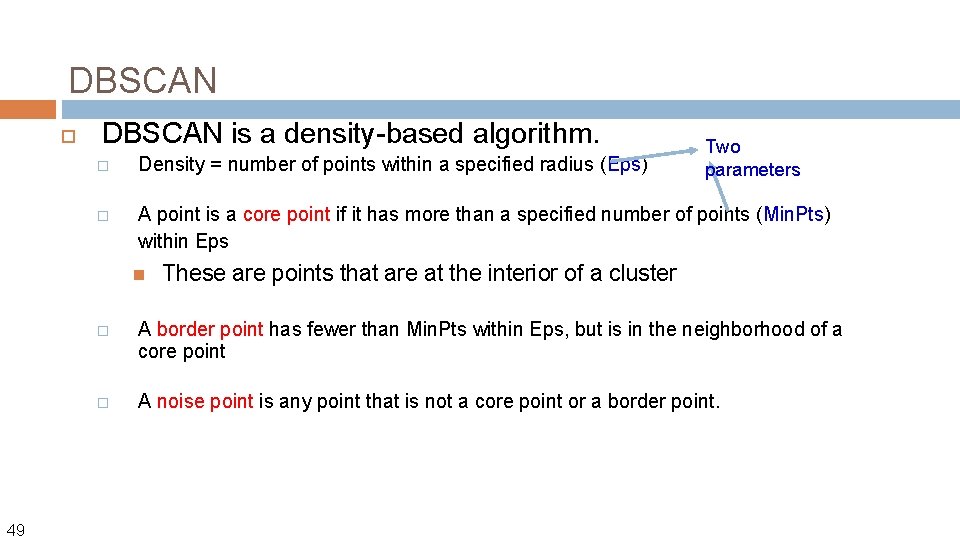
DBSCAN (M. Ester, H. -P. Kriegel, J. Sander, and X. Xu, KDD’ 96) � Discovers clusters of arbitrary shape: Density-Based Spatial Clustering of Applications with Noise DBSCAN is a density-based algorithm. � Density = number of points within a specified radius (Eps) � A point is a core point if it has more than a specified number of points (Min. Pts) within Eps � 48 These are points that are at the interior of a cluster A border point has fewer than Min. Pts within Eps, but is in the neighborhood of a core point
DBSCAN is a density-based algorithm. � Density = number of points within a specified radius (Eps) � A point is a core point if it has more than a specified number of points (Min. Pts) within Eps 49 Two parameters These are points that are at the interior of a cluster � A border point has fewer than Min. Pts within Eps, but is in the neighborhood of a core point � A noise point is any point that is not a core point or a border point.
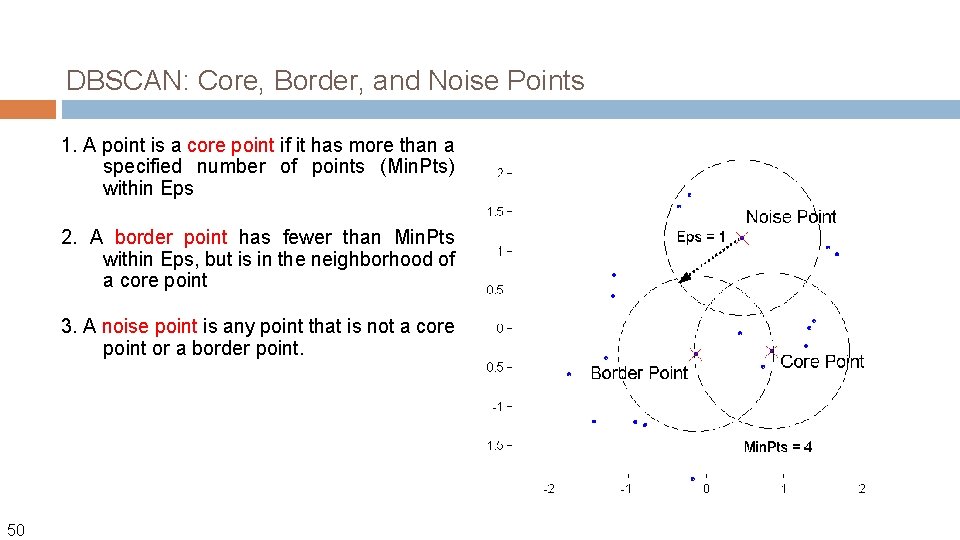
DBSCAN: Core, Border, and Noise Points 1. A point is a core point if it has more than a specified number of points (Min. Pts) within Eps 2. A border point has fewer than Min. Pts within Eps, but is in the neighborhood of a core point 3. A noise point is any point that is not a core point or a border point. 50
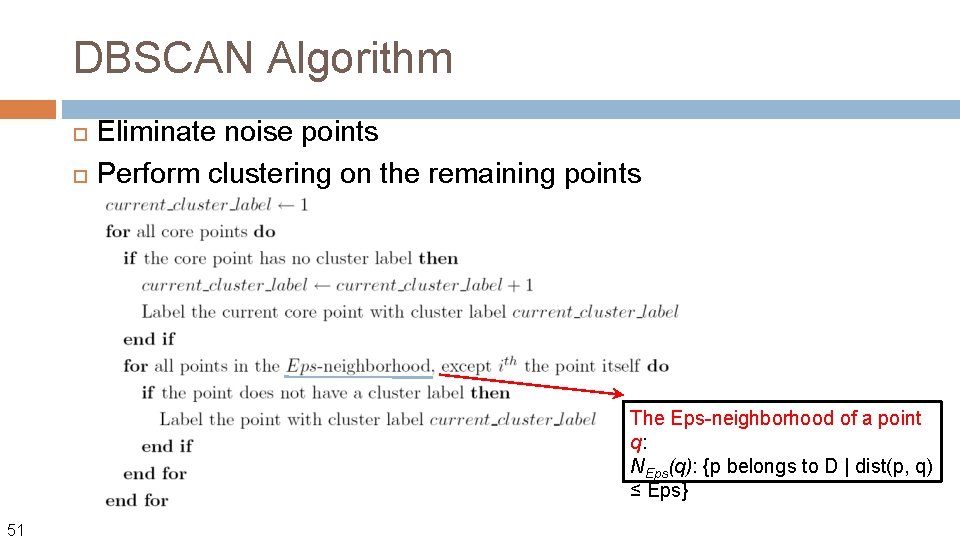
DBSCAN Algorithm Eliminate noise points Perform clustering on the remaining points The Eps-neighborhood of a point q: NEps(q): {p belongs to D | dist(p, q) ≤ Eps} 51
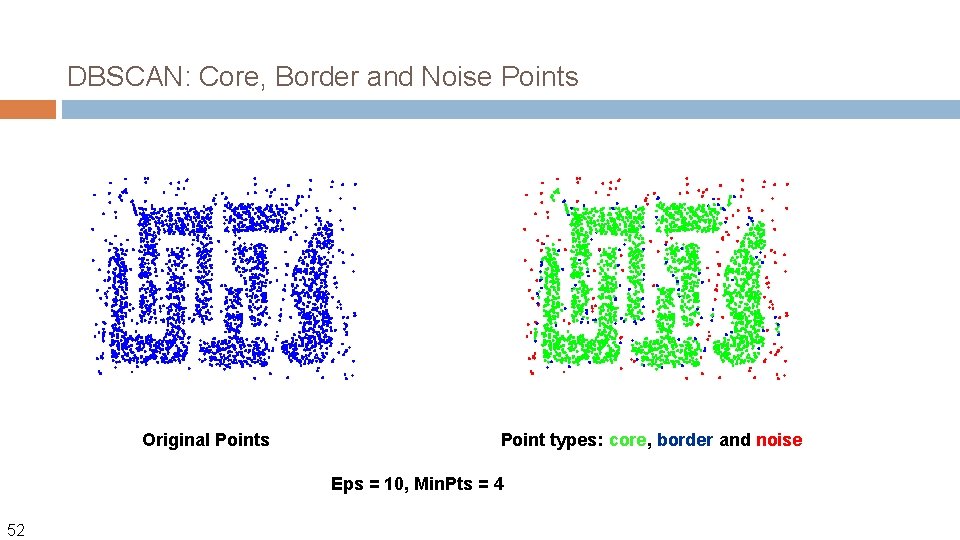
DBSCAN: Core, Border and Noise Points Original Points Point types: core, border and noise Eps = 10, Min. Pts = 4 52
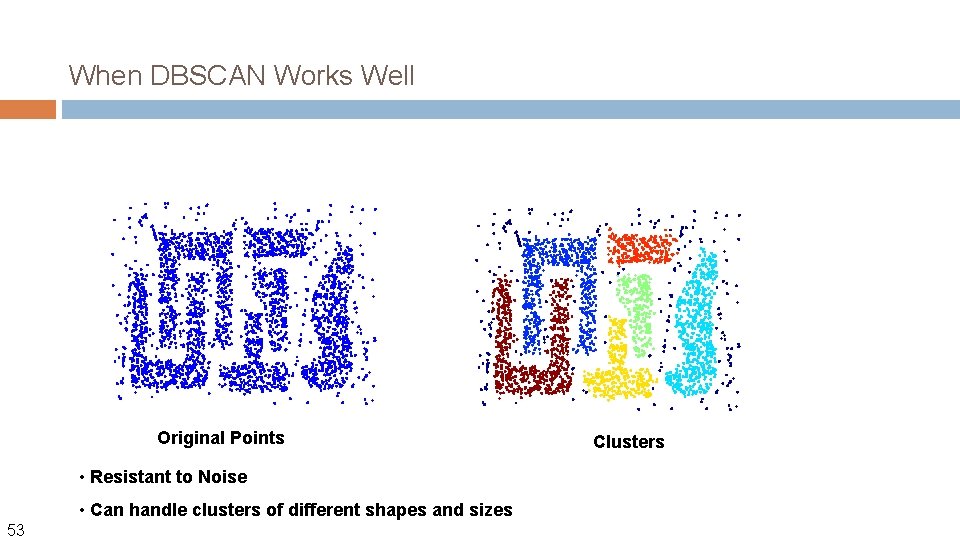
When DBSCAN Works Well Original Points • Resistant to Noise • Can handle clusters of different shapes and sizes 53 Clusters
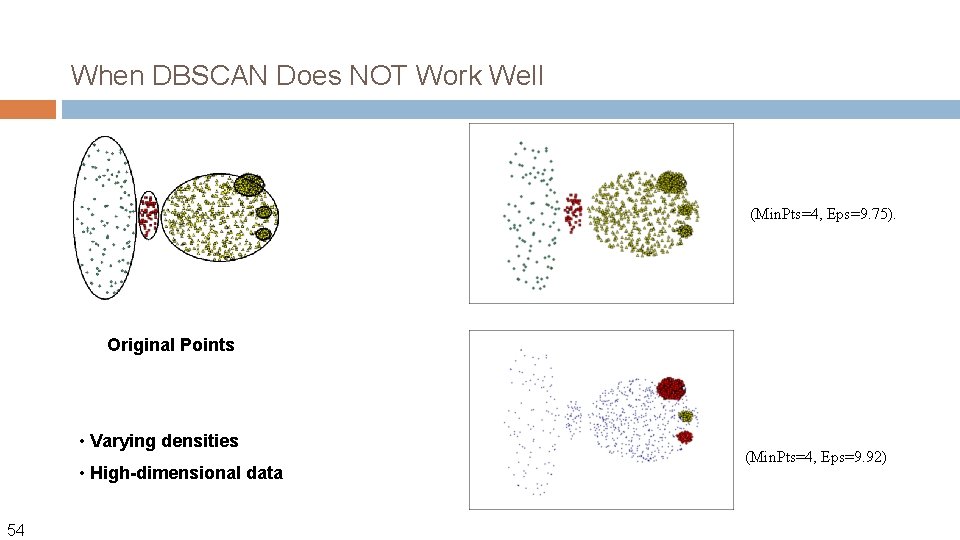
When DBSCAN Does NOT Work Well (Min. Pts=4, Eps=9. 75). Original Points • Varying densities • High-dimensional data 54 (Min. Pts=4, Eps=9. 92)
Cluster Validity For supervised classification we have a variety of measures to evaluate how good our model is � 55 Accuracy, precision, recall For cluster analysis, the analogous question is how to evaluate the “goodness” of the resulting clusters?
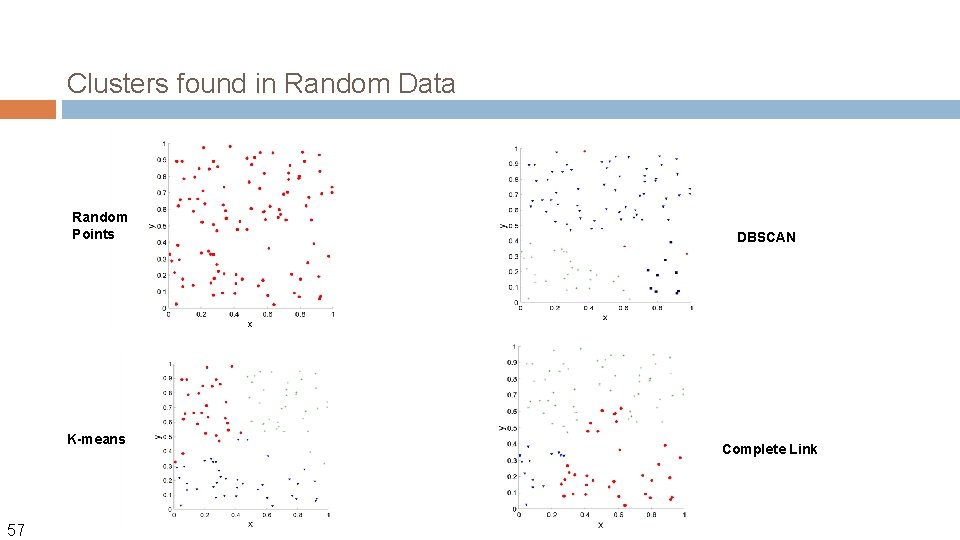
Cluster Validity For supervised classification we have a variety of measures to evaluate how good our model is � For cluster analysis, the analogous question is how to evaluate the “goodness” of the resulting clusters? But “clusters are in the eye of the beholder”! Then why do we want to evaluate them? � � 56 Accuracy, precision, recall To avoid finding patterns in noise To compare clustering algorithms To compare two sets of clusters To compare two clusters
Clusters found in Random Data Random Points K-means 57 DBSCAN Complete Link
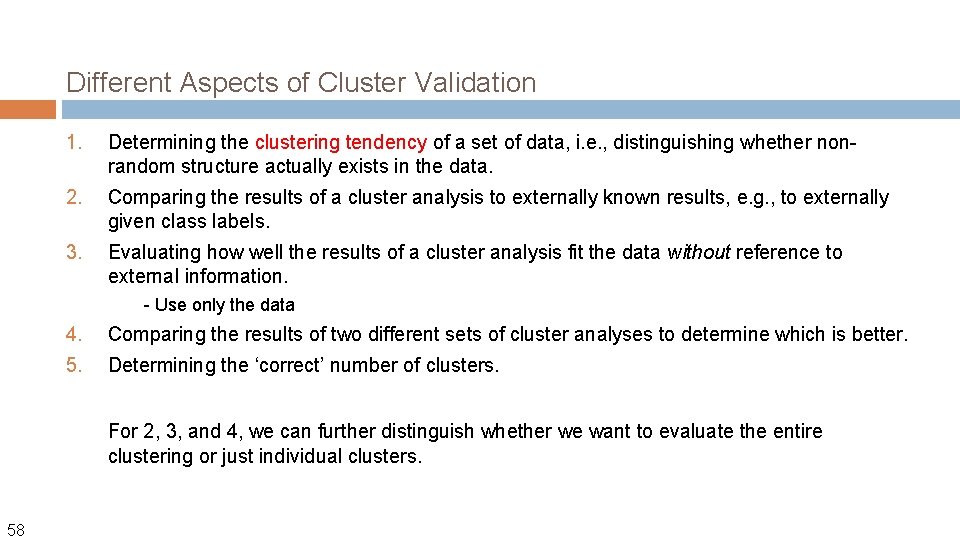
Different Aspects of Cluster Validation 1. Determining the clustering tendency of a set of data, i. e. , distinguishing whether nonrandom structure actually exists in the data. 2. Comparing the results of a cluster analysis to externally known results, e. g. , to externally given class labels. 3. Evaluating how well the results of a cluster analysis fit the data without reference to external information. - Use only the data 4. Comparing the results of two different sets of cluster analyses to determine which is better. 5. Determining the ‘correct’ number of clusters. For 2, 3, and 4, we can further distinguish whether we want to evaluate the entire clustering or just individual clusters. 58
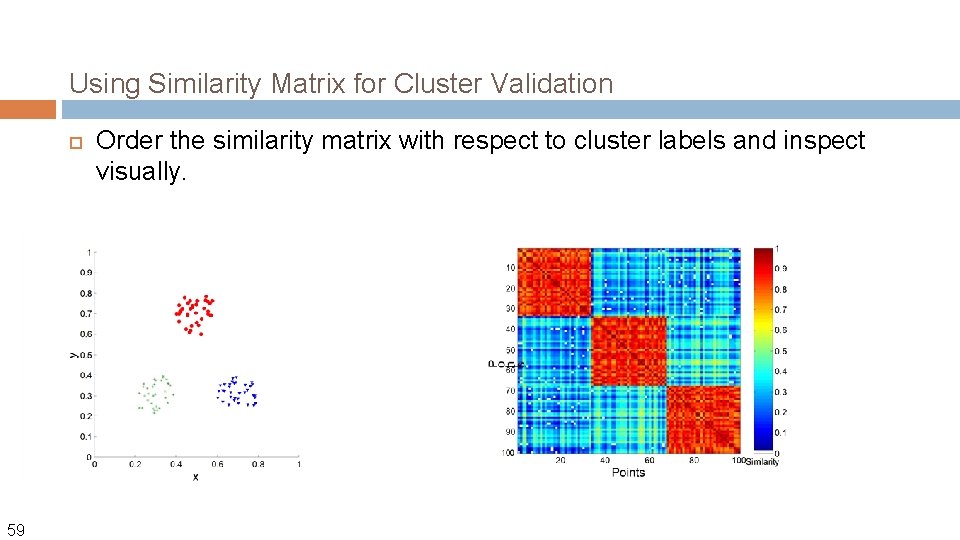
Using Similarity Matrix for Cluster Validation 59 Order the similarity matrix with respect to cluster labels and inspect visually.
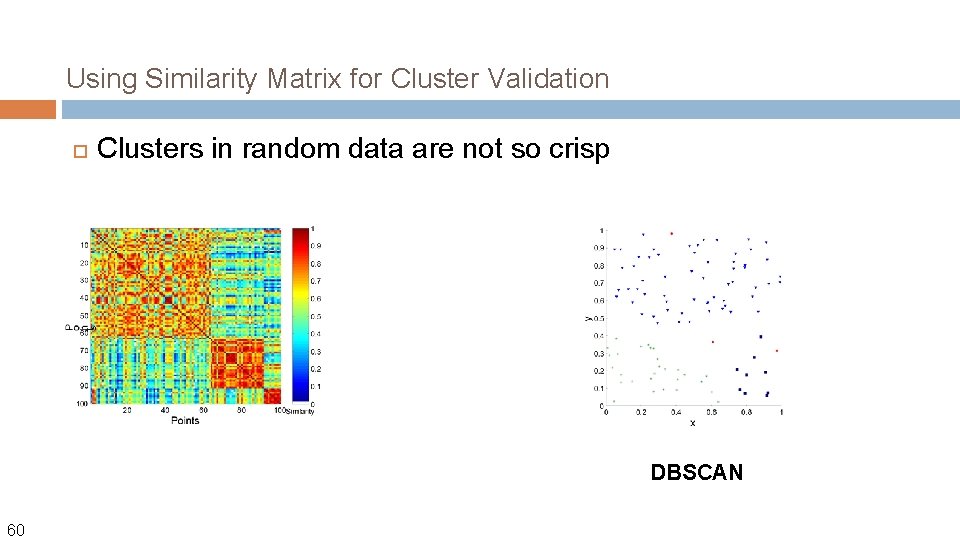
Using Similarity Matrix for Cluster Validation Clusters in random data are not so crisp DBSCAN 60
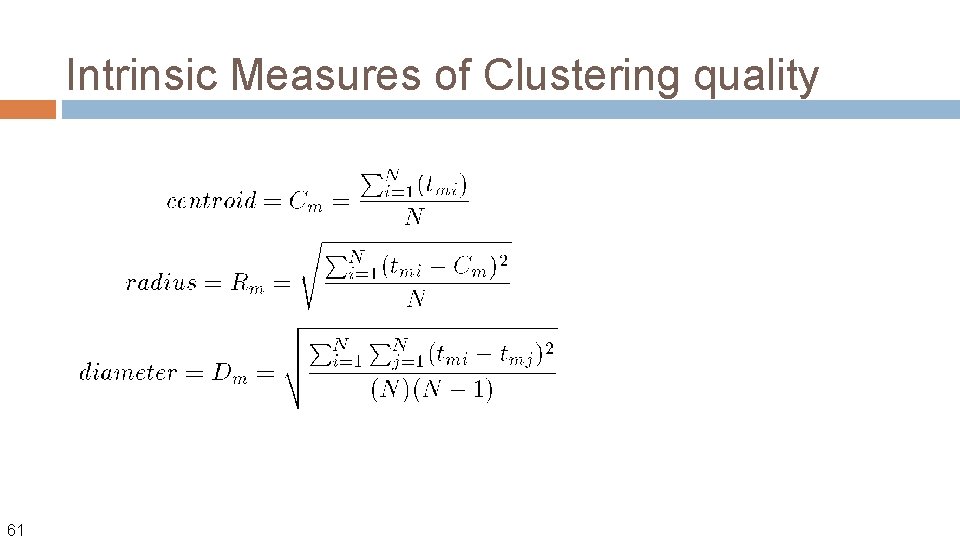
Intrinsic Measures of Clustering quality 61
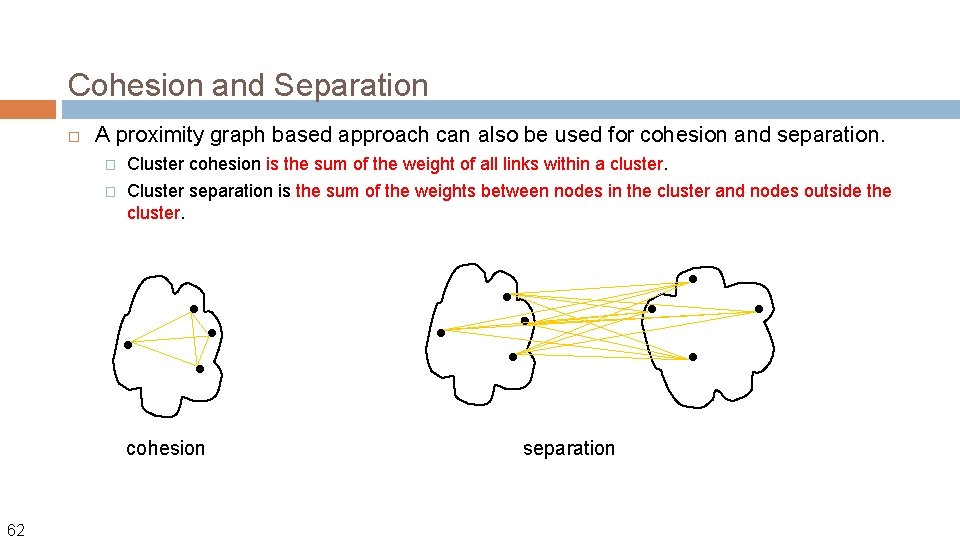
Cohesion and Separation A proximity graph based approach can also be used for cohesion and separation. � Cluster cohesion is the sum of the weight of all links within a cluster. � Cluster separation is the sum of the weights between nodes in the cluster and nodes outside the cluster. cohesion 62 separation
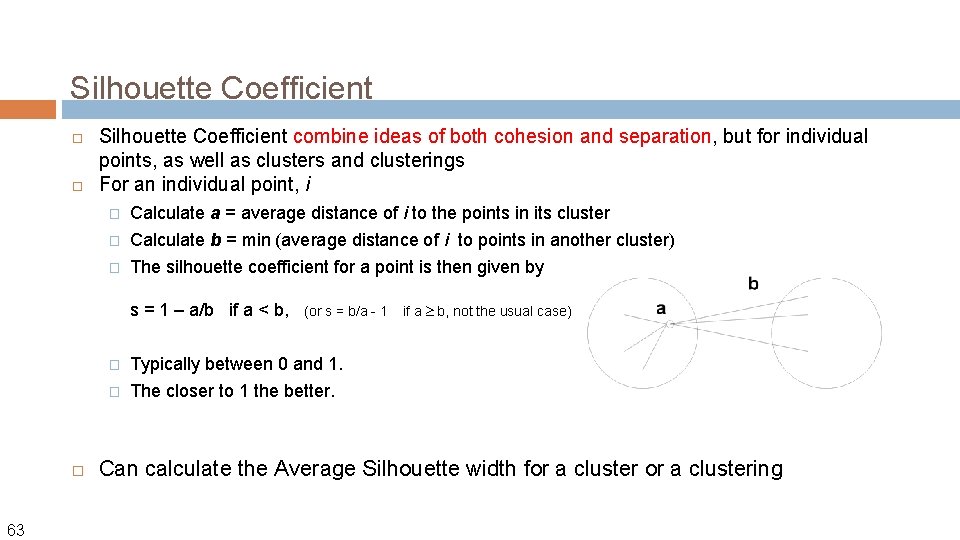
Silhouette Coefficient combine ideas of both cohesion and separation, but for individual points, as well as clusters and clusterings For an individual point, i � Calculate a = average distance of i to the points in its cluster � Calculate b = min (average distance of i to points in another cluster) � The silhouette coefficient for a point is then given by s = 1 – a/b if a < b, 63 (or s = b/a - 1 � Typically between 0 and 1. � The closer to 1 the better. if a b, not the usual case) Can calculate the Average Silhouette width for a clustering
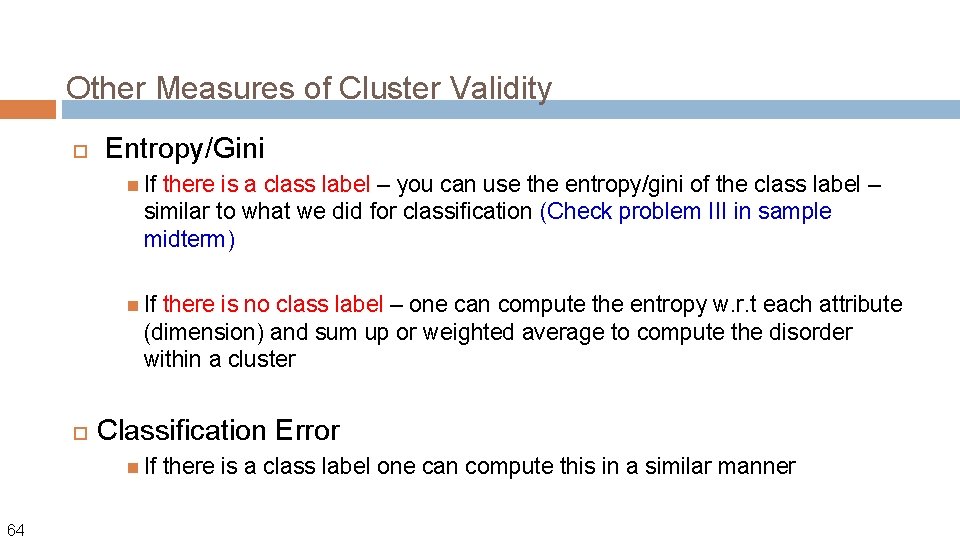
Other Measures of Cluster Validity Entropy/Gini If there is a class label – you can use the entropy/gini of the class label – similar to what we did for classification (Check problem III in sample midterm) If there is no class label – one can compute the entropy w. r. t each attribute (dimension) and sum up or weighted average to compute the disorder within a cluster Classification Error If 64 there is a class label one can compute this in a similar manner
Extensions: Clustering Large Databases Most clustering algorithms assume a large data structure which is memory resident. Clustering may be performed first on a sample of the database then applied to the entire database. Algorithms � � � 65 BIRCH DBSCAN (we have already covered this) CURE
66 Backup slides
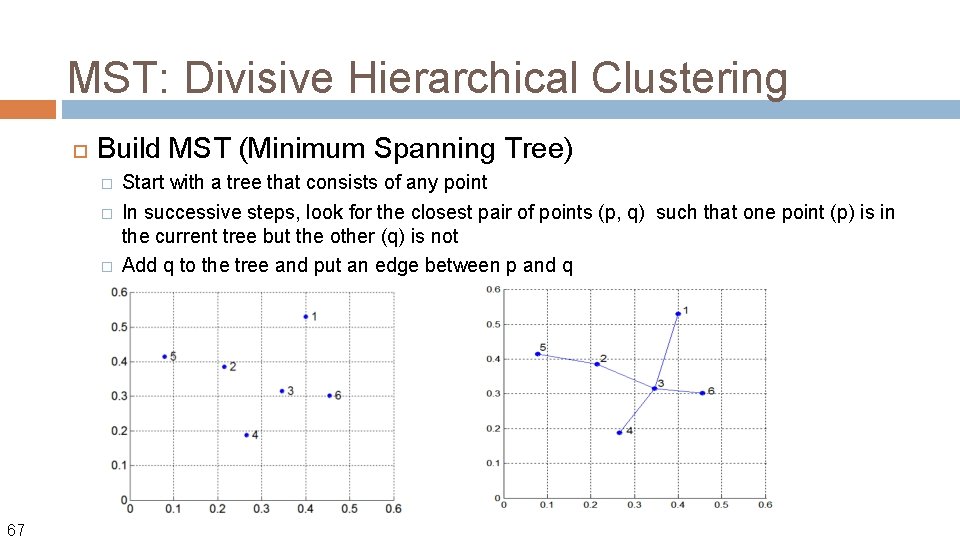
MST: Divisive Hierarchical Clustering Build MST (Minimum Spanning Tree) � � � 67 Start with a tree that consists of any point In successive steps, look for the closest pair of points (p, q) such that one point (p) is in the current tree but the other (q) is not Add q to the tree and put an edge between p and q
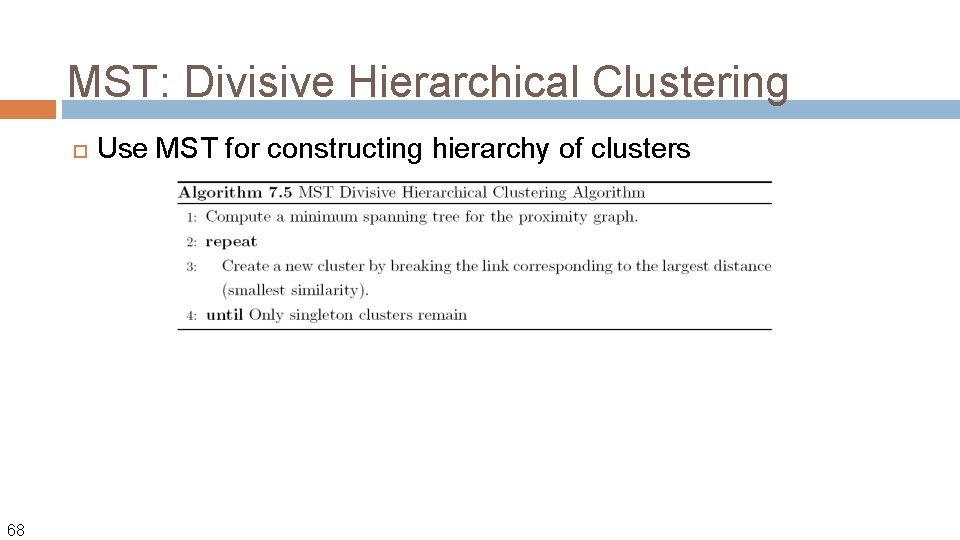
MST: Divisive Hierarchical Clustering 68 Use MST for constructing hierarchy of clusters