
CSE 502 Computer Architecture Memory Hierarchy Caches Motivation





![Fully-Associative Cache 63 address 0 tag[63: 6] block offset[5: 0] • Keep blocks in](https://slidetodoc.com/presentation_image_h2/ac9a166c2abf3bdc718df8c5ea94dad4/image-15.jpg "Fully-Associative Cache 63 address 0 tag[63: 6] block offset[5: 0] • Keep blocks in")


![Direct-Mapped Cache tag[63: 16] index[15: 6] block offset[5: 0] • Use middle bits as](https://slidetodoc.com/presentation_image_h2/ac9a166c2abf3bdc718df8c5ea94dad4/image-21.jpg "Direct-Mapped Cache tag[63: 16] index[15: 6] block offset[5: 0] • Use middle bits as")


![N-Way Set-Associative Cache tag[63: 15] index[14: 6] block offset[5: 0] way set state tag](https://slidetodoc.com/presentation_image_h2/ac9a166c2abf3bdc718df8c5ea94dad4/image-25.jpg "N-Way Set-Associative Cache tag[63: 15] index[14: 6] block offset[5: 0] way set state tag")


![Virtually-Indexed Caches • Core requests are VAs tag[63: 15] index[14: 6] block offset[5: 0]](https://slidetodoc.com/presentation_image_h2/ac9a166c2abf3bdc718df8c5ea94dad4/image-31.jpg "Virtually-Indexed Caches • Core requests are VAs tag[63: 15] index[14: 6] block offset[5: 0]")


- Slides: 39
CSE 502: Computer Architecture Memory Hierarchy & Caches
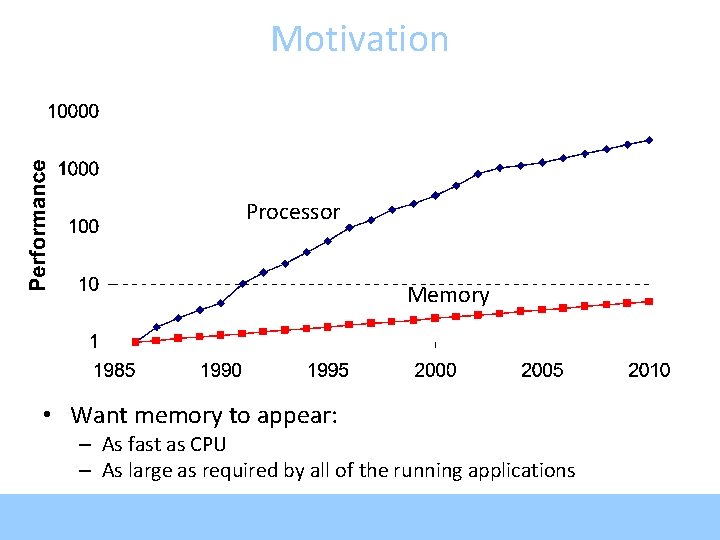
Motivation Processor Memory • Want memory to appear: – As fast as CPU – As large as required by all of the running applications
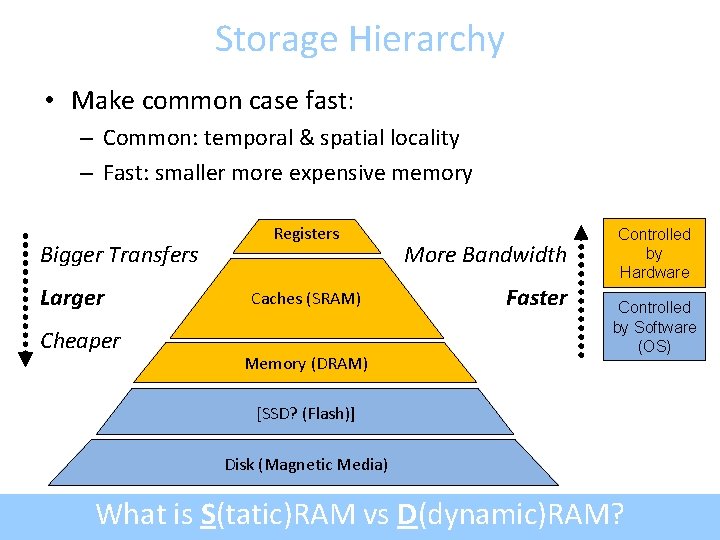
Storage Hierarchy • Make common case fast: – Common: temporal & spatial locality – Fast: smaller more expensive memory Bigger Transfers Larger Cheaper Registers Caches (SRAM) Memory (DRAM) More Bandwidth Faster Controlled by Hardware Controlled by Software (OS) [SSD? (Flash)] Disk (Magnetic Media) What is S(tatic)RAM vs D(dynamic)RAM?
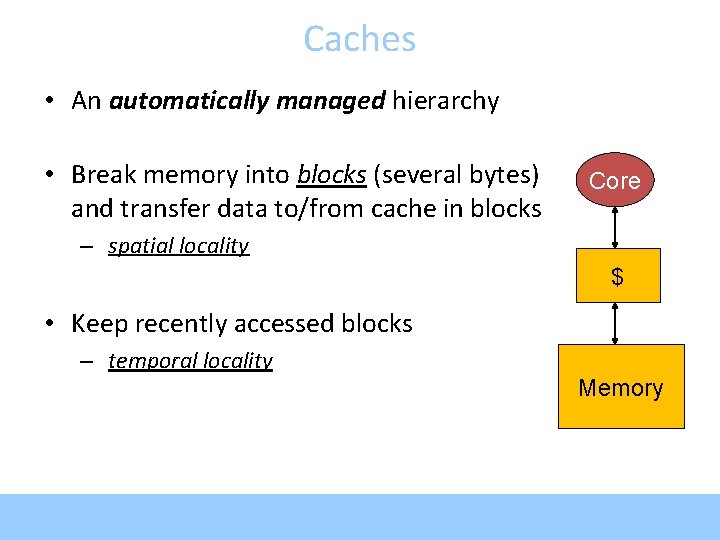
Caches • An automatically managed hierarchy • Break memory into blocks (several bytes) and transfer data to/from cache in blocks Core – spatial locality $ • Keep recently accessed blocks – temporal locality Memory
Cache Terminology • • block (cache line): minimum unit that may be cached frame: cache storage location to hold one block hit: block is found in the cache miss: block is not found in the cache miss ratio: fraction of references that miss hit time: time to access the cache miss penalty: time to replace block on a miss
Cache Example • Address sequence from core: (assume 8 -byte lines) 0 x 10000 0 x 10004 0 x 10120 0 x 10008 0 x 10124 0 x 10004 Miss Hit Core 0 x 10000 (…data…) 0 x 10008 (…data…) 0 x 10120 (…data…) Memory Final miss ratio is 50%
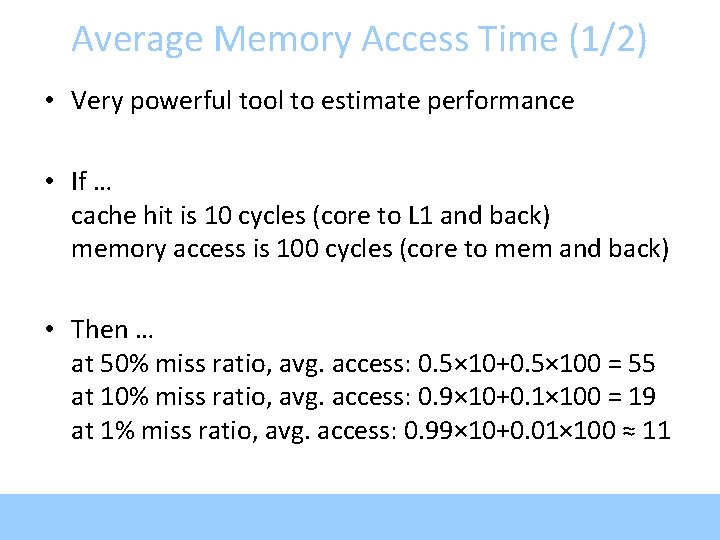
Average Memory Access Time (1/2) • Very powerful tool to estimate performance • If … cache hit is 10 cycles (core to L 1 and back) memory access is 100 cycles (core to mem and back) • Then … at 50% miss ratio, avg. access: 0. 5× 10+0. 5× 100 = 55 at 10% miss ratio, avg. access: 0. 9× 10+0. 1× 100 = 19 at 1% miss ratio, avg. access: 0. 99× 10+0. 01× 100 ≈ 11
Average Memory Access Time (2/2) • Generalizes nicely to any-depth hierarchy • If … L 1 cache hit is 5 cycles (core to L 1 and back) L 2 cache hit is 20 cycles (core to L 2 and back) memory access is 100 cycles (core to mem and back) • Then … at 20% miss ratio in L 1 and 40% miss ratio in L 2 … avg. access: 0. 8× 5+0. 2×(0. 6× 20+0. 4× 100) ≈ 14
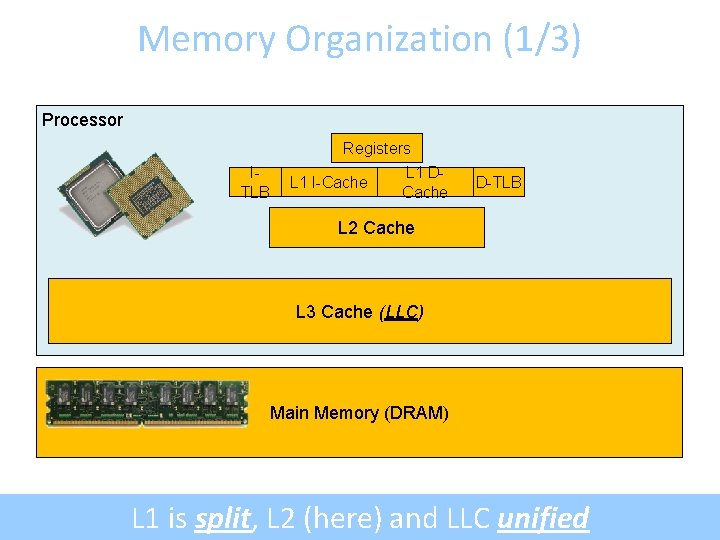
Memory Organization (1/3) Processor Registers ITLB L 1 I-Cache L 1 DCache D-TLB L 2 Cache L 3 Cache (LLC) Main Memory (DRAM) L 1 is split, L 2 (here) and LLC unified
Memory Organization (2/3) • L 1 and L 2 are private • L 3 is shared Processor Core 0 I-TLB Core 1 Registers L 1 I-Cache L 1 D-Cache D-TLB I-TLB Registers L 1 I-Cache L 2 Cache L 1 D-Cache D-TLB L 2 Cache L 3 Cache (LLC) Main Memory (DRAM) Multi-core replicates the top of the hierarchy
Intel Nehalem (3. 3 GHz, 4 cores, 2 threads per core) Memory Organization (3/3) 32 K L 1 -D 256 K L 2 32 K L 1 -I
SRAM Overview 1 1 01 01 “ 6 T SRAM” cell b b 2 access gates 2 T per inverter • Chained inverters maintain a stable state • Access gates provide access to the cell • Writing to cell involves over-powering storage inverters
8 -bit SRAM Array wordline bitlines
wordlines 8× 8 -bit SRAM Array bitlines
Fully-Associative Cache 63 address 0 tag[63: 6] block offset[5: 0] • Keep blocks in cache frames – data – state (e. g. , valid) – address tag state tag tag = = = data state tag = data hit? multiplexor What happens when the cache runs out of space?
The 3 C’s of Cache Misses • • Compulsory: Never accessed before Capacity: Accessed long ago and already replaced Conflict: Neither compulsory nor capacity (later today) Coherence: (To appear in multi-core lecture)
Cache Size • Cache size is data capacity (don’t count tag and state) – Bigger can exploit temporal locality better – Not always better • Too large a cache • Too small a cache – Limited temporal locality – Useful data constantly replaced hit rate – Smaller is faster bigger is slower – Access time may hurt critical path working set size capacity
Block Size • Block size is the data that is – Associated with an address tag – Not necessarily the unit of transfer between hierarchies • Too small a block • Too large a block – Useless data transferred – Too few total blocks hit rate – Don’t exploit spatial locality well – Excessive tag overhead • Useful data frequently replaced block size
8× 8 -bit SRAM Array 1 -of-8 decoder wordline bitlines
64× 1 -bit SRAM Array 1 -of-8 decoder wordline bitlines column mux 1 -of-8 decoder
Direct-Mapped Cache tag[63: 16] index[15: 6] block offset[5: 0] • Use middle bits as index • Only one tag comparison decoder data state tag tag data state tag multiplexor = Why take index bits out of the middle? tag match (hit? )
Cache Conflicts • What if two blocks alias on a frame? – Same index, but different tags Address sequence: 0 x. DEADBEEF 0 x. FEEDBEEF 0 x. DEADBEEF 110111101010110110111011111110110110111011110101011011011101111 tag index • 0 x. DEADBEEF experiences a Conflict miss block offset – Not Compulsory (seen it before) – Not Capacity (lots of other indexes available in cache)
Associativity (1/2) • Where does block index 12 (b’ 1100) go? Block 0 1 2 3 4 5 6 7 Fully-associative block goes in any frame (all frames in 1 set) Set/Block 0 0 1 1 0 1 2 0 1 3 0 1 Set 0 1 2 3 4 5 6 7 Set-associative Direct-mapped block goes in any frame block goes in exactly in one set one frame (frames grouped in sets) (1 frame per set)
Associativity (2/2) • Larger associativity – lower miss rate (fewer conflicts) – higher power consumption • Smaller associativity hit rate – lower cost – faster hit time ~5 for L 1 -D associativity
N-Way Set-Associative Cache tag[63: 15] index[14: 6] block offset[5: 0] way set state tag tag data state tag multiplexor decoder data data state tag tag data state tag multiplexor = = multiplexor hit? Note the additional bit(s) moved from index to tag
Associative Block Replacement • Which block in a set to replace on a miss? • Ideal replacement (Belady’s Algorithm) – Replace block accessed farthest in the future – Trick question: How do you implement it? • Least Recently Used (LRU) – Optimized for temporal locality (expensive for >2 -way) • Not Most Recently Used (NMRU) – Track MRU, random select among the rest • Random – Nearly as good as LRU, sometimes better (when? ) • Pseudo-LRU – Used in caches with high associativity – Examples: Tree-PLRU, Bit-PLRU
Victim Cache (1/2) • Associativity is expensive – Performance from extra muxes – Power from reading and checking more tags and data • Conflicts are expensive – Performance from extra mises • Observation: Conflicts don’t occur in all sets
Victim Cache (2/2) Access Sequence: E A B N J C K L D M 4 -way Set-Associative L 1 Cache D A E A B B C X Y Z N J M P K J Q L K R C D M L Every access is a miss! ABCDE and JKLMN do not “fit” in a 4 -way set associative cache 4 -way Set-Associative L 1 Cache A E A B C B X Y Z N J P K J Q K L R + Fully-Associative Victim Cache D C C B D A M K L J M L Victim cache provides a “fifth way” so long as only four sets overflow into it at the same time Can even provide 6 th or 7 th … ways Provide “extra” associativity, but not for all sets
Parallel vs Serial Caches • Tag and Data usually separate (tag is smaller & faster) – State bits stored along with tags • Valid bit, “LRU” bit(s), … Parallel access to Tag and Data reduces latency (good for L 1) Serial access to Tag and Data reduces power (good for L 2+) enable = = = = valid ? hit? dat a
Physically-Indexed Caches • 8 KB pages & 512 cache sets – 13 -bit page offset – 9 -bit cache index tag[63: 15] index[14: 6] block offset[5: 0] virtual page[63: 13] • Core requests are VAs • Cache index is PA[14: 6] – – PA[12: 6] == VA[12: 6] VA passes through TLB D-TLB on critical path PA[14: 13] from TLB • Cache tag is PA[63: 15] • If index size < page size – Can use VA for index page offset[12: 0] Virtual Address D-TLB / physical index[6: 0] (lower-bits of index from VA) physical index[8: 0] / / physical index[8: 7] (lower-bit of physical page number) / physical tag = = (higher-bits of physical page number) Simple, but slow. Can we do better?
Virtually-Indexed Caches • Core requests are VAs tag[63: 15] index[14: 6] block offset[5: 0] • Cache index is VA[14: 6] virtual page[63: 13] page offset[12: 0] / virtual index[8: 0] • Cache tag is PA[63: 13] – Why not PA[63: 15]? • Why not tag with VA? – VA does not uniquely identify memory location – Cache flush on ctxt switch D-TLB / physical tag = = Virtual Address
Virtually-Indexed Caches • Main problem: Virtual aliases – Different virtual addresses for the same physical location – Different virtual addrs → map to different sets in the cache • Solution: ensure they don’t exist by invalidating all aliases when a miss happens – If page offset is p bits, block offset is b bits and index is m bits, an alias might exist in any of 2 m-(p-b) sets. – Search all those sets and remove aliases (alias = same physical tag) tag m page number Fast, but complicated b p p-b Same in VA 1 m - (p - b) and VA 2 Different in VA 1 and VA 2
Multiple Accesses per Cycle • Need high-bandwidth access to caches – Core can make multiple access requests per cycle – Multiple cores can access LLC at the same time • Must either delay some requests, or… – Design SRAM with multiple ports • Big and power-hungry – Split SRAM into multiple banks • Can result in delays, but usually not
Multi-Ported SRAMs Wordline 2 Wordline 1 b 2 b 1 Wordlines = 1 per port Bitlines = 2 per port b 1 b 2 Area = O(ports 2)
Multi-Porting vs Banking SRAM Array Decoder SRAM Array S S 4 ports Big (and slow) Guarantees concurrent access SRAM Array S S Sense Column Muxing Decoder Decoder SRAM Array 4 banks, 1 port each Each bank small (and fast) Conflicts (delays) possible How to decide which bank to go to?
Bank Conflicts • Banks are address interleaved – For block size b cache with N banks… – Bank = (Address / b) % N • Looks more complicated than is: just low-order bits of index tag index offset no banking tag index bank offset w/ banking – Modern processors perform hashed cache indexing • May randomize bank and index • Banking can provide high bandwidth – But only if all accesses are to different banks – For 4 banks, 2 accesses, chance of conflict is 25%
Write Policies • Writes are more interesting – On reads, tag and data can be accessed in parallel – On writes, needs two steps – Is access time important for writes? • Choices of Write Policies – On write hits, update memory? • Yes: write-through (higher bandwidth) • No: write-back (uses Dirty bits to identify blocks to write back) – On write misses, allocate a cache block frame? • Yes: write-allocate • No: no-write-allocate
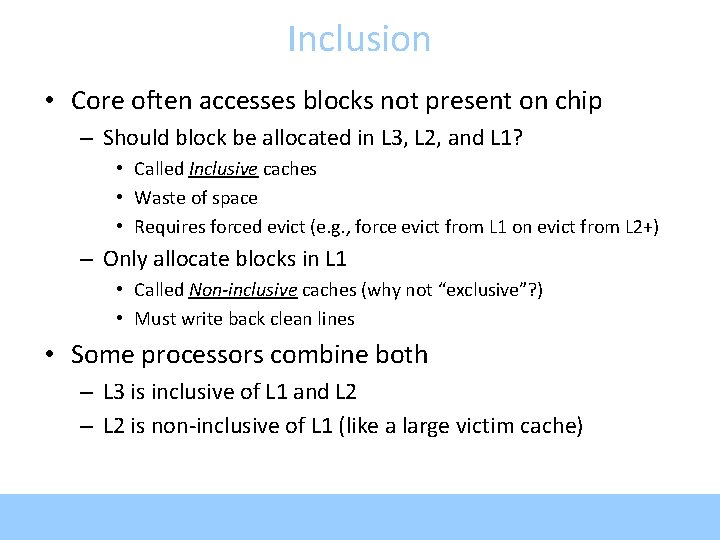
Inclusion • Core often accesses blocks not present on chip – Should block be allocated in L 3, L 2, and L 1? • Called Inclusive caches • Waste of space • Requires forced evict (e. g. , force evict from L 1 on evict from L 2+) – Only allocate blocks in L 1 • Called Non-inclusive caches (why not “exclusive”? ) • Must write back clean lines • Some processors combine both – L 3 is inclusive of L 1 and L 2 – L 2 is non-inclusive of L 1 (like a large victim cache)
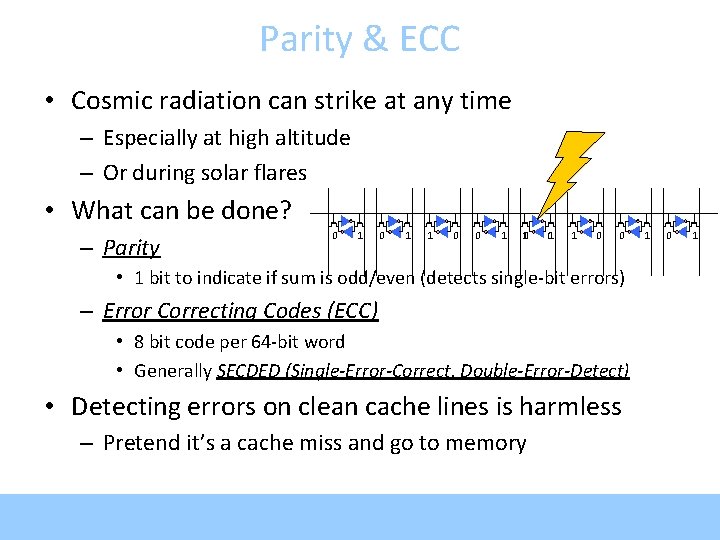
Parity & ECC • Cosmic radiation can strike at any time – Especially at high altitude – Or during solar flares • What can be done? – Parity 0 1 1 0 0 1 10 01 1 0 0 • 1 bit to indicate if sum is odd/even (detects single-bit errors) – Error Correcting Codes (ECC) • 8 bit code per 64 -bit word • Generally SECDED (Single-Error-Correct, Double-Error-Detect) • Detecting errors on clean cache lines is harmless – Pretend it’s a cache miss and go to memory 1 0 1