
CSE 490590 Computer Architecture ILP I Steve Ko
- Slides: 16
CSE 490/590 Computer Architecture ILP I Steve Ko Computer Sciences and Engineering University at Buffalo CSE 490/590, Spring 2011
Last time… • Scoreboard – Data structure that keeps track of dependencies among instructions • In-order limitations – Out-of-order alone cannot solve • Register renaming – Overcoming the restriction caused by the # of registers CSE 490/590, Spring 2011 2
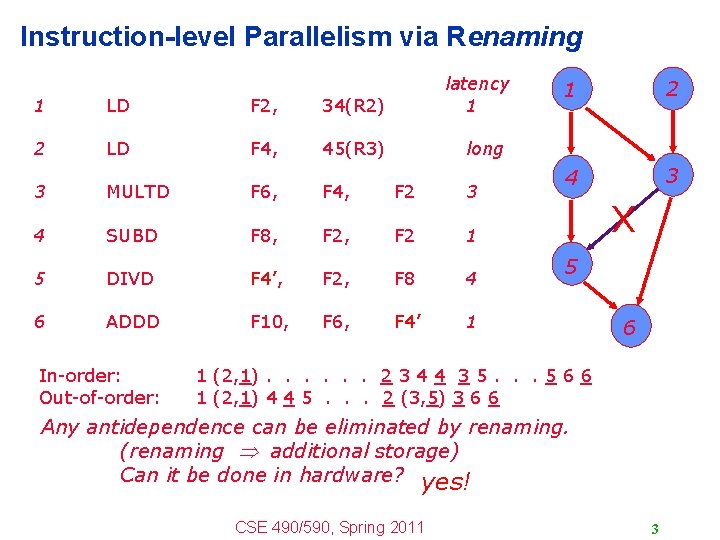
Instruction-level Parallelism via Renaming 1 LD F 2, 34(R 2) latency 1 2 LD F 4, 45(R 3) long 3 MULTD F 6, F 4, F 2 3 4 SUBD F 8, F 2 1 5 DIVD F 4’, F 2, F 8 4 6 ADDD F 10, F 6, F 4’ 1 In-order: Out-of-order: 1 2 4 3 X 5 6 1 (2, 1). . . 2 3 4 4 3 5. . . 5 6 6 1 (2, 1) 4 4 5. . . 2 (3, 5) 3 6 6 Any antidependence can be eliminated by renaming. (renaming additional storage) Can it be done in hardware? yes! CSE 490/590, Spring 2011 3
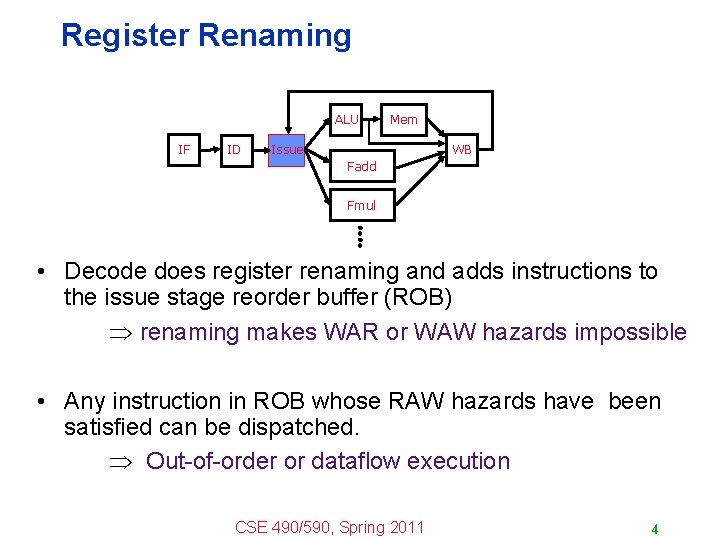
Register Renaming ALU IF ID Mem Issue WB Fadd Fmul • Decode does register renaming and adds instructions to the issue stage reorder buffer (ROB) renaming makes WAR or WAW hazards impossible • Any instruction in ROB whose RAW hazards have been satisfied can be dispatched. Out-of-order or dataflow execution CSE 490/590, Spring 2011 4
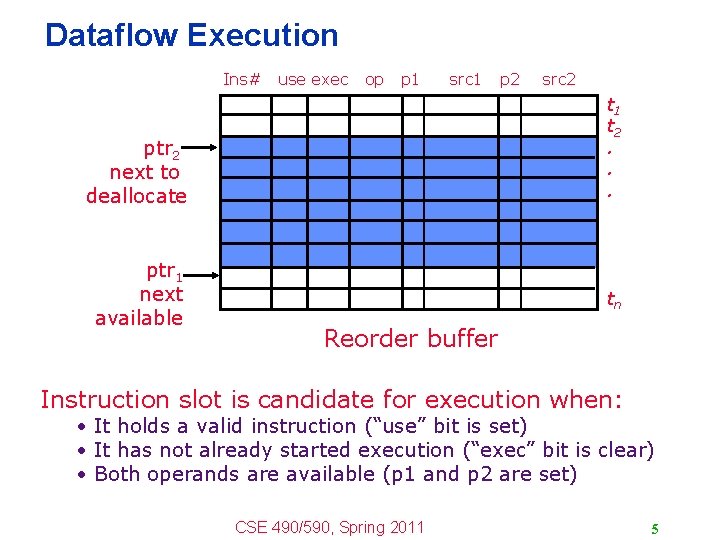
Dataflow Execution Ins# use exec op p 1 src 2 t 1 t 2. . . ptr 2 next to deallocate ptr 1 next available p 2 tn Reorder buffer Instruction slot is candidate for execution when: • It holds a valid instruction (“use” bit is set) • It has not already started execution (“exec” bit is clear) • Both operands are available (p 1 and p 2 are set) CSE 490/590, Spring 2011 5
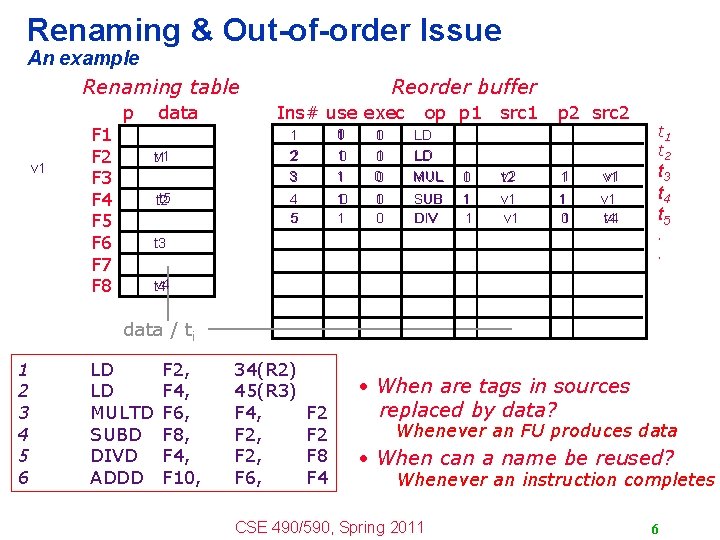
Renaming & Out-of-order Issue An example Renaming table v 1 F 2 F 3 F 4 F 5 F 6 F 7 F 8 p data v 1 t 5 t 2 Reorder buffer Ins# use exec op p 1 src 1 p 2 src 2 0 1 1 0 LD LD 3 0 1 10 1 0 MUL 10 v 2 t 2 11 v 1 4 5 10 1 1 0 0 SUB DIV 1 1 v 1 1 0 1 v 1 t 4 v 4 1 22 t 3 t 1 t 2 t 3 t 4 t 5. . v 4 t 4 data / ti 1 2 3 4 5 6 LD LD MULTD SUBD DIVD ADDD F 2, F 4, F 6, F 8, F 4, F 10, 34(R 2) 45(R 3) F 4, F 2, F 6, F 2 F 8 F 4 • When are tags in sources replaced by data? Whenever an FU produces data • When can a name be reused? Whenever an instruction completes CSE 490/590, Spring 2011 6
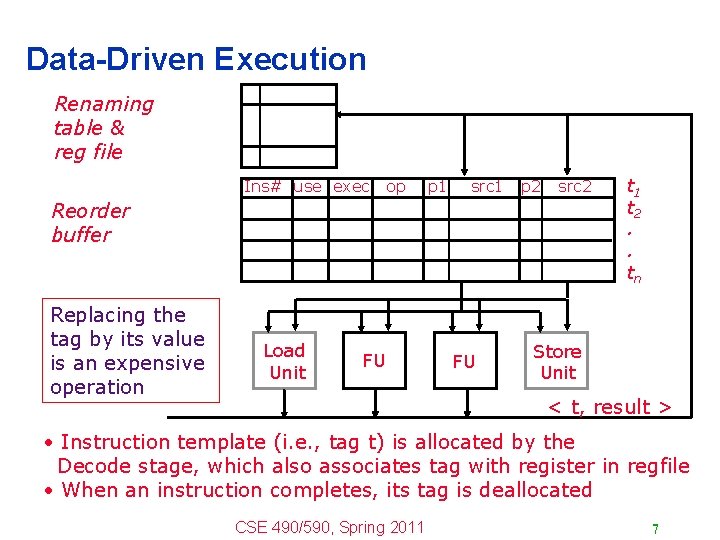
Data-Driven Execution Renaming table & reg file Ins# use exec op p 1 src 1 p 2 src 2 Reorder buffer Replacing the tag by its value is an expensive operation Load Unit FU FU t 1 t 2. . tn Store Unit < t, result > • Instruction template (i. e. , tag t) is allocated by the Decode stage, which also associates tag with register in regfile • When an instruction completes, its tag is deallocated CSE 490/590, Spring 2011 7
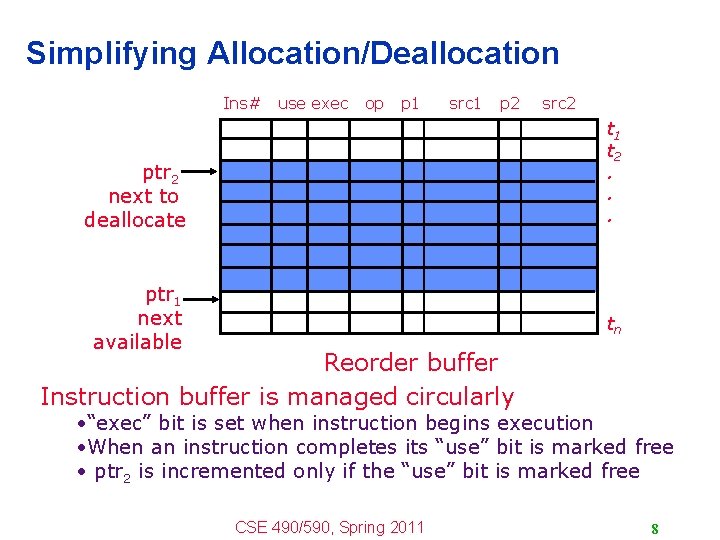
Simplifying Allocation/Deallocation Ins# use exec op p 1 src 1 p 2 src 2 t 1 t 2. . . ptr 2 next to deallocate ptr 1 next available tn Reorder buffer Instruction buffer is managed circularly • “exec” bit is set when instruction begins execution • When an instruction completes its “use” bit is marked free • ptr 2 is incremented only if the “use” bit is marked free CSE 490/590, Spring 2011 8
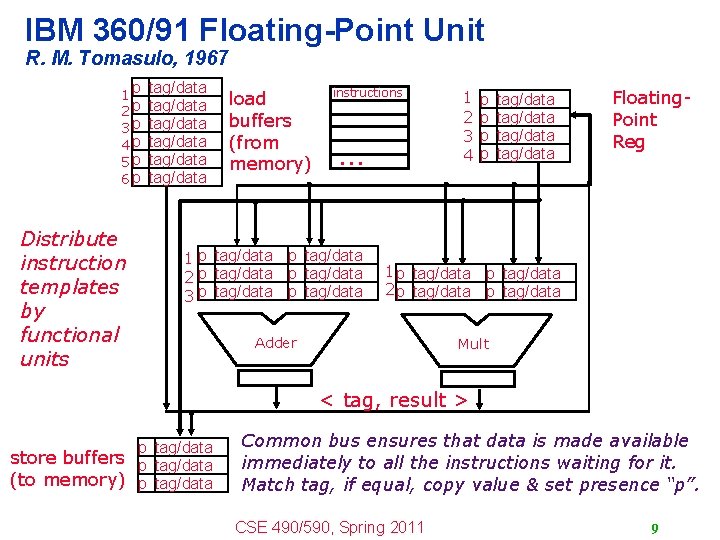
IBM 360/91 Floating-Point Unit R. M. Tomasulo, 1967 1 p 2 p 3 p 4 p 5 p 6 p Distribute instruction templates by functional units tag/data tag/data load buffers (from memory) instructions . . . 1 2 3 4 p p tag/data 1 p tag/data 2 p tag/data 3 p tag/data 1 p tag/data 2 p tag/data Adder Mult Floating. Point Reg < tag, result > p tag/data store buffers p tag/data (to memory) p tag/data Common bus ensures that data is made available immediately to all the instructions waiting for it. Match tag, if equal, copy value & set presence “p”. CSE 490/590, Spring 2011 9
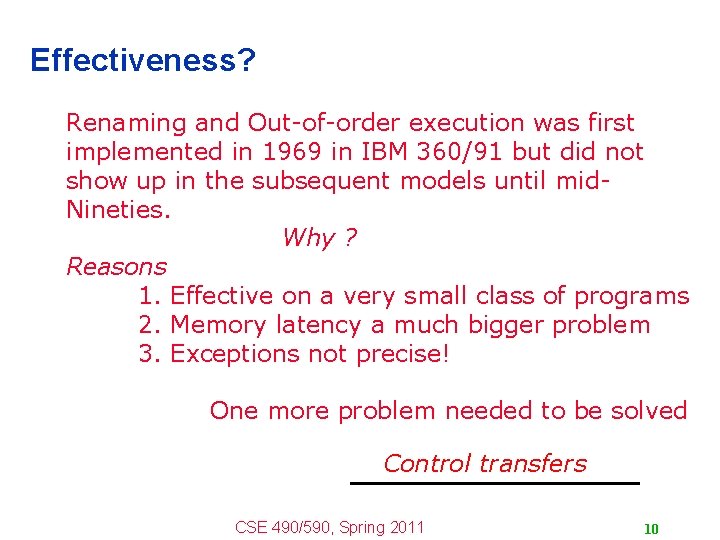
Effectiveness? Renaming and Out-of-order execution was first implemented in 1969 in IBM 360/91 but did not show up in the subsequent models until mid. Nineties. Why ? Reasons 1. Effective on a very small class of programs 2. Memory latency a much bigger problem 3. Exceptions not precise! One more problem needed to be solved Control transfers CSE 490/590, Spring 2011 10
CSE 490/590 Administrivia • No office hours this week – Appointment via email if needed – Project-related questions fastest: Safwan or Jangyoung • Guest Lecture by Prof. Kris Schindler on Wed • Guest lecture by Prof. Tevfik Kosar on Fri CSE 490/590, Spring 2011 11
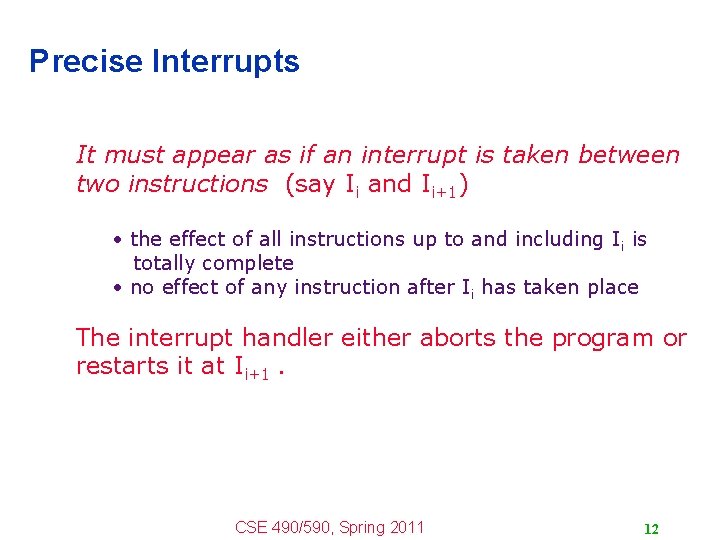
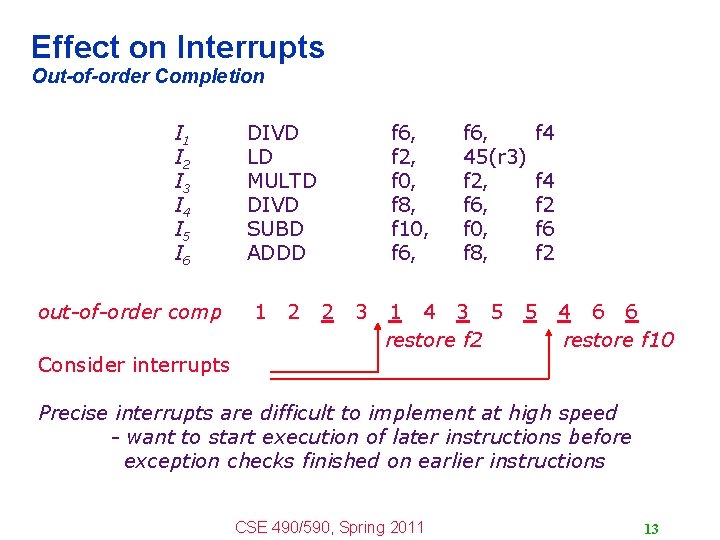
Precise Interrupts It must appear as if an interrupt is taken between two instructions (say Ii and Ii+1) • the effect of all instructions up to and including Ii is totally complete • no effect of any instruction after Ii has taken place The interrupt handler either aborts the program or restarts it at Ii+1. CSE 490/590, Spring 2011 12
Effect on Interrupts Out-of-order Completion I 1 I 2 I 3 I 4 I 5 I 6 out-of-order comp DIVD LD MULTD DIVD SUBD ADDD 1 2 f 6, f 2, f 0, f 8, f 10, f 6, 2 3 f 6, 45(r 3) f 2, f 6, f 0, f 8, 1 4 3 5 restore f 2 f 4 f 2 f 6 f 2 5 4 6 6 restore f 10 Consider interrupts Precise interrupts are difficult to implement at high speed - want to start execution of later instructions before exception checks finished on earlier instructions CSE 490/590, Spring 2011 13
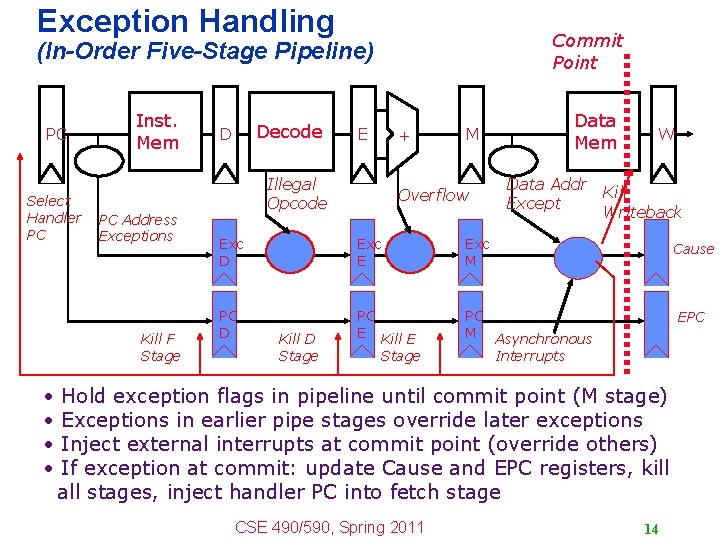
Exception Handling Commit Point (In-Order Five-Stage Pipeline) PC Select Handler PC Inst. Mem PC Address Exceptions Kill F Stage • • Decode D E Illegal Opcode + M Overflow Data Mem Data Addr Kill Except Writeback Exc D Exc E Exc M PC D PC E Kill E Stage PC M Asynchronous Interrupts Kill D Stage W Cause EPC Hold exception flags in pipeline until commit point (M stage) Exceptions in earlier pipe stages override later exceptions Inject external interrupts at commit point (override others) If exception at commit: update Cause and EPC registers, kill all stages, inject handler PC into fetch stage CSE 490/590, Spring 2011 14
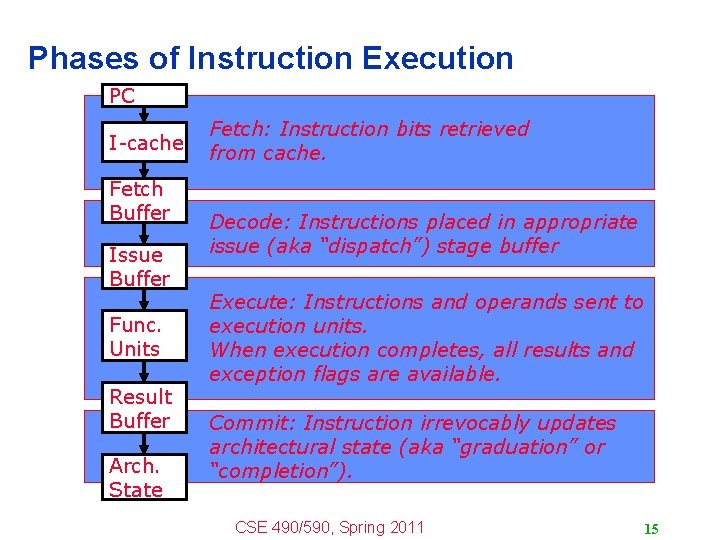
Phases of Instruction Execution PC I-cache Fetch Buffer Issue Buffer Func. Units Result Buffer Arch. State Fetch: Instruction bits retrieved from cache. Decode: Instructions placed in appropriate issue (aka “dispatch”) stage buffer Execute: Instructions and operands sent to execution units. When execution completes, all results and exception flags are available. Commit: Instruction irrevocably updates architectural state (aka “graduation” or “completion”). CSE 490/590, Spring 2011 15
Acknowledgements • These slides heavily contain material developed and copyright by – Krste Asanovic (MIT/UCB) – David Patterson (UCB) • And also by: – – Arvind (MIT) Joel Emer (Intel/MIT) James Hoe (CMU) John Kubiatowicz (UCB) • MIT material derived from course 6. 823 • UCB material derived from course CS 252 CSE 490/590, Spring 2011 16