
CSE 486586 Distributed Systems Time and Synchronization Steve
CSE 486/586 Distributed Systems Time and Synchronization Steve Ko Computer Sciences and Engineering University at Buffalo CSE 486/586
Last Time • Models of Distributed Systems – Synchronous systems – Asynchronous systems • Failure detectors---why? – Because things do fail. • Failure detectors---what? – Properties: completeness & accuracy – Cannot have a perfect failure detector – Metrics: bandwidth, detection time, scale, accuracy • Failure detectors---how? – Two processes: Heartbeating and Ping – Multiple processes: Centralized, ring, all-to-all CSE 486/586 2
Today’s Question • The topic of time – Today and next time • Why? – Need to know when things happen – One of the fundamental challenges • What? – Ideally, we’d like to know when exactly something happened. • How? – Let’s see! CSE 486/586 3
Today’s Question • Servers in the cloud need to timestamp events • Server A and server B in the cloud can have different clock values. – – – The cloud has server A and server B that service customers. You try to purchase an airline ticket online via the cloud. It’s the last airline ticket available on that flight. Server A timestamps your attempt at 9 h: 15 m: 32. 45 s. Server B timestamps someone else’s attempt at 9 h: 20 m: 22. 76 s. – Who should get the ticket? – What if Server A’s clock was > 10 minutes ahead of server B’s clock? Behind? – How would you know what the difference was at those times? CSE 486/586 4
Physical Clocks & Synchronization • Some definitions: Clock Skew versus Drift • Clock Skew = Relative Difference in clock values of two processes • Clock Drift = Relative Difference in clock frequencies (rates) of two processes • A non-zero clock drift will cause skew to continuously increase. • Real-life examples – Ever had “make: warning: Clock skew detected. Your build may be incomplete. ”? – It’s reported that in the worst case, there’s 1 sec/day drift in modern HW. – Almost all physical clocks experience this. CSE 486/586 5
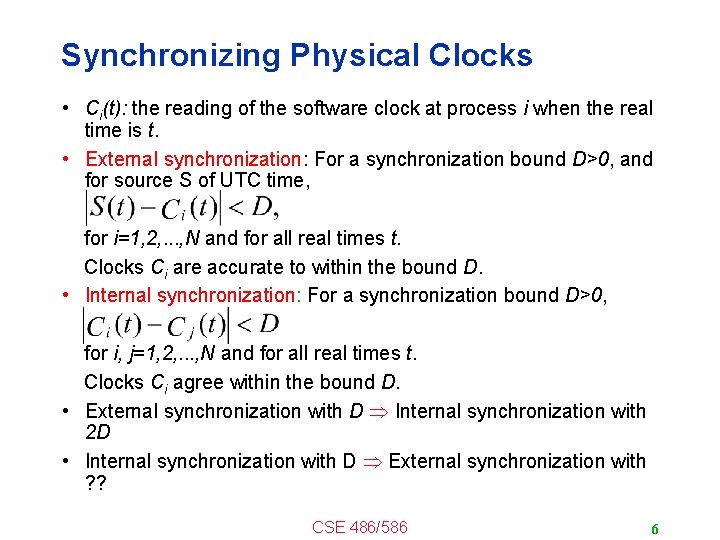
Synchronizing Physical Clocks • Ci(t): the reading of the software clock at process i when the real time is t. • External synchronization: For a synchronization bound D>0, and for source S of UTC time, for i=1, 2, . . . , N and for all real times t. Clocks Ci are accurate to within the bound D. • Internal synchronization: For a synchronization bound D>0, for i, j=1, 2, . . . , N and for all real times t. Clocks Ci agree within the bound D. • External synchronization with D Internal synchronization with 2 D • Internal synchronization with D External synchronization with ? ? CSE 486/586 6
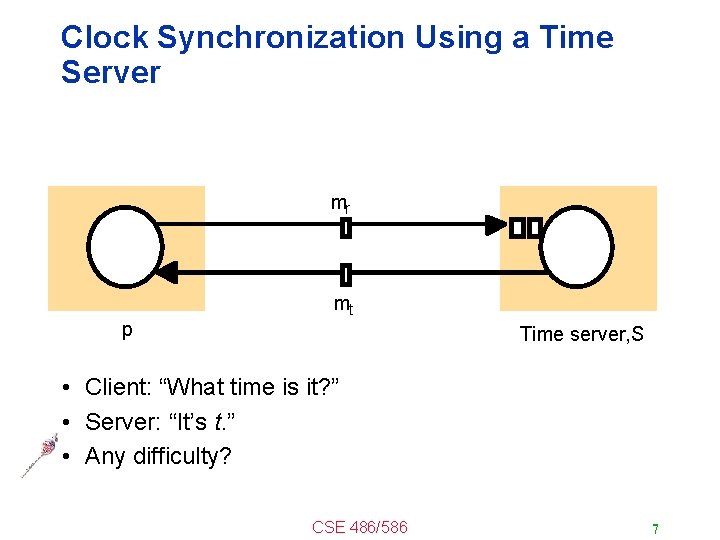
Clock Synchronization Using a Time Server mr mt p Time server, S • Client: “What time is it? ” • Server: “It’s t. ” • Any difficulty? CSE 486/586 7
Cristian’s Algorithm • Uses a time server to synchronize clocks • Mainly designed for LAN • Time server keeps the reference time (say UTC) • A client asks the time server for time, the server responds with its current time T, and the client uses the received value T to set its clock • But network round-trip time introduces an error. • So what do we need to do? – Estimate one-way delay CSE 486/586 8
Cristian’s Algorithm • Let RTT = response-received-time – request-senttime (measurable at client) • Also, suppose we know – The minimum value min of the client-server one-way transmission time [Depends on what? ] (to simplify our discussion, let’s say there’s a single min) – That the server timestamped the message at the last possible instant before sending it back • Ideally, the client should set its time to: T + (one-way latency from the server to the client) CSE 486/586 9
Cristian’s Algorithm • But we don’t know the one-way latency from the server to the client. • When the client receives the time (T) from the server, T can be in a range of possible values. • Consider two extreme cases. CSE 486/586 10
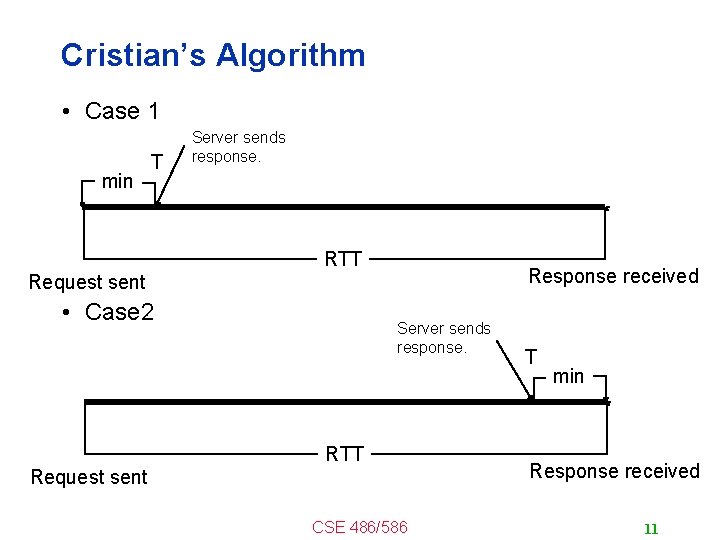
Cristian’s Algorithm • Case 1 min T Server sends response. RTT Response received Request sent • Case 2 Server sends response. RTT Request sent CSE 486/586 T min Response received 11
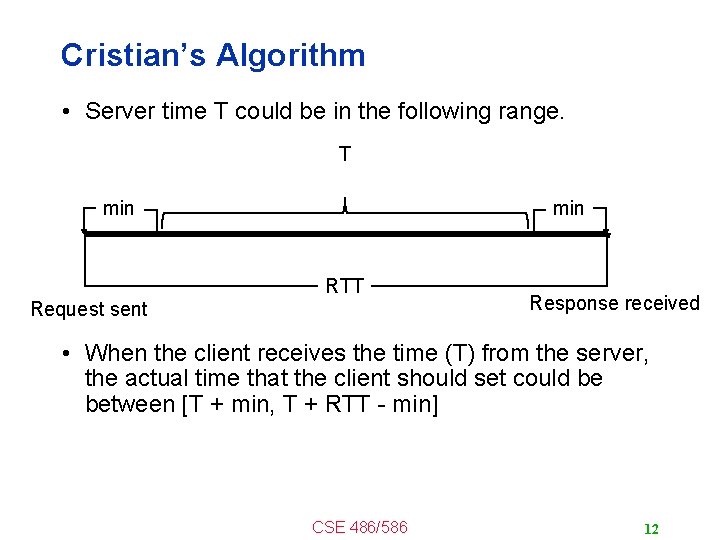
Cristian’s Algorithm • Server time T could be in the following range. T min RTT Request sent Response received • When the client receives the time (T) from the server, the actual time that the client should set could be between [T + min, T + RTT - min] CSE 486/586 12
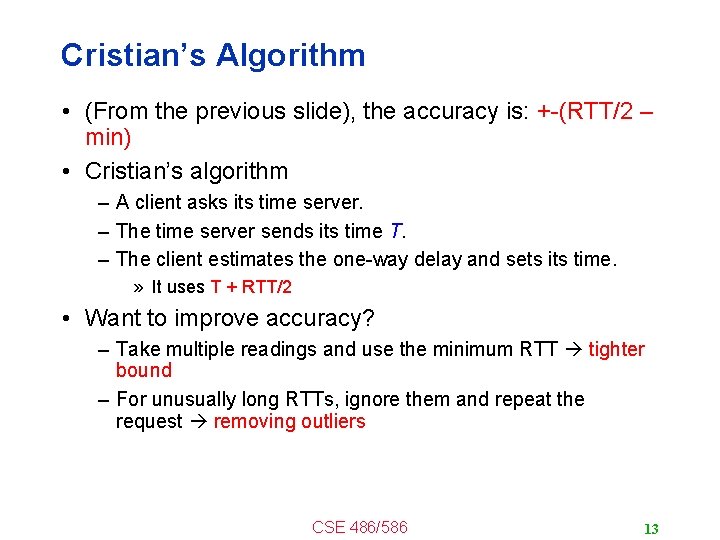
Cristian’s Algorithm • (From the previous slide), the accuracy is: +-(RTT/2 – min) • Cristian’s algorithm – A client asks its time server. – The time server sends its time T. – The client estimates the one-way delay and sets its time. » It uses T + RTT/2 • Want to improve accuracy? – Take multiple readings and use the minimum RTT tighter bound – For unusually long RTTs, ignore them and repeat the request removing outliers CSE 486/586 13
CSE 486/586 Administrivia • Please start PA 2 -A. • Grades will go to UBlearns. Will post grades for PA 1 probably early next week. • Please use Piazza; all announcements will go there. CSE 486/586 14
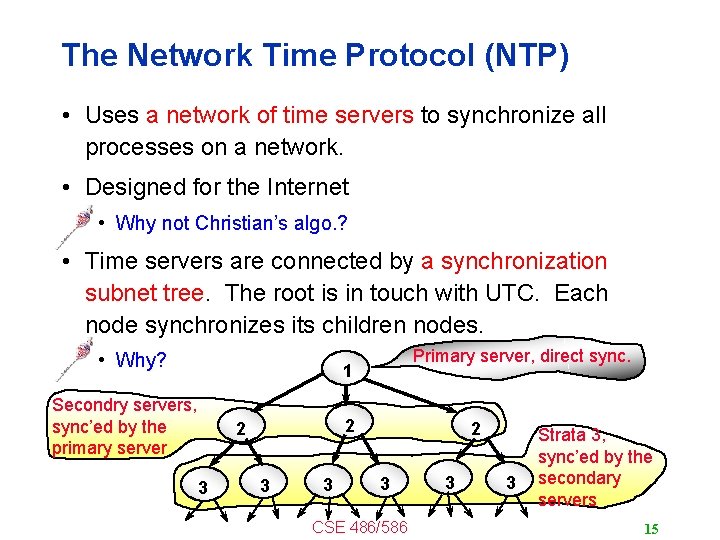
The Network Time Protocol (NTP) • Uses a network of time servers to synchronize all processes on a network. • Designed for the Internet • Why not Christian’s algo. ? • Time servers are connected by a synchronization subnet tree. The root is in touch with UTC. Each node synchronizes its children nodes. • Why? Primary server, direct sync. 1 Secondry servers, sync’ed by the primary server 2 2 3 3 3 2 3 CSE 486/586 3 3 Strata 3, sync’ed by the secondary servers 15
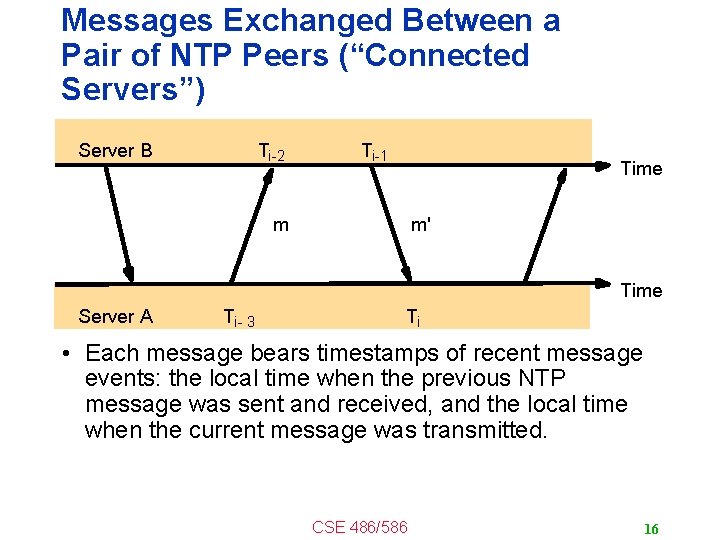
Messages Exchanged Between a Pair of NTP Peers (“Connected Servers”) Server B Ti-2 Ti-1 Time m m' Time Server A Ti- 3 Ti • Each message bears timestamps of recent message events: the local time when the previous NTP message was sent and received, and the local time when the current message was transmitted. CSE 486/586 16
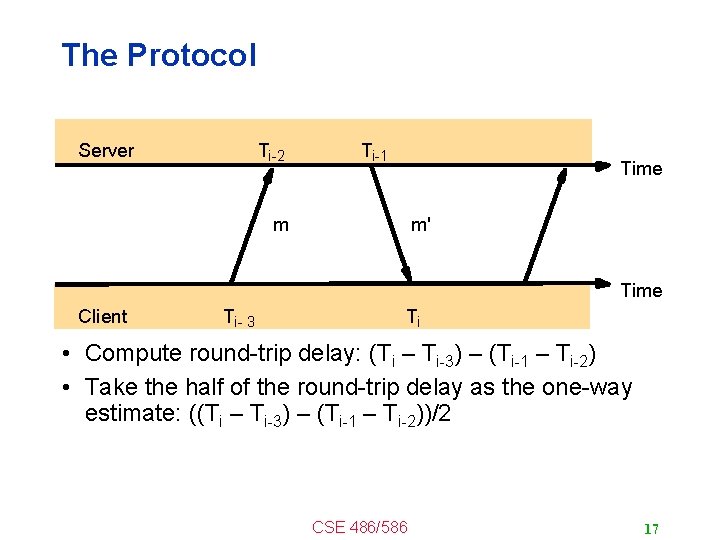
The Protocol Server Ti-2 Ti-1 Time m m' Time Client Ti- 3 Ti • Compute round-trip delay: (Ti – Ti-3) – (Ti-1 – Ti-2) • Take the half of the round-trip delay as the one-way estimate: ((Ti – Ti-3) – (Ti-1 – Ti-2))/2 CSE 486/586 17
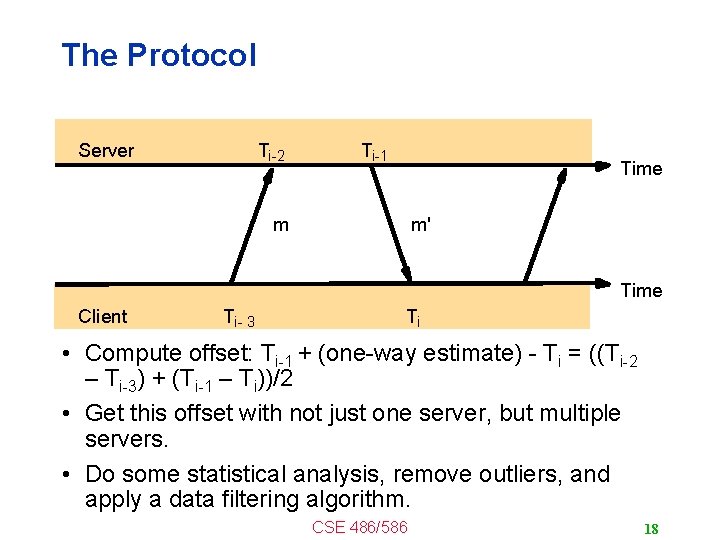
The Protocol Server Ti-2 Ti-1 Time m m' Time Client Ti- 3 Ti • Compute offset: Ti-1 + (one-way estimate) - Ti = ((Ti-2 – Ti-3) + (Ti-1 – Ti))/2 • Get this offset with not just one server, but multiple servers. • Do some statistical analysis, remove outliers, and apply a data filtering algorithm. CSE 486/586 18
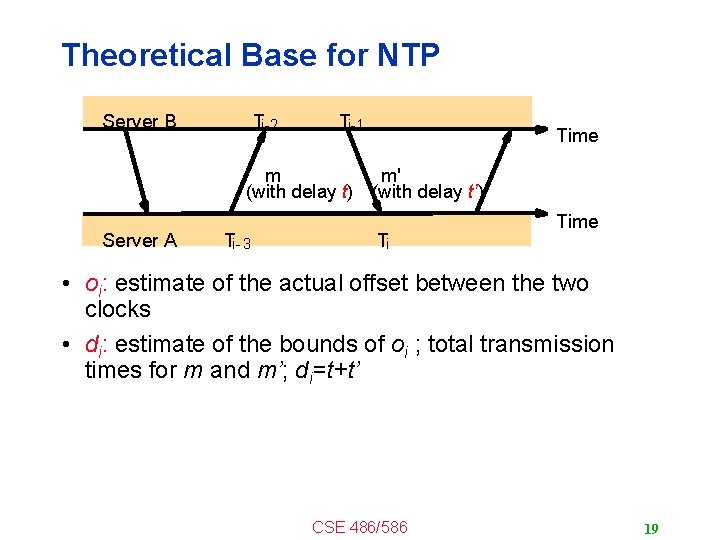
Theoretical Base for NTP Server B Ti-2 Ti-1 Time m m' (with delay t) (with delay t’) Server A Ti- 3 Ti Time • oi: estimate of the actual offset between the two clocks • di: estimate of the bounds of oi ; total transmission times for m and m’; di=t+t’ CSE 486/586 19
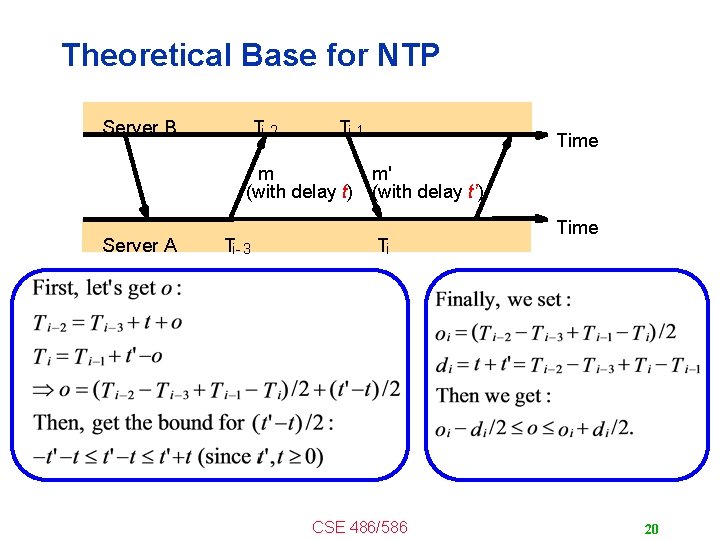
Theoretical Base for NTP Server B Ti-2 Ti-1 Time m m' (with delay t) (with delay t’) Server A Ti- 3 Ti CSE 486/586 Time 20
Then a Breakthrough… • We cannot sync multiple clocks perfectly. • Thus, if we want to order events happened at different processes (remember the ticket reservation example? ), we cannot rely on physical clocks. • Then came logical time. – First proposed by Leslie Lamport in the 70’s – Based on causality of events – Defined relative time, not absolute time • Critical observation: time (ordering) only matters if two or more processes interact, i. e. , send/receive messages. CSE 486/586 21
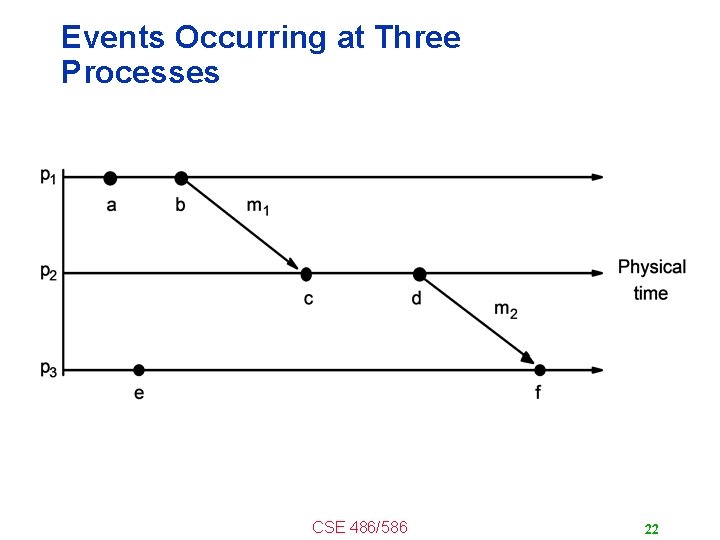
Events Occurring at Three Processes CSE 486/586 22
Summary • Time synchronization important for distributed systems – Cristian’s algorithm – NTP • Relative order of events enough for practical purposes – Lamport’s logical clocks • Next: continue on logical clocks CSE 486/586 23
Acknowledgements • These slides contain material developed and copyrighted by Indranil Gupta at UIUC. CSE 486/586 24
- Slides: 24