
CSE 486586 Distributed Systems Mutual Exclusion 1 Steve
CSE 486/586 Distributed Systems Mutual Exclusion --- 1 Steve Ko Computer Sciences and Engineering University at Buffalo CSE 486/586, Spring 2012
Recap: Consensus • On a synchronous system – There’s an algorithm that works. • On an asynchronous system – It’s been shown (FLP) that it’s impossible to guarantee. • Getting around the result – Masking faults – Using failure detectors – Still not perfect • Impossibility Result – Lemma 1: schedules are commutative – Lemma 2: some initial configuration is bivalent – Lemma 3: from a bivalent configuration, there is always another bivalent configuration that is reachable. CSE 486/586, Spring 2012 2
Why Mutual Exclusion? • Bank’s Servers in the Cloud: Think of two simultaneous deposits of $10, 000 into your bank account, each from one ATM. – Both ATMs read initial amount of $1000 concurrently from the bank’s cloud server – Both ATMs add $10, 000 to this amount (locally at the ATM) – Both write the final amount to the server – What’s wrong? CSE 486/586, Spring 2012 3
Why Mutual Exclusion? • Bank’s Servers in the Cloud: Think of two simultaneous deposits of $10, 000 into your bank account, each from one ATM. – Both ATMs read initial amount of $1000 concurrently from the bank’s cloud server – Both ATMs add $10, 000 to this amount (locally at the ATM) – Both write the final amount to the server – What’s wrong? • The ATMs need mutually exclusive access to your account entry at the server (or, to executing the code that modifies the account entry) CSE 486/586, Spring 2012 4
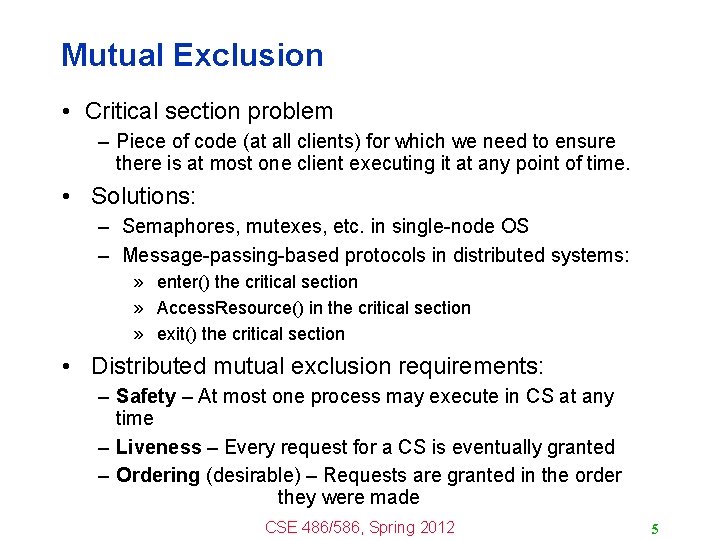
Mutual Exclusion • Critical section problem – Piece of code (at all clients) for which we need to ensure there is at most one client executing it at any point of time. • Solutions: – Semaphores, mutexes, etc. in single-node OS – Message-passing-based protocols in distributed systems: » enter() the critical section » Access. Resource() in the critical section » exit() the critical section • Distributed mutual exclusion requirements: – Safety – At most one process may execute in CS at any time – Liveness – Every request for a CS is eventually granted – Ordering (desirable) – Requests are granted in the order they were made CSE 486/586, Spring 2012 5
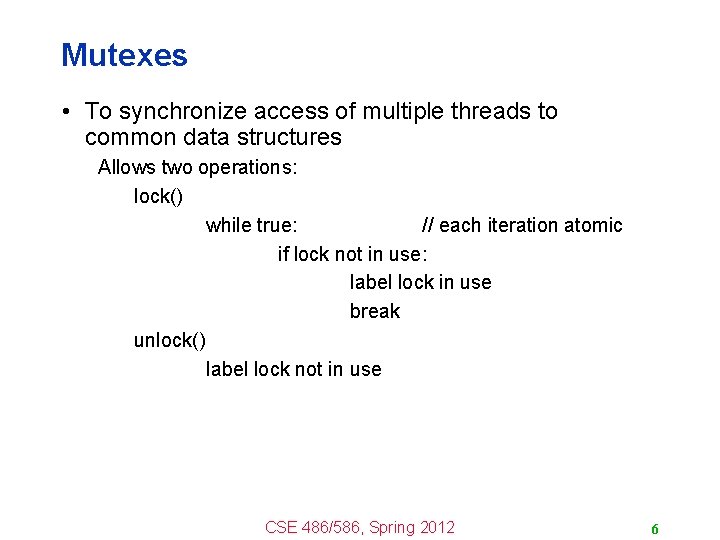
Mutexes • To synchronize access of multiple threads to common data structures Allows two operations: lock() while true: // each iteration atomic if lock not in use: label lock in use break unlock() label lock not in use CSE 486/586, Spring 2012 6
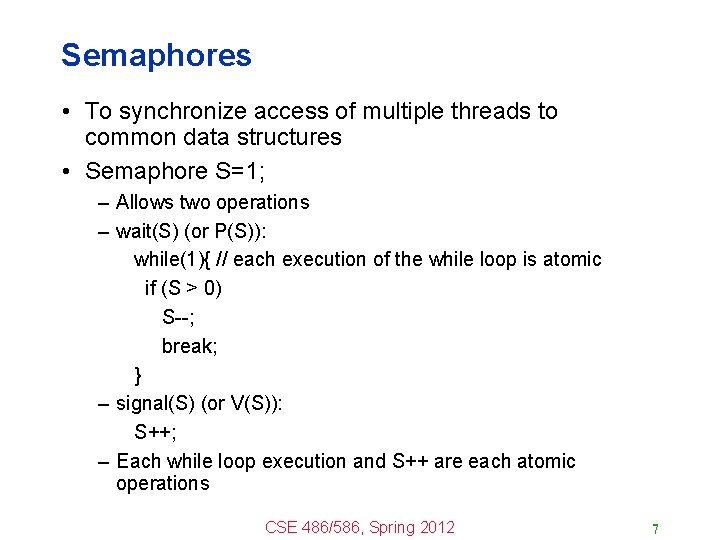
Semaphores • To synchronize access of multiple threads to common data structures • Semaphore S=1; – Allows two operations – wait(S) (or P(S)): while(1){ // each execution of the while loop is atomic if (S > 0) S--; break; } – signal(S) (or V(S)): S++; – Each while loop execution and S++ are each atomic operations CSE 486/586, Spring 2012 7
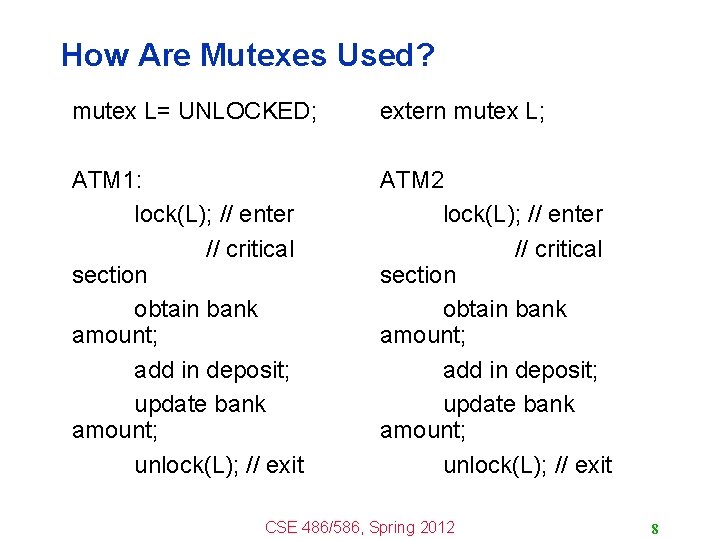
How Are Mutexes Used? mutex L= UNLOCKED; extern mutex L; ATM 1: lock(L); // enter // critical section obtain bank amount; add in deposit; update bank amount; unlock(L); // exit ATM 2 lock(L); // enter // critical section obtain bank amount; add in deposit; update bank amount; unlock(L); // exit CSE 486/586, Spring 2012 8
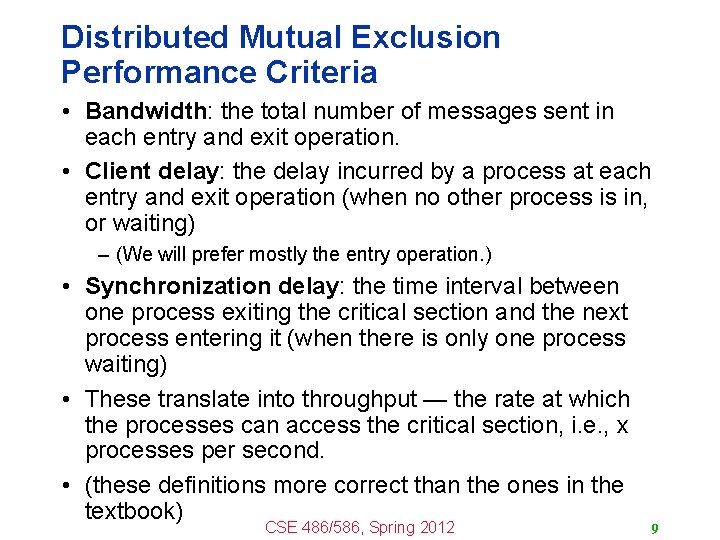
Distributed Mutual Exclusion Performance Criteria • Bandwidth: the total number of messages sent in each entry and exit operation. • Client delay: the delay incurred by a process at each entry and exit operation (when no other process is in, or waiting) – (We will prefer mostly the entry operation. ) • Synchronization delay: the time interval between one process exiting the critical section and the next process entering it (when there is only one process waiting) • These translate into throughput — the rate at which the processes can access the critical section, i. e. , x processes per second. • (these definitions more correct than the ones in the textbook) CSE 486/586, Spring 2012 9
Assumptions/System Model • For all the algorithms studied, we make the following assumptions: – Each pair of processes is connected by reliable channels (such as TCP). – Messages are eventually delivered to recipients’ input buffer in FIFO order. – Processes do not fail (why? ) • Four algorithms – – Centralized control Token ring Ricart and Agrawala Maekawa CSE 486/586, Spring 2012 10
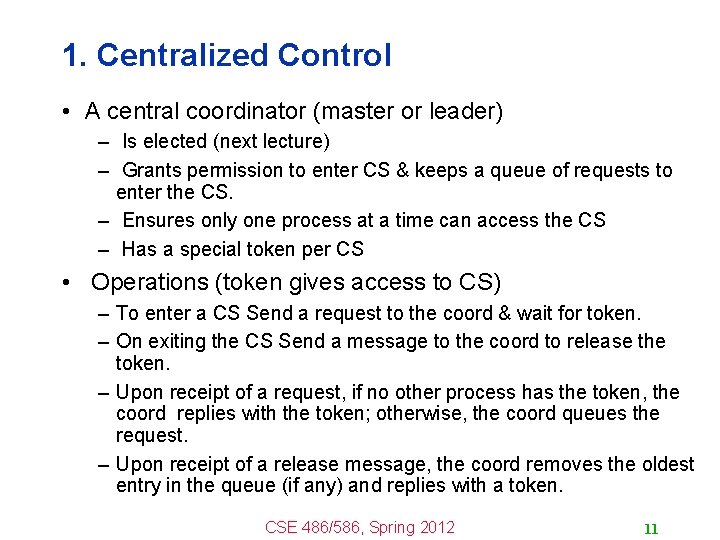
1. Centralized Control • A central coordinator (master or leader) – Is elected (next lecture) – Grants permission to enter CS & keeps a queue of requests to enter the CS. – Ensures only one process at a time can access the CS – Has a special token per CS • Operations (token gives access to CS) – To enter a CS Send a request to the coord & wait for token. – On exiting the CS Send a message to the coord to release the token. – Upon receipt of a request, if no other process has the token, the coord replies with the token; otherwise, the coord queues the request. – Upon receipt of a release message, the coord removes the oldest entry in the queue (if any) and replies with a token. CSE 486/586, Spring 2012 11
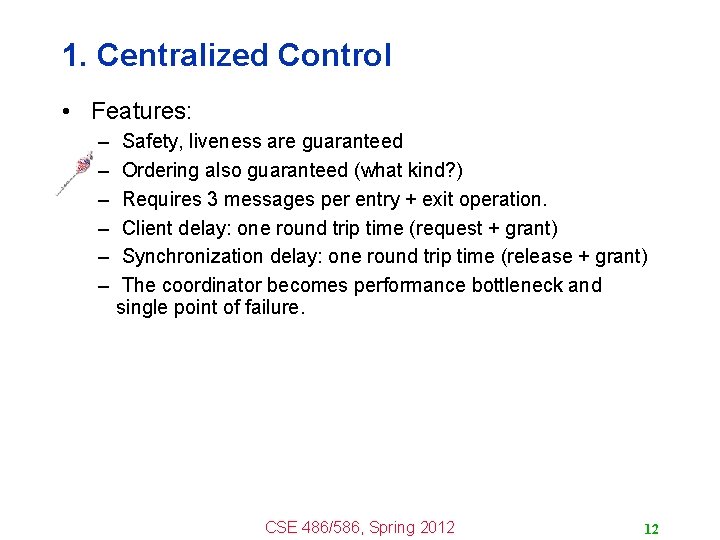
1. Centralized Control • Features: – – – Safety, liveness are guaranteed Ordering also guaranteed (what kind? ) Requires 3 messages per entry + exit operation. Client delay: one round trip time (request + grant) Synchronization delay: one round trip time (release + grant) The coordinator becomes performance bottleneck and single point of failure. CSE 486/586, Spring 2012 12
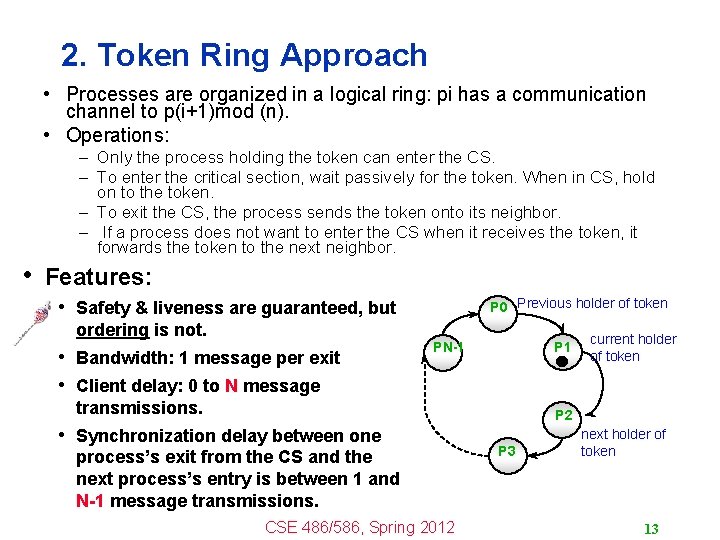
2. Token Ring Approach • Processes are organized in a logical ring: pi has a communication channel to p(i+1)mod (n). • Operations: – Only the process holding the token can enter the CS. – To enter the critical section, wait passively for the token. When in CS, hold on to the token. – To exit the CS, the process sends the token onto its neighbor. – If a process does not want to enter the CS when it receives the token, it forwards the token to the next neighbor. • Features: • Safety & liveness are guaranteed, but ordering is not. • Bandwidth: 1 message per exit • Client delay: 0 to N message P 0 Previous holder of token PN-1 P 1 transmissions. • Synchronization delay between one process’s exit from the CS and the next process’s entry is between 1 and N-1 message transmissions. CSE 486/586, Spring 2012 current holder of token P 2 P 3 next holder of token 13
CSE 486/586 Administrivia • Amazon EC 2 – Please watch the usage (you’ll get charged if your usage goes over the credit). Stop your instance every time you’re done. – Don’t use this for your development and simple debugging. – Please change the default password • Project 1 – Will be revised slightly. – Deadline will be extended by one week. • Group assignment – Watch Piazza • Midterm: 3/5 (Monday) in class – Read the textbook & go over the slides – Go over the problems in the textbook CSE 486/586, Spring 2012 14
3. Ricart & Agrawala’s Algorithm • Processes requiring entry to critical section multicast a request, and can enter it only when all other processes have replied positively. • Messages requesting entry are of the form <T, pi>, where T is the sender’s timestamp (from a Lamport clock) and pi the sender’s identity (used to break ties in T). CSE 486/586, Spring 2012 15
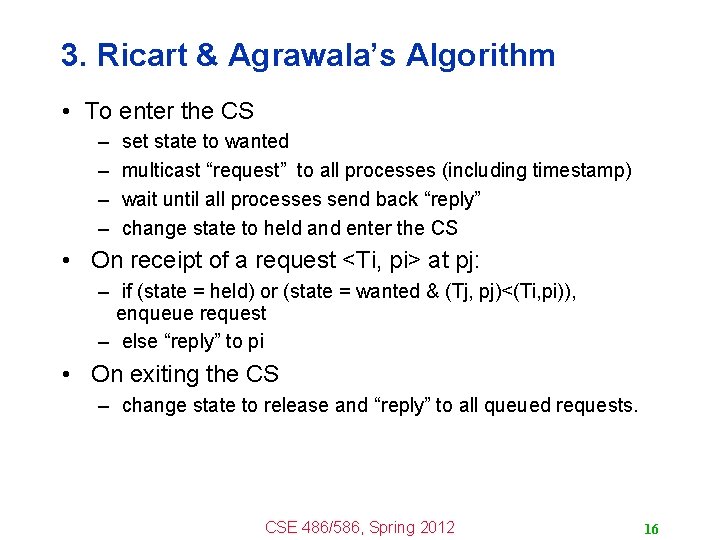
3. Ricart & Agrawala’s Algorithm • To enter the CS – – set state to wanted multicast “request” to all processes (including timestamp) wait until all processes send back “reply” change state to held and enter the CS • On receipt of a request <Ti, pi> at pj: – if (state = held) or (state = wanted & (Tj, pj)<(Ti, pi)), enqueue request – else “reply” to pi • On exiting the CS – change state to release and “reply” to all queued requests. CSE 486/586, Spring 2012 16
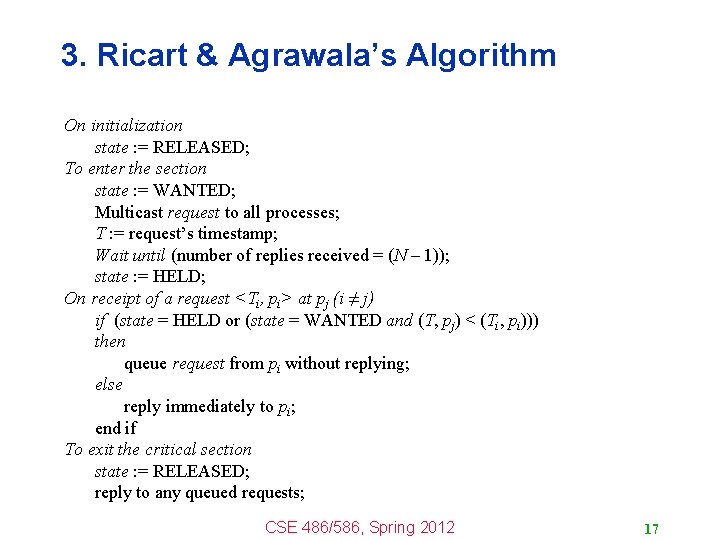
3. Ricart & Agrawala’s Algorithm On initialization state : = RELEASED; To enter the section state : = WANTED; Multicast request to all processes; T : = request’s timestamp; Wait until (number of replies received = (N – 1)); state : = HELD; On receipt of a request <Ti, pi> at pj (i ≠ j) if (state = HELD or (state = WANTED and (T, pj) < (Ti, pi))) then queue request from pi without replying; else reply immediately to pi; end if To exit the critical section state : = RELEASED; reply to any queued requests; CSE 486/586, Spring 2012 17
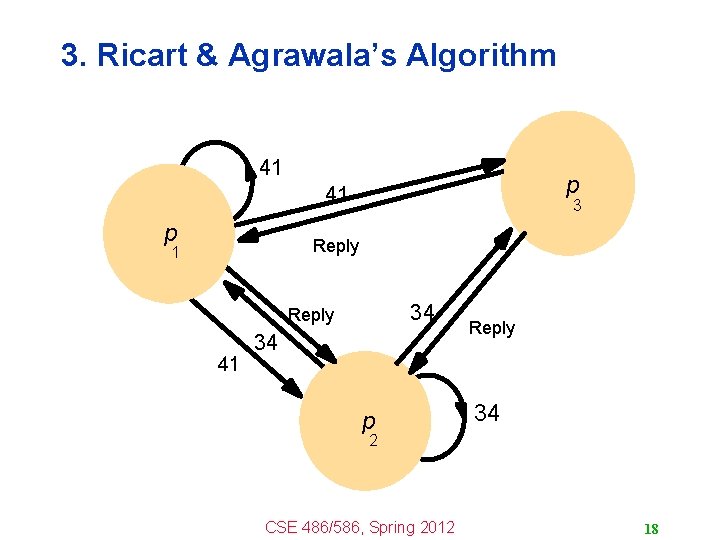
3. Ricart & Agrawala’s Algorithm 41 p 3 Reply 1 34 Reply 41 34 p Reply 34 2 CSE 486/586, Spring 2012 18
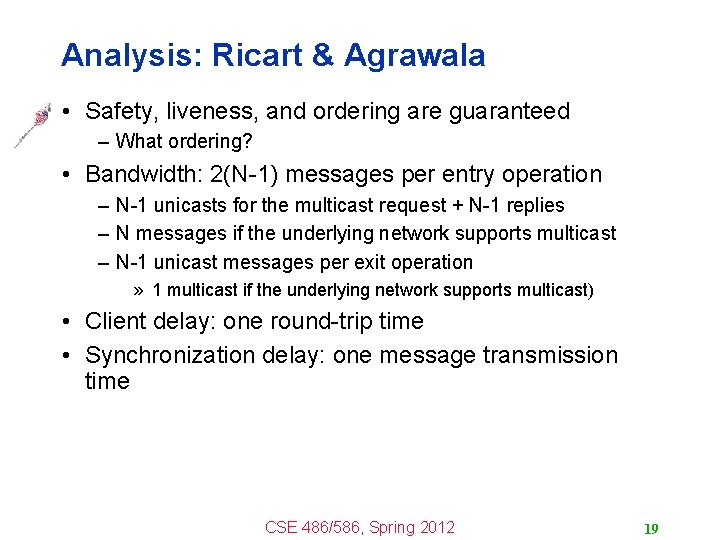
Analysis: Ricart & Agrawala • Safety, liveness, and ordering are guaranteed – What ordering? • Bandwidth: 2(N-1) messages per entry operation – N-1 unicasts for the multicast request + N-1 replies – N messages if the underlying network supports multicast – N-1 unicast messages per exit operation » 1 multicast if the underlying network supports multicast) • Client delay: one round-trip time • Synchronization delay: one message transmission time CSE 486/586, Spring 2012 19
Summary • Mutual exclusion – Coordinator-based token – Token ring – Ricart and Agrawala’s timestamp algorithm • Next: mutex & leader election CSE 486/586, Spring 2012 20
Acknowledgements • These slides contain material developed and copyrighted by Indranil Gupta (UIUC). CSE 486/586, Spring 2012 21
- Slides: 21