
CSE 486586 Distributed Systems Introduction Steve Ko Computer
CSE 486/586 Distributed Systems Introduction Steve Ko Computer Sciences and Engineering University at Buffalo CSE 486/586, Spring 2013
Welcome to CSE 486/586 • Why do you want to take this course? • Some positive feedback of this course… – “(CSE 486/586) didn't only helped with understanding the concepts involved, but have also always given me something cool and interesting to talk about in interviews. ” – “I am actually learning new things. ” • Some negative feedback of this course… – “Projects are a bit too much on the difficult side. ” – “The midterm came almost out of nowhere. ” • Are you ready? ; -) CSE 486/586, Spring 2013 2
Building a Distributed System • “The number of people who know how to build really solid distributed systems…is about ten” – Scott Shenker, Professor at UC Berkeley • The point: it’s hard to build a solid distributed system. • So, why is it hard? . . . but first of all… CSE 486/586, Spring 2013 3
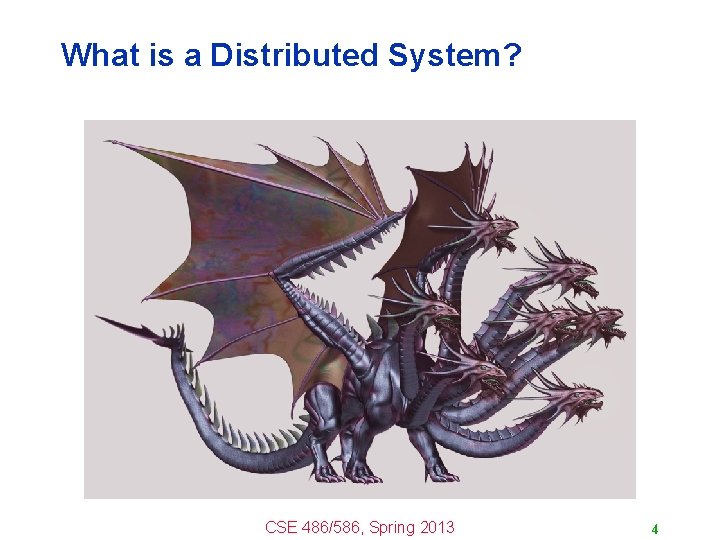
What is a Distributed System? CSE 486/586, Spring 2013 4

What is a Distributed System? • A distributed system is a collection of entities with a common goal, each of which is autonomous, programmable, asynchronous and failure-prone, and which communicate through an unreliable communication medium. • This will be a working definition for us. CSE 486/586, Spring 2013 5
Why Is It Hard to Build One? • Scale: hundreds or thousands of machines – – – Google: 4 K-machine Map. Reduce cluster Yahoo!: 4 K-machine Hadoop cluster Akamai: 70 K machines distributed over the world Facebook: 60 K machines providing the service Hard enough to program one machine! • Dynamism: machines do fail! – 50 machine failures out of 20 K machine cluster per day (reported by Yahoo!) – 1 disk failure out of 16 K disks every 6 hours (reported by Google) • What else? – Concurrent execution, consistency, etc. CSE 486/586, Spring 2013 6
OK; But Who Cares? • This is where all the actions are! – What is the two biggest driving forces in the computing industry for the last 5 years? – It’s the cloud! – And smartphones! – They are distributed! • Now --- it’s all about distributed systems! – Well…with a bit of exaggeration… ; -) CSE 486/586, Spring 2013 7
OK, Cool; How Am I Going to Learn? • Textbook – Main: Distributed Systems: Concepts and Design, 5 th Edition (Coulouris, Dollimore, Kindberg, Blair) – Optional: Distributed Systems: Principles and Paradigms, 2 nd Edition, (Tanenbaum, Van Steen) • Prerequisites – Minimum: CSE 250 Data Structures and Algorithms – Ideal: Basic networking concepts (TCP/IP, routing), basic OS concepts (processes, threads, synchronization, file systems), systems programming (pthread, socket) • • Lectures (Non-graded) HW assignments Programming assignments Exams CSE 486/586, Spring 2013 8
What Am I Going to Build? • A “starter” project: project 0 • A distributed key-value storage (based on Amazon Dynamo) on Android in 3 stages: project 1 ~ project 3 • For each project, submit a solution/design document as well as code • Individual submission CSE 486/586, Spring 2013 9
Important Policies • Late submission: 20% penalty per day • Regrading – If requested, the entire work will be regraded • No “I” • No makeup exam • No grade negotiation CSE 486/586, Spring 2013 10
Academic Integrity Policies • Academic integrity: exams, HW, and code – Copying others’ code: no – Copying from other sources (the Web, books, etc. ): get permission – Exceptions: http: //developer. android. com (copy freely, but mark clearly that you copied) – http: //stackoverflow. com (generally OK to see how things get done; but do not copy and paste. ) – If found, the incident will be reported to the university • Will use an automatic similarity checker. – When similar submissions are found, both will get F for the entire semester. • Please be careful when using an online code repository, e. g. , Git. Hub, Bit. Bucket, etc. CSE 486/586, Spring 2013 11
How Can I Reach the Teaching Staff? • Steve: 304 Davis – Lectures (MWF 3: 00 pm-3: 50 pm) – Office hours (MWF 4 pm-5 pm) • TAs – (Tentative) Recitations: M (10: 00 – 10: 50) & F (2: 00 – 2: 50) @ Baldy 106 – Office hours: generally 3 hours for each and every weekday will be covered. – Please do not expect that the TAs will stay more than 3 hours. • Use Piazza (http: //piazza. com/class), instead of email, mailing list, blog, etc. CSE 486/586, Spring 2013 12

What Exactly Am I Going to Learn? Distributed Systems 10 Questions! • Course goal: answering 10 questions on distributed systems – At the end of the semester, if you can answer only 10 questions about distributed systems, you’ll probably get an A. – Easy enough! • What are those questions? – Organized in 6 themes – 1~2 questions in each theme – A few (or several) lectures to answer each question CSE 486/586, Spring 2013 13
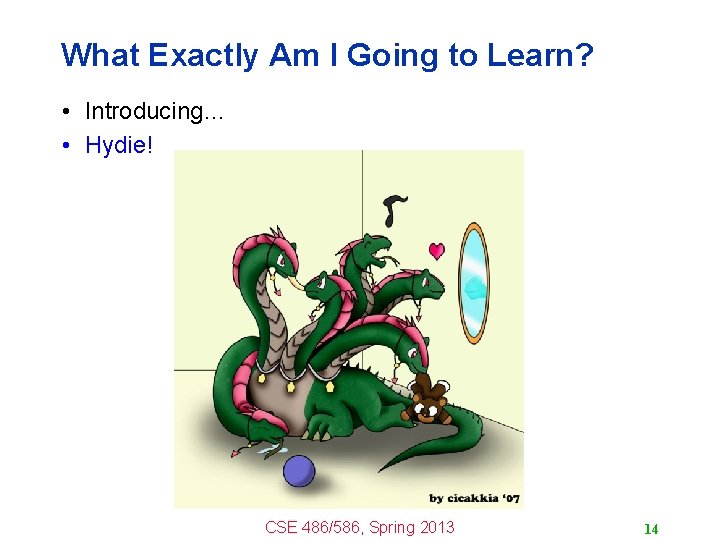
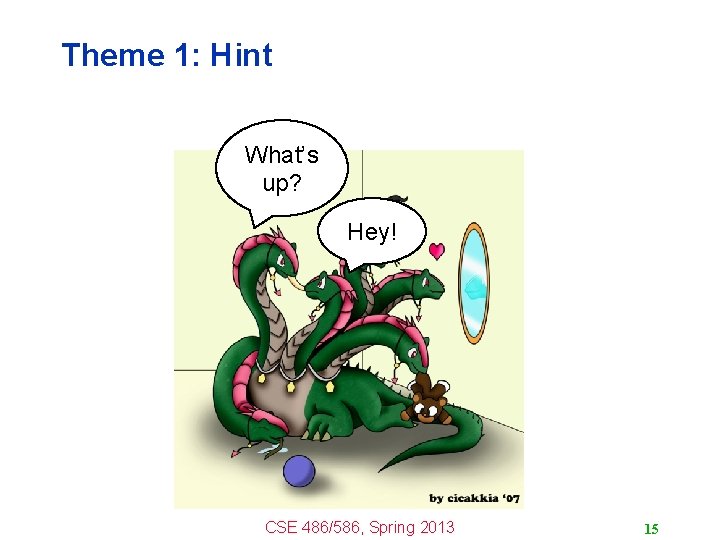
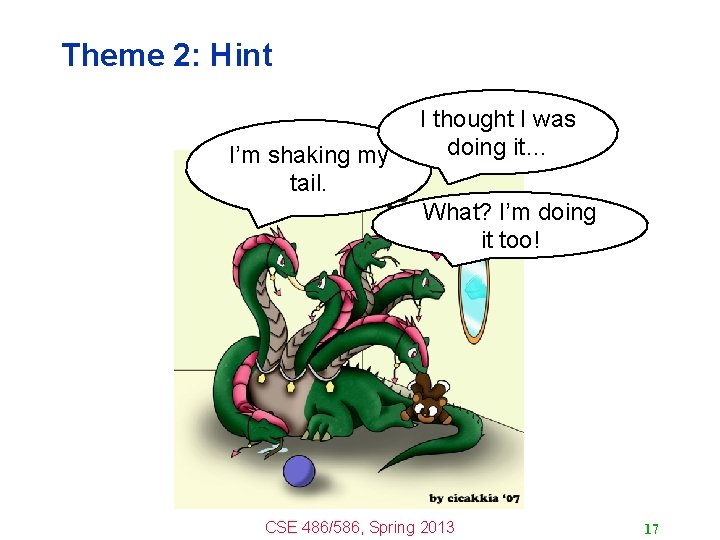
What Exactly Am I Going to Learn? • Introducing… • Hydie! CSE 486/586, Spring 2013 14
Theme 1: Hint What’s up? Hey! CSE 486/586, Spring 2013 15
Theme 1: Communications • Q 1: how do you talk to another machine? – Networking basics • Q 2: how do you talk to multiple machines at once? – Multicast • Q 3: can you call a function/method/procedure running in another machine? – RPC CSE 486/586, Spring 2013 16
Theme 2: Hint I’m shaking my tail. I thought I was doing it… What? I’m doing it too! CSE 486/586, Spring 2013 17
Theme 2: Concurrency • Q 4: how do you control access to shared resources? – Distributed mutual exclusion, distributed transactions, 2 phase commit, etc. CSE 486/586, Spring 2013 18
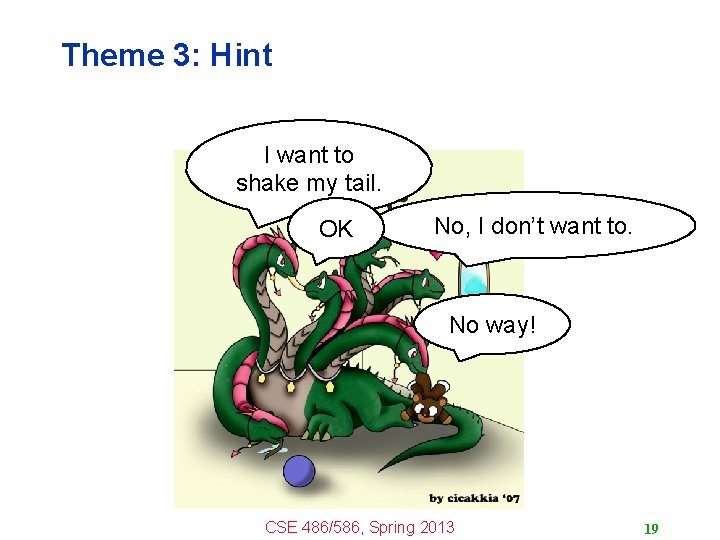
Theme 3: Hint I want to shake my tail. OK No, I don’t want to. No way! CSE 486/586, Spring 2013 19
Theme 3: Consensus • Q 5: how do multiple machines reach an agreement? – Time & synchronization, global states, snapshots, mutual exclusion, leader election, paxos • Bad news: it’s impossible! – The impossibility of consensus CSE 486/586, Spring 2013 20
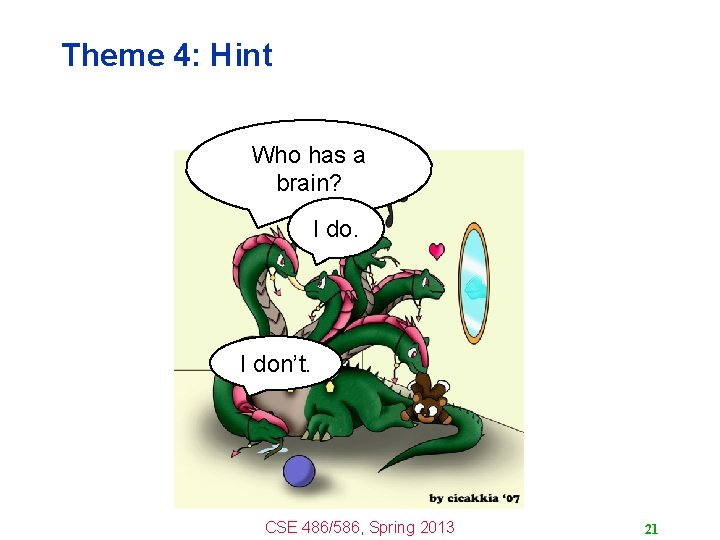
Theme 4: Hint Who has a brain? I don’t. CSE 486/586, Spring 2013 21
Theme 4: Storage Management • Q 6: how do you locate where things are and access them? – DHT, DFS CSE 486/586, Spring 2013 22
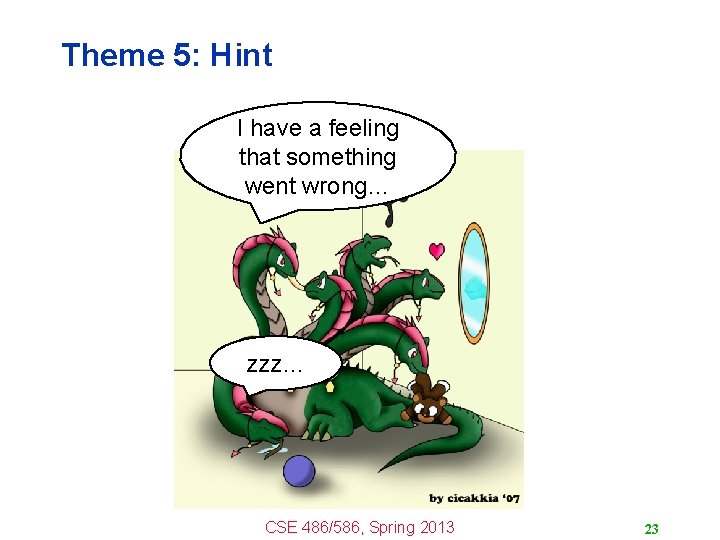
Theme 5: Hint I have a feeling that something went wrong… zzz… CSE 486/586, Spring 2013 23
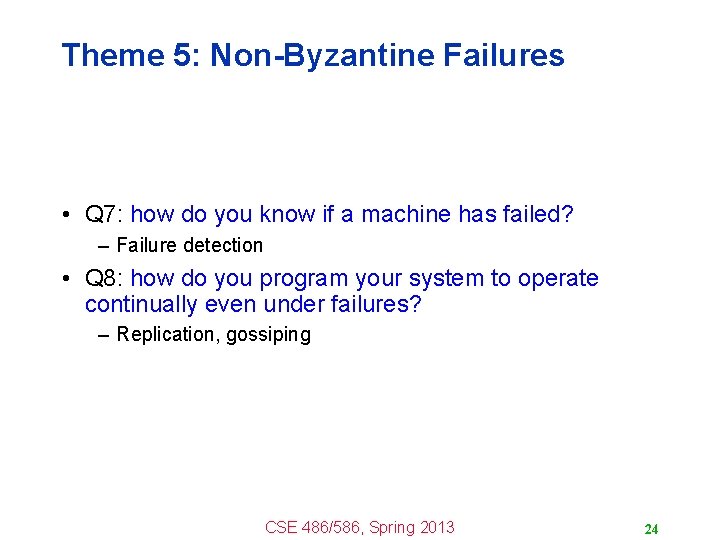
Theme 5: Non-Byzantine Failures • Q 7: how do you know if a machine has failed? – Failure detection • Q 8: how do you program your system to operate continually even under failures? – Replication, gossiping CSE 486/586, Spring 2013 24
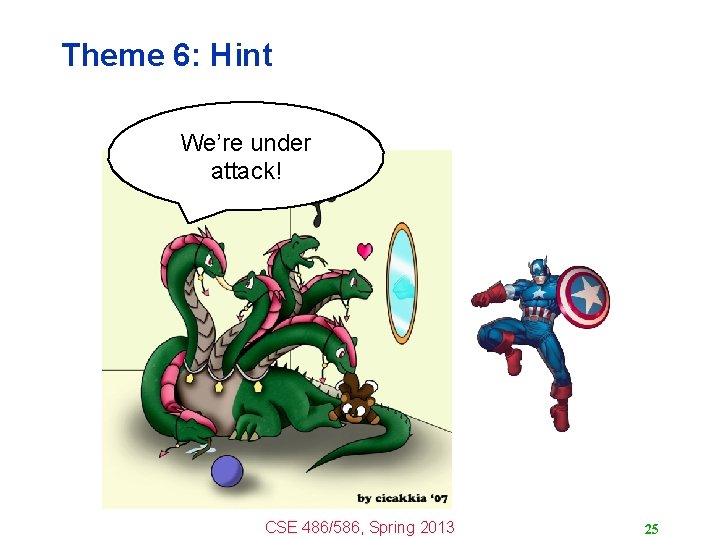
Theme 6: Hint We’re under attack! CSE 486/586, Spring 2013 25
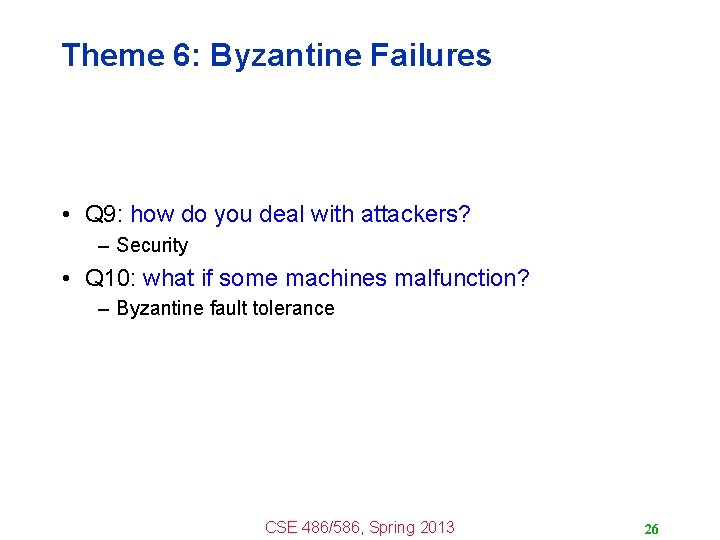
Theme 6: Byzantine Failures • Q 9: how do you deal with attackers? – Security • Q 10: what if some machines malfunction? – Byzantine fault tolerance CSE 486/586, Spring 2013 26
Acknowledgements • These slides heavily contain material developed and copyrighted by Indranil Gupta at UIUC. • The material was originally developed for courses CS 425/CSE 424/ECE 428 at UIUC. CSE 486/586, Spring 2013 27
- Slides: 27