
CSE 473 Automated Planning Dan Weld With slides
- Slides: 54
CSE 473 Automated Planning Dan Weld (With slides by UW AI faculty & Dana Nau I have a plan - a plan that cannot possibly fail. - Inspector Clousseau
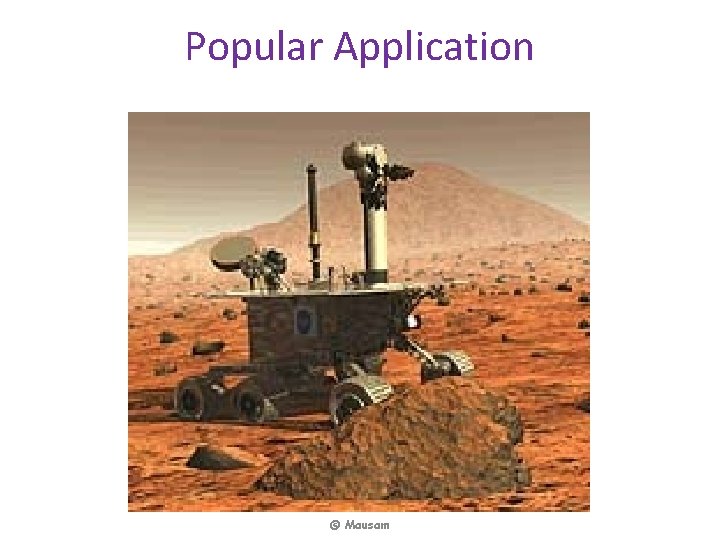
Popular Application © Mausam
Overview – Introduction & Agents – Search, Heuristics & CSPs – Adversarial Search – Logical Knowledge Representation – Planning & MDPs – Reinforcement Learning – Uncertainty & Bayesian Networks – Machine Learning – NLP & Special Topics
Planning & Logic • Actions specified using first-order logic • Planning implemented using SAT solver – E. g. , DPLL or Walk. SAT – Also an example of solving FOL using propositional SAT
Logistics • PS 2 due today • HW 1 due in one week – Parts due in between: • Friday • Monday • Wed written problem feedback on another person’s answer revise your answer
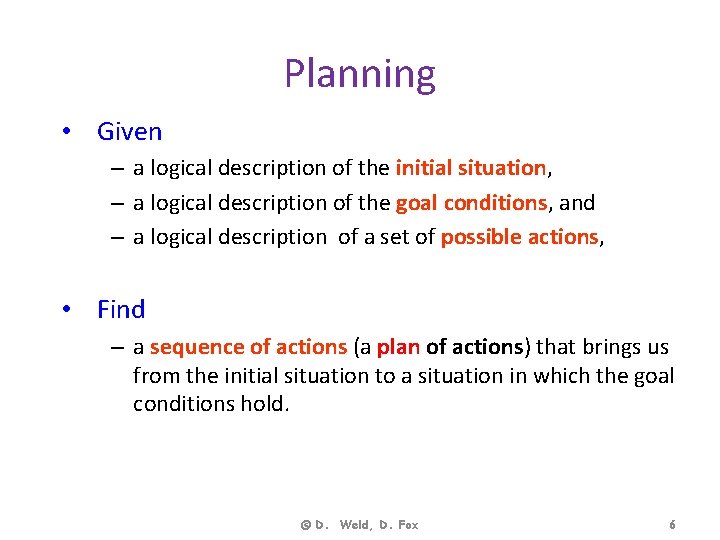
Planning • Given – a logical description of the initial situation, – a logical description of the goal conditions, and – a logical description of a set of possible actions, • Find – a sequence of actions (a plan of actions) that brings us from the initial situation to a situation in which the goal conditions hold. © D. Weld, D. Fox 6
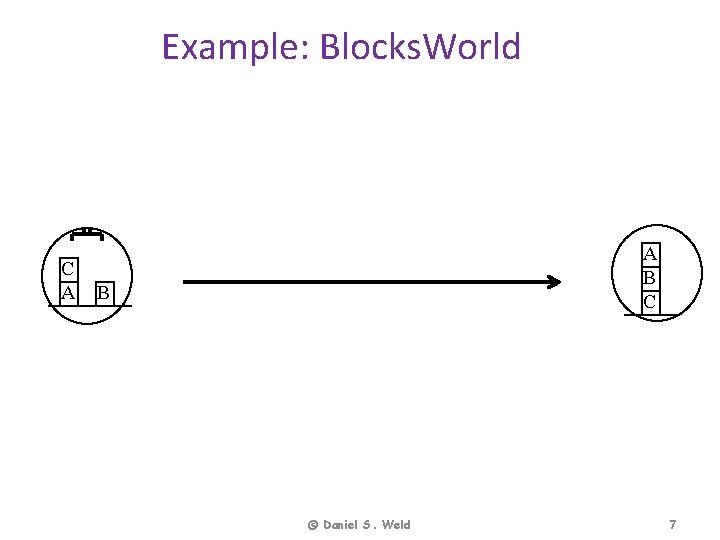
Example: Blocks. World C A A B C B © Daniel S. Weld 7
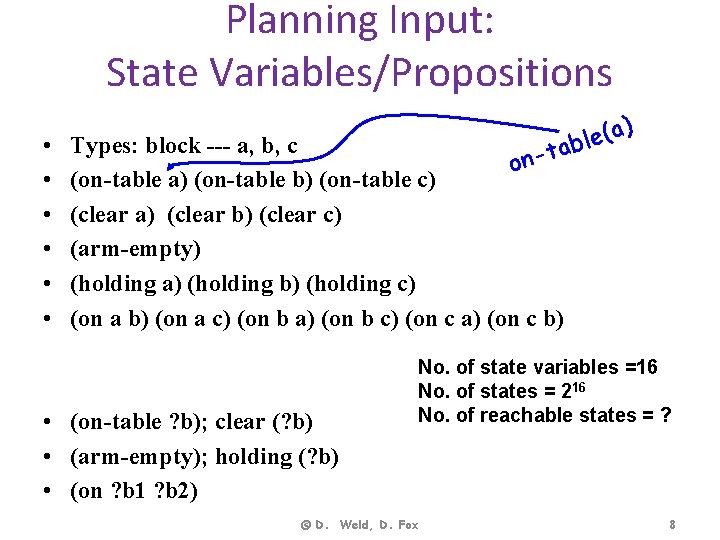
Planning Input: State Variables/Propositions • • • a) ( e l ab Types: block --- a, b, c t n o (on-table a) (on-table b) (on-table c) (clear a) (clear b) (clear c) (arm-empty) (holding a) (holding b) (holding c) (on a b) (on a c) (on b a) (on b c) (on c a) (on c b) • (on-table ? b); clear (? b) • (arm-empty); holding (? b) • (on ? b 1 ? b 2) No. of state variables =16 No. of states = 216 No. of reachable states = ? © D. Weld, D. Fox 8
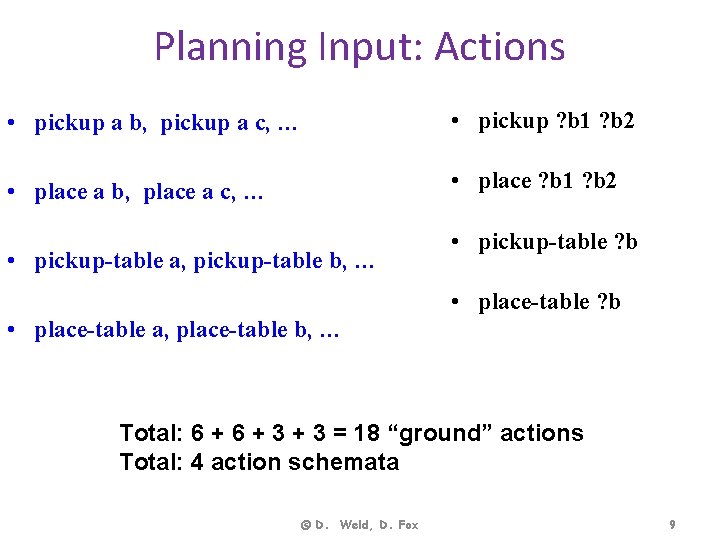
Planning Input: Actions • pickup a b, pickup a c, … • pickup ? b 1 ? b 2 • place a b, place a c, … • place ? b 1 ? b 2 • pickup-table a, pickup-table b, … • pickup-table ? b • place-table ? b • place-table a, place-table b, … Total: 6 + 3 + 3 = 18 “ground” actions Total: 4 action schemata © D. Weld, D. Fox 9
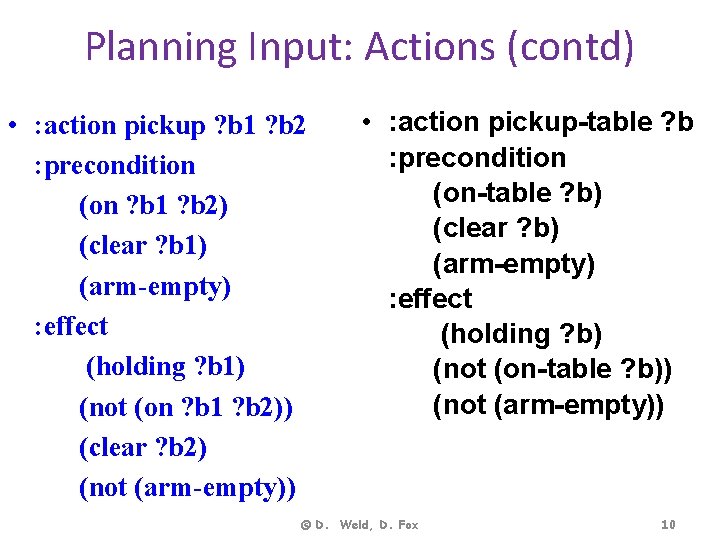
Planning Input: Actions (contd) • : action pickup ? b 1 ? b 2 : precondition (on ? b 1 ? b 2) (clear ? b 1) (arm-empty) : effect (holding ? b 1) (not (on ? b 1 ? b 2)) (clear ? b 2) (not (arm-empty)) • : action pickup-table ? b : precondition (on-table ? b) (clear ? b) (arm-empty) : effect (holding ? b) (not (on-table ? b)) (not (arm-empty)) © D. Weld, D. Fox 10
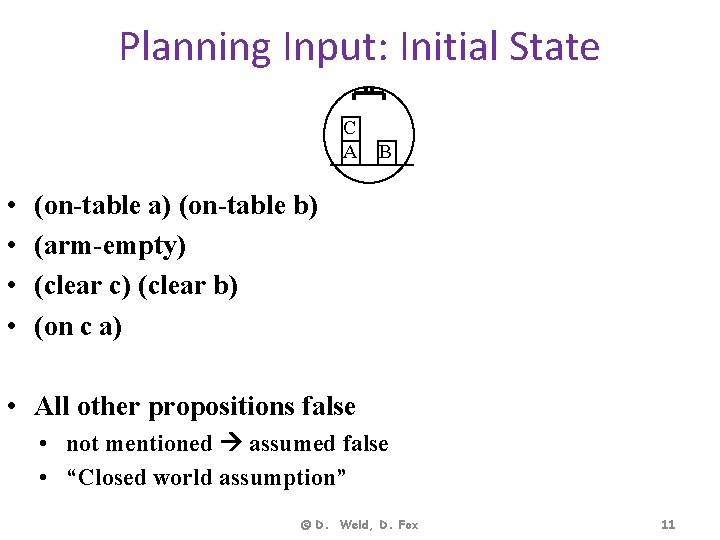
Planning Input: Initial State C A • • B (on-table a) (on-table b) (arm-empty) (clear c) (clear b) (on c a) • All other propositions false • not mentioned assumed false • “Closed world assumption” © D. Weld, D. Fox 11
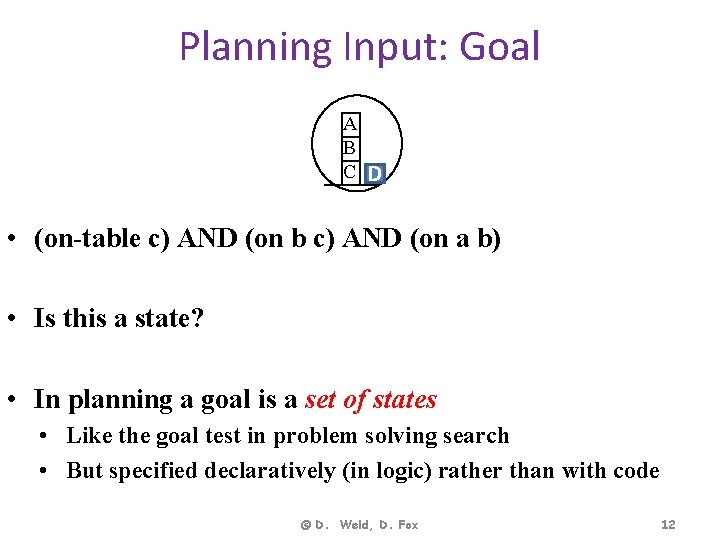
Planning Input: Goal A B C D • (on-table c) AND (on b c) AND (on a b) • Is this a state? • In planning a goal is a set of states • Like the goal test in problem solving search • But specified declaratively (in logic) rather than with code © D. Weld, D. Fox 12
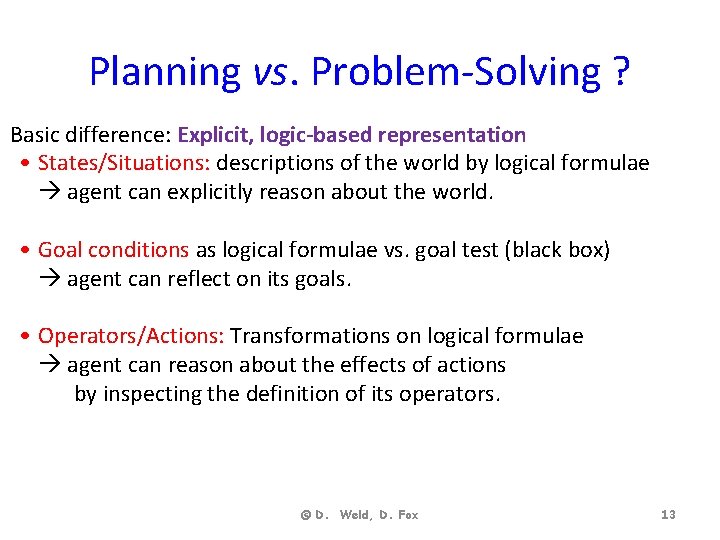
Planning vs. Problem-Solving ? Basic difference: Explicit, logic-based representation • States/Situations: descriptions of the world by logical formulae agent can explicitly reason about the world. • Goal conditions as logical formulae vs. goal test (black box) agent can reflect on its goals. • Operators/Actions: Transformations on logical formulae agent can reason about the effects of actions by inspecting the definition of its operators. © D. Weld, D. Fox 13
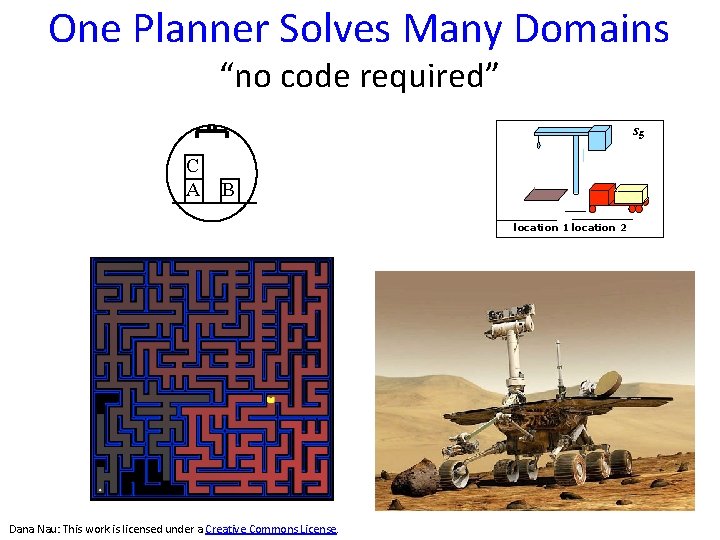
One Planner Solves Many Domains “no code required” s 5 C A B location 1 location 2 Dana Nau: This work is licensed under a Creative Commons License.
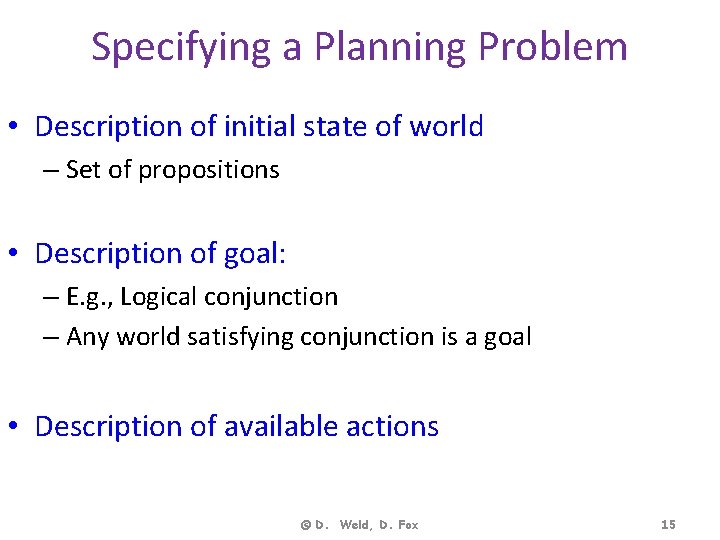
Specifying a Planning Problem • Description of initial state of world – Set of propositions • Description of goal: – E. g. , Logical conjunction – Any world satisfying conjunction is a goal • Description of available actions © D. Weld, D. Fox 15
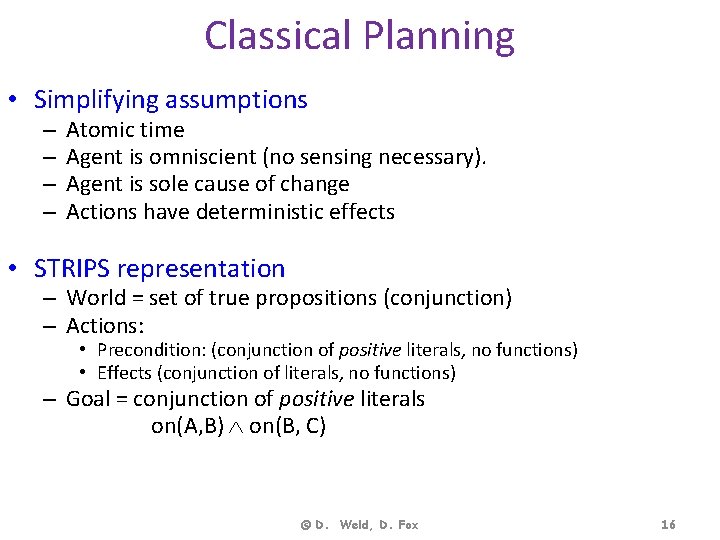
Classical Planning • Simplifying assumptions – – Atomic time Agent is omniscient (no sensing necessary). Agent is sole cause of change Actions have deterministic effects • STRIPS representation – World = set of true propositions (conjunction) – Actions: • Precondition: (conjunction of positive literals, no functions) • Effects (conjunction of literals, no functions) – Goal = conjunction of positive literals on(A, B) on(B, C) © D. Weld, D. Fox 16
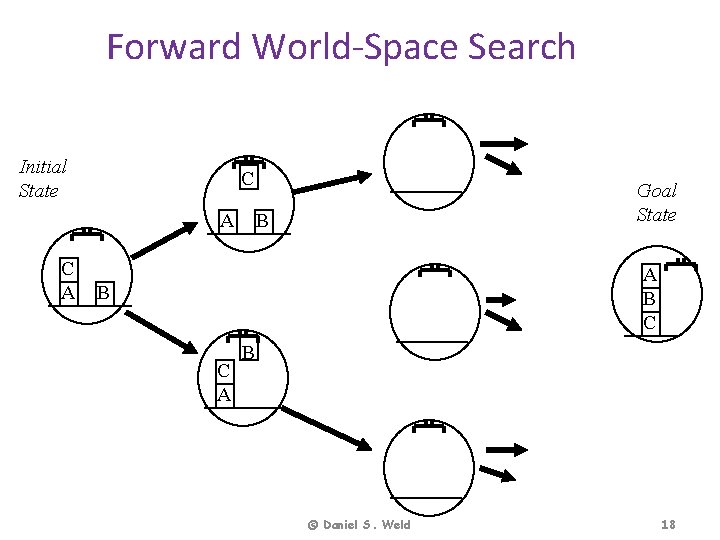
Forward World-Space Search Initial State C A Goal State B A B C A B © Daniel S. Weld 18
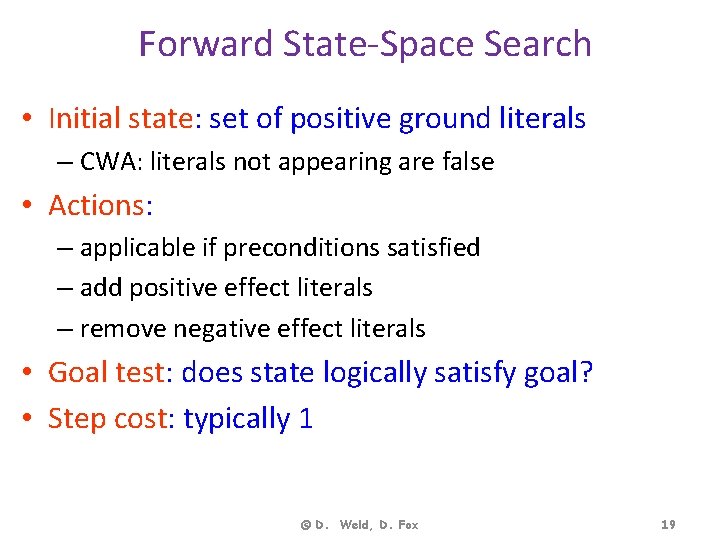
Forward State-Space Search • Initial state: set of positive ground literals – CWA: literals not appearing are false • Actions: – applicable if preconditions satisfied – add positive effect literals – remove negative effect literals • Goal test: does state logically satisfy goal? • Step cost: typically 1 © D. Weld, D. Fox 19
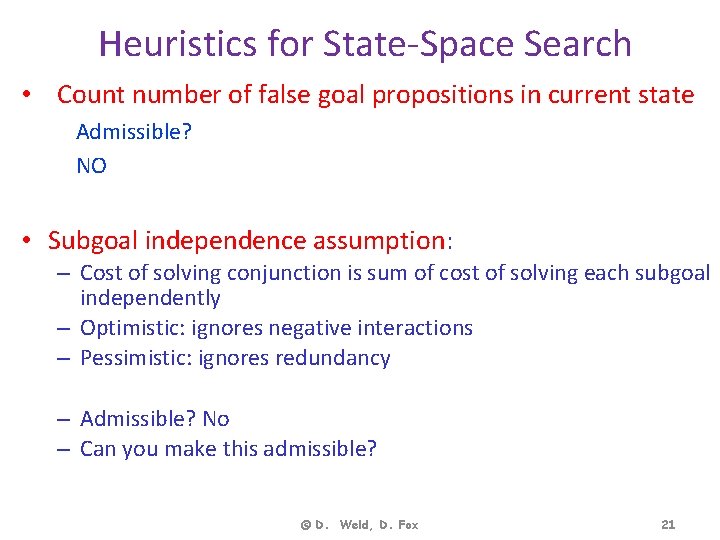
Heuristics for State-Space Search • Count number of false goal propositions in current state Admissible? NO • Subgoal independence assumption: – Cost of solving conjunction is sum of cost of solving each subgoal independently – Optimistic: ignores negative interactions – Pessimistic: ignores redundancy – Admissible? No – Can you make this admissible? © D. Weld, D. Fox 21
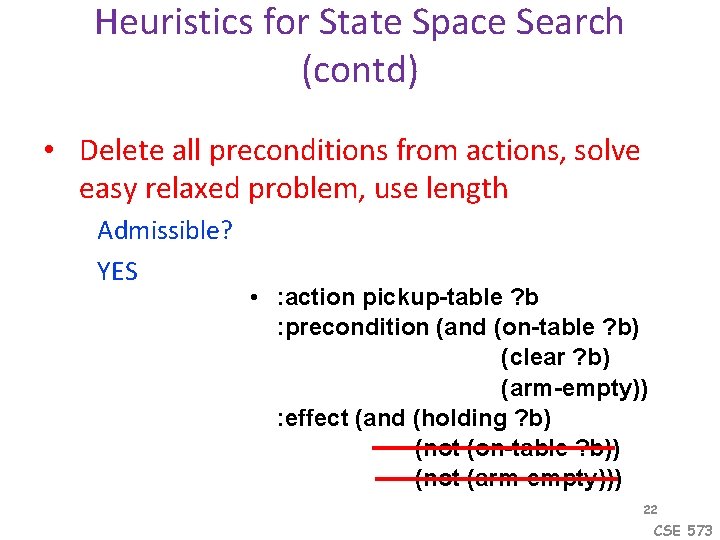
Heuristics for State Space Search (contd) • Delete all preconditions from actions, solve easy relaxed problem, use length Admissible? YES • : action pickup-table ? b : precondition (and (on-table ? b) (clear ? b) (arm-empty)) : effect (and (holding ? b) (not (on-table ? b)) (not (arm-empty))) 22 CSE 573
Planning Graph: Basic idea • Construct a planning graph: encodes constraints on possible plans • Use this planning graph to compute an informative heuristic (Forward A*) • Planning graph can be built for each problem in polynomial time © D. Weld, D. Fox 26
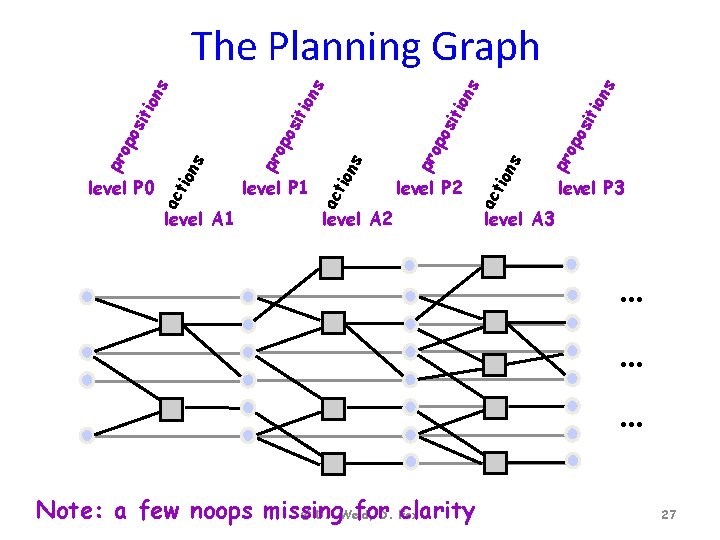
s pr on s op os iti on s os iti on op pr s pr on level A 2 level P 2 ac ti level A 1 level P 1 ac ti level P 0 on s pr op op os iti on on s s The Planning Graph level P 3 level A 3 … … … Note: a few noops missing for. D. Fox clarity © D. Weld, 27
Regression search • States • Operators • Initial State • Goal
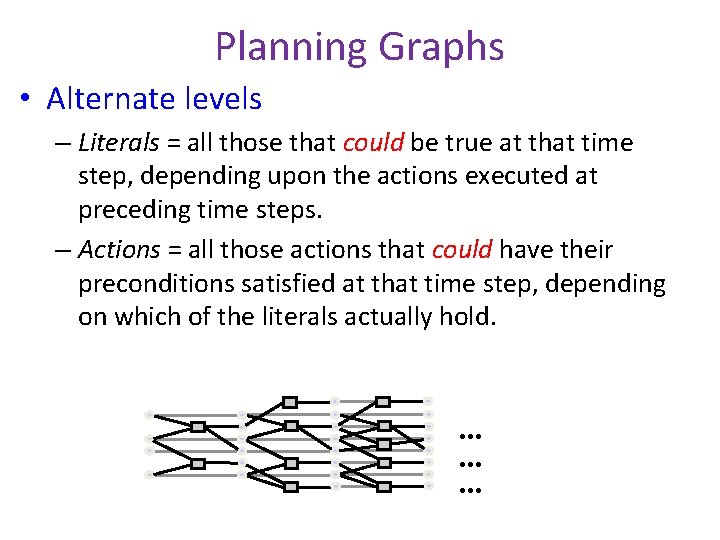
Planning Graphs • Planning graphs consists of a seq of levels that correspond to time steps in the plan. – Level 0 is the initial state. – Each level consists of a set of literals and a set of actions that represent what might be possible at that step in the plan – Might be is the key to efficiency – Records only a restricted subset of possible negative interactions among actions.
Planning Graphs • Alternate levels – Literals = all those that could be true at that time step, depending upon the actions executed at preceding time steps. – Actions = all those actions that could have their preconditions satisfied at that time step, depending on which of the literals actually hold. … … …
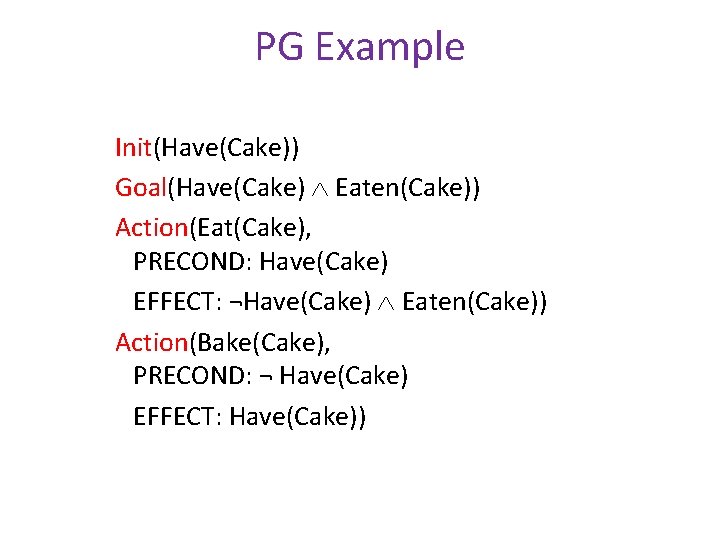
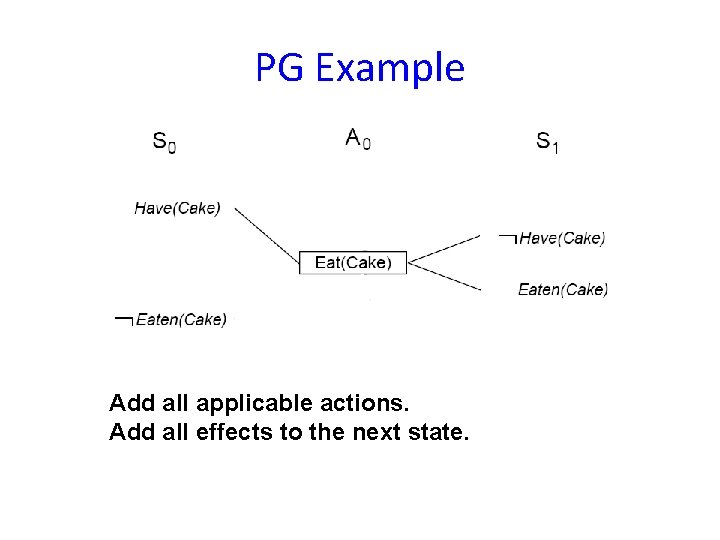
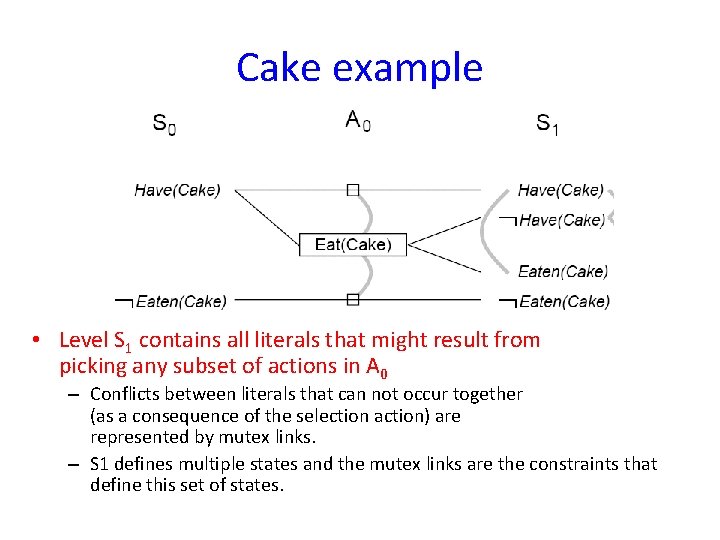
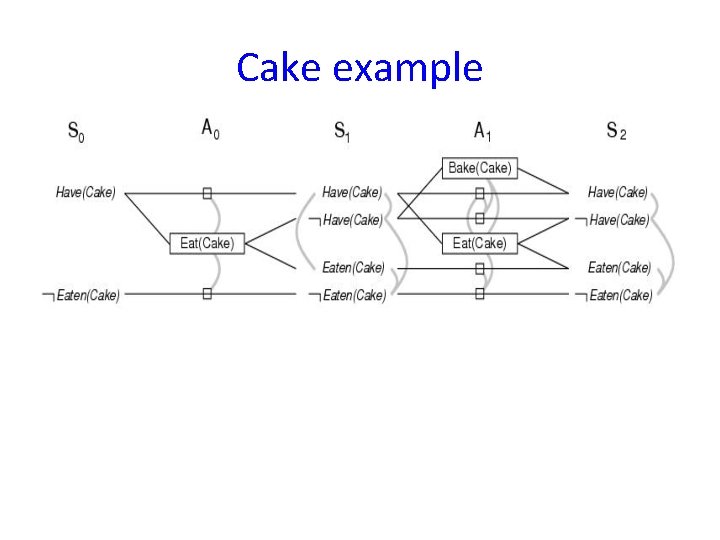
PG Example Init(Have(Cake)) Goal(Have(Cake) Eaten(Cake)) Action(Eat(Cake), PRECOND: Have(Cake) EFFECT: ¬Have(Cake) Eaten(Cake)) Action(Bake(Cake), PRECOND: ¬ Have(Cake) EFFECT: Have(Cake))
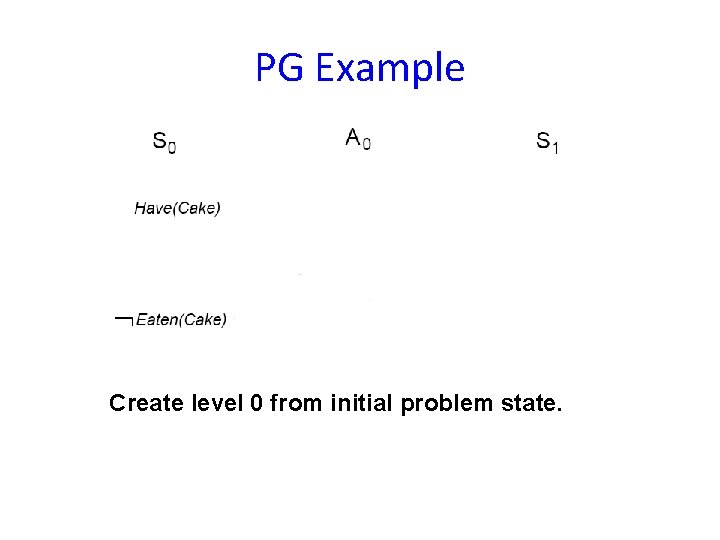
PG Example Create level 0 from initial problem state.
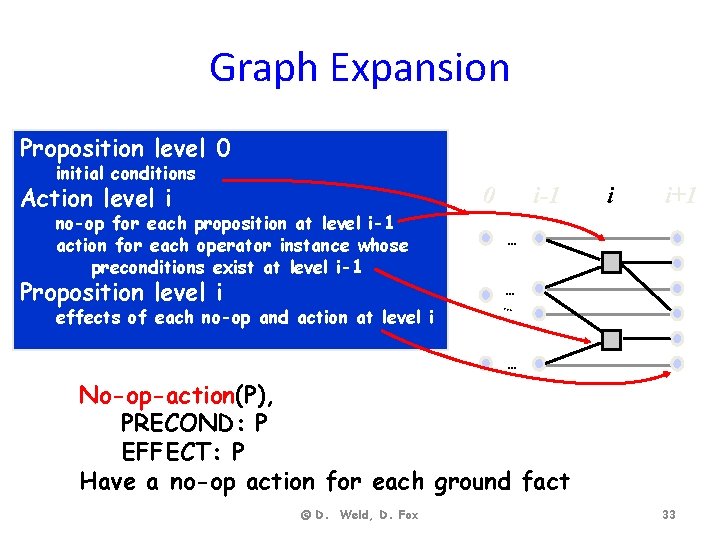
Graph Expansion Proposition level 0 initial conditions Action level i 0 no-op for each proposition at level i-1 action for each operator instance whose preconditions exist at level i-1 Proposition level i effects of each no-op and action at level i i-1 i i+1 … … No-op-action(P), PRECOND: P EFFECT: P Have a no-op action for each ground fact © D. Weld, D. Fox 33
PG Example Add all applicable actions. Add all effects to the next state.
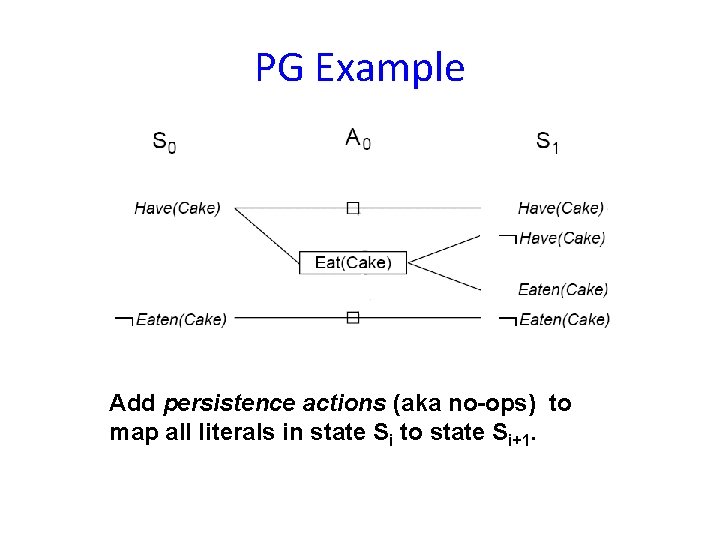
PG Example Add persistence actions (aka no-ops) to map all literals in state Si to state Si+1.
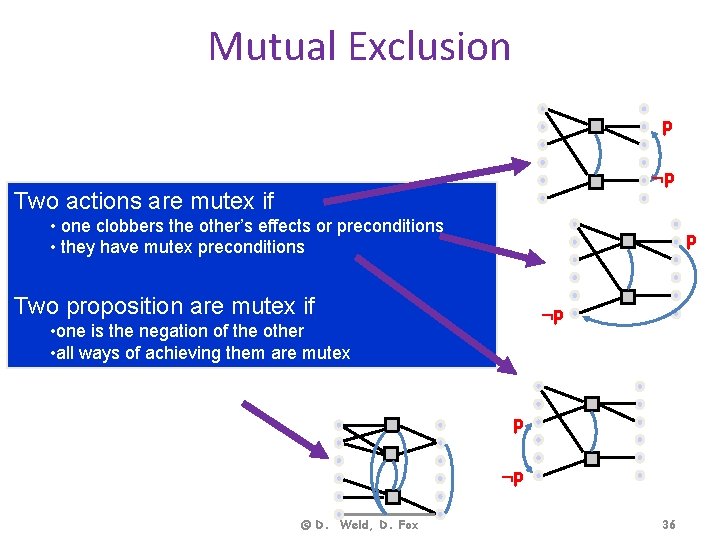
Mutual Exclusion p p Two actions are mutex if • one clobbers the other’s effects or preconditions • they have mutex preconditions p Two proposition are mutex if p • one is the negation of the other • all ways of achieving them are mutex p p © D. Weld, D. Fox 36
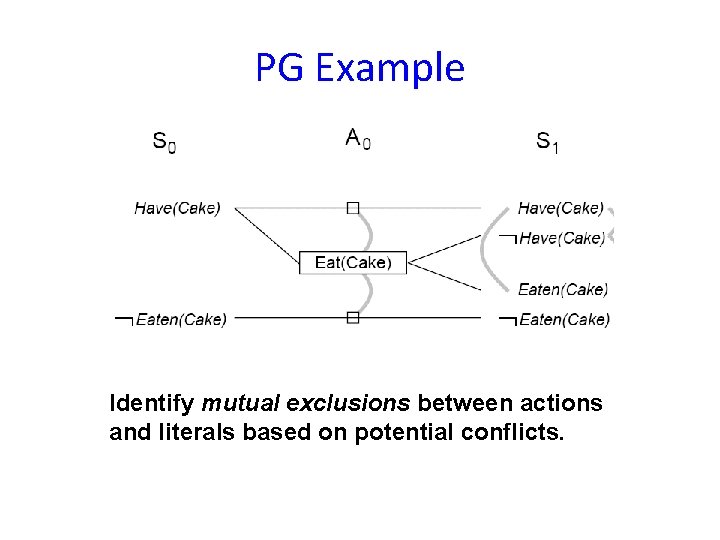
PG Example Identify mutual exclusions between actions and literals based on potential conflicts.
Cake example • Level S 1 contains all literals that might result from picking any subset of actions in A 0 – Conflicts between literals that can not occur together (as a consequence of the selection action) are represented by mutex links. – S 1 defines multiple states and the mutex links are the constraints that define this set of states.
Cake example
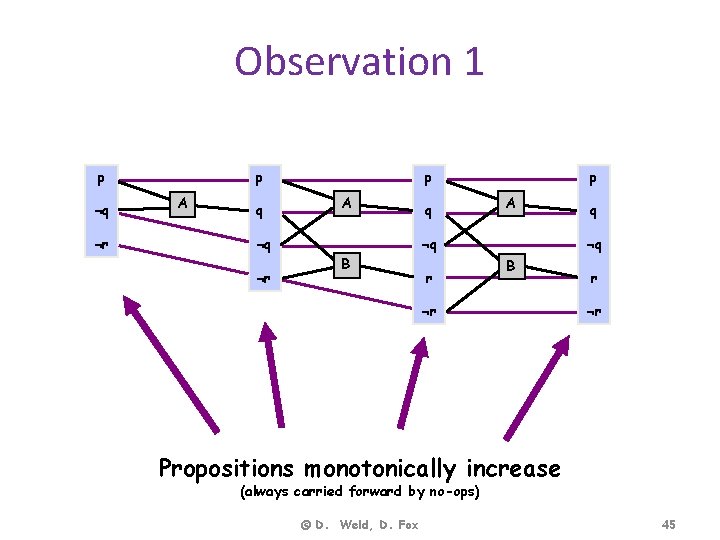
Observation 1 p ¬q ¬r p A q p A ¬q ¬r q p A ¬q B r q ¬q B ¬r r ¬r Propositions monotonically increase (always carried forward by no-ops) © D. Weld, D. Fox 45
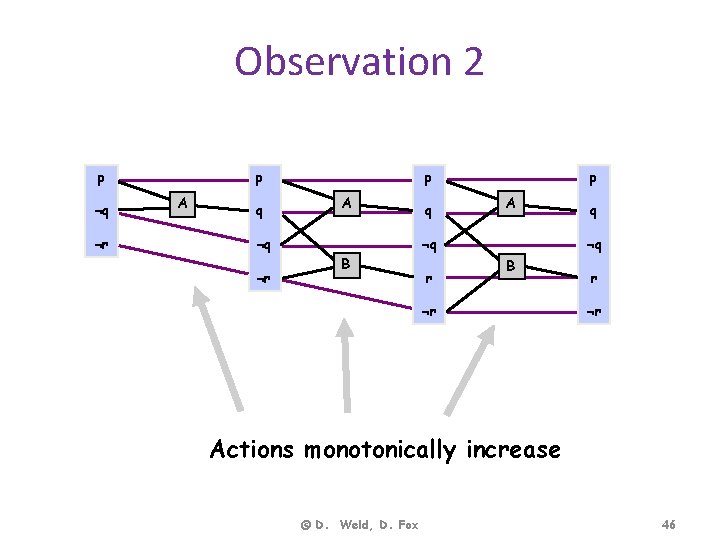
Observation 2 p ¬q ¬r p A q p A ¬q ¬r q p A ¬q B r q ¬q B ¬r r ¬r Actions monotonically increase © D. Weld, D. Fox 46
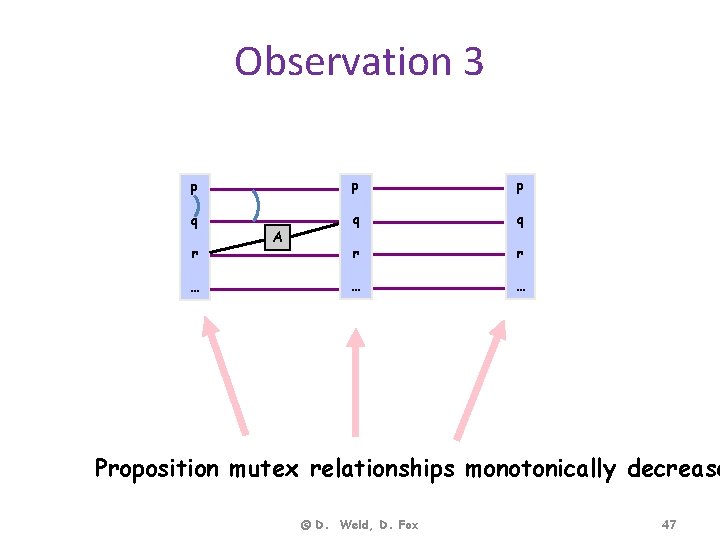
Observation 3 p p p q q q r r … … r … A Proposition mutex relationships monotonically decrease © D. Weld, D. Fox 47
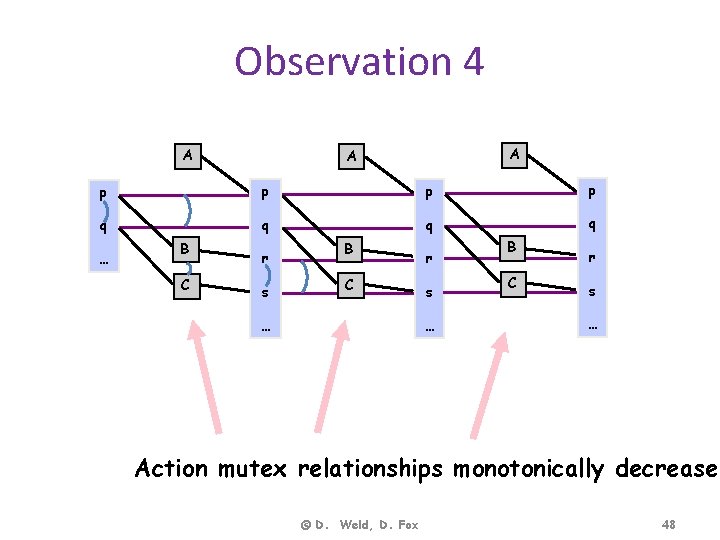
Observation 4 A A A p p q q … B C r s B C … r s … B C r s … Action mutex relationships monotonically decrease © D. Weld, D. Fox 48
Observation 5 Planning Graph ‘levels off’. • After some time k all levels are identical • Because it’s a finite space, the set of literals never decreases and mutexes don’t reappear. © D. Weld, D. Fox 49
Properties of Planning Graph • If goal is absent from last level? – Then goal cannot be achieved! • If there exists a plan to achieve goal? – Then goal is present in the last level & – No mutexes between conjuncts • If goal is present in last level (w/ no mutexes) ? – There still may not exist any viable plan © D. Weld, D. Fox 50
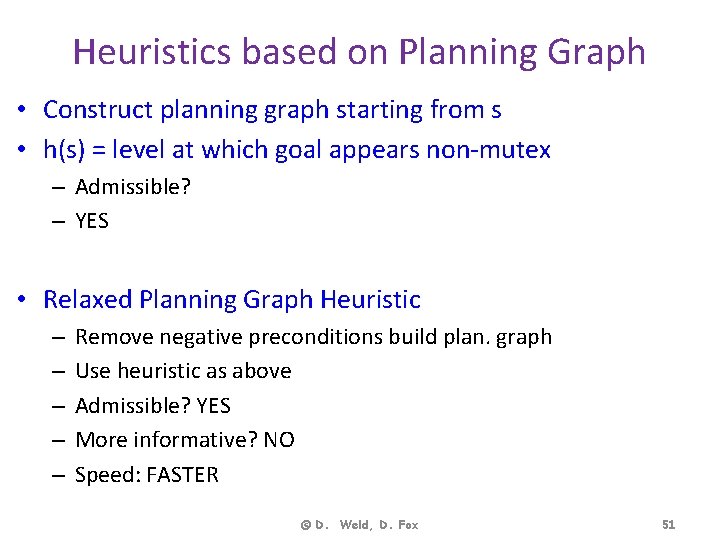
Heuristics based on Planning Graph • Construct planning graph starting from s • h(s) = level at which goal appears non-mutex – Admissible? – YES • Relaxed Planning Graph Heuristic – – – Remove negative preconditions build plan. graph Use heuristic as above Admissible? YES More informative? NO Speed: FASTER © D. Weld, D. Fox 51
FF • Topmost classical planner until 2009 • State space local search – Guided by relaxed planning graph – Full best-first seach to escape plateaus – A few other bells and whistles… © Mausam
Planning Summary § Problem solving algorithms that operate on explicit propositional representations of states and actions. § Make use of domain-independent heuristics. § STRIPS: restrictive propositional language § Heuristic search § forward (progression) § backward (regression) search [didn’t cover] § Local search FF [didn’t cover] © D. Weld, D. Fox 55
Generative Planning Input Description of (initial state of) world (in some KR) Description of goal (in some KR) Description of available actions (in some KR) Output Controller E. g. Sequence of actions E. g. Plan with loops and conditionals E. g. Policy = f: states -> actions © Daniel S. Weld 56
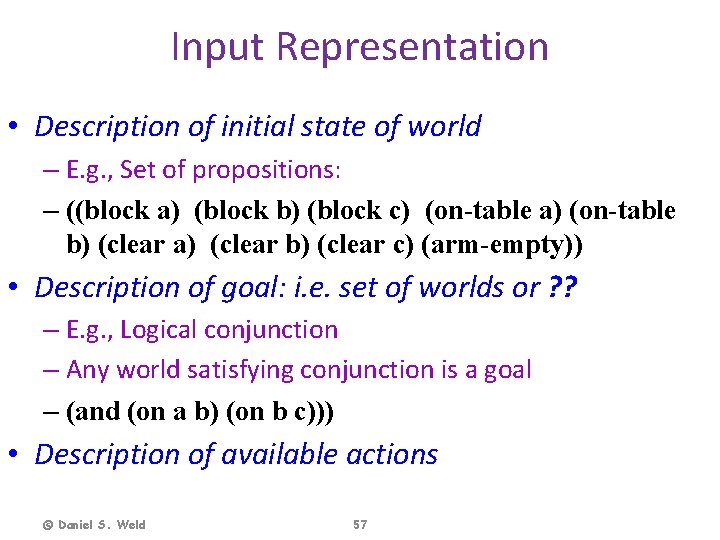
Input Representation • Description of initial state of world – E. g. , Set of propositions: – ((block a) (block b) (block c) (on-table a) (on-table b) (clear a) (clear b) (clear c) (arm-empty)) • Description of goal: i. e. set of worlds or ? ? – E. g. , Logical conjunction – Any world satisfying conjunction is a goal – (and (on a b) (on b c))) • Description of available actions © Daniel S. Weld 57
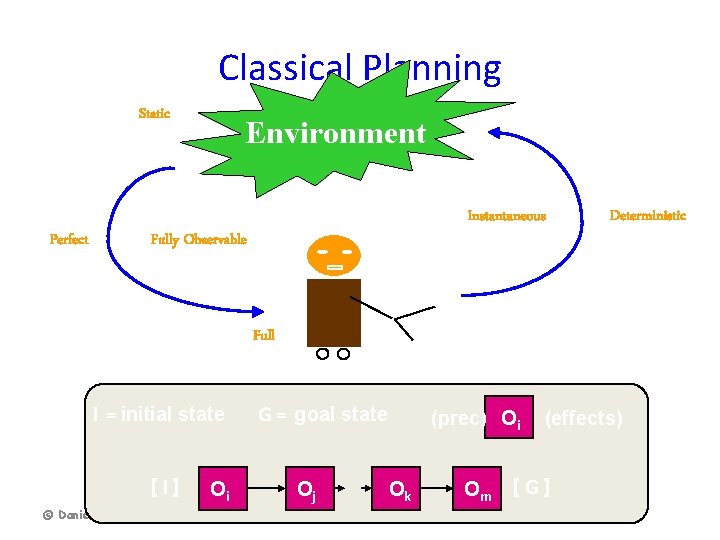
Classical Planning Static Perfect Environment Instantaneous Fully Observable Deterministic Full I = initial state [ I] © Daniel S. Weld Oi G = goal state Oj (prec) Oi Ok 58 Om (effects) [ G]
Compilation to SAT • Init state • Actions • Goal © Daniel S. Weld 59 ?
The Idea • Suppose a plan of length n exists • Encode this hypothesis in SAT – Init state true at t 0 – Goal true at Tn – Actions imply effects, etc • Look for satisfying assignment • Decode into plan RISC: The Revolutionary Excitement © Daniel S. Weld 60
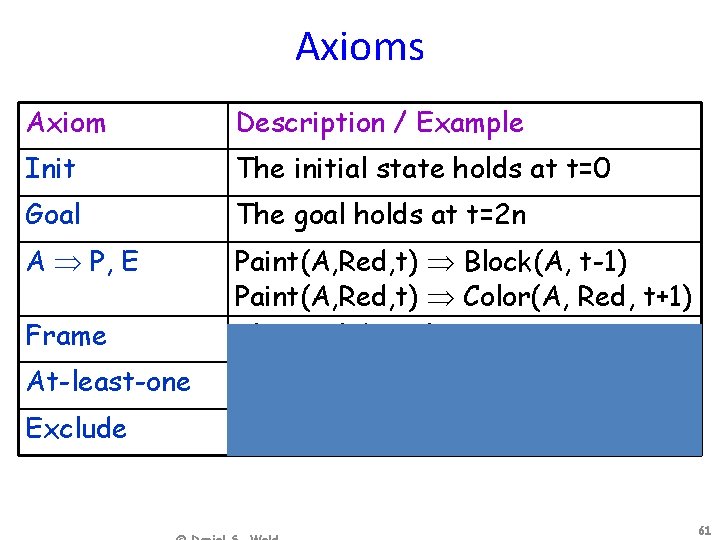
Axioms Axiom Description / Example Init The initial state holds at t=0 Goal The goal holds at t=2 n A P, E Frame Paint(A, Red, t) Block(A, t-1) Paint(A, Red, t) Color(A, Red, t+1) Classical / Explanatory At-least-one Act 1(…, t) Act 2(…, t) … Exclude Act 1(…, t) Act 2(…, t) 61
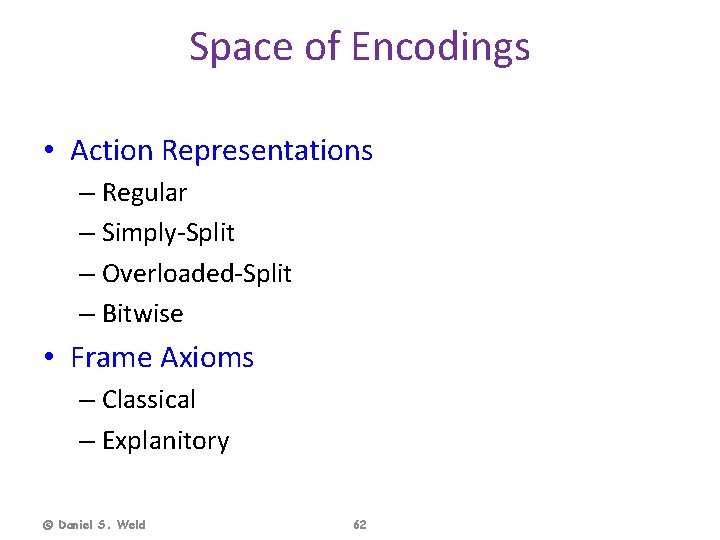
Space of Encodings • Action Representations – Regular – Simply-Split – Overloaded-Split – Bitwise • Frame Axioms – Classical – Explanitory © Daniel S. Weld 62
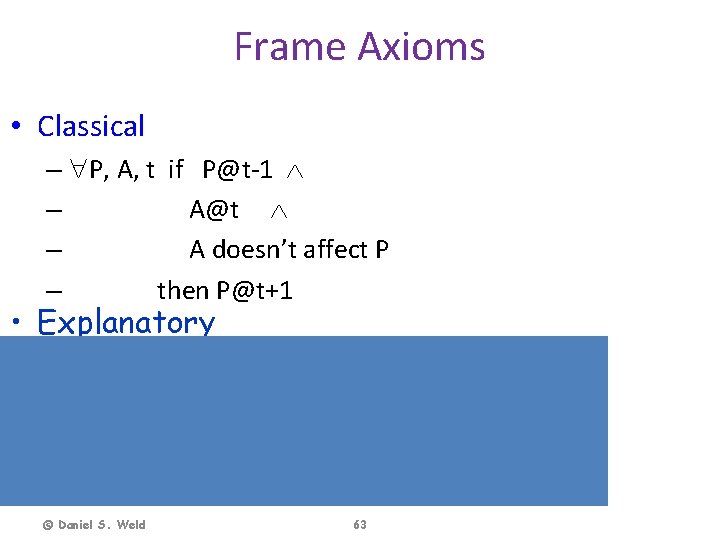
Frame Axioms • Classical – P, A, t if P@t-1 – A@t – A doesn’t affect P – then P@t+1 • Explanatory P, A, t if P@t-1 P@t+1 then A 1@t A 2@t … forall Ai that do affect P © Daniel S. Weld 63
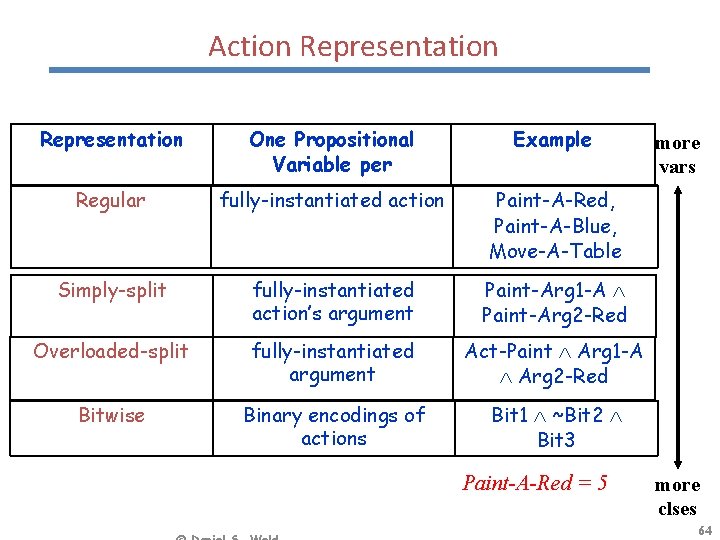
Action Representation One Propositional Variable per Example Regular fully-instantiated action Paint-A-Red, Paint-A-Blue, Move-A-Table Simply-split fully-instantiated action’s argument Paint-Arg 1 -A Paint-Arg 2 -Red Overloaded-split fully-instantiated argument Act-Paint Arg 1 -A Arg 2 -Red Bitwise Binary encodings of actions Bit 1 ~Bit 2 Bit 3 Paint-A-Red = 5 more vars more clses 64
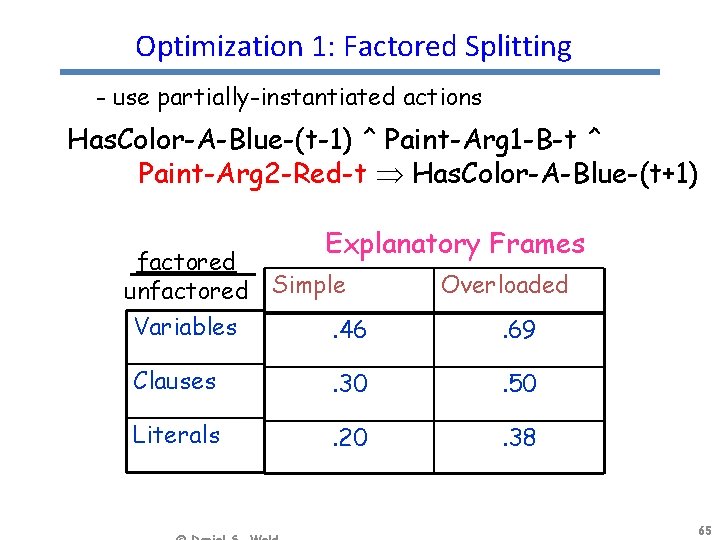
Optimization 1: Factored Splitting - use partially-instantiated actions Has. Color-A-Blue-(t-1) ^ Paint-Arg 1 -B-t ^ Paint-Arg 2 -Red-t Has. Color-A-Blue-(t+1) Explanatory Frames factored unfactored Simple Overloaded Variables . 46 . 69 Clauses . 30 . 50 Literals . 20 . 38 65
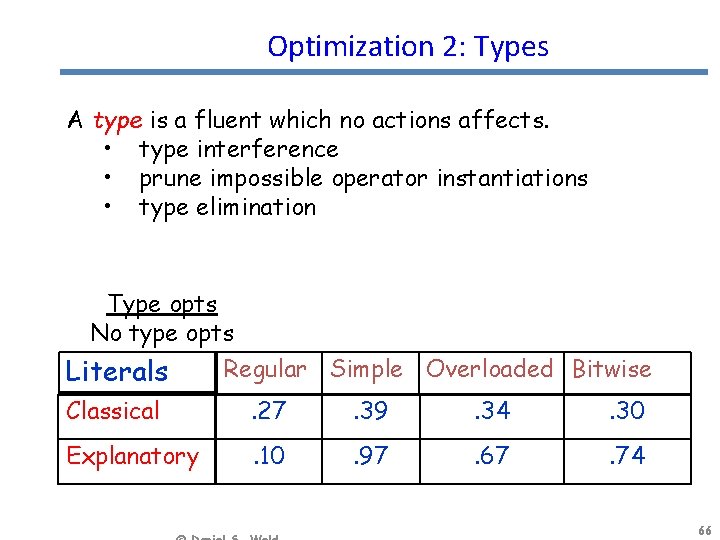
Optimization 2: Types A type is a fluent which no actions affects. • type interference • prune impossible operator instantiations • type elimination Type opts No type opts Literals Regular Simple Overloaded Bitwise Classical . 27 . 39 . 34 . 30 Explanatory . 10 . 97 . 67 . 74 66