
CSE 461 Interdomain Routing TCP Review Thought Questions
- Slides: 31
CSE 461: Interdomain Routing
TCP Review: Thought Questions 1. Why do wireless networks often do link-layer re-tx? Hint: is loss always correlated with load? 2. Write a server that accepts new TCP connections but never reads data. Then write a client that opens a TCP connection to that server, and writes forever. Why does write() finally stop working? Where is data stored at that point?
Routing: Scalability Concerns § Routing burden grows with size of an inter-network § Size of routing tables § Volume of routing messages § CPU time required for routing computation § To scale to the size of the Internet, apply: § Hierarchical addressing § Route aggregation
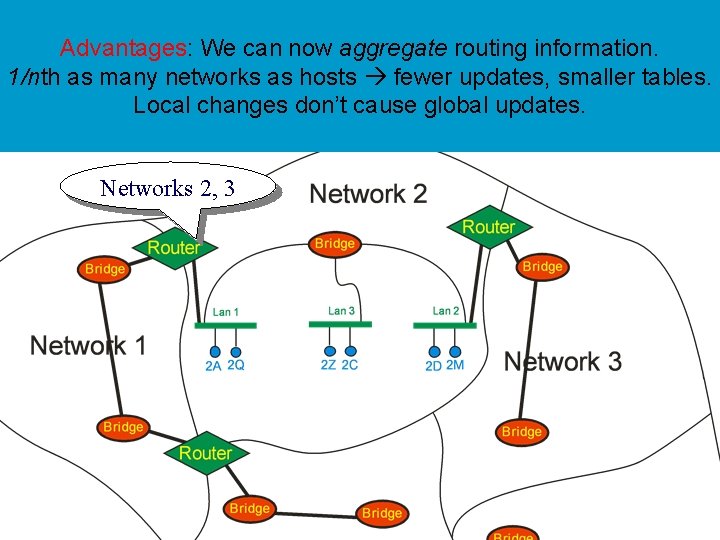
Advantages: We can now aggregate routing information. 1/nth as many networks as hosts fewer updates, smaller tables. Local changes don’t cause global updates. Networks 2, 3
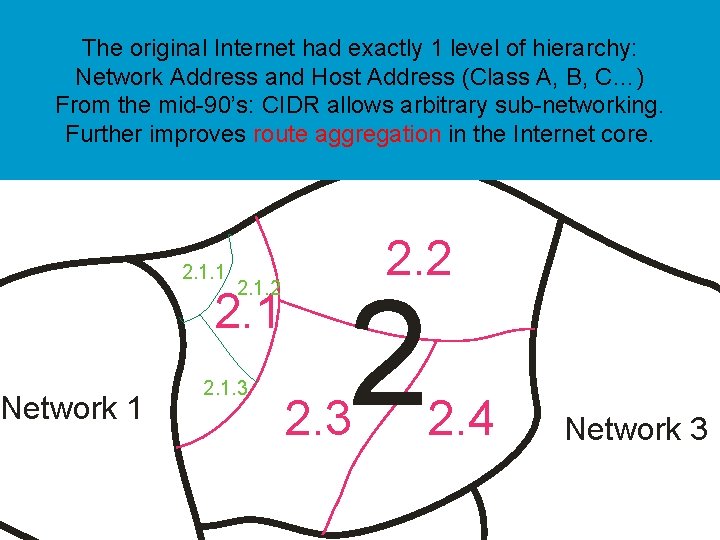
The original Internet had exactly 1 level of hierarchy: Network Address and Host Address (Class A, B, C…) From the mid-90’s: CIDR allows arbitrary sub-networking. Further improves route aggregation in the Internet core. 2. 1. 1 2. 1. 2 2. 1 Network 1 2. 1. 3 2. 2 2 2. 3 2. 4 Network 3
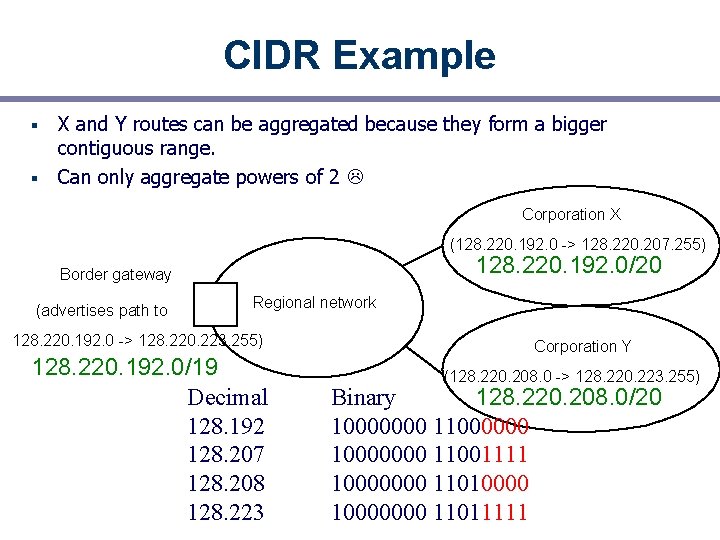
CIDR Example X and Y routes can be aggregated because they form a bigger contiguous range. § Can only aggregate powers of 2 § Corporation X (128. 220. 192. 0 -> 128. 220. 207. 255) 128. 220. 192. 0/20 Border gateway (advertises path to Regional network 128. 220. 192. 0 -> 128. 220. 223. 255) 128. 220. 192. 0/19 Decimal 128. 192 128. 207 128. 208 128. 223 Corporation Y (128. 220. 208. 0 -> 128. 220. 223. 255) Binary 128. 220. 208. 0/20 10000000 110000000 11001111 10000000 11010000000 11011111
IP Forwarding Revisited § Routing table now contains routes to “prefixes” § IP address and length indicating what bits are fixed § Now need to “search” routing table for longest matching prefix, only at routers § Search routing table for the prefix that the destination belongs to, and use that to forward as before § There can be multiple matches; take the longest prefix § This is the IP forwarding routine used at routers.
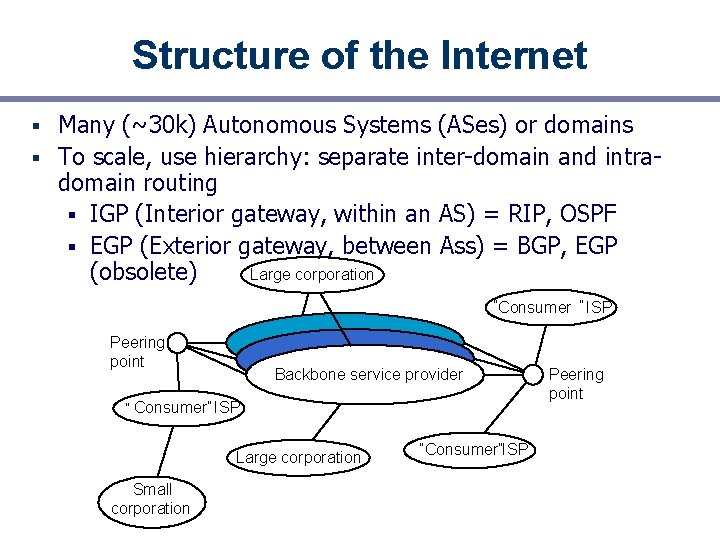
Structure of the Internet Many (~30 k) Autonomous Systems (ASes) or domains § To scale, use hierarchy: separate inter-domain and intradomain routing § IGP (Interior gateway, within an AS) = RIP, OSPF § EGP (Exterior gateway, between Ass) = BGP, EGP Large corporation (obsolete) § “Consumer ” ISP Peering point Backbone service provider “ Consumer” ISP Large corporation Small corporation “Consumer”ISP Peering point
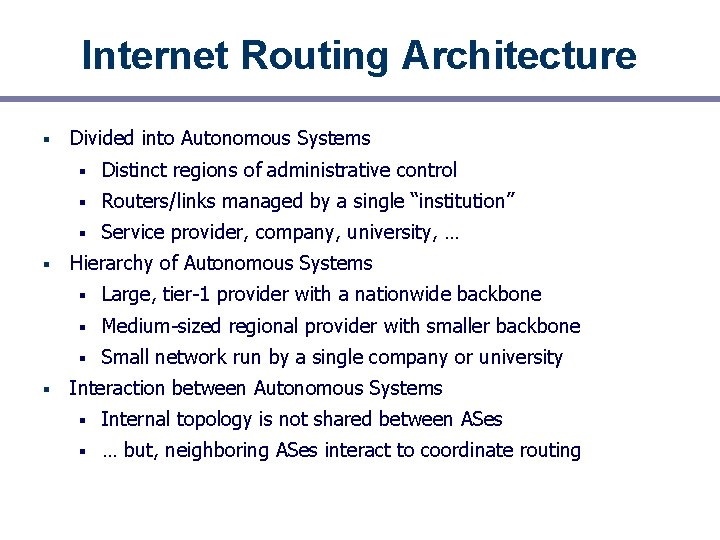
Internet Routing Architecture § § § Divided into Autonomous Systems § Distinct regions of administrative control § Routers/links managed by a single “institution” § Service provider, company, university, … Hierarchy of Autonomous Systems § Large, tier-1 provider with a nationwide backbone § Medium-sized regional provider with smaller backbone § Small network run by a single company or university Interaction between Autonomous Systems § Internal topology is not shared between ASes § … but, neighboring ASes interact to coordinate routing
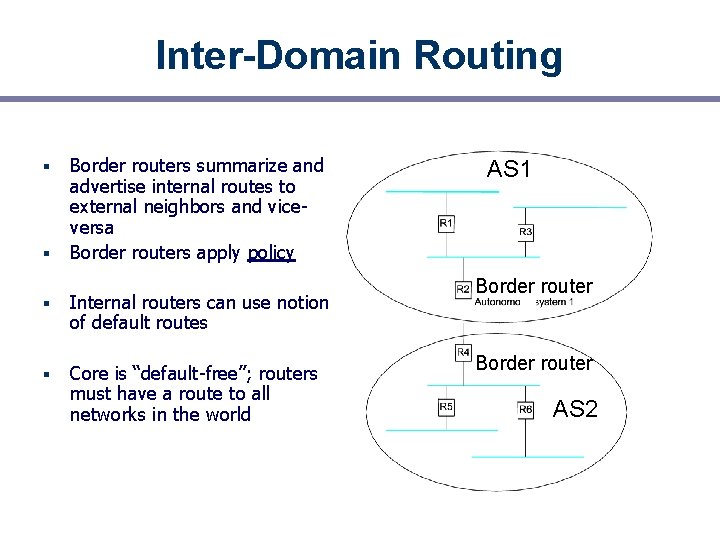
Inter-Domain Routing § § Border routers summarize and advertise internal routes to external neighbors and viceversa Border routers apply policy § Internal routers can use notion of default routes § Core is “default-free”; routers must have a route to all networks in the world AS 1 Border router AS 2
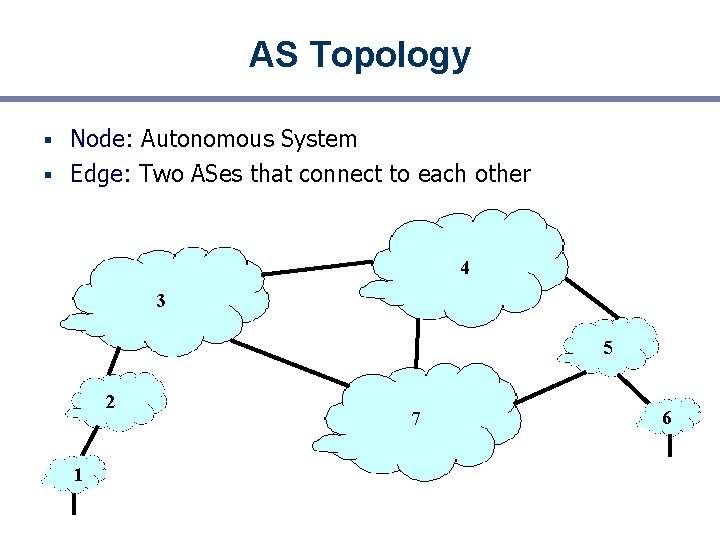
AS Topology Node: Autonomous System § Edge: Two ASes that connect to each other § 4 3 5 2 1 7 6
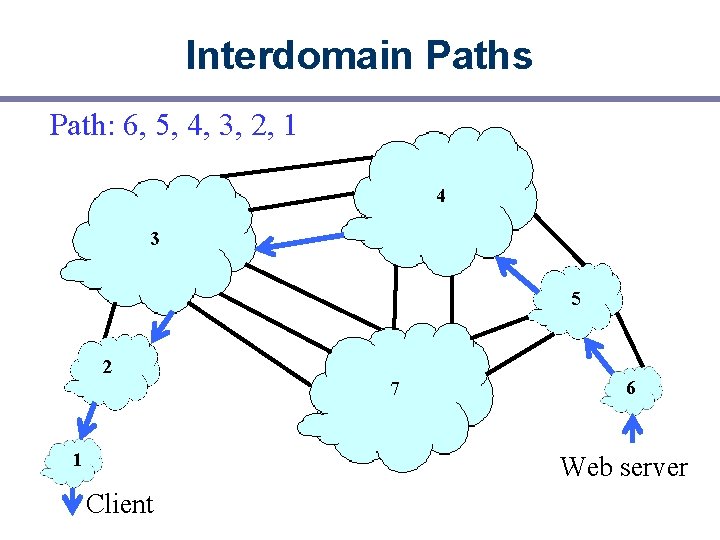
Interdomain Paths Path: 6, 5, 4, 3, 2, 1 4 3 5 2 1 7 6 Web server Client
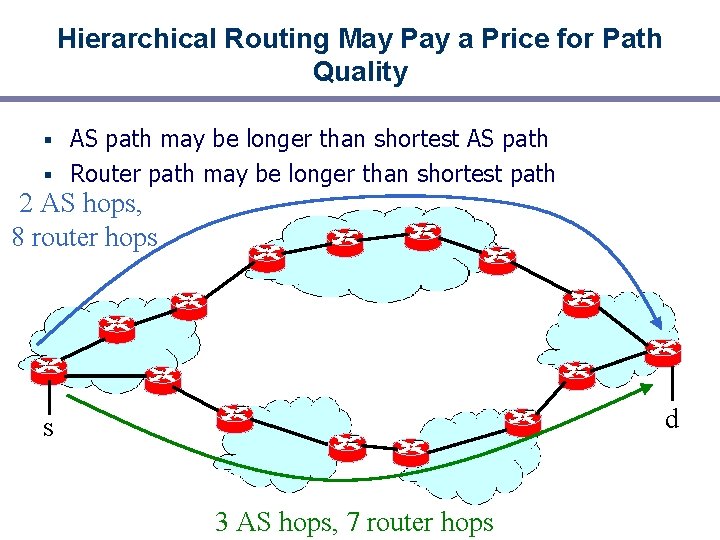
Hierarchical Routing May Pay a Price for Path Quality AS path may be longer than shortest AS path § Router path may be longer than shortest path § 2 AS hops, 8 router hops d s 3 AS hops, 7 router hops
Border Gateway Protocol (BGP 4) § Features: § Path vector routing § Application of policy § Operates over reliable transport (TCP) § Uses route aggregation (CIDR)
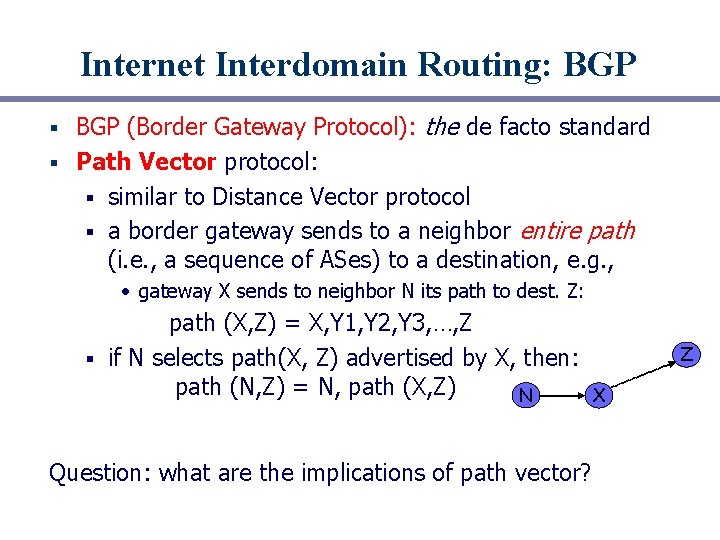
Internet Interdomain Routing: BGP (Border Gateway Protocol): the de facto standard § Path Vector protocol: § similar to Distance Vector protocol § a border gateway sends to a neighbor entire path (i. e. , a sequence of ASes) to a destination, e. g. , § • gateway X sends to neighbor N its path to dest. Z: path (X, Z) = X, Y 1, Y 2, Y 3, …, Z § if N selects path(X, Z) advertised by X, then: path (N, Z) = N, path (X, Z) N Question: what are the implications of path vector? Z X
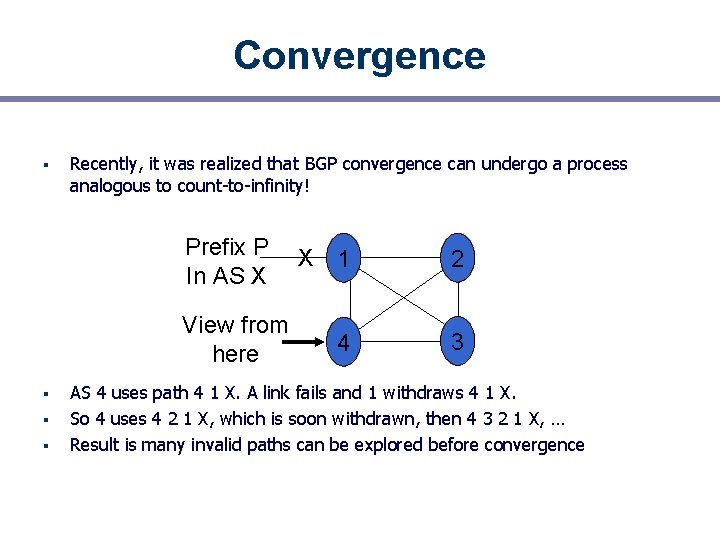
Convergence § Recently, it was realized that BGP convergence can undergo a process analogous to count-to-infinity! Prefix P In AS X View from here § § § X 1 2 4 3 AS 4 uses path 4 1 X. A link fails and 1 withdraws 4 1 X. So 4 uses 4 2 1 X, which is soon withdrawn, then 4 3 2 1 X, … Result is many invalid paths can be explored before convergence
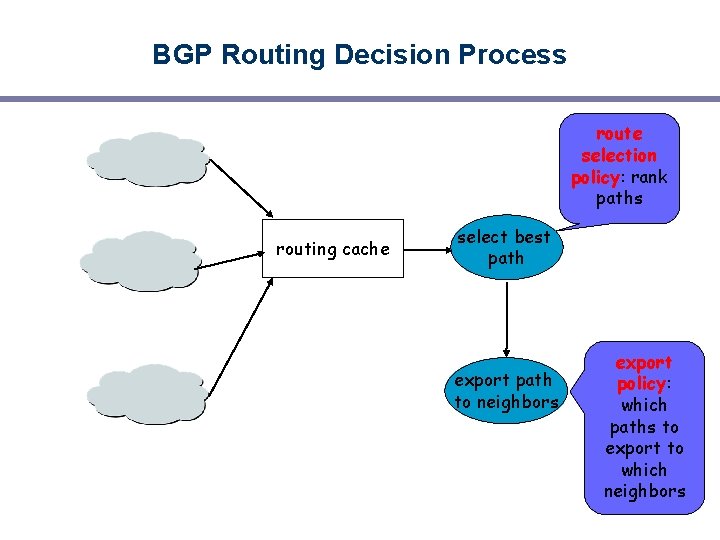
BGP Routing Decision Process route selection policy: rank paths routing cache select best path export path to neighbors export policy: which paths to export to which neighbors
Business Relationships Neighboring ASes have business contracts § How much traffic to carry § Which destinations to reach § How much money to pay § Common business relationships § Provider § Customer § • E. g. , UW is a customer of NTT • E. g. , MIT is a customer of Level 3 § Peer • E. g. , AT&T is a peer of Sprint
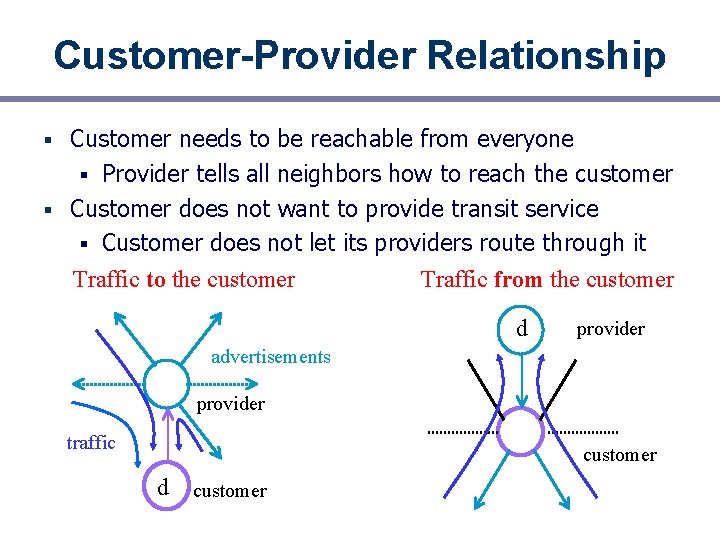
Customer-Provider Relationship Customer needs to be reachable from everyone § Provider tells all neighbors how to reach the customer § Customer does not want to provide transit service § Customer does not let its providers route through it Traffic to the customer Traffic from the customer § d provider advertisements provider traffic customer d customer
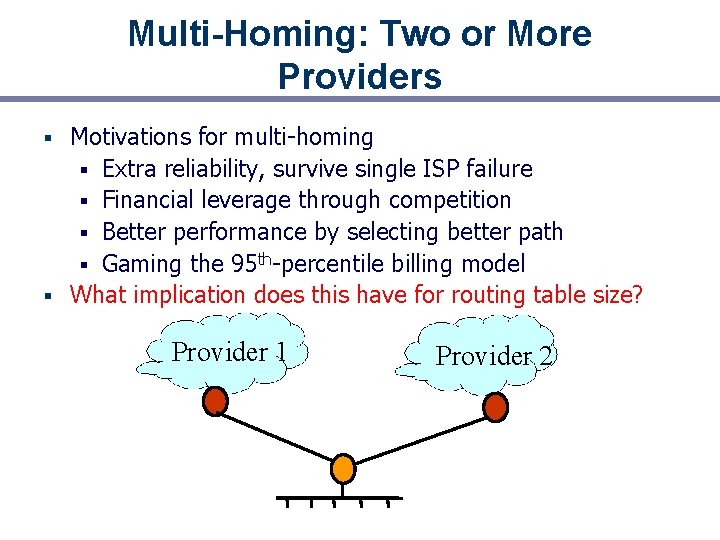
Multi-Homing: Two or More Providers Motivations for multi-homing § Extra reliability, survive single ISP failure § Financial leverage through competition § Better performance by selecting better path § Gaming the 95 th-percentile billing model § What implication does this have for routing table size? § Provider 1 Provider 2
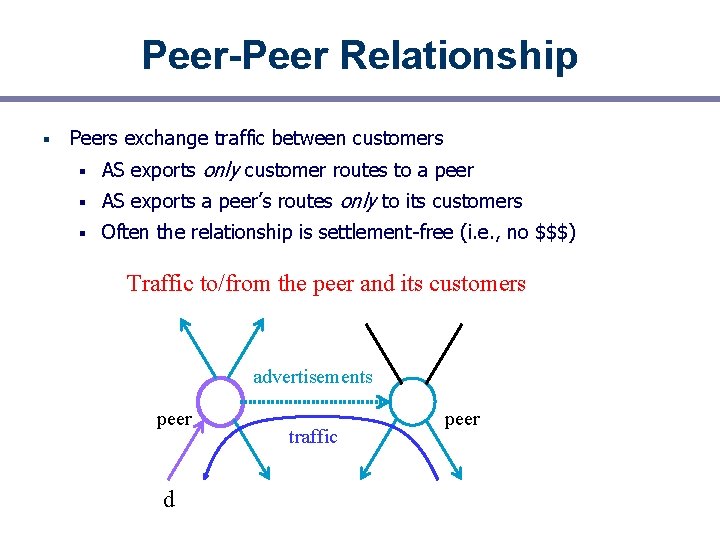
Peer-Peer Relationship § Peers exchange traffic between customers § AS exports only customer routes to a peer § AS exports a peer’s routes only to its customers § Often the relationship is settlement-free (i. e. , no $$$) Traffic to/from the peer and its customers advertisements peer d traffic peer
Implication of Business Relationship on Policies § Route selection (ranking) policy: § the typical route selection policy is to prefer customers over peers/providers to reach a destination, i. e. , Customer > Peer > Provider § Route export policy: § since the export of a path to a neighbor is an indication that the AS is willing to transport traffic for the neighbor, an AS may not export routes to all neighbors
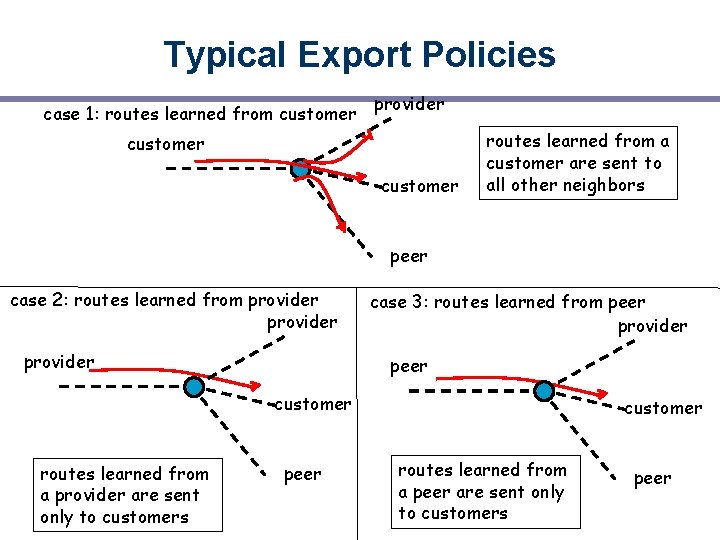
Typical Export Policies case 1: routes learned from customer provider customer routes learned from a customer are sent to all other neighbors peer case 2: routes learned from provider case 3: routes learned from peer provider peer customer routes learned from a provider are sent only to customers peer customer routes learned from a peer are sent only to customers peer
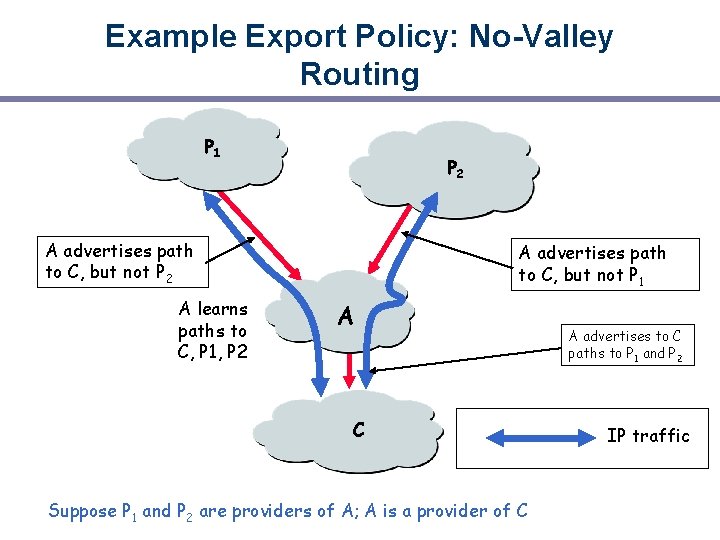
Example Export Policy: No-Valley Routing P 1 P 2 A advertises path to C, but not P 2 A learns paths to C, P 1, P 2 A advertises path to C, but not P 1 A C Suppose P 1 and P 2 are providers of A; A is a provider of C A advertises to C paths to P 1 and P 2 IP traffic
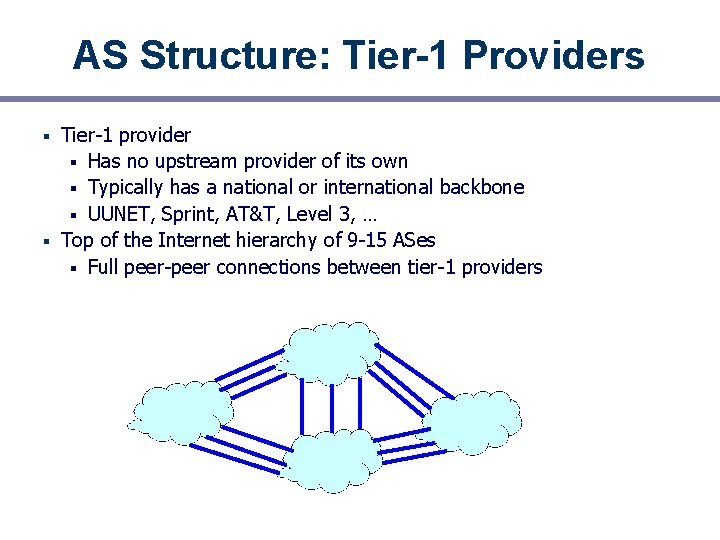
AS Structure: Tier-1 Providers Tier-1 provider § Has no upstream provider of its own § Typically has a national or international backbone § UUNET, Sprint, AT&T, Level 3, … § Top of the Internet hierarchy of 9 -15 ASes § Full peer-peer connections between tier-1 providers §
AS Structure: Other ASes § Tier-2 and Tier-3 providers § Provide transit service to downstream customers § … but, need at least one provider of their own § Typically have national or regional scope § E. g. , Minnesota Regional Network § Includes a few thousand of the Ases § Stub ASes § Do not provide transit service to others § Connect to one or more upstream providers § Includes vast majority (e. g. , 85 -90%) of the ASes
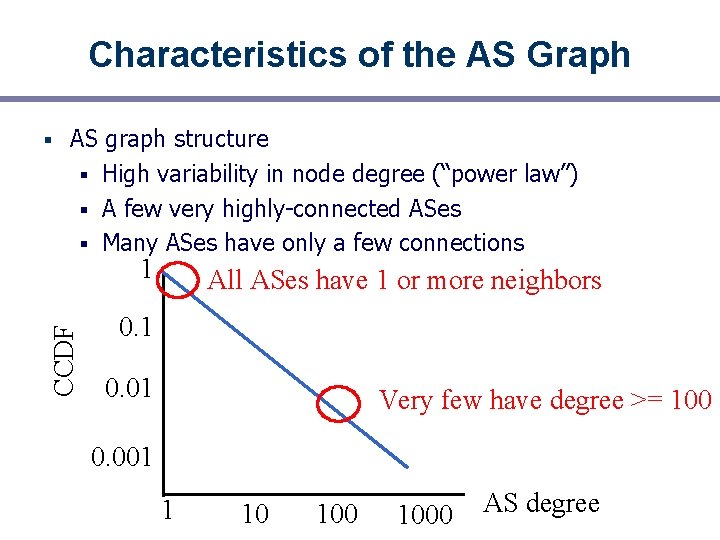
Characteristics of the AS Graph § AS graph structure § High variability in node degree (“power law”) § A few very highly-connected ASes § Many ASes have only a few connections CCDF 1 All ASes have 1 or more neighbors 0. 1 0. 01 Very few have degree >= 100 0. 001 1 10 1000 AS degree
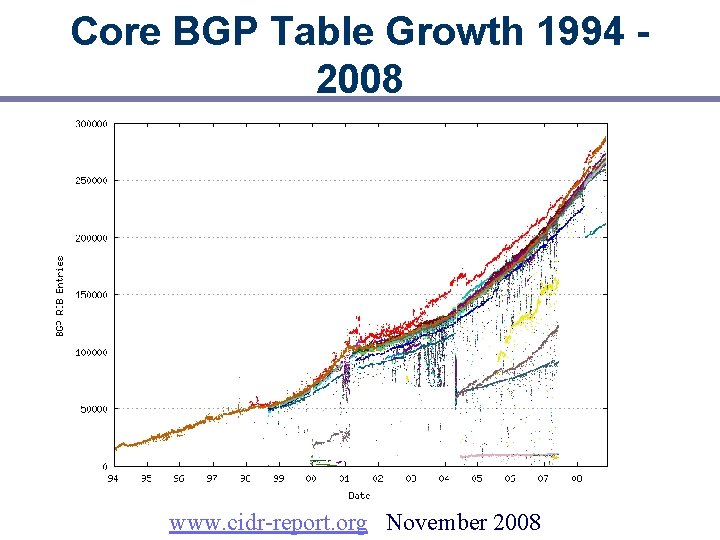
Core BGP Table Growth 1994 2008 www. cidr-report. org November 2008
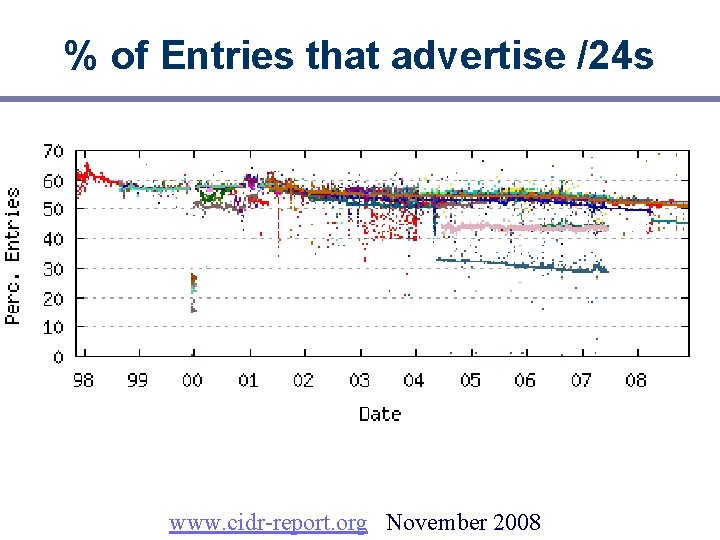
% of Entries that advertise /24 s www. cidr-report. org November 2008
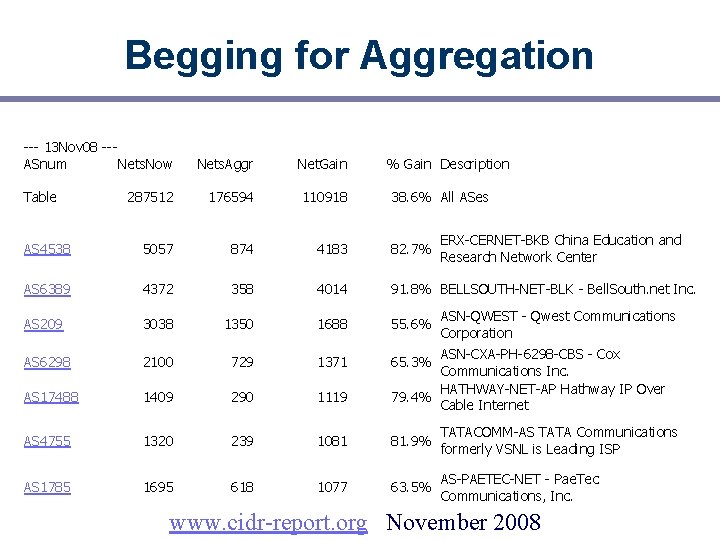
Begging for Aggregation --- 13 Nov 08 --ASnum Nets. Now Nets. Aggr Net. Gain 287512 176594 110918 AS 4538 5057 874 4183 82. 7% AS 6389 4372 358 4014 91. 8% BELLSOUTH-NET-BLK - Bell. South. net Inc. AS 209 3038 1350 1688 55. 6% AS 6298 2100 729 1371 65. 3% AS 17488 1409 290 1119 AS 4755 1320 239 1081 81. 9% TATACOMM-AS TATA Communications formerly VSNL is Leading ISP AS 1785 1695 618 1077 63. 5% AS-PAETEC-NET - Pae. Tec Communications, Inc. Table % Gain Description 38. 6% All ASes ERX-CERNET-BKB China Education and Research Network Center ASN-QWEST - Qwest Communications Corporation ASN-CXA-PH-6298 -CBS - Cox Communications Inc. HATHWAY-NET-AP Hathway IP Over 79. 4% Cable Internet www. cidr-report. org November 2008
Key Concepts Internet is a collection of Autonomous Systems (ASes) § Policy dominates routing at the AS level § Structural hierarchy helps make routing scalable § BGP routes between autonomous systems (ASes) §