
CSE 451 Operating Systems Winter 2009 Module 6
- Slides: 25
CSE 451: Operating Systems Winter 2009 Module 6 Scheduling Mark Zbikowski Gary Kimura 1/14/2022 1
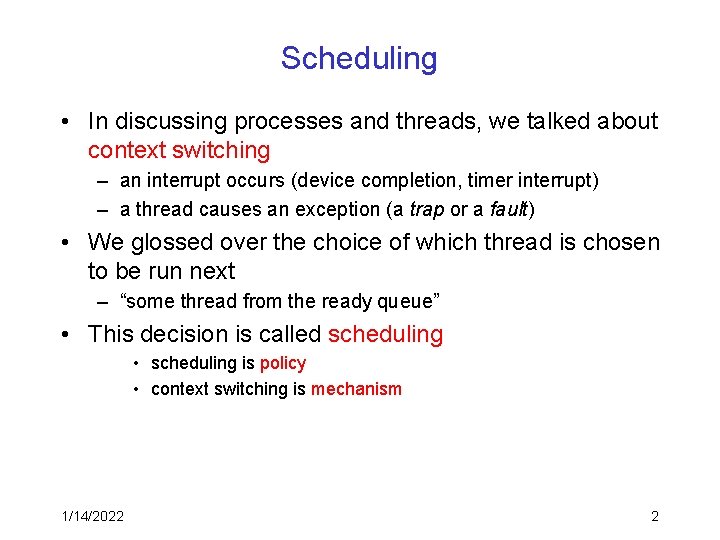
Scheduling • In discussing processes and threads, we talked about context switching – an interrupt occurs (device completion, timer interrupt) – a thread causes an exception (a trap or a fault) • We glossed over the choice of which thread is chosen to be run next – “some thread from the ready queue” • This decision is called scheduling • scheduling is policy • context switching is mechanism 1/14/2022 2
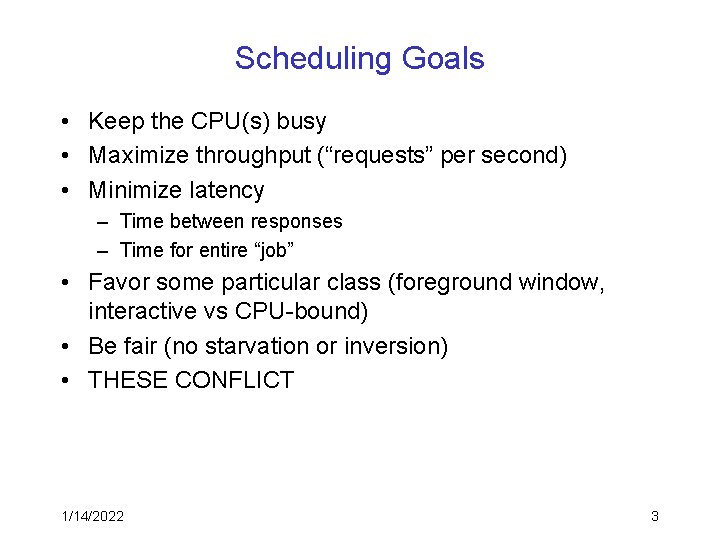
Scheduling Goals • Keep the CPU(s) busy • Maximize throughput (“requests” per second) • Minimize latency – Time between responses – Time for entire “job” • Favor some particular class (foreground window, interactive vs CPU-bound) • Be fair (no starvation or inversion) • THESE CONFLICT 1/14/2022 3
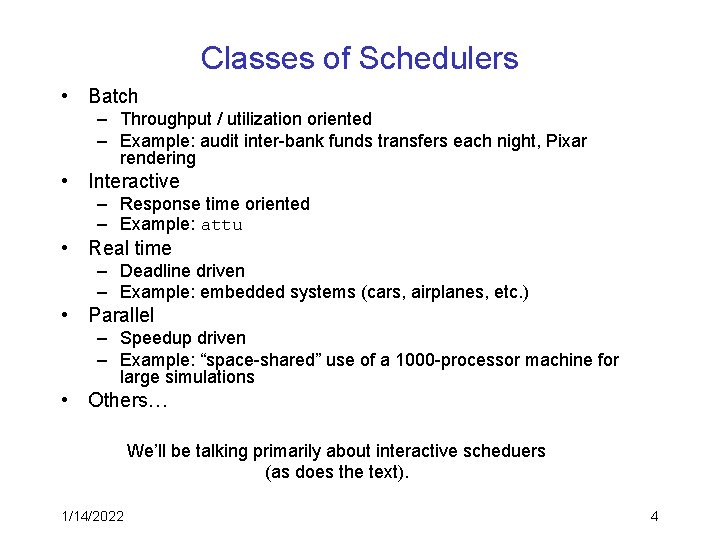
Classes of Schedulers • Batch – Throughput / utilization oriented – Example: audit inter-bank funds transfers each night, Pixar rendering • Interactive – Response time oriented – Example: attu • Real time – Deadline driven – Example: embedded systems (cars, airplanes, etc. ) • Parallel – Speedup driven – Example: “space-shared” use of a 1000 -processor machine for large simulations • Others… We’ll be talking primarily about interactive scheduers (as does the text). 1/14/2022 4
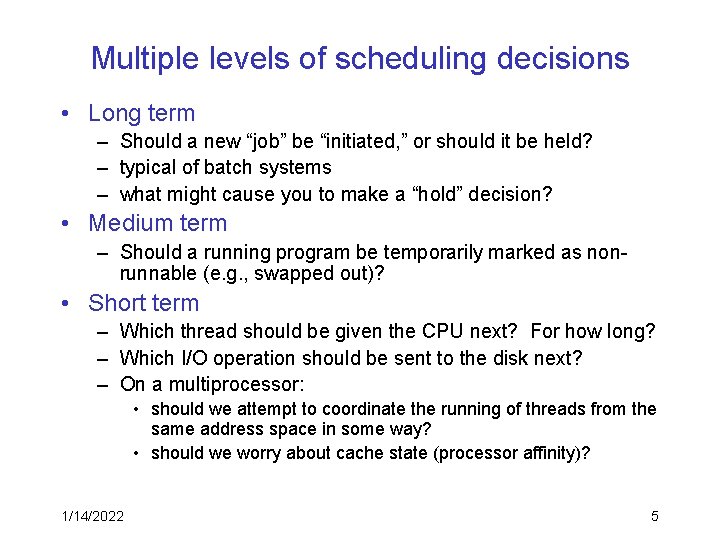
Multiple levels of scheduling decisions • Long term – Should a new “job” be “initiated, ” or should it be held? – typical of batch systems – what might cause you to make a “hold” decision? • Medium term – Should a running program be temporarily marked as nonrunnable (e. g. , swapped out)? • Short term – Which thread should be given the CPU next? For how long? – Which I/O operation should be sent to the disk next? – On a multiprocessor: • should we attempt to coordinate the running of threads from the same address space in some way? • should we worry about cache state (processor affinity)? 1/14/2022 5
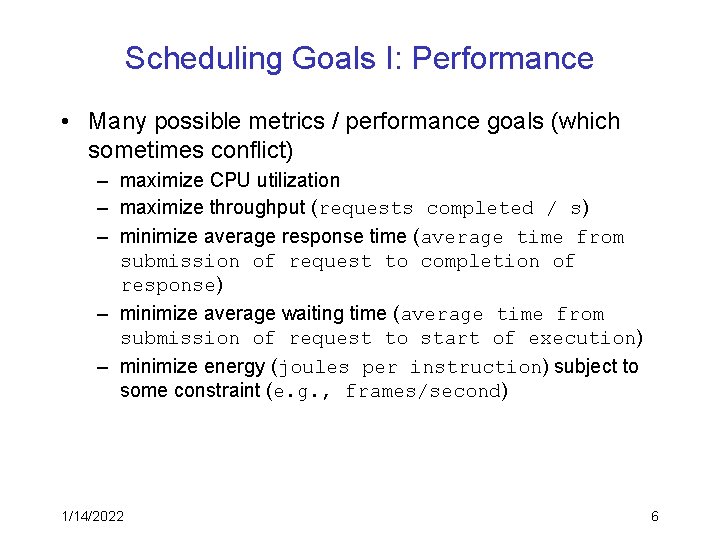
Scheduling Goals I: Performance • Many possible metrics / performance goals (which sometimes conflict) – maximize CPU utilization – maximize throughput (requests completed / s) – minimize average response time (average time from submission of request to completion of response) – minimize average waiting time (average time from submission of request to start of execution) – minimize energy (joules per instruction) subject to some constraint (e. g. , frames/second) 1/14/2022 6
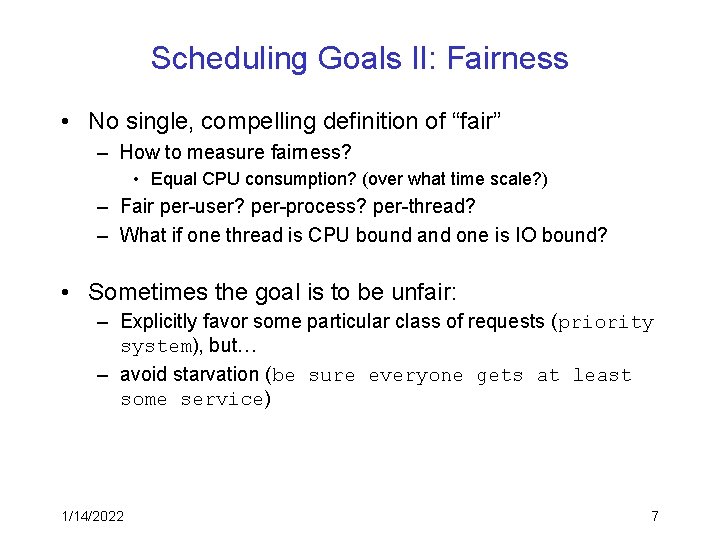
Scheduling Goals II: Fairness • No single, compelling definition of “fair” – How to measure fairness? • Equal CPU consumption? (over what time scale? ) – Fair per-user? per-process? per-thread? – What if one thread is CPU bound and one is IO bound? • Sometimes the goal is to be unfair: – Explicitly favor some particular class of requests (priority system), but… – avoid starvation (be sure everyone gets at least some service) 1/14/2022 7
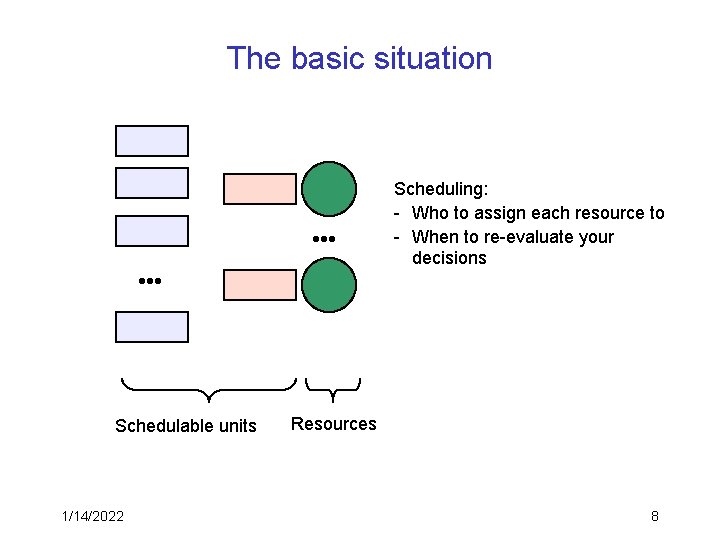
The basic situation Scheduling: - Who to assign each resource to - When to re-evaluate your decisions Schedulable units 1/14/2022 Resources 8
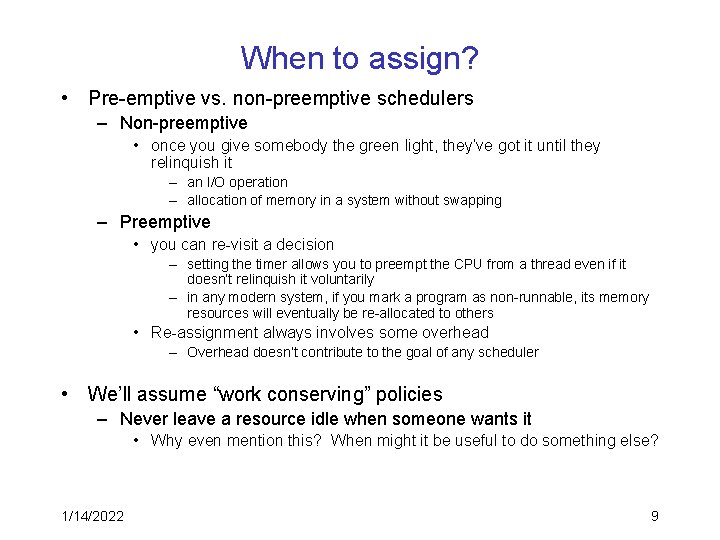
When to assign? • Pre-emptive vs. non-preemptive schedulers – Non-preemptive • once you give somebody the green light, they’ve got it until they relinquish it – an I/O operation – allocation of memory in a system without swapping – Preemptive • you can re-visit a decision – setting the timer allows you to preempt the CPU from a thread even if it doesn’t relinquish it voluntarily – in any modern system, if you mark a program as non-runnable, its memory resources will eventually be re-allocated to others • Re-assignment always involves some overhead – Overhead doesn’t contribute to the goal of any scheduler • We’ll assume “work conserving” policies – Never leave a resource idle when someone wants it • Why even mention this? When might it be useful to do something else? 1/14/2022 9
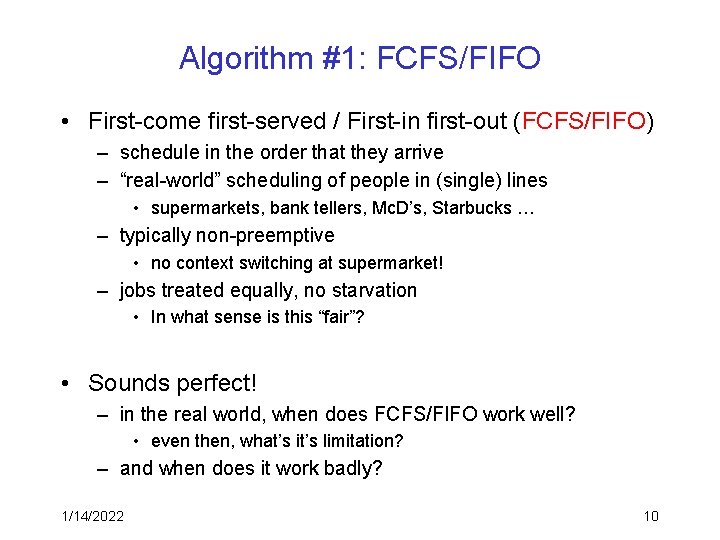
Algorithm #1: FCFS/FIFO • First-come first-served / First-in first-out (FCFS/FIFO) – schedule in the order that they arrive – “real-world” scheduling of people in (single) lines • supermarkets, bank tellers, Mc. D’s, Starbucks … – typically non-preemptive • no context switching at supermarket! – jobs treated equally, no starvation • In what sense is this “fair”? • Sounds perfect! – in the real world, when does FCFS/FIFO work well? • even then, what’s it’s limitation? – and when does it work badly? 1/14/2022 10
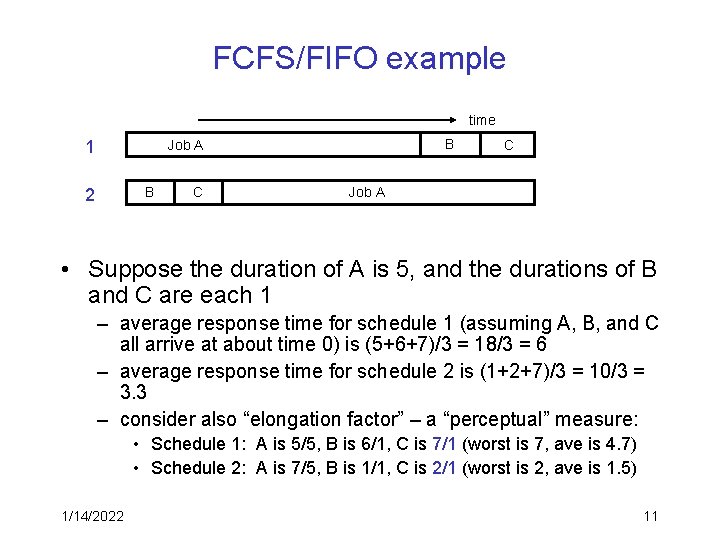
FCFS/FIFO example time 1 B Job A B 2 C C Job A • Suppose the duration of A is 5, and the durations of B and C are each 1 – average response time for schedule 1 (assuming A, B, and C all arrive at about time 0) is (5+6+7)/3 = 18/3 = 6 – average response time for schedule 2 is (1+2+7)/3 = 10/3 = 3. 3 – consider also “elongation factor” – a “perceptual” measure: • Schedule 1: A is 5/5, B is 6/1, C is 7/1 (worst is 7, ave is 4. 7) • Schedule 2: A is 7/5, B is 1/1, C is 2/1 (worst is 2, ave is 1. 5) 1/14/2022 11
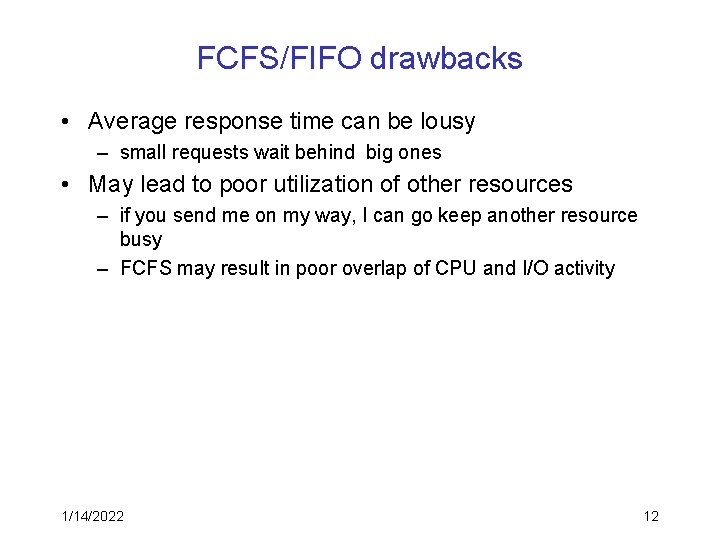
FCFS/FIFO drawbacks • Average response time can be lousy – small requests wait behind big ones • May lead to poor utilization of other resources – if you send me on my way, I can go keep another resource busy – FCFS may result in poor overlap of CPU and I/O activity 1/14/2022 12
Algorithm #2: SPT/SJF • Shortest processing time first / Shortest job first (SPT/SJF) – choose the request with the smallest service requirement • Provably optimal with respect to average response time 1/14/2022 13
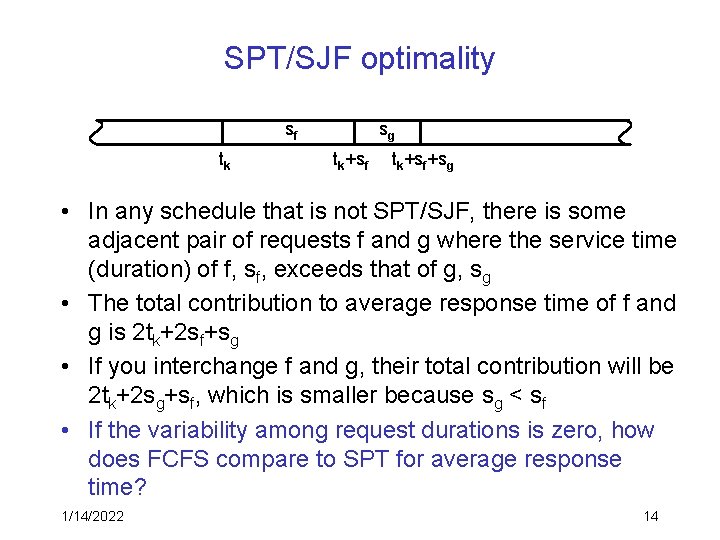
SPT/SJF optimality sf tk sg tk+sf+sg • In any schedule that is not SPT/SJF, there is some adjacent pair of requests f and g where the service time (duration) of f, sf, exceeds that of g, sg • The total contribution to average response time of f and g is 2 tk+2 sf+sg • If you interchange f and g, their total contribution will be 2 tk+2 sg+sf, which is smaller because sg < sf • If the variability among request durations is zero, how does FCFS compare to SPT for average response time? 1/14/2022 14
SPT/SJF drawbacks • It’s non-preemptive – So? • … but there’s a preemptive version – SRPT (Shortest Remaining Processing Time first) – that accommodates arrivals (rather than assuming all requests are initially available) • Sounds perfect! – what about starvation? – can you know the processing time of a request? – can you guess/approximate? How? 1/14/2022 15
Algorithm #3: RR • Round Robin scheduling (RR) – ready queue is treated as a circular FIFO queue – each request is given a time slice, called a quantum • request executes for duration of quantum, or until it blocks – what signifies the end of a quantum? • time-division multiplexing (time-slicing) – great for timesharing • no starvation • Sounds perfect! – – how is RR an improvement over FCFS? how is RR an improvement over SPT? how is RR an approximation to SPT? what are the warts? 1/14/2022 16
RR drawbacks • What if all jobs are exactly the same length? – What would the pessimal schedule be? • What do you set the quantum to be? – no value is “correct” • if small, then context switch often, incurring high overhead • if large, then response time degrades – treats all jobs equally • if I run 100 copies of SETI@home, it degrades your service • how might I fix this? 1/14/2022 17
Algorithm #4: Priority • Assign priorities to requests – choose request with highest priority to run next • if tie, use another scheduling algorithm to break (e. g. , RR) – to implement SJF, priority = expected length of CPU burst • Abstractly modeled (and usually implemented) as multiple “priority queues” – put a ready request on the queue associated with its priority • Sounds perfect! 1/14/2022 18
Priority drawbacks • How are you going to assign priorities? • Starvation – if there is an endless supply of high priority jobs, no lowpriority job will ever run • Solution: “age” threads over time – increase priority as a function of accumulated wait time – decrease priority as a function of accumulated processing time – many ugly heuristics have been explored in this space 1/14/2022 19
Combining algorithms • In practice, any real system uses some sort of hybrid approach, with elements of FCFS, SPT, RR, and Priority • Example: multi-level feedback queues (MLFQ) – – – there is a hierarchy of queues there is a priority ordering among the queues new requests enter the highest priority queue each queue is scheduled RR queues have different quanta requests move between queues based on execution history – In what situations might this approximate SJF? 1/14/2022 20
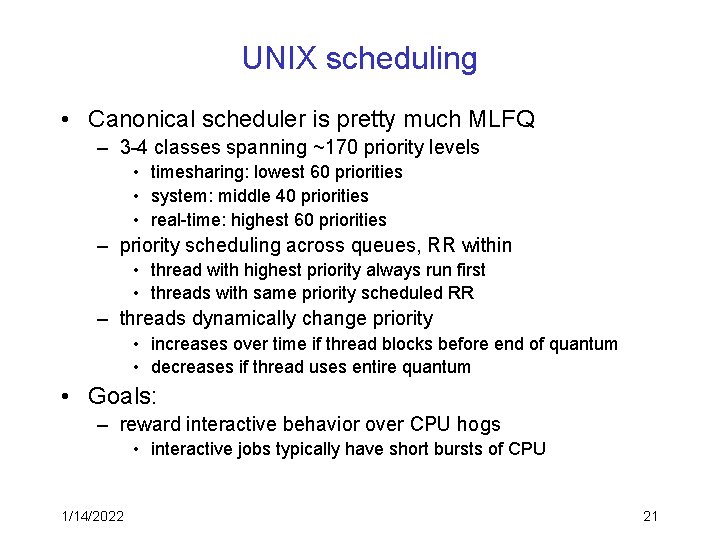
UNIX scheduling • Canonical scheduler is pretty much MLFQ – 3 -4 classes spanning ~170 priority levels • timesharing: lowest 60 priorities • system: middle 40 priorities • real-time: highest 60 priorities – priority scheduling across queues, RR within • thread with highest priority always run first • threads with same priority scheduled RR – threads dynamically change priority • increases over time if thread blocks before end of quantum • decreases if thread uses entire quantum • Goals: – reward interactive behavior over CPU hogs • interactive jobs typically have short bursts of CPU 1/14/2022 21
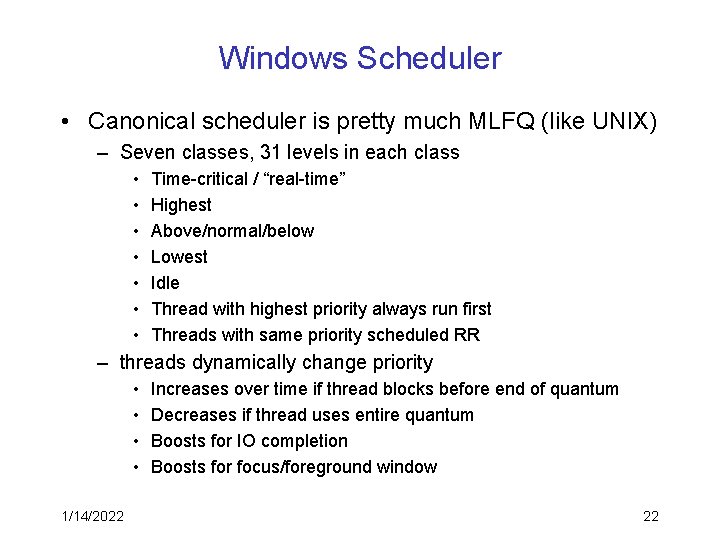
Windows Scheduler • Canonical scheduler is pretty much MLFQ (like UNIX) – Seven classes, 31 levels in each class • • Time-critical / “real-time” Highest Above/normal/below Lowest Idle Thread with highest priority always run first Threads with same priority scheduled RR – threads dynamically change priority • • 1/14/2022 Increases over time if thread blocks before end of quantum Decreases if thread uses entire quantum Boosts for IO completion Boosts for focus/foreground window 22
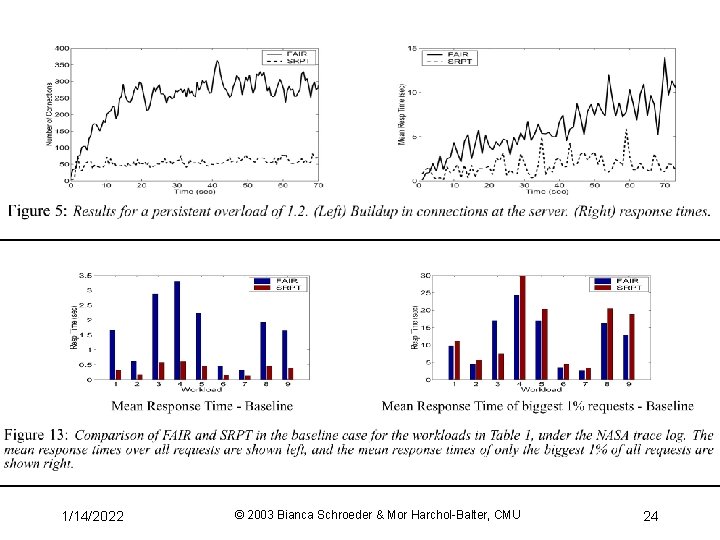
Scheduling the Apache web server SRPT • What does a web request consist of? (What’s it trying to get done? ) • How are incoming web requests scheduled, in practice? • How might you estimate the service time of an incoming request? • Starvation under SRPT is a problem in theory – is it a problem in practice? – “Kleinrock’s conservation law” (Recent work by Bianca Schroeder and Mor Harchol-Balter at CMU) 1/14/2022 23
1/14/2022 © 2003 Bianca Schroeder & Mor Harchol-Balter, CMU 24
Summary • Scheduling takes place at many levels • It can make a huge difference in performance – this difference increases with the variability in service requirements • Multiple goals, sometimes (always? ) conflicting • There are many “pure” algorithms, most with some drawbacks in practice – FCFS, SPT, RR, Priority • Real systems use hybrids • Recent work has shown that SPT/SRPT – always known to be beneficial in principle – may be more practical in some settings than long thought 1/14/2022 25