
CSE 421 NPCompleteness Yin Tat Lee 1 Computational

- Slides: 21
CSE 421 NP-Completeness Yin Tat Lee 1
Computational Complexity Goal: Classify problems according to the amount of computational resources used by the best algorithms that solve them Here we focus on time complexity Recall: worst-case running time of an algorithm • max # steps algorithm takes on any input of size n 2
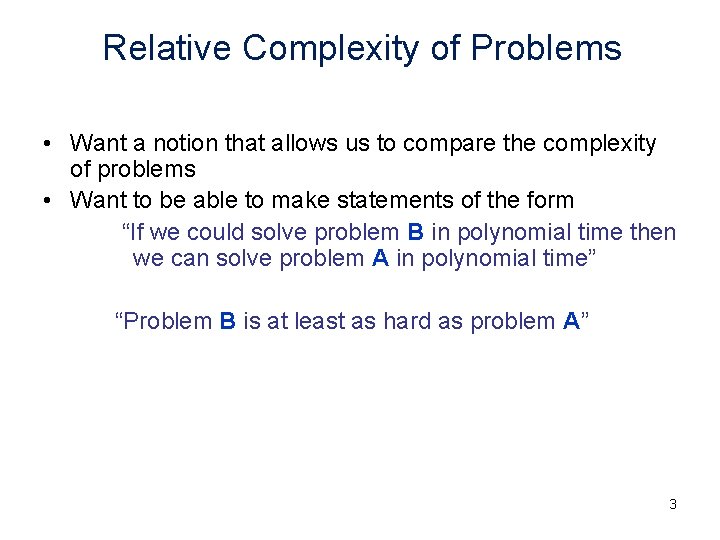
Relative Complexity of Problems • Want a notion that allows us to compare the complexity of problems • Want to be able to make statements of the form “If we could solve problem B in polynomial time then we can solve problem A in polynomial time” “Problem B is at least as hard as problem A” 3
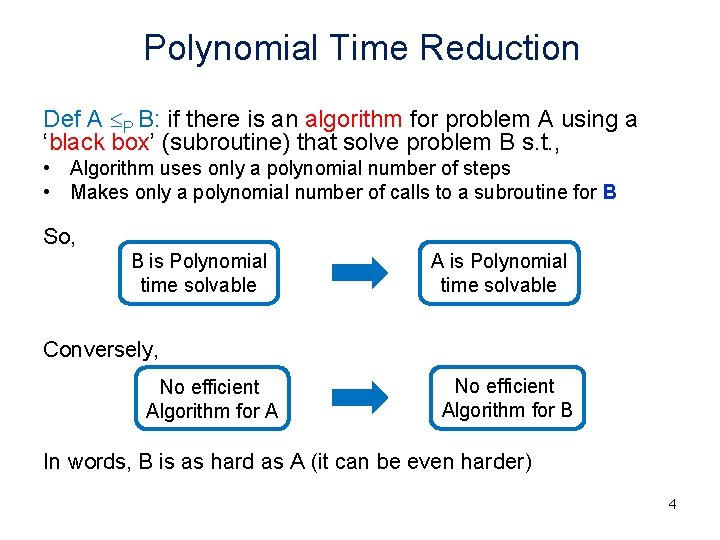
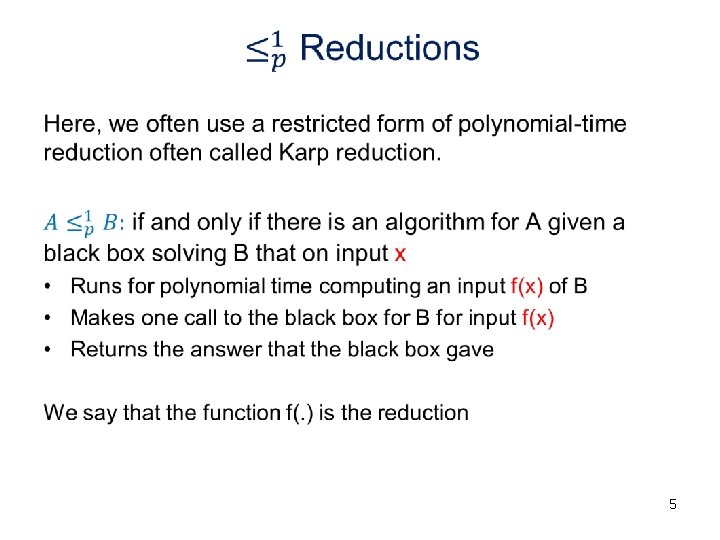
Polynomial Time Reduction Def A P B: if there is an algorithm for problem A using a ‘black box’ (subroutine) that solve problem B s. t. , • Algorithm uses only a polynomial number of steps • Makes only a polynomial number of calls to a subroutine for B So, B is Polynomial time solvable A is Polynomial time solvable Conversely, No efficient Algorithm for A No efficient Algorithm for B In words, B is as hard as A (it can be even harder) 4
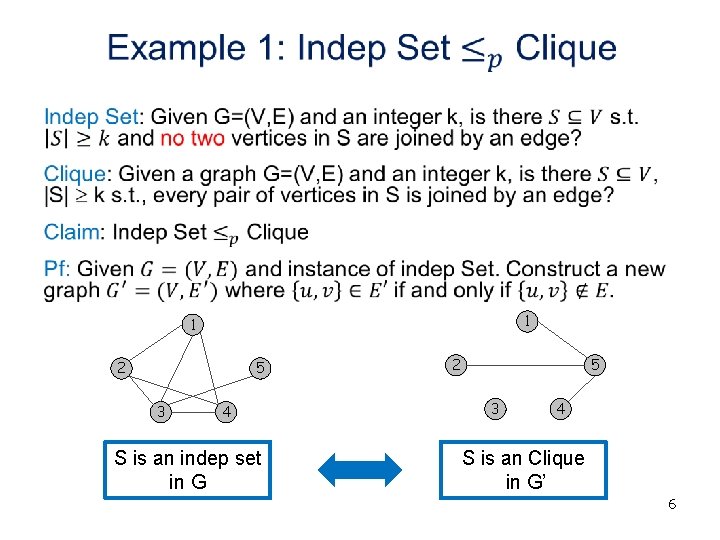
• 1 1 5 2 3 4 S is an indep set in G 5 2 3 4 S is an Clique in G’ 6
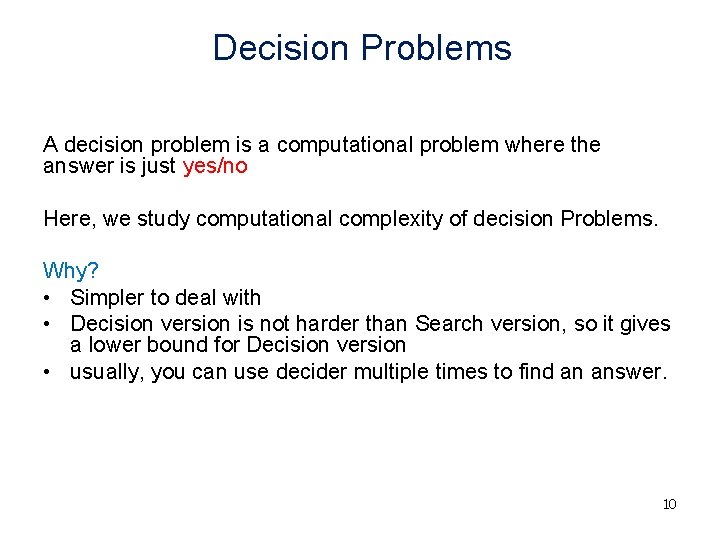
Decision Problems A decision problem is a computational problem where the answer is just yes/no Here, we study computational complexity of decision Problems. Why? • Simpler to deal with • Decision version is not harder than Search version, so it gives a lower bound for Decision version • usually, you can use decider multiple times to find an answer. 10
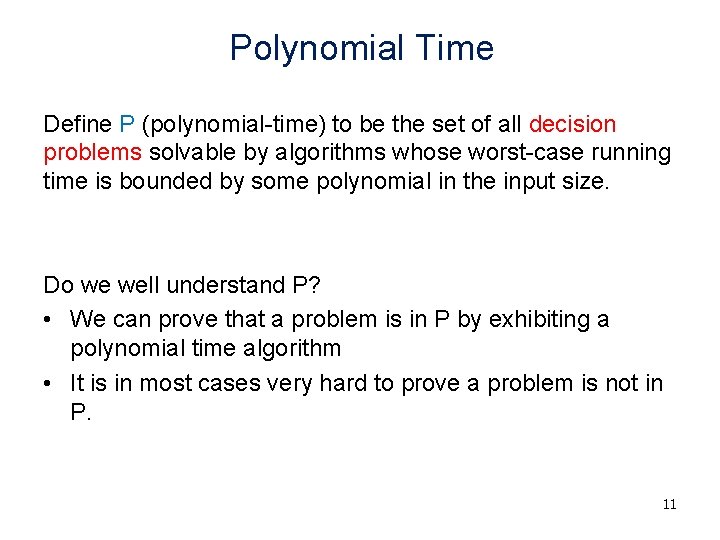
Polynomial Time Define P (polynomial-time) to be the set of all decision problems solvable by algorithms whose worst-case running time is bounded by some polynomial in the input size. Do we well understand P? • We can prove that a problem is in P by exhibiting a polynomial time algorithm • It is in most cases very hard to prove a problem is not in P. 11
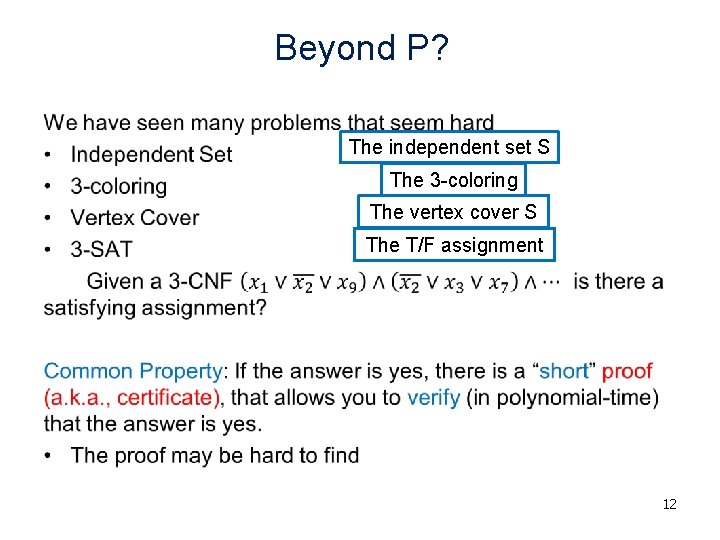
Beyond P? • The independent set S The 3 -coloring The vertex cover S The T/F assignment 12
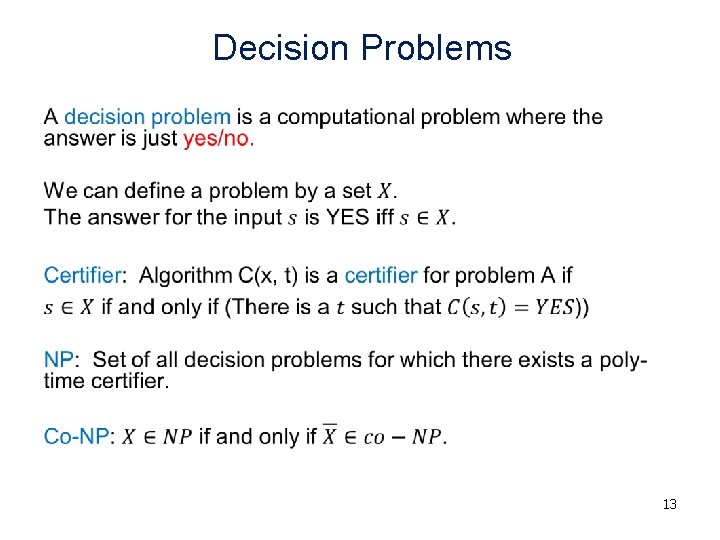
Decision Problems • 13
Example: 3 SAT is in NP • 14
What do we know about NP? • 15
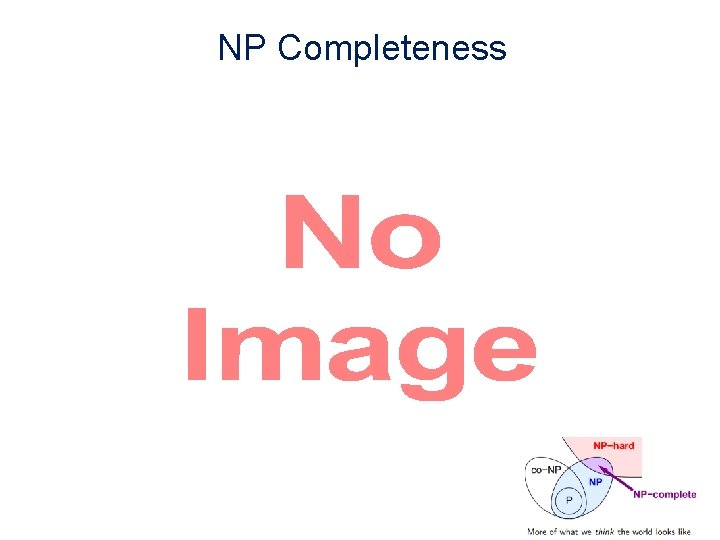
NP Completeness • 16
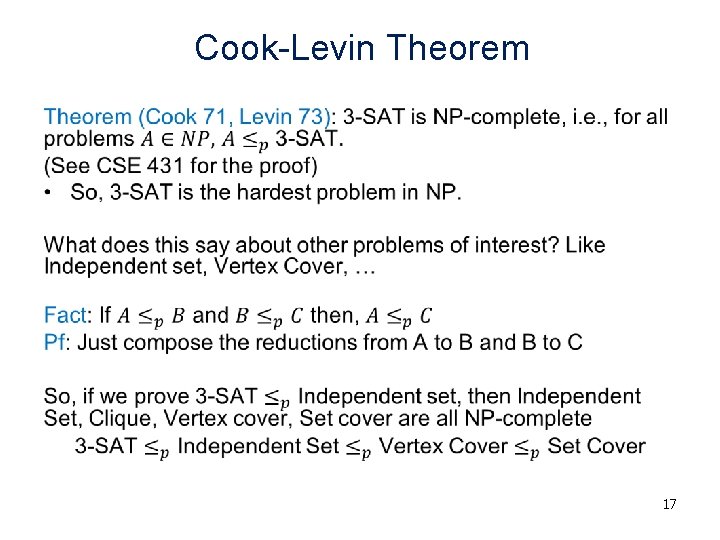
Cook-Levin Theorem • 17
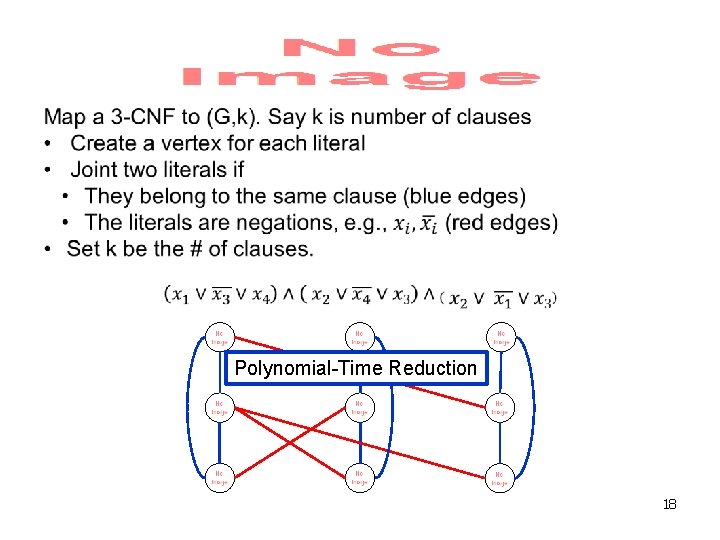
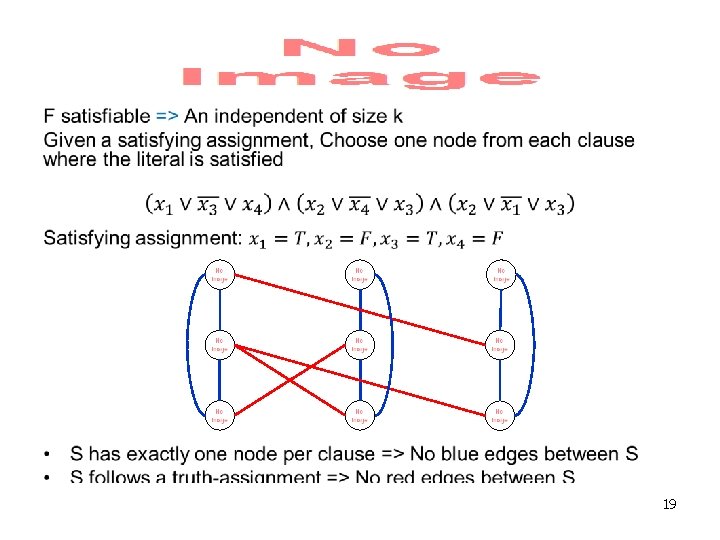
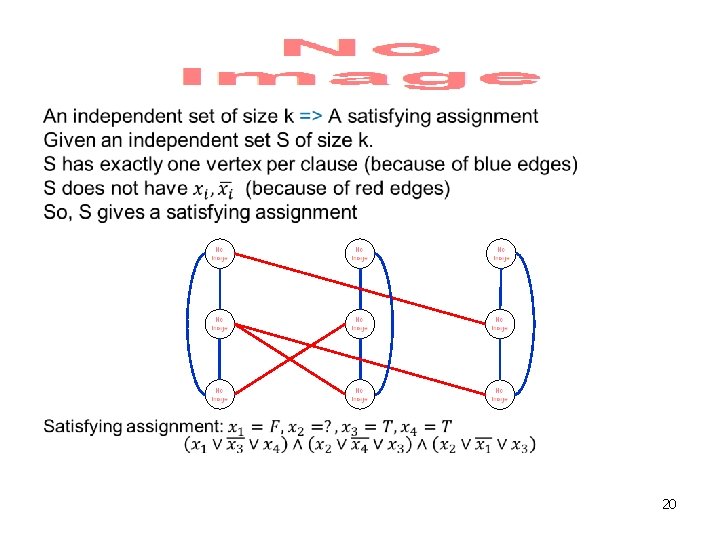
• Polynomial-Time Reduction 18
Summary • If a problem is NP-hard it does not mean that all instances are hared, e. g. , Vertex-cover has a polynomial-time algorithm in trees • We learned the crucial idea of polynomial-time reduction. This can be even used in algorithm design, e. g. , we know how to solve max-flow so we reduce image segmentation to max-flow • NP-Complete problems are the hardest problem in NP • NP-hard problems may not necessarily belong to NP. • Polynomial-time reductions are transitive relations 21