
CSE 421 Divide and Conquer Median Yin Tat


![DP for Knapsack Compute-OPT(i, w) if M[i, w] == empty if (i==0) recursive M[i,](https://slidetodoc.com/presentation_image_h2/9b1492b21ae4fdd80779157c1d834fa6/image-36.jpg "DP for Knapsack Compute-OPT(i, w) if M[i, w] == empty if (i==0) recursive M[i,")


- Slides: 44
CSE 421 Divide and Conquer / Median Yin Tat Lee 1
Median
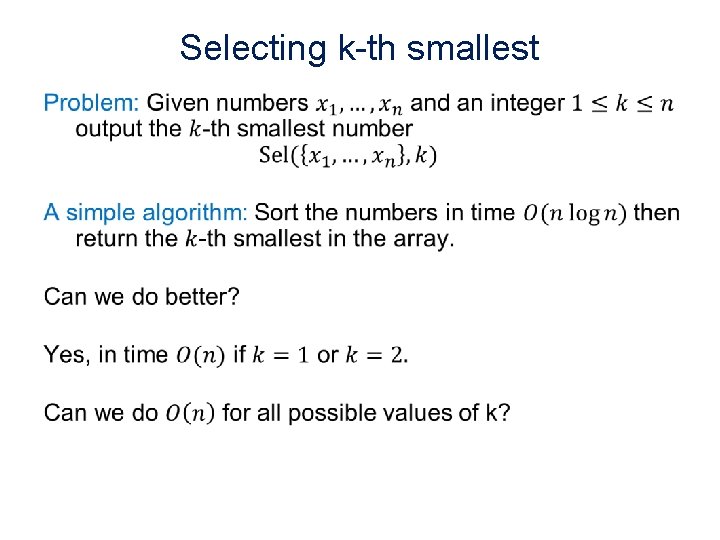
Selecting k-th smallest •
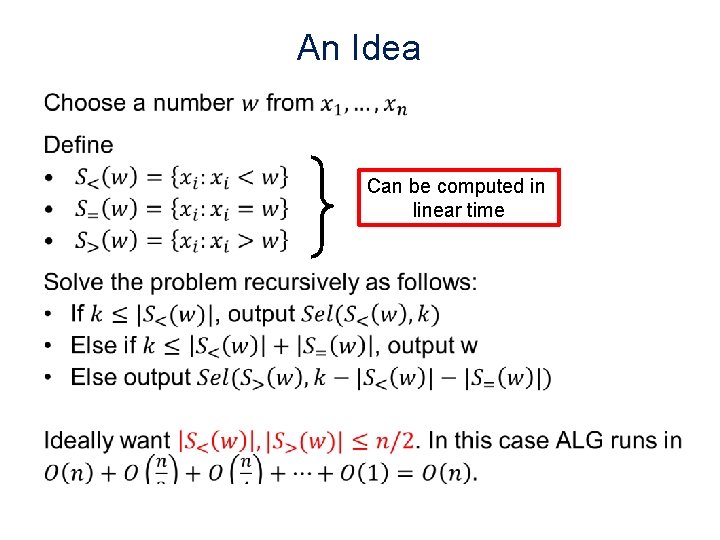
An Idea • Can be computed in linear time
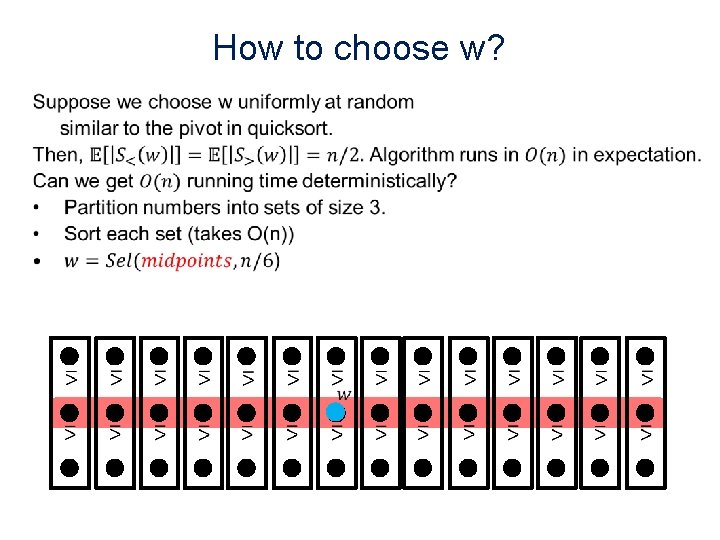
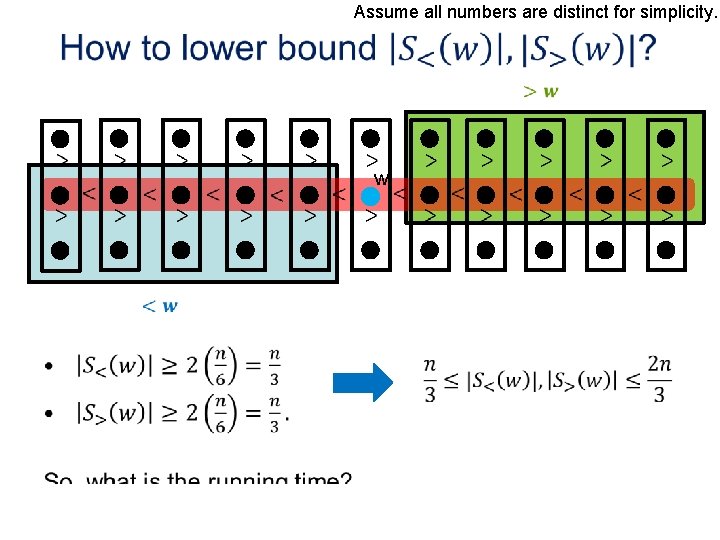
How to choose w? •
Assume all numbers are distinct for simplicity. • w
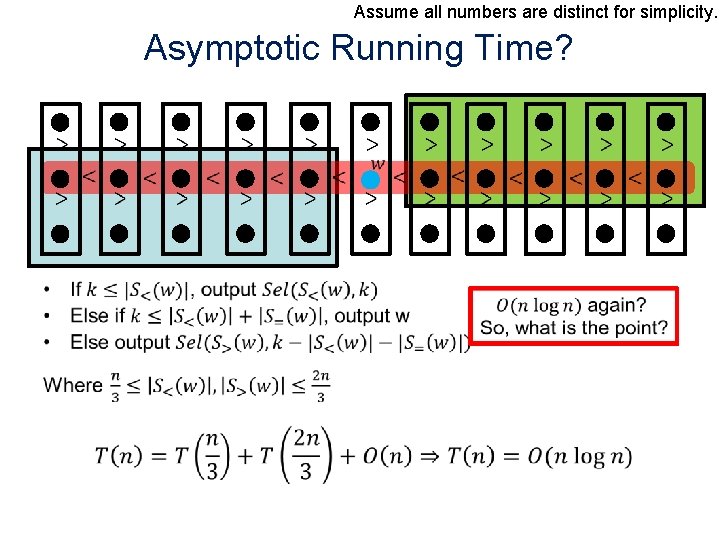
Assume all numbers are distinct for simplicity. Asymptotic Running Time? •
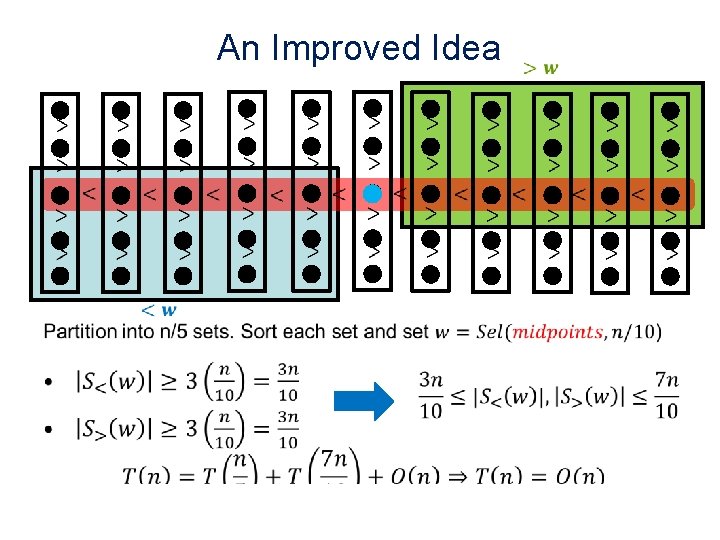
An Improved Idea •
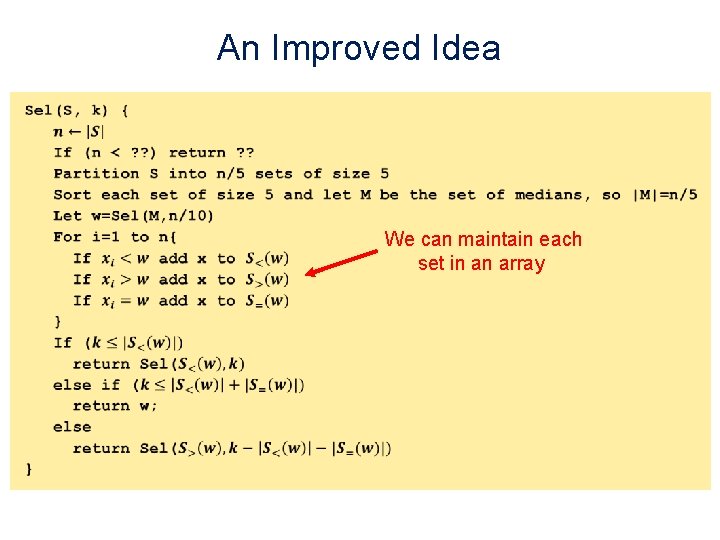
An Improved Idea We can maintain each set in an array
Weighted Interval Scheduling
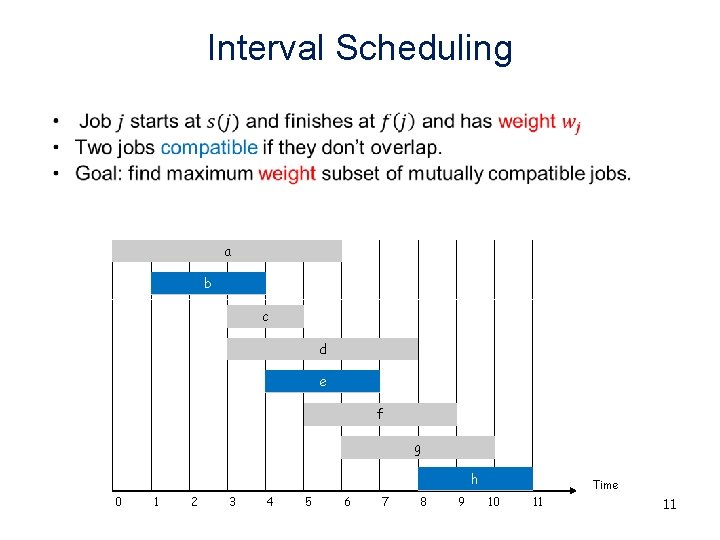
Interval Scheduling • a b c d e f g h 0 1 2 3 4 5 6 7 8 9 10 11 Time 11
Unweighted Interval Scheduling: Review Recall: Greedy algorithm works if all weights are 1: • Consider jobs in ascending order of finishing time • Add job to a subset if it is compatible with prev added jobs. Observation: Greedy ALG fails spectacularly if arbitrary weights are allowed: b weight = 1000 by finish a weight = 1 0 1 2 3 4 5 6 7 8 9 10 11 b weight = 1000 a 1 weight = 999 0 a 1 1 a 1 2 a 1 3 a 1 4 by weight a 1 5 Time a 1 6 a 1 7 a 1 8 a 1 9 10 11 Time 12
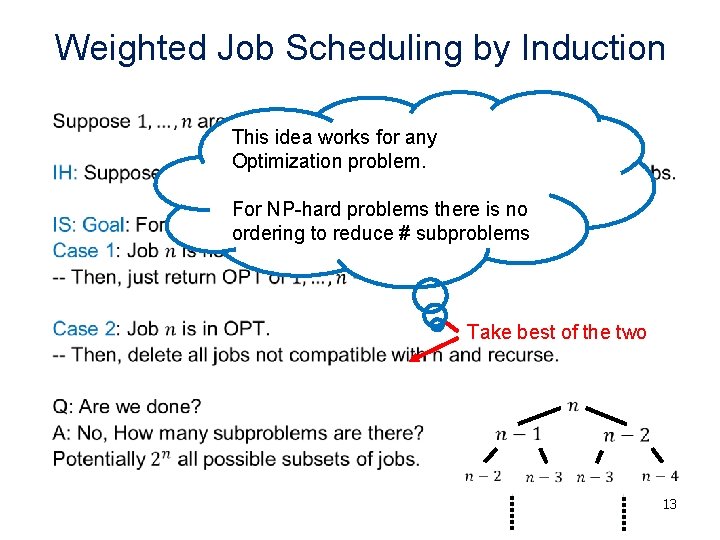
Weighted Job Scheduling by Induction • This idea works for any Optimization problem. For NP-hard problems there is no ordering to reduce # subproblems Take best of the two 13
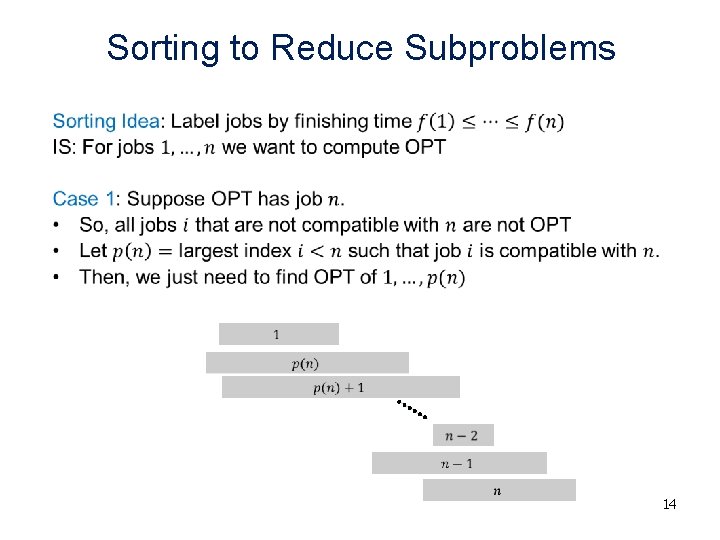
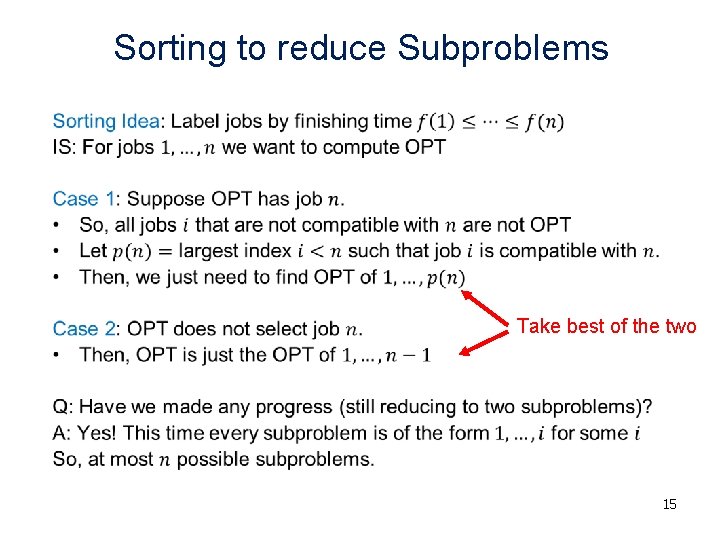
Sorting to Reduce Subproblems • 14
Sorting to reduce Subproblems • Take best of the two 15
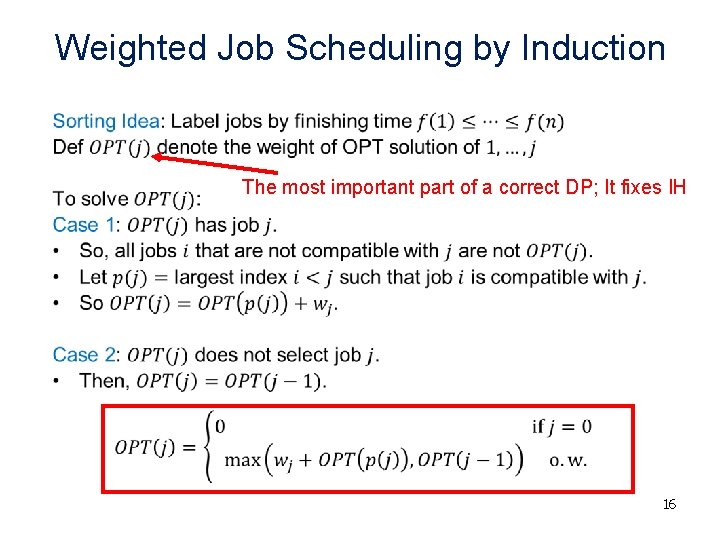
Weighted Job Scheduling by Induction • The most important part of a correct DP; It fixes IH 16
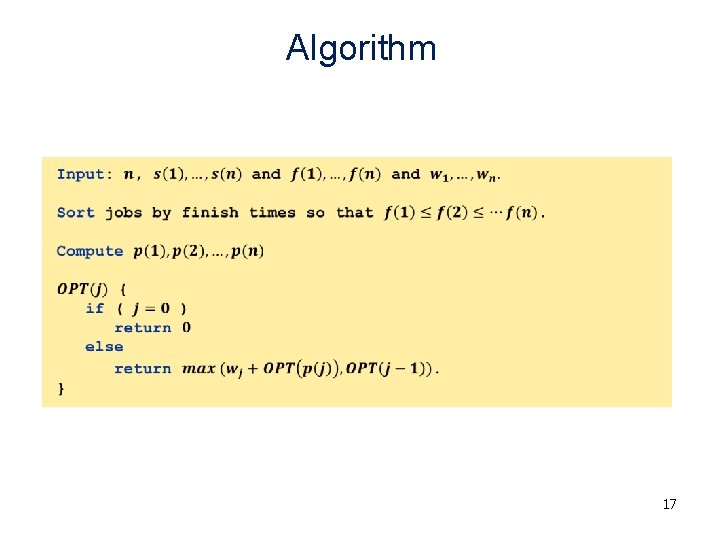
Algorithm 17
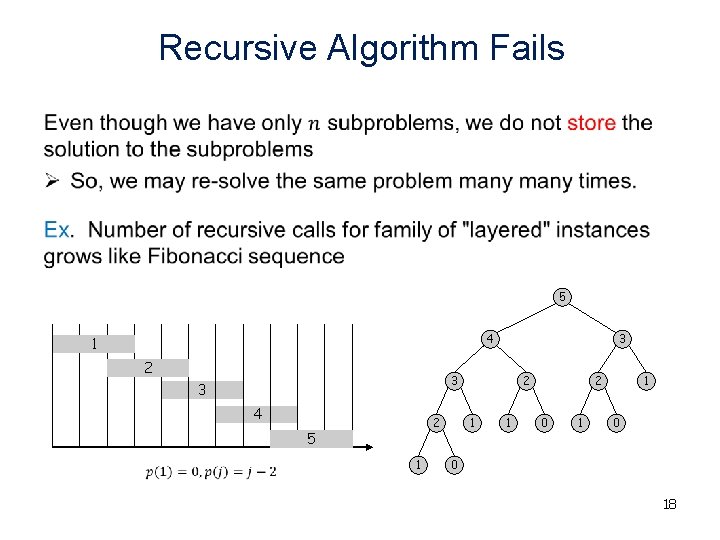
Recursive Algorithm Fails • 5 4 1 2 3 3 3 4 2 5 1 2 1 1 2 0 1 1 0 0 18
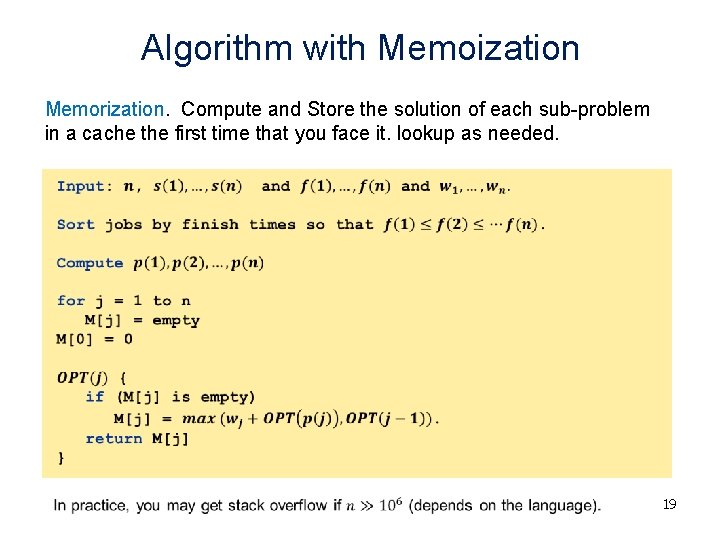
Algorithm with Memoization Memorization. Compute and Store the solution of each sub-problem in a cache the first time that you face it. lookup as needed. 19
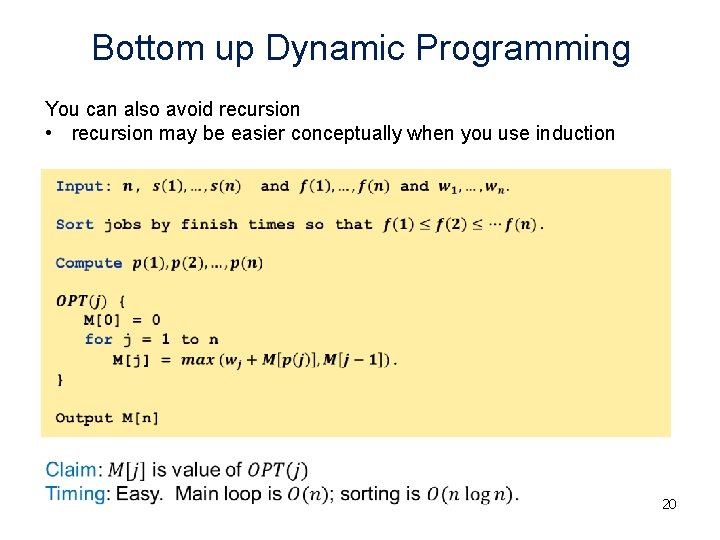
Bottom up Dynamic Programming You can also avoid recursion • recursion may be easier conceptually when you use induction 20
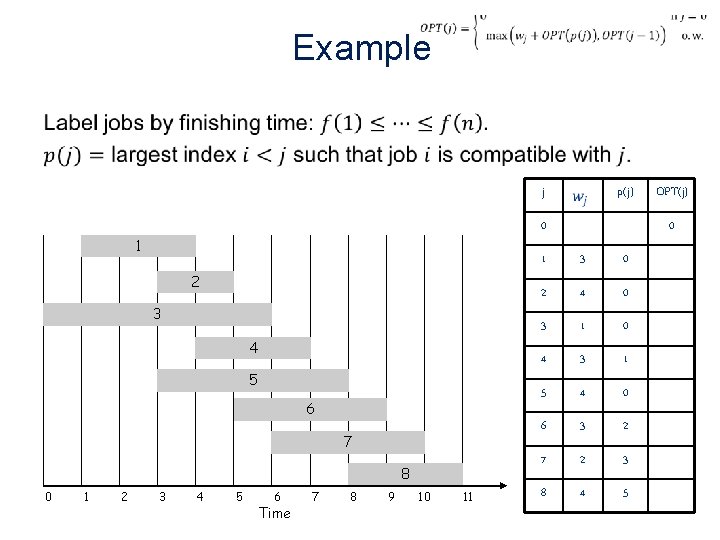
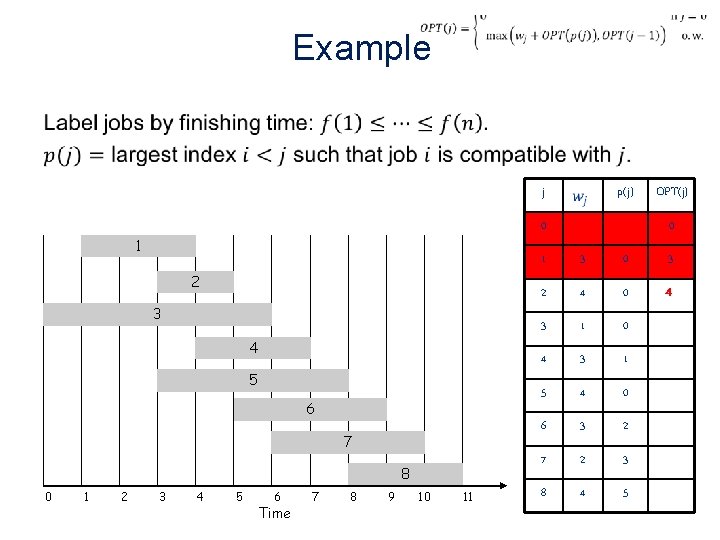
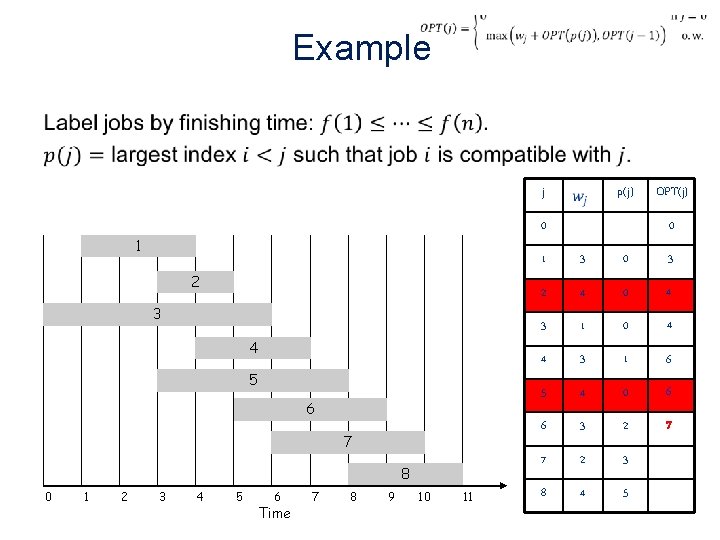
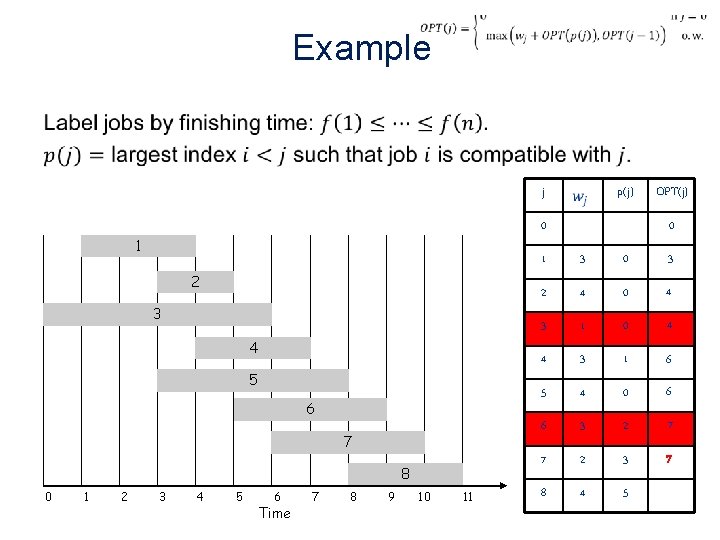
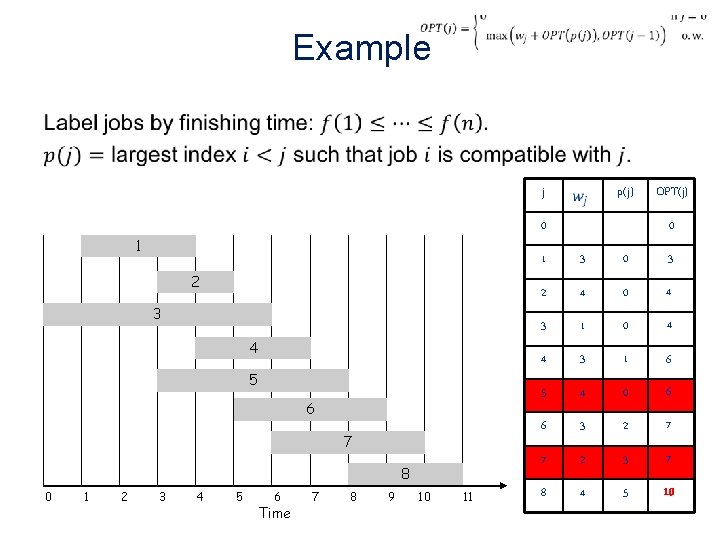
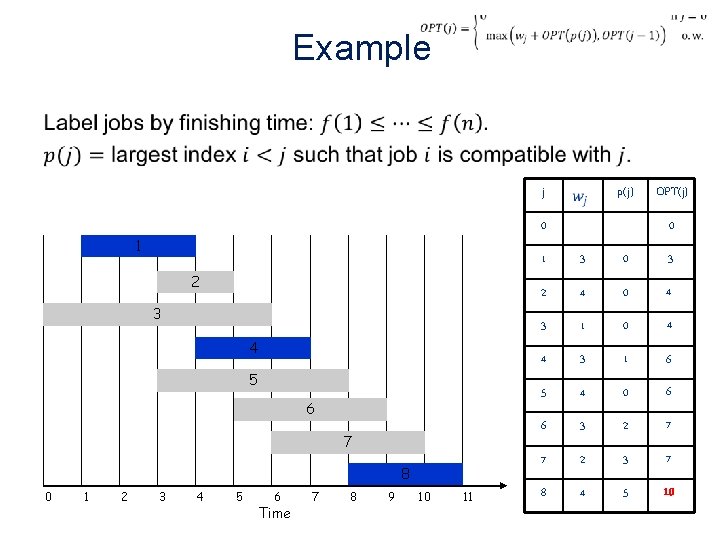
Example • j 0 1 2 3 4 5 6 7 8 0 1 2 p(j) 3 4 5 6 Time 7 8 9 10 11 OPT(j) 0 1 3 0 2 4 0 3 1 0 4 3 1 5 4 0 6 3 2 7 2 3 8 4 5
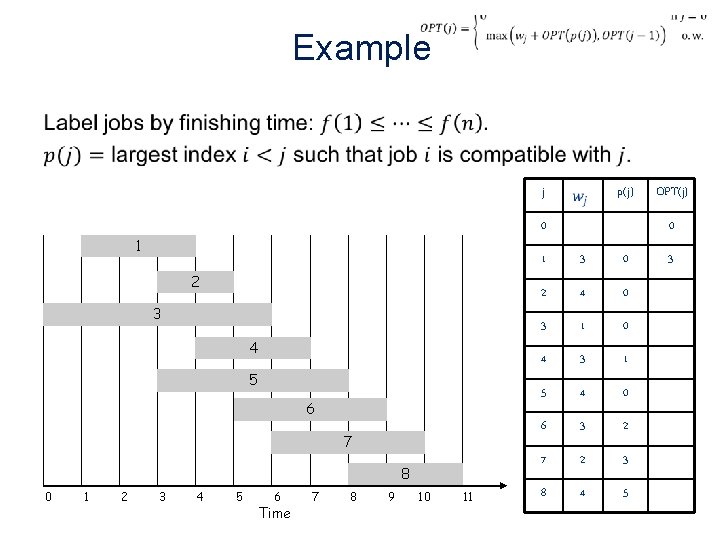
Example • j 0 1 2 3 4 5 6 7 8 0 1 2 p(j) 3 4 5 6 Time 7 8 9 10 11 OPT(j) 0 1 3 0 2 4 0 3 1 0 4 3 1 5 4 0 6 3 2 7 2 3 8 4 5 3
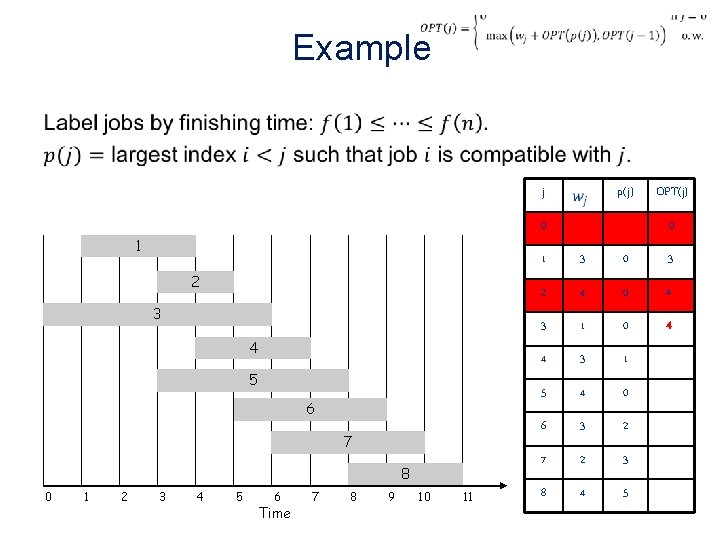
Example • j 0 1 2 3 4 5 6 7 8 0 1 2 p(j) 3 4 5 6 Time 7 8 9 10 11 OPT(j) 0 1 3 0 3 2 4 0 4 3 1 5 4 0 6 3 2 7 2 3 8 4 5
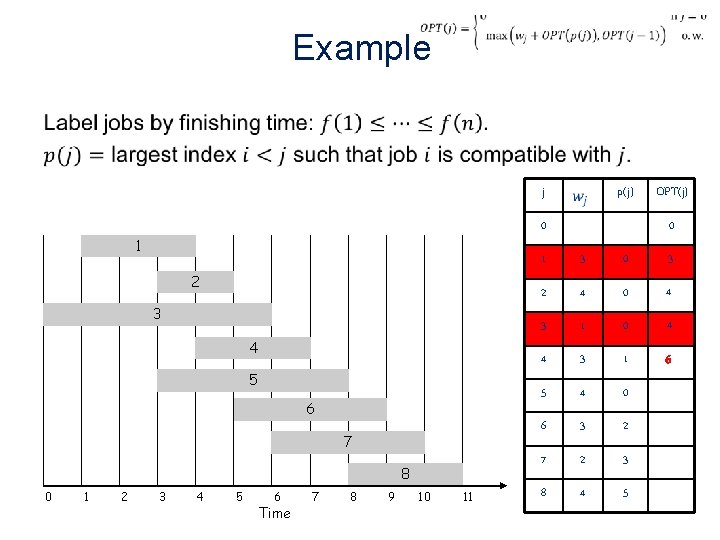
Example • j 0 1 2 3 4 5 6 7 8 0 1 2 p(j) 3 4 5 6 Time 7 8 9 10 11 OPT(j) 0 1 3 0 3 2 4 0 4 3 1 0 4 4 3 1 5 4 0 6 3 2 7 2 3 8 4 5
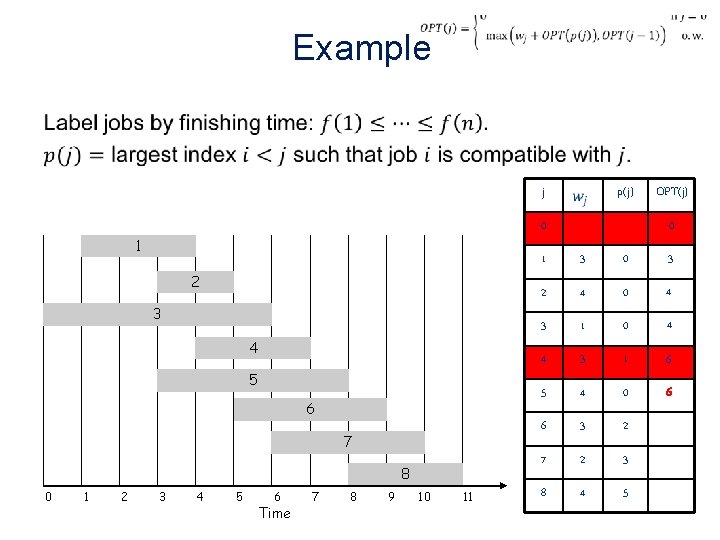
Example • j 0 1 2 3 4 5 6 7 8 0 1 2 p(j) 3 4 5 6 Time 7 8 9 10 11 OPT(j) 0 1 3 0 3 2 4 0 4 3 1 0 4 4 3 1 6 5 4 0 6 3 2 7 2 3 8 4 5
Example • j 0 1 2 3 4 5 6 7 8 0 1 2 p(j) 3 4 5 6 Time 7 8 9 10 11 OPT(j) 0 1 3 0 3 2 4 0 4 3 1 0 4 4 3 1 6 5 4 0 6 6 3 2 7 2 3 8 4 5
Example • j 0 1 2 3 4 5 6 7 8 0 1 2 p(j) 3 4 5 6 Time 7 8 9 10 11 OPT(j) 0 1 3 0 3 2 4 0 4 3 1 0 4 4 3 1 6 5 4 0 6 6 3 2 7 7 2 3 8 4 5
Example • j 0 1 2 3 4 5 6 7 8 0 1 2 p(j) 3 4 5 6 Time 7 8 9 10 11 OPT(j) 0 1 3 0 3 2 4 0 4 3 1 0 4 4 3 1 6 5 4 0 6 6 3 2 77 7 2 3 7 8 4 5
Example • j 0 1 2 3 4 5 6 7 8 0 1 2 p(j) 3 4 5 6 Time 7 8 9 10 11 OPT(j) 0 1 3 0 3 2 4 0 4 3 1 0 4 4 3 1 6 5 4 0 6 6 3 2 7 7 2 3 7 8 4 5 10
Example • j 0 1 2 3 4 5 6 7 8 0 1 2 p(j) 3 4 5 6 Time 7 8 9 10 11 OPT(j) 0 1 3 0 3 2 4 0 4 3 1 0 4 4 3 1 6 5 4 0 6 6 3 2 7 7 2 3 7 8 4 5 10
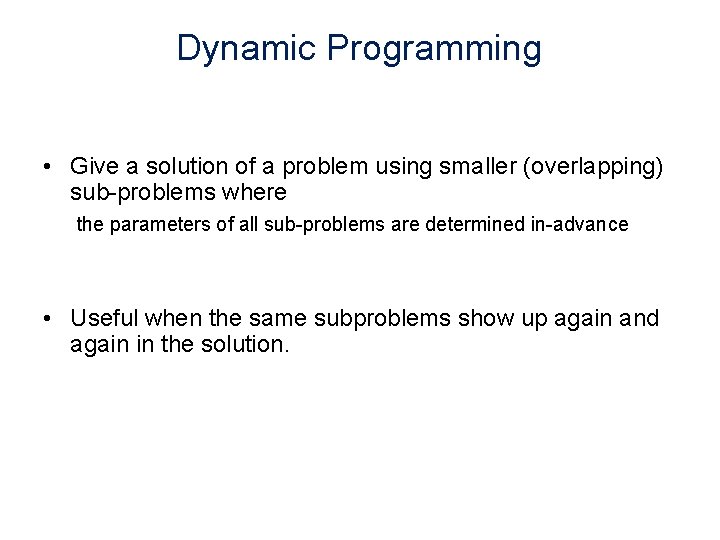
Dynamic Programming • Give a solution of a problem using smaller (overlapping) sub-problems where the parameters of all sub-problems are determined in-advance • Useful when the same subproblems show up again and again in the solution.
Knapsack Problem
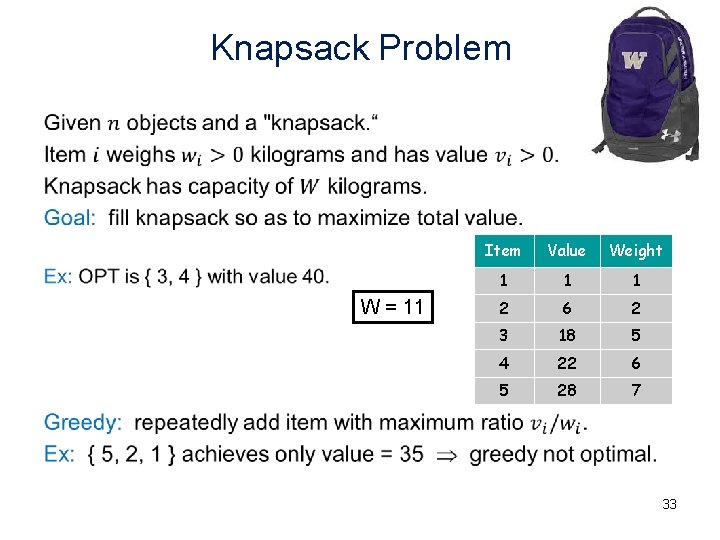
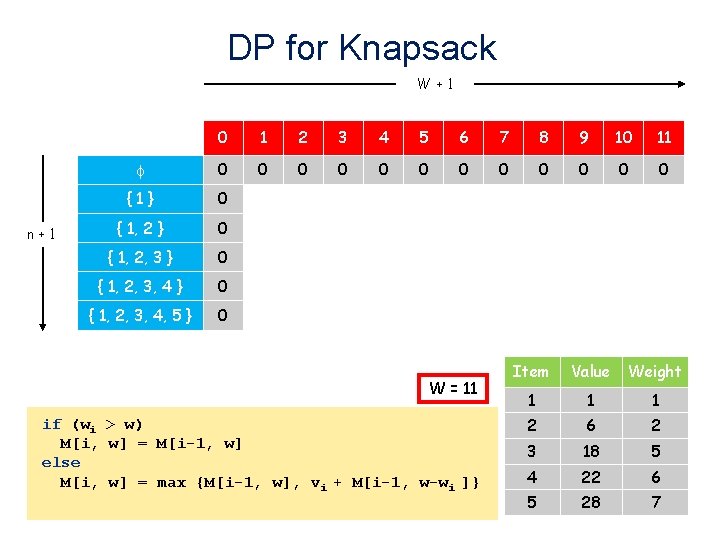
Knapsack Problem • W = 11 Item Value Weight 1 1 1 2 6 2 3 18 5 4 22 6 5 28 7 33
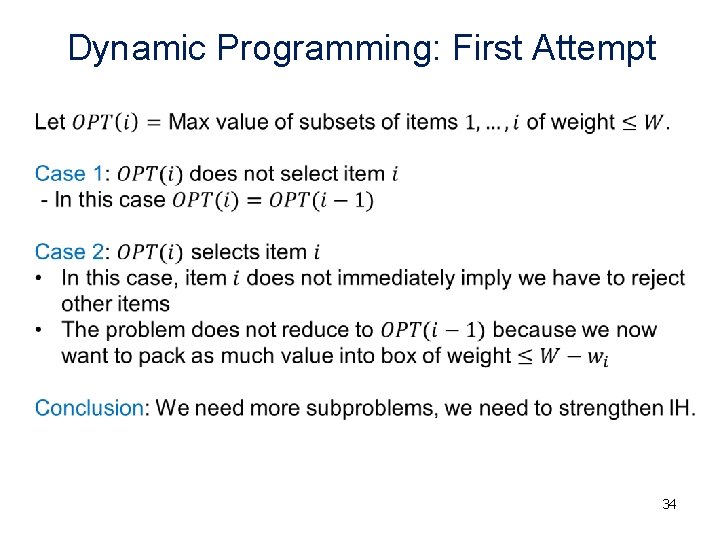
Dynamic Programming: First Attempt • 34
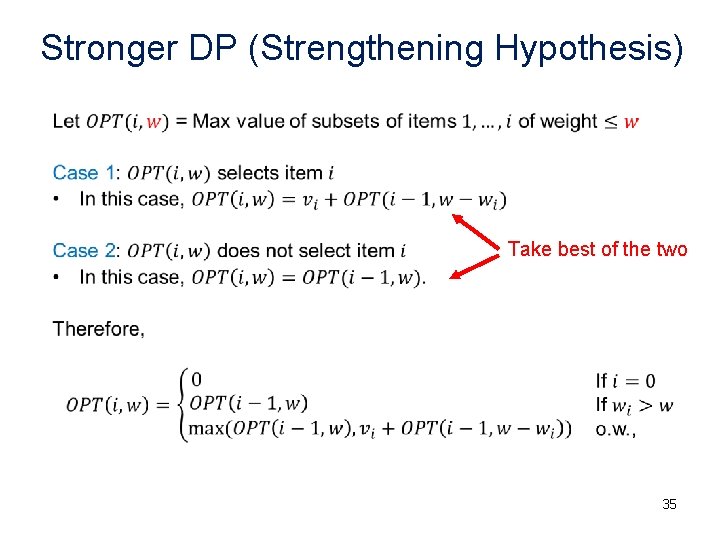
Stronger DP (Strengthening Hypothesis) • Take best of the two 35
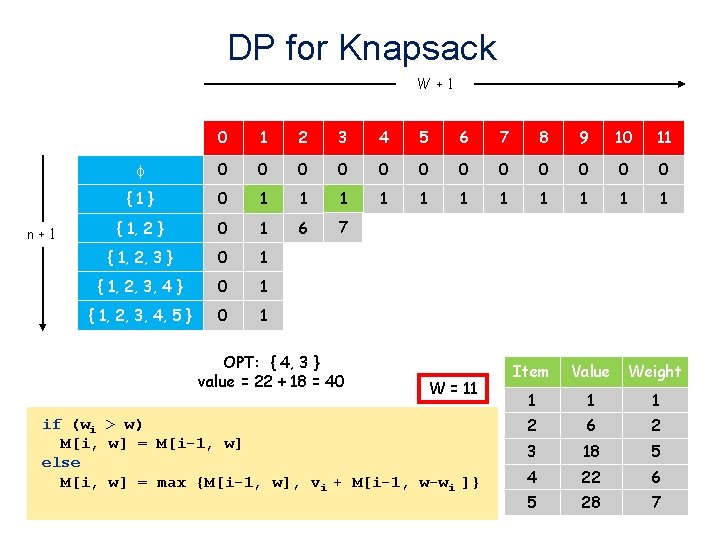
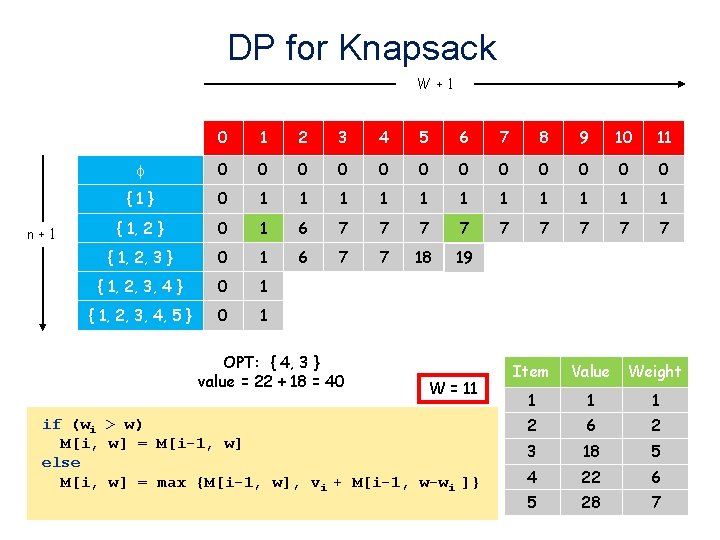
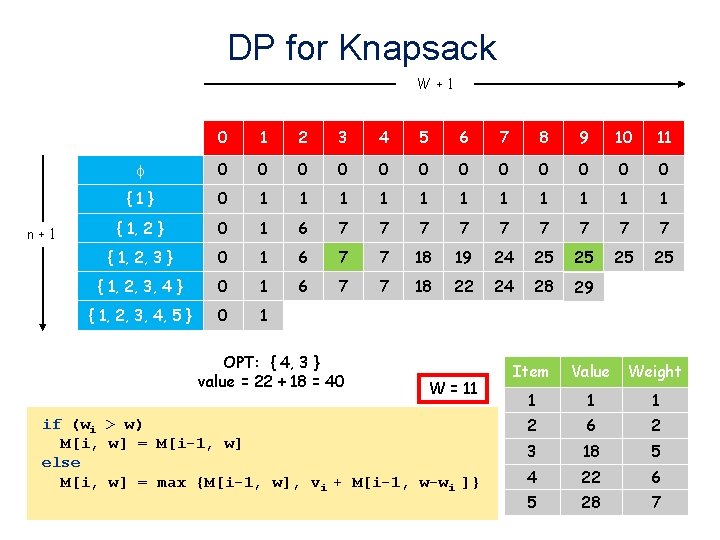
DP for Knapsack Compute-OPT(i, w) if M[i, w] == empty if (i==0) recursive M[i, w]=0 else if (wi > w) M[i, w]=Comp-OPT(i-1, w) else M[i, w]= max {Comp-OPT(i-1, w), vi + Comp-OPT(i-1, w-wi)} return M[i, w] for w = 0 to W M[0, w] = 0 for i = 1 to n Non-recursive for w = 1 to W if (wi > w) M[i, w] = M[i-1, w] else M[i, w] = max {M[i-1, w], vi + M[i-1, w-wi ]} return M[n, W] 36
DP for Knapsack W+1 n+1 0 1 2 3 4 5 6 7 8 9 10 11 0 0 0 {1} 0 { 1, 2, 3, 4 } 0 { 1, 2, 3, 4, 5 } 0 W = 11 if (wi > w) M[i, w] = M[i-1, w] else M[i, w] = max {M[i-1, w], vi + M[i-1, w-wi ]} Item Value Weight 1 1 1 2 6 2 3 18 5 4 22 6 5 28 7 37
DP for Knapsack W+1 n+1 0 1 2 3 4 5 6 7 8 9 10 11 0 0 0 {1} 0 1 1 1 { 1, 2 } 0 { 1, 2, 3, 4, 5 } 0 W = 11 if (wi > w) M[i, w] = M[i-1, w] else M[i, w] = max {M[i-1, w], vi + M[i-1, w-wi ]} Item Value Weight 1 1 1 2 6 2 3 18 5 4 22 6 5 28 7 38
DP for Knapsack W+1 n+1 0 1 2 3 4 5 6 7 8 9 10 11 0 0 0 {1} 0 1 1 1 { 1, 2 } 0 1 6 7 { 1, 2, 3 } 0 1 { 1, 2, 3, 4, 5 } 0 1 OPT: { 4, 3 } value = 22 + 18 = 40 W = 11 if (wi > w) M[i, w] = M[i-1, w] else M[i, w] = max {M[i-1, w], vi + M[i-1, w-wi ]} Item Value Weight 1 1 1 2 6 2 3 18 5 4 22 6 5 28 7 39
DP for Knapsack W+1 n+1 0 1 2 3 4 5 6 7 8 9 10 11 0 0 0 {1} 0 1 1 1 { 1, 2 } 0 1 6 7 7 7 7 7 { 1, 2, 3 } 0 1 6 7 7 18 19 { 1, 2, 3, 4 } 0 1 { 1, 2, 3, 4, 5 } 0 1 OPT: { 4, 3 } value = 22 + 18 = 40 W = 11 if (wi > w) M[i, w] = M[i-1, w] else M[i, w] = max {M[i-1, w], vi + M[i-1, w-wi ]} Item Value Weight 1 1 1 2 6 2 3 18 5 4 22 6 5 28 7 40
DP for Knapsack W+1 n+1 0 1 2 3 4 5 6 7 8 9 10 11 0 0 0 {1} 0 1 1 1 { 1, 2 } 0 1 6 7 7 7 7 7 { 1, 2, 3 } 0 1 6 7 7 18 19 24 25 25 { 1, 2, 3, 4 } 0 1 6 7 7 18 22 24 28 29 { 1, 2, 3, 4, 5 } 0 1 OPT: { 4, 3 } value = 22 + 18 = 40 W = 11 if (wi > w) M[i, w] = M[i-1, w] else M[i, w] = max {M[i-1, w], vi + M[i-1, w-wi ]} Item Value Weight 1 1 1 2 6 2 3 18 5 4 22 6 5 28 7 41
DP for Knapsack W+1 n+1 0 1 2 3 4 5 6 7 8 9 10 11 0 0 0 {1} 0 1 1 1 { 1, 2 } 0 1 6 7 7 7 7 7 { 1, 2, 3 } 0 1 6 7 7 18 19 24 25 25 { 1, 2, 3, 4 } 0 1 6 7 7 18 22 24 28 29 29 40 { 1, 2, 3, 4, 5 } 0 1 6 7 7 18 22 28 29 34 34 40 OPT: { 4, 3 } value = 22 + 18 = 40 W = 11 if (wi > w) M[i, w] = M[i-1, w] else M[i, w] = max {M[i-1, w], vi + M[i-1, w-wi ]} Item Value Weight 1 1 1 2 6 2 3 18 5 4 22 6 5 28 7 42
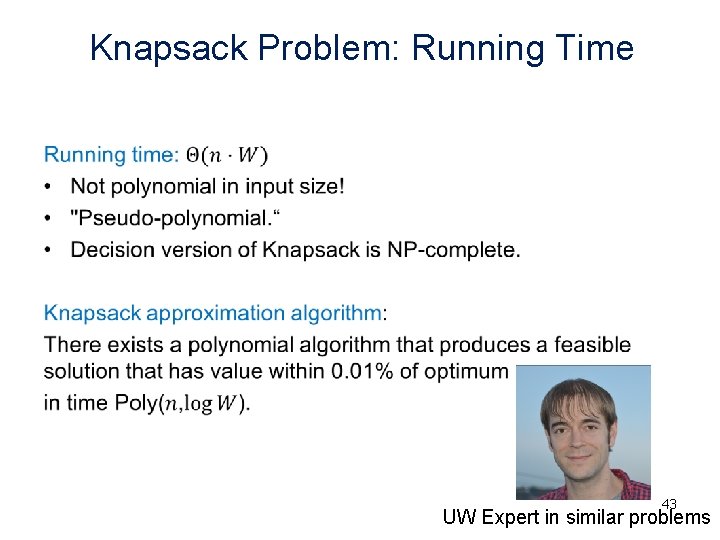
Knapsack Problem: Running Time • 43 UW Expert in similar problems
DP Ideas so far • You may have to define an ordering to decrease #subproblems • You may have to strengthen DP, equivalently the induction, i. e. , you have may have to carry more information to find the Optimum. • This means that sometimes we may have to use two dimensional or three dimensional induction 44