
CSE 421 Algorithms Richard Anderson Winter 2019 Lecture


- Slides: 25
CSE 421 Algorithms Richard Anderson Winter 2019 Lecture 2
Announcements • Homework due Wednesdays – HW 1, Due January 16 – It’s on the web – Submit solutions on canvas – pay attention to making explanations clear and understandable • Instructor Office hours (CSE 582): – Monday 2: 30 -3: 20, Wednesday 2: 30 -3: 20 • TA Office hours: – TBD
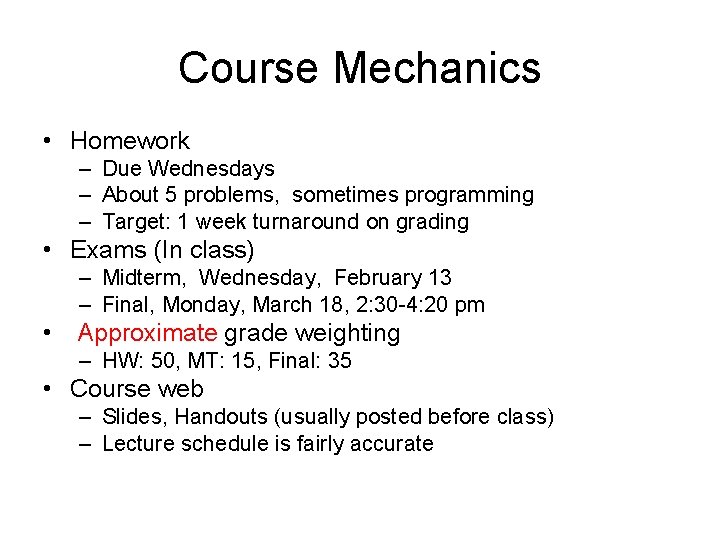
Course Mechanics • Homework – Due Wednesdays – About 5 problems, sometimes programming – Target: 1 week turnaround on grading • Exams (In class) – Midterm, Wednesday, February 13 – Final, Monday, March 18, 2: 30 -4: 20 pm • Approximate grade weighting – HW: 50, MT: 15, Final: 35 • Course web – Slides, Handouts (usually posted before class) – Lecture schedule is fairly accurate
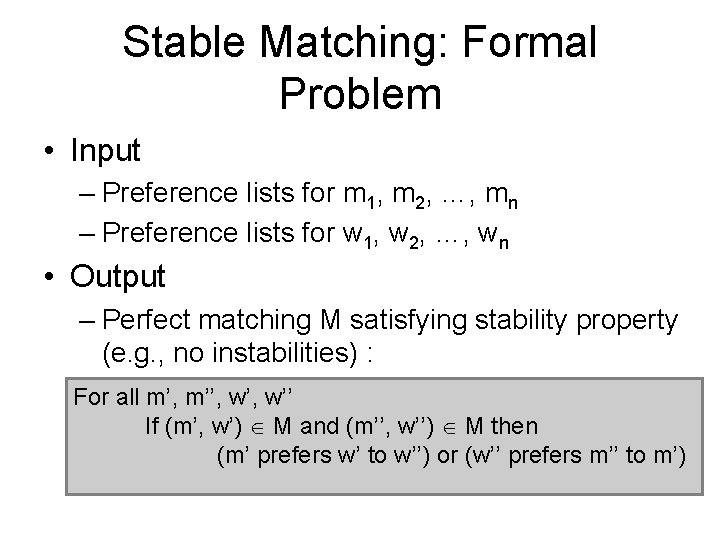
Stable Matching: Formal Problem • Input – Preference lists for m 1, m 2, …, mn – Preference lists for w 1, w 2, …, wn • Output – Perfect matching M satisfying stability property (e. g. , no instabilities) : For all m’, m’’, w’’ If (m’, w’) M and (m’’, w’’) M then (m’ prefers w’ to w’’) or (w’’ prefers m’’ to m’)
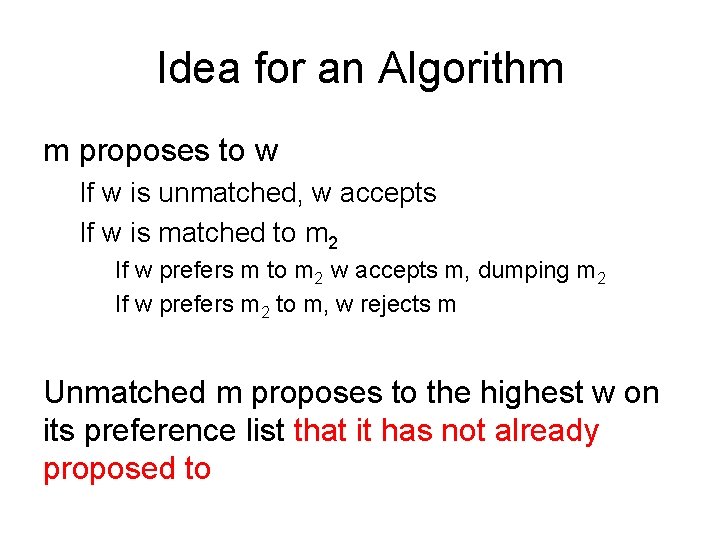
Idea for an Algorithm m proposes to w If w is unmatched, w accepts If w is matched to m 2 If w prefers m to m 2 w accepts m, dumping m 2 If w prefers m 2 to m, w rejects m Unmatched m proposes to the highest w on its preference list that it has not already proposed to
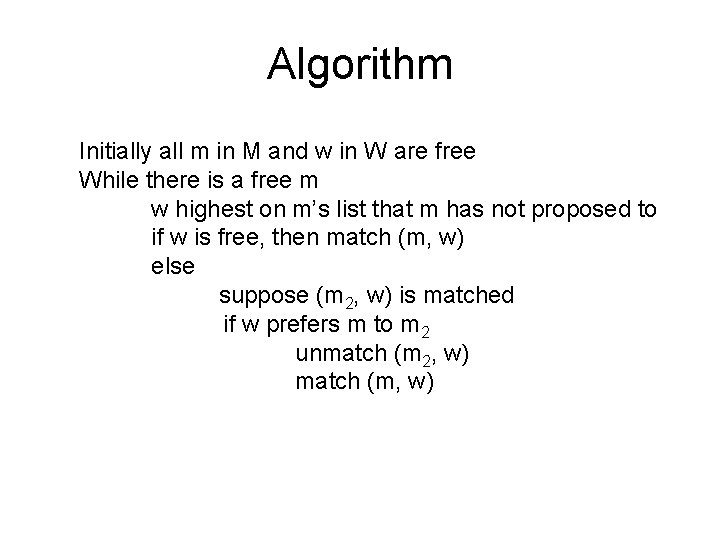
Algorithm Initially all m in M and w in W are free While there is a free m w highest on m’s list that m has not proposed to if w is free, then match (m, w) else suppose (m 2, w) is matched if w prefers m to m 2 unmatch (m 2, w) match (m, w)
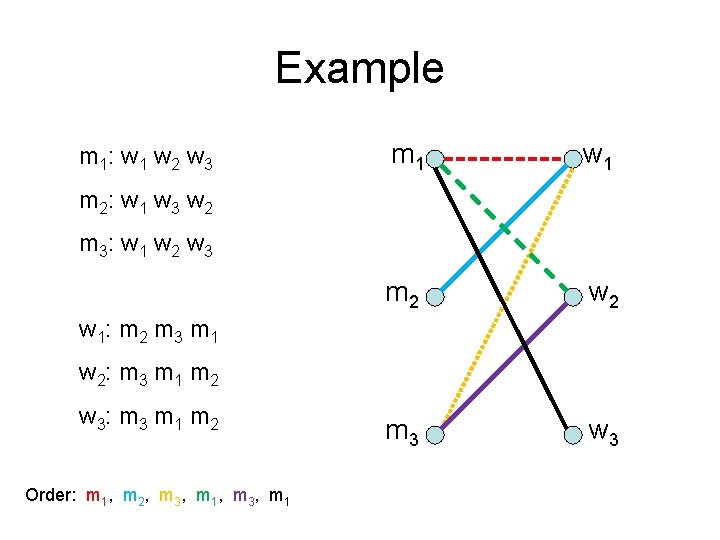
Example m 1 : w 1 w 2 w 3 m 1 w 1 m 2 w 2 m 3 w 3 m 2 : w 1 w 3 w 2 m 3 : w 1 w 2 w 3 w 1: m 2 m 3 m 1 w 2: m 3 m 1 m 2 w 3: m 3 m 1 m 2 Order: m 1, m 2, m 3, m 1
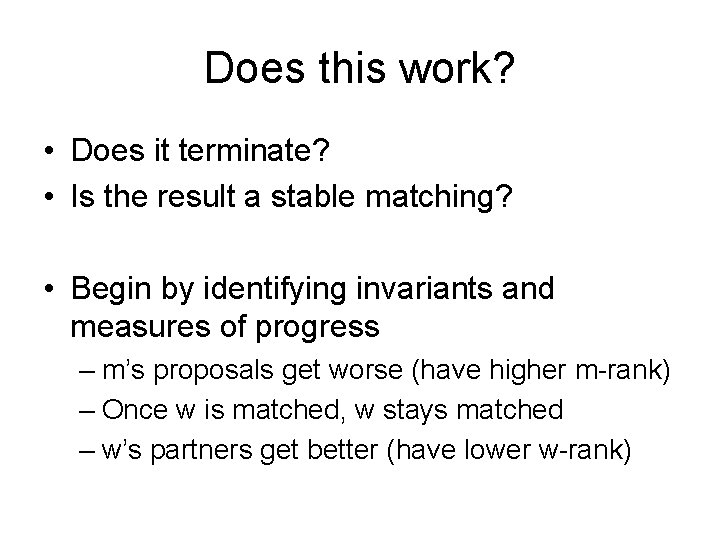
Does this work? • Does it terminate? • Is the result a stable matching? • Begin by identifying invariants and measures of progress – m’s proposals get worse (have higher m-rank) – Once w is matched, w stays matched – w’s partners get better (have lower w-rank)
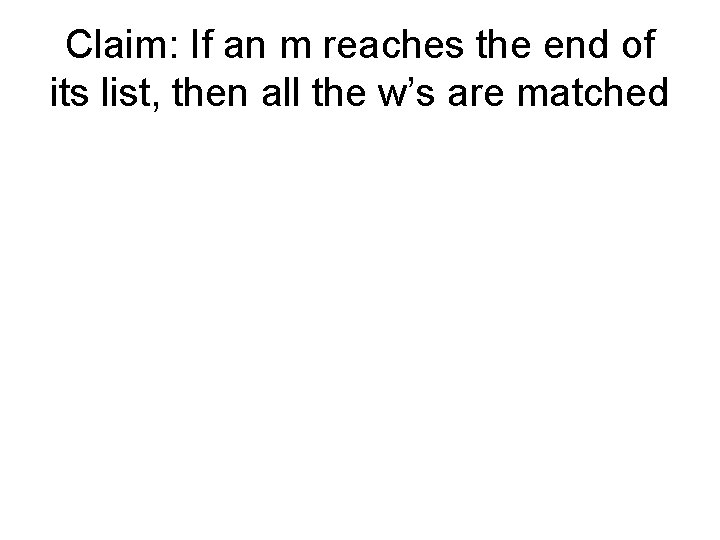
Claim: If an m reaches the end of its list, then all the w’s are matched
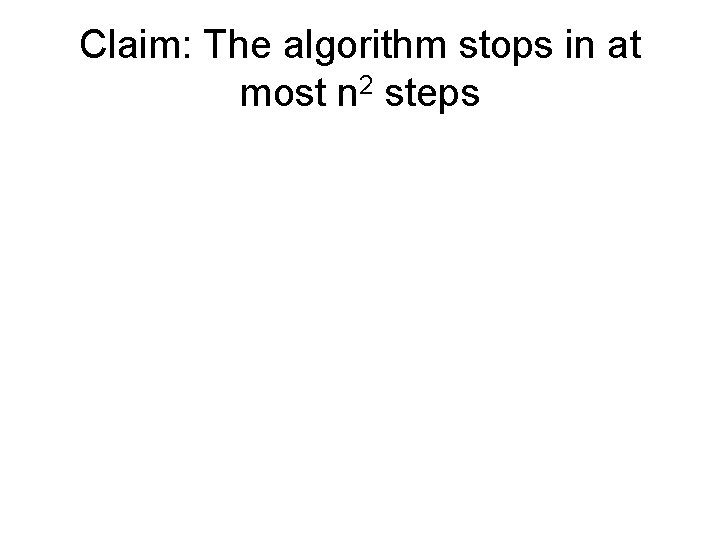
Claim: The algorithm stops in at most n 2 steps
When the algorithms halts, every w is matched Hence, the algorithm finds a perfect matching
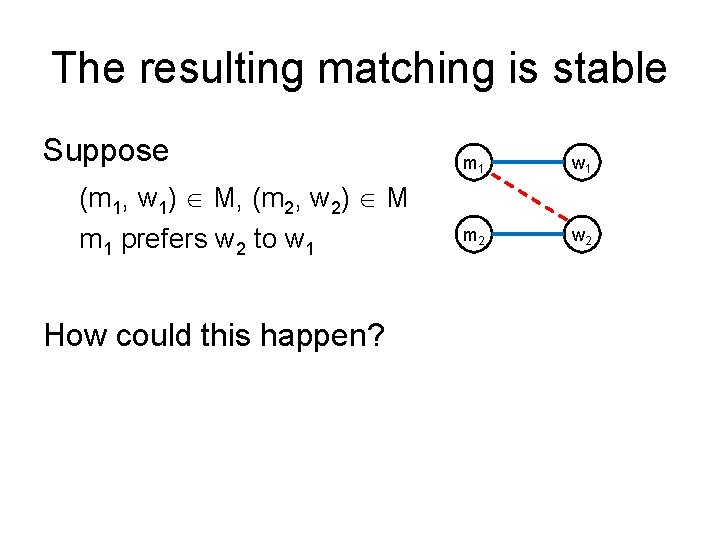
The resulting matching is stable Suppose (m 1, w 1) M, (m 2, w 2) M m 1 prefers w 2 to w 1 How could this happen? m 1 w 1 m 2 w 2
Result • Simple, O(n 2) algorithm to compute a stable matching • Corollary – A stable matching always exists
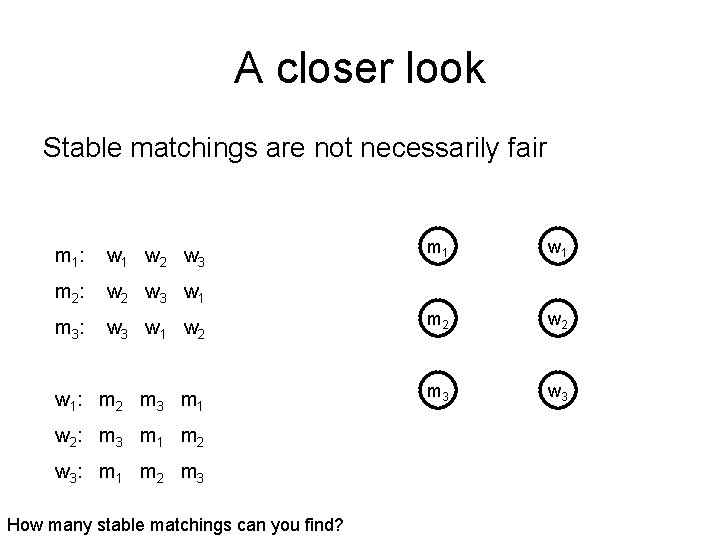
A closer look Stable matchings are not necessarily fair m 1 w 3 w 1 w 2 m 2 w 1 : m 2 m 3 m 1 m 3 w 3 m 1 : w 1 w 2 w 3 m 2 : w 2 w 3 w 1 m 3 : w 2 : m 3 m 1 m 2 w 3 : m 1 m 2 m 3 How many stable matchings can you find?
Algorithm under specified • Many different ways of picking m’s to propose • Surprising result – All orderings of picking free m’s give the same result • Proving this type of result – Reordering argument – Prove algorithm is computing something mores specific • Show property of the solution – so it computes a specific stable matching
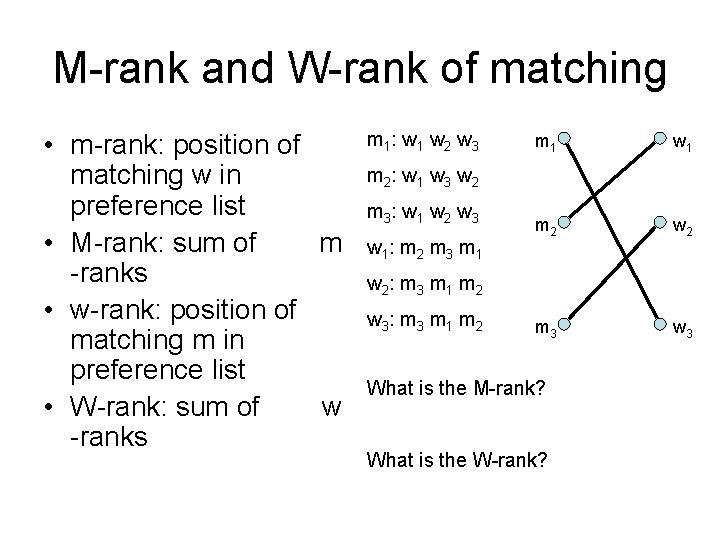
M-rank and W-rank of matching • m-rank: position of matching w in preference list • M-rank: sum of m -ranks • w-rank: position of matching m in preference list • W-rank: sum of w -ranks m 1 : w 1 w 2 w 3 m 1 w 1 m 2 w 2 m 3 w 3 m 2 : w 1 w 3 w 2 m 3 : w 1 w 2 w 3 w 1 : m 2 m 3 m 1 w 2 : m 3 m 1 m 2 w 3 : m 3 m 1 m 2 What is the M-rank? What is the W-rank?
Suppose there are n m’s, and n w’s • What is the minimum possible M-rank? • What is the maximum possible M-rank? • Suppose each m is matched with a random w, what is the expected M-rank?
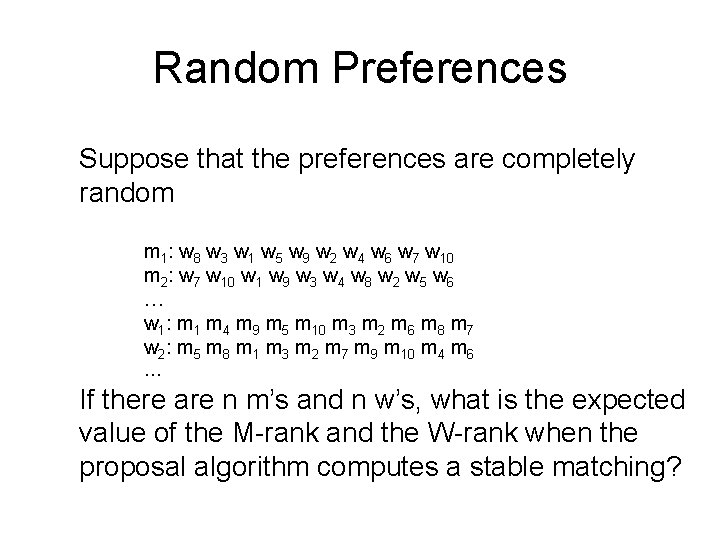
Random Preferences Suppose that the preferences are completely random m 1: w 8 w 3 w 1 w 5 w 9 w 2 w 4 w 6 w 7 w 10 m 2: w 7 w 10 w 1 w 9 w 3 w 4 w 8 w 2 w 5 w 6 … w 1: m 1 m 4 m 9 m 5 m 10 m 3 m 2 m 6 m 8 m 7 w 2: m 5 m 8 m 1 m 3 m 2 m 7 m 9 m 10 m 4 m 6 … If there are n m’s and n w’s, what is the expected value of the M-rank and the W-rank when the proposal algorithm computes a stable matching?
Stable Matching Algorithms • M Proposal Algorithm – Iterate over all m’s until all are matched • W Proposal Algorithm – Change the role of m’s and w’s – Iterate over all w’s until all are matched
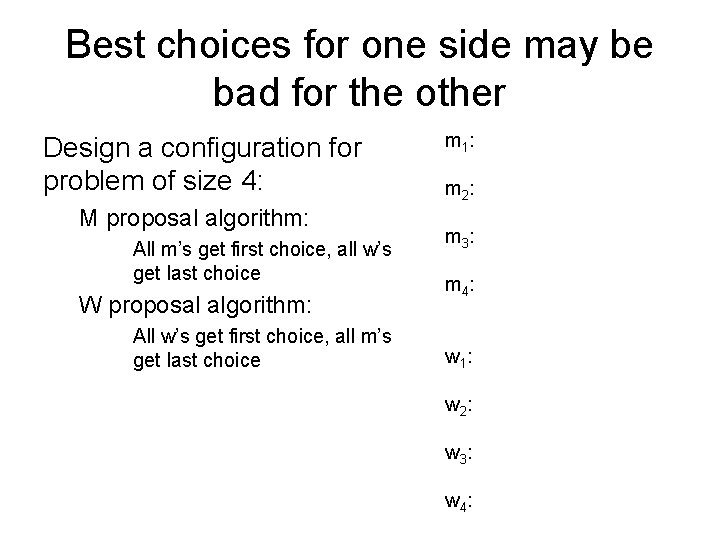
Best choices for one side may be bad for the other Design a configuration for problem of size 4: M proposal algorithm: All m’s get first choice, all w’s get last choice W proposal algorithm: All w’s get first choice, all m’s get last choice m 1 : m 2 : m 3 : m 4 : w 1 : w 2 : w 3 : w 4 :
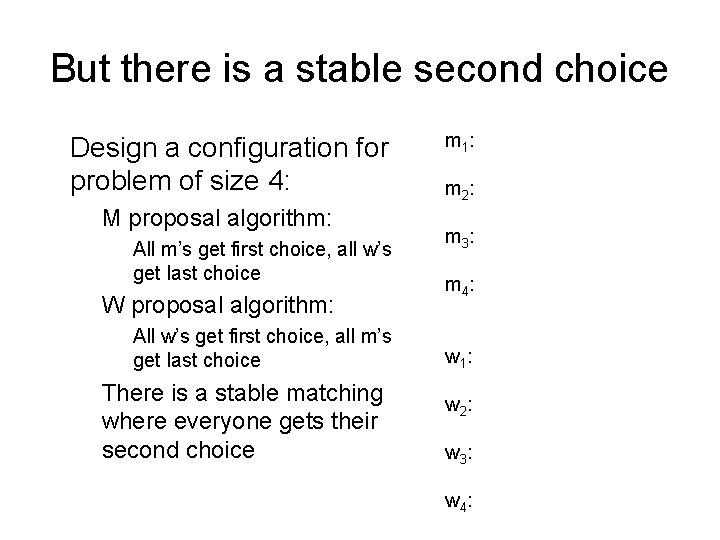
But there is a stable second choice Design a configuration for problem of size 4: M proposal algorithm: All m’s get first choice, all w’s get last choice W proposal algorithm: All w’s get first choice, all m’s get last choice There is a stable matching where everyone gets their second choice m 1 : m 2 : m 3 : m 4 : w 1 : w 2 : w 3 : w 4 :
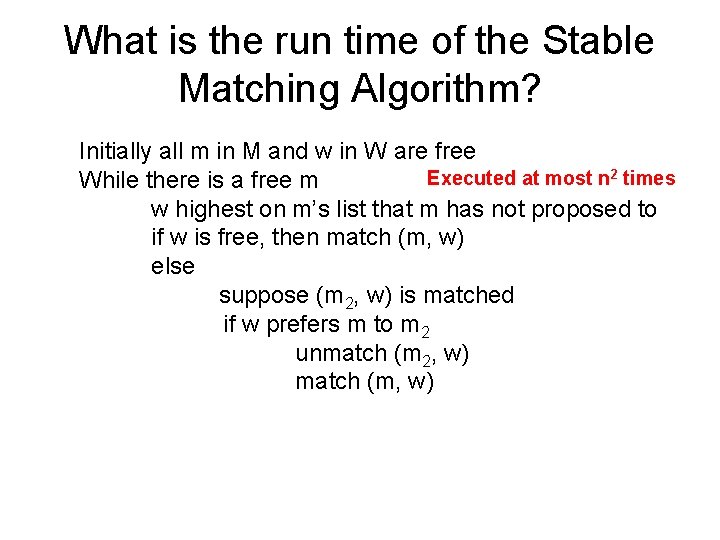
What is the run time of the Stable Matching Algorithm? Initially all m in M and w in W are free Executed at most n 2 times While there is a free m w highest on m’s list that m has not proposed to if w is free, then match (m, w) else suppose (m 2, w) is matched if w prefers m to m 2 unmatch (m 2, w) match (m, w)
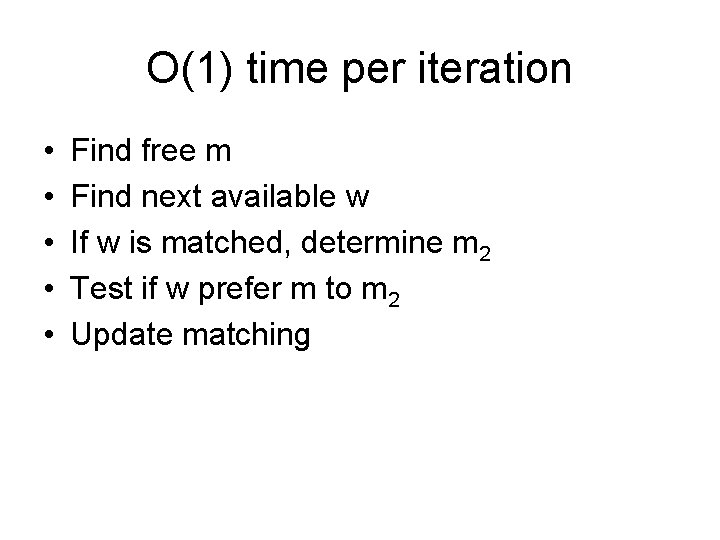
O(1) time per iteration • • • Find free m Find next available w If w is matched, determine m 2 Test if w prefer m to m 2 Update matching
What does it mean for an algorithm to be efficient?
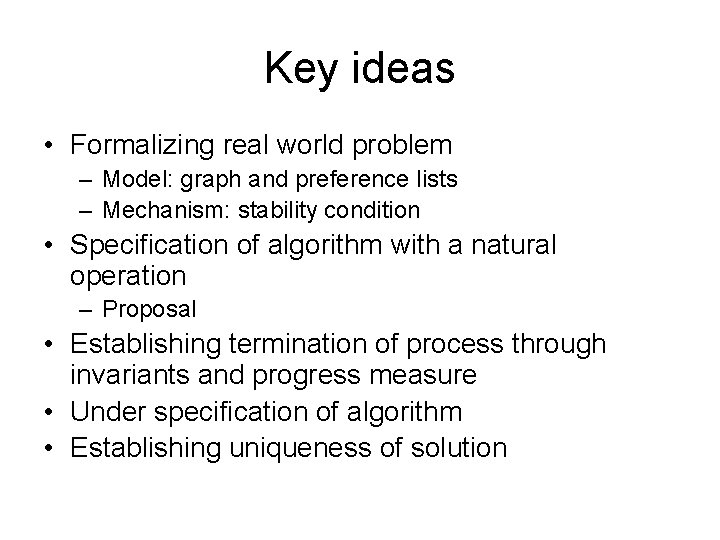
Key ideas • Formalizing real world problem – Model: graph and preference lists – Mechanism: stability condition • Specification of algorithm with a natural operation – Proposal • Establishing termination of process through invariants and progress measure • Under specification of algorithm • Establishing uniqueness of solution