
CSE 417 Algorithms Lecture 16 Winter 2020 Inversions
- Slides: 26
CSE 417 Algorithms Lecture 16, Winter 2020 Inversions and 2 -d Closest Pair
Announcements • Exams will be returned at end of class
Divide and Conquer Algorithms • • • Mergesort, Quicksort Strassen’s Algorithm Median Inversion counting Closest Pair Algorithm (2 d) Integer Multiplication (Karatsuba’s Algorithm)
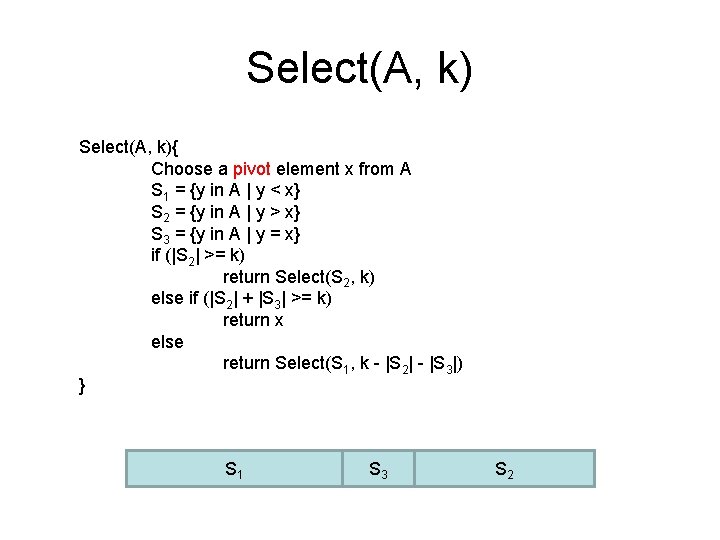
Select the k-th largest from an array • Selection, given n numbers and an integer k, find the k-th largest • Median is a special case • The standard approach is to use a quicksort like algorithm – But with one recursive problem • The difficulty is ensuring a good split – Worst case O(n 2) time
Select(A, k){ Choose a pivot element x from A S 1 = {y in A | y < x} S 2 = {y in A | y > x} S 3 = {y in A | y = x} if (|S 2| >= k) return Select(S 2, k) else if (|S 2| + |S 3| >= k) return x else return Select(S 1, k - |S 2| - |S 3|) } S 1 S 3 S 2
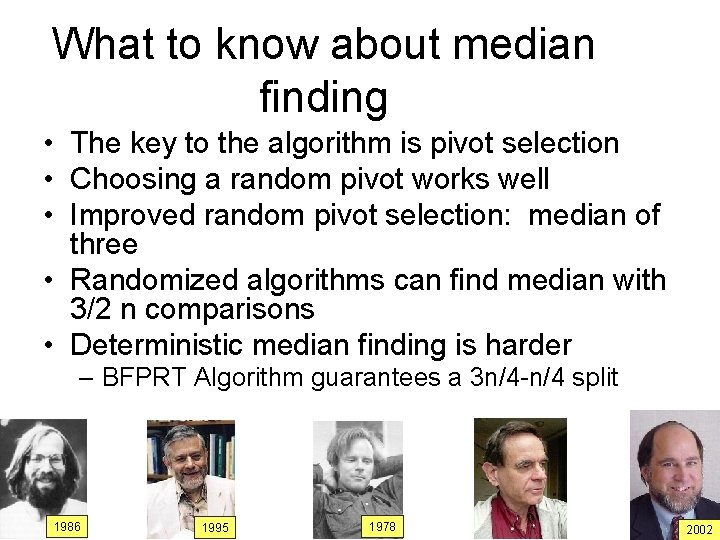
What to know about median finding • The key to the algorithm is pivot selection • Choosing a random pivot works well • Improved random pivot selection: median of three • Randomized algorithms can find median with 3/2 n comparisons • Deterministic median finding is harder – BFPRT Algorithm guarantees a 3 n/4 -n/4 split 1986 1995 1978 2002
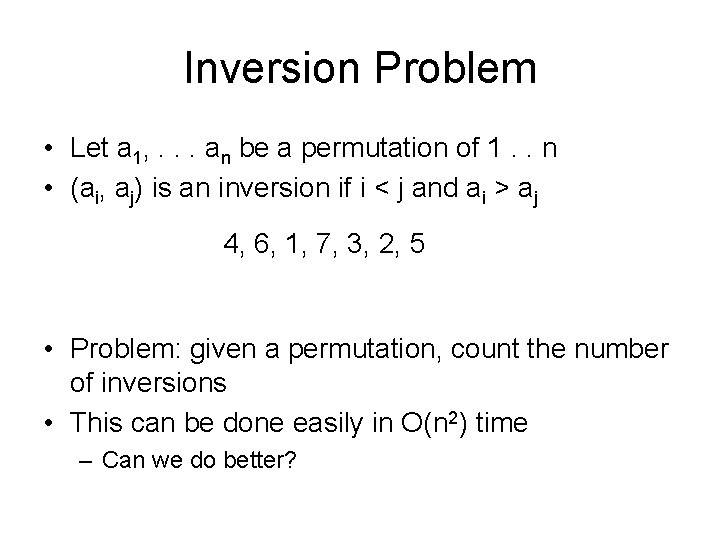
Inversion Problem • Let a 1, . . . an be a permutation of 1. . n • (ai, aj) is an inversion if i < j and ai > aj 4, 6, 1, 7, 3, 2, 5 • Problem: given a permutation, count the number of inversions • This can be done easily in O(n 2) time – Can we do better?
Application • Counting inversions can be use to measure how close ranked preferences are – People rank 20 movies, based on their rankings you cluster people who like that same type of movie
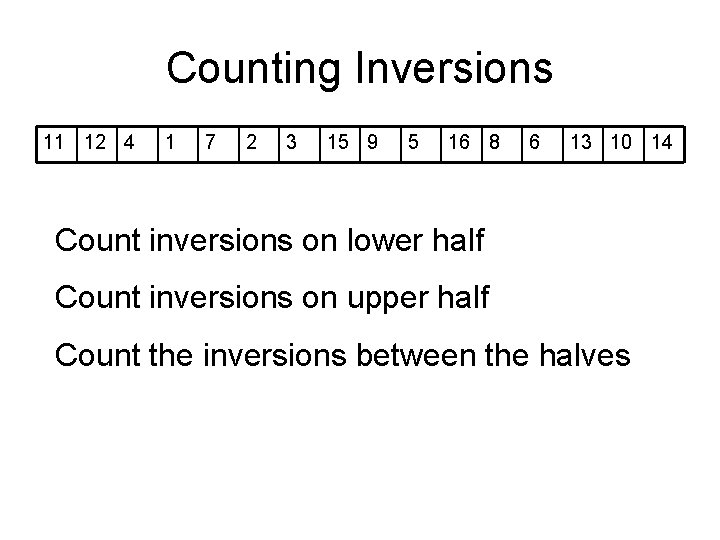
Counting Inversions 11 12 4 1 7 2 3 15 9 5 16 8 6 13 10 14 Count inversions on lower half Count inversions on upper half Count the inversions between the halves
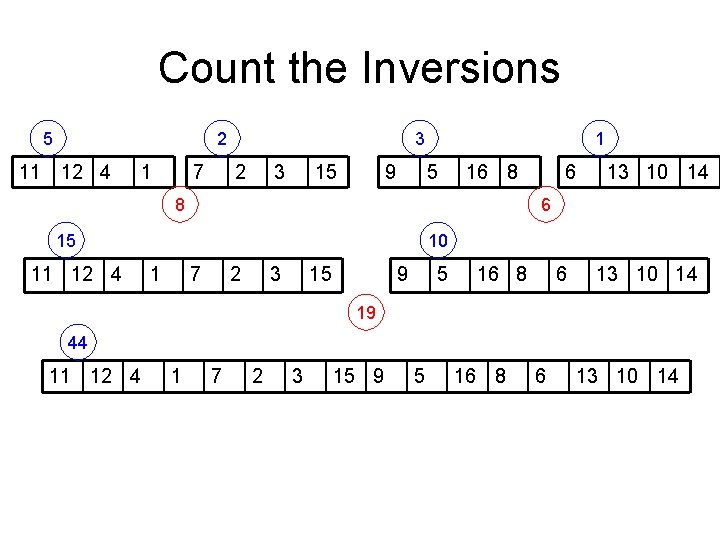
Count the Inversions 5 2 11 12 4 1 7 3 2 3 15 9 1 5 16 8 8 13 10 14 6 15 11 12 4 6 10 1 7 2 3 15 9 5 16 8 6 13 10 14 19 44 11 12 4 1 7 2 3 15 9 5 16 8 6 13 10 14
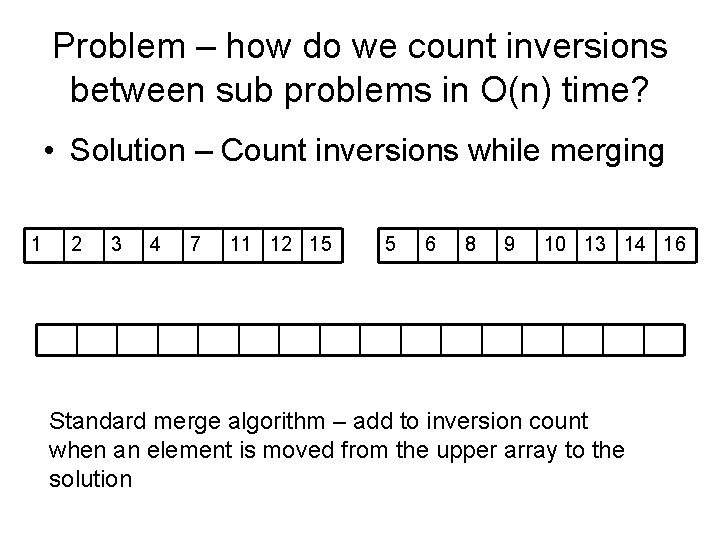
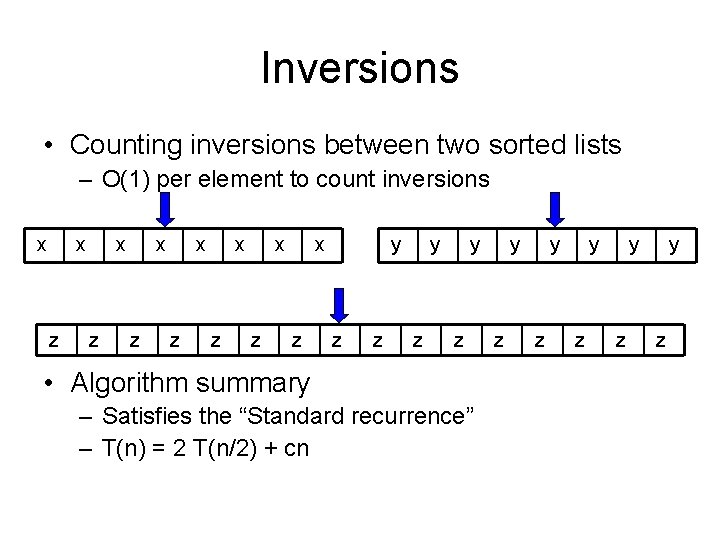
Problem – how do we count inversions between sub problems in O(n) time? • Solution – Count inversions while merging 1 2 3 4 7 11 12 15 5 6 8 9 10 13 14 16 Standard merge algorithm – add to inversion count when an element is moved from the upper array to the solution
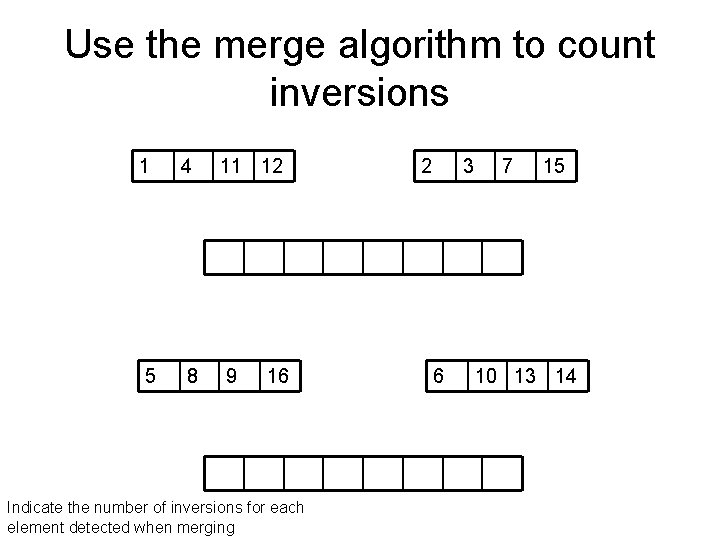
Use the merge algorithm to count inversions 1 4 11 12 5 8 9 16 Indicate the number of inversions for each element detected when merging 2 3 6 7 15 10 13 14
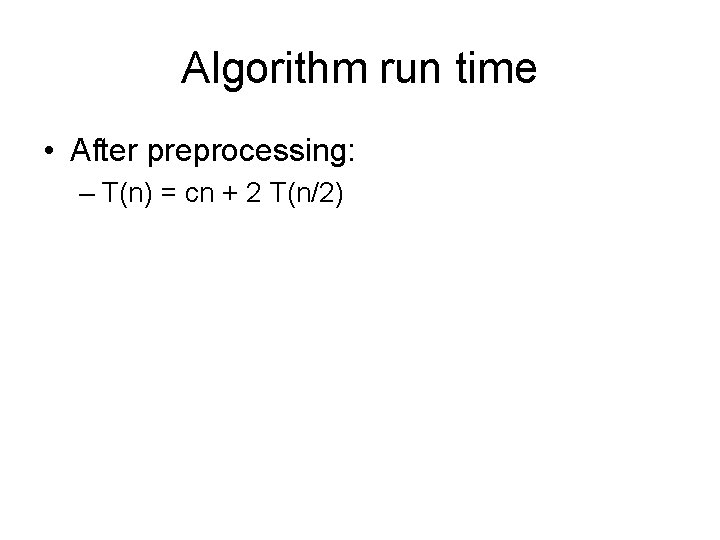
Inversions • Counting inversions between two sorted lists – O(1) per element to count inversions x x z x z y z y z • Algorithm summary – Satisfies the “Standard recurrence” – T(n) = 2 T(n/2) + cn y z y z y z
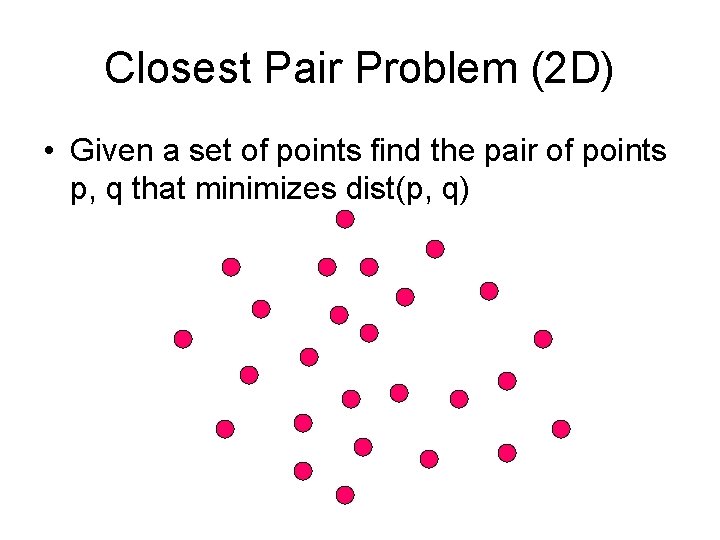
Closest Pair Problem (2 D) • Given a set of points find the pair of points p, q that minimizes dist(p, q)
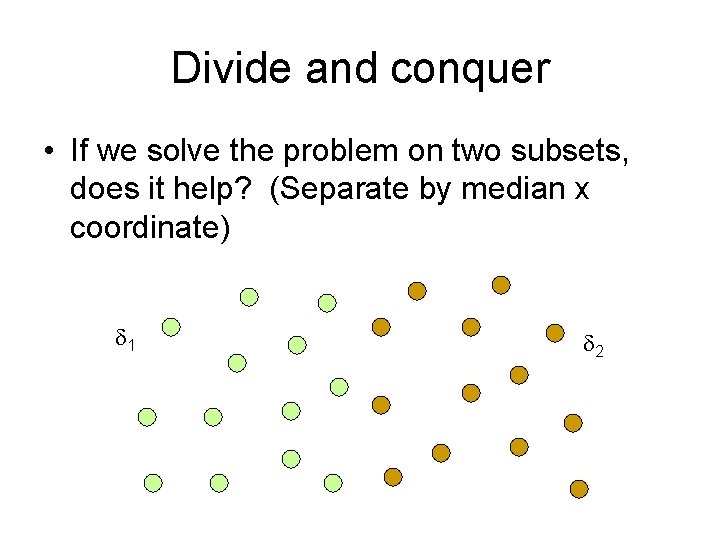
Divide and conquer • If we solve the problem on two subsets, does it help? (Separate by median x coordinate) d 1 d 2
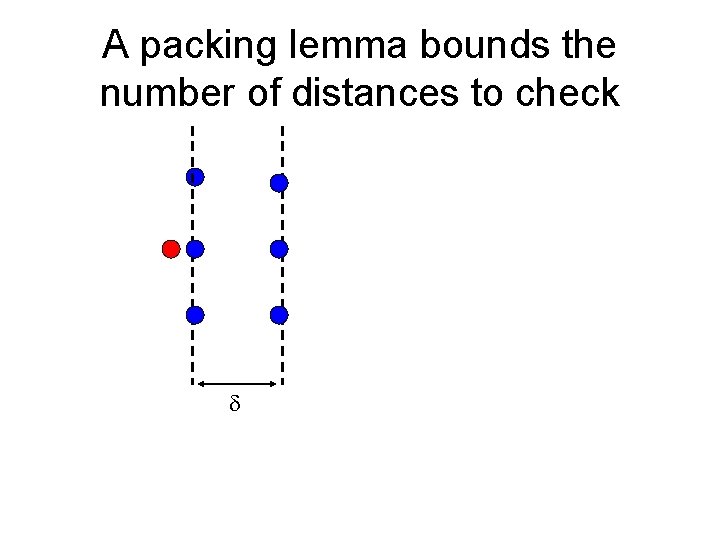
Packing Lemma Suppose that the minimum distance between points is at least d, what is the maximum number of points that can be packed in a ball of radius d?
Combining Solutions • Suppose the minimum separation from the sub problems is d • In looking for cross set closest pairs, we only need to consider points with d of the boundary • How many cross border interactions do we need to test?
A packing lemma bounds the number of distances to check d
Details • Preprocessing: sort points by y • Merge step – Select points in boundary zone – For each point in the boundary • Find highest point on the other side that is at most d above • Find lowest point on the other side that is at most d below • Compare with the points in this interval (there at most 6)
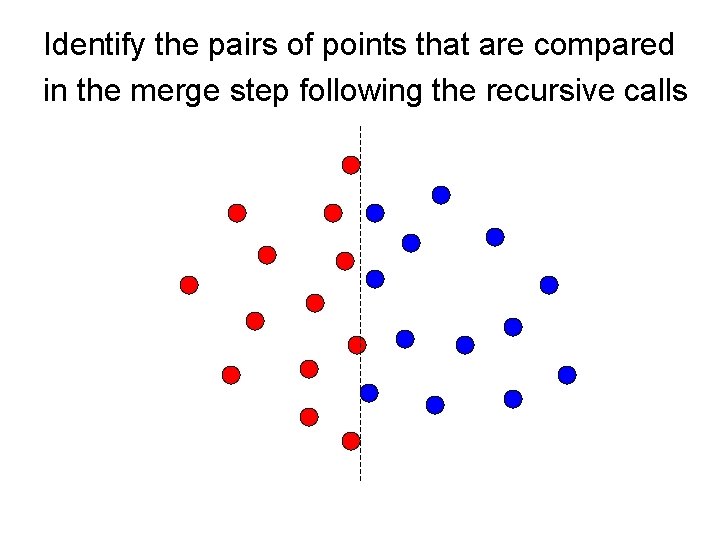
Identify the pairs of points that are compared in the merge step following the recursive calls
Algorithm run time • After preprocessing: – T(n) = cn + 2 T(n/2)
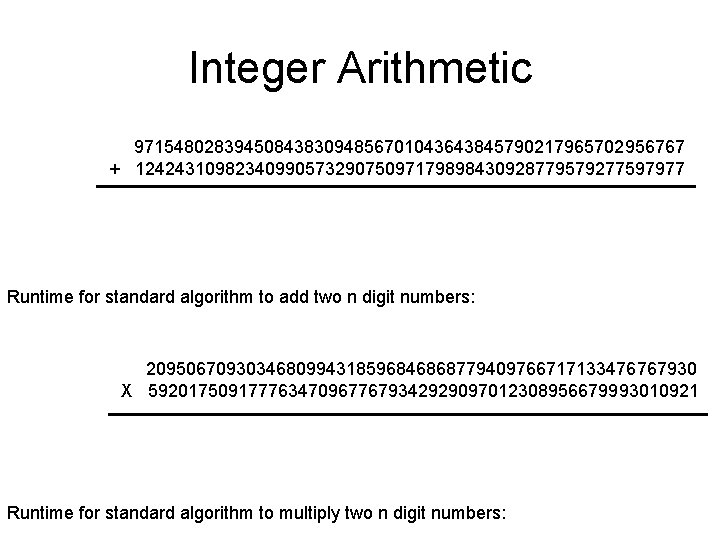
Integer Arithmetic 9715480283945084383094856701043643845790217965702956767 + 1242431098234099057329075097179898430928779579277597977 Runtime for standard algorithm to add two n digit numbers: 2095067093034680994318596846868779409766717133476767930 X 5920175091777634709677679342929097012308956679993010921 Runtime for standard algorithm to multiply two n digit numbers:
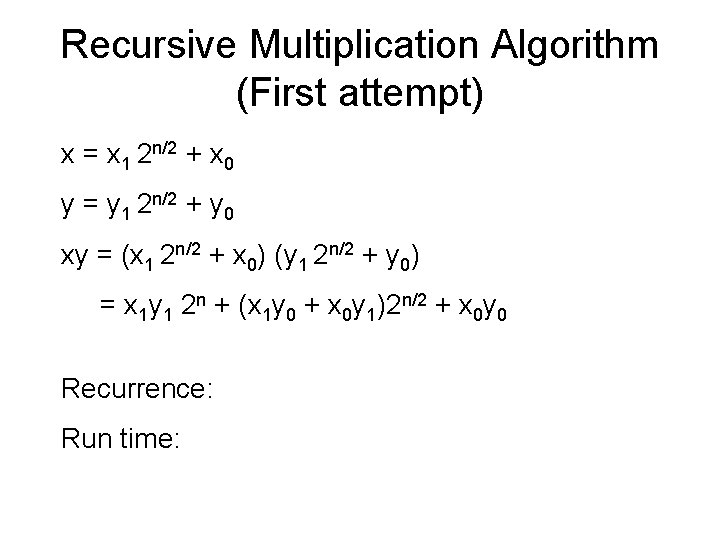
Recursive Multiplication Algorithm (First attempt) x = x 1 2 n/2 + x 0 y = y 1 2 n/2 + y 0 xy = (x 1 2 n/2 + x 0) (y 1 2 n/2 + y 0) = x 1 y 1 2 n + (x 1 y 0 + x 0 y 1)2 n/2 + x 0 y 0 Recurrence: Run time:
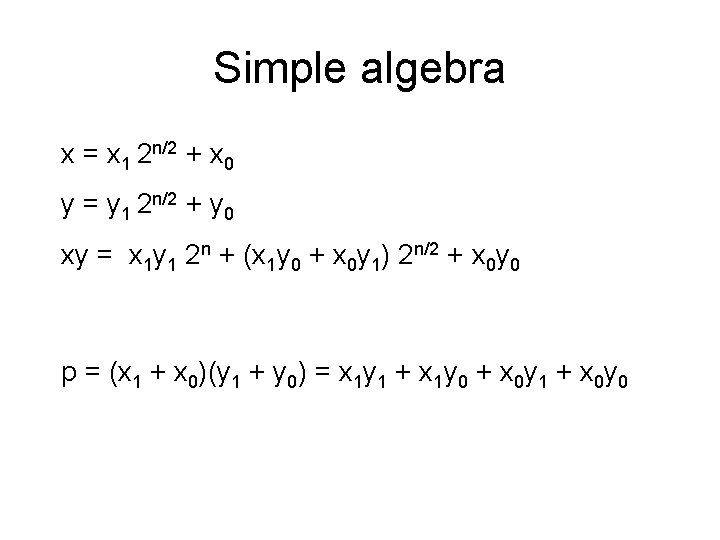
Simple algebra x = x 1 2 n/2 + x 0 y = y 1 2 n/2 + y 0 xy = x 1 y 1 2 n + (x 1 y 0 + x 0 y 1) 2 n/2 + x 0 y 0 p = (x 1 + x 0)(y 1 + y 0) = x 1 y 1 + x 1 y 0 + x 0 y 1 + x 0 y 0
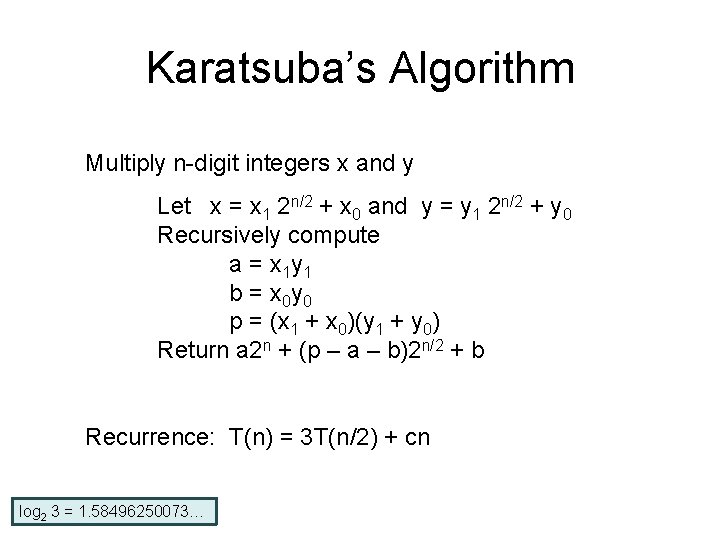
Karatsuba’s Algorithm Multiply n-digit integers x and y Let x = x 1 2 n/2 + x 0 and y = y 1 2 n/2 + y 0 Recursively compute a = x 1 y 1 b = x 0 y 0 p = (x 1 + x 0)(y 1 + y 0) Return a 2 n + (p – a – b)2 n/2 + b Recurrence: T(n) = 3 T(n/2) + cn log 2 3 = 1. 58496250073…
Next week • Dynamic Programming!