
CSE 417 Algorithms and Complexity Autumn 2020 Lecture


![Assume all edges have non-negative cost Dijkstra’s Algorithm S = { }; d[s] =](https://slidetodoc.com/presentation_image_h2/6c278e13dbada11d996c391eeaa04e32/image-6.jpg "Assume all edges have non-negative cost Dijkstra’s Algorithm S = { }; d[s] =")


![Proof • Let v be a vertex in V-S with minimum d[v] • Let](https://slidetodoc.com/presentation_image_h2/6c278e13dbada11d996c391eeaa04e32/image-12.jpg "Proof • Let v be a vertex in V-S with minimum d[v] • Let")
![Dijkstra Implementation S = { }; d[s] = 0; d[v] = infinity for v](https://slidetodoc.com/presentation_image_h2/6c278e13dbada11d996c391eeaa04e32/image-14.jpg "Dijkstra Implementation S = { }; d[s] = 0; d[v] = infinity for v")
![O(n 2) Implementation for Dense Graphs FOR i : = 1 TO n d[i]](https://slidetodoc.com/presentation_image_h2/6c278e13dbada11d996c391eeaa04e32/image-15.jpg "O(n 2) Implementation for Dense Graphs FOR i : = 1 TO n d[i]")
- Slides: 18
CSE 417 Algorithms and Complexity Autumn 2020 Lecture 11 Dijkstra’s algorithm
Upcoming lectures • Topics – Dijkstra’s Algorithm (Section 4. 4) – Monday: Minimum Spanning Trees • Reading – 4. 4, 4. 5, 4. 7, 4. 8
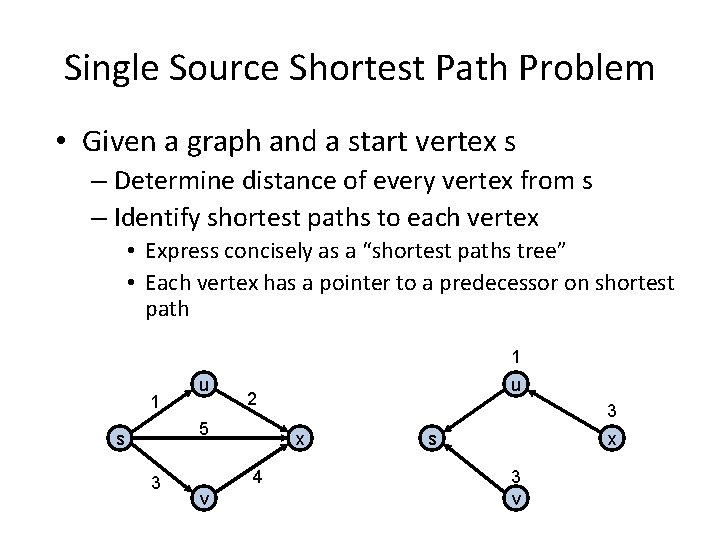
Single Source Shortest Path Problem • Given a graph and a start vertex s – Determine distance of every vertex from s – Identify shortest paths to each vertex • Express concisely as a “shortest paths tree” • Each vertex has a pointer to a predecessor on shortest path 1 1 u 2 5 s 3 3 x 4 v u s x 3 v
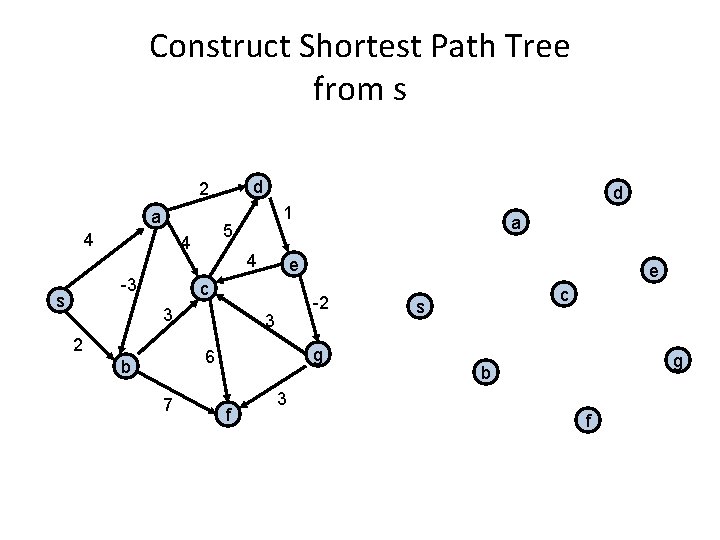
Construct Shortest Path Tree from s d 2 a 4 s 1 5 4 -3 d 4 e c 3 2 7 e -2 3 g 6 b a f c s g b 3 f
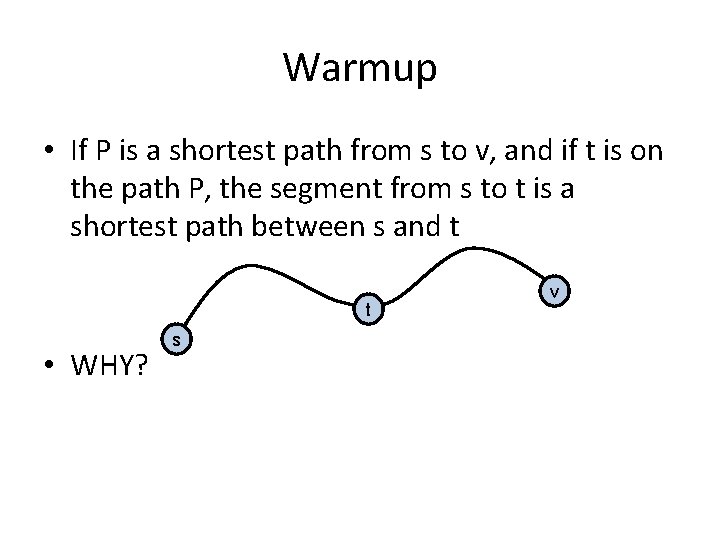
Warmup • If P is a shortest path from s to v, and if t is on the path P, the segment from s to t is a shortest path between s and t t • WHY? s v
Assume all edges have non-negative cost Dijkstra’s Algorithm S = { }; d[s] = 0; d[v] = infinity for v != s While S != V Choose v in V-S with minimum d[v] Add v to S For each w in the neighborhood of v d[w] = min(d[w], d[v] + c(v, w)) 0 s 1 u 1 2 4 2 v 4 y 3 1 1 x 2 2 3 2 z 5
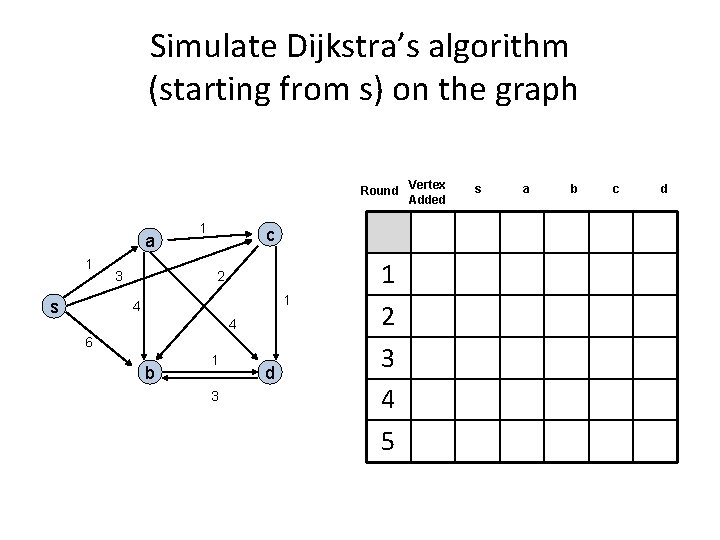
Simulate Dijkstra’s algorithm (starting from s) on the graph Round Vertex Added a 1 s 3 1 c 2 1 4 4 6 b 1 3 d 1 2 3 4 5 s a b c d
Who was Dijkstra? • What were his major contributions?
http: //www. cs. utexas. edu/users/EWD/ • Edsger Wybe Dijkstra was one of the most influential members of computing science's founding generation. Among the domains in which his scientific contributions are fundamental are – – – – algorithm design programming languages program design operating systems distributed processing formal specification and verification design of mathematical arguments
Dijkstra’s Algorithm as a greedy algorithm • Elements committed to the solution by order of minimum distance
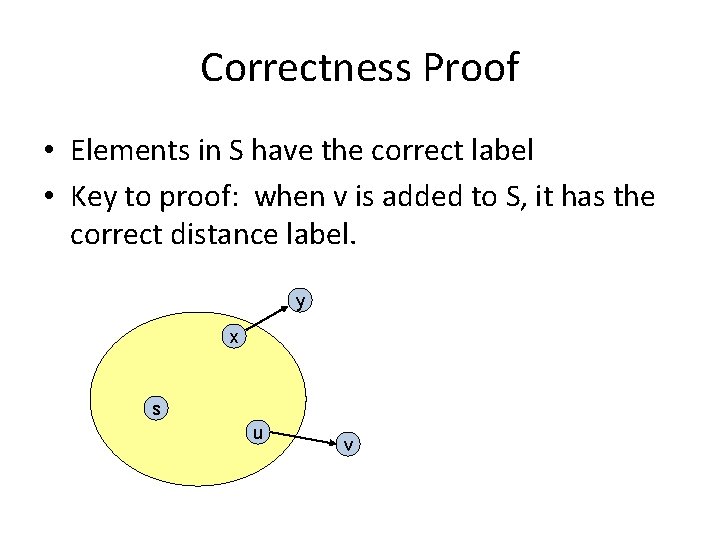
Correctness Proof • Elements in S have the correct label • Key to proof: when v is added to S, it has the correct distance label. y x s u v
Proof • Let v be a vertex in V-S with minimum d[v] • Let Pv be a path of length d[v], with an edge (u, v) • Let P be some other path to v. Suppose P first leaves S on the edge (x, y) – – P = Psx + c(x, y) + Pyv Len(Psx) + c(x, y) >= d[y] Len(Pyv) >= 0 Len(P) >= d[y] + 0 >= d[v] y x s u v
Negative Cost Edges • Draw a small example a negative cost edge and show that Dijkstra’s algorithm fails on this example
Dijkstra Implementation S = { }; d[s] = 0; d[v] = infinity for v != s While S != V Choose v in V-S with minimum d[v] Add v to S For each w in the neighborhood of v d[w] = min(d[w], d[v] + c(v, w)) • Basic implementation requires Heap for tracking the distance values • Run time O(m log n)
O(n 2) Implementation for Dense Graphs FOR i : = 1 TO n d[i] : = Infinity; d[s] : = 0; visited[i] : = FALSE; FOR i : = 1 TO n v : = -1; d. Min : = Infinity; FOR j : = 1 TO n IF visited[j] = FALSE AND d[j] < d. Min v : = j; d. Min : = d[j]; IF v = -1 RETURN; visited[v] : = TRUE; FOR j : = 1 TO n IF d[v] + len[v, j] < d[j] : = d[v] + len[v, j]; prev[j] : = v;
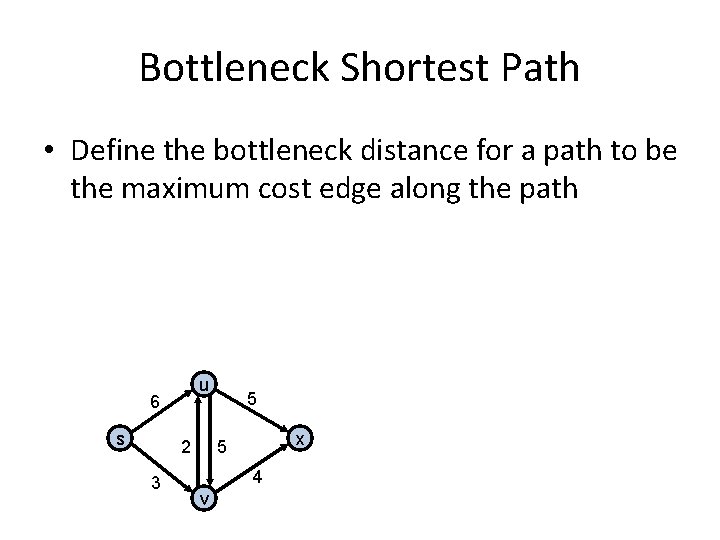
Bottleneck Shortest Path • Define the bottleneck distance for a path to be the maximum cost edge along the path u 6 s 2 3 5 x 5 4 v
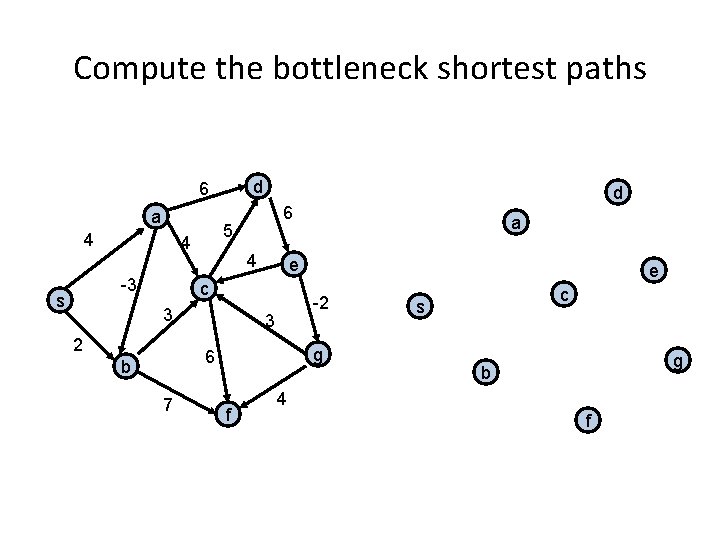
Compute the bottleneck shortest paths d 6 a 4 s 6 5 4 -3 d 4 e c 3 2 7 e -2 3 g 6 b a f c s g b 4 f
How do you adapt Dijkstra’s algorithm to handle bottleneck distances • Does the correctness proof still apply?