
CSE 417 Algorithms and Complexity Autumn 2020 Lecture
![Greedy Algorithms for Minimum Spanning Tree • [Prim] Extend a tree by including the](https://slidetodoc.com/presentation_image_h2/551c72d4501b20af69cac5c6a66c78fc/image-3.jpg "Greedy Algorithms for Minimum Spanning Tree • [Prim] Extend a tree by including the")



- Slides: 26
CSE 417 Algorithms and Complexity Autumn 2020 Lecture 14 MST + Recurrences
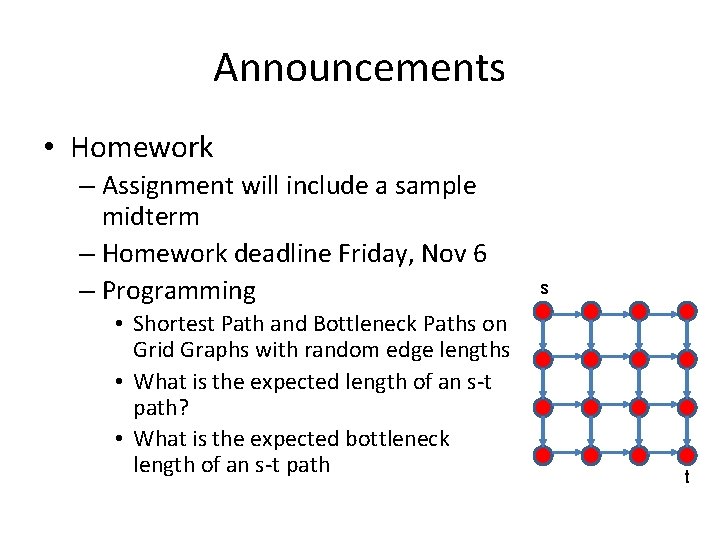
Announcements • Homework – Assignment will include a sample midterm – Homework deadline Friday, Nov 6 – Programming • Shortest Path and Bottleneck Paths on Grid Graphs with random edge lengths • What is the expected length of an s-t path? • What is the expected bottleneck length of an s-t path s t
Greedy Algorithms for Minimum Spanning Tree • [Prim] Extend a tree by including the cheapest out going edge • [Kruskal] Add the cheapest edge that joins disjoint components 4 b 20 c 5 11 8 a d 7 e 22
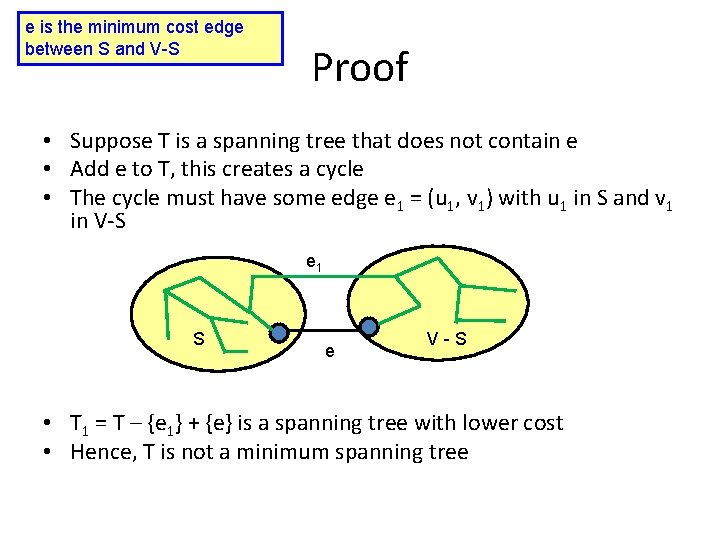
Edge inclusion lemma • Let S be a subset of V, and suppose e = (u, v) is the minimum cost edge of E, with u in S and v in V-S • e is in every minimum spanning tree of G – Or equivalently, if e is not in T, then T is not a minimum spanning tree e S V-S
e is the minimum cost edge between S and V-S Proof • Suppose T is a spanning tree that does not contain e • Add e to T, this creates a cycle • The cycle must have some edge e 1 = (u 1, v 1) with u 1 in S and v 1 in V-S e 1 S e V-S • T 1 = T – {e 1} + {e} is a spanning tree with lower cost • Hence, T is not a minimum spanning tree
Optimality Proofs • Prim’s Algorithm computes a MST • Kruskal’s Algorithm computes a MST • Show that when an edge is added to the MST by Prim or Kruskal, the edge is the minimum cost edge between S and V-S for some set S.
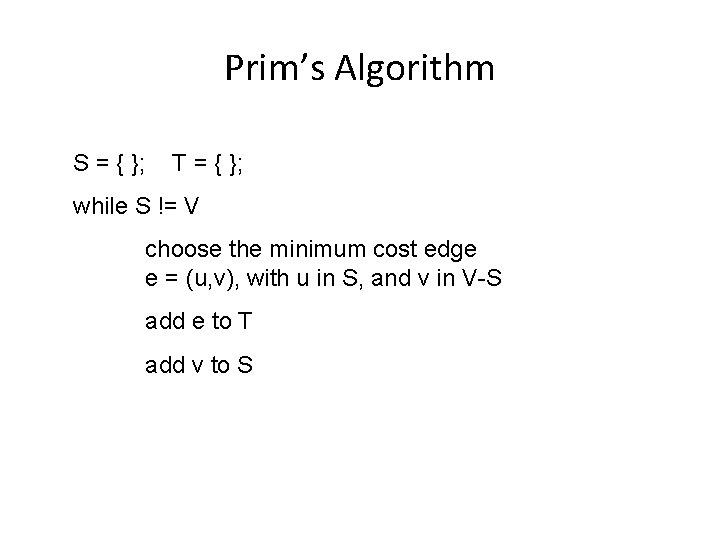
Prim’s Algorithm S = { }; T = { }; while S != V choose the minimum cost edge e = (u, v), with u in S, and v in V-S add e to T add v to S
Prove Prim’s algorithm computes an MST • Show an edge e is in the MST when it is added to T
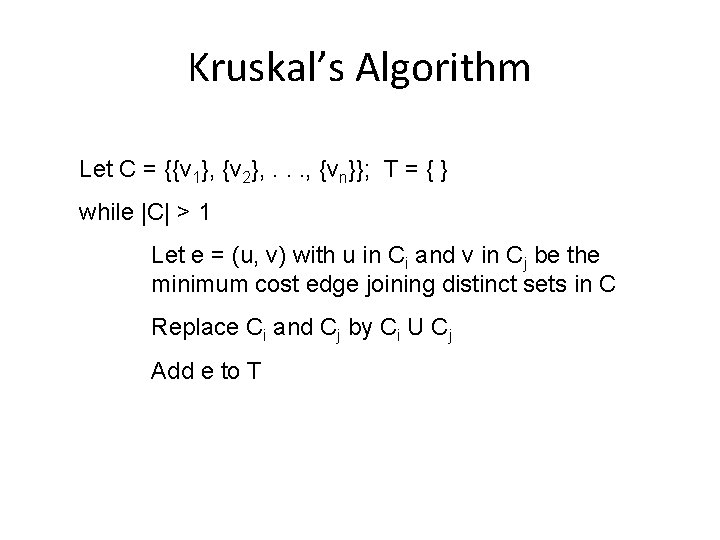
Kruskal’s Algorithm Let C = {{v 1}, {v 2}, . . . , {vn}}; T = { } while |C| > 1 Let e = (u, v) with u in Ci and v in Cj be the minimum cost edge joining distinct sets in C Replace Ci and Cj by Ci U Cj Add e to T
Prove Kruskal’s algorithm computes an MST • Show an edge e is in the MST when it is added to T
Divide and Conquer • Recurrences, Sections 5. 1 and 5. 2 • Algorithms – Fast Matrix Multiplication – Counting Inversions (5. 3) – Closest Pair (5. 4) – Multiplication (5. 5)
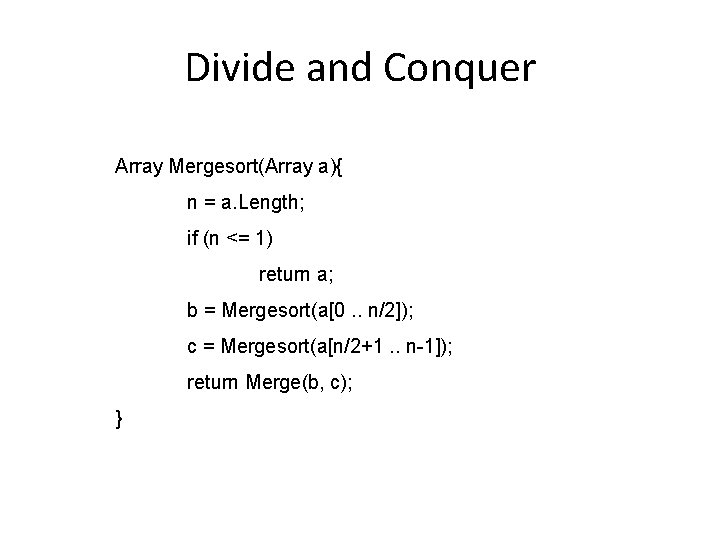
Divide and Conquer Array Mergesort(Array a){ n = a. Length; if (n <= 1) return a; b = Mergesort(a[0. . n/2]); c = Mergesort(a[n/2+1. . n-1]); return Merge(b, c); }
Algorithm Analysis • Cost of Mergesort
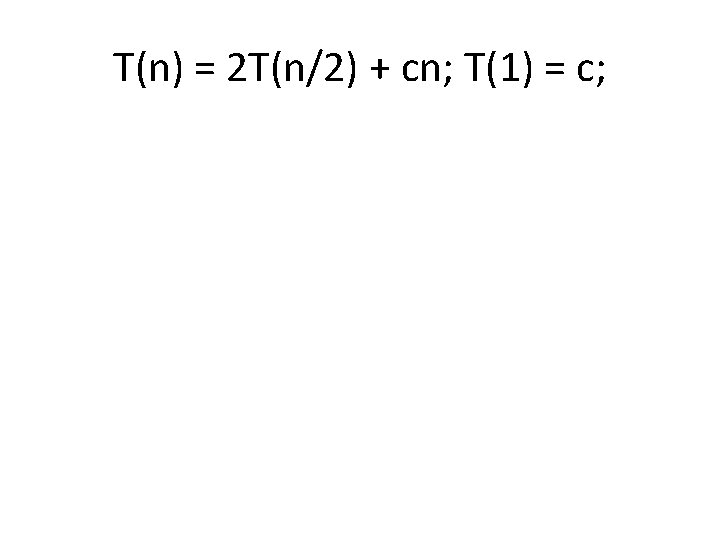
T(n) = 2 T(n/2) + cn; T(1) = c;
Recurrence Analysis • Solution methods – Unrolling recurrence – Guess and verify – Plugging in to a “Master Theorem”
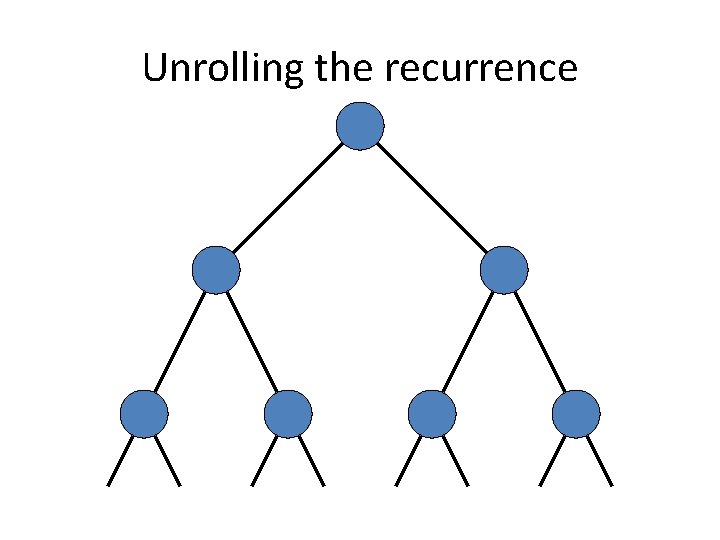
Unrolling the recurrence
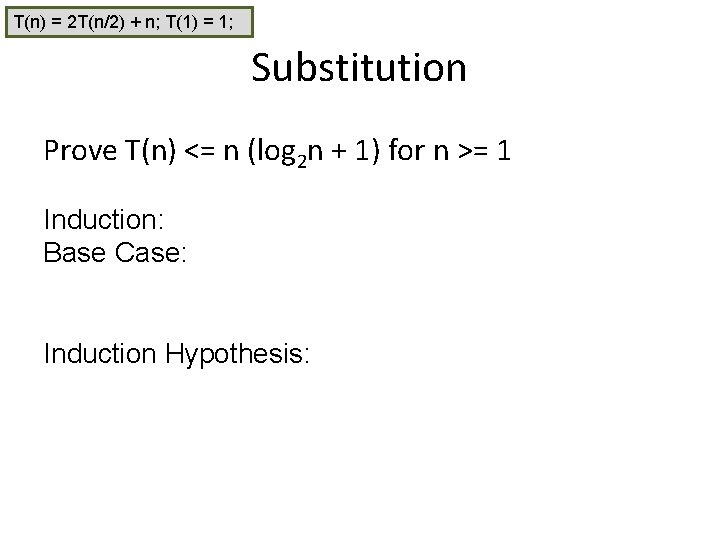
T(n) = 2 T(n/2) + n; T(1) = 1; Substitution Prove T(n) <= n (log 2 n + 1) for n >= 1 Induction: Base Case: Induction Hypothesis:
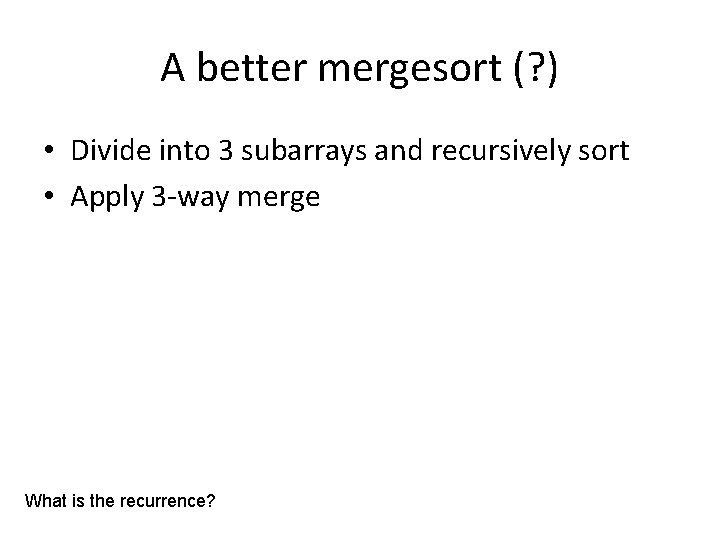
A better mergesort (? ) • Divide into 3 subarrays and recursively sort • Apply 3 -way merge What is the recurrence?
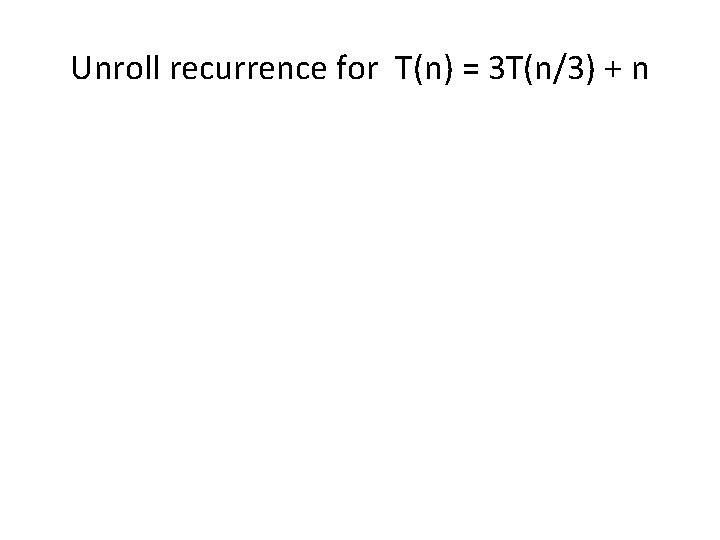
Unroll recurrence for T(n) = 3 T(n/3) + n
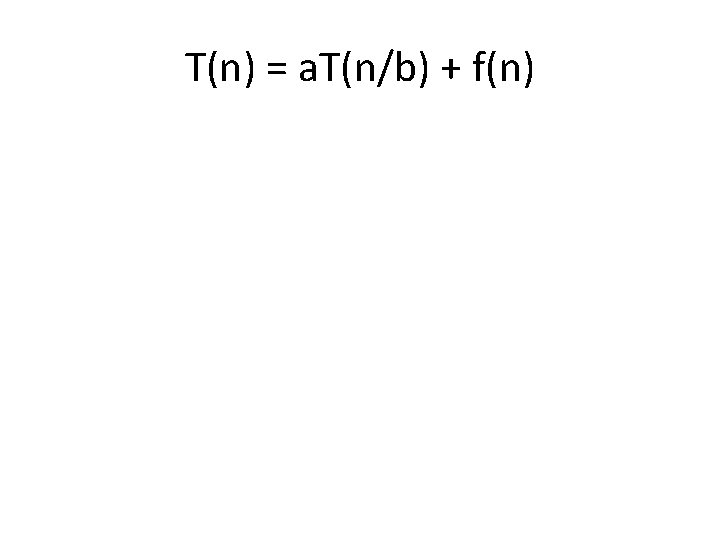
T(n) = a. T(n/b) + f(n)
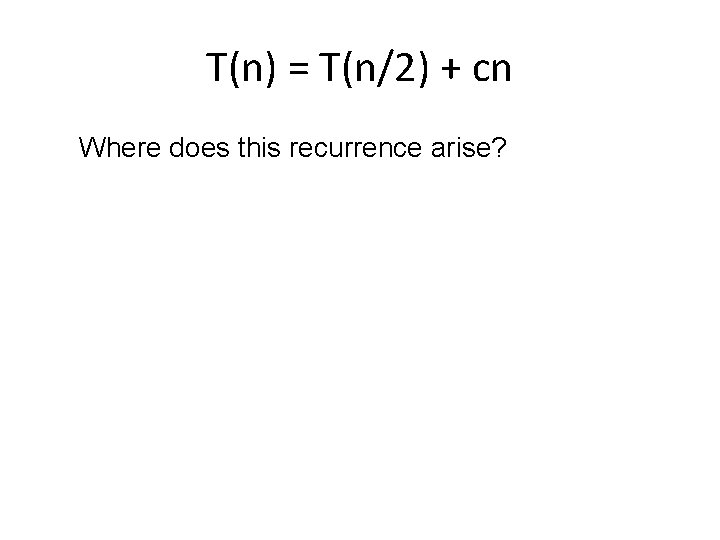
T(n) = T(n/2) + cn Where does this recurrence arise?
Solving the recurrence exactly
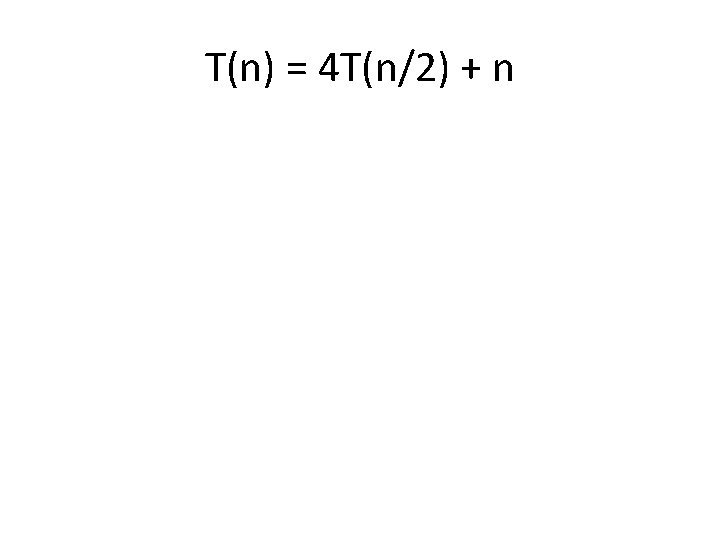
T(n) = 4 T(n/2) + n
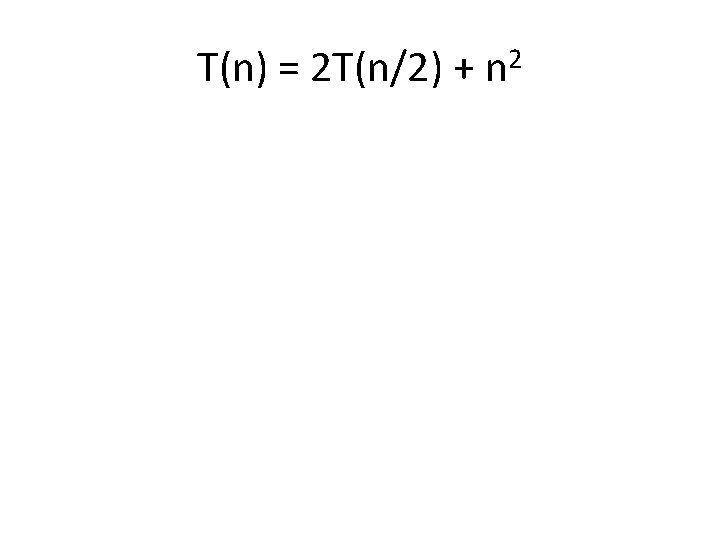
T(n) = 2 T(n/2) + n 2
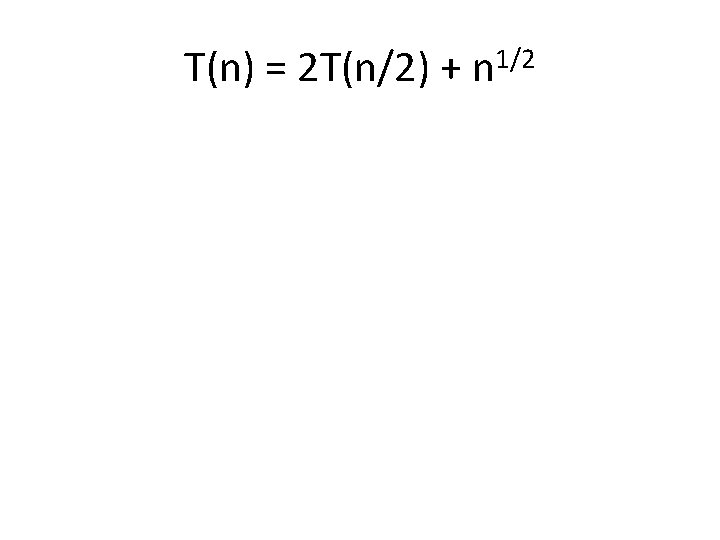
T(n) = 2 T(n/2) + n 1/2
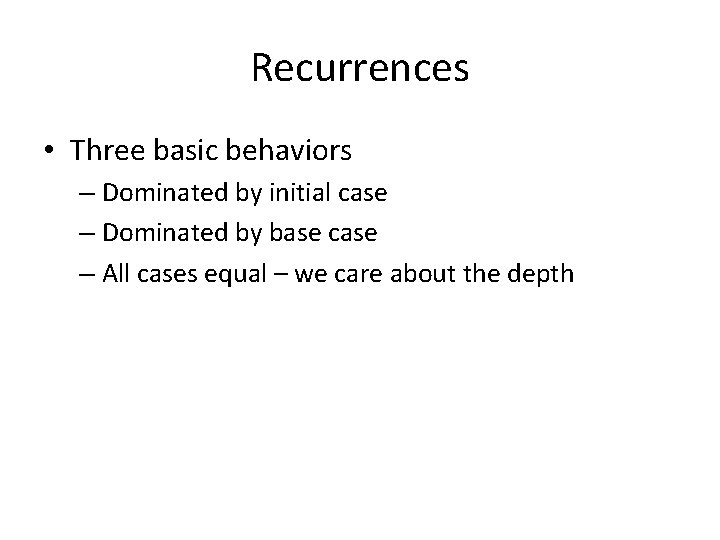
Recurrences • Three basic behaviors – Dominated by initial case – Dominated by base case – All cases equal – we care about the depth