
CSE 373 Data Structures Algorithms Lecture 20 Minimum
- Slides: 45
CSE 373: Data Structures & Algorithms Lecture 20: Minimum Spanning Trees Linda Shapiro Winter 2015
Announcements • • HW 06 due Monday, March 9 at 2: 30 IN CLASS Regular help session Thursday 4: 30 pm New help session Friday 6: 00 pm (Bagley 154) Final Exam will allow TWO double-sided sheets of notes. • Final Counts 30% of grade. • Similar to midterm, but no coding. Winter 2015 CSE 373: Data Structures & Algorithms 2
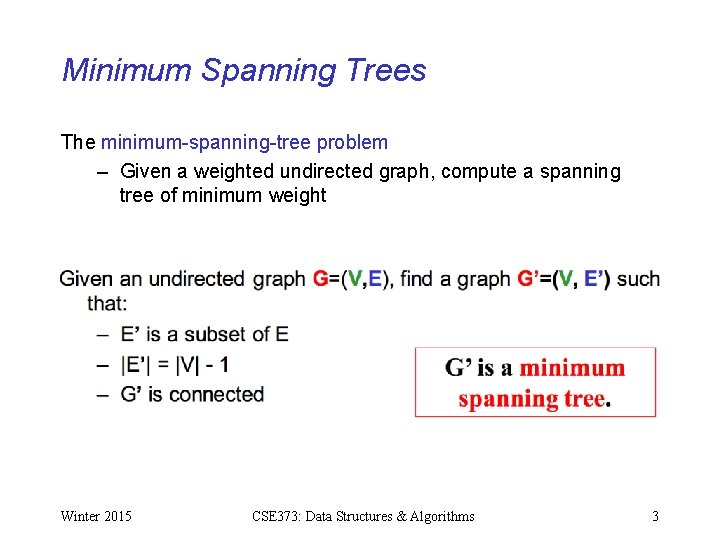
Minimum Spanning Trees The minimum-spanning-tree problem – Given a weighted undirected graph, compute a spanning tree of minimum weight Winter 2015 CSE 373: Data Structures & Algorithms 3
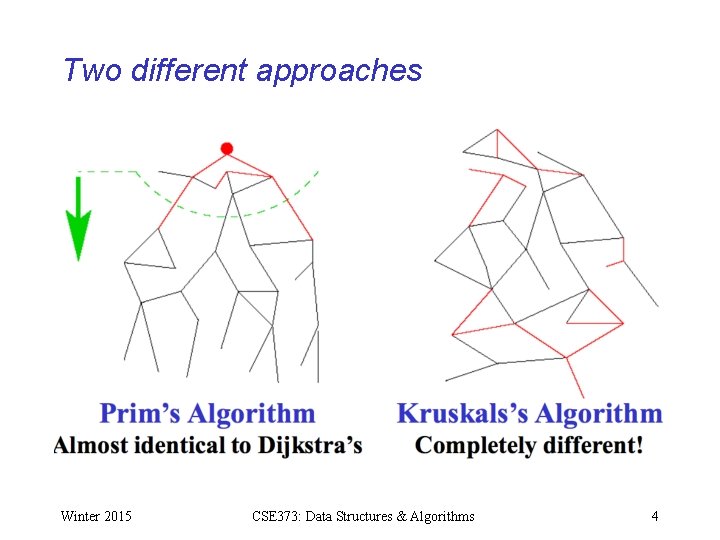
Two different approaches Winter 2015 CSE 373: Data Structures & Algorithms 4
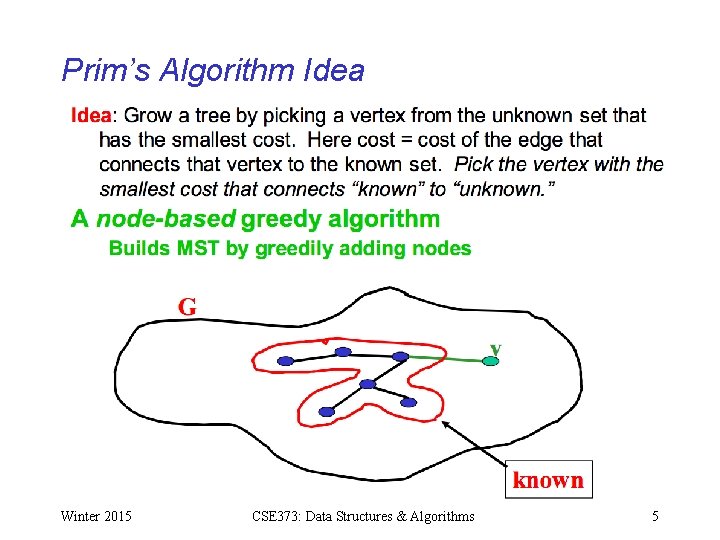
Prim’s Algorithm Idea Winter 2015 CSE 373: Data Structures & Algorithms 5
Prim’s vs. Dijkstra’s Recall: Dijkstra picked the unknown vertex with smallest cost where cost = distance to the source. Prim’s pick the unknown vertex with smallest cost where cost = distance from this vertex to the known set (in other words, the cost of the smallest edge connecting this vertex to the known set) Otherwise identical Winter 2015 CSE 373: Data Structures & Algorithms 6
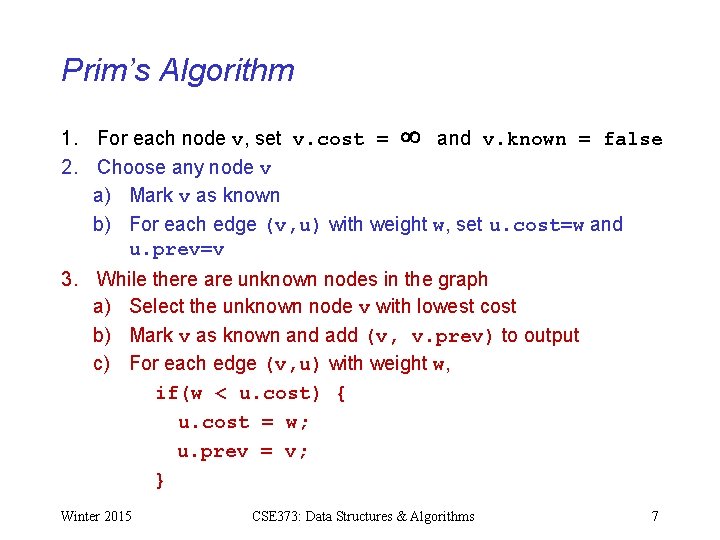
Prim’s Algorithm 1. For each node v, set v. cost = and v. known = false 2. Choose any node v a) Mark v as known b) For each edge (v, u) with weight w, set u. cost=w and u. prev=v 3. While there are unknown nodes in the graph a) Select the unknown node v with lowest cost b) Mark v as known and add (v, v. prev) to output c) For each edge (v, u) with weight w, if(w < u. cost) { u. cost = w; u. prev = v; } Winter 2015 CSE 373: Data Structures & Algorithms 7
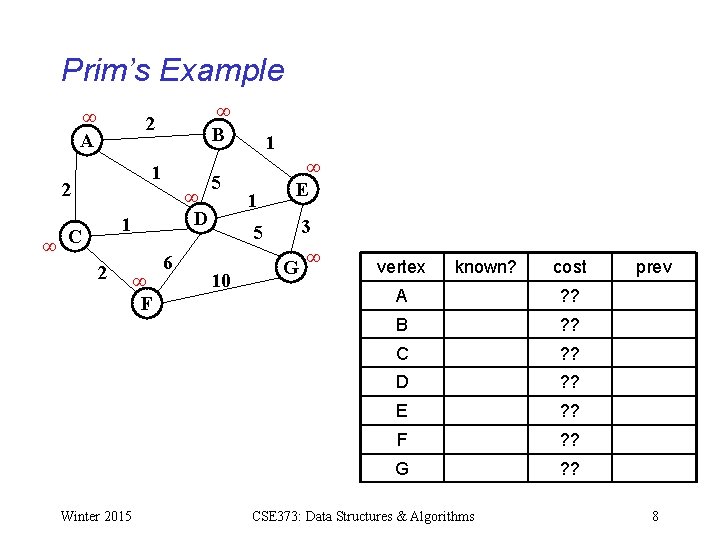
Prim’s Example ∞ A ∞ B 2 1 2 ∞ D 1 ∞ C 2 Winter 2015 ∞ F 6 5 1 1 ∞ E 5 10 G 3 ∞ vertex known? cost A ? ? B ? ? C ? ? D ? ? E ? ? F ? ? G ? ? CSE 373: Data Structures & Algorithms prev 8
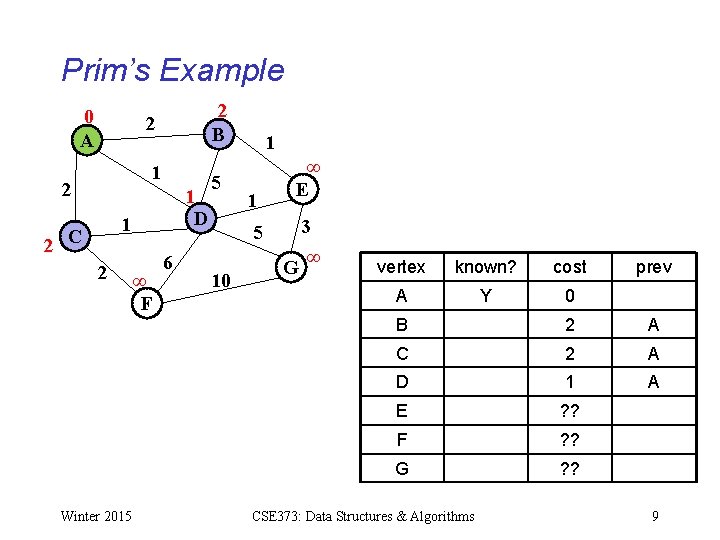
Prim’s Example 0 A 2 B 2 1 D 1 2 C 2 Winter 2015 ∞ F 6 5 1 1 ∞ E 5 10 G 3 ∞ vertex known? cost A Y 0 prev B 2 A C 2 A D 1 A E ? ? F ? ? G ? ? CSE 373: Data Structures & Algorithms 9
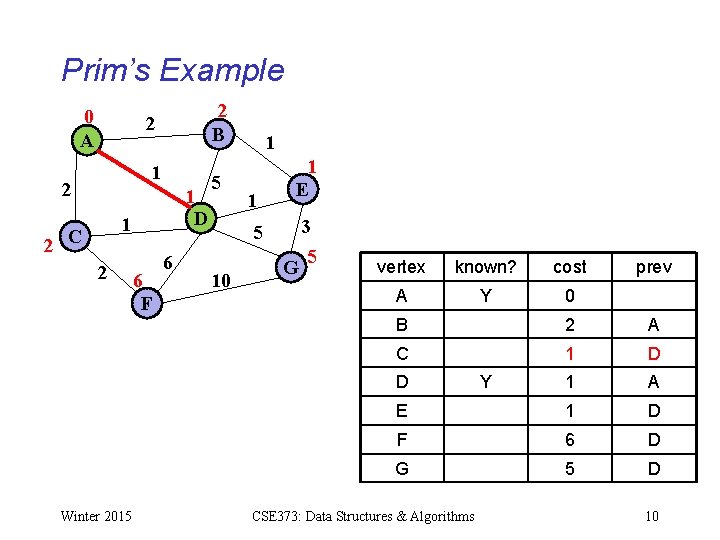
Prim’s Example 0 A 2 B 2 1 D 1 2 C 2 6 F 6 5 1 1 1 E 5 10 G 3 5 vertex known? cost A Y 0 B 2 A C 1 D 1 A E 1 D F 6 D G 5 D D Winter 2015 prev CSE 373: Data Structures & Algorithms Y 10
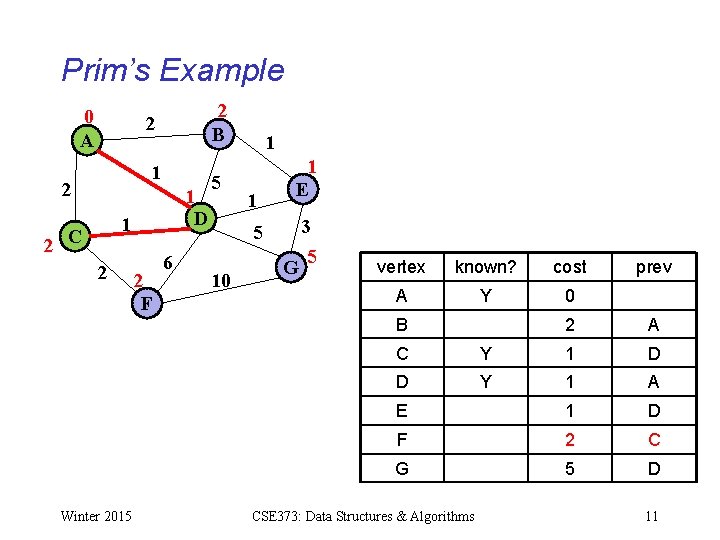
Prim’s Example 0 A 2 B 2 1 D 1 2 C 2 Winter 2015 2 F 6 5 1 1 1 E 5 10 G 3 5 vertex known? cost A Y 0 B prev 2 A C Y 1 D D Y 1 A E 1 D F 2 C G 5 D CSE 373: Data Structures & Algorithms 11
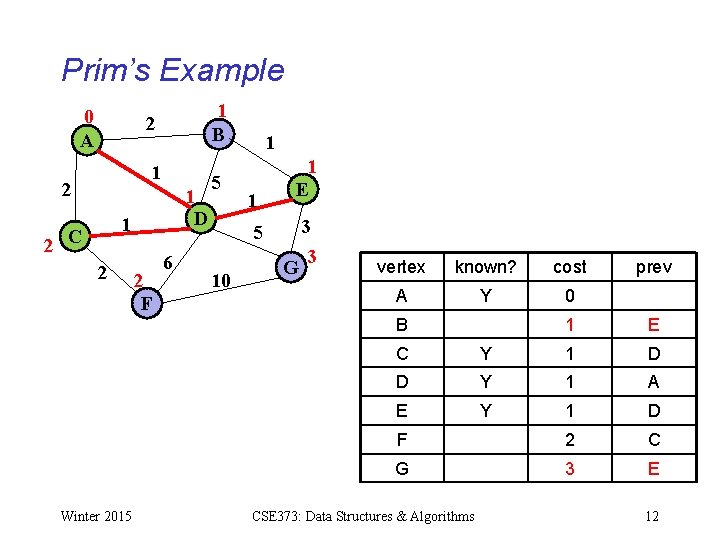
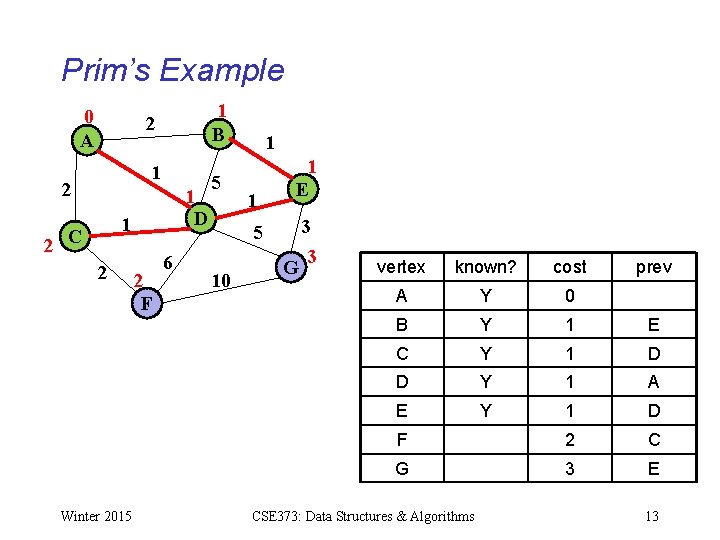
Prim’s Example 0 A 1 B 2 1 D 1 2 C 2 Winter 2015 2 F 6 5 1 1 1 E 5 10 G 3 3 vertex known? cost A Y 0 B prev 1 E C Y 1 D D Y 1 A E Y 1 D F 2 C G 3 E CSE 373: Data Structures & Algorithms 12
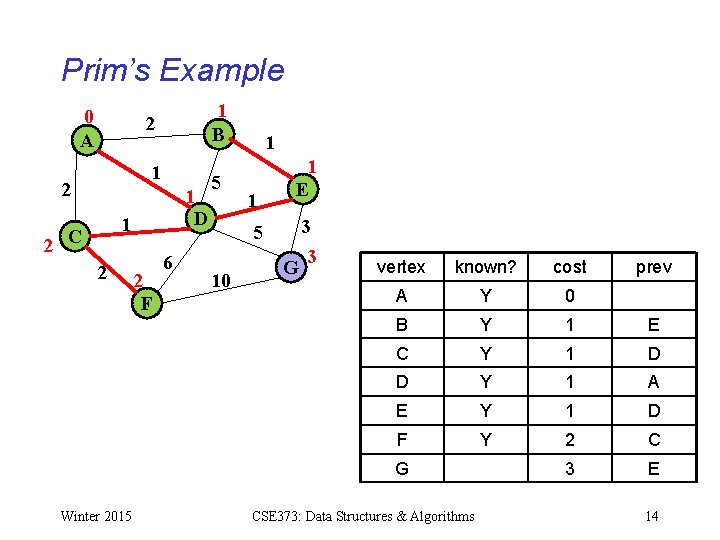
Prim’s Example 0 A 1 B 2 1 D 1 2 C 2 Winter 2015 2 F 6 5 1 1 1 E 5 10 G 3 3 vertex known? cost A Y 0 B Y 1 E C Y 1 D D Y 1 A E Y 1 D F 2 C G 3 E CSE 373: Data Structures & Algorithms prev 13
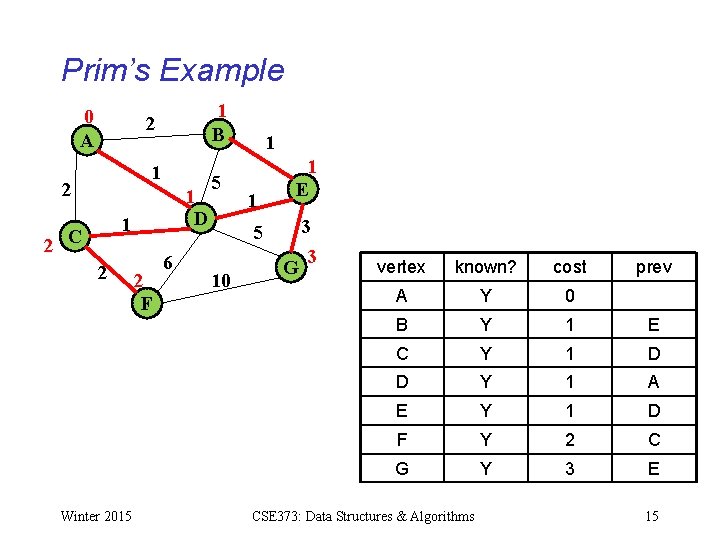
Prim’s Example 0 A 1 B 2 1 D 1 2 C 2 2 F 6 5 1 1 1 E 5 10 G 3 3 vertex known? cost A Y 0 B Y 1 E C Y 1 D D Y 1 A E Y 1 D F Y 2 C 3 E G Winter 2015 CSE 373: Data Structures & Algorithms prev 14
Prim’s Example 0 A 1 B 2 1 D 1 2 C 2 Winter 2015 2 F 6 5 1 1 1 E 5 10 G 3 3 vertex known? cost A Y 0 B Y 1 E C Y 1 D D Y 1 A E Y 1 D F Y 2 C G Y 3 E CSE 373: Data Structures & Algorithms prev 15
Analysis • Correctness – A bit tricky – Intuitively similar to Dijkstra • Run-time – Same as Dijkstra – O(|E|log|V|) using a priority queue • Costs/priorities are just edge-costs, not path-costs Winter 2015 CSE 373: Data Structures & Algorithms 16
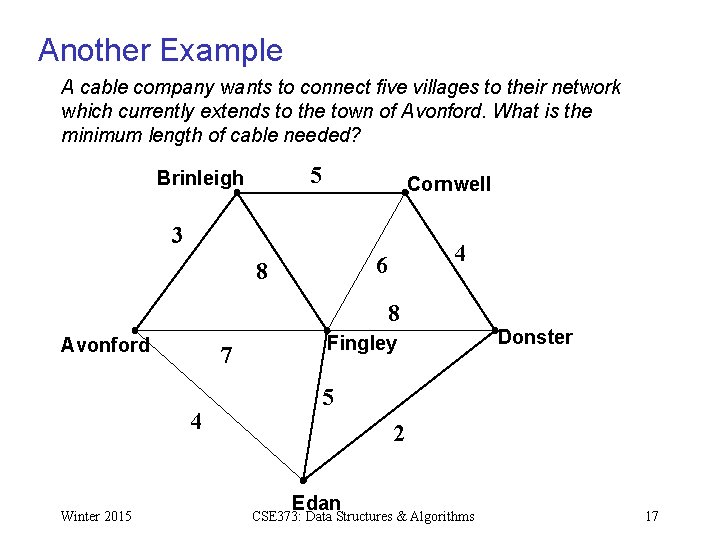
Another Example A cable company wants to connect five villages to their network which currently extends to the town of Avonford. What is the minimum length of cable needed? 5 Brinleigh Cornwell 3 4 6 8 8 Avonford 7 4 Winter 2015 Fingley Donster 5 2 Edan CSE 373: Data Structures & Algorithms 17
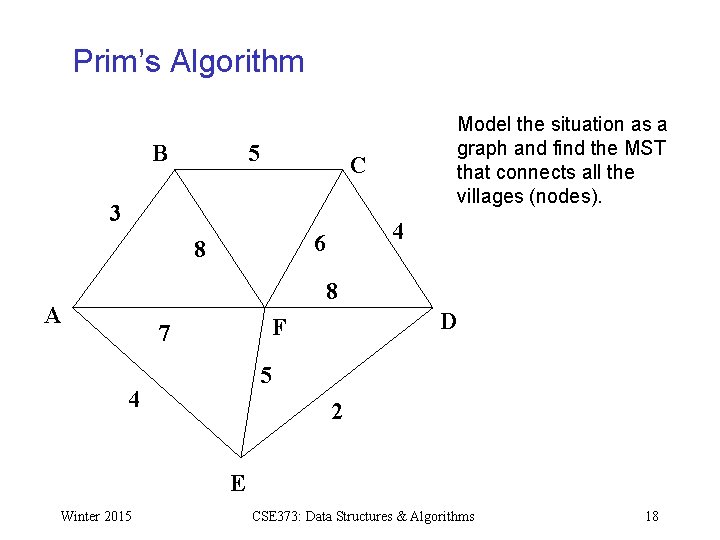
Prim’s Algorithm B 5 Model the situation as a graph and find the MST that connects all the villages (nodes). C 3 4 6 8 8 A D F 7 5 4 2 E Winter 2015 CSE 373: Data Structures & Algorithms 18
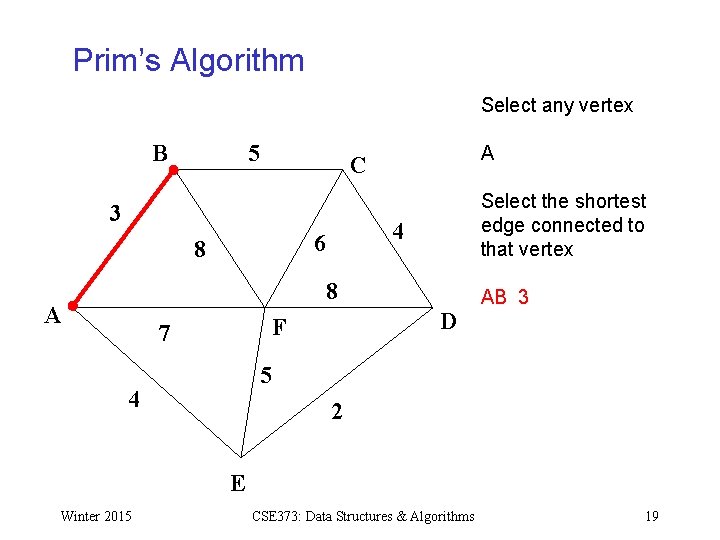
Prim’s Algorithm Select any vertex B 5 A C 3 4 6 8 Select the shortest edge connected to that vertex 8 A D F 7 AB 3 5 4 2 E Winter 2015 CSE 373: Data Structures & Algorithms 19
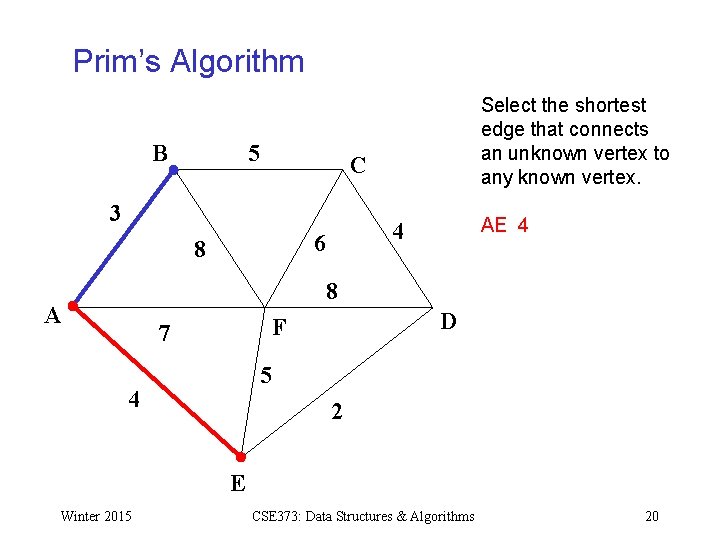
Prim’s Algorithm B 5 Select the shortest edge that connects an unknown vertex to any known vertex. C 3 6 8 AE 4 4 8 A D F 7 5 4 2 E Winter 2015 CSE 373: Data Structures & Algorithms 20
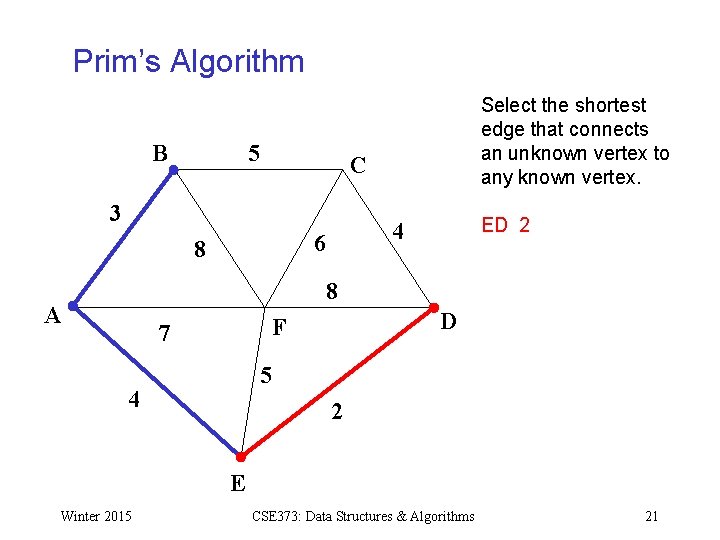
Prim’s Algorithm B 5 Select the shortest edge that connects an unknown vertex to any known vertex. C 3 6 8 ED 2 4 8 A D F 7 5 4 2 E Winter 2015 CSE 373: Data Structures & Algorithms 21
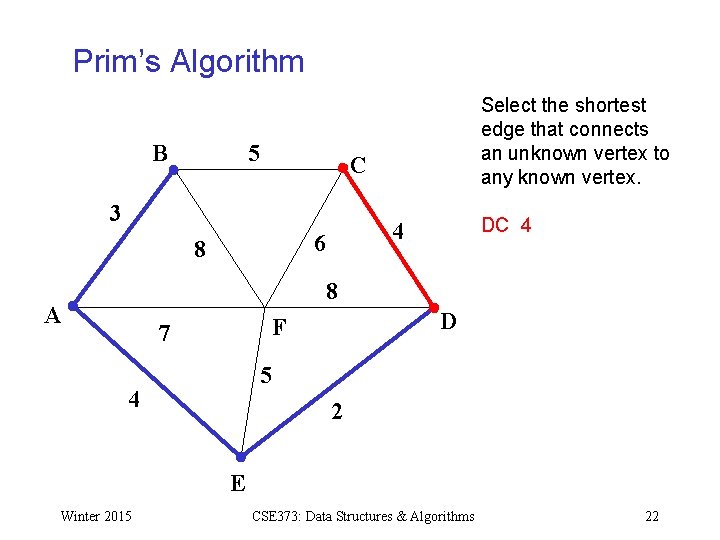
Prim’s Algorithm B 5 Select the shortest edge that connects an unknown vertex to any known vertex. C 3 6 8 DC 4 4 8 A D F 7 5 4 2 E Winter 2015 CSE 373: Data Structures & Algorithms 22
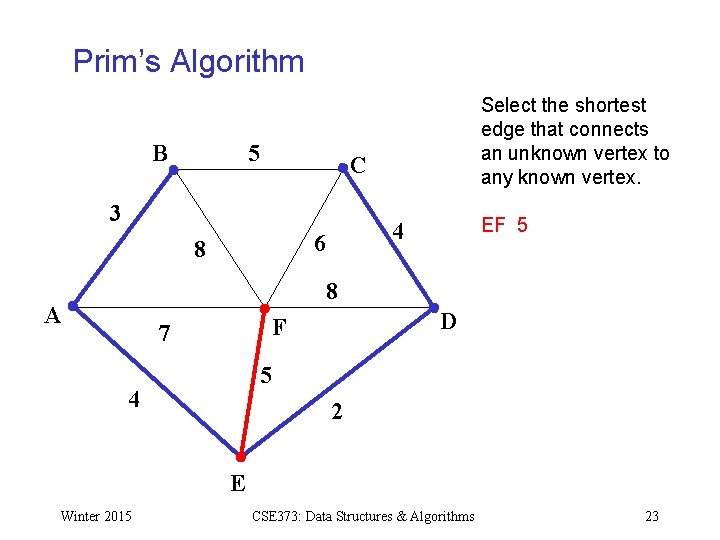
Prim’s Algorithm B 5 Select the shortest edge that connects an unknown vertex to any known vertex. C 3 6 8 EF 5 4 8 A D F 7 5 4 2 E Winter 2015 CSE 373: Data Structures & Algorithms 23
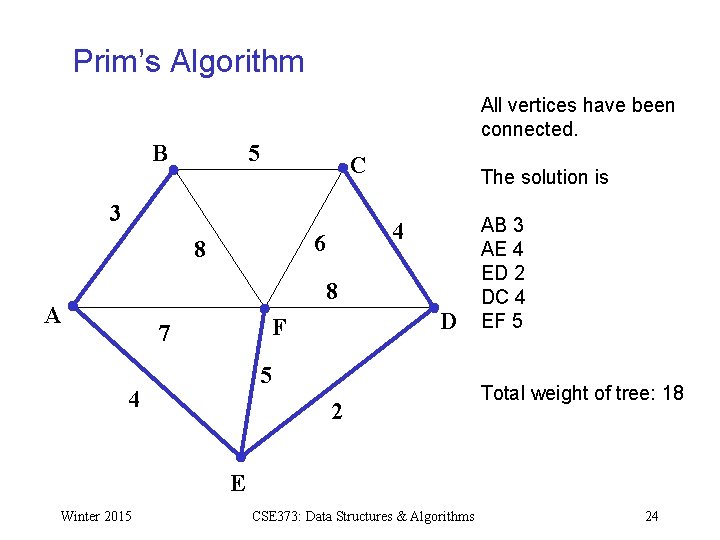
Prim’s Algorithm B All vertices have been connected. 5 C 3 4 6 8 The solution is 8 A D F 7 5 4 2 AB 3 AE 4 ED 2 DC 4 EF 5 Total weight of tree: 18 E Winter 2015 CSE 373: Data Structures & Algorithms 24
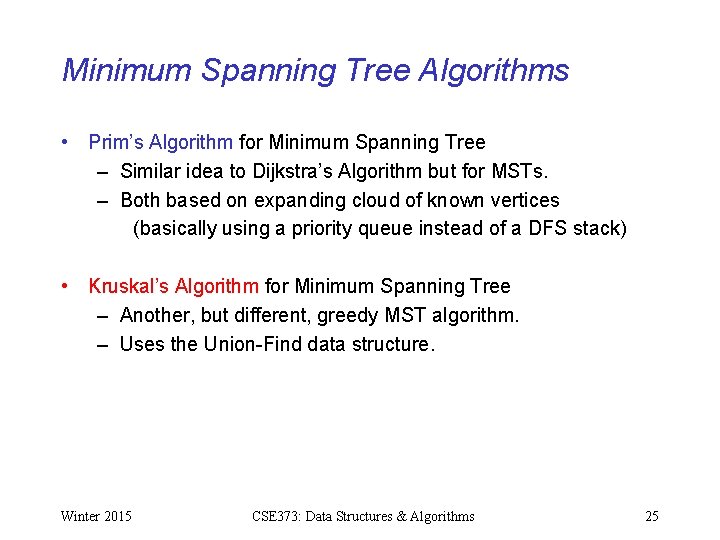
Minimum Spanning Tree Algorithms • Prim’s Algorithm for Minimum Spanning Tree – Similar idea to Dijkstra’s Algorithm but for MSTs. – Both based on expanding cloud of known vertices (basically using a priority queue instead of a DFS stack) • Kruskal’s Algorithm for Minimum Spanning Tree – Another, but different, greedy MST algorithm. – Uses the Union-Find data structure. Winter 2015 CSE 373: Data Structures & Algorithms 25
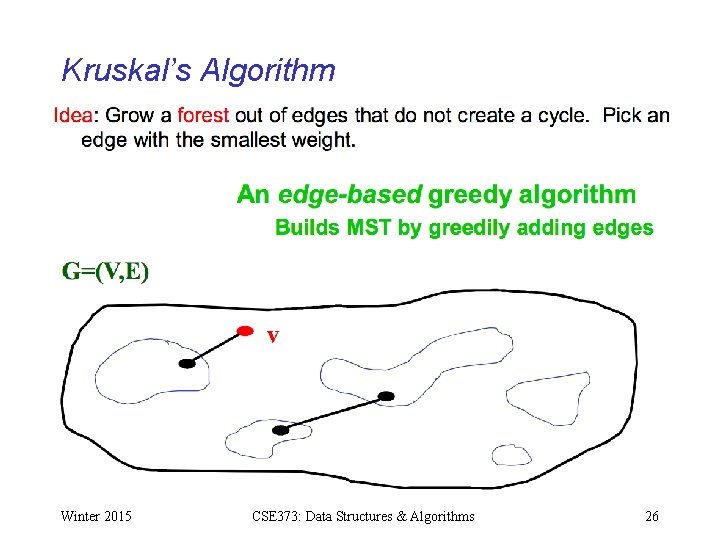
Kruskal’s Algorithm Winter 2015 CSE 373: Data Structures & Algorithms 26
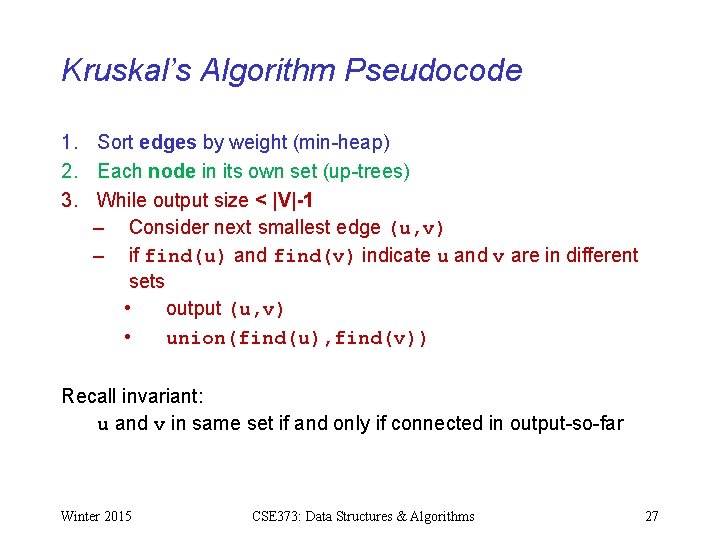
Kruskal’s Algorithm Pseudocode 1. Sort edges by weight (min-heap) 2. Each node in its own set (up-trees) 3. While output size < |V|-1 – Consider next smallest edge (u, v) – if find(u) and find(v) indicate u and v are in different sets • output (u, v) • union(find(u), find(v)) Recall invariant: u and v in same set if and only if connected in output-so-far Winter 2015 CSE 373: Data Structures & Algorithms 27
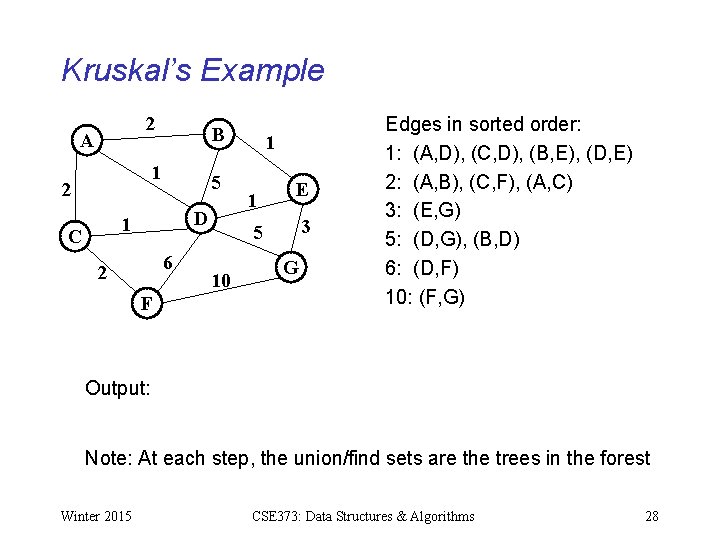
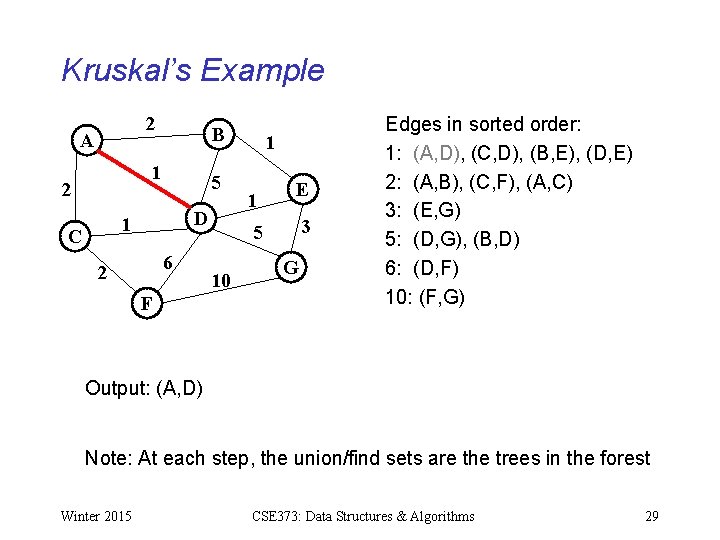
Kruskal’s Example 2 A B 1 2 5 D 1 C 6 2 F 1 1 E 3 5 10 G Edges in sorted order: 1: (A, D), (C, D), (B, E), (D, E) 2: (A, B), (C, F), (A, C) 3: (E, G) 5: (D, G), (B, D) 6: (D, F) 10: (F, G) Output: Note: At each step, the union/find sets are the trees in the forest Winter 2015 CSE 373: Data Structures & Algorithms 28
Kruskal’s Example 2 A B 1 2 5 D 1 C 6 2 F 1 1 E 3 5 10 G Edges in sorted order: 1: (A, D), (C, D), (B, E), (D, E) 2: (A, B), (C, F), (A, C) 3: (E, G) 5: (D, G), (B, D) 6: (D, F) 10: (F, G) Output: (A, D) Note: At each step, the union/find sets are the trees in the forest Winter 2015 CSE 373: Data Structures & Algorithms 29
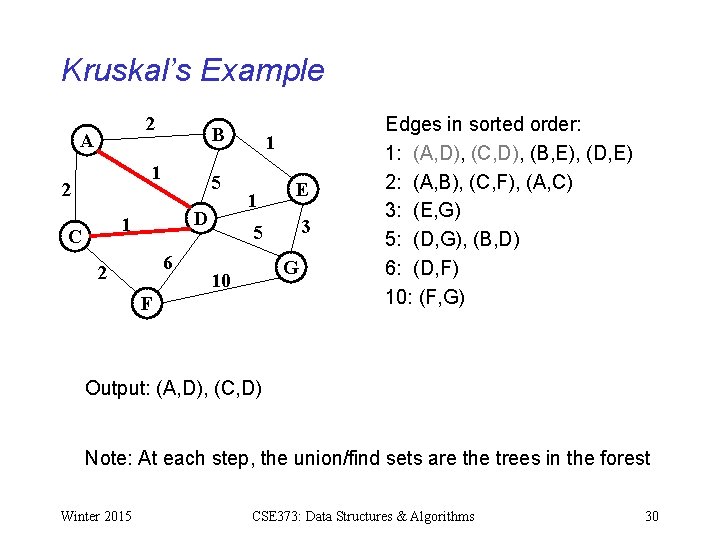
Kruskal’s Example 2 A B 1 2 5 D 1 C 6 2 1 1 E 3 5 G 10 F Edges in sorted order: 1: (A, D), (C, D), (B, E), (D, E) 2: (A, B), (C, F), (A, C) 3: (E, G) 5: (D, G), (B, D) 6: (D, F) 10: (F, G) Output: (A, D), (C, D) Note: At each step, the union/find sets are the trees in the forest Winter 2015 CSE 373: Data Structures & Algorithms 30
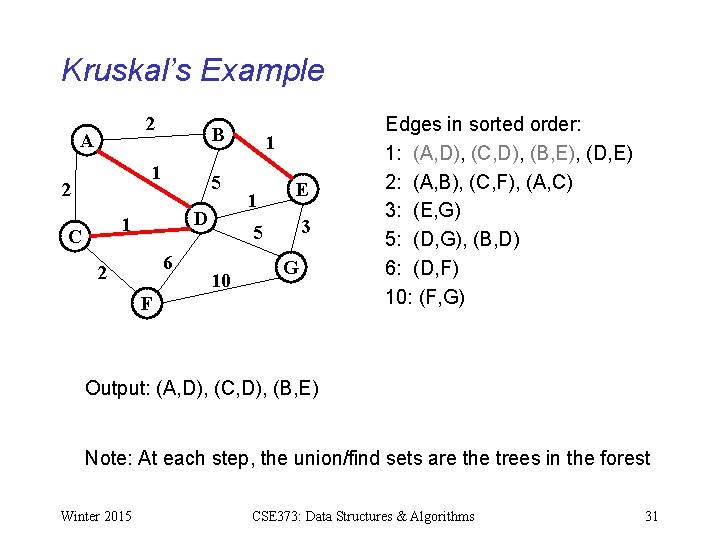
Kruskal’s Example 2 A B 1 2 5 D 1 C 6 2 1 1 E 3 5 10 G F Edges in sorted order: 1: (A, D), (C, D), (B, E), (D, E) 2: (A, B), (C, F), (A, C) 3: (E, G) 5: (D, G), (B, D) 6: (D, F) 10: (F, G) Output: (A, D), (C, D), (B, E) Note: At each step, the union/find sets are the trees in the forest Winter 2015 CSE 373: Data Structures & Algorithms 31
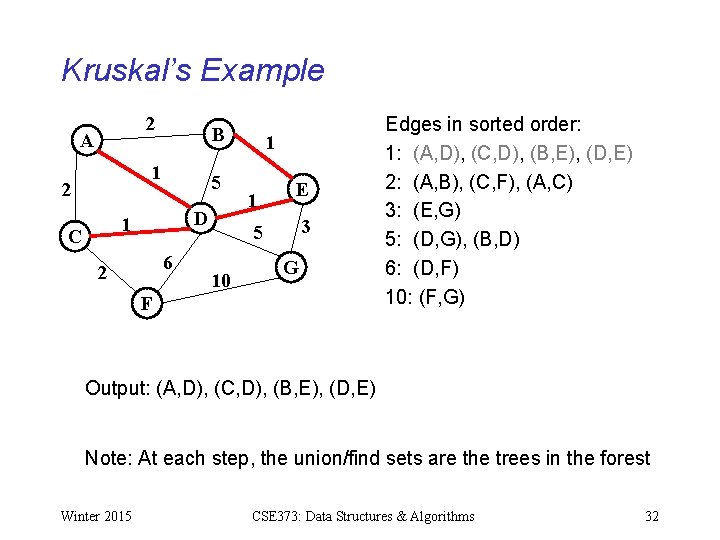
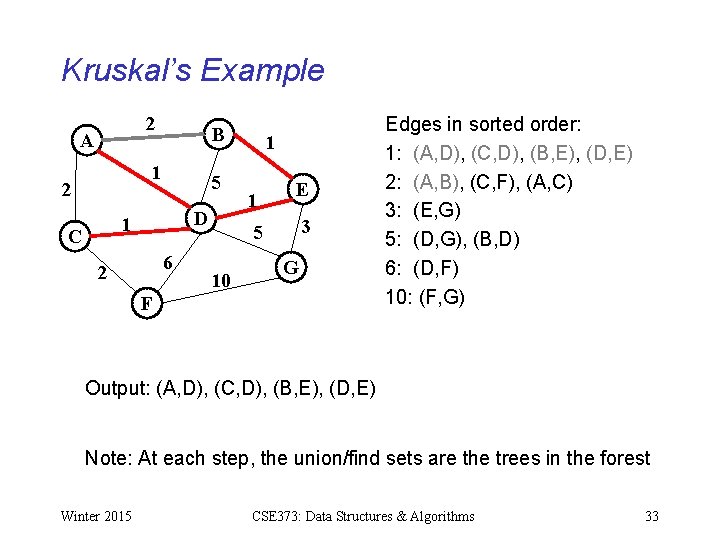
Kruskal’s Example 2 A B 1 2 5 D 1 C 6 2 1 1 E 3 5 10 G F Edges in sorted order: 1: (A, D), (C, D), (B, E), (D, E) 2: (A, B), (C, F), (A, C) 3: (E, G) 5: (D, G), (B, D) 6: (D, F) 10: (F, G) Output: (A, D), (C, D), (B, E), (D, E) Note: At each step, the union/find sets are the trees in the forest Winter 2015 CSE 373: Data Structures & Algorithms 32
Kruskal’s Example 2 A B 1 2 5 D 1 C 6 2 1 1 E 3 5 10 G F Edges in sorted order: 1: (A, D), (C, D), (B, E), (D, E) 2: (A, B), (C, F), (A, C) 3: (E, G) 5: (D, G), (B, D) 6: (D, F) 10: (F, G) Output: (A, D), (C, D), (B, E), (D, E) Note: At each step, the union/find sets are the trees in the forest Winter 2015 CSE 373: Data Structures & Algorithms 33
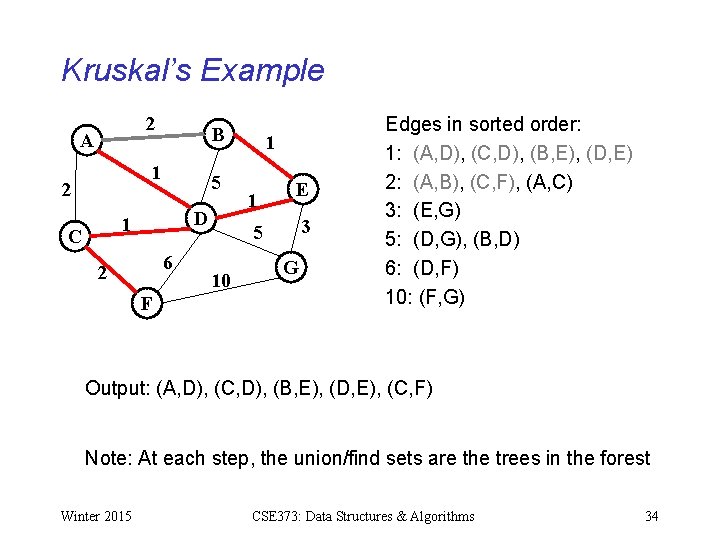
Kruskal’s Example 2 A B 1 2 5 D 1 C 6 2 F 1 1 E 3 5 10 G Edges in sorted order: 1: (A, D), (C, D), (B, E), (D, E) 2: (A, B), (C, F), (A, C) 3: (E, G) 5: (D, G), (B, D) 6: (D, F) 10: (F, G) Output: (A, D), (C, D), (B, E), (D, E), (C, F) Note: At each step, the union/find sets are the trees in the forest Winter 2015 CSE 373: Data Structures & Algorithms 34
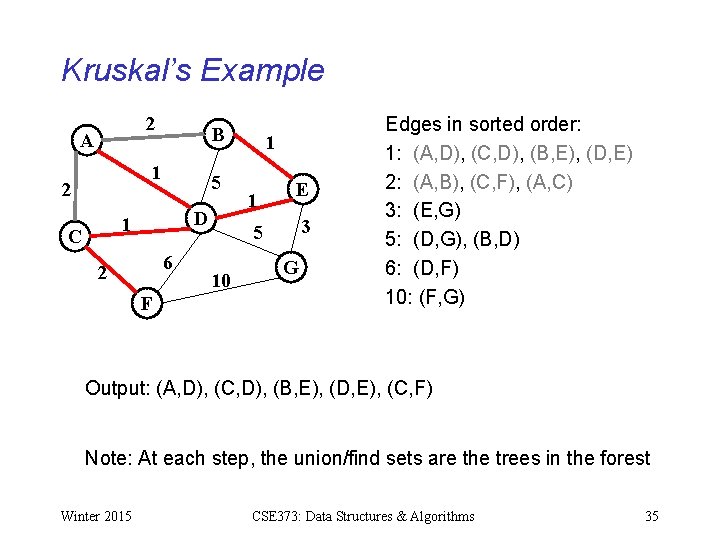
Kruskal’s Example 2 A B 1 2 5 D 1 C 6 2 F 1 1 E 3 5 10 G Edges in sorted order: 1: (A, D), (C, D), (B, E), (D, E) 2: (A, B), (C, F), (A, C) 3: (E, G) 5: (D, G), (B, D) 6: (D, F) 10: (F, G) Output: (A, D), (C, D), (B, E), (D, E), (C, F) Note: At each step, the union/find sets are the trees in the forest Winter 2015 CSE 373: Data Structures & Algorithms 35
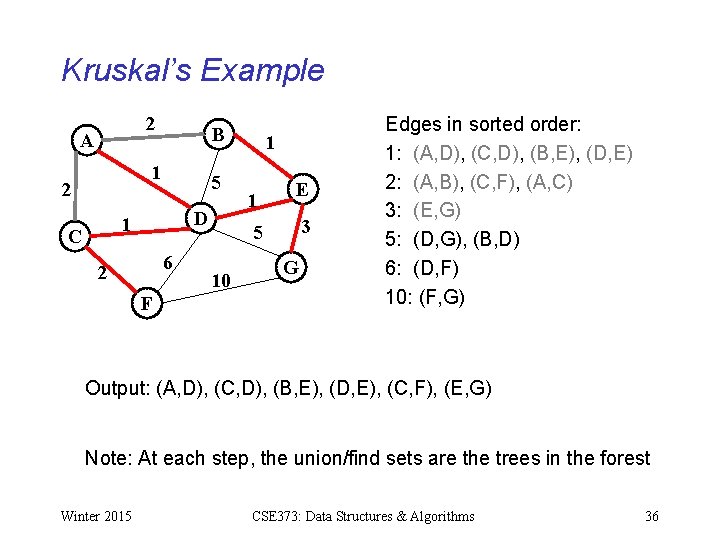
Kruskal’s Example 2 A B 1 2 5 D 1 C 6 2 F 1 1 E 3 5 10 G Edges in sorted order: 1: (A, D), (C, D), (B, E), (D, E) 2: (A, B), (C, F), (A, C) 3: (E, G) 5: (D, G), (B, D) 6: (D, F) 10: (F, G) Output: (A, D), (C, D), (B, E), (D, E), (C, F), (E, G) Note: At each step, the union/find sets are the trees in the forest Winter 2015 CSE 373: Data Structures & Algorithms 36
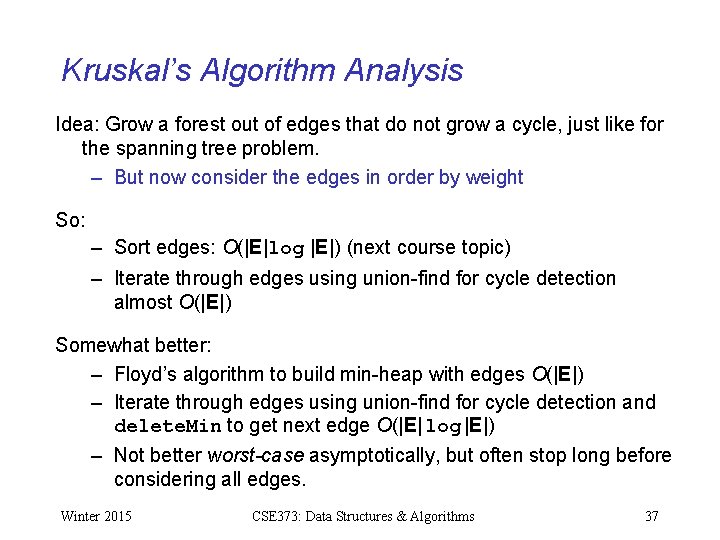
Kruskal’s Algorithm Analysis Idea: Grow a forest out of edges that do not grow a cycle, just like for the spanning tree problem. – But now consider the edges in order by weight So: – Sort edges: O(|E|log |E|) (next course topic) – Iterate through edges using union-find for cycle detection almost O(|E|) Somewhat better: – Floyd’s algorithm to build min-heap with edges O(|E|) – Iterate through edges using union-find for cycle detection and delete. Min to get next edge O(|E| log |E|) – Not better worst-case asymptotically, but often stop long before considering all edges. Winter 2015 CSE 373: Data Structures & Algorithms 37
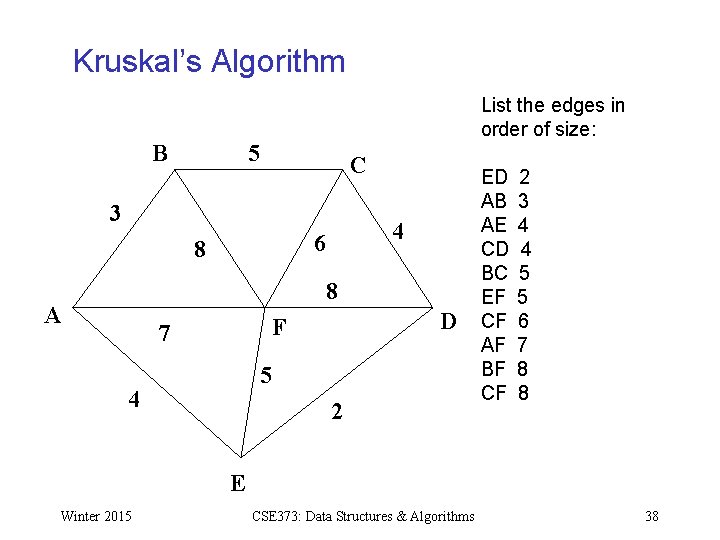
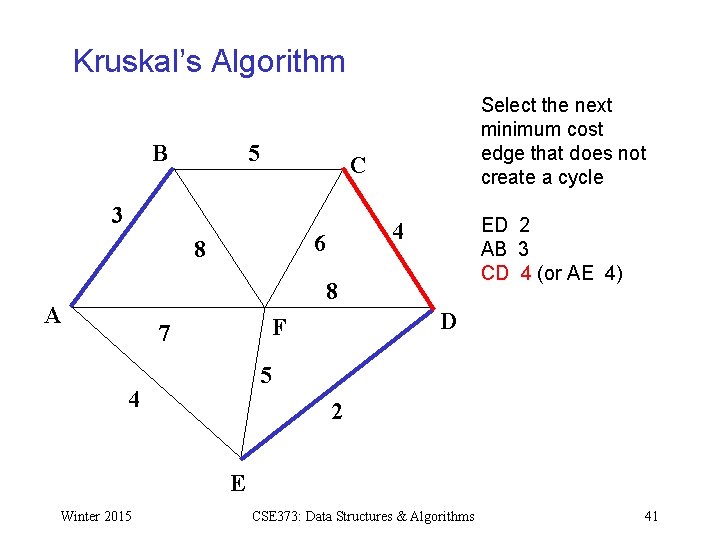
Kruskal’s Algorithm B List the edges in order of size: 5 C 3 4 6 8 8 A D F 7 5 4 2 ED AB AE CD BC EF CF AF BF CF 2 3 4 4 5 5 6 7 8 8 E Winter 2015 CSE 373: Data Structures & Algorithms 38
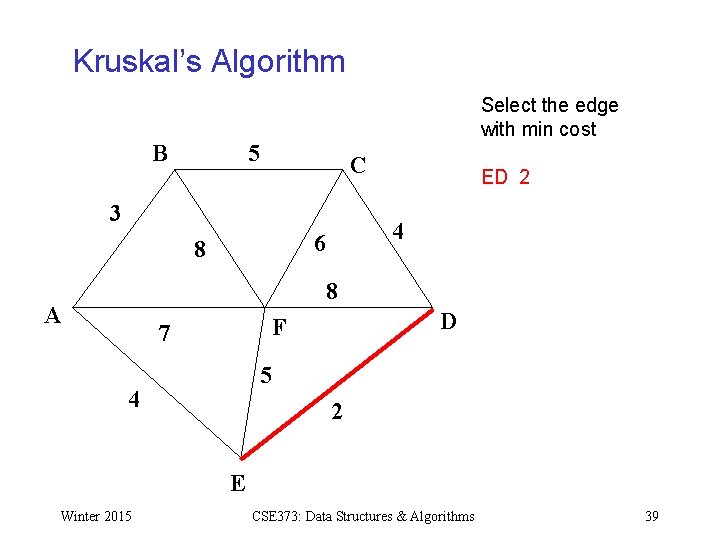
Kruskal’s Algorithm B Select the edge with min cost 5 C 3 4 6 8 ED 2 8 A D F 7 5 4 2 E Winter 2015 CSE 373: Data Structures & Algorithms 39
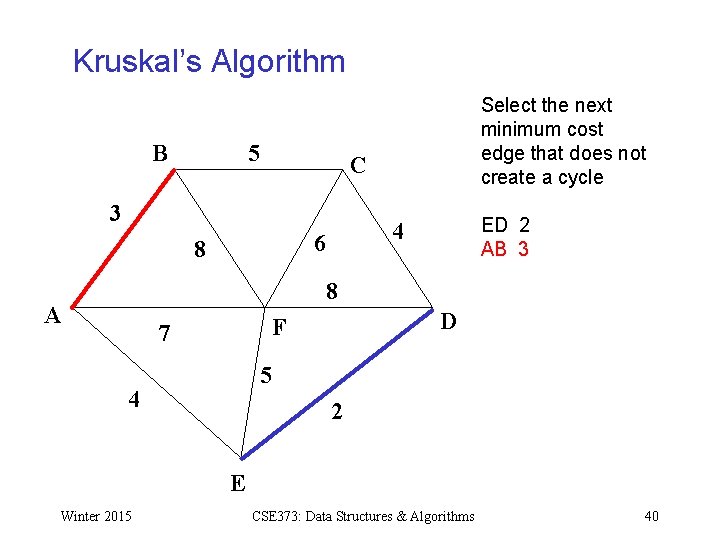
Kruskal’s Algorithm B 5 Select the next minimum cost edge that does not create a cycle C 3 6 8 ED 2 AB 3 4 8 A D F 7 5 4 2 E Winter 2015 CSE 373: Data Structures & Algorithms 40
Kruskal’s Algorithm B 5 Select the next minimum cost edge that does not create a cycle C 3 6 8 ED 2 AB 3 CD 4 (or AE 4) 4 8 A D F 7 5 4 2 E Winter 2015 CSE 373: Data Structures & Algorithms 41
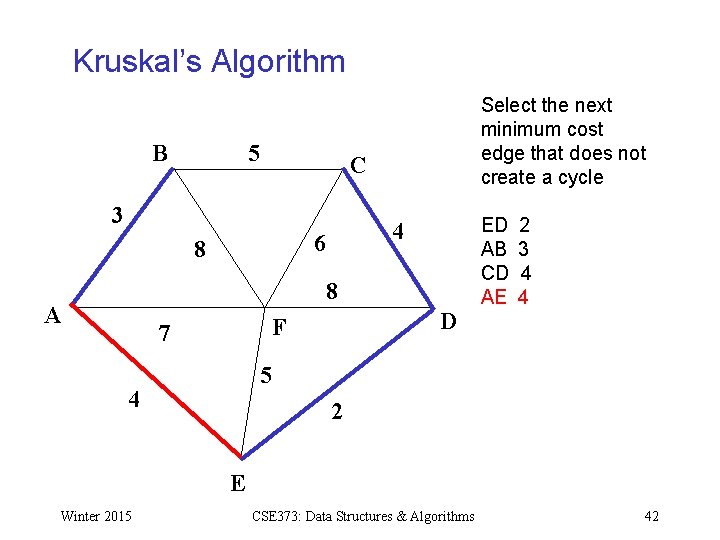
Kruskal’s Algorithm B 5 Select the next minimum cost edge that does not create a cycle C 3 4 6 8 8 A D F 7 ED AB CD AE 2 3 4 4 5 4 2 E Winter 2015 CSE 373: Data Structures & Algorithms 42
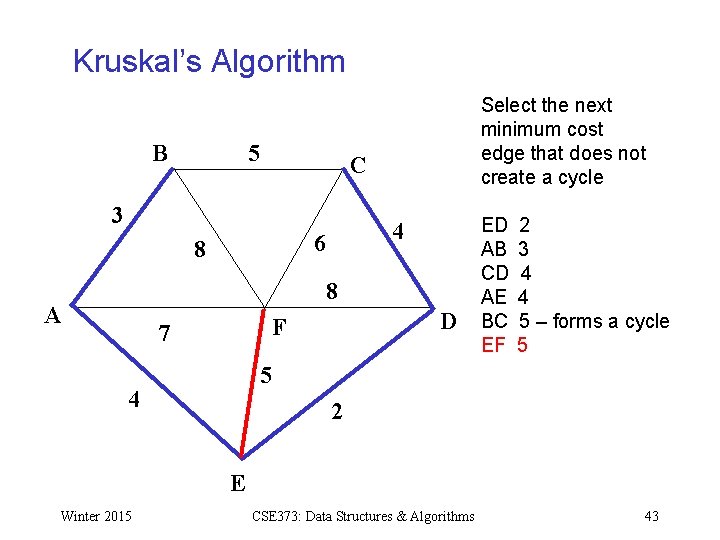
Kruskal’s Algorithm B 5 Select the next minimum cost edge that does not create a cycle C 3 4 6 8 8 A D F 7 ED AB CD AE BC EF 2 3 4 4 5 – forms a cycle 5 5 4 2 E Winter 2015 CSE 373: Data Structures & Algorithms 43
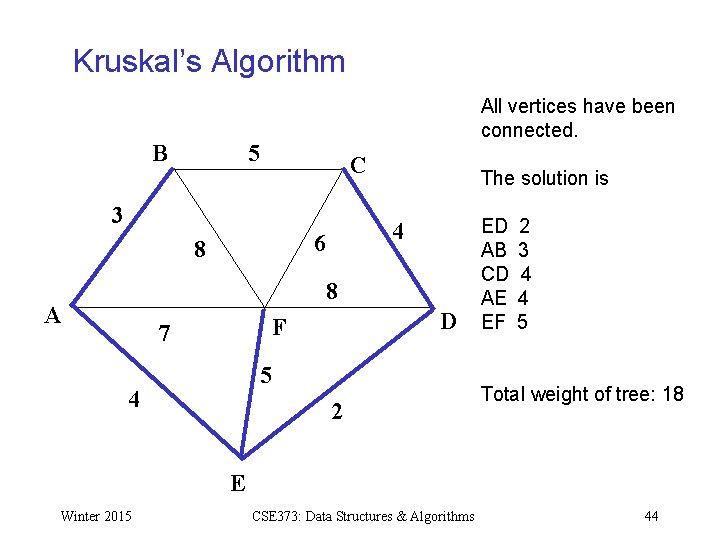
Kruskal’s Algorithm B All vertices have been connected. 5 C 3 4 6 8 The solution is 8 A D F 7 5 4 2 ED AB CD AE EF 2 3 4 4 5 Total weight of tree: 18 E Winter 2015 CSE 373: Data Structures & Algorithms 44
Done with graph algorithms! Next lecture… • Sorting Winter 2015 CSE 373: Data Structures & Algorithms 45