
CSE 373 Data Structures Algorithms Lecture 10 Disjoint
- Slides: 29
CSE 373: Data Structures & Algorithms Lecture 10: Disjoint Sets and the Union-Find ADT Linda Shapiro Spring 2016
Announcements • Get started on HW 03 – Keyword search in binary search trees Spring 2016 CSE 373: Data Structures & Algorithms 2
Where we are Last lecture: • Priority queues and binary heaps Today: • Disjoint sets • The union-find ADT for disjoint sets Spring 2016 CSE 373: Data Structures & Algorithms 3
Disjoint sets • A set is a collection of elements (no-repeats) • In computer science, two sets are said to be disjoint if they have no element in common. • S 1 S 2 = • For example, {1, 2, 3} and {4, 5, 6} are disjoint sets. • For example, {x, y, z} and {t, u, x} are not disjoint. Spring 2016 CSE 373: Data Structures & Algorithms 4
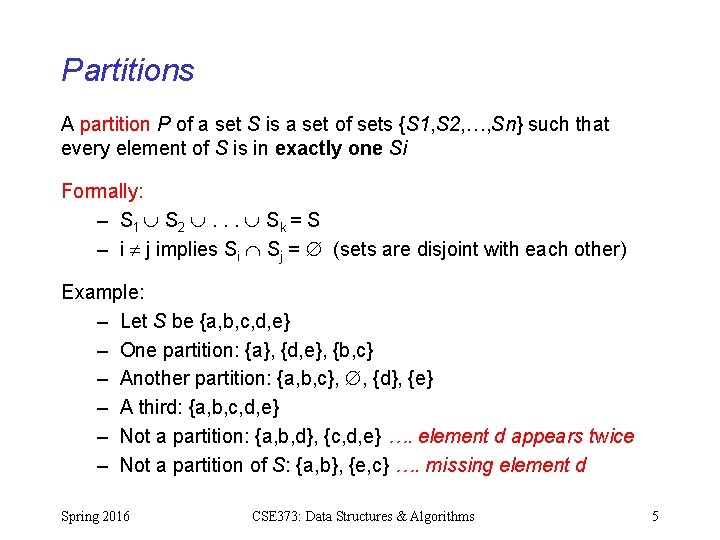
Partitions A partition P of a set S is a set of sets {S 1, S 2, …, Sn} such that every element of S is in exactly one Si Formally: – S 1 S 2 . . . S k = S – i j implies Si Sj = (sets are disjoint with each other) Example: – Let S be {a, b, c, d, e} – One partition: {a}, {d, e}, {b, c} – Another partition: {a, b, c}, , {d}, {e} – A third: {a, b, c, d, e} – Not a partition: {a, b, d}, {c, d, e} …. element d appears twice – Not a partition of S: {a, b}, {e, c} …. missing element d Spring 2016 CSE 373: Data Structures & Algorithms 5
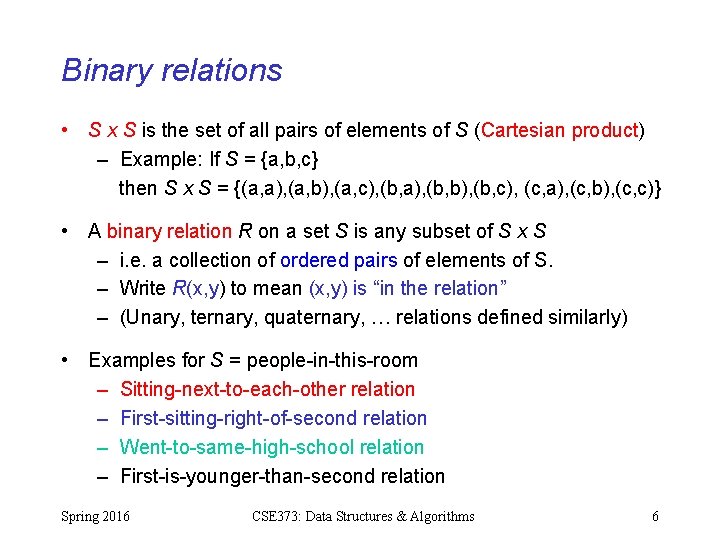
Binary relations • S x S is the set of all pairs of elements of S (Cartesian product) – Example: If S = {a, b, c} then S x S = {(a, a), (a, b), (a, c), (b, a), (b, b), (b, c), (c, a), (c, b), (c, c)} • A binary relation R on a set S is any subset of S x S – i. e. a collection of ordered pairs of elements of S. – Write R(x, y) to mean (x, y) is “in the relation” – (Unary, ternary, quaternary, … relations defined similarly) • Examples for S = people-in-this-room – Sitting-next-to-each-other relation – First-sitting-right-of-second relation – Went-to-same-high-school relation – First-is-younger-than-second relation Spring 2016 CSE 373: Data Structures & Algorithms 6
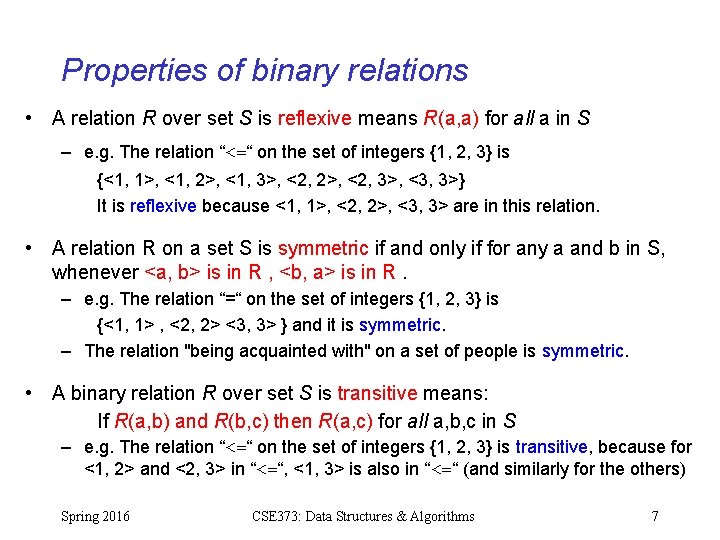
Properties of binary relations • A relation R over set S is reflexive means R(a, a) for all a in S – e. g. The relation “<=“ on the set of integers {1, 2, 3} is {<1, 1>, <1, 2>, <1, 3>, <2, 2>, <2, 3>, <3, 3>} It is reflexive because <1, 1>, <2, 2>, <3, 3> are in this relation. • A relation R on a set S is symmetric if and only if for any a and b in S, whenever <a, b> is in R , <b, a> is in R. – e. g. The relation “=“ on the set of integers {1, 2, 3} is {<1, 1> , <2, 2> <3, 3> } and it is symmetric. – The relation "being acquainted with" on a set of people is symmetric. • A binary relation R over set S is transitive means: If R(a, b) and R(b, c) then R(a, c) for all a, b, c in S – e. g. The relation “<=“ on the set of integers {1, 2, 3} is transitive, because for <1, 2> and <2, 3> in “<=“, <1, 3> is also in “<=“ (and similarly for the others) Spring 2016 CSE 373: Data Structures & Algorithms 7
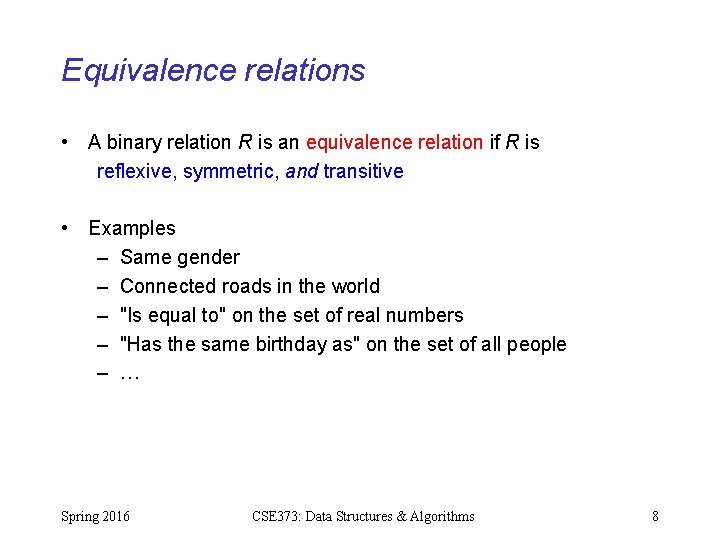
Equivalence relations • A binary relation R is an equivalence relation if R is reflexive, symmetric, and transitive • Examples – Same gender – Connected roads in the world – "Is equal to" on the set of real numbers – "Has the same birthday as" on the set of all people – … Spring 2016 CSE 373: Data Structures & Algorithms 8
Punch-line • Equivalence relations give rise to partitions. • Every partition induces an equivalence relation • Every equivalence relation induces a partition • Suppose P={S 1, S 2, …, Sn} is a partition – Define R(x, y) to mean x and y are in the same Si • R is an equivalence relation • Suppose R is an equivalence relation over S – Consider a set of sets S 1, S 2, …, Sn where (1) x and y are in the same Si if and only if R(x, y) (2) Every x is in some Si • This set of sets is a partition Spring 2016 CSE 373: Data Structures & Algorithms 9
Example • Let S be {a, b, c, d, e} • One partition: {a, b, c}, {d}, {e} • The corresponding equivalence relation: (a, a), (b, b), (c, c), (a, b), (b, a), (a, c), (c, a), (b, c), (c, b), (d, d), (e, e) Spring 2016 CSE 373: Data Structures & Algorithms 10
The Union-Find ADT • The union-find ADT (or "Disjoint Sets" or "Dynamic Equivalence Relation") keeps track of a set of elements partitioned into a number of disjoint subsets. • Many uses (which is why an ADT taught in CSE 373): – Road/network/graph connectivity (will see this again) • “connected components” e. g. , in social network – Partition an image by connected-pixels-of-similar-color – Type inference in programming languages • Not as common as dictionaries, queues, and stacks, but valuable because implementations are very fast, so when applicable can provide big improvements Spring 2016 CSE 373: Data Structures & Algorithms 11
Connected Components of an Image gray tone image Spring 2016 binary image cleaned up CSE 373: Data Structures & Algorithms components 12
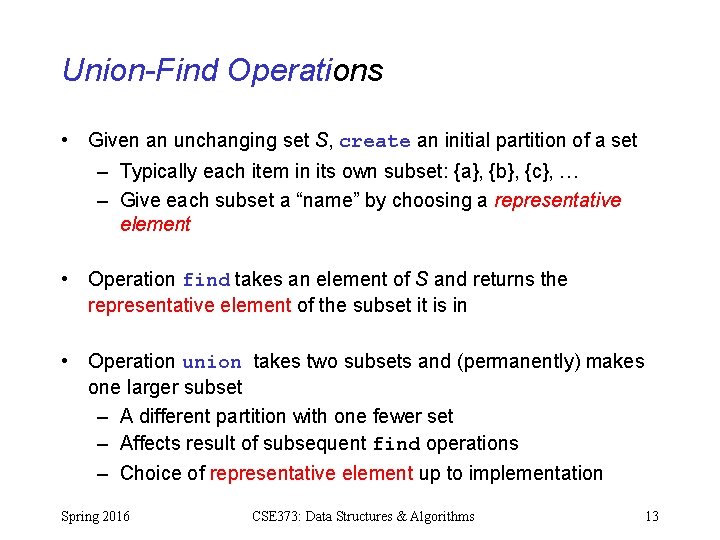
Union-Find Operations • Given an unchanging set S, create an initial partition of a set – Typically each item in its own subset: {a}, {b}, {c}, … – Give each subset a “name” by choosing a representative element • Operation find takes an element of S and returns the representative element of the subset it is in • Operation union takes two subsets and (permanently) makes one larger subset – A different partition with one fewer set – Affects result of subsequent find operations – Choice of representative element up to implementation Spring 2016 CSE 373: Data Structures & Algorithms 13
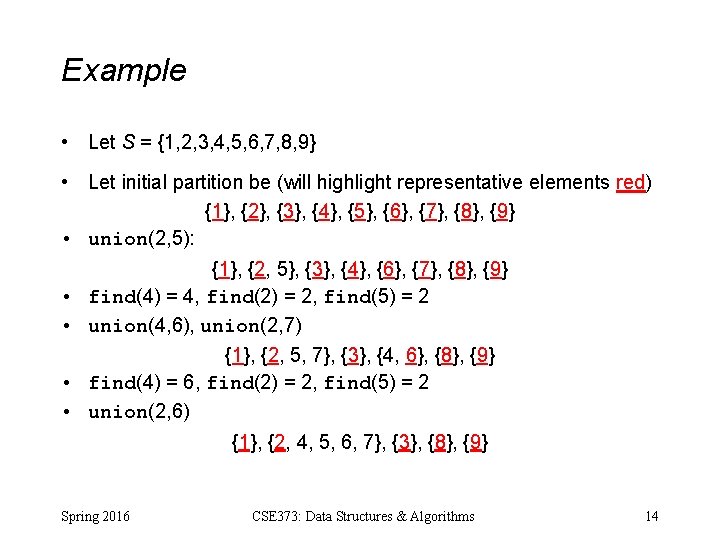
Example • Let S = {1, 2, 3, 4, 5, 6, 7, 8, 9} • Let initial partition be (will highlight representative elements red) {1}, {2}, {3}, {4}, {5}, {6}, {7}, {8}, {9} • union(2, 5): {1}, {2, 5}, {3}, {4}, {6}, {7}, {8}, {9} • find(4) = 4, find(2) = 2, find(5) = 2 • union(4, 6), union(2, 7) {1}, {2, 5, 7}, {3}, {4, 6}, {8}, {9} • find(4) = 6, find(2) = 2, find(5) = 2 • union(2, 6) {1}, {2, 4, 5, 6, 7}, {3}, {8}, {9} Spring 2016 CSE 373: Data Structures & Algorithms 14
No other operations • All that can “happen” is sets get unioned – No “un-union” or “create new set” or … • As always: trade-offs – Implementations will exploit this small ADT • Surprisingly useful ADT – But not as common as dictionaries or priority queues Spring 2016 CSE 373: Data Structures & Algorithms 15
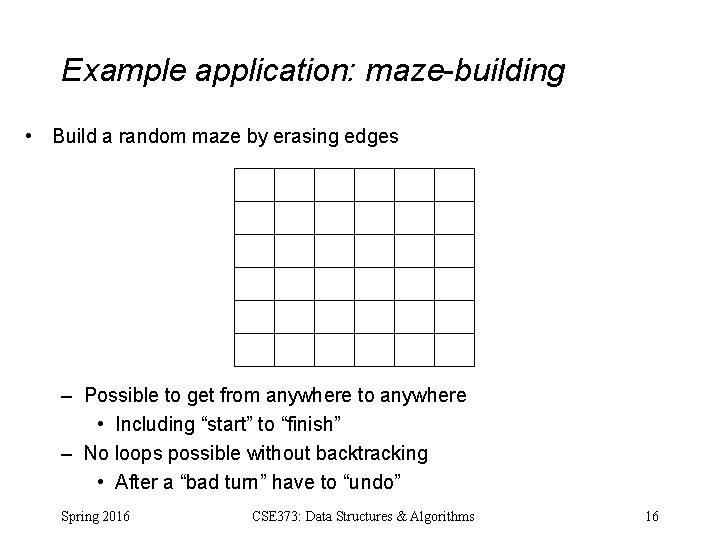
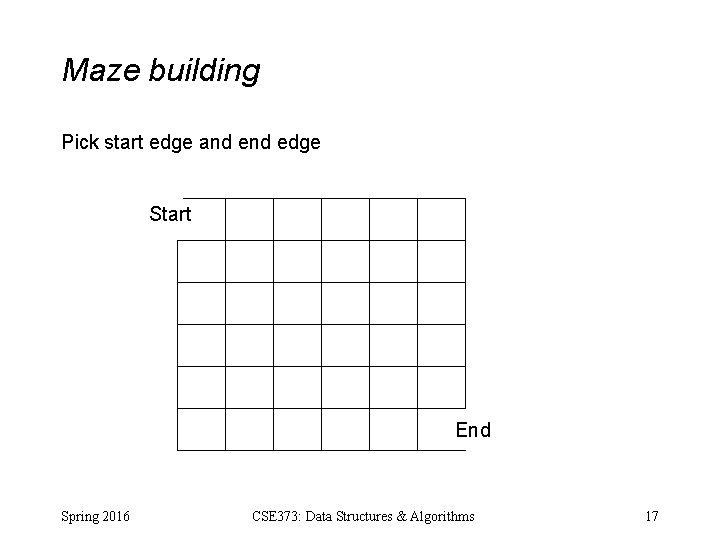
Example application: maze-building • Build a random maze by erasing edges – Possible to get from anywhere to anywhere • Including “start” to “finish” – No loops possible without backtracking • After a “bad turn” have to “undo” Spring 2016 CSE 373: Data Structures & Algorithms 16
Maze building Pick start edge and edge Start End Spring 2016 CSE 373: Data Structures & Algorithms 17
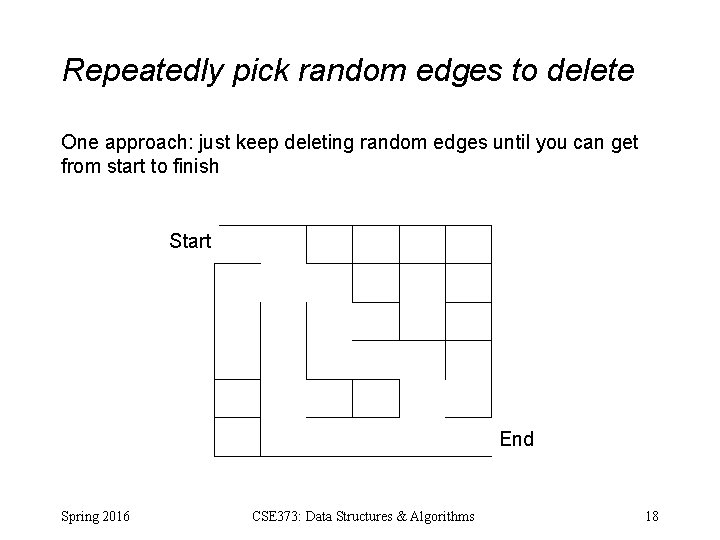
Repeatedly pick random edges to delete One approach: just keep deleting random edges until you can get from start to finish Start End Spring 2016 CSE 373: Data Structures & Algorithms 18
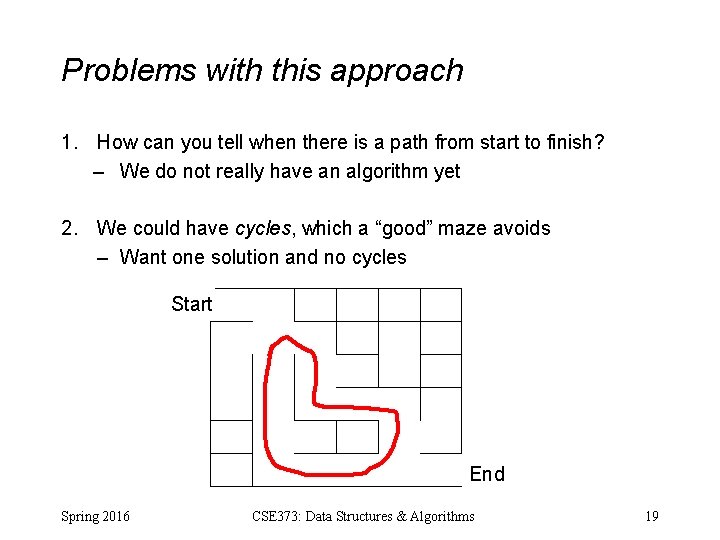
Problems with this approach 1. How can you tell when there is a path from start to finish? – We do not really have an algorithm yet 2. We could have cycles, which a “good” maze avoids – Want one solution and no cycles Start End Spring 2016 CSE 373: Data Structures & Algorithms 19
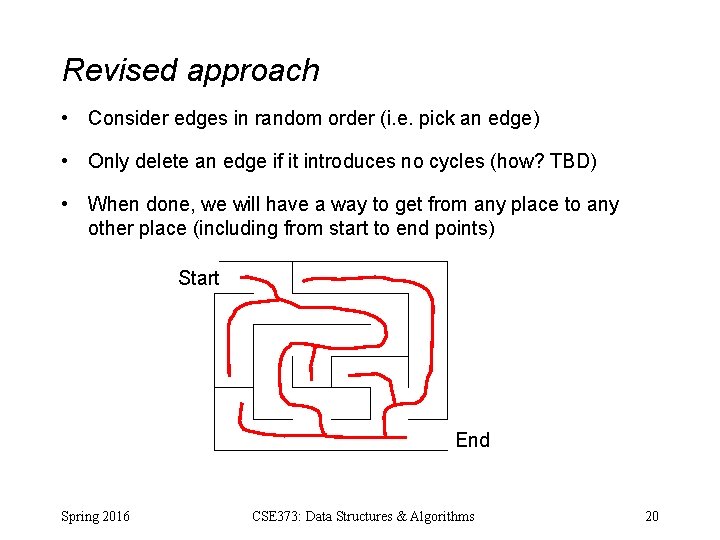
Revised approach • Consider edges in random order (i. e. pick an edge) • Only delete an edge if it introduces no cycles (how? TBD) • When done, we will have a way to get from any place to any other place (including from start to end points) Start End Spring 2016 CSE 373: Data Structures & Algorithms 20
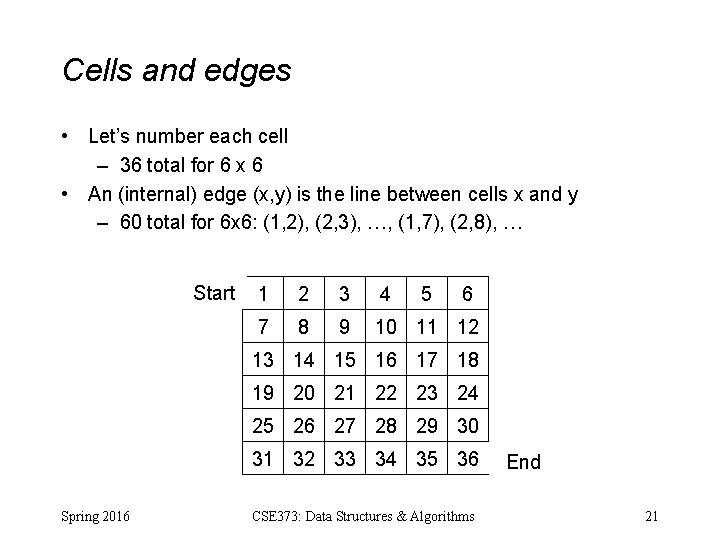
Cells and edges • Let’s number each cell – 36 total for 6 x 6 • An (internal) edge (x, y) is the line between cells x and y – 60 total for 6 x 6: (1, 2), (2, 3), …, (1, 7), (2, 8), … Start 1 2 3 4 5 6 7 8 9 10 11 12 13 14 15 16 17 18 19 20 21 22 23 24 25 26 27 28 29 30 31 32 33 34 35 36 Spring 2016 CSE 373: Data Structures & Algorithms End 21
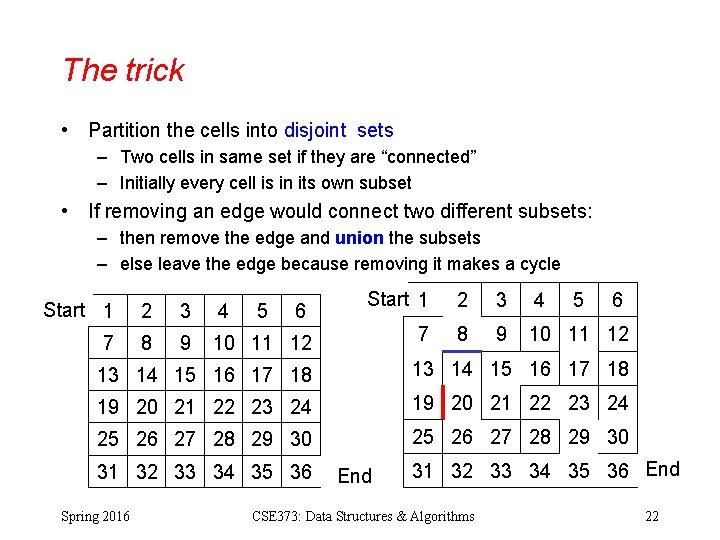
The trick • Partition the cells into disjoint sets – Two cells in same set if they are “connected” – Initially every cell is in its own subset • If removing an edge would connect two different subsets: – then remove the edge and union the subsets – else leave the edge because removing it makes a cycle Start 1 2 3 4 7 8 9 10 11 12 5 6 13 14 15 16 17 18 19 20 21 22 23 24 25 26 27 28 29 30 31 32 33 34 35 36 Spring 2016 End 31 32 33 34 35 36 End CSE 373: Data Structures & Algorithms 22
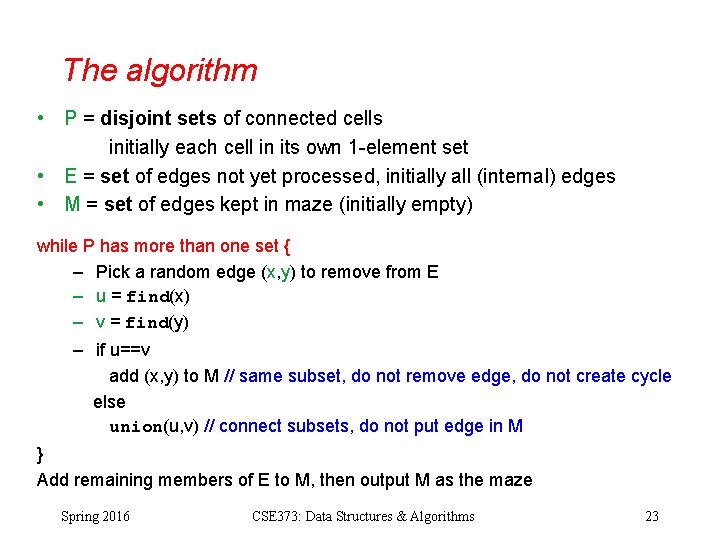
The algorithm • P = disjoint sets of connected cells initially each cell in its own 1 -element set • E = set of edges not yet processed, initially all (internal) edges • M = set of edges kept in maze (initially empty) while P has more than one set { – Pick a random edge (x, y) to remove from E – u = find(x) – v = find(y) – if u==v add (x, y) to M // same subset, do not remove edge, do not create cycle else union(u, v) // connect subsets, do not put edge in M } Add remaining members of E to M, then output M as the maze Spring 2016 CSE 373: Data Structures & Algorithms 23
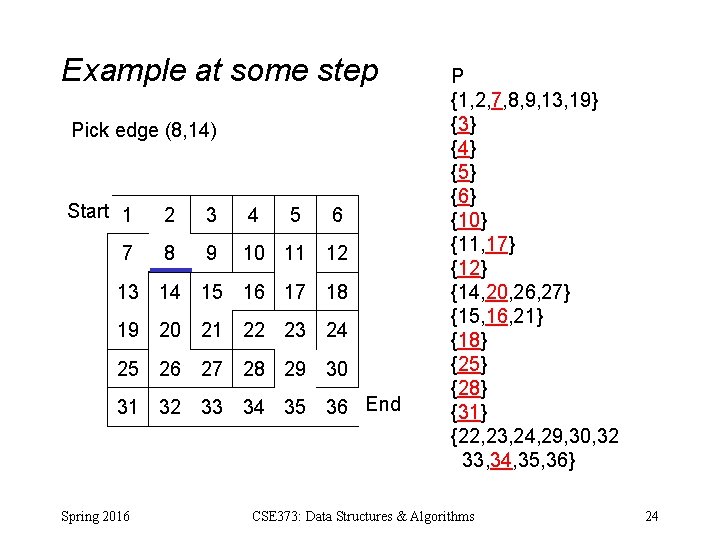
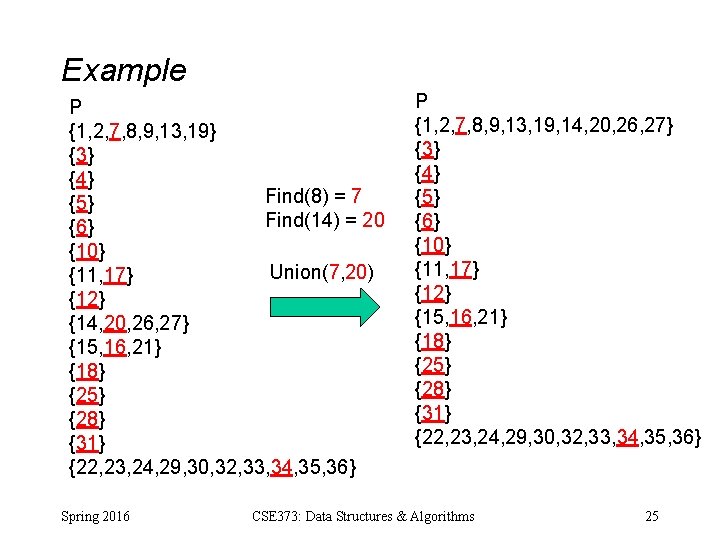
Example at some step Pick edge (8, 14) Start 1 2 3 4 7 8 9 10 11 12 5 6 13 14 15 16 17 18 19 20 21 22 23 24 25 26 27 28 29 30 31 32 33 34 35 36 End Spring 2016 P {1, 2, 7, 8, 9, 13, 19} {3} {4} {5} {6} {10} {11, 17} {12} {14, 20, 26, 27} {15, 16, 21} {18} {25} {28} {31} {22, 23, 24, 29, 30, 32 33, 34, 35, 36} CSE 373: Data Structures & Algorithms 24
Example P {1, 2, 7, 8, 9, 13, 19} {3} {4} Find(8) = 7 {5} Find(14) = 20 {6} {10} Union(7, 20) {11, 17} {12} {14, 20, 26, 27} {15, 16, 21} {18} {25} {28} {31} {22, 23, 24, 29, 30, 32, 33, 34, 35, 36} Spring 2016 P {1, 2, 7, 8, 9, 13, 19, 14, 20, 26, 27} {3} {4} {5} {6} {10} {11, 17} {12} {15, 16, 21} {18} {25} {28} {31} {22, 23, 24, 29, 30, 32, 33, 34, 35, 36} CSE 373: Data Structures & Algorithms 25
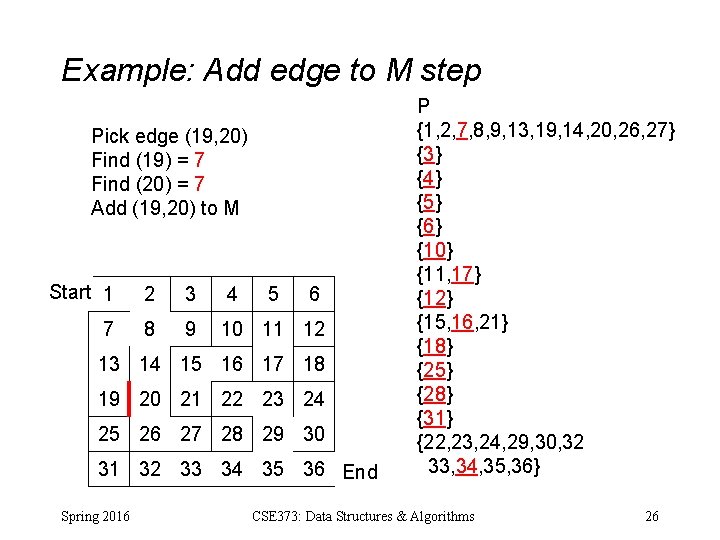
Example: Add edge to M step Pick edge (19, 20) Find (19) = 7 Find (20) = 7 Add (19, 20) to M Start 1 2 3 4 7 8 9 10 11 12 5 6 13 14 15 16 17 18 19 20 21 22 23 24 25 26 27 28 29 30 31 32 33 34 35 36 End Spring 2016 P {1, 2, 7, 8, 9, 13, 19, 14, 20, 26, 27} {3} {4} {5} {6} {10} {11, 17} {12} {15, 16, 21} {18} {25} {28} {31} {22, 23, 24, 29, 30, 32 33, 34, 35, 36} CSE 373: Data Structures & Algorithms 26
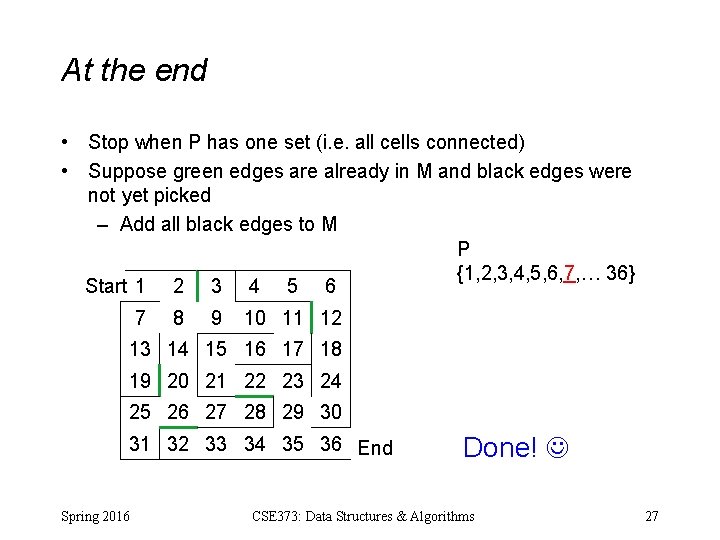
At the end • Stop when P has one set (i. e. all cells connected) • Suppose green edges are already in M and black edges were not yet picked – Add all black edges to M P {1, 2, 3, 4, 5, 6, 7, … 36} Start 1 2 3 4 5 6 7 8 9 10 11 12 13 14 15 16 17 18 19 20 21 22 23 24 25 26 27 28 29 30 31 32 33 34 35 36 End Spring 2016 Done! CSE 373: Data Structures & Algorithms 27
A data structure for the union-find ADT • Start with an initial partition of n subsets – Often 1 -element sets, e. g. , {1}, {2}, {3}, …, {n} • May have any number of find operations • May have up to n-1 union operations in any order – After n-1 union operations, every find returns same 1 set Spring 2016 CSE 373: Data Structures & Algorithms 28
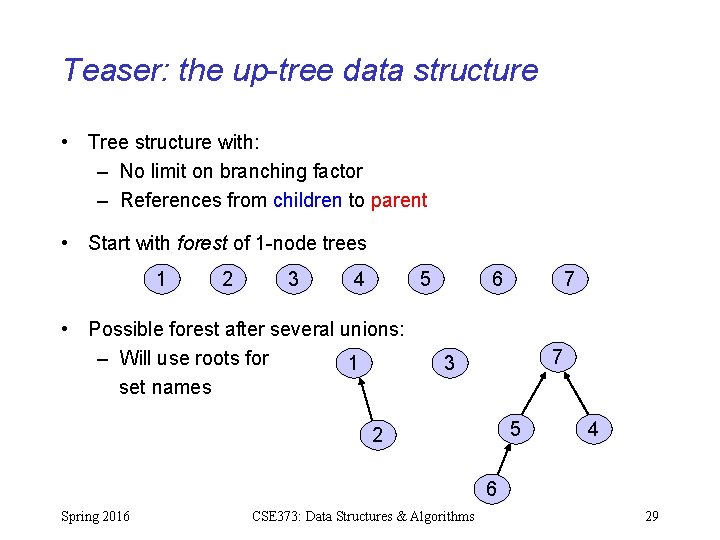
Teaser: the up-tree data structure • Tree structure with: – No limit on branching factor – References from children to parent • Start with forest of 1 -node trees 1 2 3 4 5 • Possible forest after several unions: – Will use roots for 1 set names 6 7 7 3 5 2 4 6 Spring 2016 CSE 373: Data Structures & Algorithms 29