
CSE 341 Programming Languages Lecture 7 FirstClass Functions
![Map fun map (f, xs) = case xs of [] => [] | x:](https://slidetodoc.com/presentation_image_h2/882adcd9638394c092ee3e9162349691/image-8.jpg "Map fun map (f, xs) = case xs of [] => [] | x:")
![Filter fun filter (f, xs) = case xs of [] => [] | x:](https://slidetodoc.com/presentation_image_h2/882adcd9638394c092ee3e9162349691/image-9.jpg "Filter fun filter (f, xs) = case xs of [] => [] | x:")
- Slides: 19
CSE 341: Programming Languages Lecture 7 First-Class Functions Brett Wortzman Spring 2020
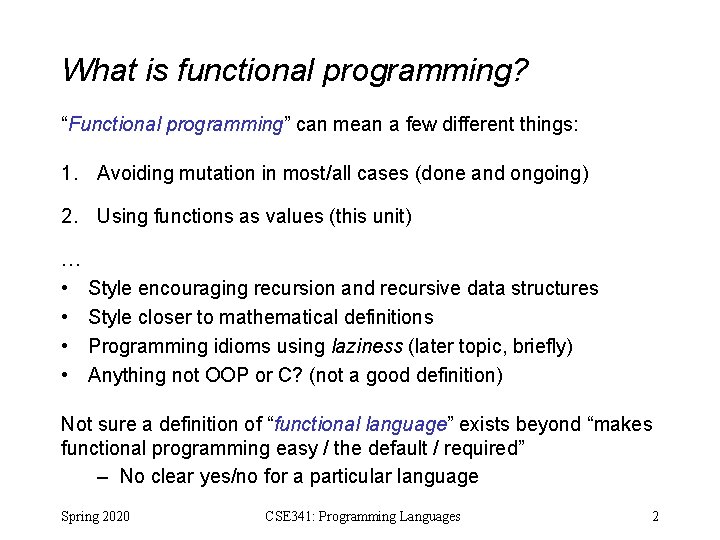
What is functional programming? “Functional programming” can mean a few different things: 1. Avoiding mutation in most/all cases (done and ongoing) 2. Using functions as values (this unit) … • • Style encouraging recursion and recursive data structures Style closer to mathematical definitions Programming idioms using laziness (later topic, briefly) Anything not OOP or C? (not a good definition) Not sure a definition of “functional language” exists beyond “makes functional programming easy / the default / required” – No clear yes/no for a particular language Spring 2020 CSE 341: Programming Languages 2
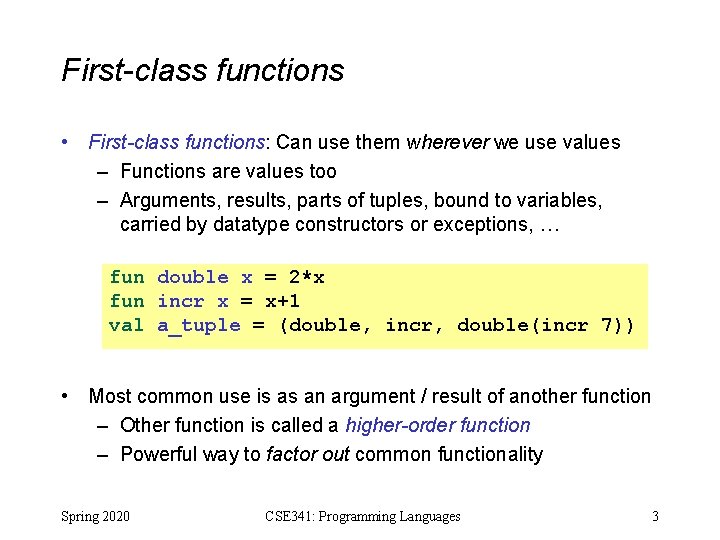
First-class functions • First-class functions: Can use them wherever we use values – Functions are values too – Arguments, results, parts of tuples, bound to variables, carried by datatype constructors or exceptions, … fun double x = 2*x fun incr x = x+1 val a_tuple = (double, incr, double(incr 7)) • Most common use is as an argument / result of another function – Other function is called a higher-order function – Powerful way to factor out common functionality Spring 2020 CSE 341: Programming Languages 3
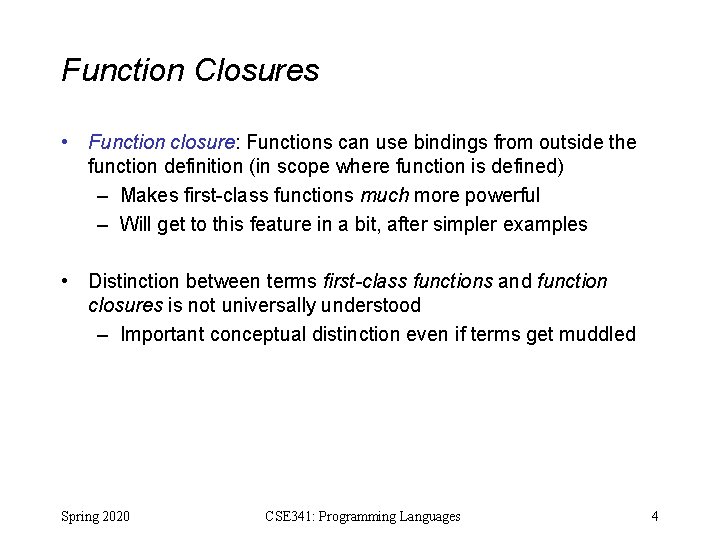
Function Closures • Function closure: Functions can use bindings from outside the function definition (in scope where function is defined) – Makes first-class functions much more powerful – Will get to this feature in a bit, after simpler examples • Distinction between terms first-class functions and function closures is not universally understood – Important conceptual distinction even if terms get muddled Spring 2020 CSE 341: Programming Languages 4
Onward The next week: – How to use first-class functions and closures – The precise semantics – Multiple powerful idioms Spring 2020 CSE 341: Programming Languages 5
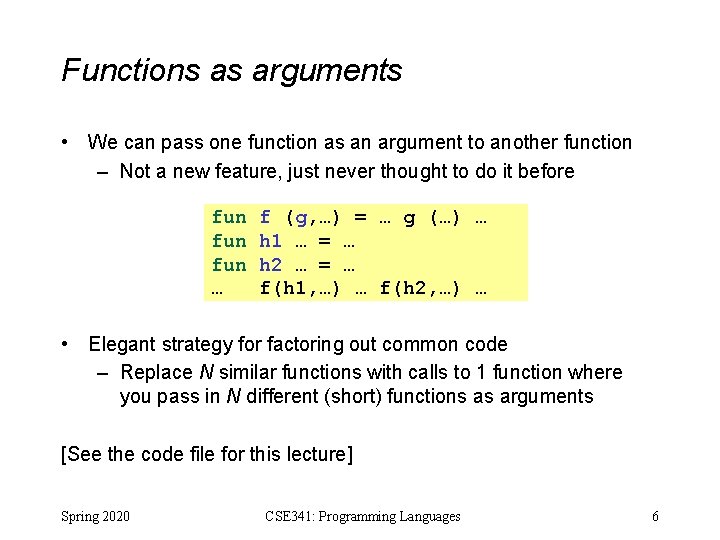
Functions as arguments • We can pass one function as an argument to another function – Not a new feature, just never thought to do it before fun fun … f (g, …) = … g (…) … h 1 … = … h 2 … = … f(h 1, …) … f(h 2, …) … • Elegant strategy for factoring out common code – Replace N similar functions with calls to 1 function where you pass in N different (short) functions as arguments [See the code file for this lecture] Spring 2020 CSE 341: Programming Languages 6
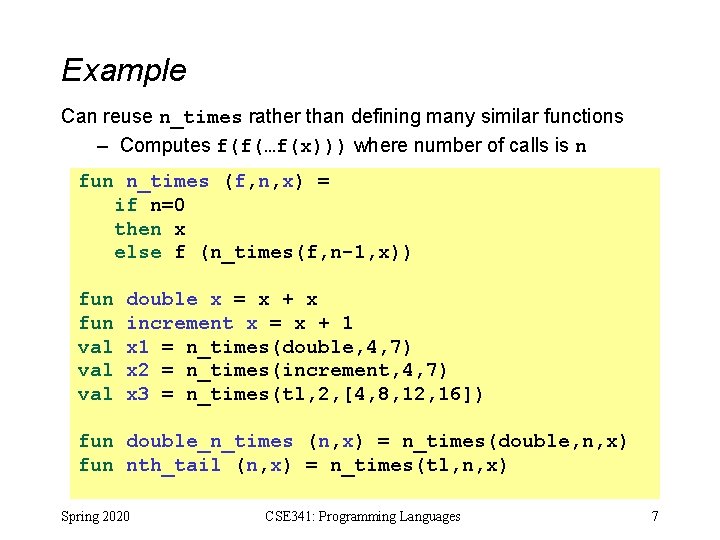
Example Can reuse n_times rather than defining many similar functions – Computes f(f(…f(x))) where number of calls is n fun n_times (f, n, x) = if n=0 then x else f (n_times(f, n-1, x)) fun val val double x = x + x increment x = x + 1 x 1 = n_times(double, 4, 7) x 2 = n_times(increment, 4, 7) x 3 = n_times(tl, 2, [4, 8, 12, 16]) fun double_n_times (n, x) = n_times(double, n, x) fun nth_tail (n, x) = n_times(tl, n, x) Spring 2020 CSE 341: Programming Languages 7
Map fun map (f, xs) = case xs of [] => [] | x: : xs’ => (f x): : (map(f, xs’)) val map : ('a -> 'b) * 'a list -> 'b list Map is, without doubt, in the “higher-order function hall-of-fame” – The name is standard (for any data structure) – You use it all the time once you know it: saves a little space, but more importantly, communicates what you are doing – Similar predefined function: List. map • But it uses currying (coming soon) Spring 2020 CSE 341: Programming Languages 8
Filter fun filter (f, xs) = case xs of [] => [] | x: : xs’ => if f x then x: : (filter(f, xs’)) else filter(f, xs’) val filter : ('a -> bool) * 'a list -> 'a list Filter is also in the hall-of-fame – So use it whenever your computation is a filter – Similar predefined function: List. filter • But it uses currying (coming soon) Spring 2020 CSE 341: Programming Languages 9
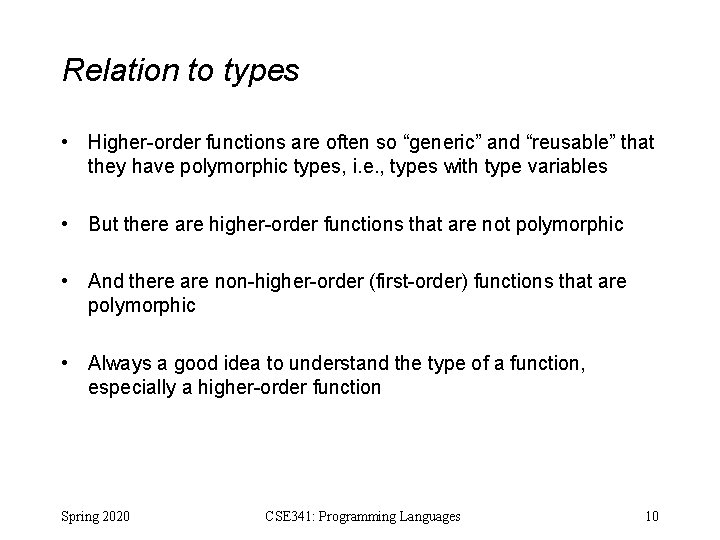
Relation to types • Higher-order functions are often so “generic” and “reusable” that they have polymorphic types, i. e. , types with type variables • But there are higher-order functions that are not polymorphic • And there are non-higher-order (first-order) functions that are polymorphic • Always a good idea to understand the type of a function, especially a higher-order function Spring 2020 CSE 341: Programming Languages 10
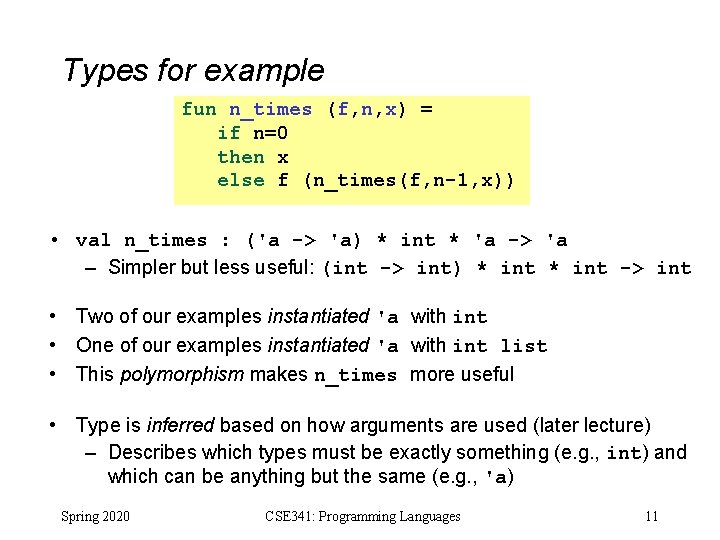
Types for example fun n_times (f, n, x) = if n=0 then x else f (n_times(f, n-1, x)) • val n_times : ('a -> 'a) * int * 'a -> 'a – Simpler but less useful: (int -> int) * int -> int • Two of our examples instantiated 'a with int • One of our examples instantiated 'a with int list • This polymorphism makes n_times more useful • Type is inferred based on how arguments are used (later lecture) – Describes which types must be exactly something (e. g. , int) and which can be anything but the same (e. g. , 'a) Spring 2020 CSE 341: Programming Languages 11
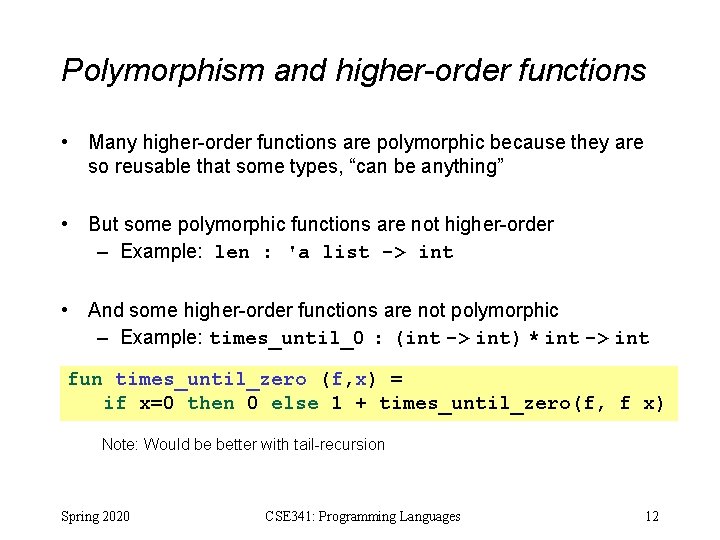
Polymorphism and higher-order functions • Many higher-order functions are polymorphic because they are so reusable that some types, “can be anything” • But some polymorphic functions are not higher-order – Example: len : 'a list -> int • And some higher-order functions are not polymorphic – Example: times_until_0 : (int -> int) * int -> int fun times_until_zero (f, x) = if x=0 then 0 else 1 + times_until_zero(f, f x) Note: Would be better with tail-recursion Spring 2020 CSE 341: Programming Languages 12
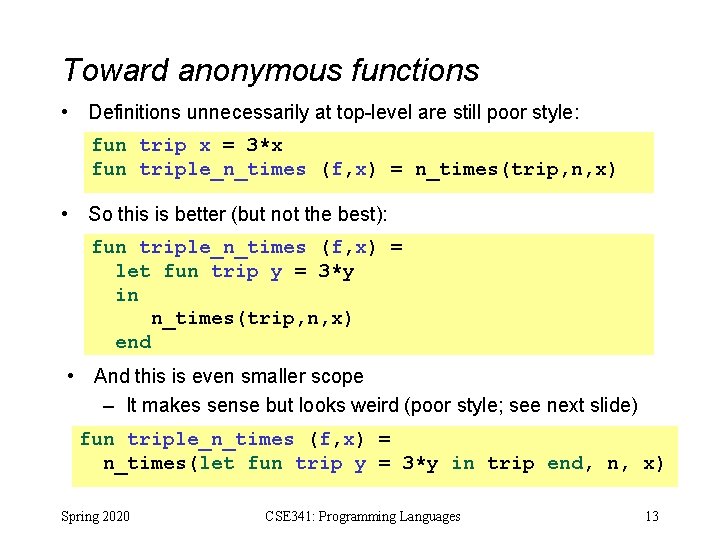
Toward anonymous functions • Definitions unnecessarily at top-level are still poor style: fun trip x = 3*x fun triple_n_times (f, x) = n_times(trip, n, x) • So this is better (but not the best): fun triple_n_times (f, x) = let fun trip y = 3*y in n_times(trip, n, x) end • And this is even smaller scope – It makes sense but looks weird (poor style; see next slide) fun triple_n_times (f, x) = n_times(let fun trip y = 3*y in trip end, n, x) Spring 2020 CSE 341: Programming Languages 13
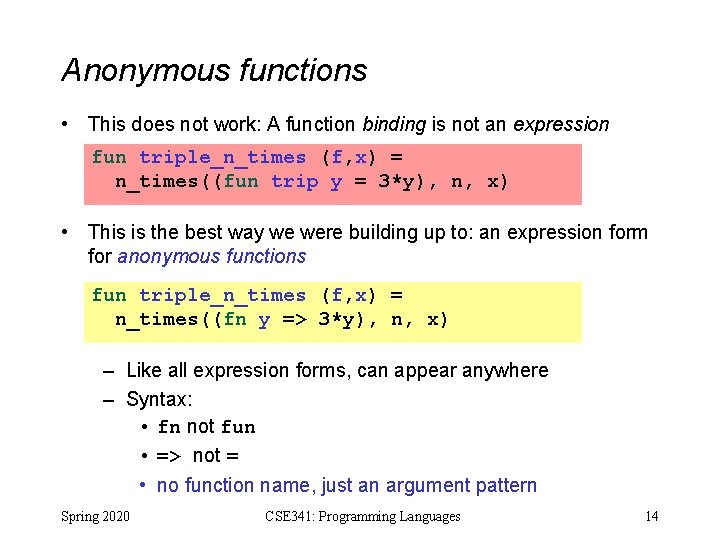
Anonymous functions • This does not work: A function binding is not an expression fun triple_n_times (f, x) = n_times((fun trip y = 3*y), n, x) • This is the best way we were building up to: an expression form for anonymous functions fun triple_n_times (f, x) = n_times((fn y => 3*y), n, x) – Like all expression forms, can appear anywhere – Syntax: • fn not fun • => not = • no function name, just an argument pattern Spring 2020 CSE 341: Programming Languages 14
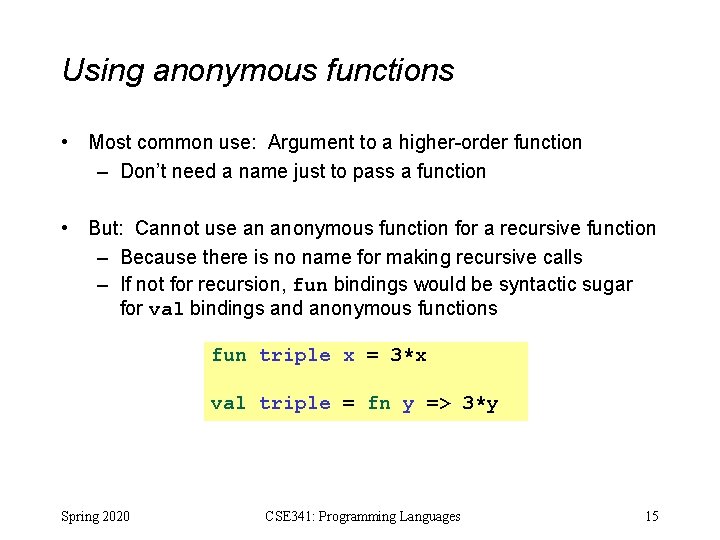
Using anonymous functions • Most common use: Argument to a higher-order function – Don’t need a name just to pass a function • But: Cannot use an anonymous function for a recursive function – Because there is no name for making recursive calls – If not for recursion, fun bindings would be syntactic sugar for val bindings and anonymous functions fun triple x = 3*x val triple = fn y => 3*y Spring 2020 CSE 341: Programming Languages 15
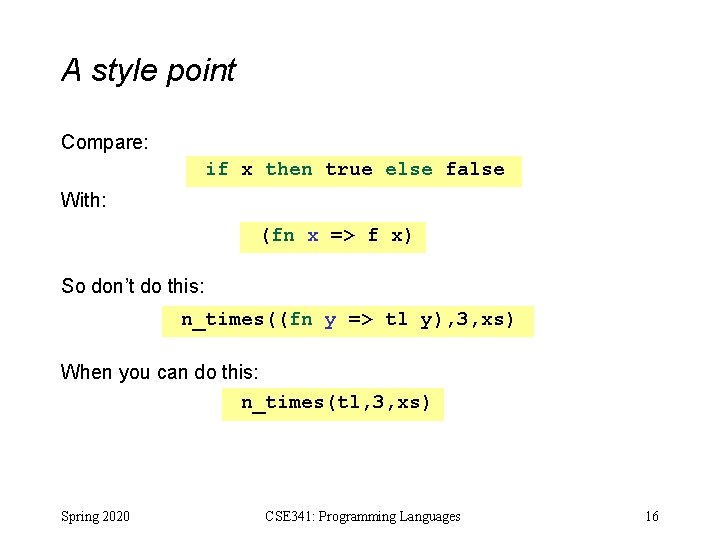
A style point Compare: if x then true else false With: (fn x => f x) So don’t do this: n_times((fn y => tl y), 3, xs) When you can do this: n_times(tl, 3, xs) Spring 2020 CSE 341: Programming Languages 16
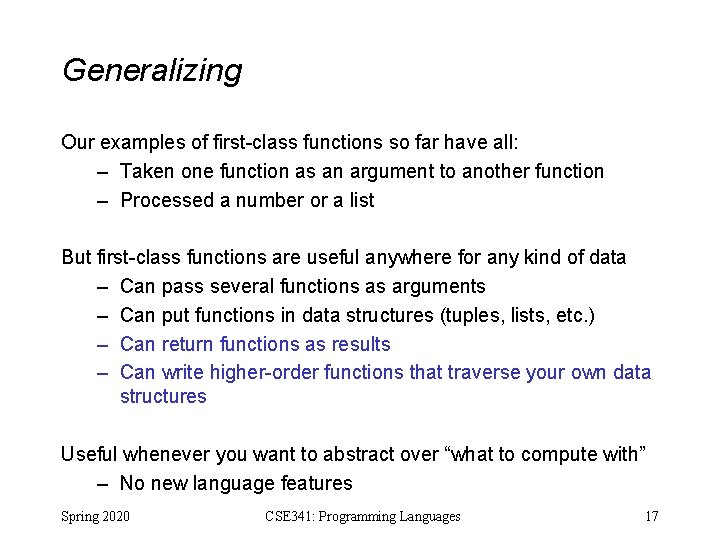
Generalizing Our examples of first-class functions so far have all: – Taken one function as an argument to another function – Processed a number or a list But first-class functions are useful anywhere for any kind of data – Can pass several functions as arguments – Can put functions in data structures (tuples, lists, etc. ) – Can return functions as results – Can write higher-order functions that traverse your own data structures Useful whenever you want to abstract over “what to compute with” – No new language features Spring 2020 CSE 341: Programming Languages 17
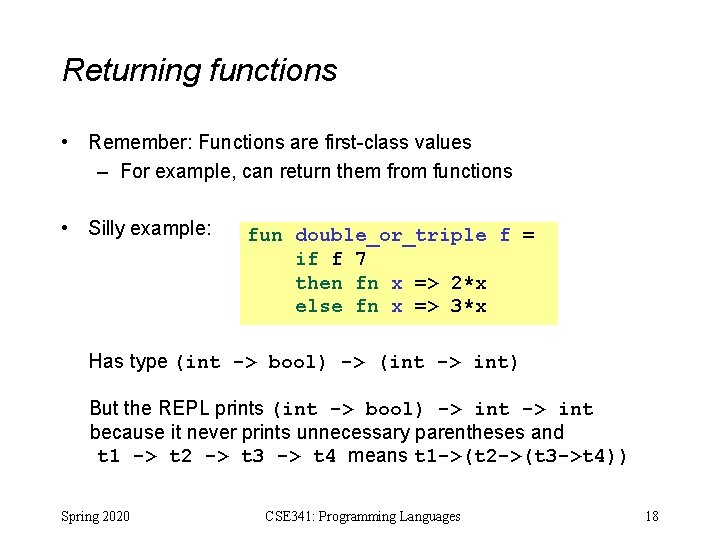
Returning functions • Remember: Functions are first-class values – For example, can return them from functions • Silly example: fun double_or_triple f = if f 7 then fn x => 2*x else fn x => 3*x Has type (int -> bool) -> (int -> int) But the REPL prints (int -> bool) -> int because it never prints unnecessary parentheses and t 1 -> t 2 -> t 3 -> t 4 means t 1 ->(t 2 ->(t 3 ->t 4)) Spring 2020 CSE 341: Programming Languages 18
Other data structures • Higher-order functions are not just for numbers and lists • They work great for common recursive traversals over your own data structures (datatype bindings) too • Example of a higher-order predicate: – Are all constants in an arithmetic expression even numbers? – Use a more general function of type (int -> bool) * exp -> bool – And call it with (fn x => x mod 2 = 0) Spring 2020 CSE 341: Programming Languages 19