
CSE 341 Programming Languages Lecture 20 Blocks Procs
CSE 341: Programming Languages Lecture 20 Blocks & Procs; Inheritance & Overriding Dan Grossman Fall 2011
This lecture Two separate topics • Ruby's approach to almost-closures (blocks) and closures (Procs) – Convenient to use; unusual approach – Used throughout large standard library • Explicit loops rare • Instead of a loop, go find a useful iterator • Subclasses, inheritance, and overriding – The essence of OOP – Not unlike in Java, but worth studying from PL perspective and in a more dynamic language Fall 2011 CSE 341: Programming Languages 2
Blocks are probably Ruby's strangest feature compared to other PLs – Normal: easy way to pass anonymous functions for all the reasons we have been studying – Normal: Blocks can take 0 or more arguments – Strange: Can send 0 or 1 block with any message send – Strange: Callee does not have a name for the block • Calls it with yield, yield 42, yield (3, 5), etc. • Can ask block_given? but rarely used in practice (usually assume a block is given if expected, or that a block's presence is implied by other arguments) Fall 2011 CSE 341: Programming Languages 3
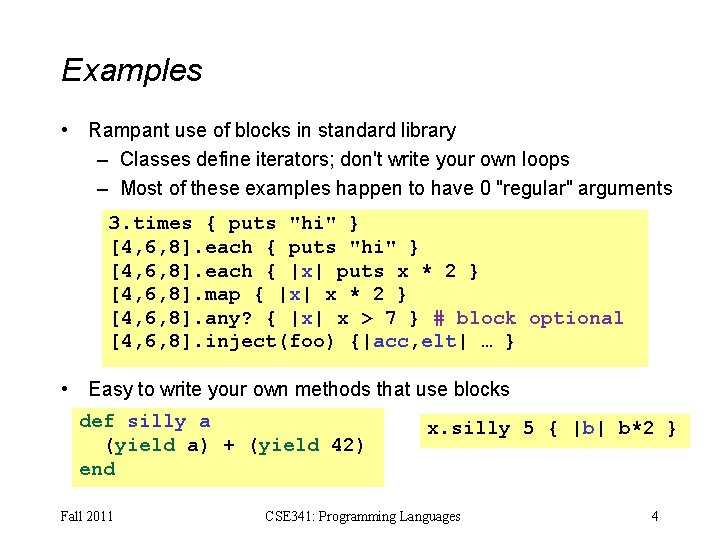
Examples • Rampant use of blocks in standard library – Classes define iterators; don't write your own loops – Most of these examples happen to have 0 "regular" arguments 3. times { puts "hi" } [4, 6, 8]. each { |x| puts x * 2 } [4, 6, 8]. map { |x| x * 2 } [4, 6, 8]. any? { |x| x > 7 } # block optional [4, 6, 8]. inject(foo) {|acc, elt| … } • Easy to write your own methods that use blocks def silly a (yield a) + (yield 42) end Fall 2011 x. silly 5 { |b| b*2 } CSE 341: Programming Languages 4
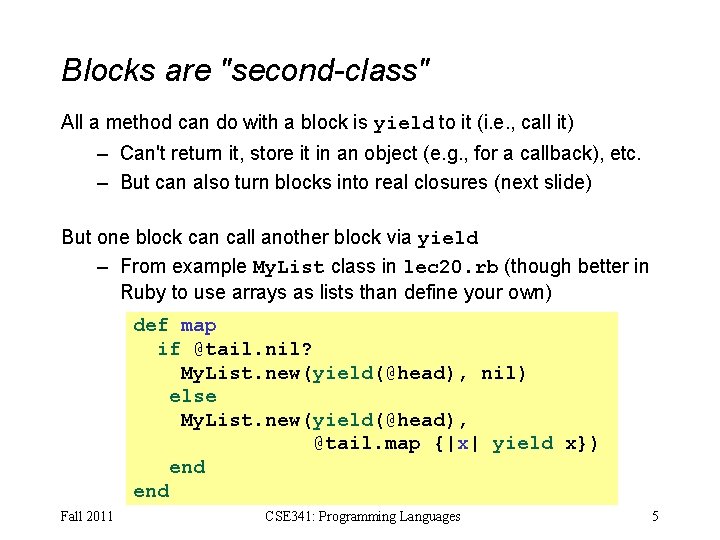
Blocks are "second-class" All a method can do with a block is yield to it (i. e. , call it) – Can't return it, store it in an object (e. g. , for a callback), etc. – But can also turn blocks into real closures (next slide) But one block can call another block via yield – From example My. List class in lec 20. rb (though better in Ruby to use arrays as lists than define your own) def map if @tail. nil? My. List. new(yield(@head), nil) else My. List. new(yield(@head), @tail. map {|x| yield x}) end Fall 2011 CSE 341: Programming Languages 5
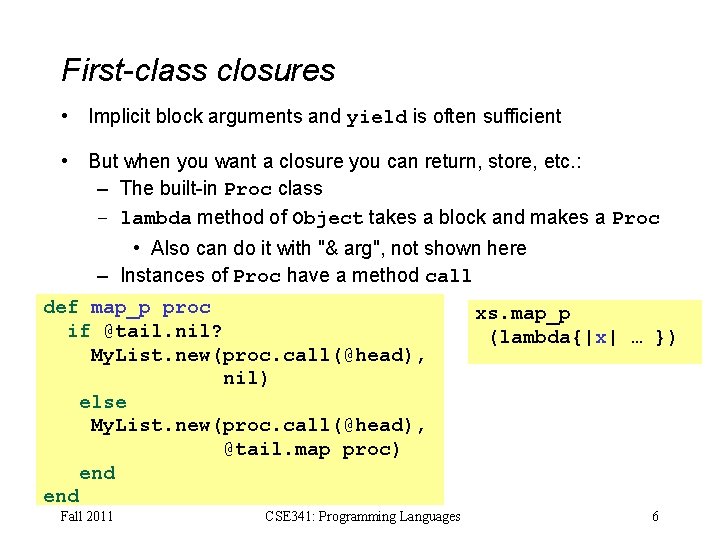
First-class closures • Implicit block arguments and yield is often sufficient • But when you want a closure you can return, store, etc. : – The built-in Proc class – lambda method of Object takes a block and makes a Proc • Also can do it with "& arg", not shown here – Instances of Proc have a method call def map_p proc if @tail. nil? My. List. new(proc. call(@head), nil) else My. List. new(proc. call(@head), @tail. map proc) end Fall 2011 CSE 341: Programming Languages xs. map_p (lambda{|x| … }) 6
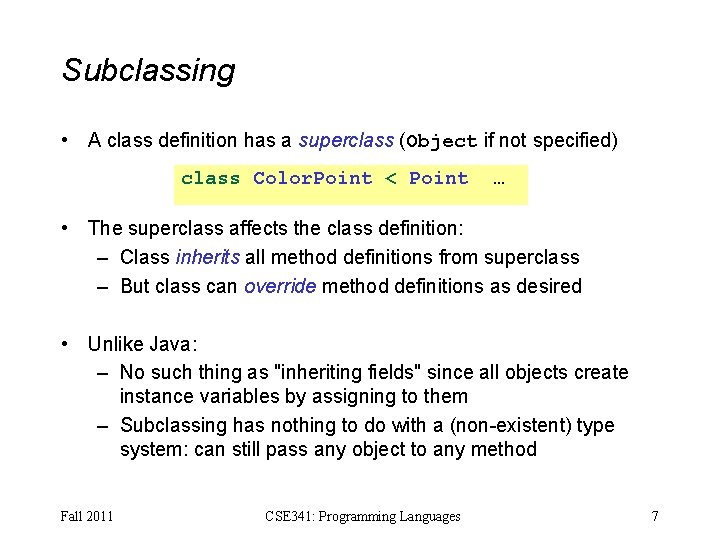
Subclassing • A class definition has a superclass (Object if not specified) class Color. Point < Point … • The superclass affects the class definition: – Class inherits all method definitions from superclass – But class can override method definitions as desired • Unlike Java: – No such thing as "inheriting fields" since all objects create instance variables by assigning to them – Subclassing has nothing to do with a (non-existent) type system: can still pass any object to any method Fall 2011 CSE 341: Programming Languages 7
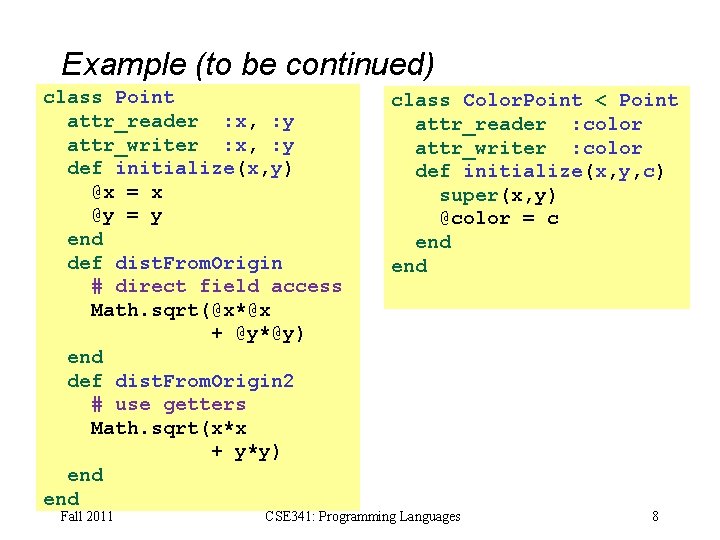
Example (to be continued) class Point attr_reader : x, : y attr_writer : x, : y def initialize(x, y) @x = x @y = y end def dist. From. Origin # direct field access Math. sqrt(@x*@x + @y*@y) end def dist. From. Origin 2 # use getters Math. sqrt(x*x + y*y) end Fall 2011 class Color. Point < Point attr_reader : color attr_writer : color def initialize(x, y, c) super(x, y) @color = c end CSE 341: Programming Languages 8
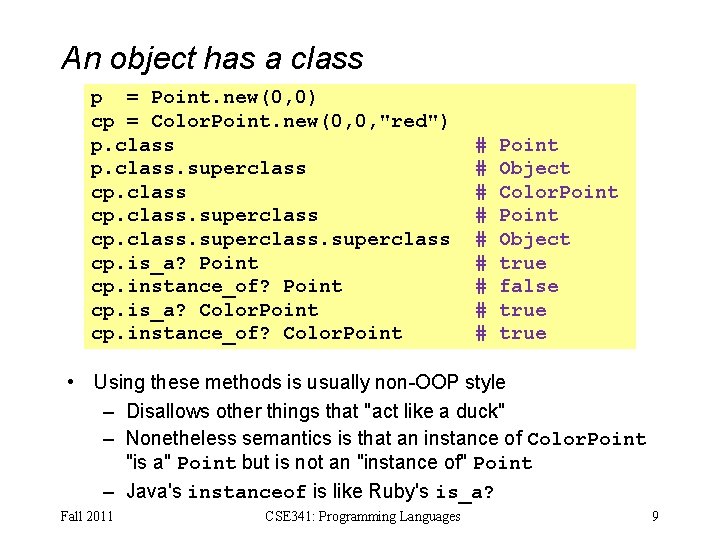
An object has a class p = Point. new(0, 0) cp = Color. Point. new(0, 0, "red") p. class. superclass cp. is_a? Point cp. instance_of? Point cp. is_a? Color. Point cp. instance_of? Color. Point # # # # # Point Object Color. Point Object true false true • Using these methods is usually non-OOP style – Disallows other things that "act like a duck" – Nonetheless semantics is that an instance of Color. Point "is a" Point but is not an "instance of" Point – Java's instanceof is like Ruby's is_a? Fall 2011 CSE 341: Programming Languages 9
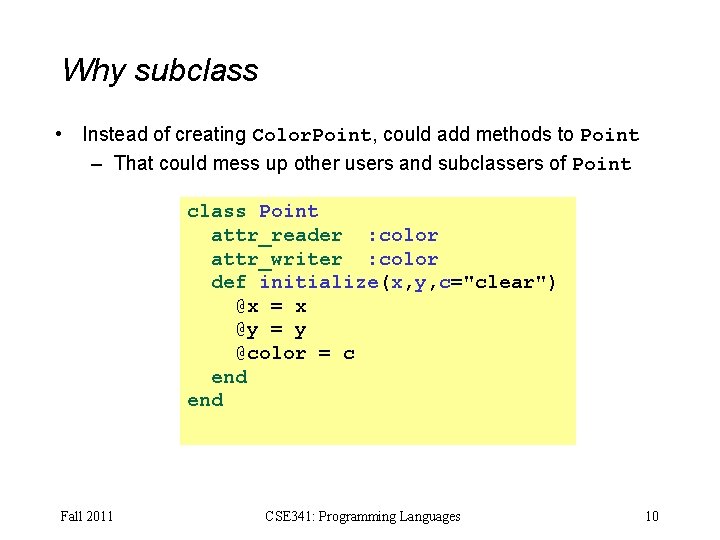
Why subclass • Instead of creating Color. Point, could add methods to Point – That could mess up other users and subclassers of Point class Point attr_reader : color attr_writer : color def initialize(x, y, c="clear") @x = x @y = y @color = c end Fall 2011 CSE 341: Programming Languages 10
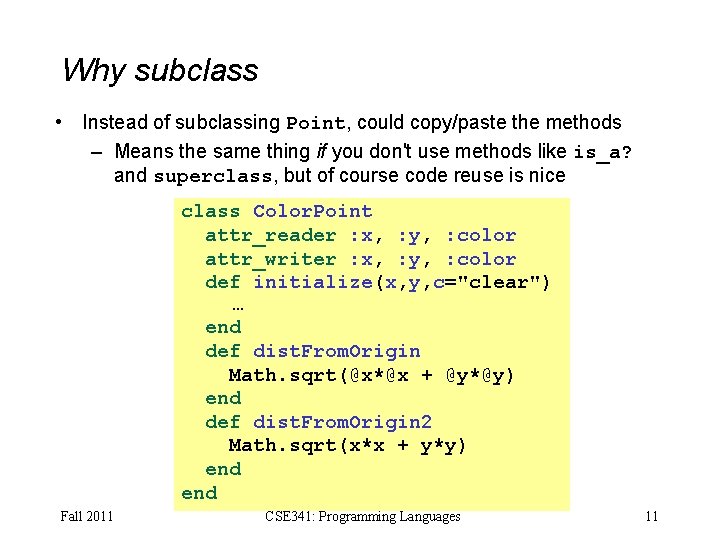
Why subclass • Instead of subclassing Point, could copy/paste the methods – Means the same thing if you don't use methods like is_a? and superclass, but of course code reuse is nice class Color. Point attr_reader : x, : y, : color attr_writer : x, : y, : color def initialize(x, y, c="clear") … end def dist. From. Origin Math. sqrt(@x*@x + @y*@y) end def dist. From. Origin 2 Math. sqrt(x*x + y*y) end Fall 2011 CSE 341: Programming Languages 11
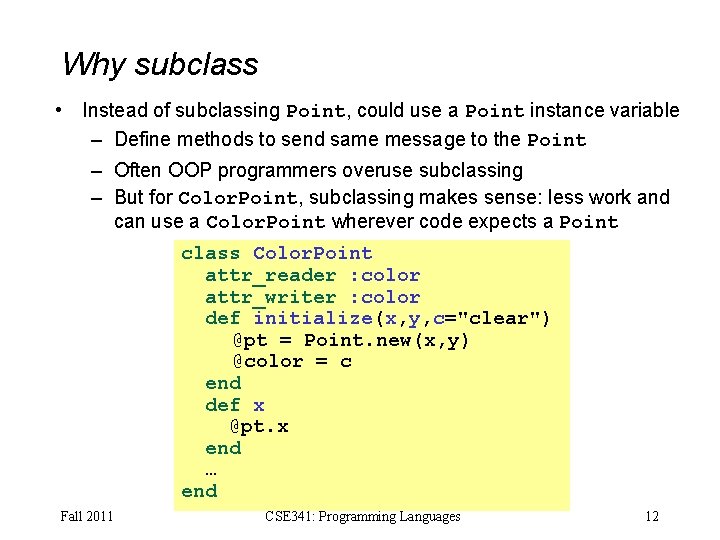
Why subclass • Instead of subclassing Point, could use a Point instance variable – Define methods to send same message to the Point – Often OOP programmers overuse subclassing – But for Color. Point, subclassing makes sense: less work and can use a Color. Point wherever code expects a Point class Color. Point attr_reader : color attr_writer : color def initialize(x, y, c="clear") @pt = Point. new(x, y) @color = c end def x @pt. x end … end Fall 2011 CSE 341: Programming Languages 12
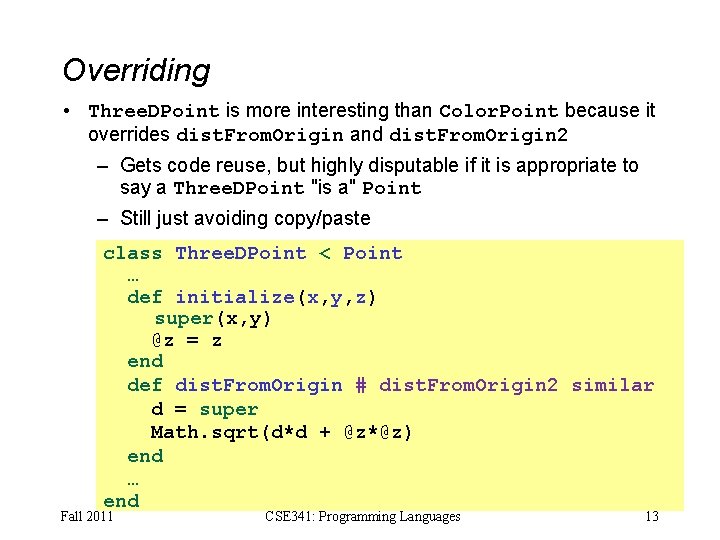
Overriding • Three. DPoint is more interesting than Color. Point because it overrides dist. From. Origin and dist. From. Origin 2 – Gets code reuse, but highly disputable if it is appropriate to say a Three. DPoint "is a" Point – Still just avoiding copy/paste class Three. DPoint < Point … def initialize(x, y, z) super(x, y) @z = z end def dist. From. Origin # dist. From. Origin 2 similar d = super Math. sqrt(d*d + @z*@z) end … end Fall 2011 CSE 341: Programming Languages 13
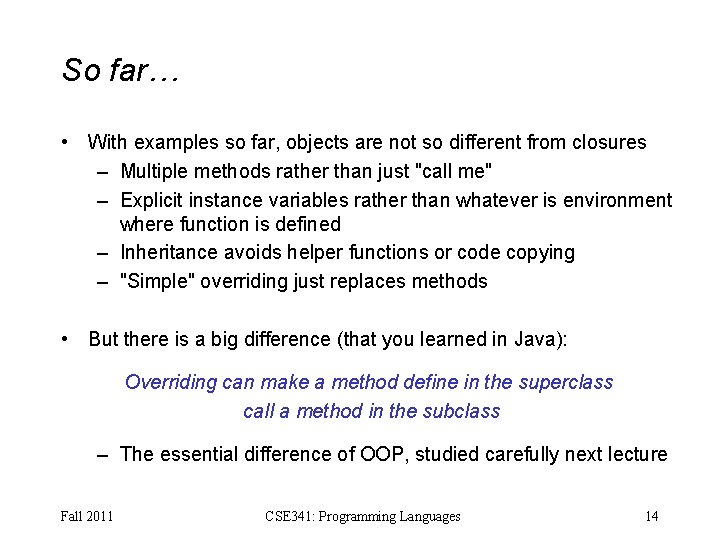
So far… • With examples so far, objects are not so different from closures – Multiple methods rather than just "call me" – Explicit instance variables rather than whatever is environment where function is defined – Inheritance avoids helper functions or code copying – "Simple" overriding just replaces methods • But there is a big difference (that you learned in Java): Overriding can make a method define in the superclass call a method in the subclass – The essential difference of OOP, studied carefully next lecture Fall 2011 CSE 341: Programming Languages 14
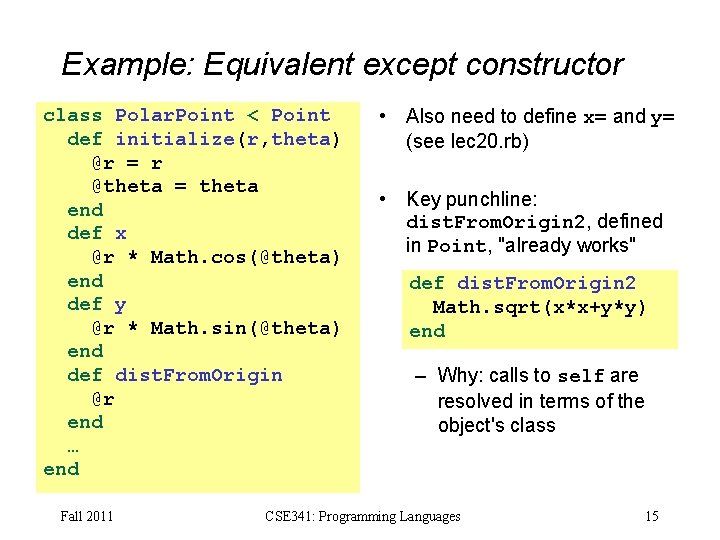
Example: Equivalent except constructor class Polar. Point < Point def initialize(r, theta) @r = r @theta = theta end def x @r * Math. cos(@theta) end def y @r * Math. sin(@theta) end def dist. From. Origin @r end … end Fall 2011 • Also need to define x= and y= (see lec 20. rb) • Key punchline: dist. From. Origin 2, defined in Point, "already works" def dist. From. Origin 2 Math. sqrt(x*x+y*y) end – Why: calls to self are resolved in terms of the object's class CSE 341: Programming Languages 15
- Slides: 15