
CSE 341 Programming Languages Lecture 2 Functions Pairs
![Building Lists • The empty list is a value: [] • In general, a](https://slidetodoc.com/presentation_image_h2/b7b271e6a01f3acd9db4c7f2cf2a8520/image-17.jpg "Building Lists • The empty list is a value: [] • In general, a")
- Slides: 22
CSE 341: Programming Languages Lecture 2 Functions, Pairs, Lists Zach Tatlock Autumn 2019
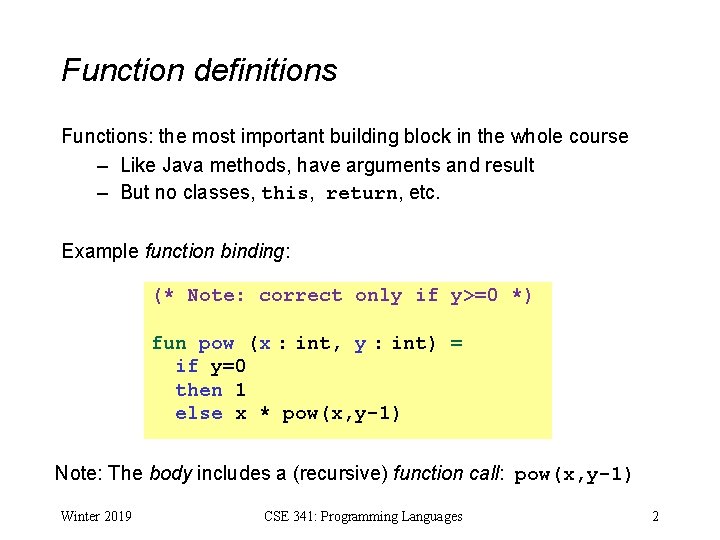
Function definitions Functions: the most important building block in the whole course – Like Java methods, have arguments and result – But no classes, this, return, etc. Example function binding: (* Note: correct only if y>=0 *) fun pow (x : int, y : int) = if y=0 then 1 else x * pow(x, y-1) Note: The body includes a (recursive) function call: pow(x, y-1) Winter 2019 CSE 341: Programming Languages 2
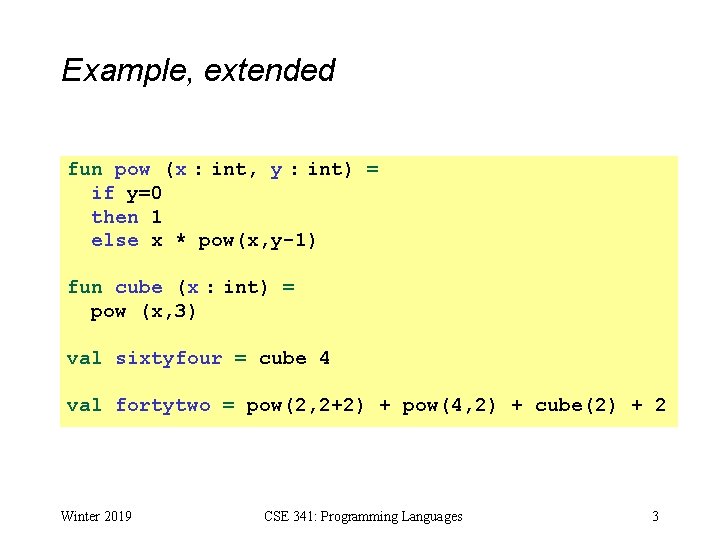
Example, extended fun pow (x : int, y : int) = if y=0 then 1 else x * pow(x, y-1) fun cube (x : int) = pow (x, 3) val sixtyfour = cube 4 val fortytwo = pow(2, 2+2) + pow(4, 2) + cube(2) + 2 Winter 2019 CSE 341: Programming Languages 3
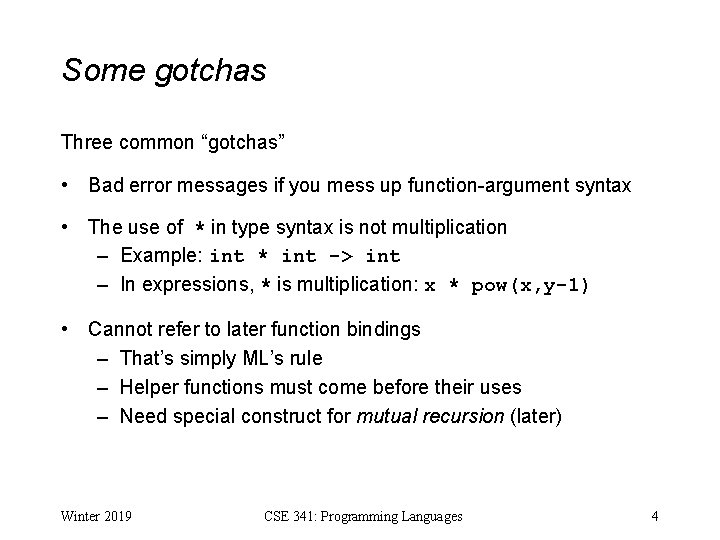
Some gotchas Three common “gotchas” • Bad error messages if you mess up function-argument syntax • The use of * in type syntax is not multiplication – Example: int * int -> int – In expressions, * is multiplication: x * pow(x, y-1) • Cannot refer to later function bindings – That’s simply ML’s rule – Helper functions must come before their uses – Need special construct for mutual recursion (later) Winter 2019 CSE 341: Programming Languages 4
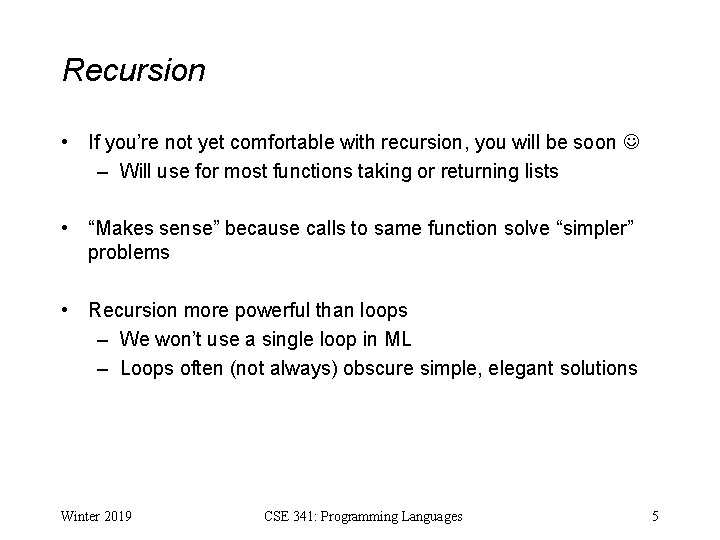
Recursion • If you’re not yet comfortable with recursion, you will be soon – Will use for most functions taking or returning lists • “Makes sense” because calls to same function solve “simpler” problems • Recursion more powerful than loops – We won’t use a single loop in ML – Loops often (not always) obscure simple, elegant solutions Winter 2019 CSE 341: Programming Languages 5
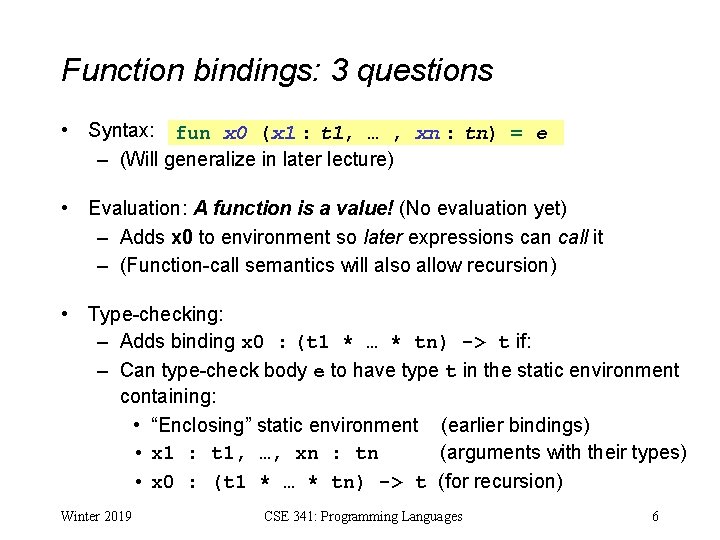
Function bindings: 3 questions • Syntax: fun x 0 (x 1 : t 1, … , xn : tn) = e – (Will generalize in later lecture) • Evaluation: A function is a value! (No evaluation yet) – Adds x 0 to environment so later expressions can call it – (Function-call semantics will also allow recursion) • Type-checking: – Adds binding x 0 : (t 1 * … * tn) -> t if: – Can type-check body e to have type t in the static environment containing: • “Enclosing” static environment (earlier bindings) • x 1 : t 1, …, xn : tn (arguments with their types) • x 0 : (t 1 * … * tn) -> t (for recursion) Winter 2019 CSE 341: Programming Languages 6
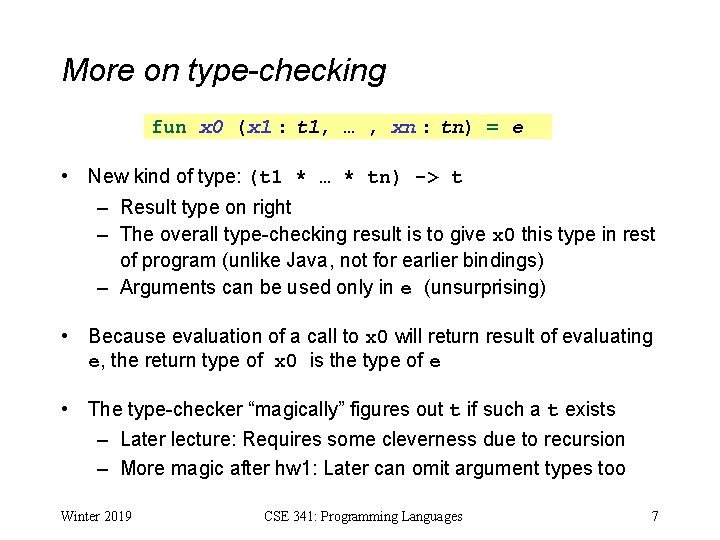
More on type-checking fun x 0 (x 1 : t 1, … , xn : tn) = e • New kind of type: (t 1 * … * tn) -> t – Result type on right – The overall type-checking result is to give x 0 this type in rest of program (unlike Java, not for earlier bindings) – Arguments can be used only in e (unsurprising) • Because evaluation of a call to x 0 will return result of evaluating e, the return type of x 0 is the type of e • The type-checker “magically” figures out t if such a t exists – Later lecture: Requires some cleverness due to recursion – More magic after hw 1: Later can omit argument types too Winter 2019 CSE 341: Programming Languages 7
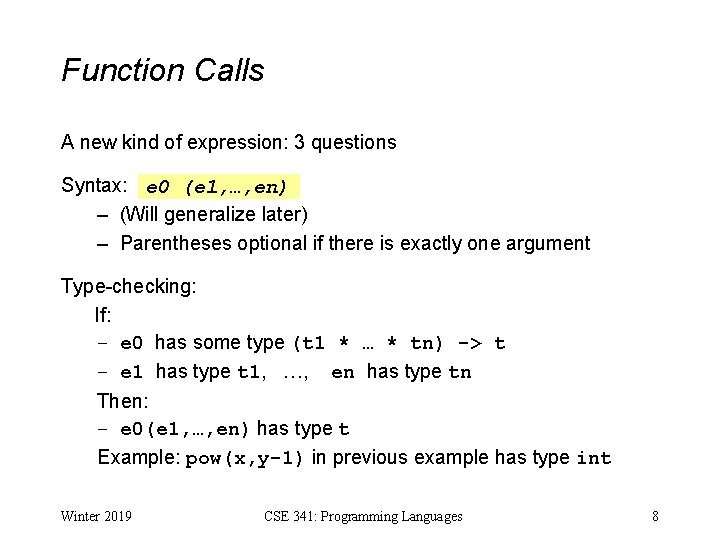
Function Calls A new kind of expression: 3 questions Syntax: e 0 (e 1, …, en) – (Will generalize later) – Parentheses optional if there is exactly one argument Type-checking: If: – e 0 has some type (t 1 * … * tn) -> t – e 1 has type t 1, …, en has type tn Then: – e 0(e 1, …, en) has type t Example: pow(x, y-1) in previous example has type int Winter 2019 CSE 341: Programming Languages 8
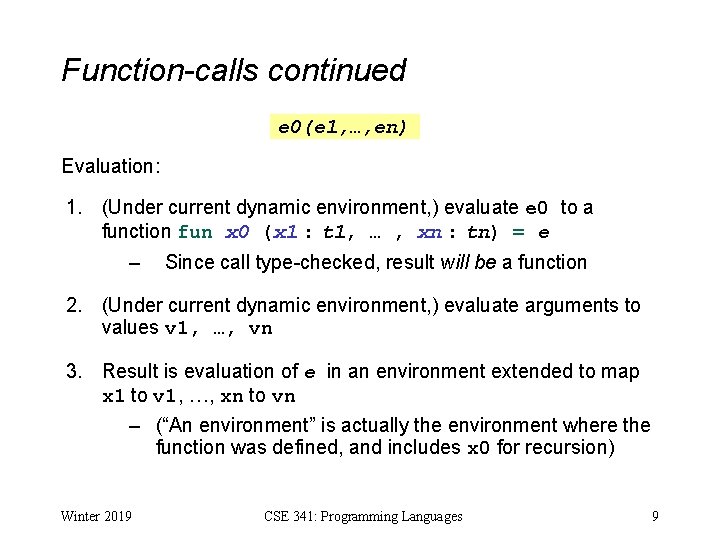
Function-calls continued e 0(e 1, …, en) Evaluation: 1. (Under current dynamic environment, ) evaluate e 0 to a function fun x 0 (x 1 : t 1, … , xn : tn) = e ‒ Since call type-checked, result will be a function 2. (Under current dynamic environment, ) evaluate arguments to values v 1, …, vn 3. Result is evaluation of e in an environment extended to map x 1 to v 1, …, xn to vn ‒ (“An environment” is actually the environment where the function was defined, and includes x 0 for recursion) Winter 2019 CSE 341: Programming Languages 9
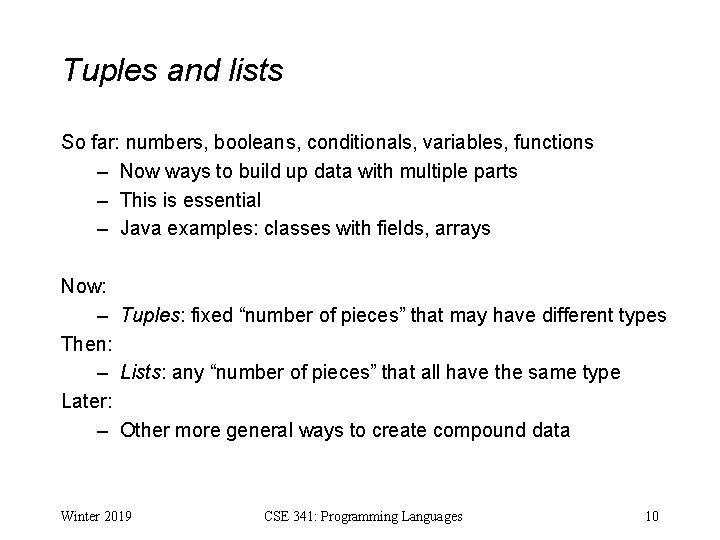
Tuples and lists So far: numbers, booleans, conditionals, variables, functions – Now ways to build up data with multiple parts – This is essential – Java examples: classes with fields, arrays Now: – Tuples: fixed “number of pieces” that may have different types Then: – Lists: any “number of pieces” that all have the same type Later: – Other more general ways to create compound data Winter 2019 CSE 341: Programming Languages 10
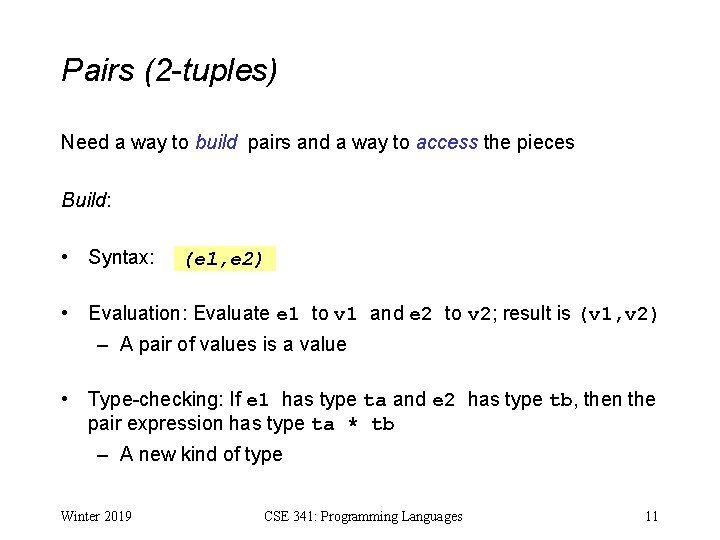
Pairs (2 -tuples) Need a way to build pairs and a way to access the pieces Build: • Syntax: (e 1, e 2) • Evaluation: Evaluate e 1 to v 1 and e 2 to v 2; result is (v 1, v 2) – A pair of values is a value • Type-checking: If e 1 has type ta and e 2 has type tb, then the pair expression has type ta * tb – A new kind of type Winter 2019 CSE 341: Programming Languages 11
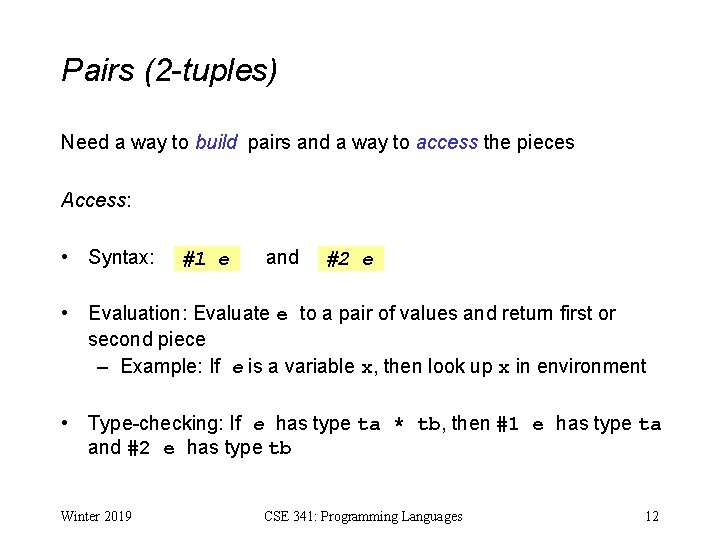
Pairs (2 -tuples) Need a way to build pairs and a way to access the pieces Access: • Syntax: #1 e and #2 e • Evaluation: Evaluate e to a pair of values and return first or second piece – Example: If e is a variable x, then look up x in environment • Type-checking: If e has type ta * tb, then #1 e has type ta and #2 e has type tb Winter 2019 CSE 341: Programming Languages 12
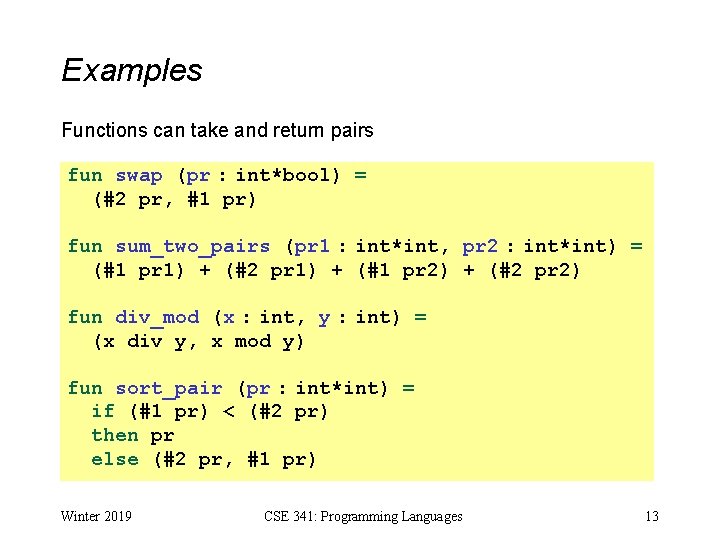
Examples Functions can take and return pairs fun swap (pr : int*bool) = (#2 pr, #1 pr) fun sum_two_pairs (pr 1 : int*int, pr 2 : int*int) = (#1 pr 1) + (#2 pr 1) + (#1 pr 2) + (#2 pr 2) fun div_mod (x : int, y : int) = (x div y, x mod y) fun sort_pair (pr : int*int) = if (#1 pr) < (#2 pr) then pr else (#2 pr, #1 pr) Winter 2019 CSE 341: Programming Languages 13
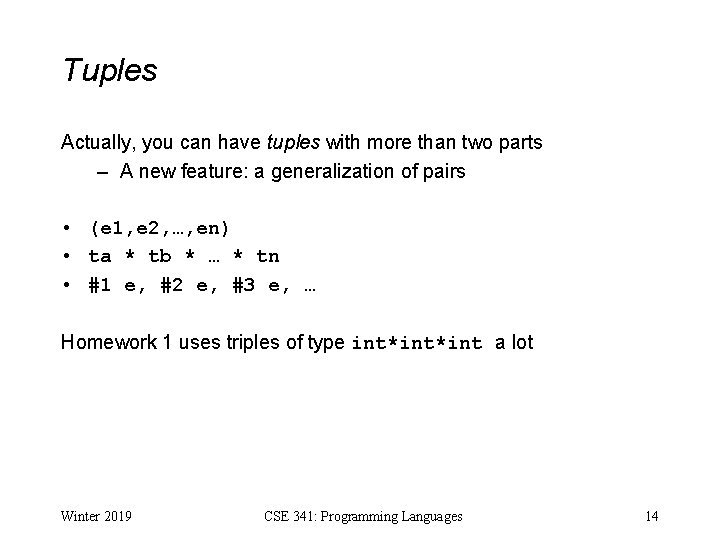
Tuples Actually, you can have tuples with more than two parts – A new feature: a generalization of pairs • (e 1, e 2, …, en) • ta * tb * … * tn • #1 e, #2 e, #3 e, … Homework 1 uses triples of type int*int a lot Winter 2019 CSE 341: Programming Languages 14
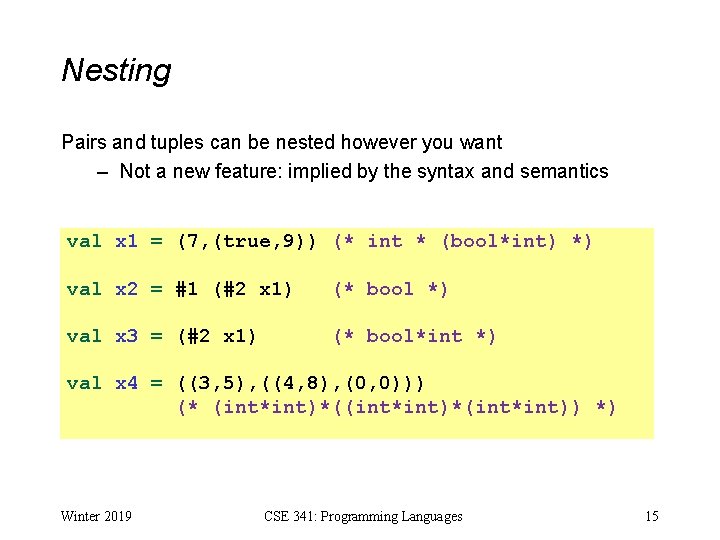
Nesting Pairs and tuples can be nested however you want – Not a new feature: implied by the syntax and semantics val x 1 = (7, (true, 9)) (* int * (bool*int) *) val x 2 = #1 (#2 x 1) (* bool *) val x 3 = (#2 x 1) (* bool*int *) val x 4 = ((3, 5), ((4, 8), (0, 0))) (* (int*int)*(int*int)) *) Winter 2019 CSE 341: Programming Languages 15
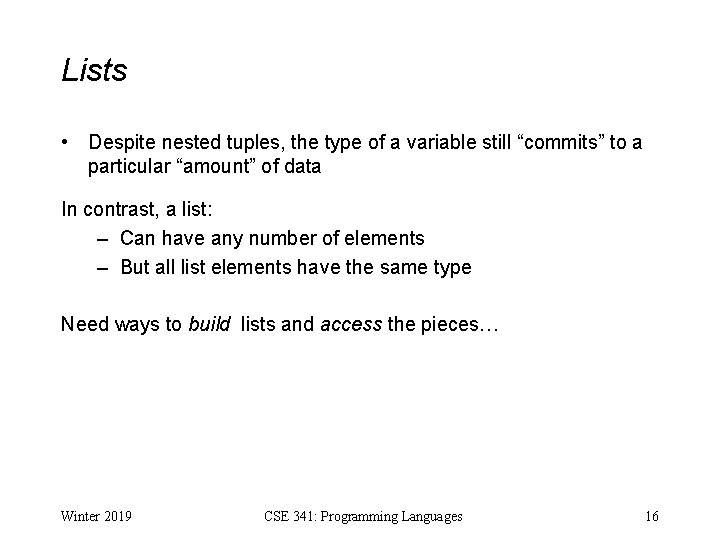
Lists • Despite nested tuples, the type of a variable still “commits” to a particular “amount” of data In contrast, a list: – Can have any number of elements – But all list elements have the same type Need ways to build lists and access the pieces… Winter 2019 CSE 341: Programming Languages 16
Building Lists • The empty list is a value: [] • In general, a list of values is a value; elements separated by commas: [v 1, v 2, …, vn] • If e 1 evaluates to v and e 2 evaluates to a list [v 1, …, vn], then e 1: : e 2 evaluates to [v, v 1, …, vn] e 1: : e 2 (* pronounced "cons" *) Winter 2019 CSE 341: Programming Languages 17
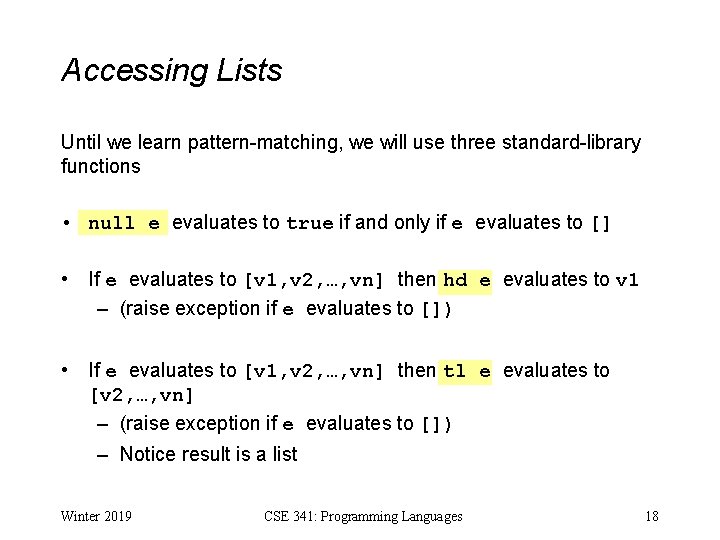
Accessing Lists Until we learn pattern-matching, we will use three standard-library functions • null e evaluates to true if and only if e evaluates to [] • If e evaluates to [v 1, v 2, …, vn] then hd e evaluates to v 1 – (raise exception if e evaluates to []) • If e evaluates to [v 1, v 2, …, vn] then tl e evaluates to [v 2, …, vn] – (raise exception if e evaluates to []) – Notice result is a list Winter 2019 CSE 341: Programming Languages 18
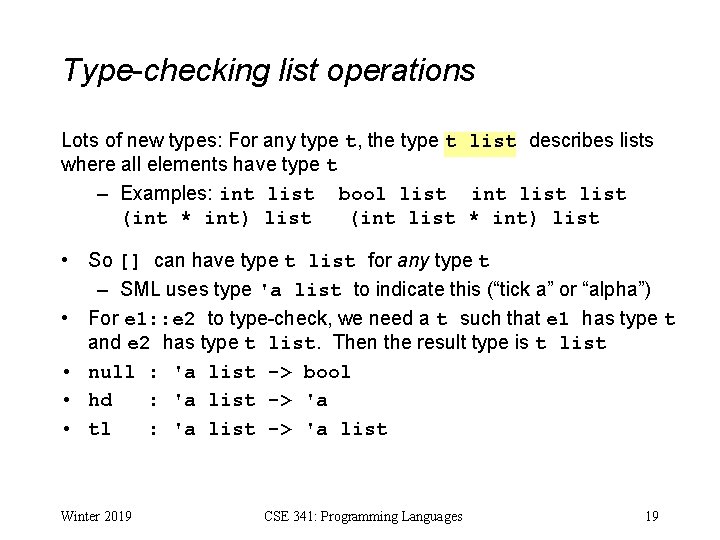
Type-checking list operations Lots of new types: For any type t, the type t list describes lists where all elements have type t – Examples: int list bool list int list (int * int) list (int list * int) list • So [] can have type t list for any type t – SML uses type 'a list to indicate this (“tick a” or “alpha”) • For e 1: : e 2 to type-check, we need a t such that e 1 has type t and e 2 has type t list. Then the result type is t list • null : 'a list -> bool • hd : 'a list -> 'a • tl : 'a list -> 'a list Winter 2019 CSE 341: Programming Languages 19
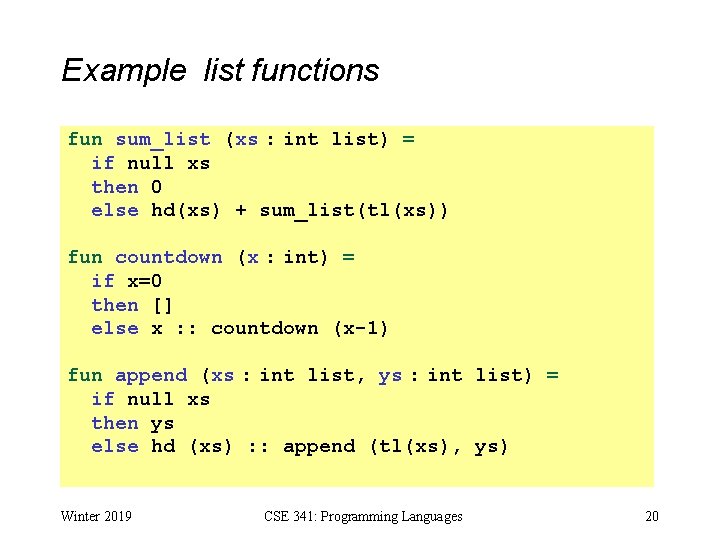
Example list functions fun sum_list (xs : int list) = if null xs then 0 else hd(xs) + sum_list(tl(xs)) fun countdown (x : int) = if x=0 then [] else x : : countdown (x-1) fun append (xs : int list, ys : int list) = if null xs then ys else hd (xs) : : append (tl(xs), ys) Winter 2019 CSE 341: Programming Languages 20
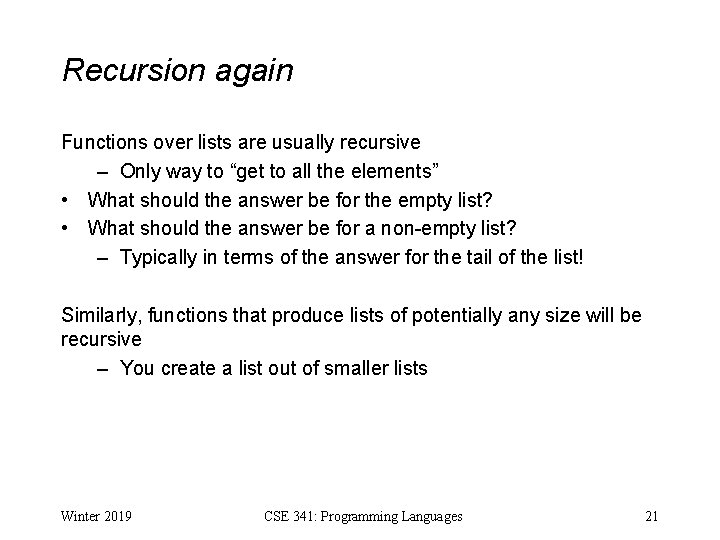
Recursion again Functions over lists are usually recursive – Only way to “get to all the elements” • What should the answer be for the empty list? • What should the answer be for a non-empty list? – Typically in terms of the answer for the tail of the list! Similarly, functions that produce lists of potentially any size will be recursive – You create a list out of smaller lists Winter 2019 CSE 341: Programming Languages 21
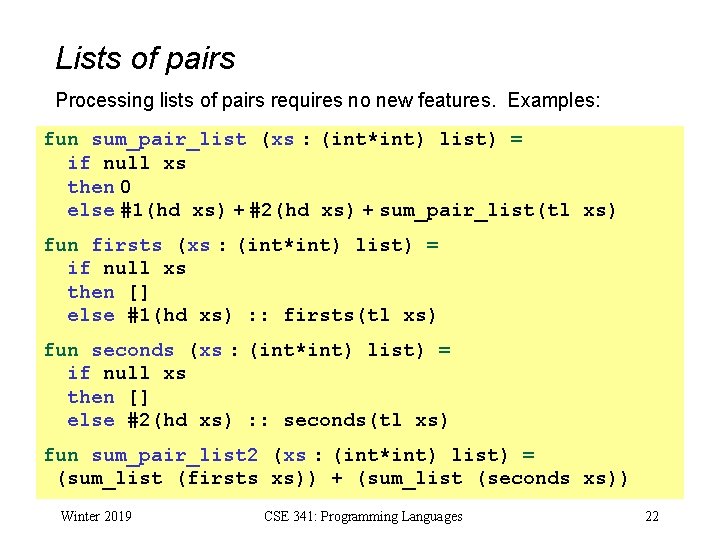
Lists of pairs Processing lists of pairs requires no new features. Examples: fun sum_pair_list (xs : (int*int) list) = if null xs then 0 else #1(hd xs) + #2(hd xs) + sum_pair_list(tl xs) fun firsts (xs : (int*int) list) = if null xs then [] else #1(hd xs) : : firsts(tl xs) fun seconds (xs : (int*int) list) = if null xs then [] else #2(hd xs) : : seconds(tl xs) fun sum_pair_list 2 (xs : (int*int) list) = (sum_list (firsts xs)) + (sum_list (seconds xs)) Winter 2019 CSE 341: Programming Languages 22