
CSE 341 Programming Languages Introduction To Ruby Dynamic
CSE 341: Programming Languages Introduction To Ruby; Dynamic OOP; "Duck Typing" Alan Borning Winter 2015 (slides borrowed from Dan Grossman)
The plan • Lecture materials may not recount every little language feature we use – Thomas book (2 nd edition, Chapters 1 -9) quite readable • Can skip/skim regexps and ranges • Also see online library documentation [large, searchable] • Focus in class will be on OOP, dynamic typing, blocks, mixins Winter 2015 CSE 341: Programming Languages 2
Logistics • We will use Ruby 2. 0. 0 – Installed on the linux Lab machines – Windows lab machines have 2. 1. 5 – hopefully any differences will not be relevant to us – In any case, use a version 2 of some kind (unit tests are different in 1. 8. 7) • Installation instructions, etc. on course web page – Can run programs with a REPL called irb • Assignment 7 is a Ruby warmup exercise; Assignment 8 is the Ruby project Winter 2015 CSE 341: Programming Languages 3
A Bit of History • Some notable examples of early object-oriented languages and systems: – First object-oriented programming language: Simula I, then Simula 67, created by Ole-Johan Dahl and Kristen Nygaard at the Norwegian Computing Center in Oslo. – Smalltalk: developed at Xerox Palo Alto Research Center by the Learning Research Group in the 1970's (Smalltalk-72, Smalltalk-76, Smalltalk-80) – Today: mature language paradigm. Some significant examples: C++, Java, C#, Python, Ruby Winter 2015 CSE 341: Programming Languages 4
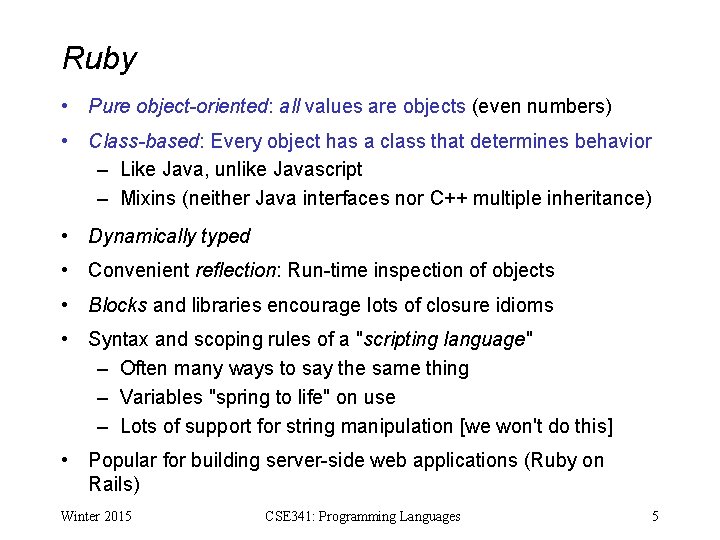
Ruby • Pure object-oriented: all values are objects (even numbers) • Class-based: Every object has a class that determines behavior – Like Java, unlike Javascript – Mixins (neither Java interfaces nor C++ multiple inheritance) • Dynamically typed • Convenient reflection: Run-time inspection of objects • Blocks and libraries encourage lots of closure idioms • Syntax and scoping rules of a "scripting language" – Often many ways to say the same thing – Variables "spring to life" on use – Lots of support for string manipulation [we won't do this] • Popular for building server-side web applications (Ruby on Rails) Winter 2015 CSE 341: Programming Languages 5
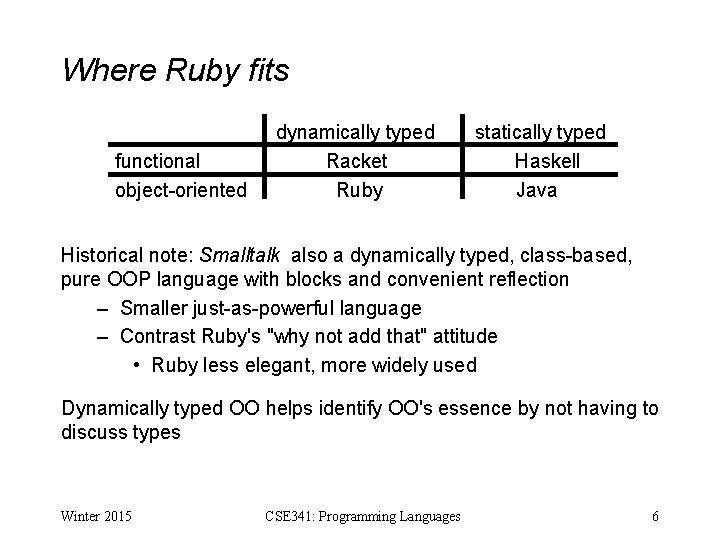
Where Ruby fits functional object-oriented dynamically typed Racket Ruby statically typed Haskell Java Historical note: Smalltalk also a dynamically typed, class-based, pure OOP language with blocks and convenient reflection – Smaller just-as-powerful language – Contrast Ruby's "why not add that" attitude • Ruby less elegant, more widely used Dynamically typed OO helps identify OO's essence by not having to discuss types Winter 2015 CSE 341: Programming Languages 6
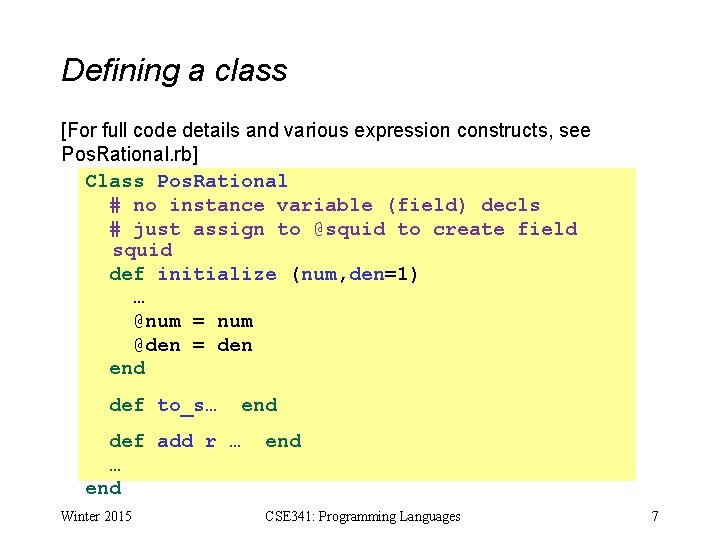
Defining a class [For full code details and various expression constructs, see Pos. Rational. rb] Class Pos. Rational # no instance variable (field) decls # just assign to @squid to create field squid def initialize (num, den=1) … @num = num @den = den end def to_s… def add r … … end Winter 2015 end CSE 341: Programming Languages 7
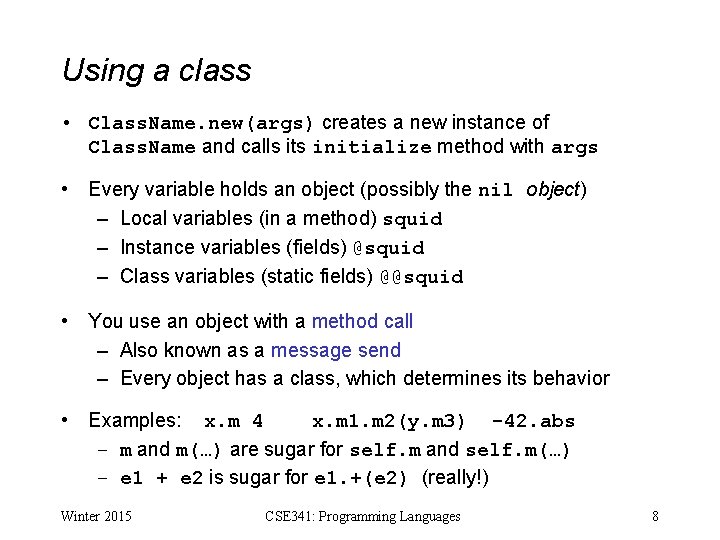
Using a class • Class. Name. new(args) creates a new instance of Class. Name and calls its initialize method with args • Every variable holds an object (possibly the nil object) – Local variables (in a method) squid – Instance variables (fields) @squid – Class variables (static fields) @@squid • You use an object with a method call – Also known as a message send – Every object has a class, which determines its behavior • Examples: x. m 4 x. m 1. m 2(y. m 3) -42. abs – m and m(…) are sugar for self. m and self. m(…) – e 1 + e 2 is sugar for e 1. +(e 2) (really!) Winter 2015 CSE 341: Programming Languages 8
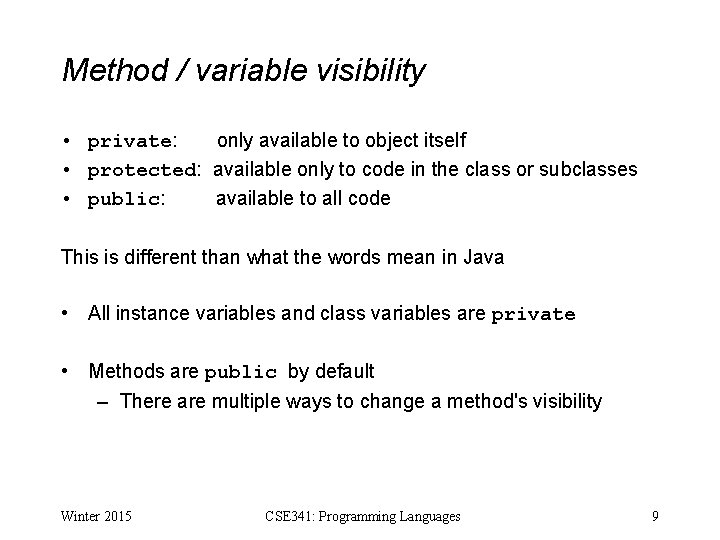
Method / variable visibility • private: only available to object itself • protected: available only to code in the class or subclasses • public: available to all code This is different than what the words mean in Java • All instance variables and class variables are private • Methods are public by default – There are multiple ways to change a method's visibility Winter 2015 CSE 341: Programming Languages 9
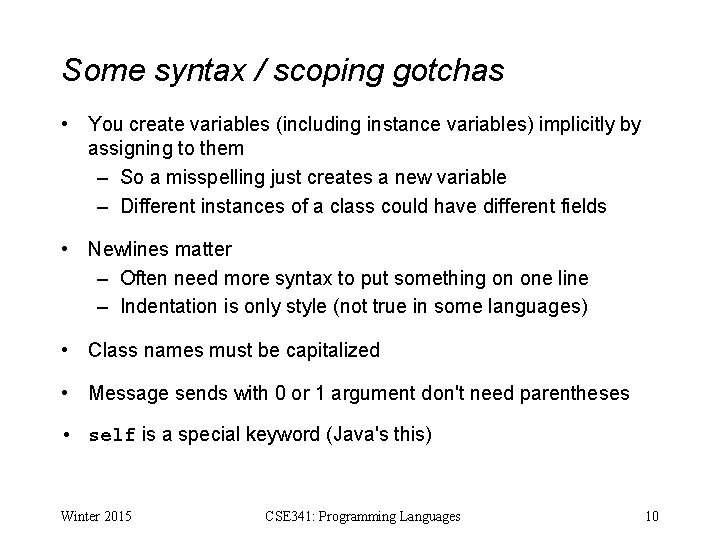
Some syntax / scoping gotchas • You create variables (including instance variables) implicitly by assigning to them – So a misspelling just creates a new variable – Different instances of a class could have different fields • Newlines matter – Often need more syntax to put something on one line – Indentation is only style (not true in some languages) • Class names must be capitalized • Message sends with 0 or 1 argument don't need parentheses • self is a special keyword (Java's this) Winter 2015 CSE 341: Programming Languages 10
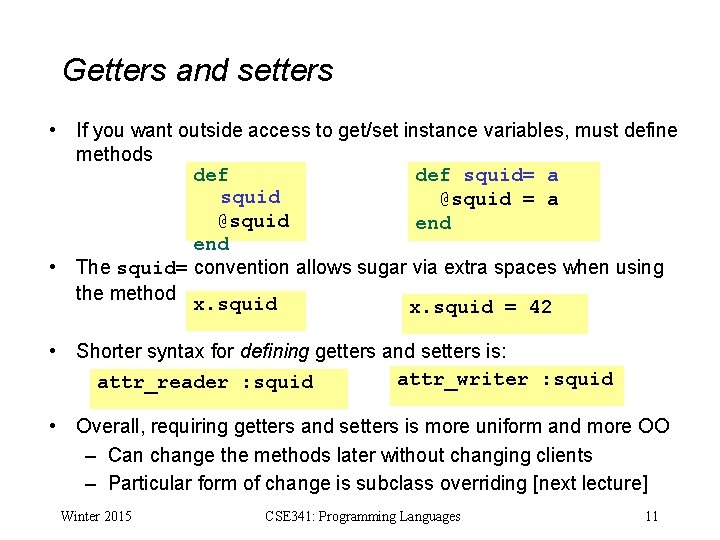
Getters and setters • If you want outside access to get/set instance variables, must define methods def squid= a squid @squid = a @squid end • The squid= convention allows sugar via extra spaces when using the method x. squid = 42 • Shorter syntax for defining getters and setters is: attr_writer : squid attr_reader : squid • Overall, requiring getters and setters is more uniform and more OO – Can change the methods later without changing clients – Particular form of change is subclass overriding [next lecture] Winter 2015 CSE 341: Programming Languages 11
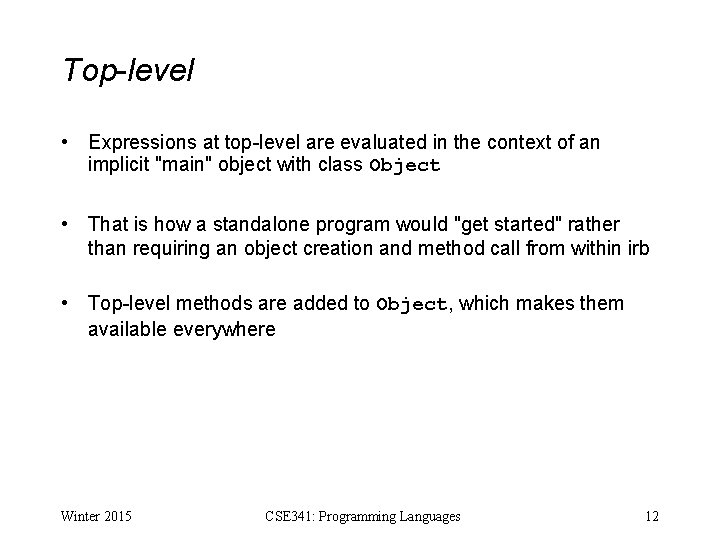
Top-level • Expressions at top-level are evaluated in the context of an implicit "main" object with class Object • That is how a standalone program would "get started" rather than requiring an object creation and method call from within irb • Top-level methods are added to Object, which makes them available everywhere Winter 2015 CSE 341: Programming Languages 12
Class definitions are dynamic • All definitions in Ruby are dynamic • Example: Any code can add or remove methods on existing classes – Very occasionally useful (or cute) to add your own method to the Array class for example, but it is visible to all arrays • Changing a class affects even already-created instances • Disastrous example: Changing Fixnum's + method • Overall: A simple language definition where everything can be changed and method lookup uses instance's classes Winter 2015 CSE 341: Programming Languages 13
Duck Typing "If it walks like a duck and quacks like a duck, it's a duck" – Or don't worry that it may not be a duck When writing a method you might think, "I need a Toad argument" but really you need an object with enough methods similar to Toad’s methods that your method works – Embracing duck typing is always making method calls rather than assuming/testing the class of arguments Plus: More code reuse; very OO approach – What messages an object receive is all that matters Minus: Almost nothing is equivalent – x+x versus x*2 versus 2*x – Callers may assume a lot about how callees are implemented Winter 2015 CSE 341: Programming Languages 14
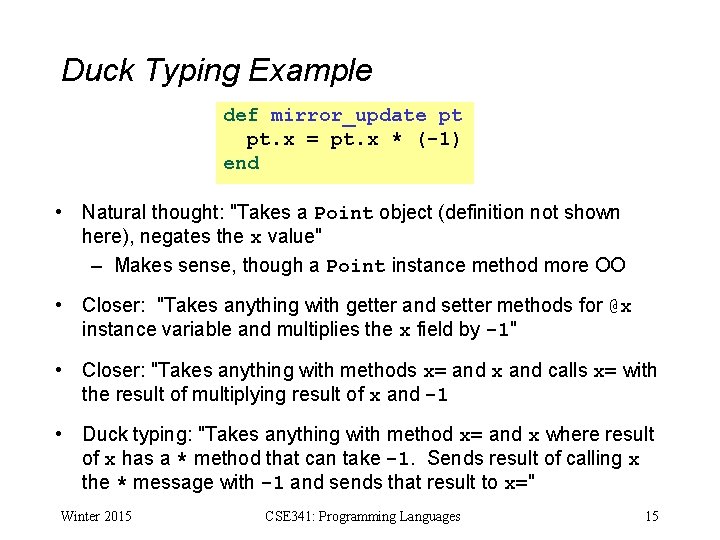
Duck Typing Example def mirror_update pt pt. x = pt. x * (-1) end • Natural thought: "Takes a Point object (definition not shown here), negates the x value" – Makes sense, though a Point instance method more OO • Closer: "Takes anything with getter and setter methods for @x instance variable and multiplies the x field by -1" • Closer: "Takes anything with methods x= and x and calls x= with the result of multiplying result of x and -1 • Duck typing: "Takes anything with method x= and x where result of x has a * method that can take -1. Sends result of calling x the * message with -1 and sends that result to x=" Winter 2015 CSE 341: Programming Languages 15
- Slides: 15