
CSE 341 Lecture 15 introduction to Scheme slides

![String procedures (string-length str) (substring str start [end]) (string-append str [str 2 str 3.](https://slidetodoc.com/presentation_image_h2/a6abdddaa53804c05274302d849ac20f/image-25.jpg "String procedures (string-length str) (substring str start [end]) (string-append str [str 2 str 3.")
- Slides: 25
CSE 341 Lecture 15 introduction to Scheme slides created by Marty Stepp http: //www. cs. washington. edu/341/
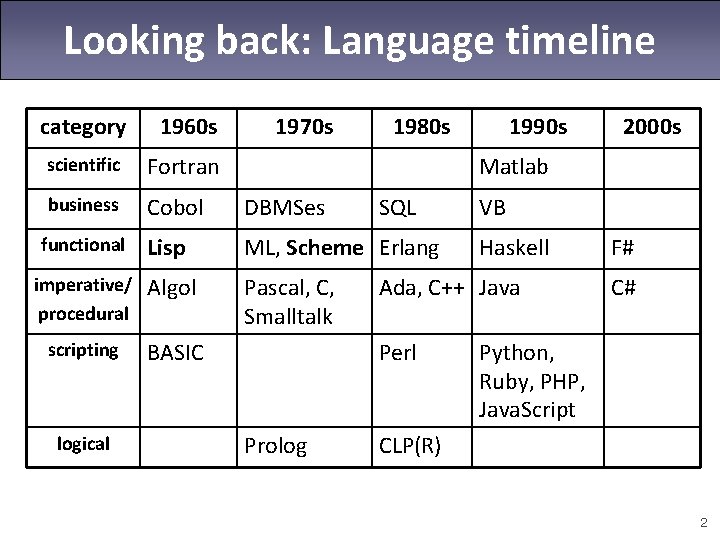
Looking back: Language timeline category 1960 s scientific Fortran business Cobol DBMSes functional Lisp ML, Scheme Erlang imperative/ procedural Algol Pascal, C, Smalltalk scripting BASIC logical 1970 s 1980 s 1990 s 2000 s Matlab SQL Haskell Ada, C++ Java Perl Prolog VB F# C# Python, Ruby, PHP, Java. Script CLP(R) 2
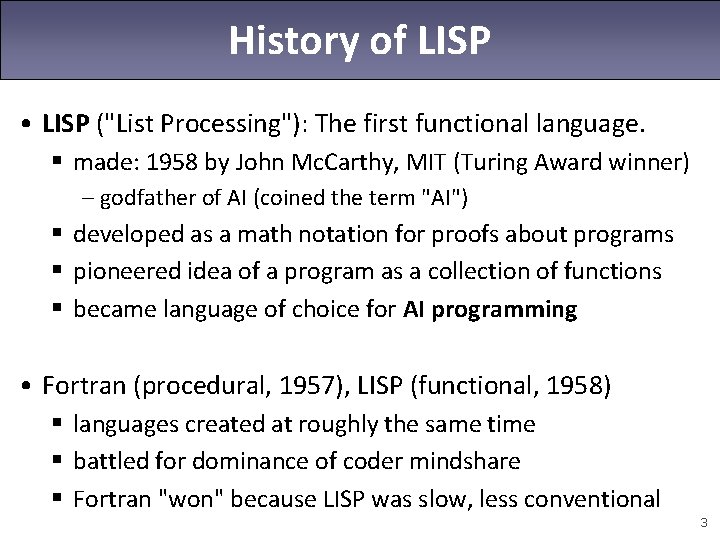
History of LISP • LISP ("List Processing"): The first functional language. § made: 1958 by John Mc. Carthy, MIT (Turing Award winner) – godfather of AI (coined the term "AI") § developed as a math notation for proofs about programs § pioneered idea of a program as a collection of functions § became language of choice for AI programming • Fortran (procedural, 1957), LISP (functional, 1958) § languages created at roughly the same time § battled for dominance of coder mindshare § Fortran "won" because LISP was slow, less conventional 3
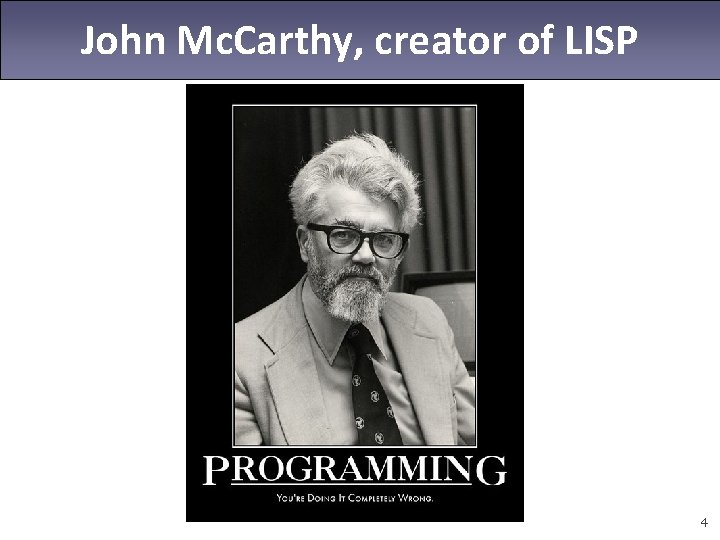
John Mc. Carthy, creator of LISP 4
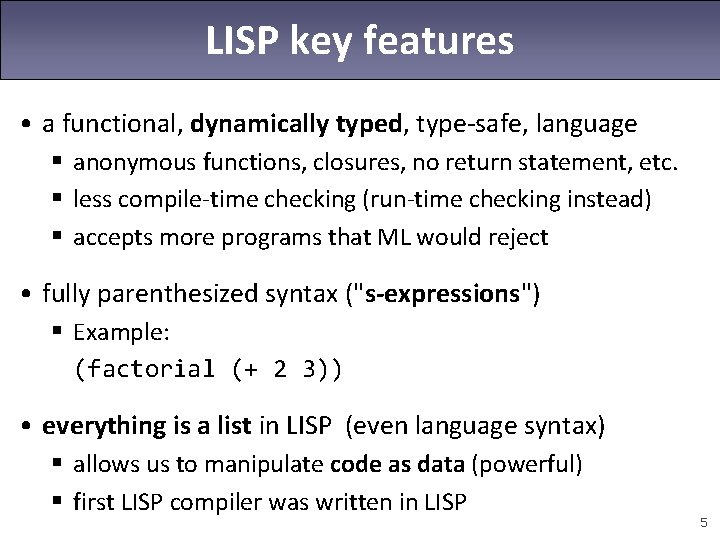
LISP key features • a functional, dynamically typed, type-safe, language § anonymous functions, closures, no return statement, etc. § less compile-time checking (run-time checking instead) § accepts more programs that ML would reject • fully parenthesized syntax ("s-expressions") § Example: (factorial (+ 2 3)) • everything is a list in LISP (even language syntax) § allows us to manipulate code as data (powerful) § first LISP compiler was written in LISP 5
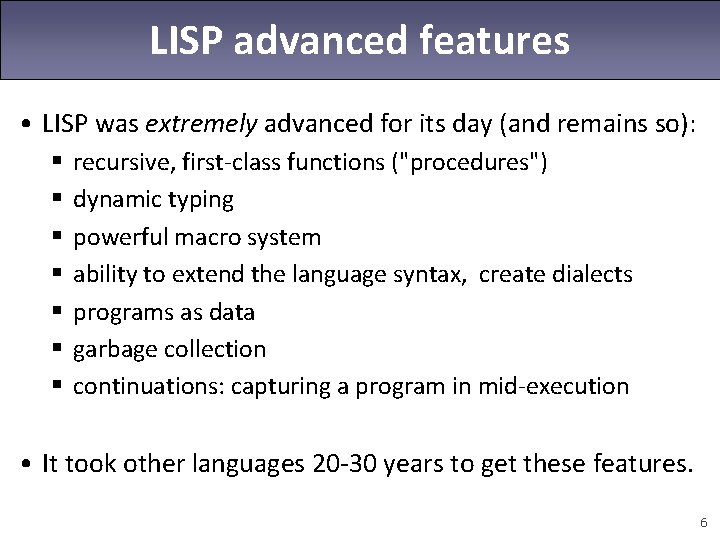
LISP advanced features • LISP was extremely advanced for its day (and remains so): § § § § recursive, first-class functions ("procedures") dynamic typing powerful macro system ability to extend the language syntax, create dialects programs as data garbage collection continuations: capturing a program in mid-execution • It took other languages 20 -30 years to get these features. 6
LISP "today" • current dialects of LISP in use: § Common LISP (1984) - unified many older dialects § Scheme (1975) - minimalist dialect w/ procedural features § Clojure (2007) - LISP dialect that runs on Java JVM • well-known software written in LISP: § § § Netscape Navigator, v 1 -3 Emacs text editor movies (Final Fantasy), games (Jak and Dexter) web sites, e. g. reddit Paul Graham (tech essayist, Hackers and Painters) 7
Scheme • Scheme: Popular dialect of LISP. § made in 1975 by Guy Steele, Gerald Sussman of MIT § Abelson and Sussman's influential textbook: – Structure and Interpretation of Computer Programs (SICP) http: //mitpress. mit. edu/sicp/ • innovative differences from other LISP dialects § § § minimalist design (50 page spec), derived from λ-calculus the first LISP to use lexical scoping and block structure lang. spec forces implementers to optimize tail recursion lazy evaluation: values are computed only as needed first-class continuations (captures of computation state) 8
Teach. Scheme! • 1995 movement by Matthias Felleisen of Rice's PLT group § goal: create pedagogic materials for students and teachers to educate them about programming and Scheme § push for use of Scheme and functional langs. in intro CS § radical yahoos who take themselves too seriously : -) • major Teach. Scheme! developments § Dr. Scheme editor, for use in education § How to Design Programs, influential Scheme intro textbook http: //www. teach-scheme. org/ http: //www. htdp. org/ 9
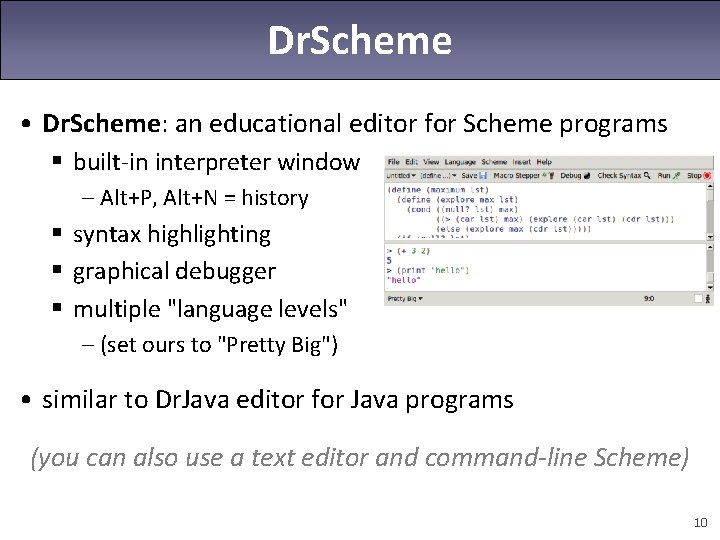
Dr. Scheme • Dr. Scheme: an educational editor for Scheme programs § built-in interpreter window – Alt+P, Alt+N = history § syntax highlighting § graphical debugger § multiple "language levels" – (set ours to "Pretty Big") • similar to Dr. Java editor for Java programs (you can also use a text editor and command-line Scheme) 10
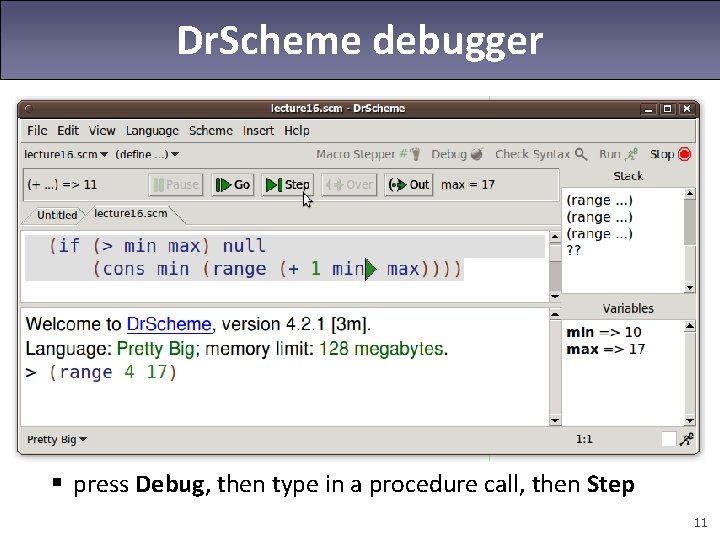
Dr. Scheme debugger § press Debug, then type in a procedure call, then Step 11
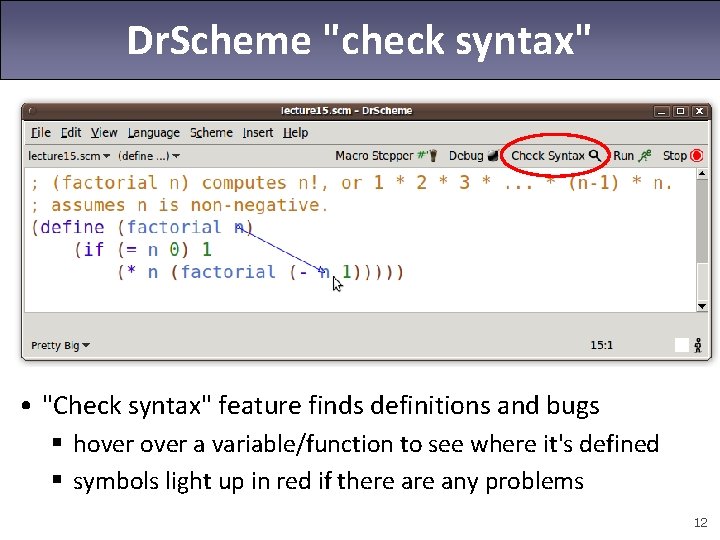
Dr. Scheme "check syntax" • "Check syntax" feature finds definitions and bugs § hover a variable/function to see where it's defined § symbols light up in red if there any problems 12
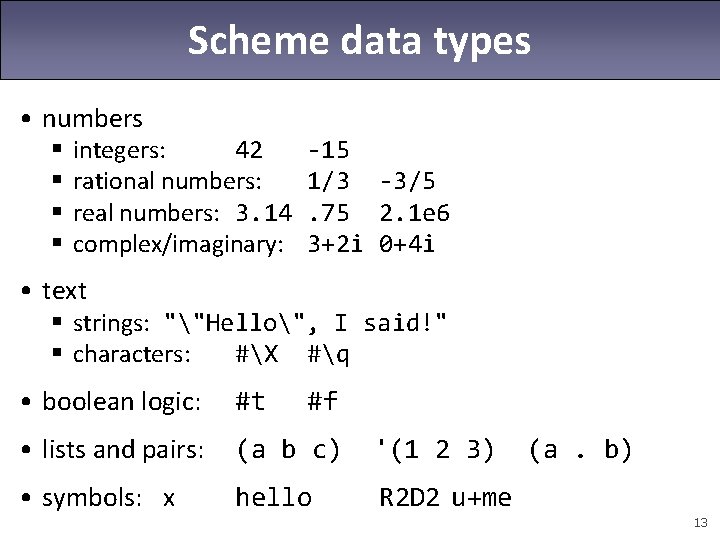
Scheme data types • numbers § § integers: 42 rational numbers: real numbers: 3. 14 complex/imaginary: -15 1/3 -3/5. 75 2. 1 e 6 3+2 i 0+4 i • text § strings: ""Hello", I said!" § characters: #X #q • boolean logic: #t • lists and pairs: (a b c) '(1 2 3) • symbols: x hello R 2 D 2 u+me #f (a. b) 13
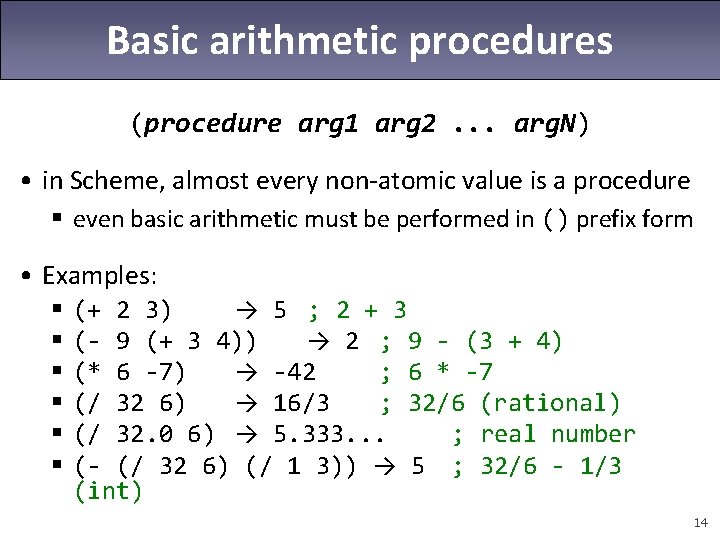
Basic arithmetic procedures (procedure arg 1 arg 2. . . arg. N) • in Scheme, almost every non-atomic value is a procedure § even basic arithmetic must be performed in () prefix form • Examples: § § § (+ 2 3) → 5 ; 2 + 3 (- 9 (+ 3 4)) → 2 ; 9 - (3 + 4) (* 6 -7) → -42 ; 6 * -7 (/ 32 6) → 16/3 ; 32/6 (rational) (/ 32. 0 6) → 5. 333. . . ; real number (- (/ 32 6) (/ 1 3)) → 5 ; 32/6 - 1/3 (int) 14
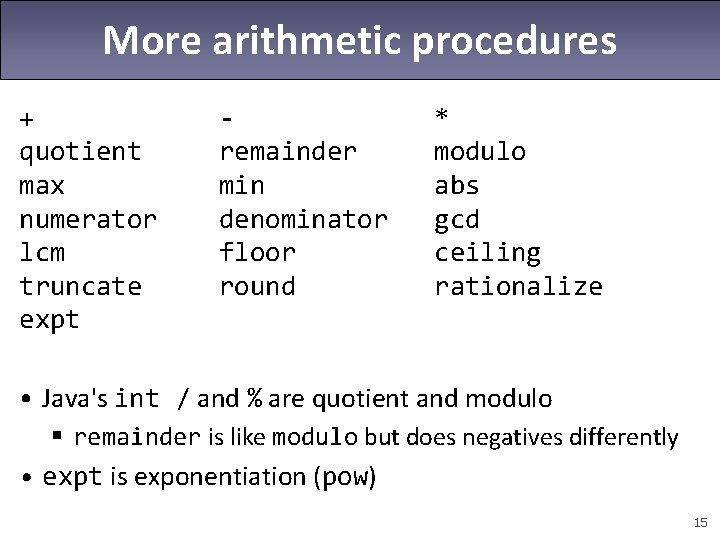
More arithmetic procedures + quotient max numerator lcm truncate expt remainder min denominator floor round * modulo abs gcd ceiling rationalize • Java's int / and % are quotient and modulo § remainder is like modulo but does negatives differently • expt is exponentiation (pow) 15
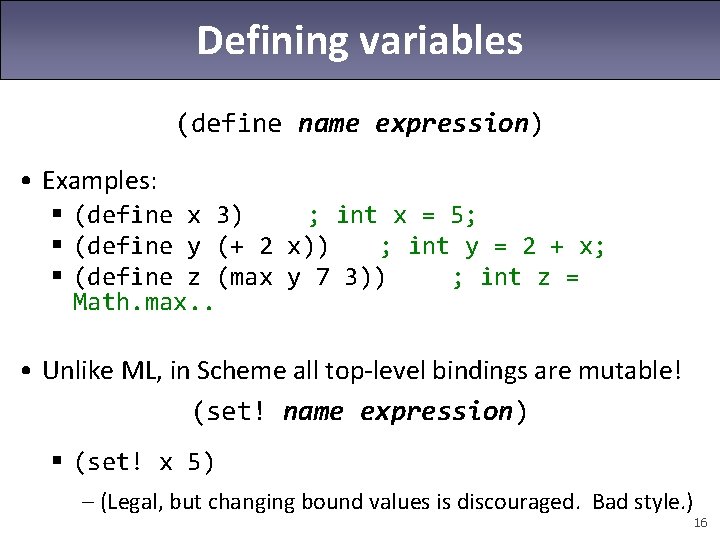
Defining variables (define name expression) • Examples: § (define x 3) ; int x = 5; § (define y (+ 2 x)) ; int y = 2 + x; § (define z (max y 7 3)) ; int z = Math. max. . • Unlike ML, in Scheme all top-level bindings are mutable! (set! name expression) § (set! x 5) – (Legal, but changing bound values is discouraged. Bad style. ) 16
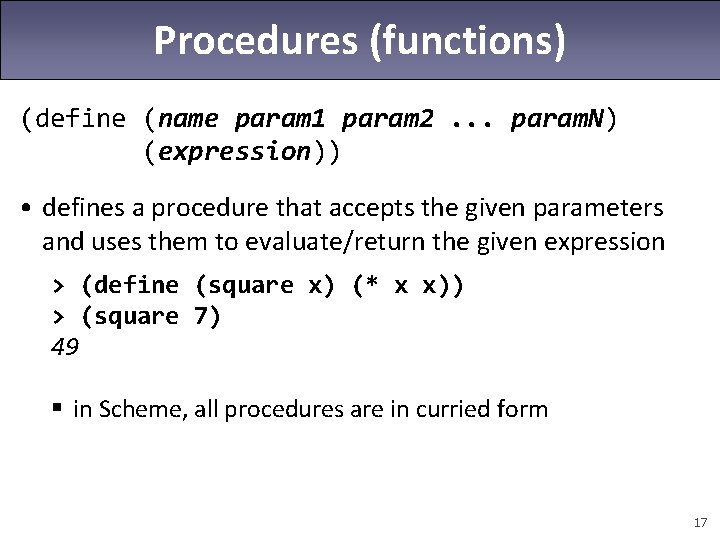
Procedures (functions) (define (name param 1 param 2. . . param. N) (expression)) • defines a procedure that accepts the given parameters and uses them to evaluate/return the given expression > (define (square x) (* x x)) > (square 7) 49 § in Scheme, all procedures are in curried form 17
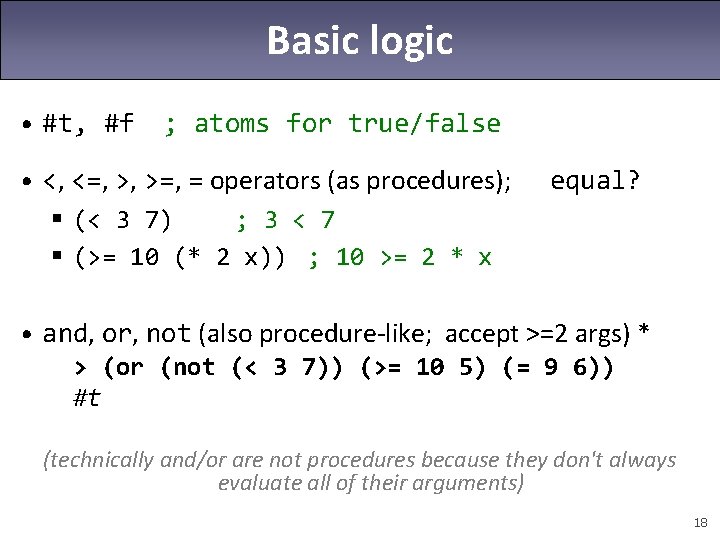
Basic logic • #t, #f ; atoms for true/false • <, <=, >, >=, = operators (as procedures); equal? § (< 3 7) ; 3 < 7 § (>= 10 (* 2 x)) ; 10 >= 2 * x • and, or, not (also procedure-like; accept >=2 args) * > (or (not (< 3 7)) (>= 10 5) (= 9 6)) #t (technically and/or are not procedures because they don't always evaluate all of their arguments) 18
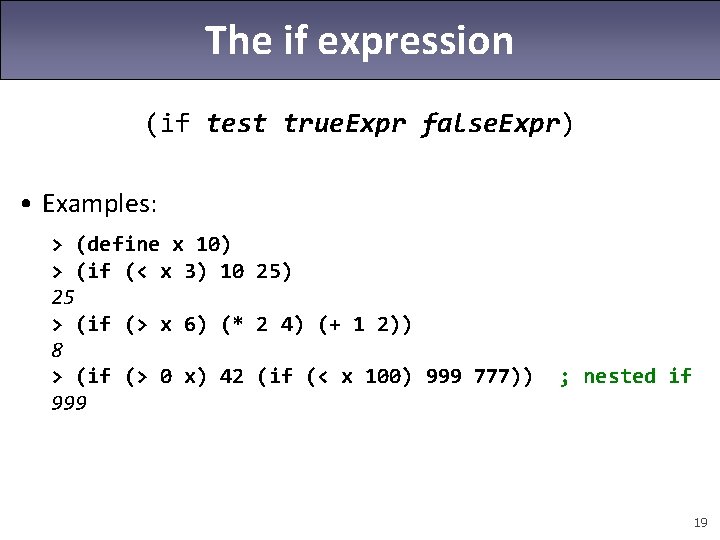
The if expression (if test true. Expr false. Expr) • Examples: > (define x 10) > (if (< x 3) 10 25) 25 > (if (> x 6) (* 2 4) (+ 1 2)) 8 > (if (> 0 x) 42 (if (< x 100) 999 777)) 999 ; nested if 19
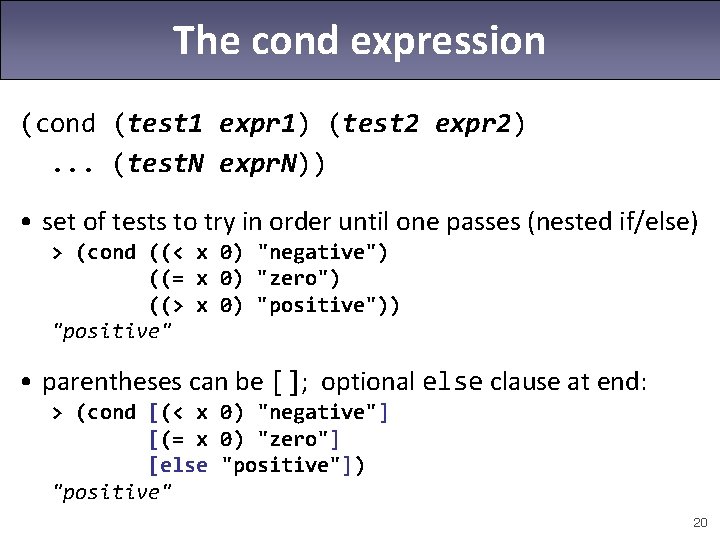
The cond expression (cond (test 1 expr 1) (test 2 expr 2). . . (test. N expr. N)) • set of tests to try in order until one passes (nested if/else) > (cond ((< x 0) "negative") ((= x 0) "zero") ((> x 0) "positive")) "positive" • parentheses can be []; optional else clause at end: > (cond [(< x 0) "negative"] [(= x 0) "zero"] [else "positive"]) "positive" 20
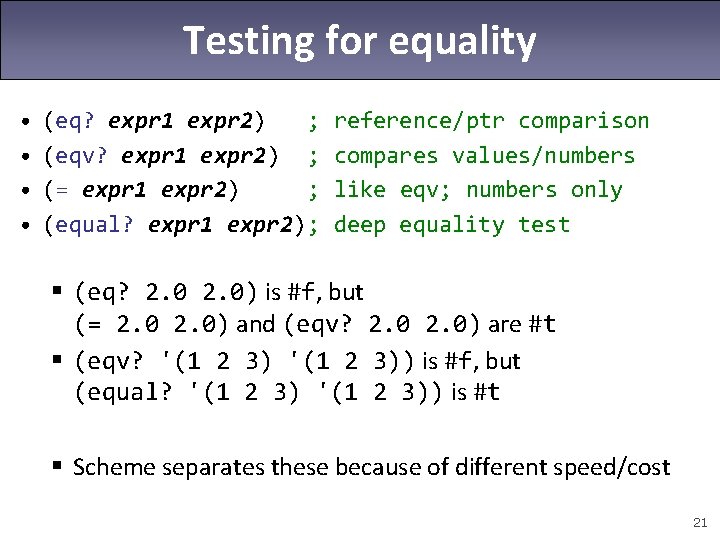
Testing for equality • • (eq? expr 1 expr 2) ; (eqv? expr 1 expr 2) ; (= expr 1 expr 2) ; (equal? expr 1 expr 2); reference/ptr comparison compares values/numbers like eqv; numbers only deep equality test § (eq? 2. 0) is #f, but (= 2. 0) and (eqv? 2. 0) are #t § (eqv? '(1 2 3)) is #f, but (equal? '(1 2 3)) is #t § Scheme separates these because of different speed/cost 21
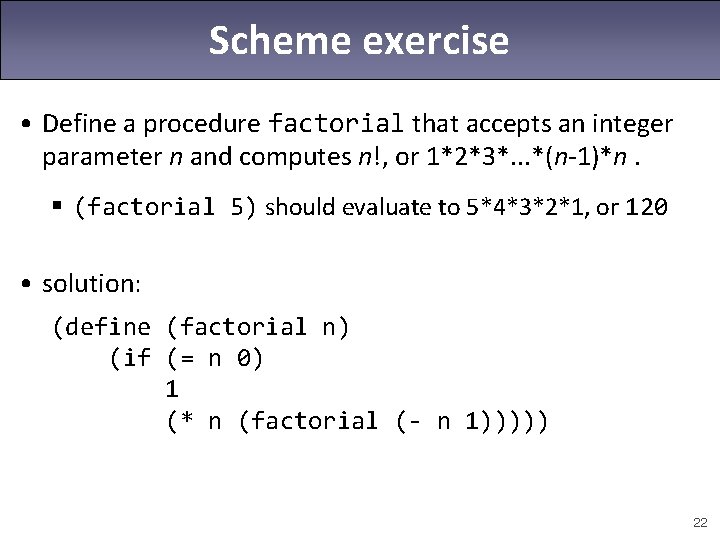
Scheme exercise • Define a procedure factorial that accepts an integer parameter n and computes n!, or 1*2*3*. . . *(n-1)*n. § (factorial 5) should evaluate to 5*4*3*2*1, or 120 • solution: (define (factorial n) (if (= n 0) 1 (* n (factorial (- n 1))))) 22
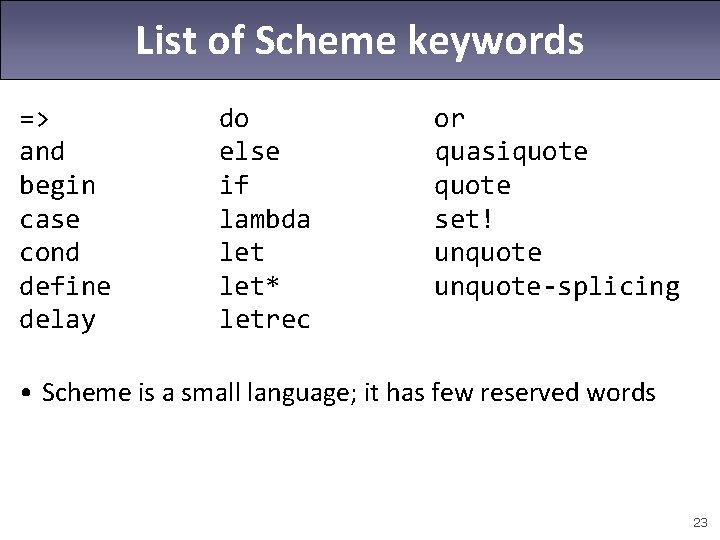
List of Scheme keywords => and begin case cond define delay do else if lambda let* letrec or quasiquote set! unquote-splicing • Scheme is a small language; it has few reserved words 23
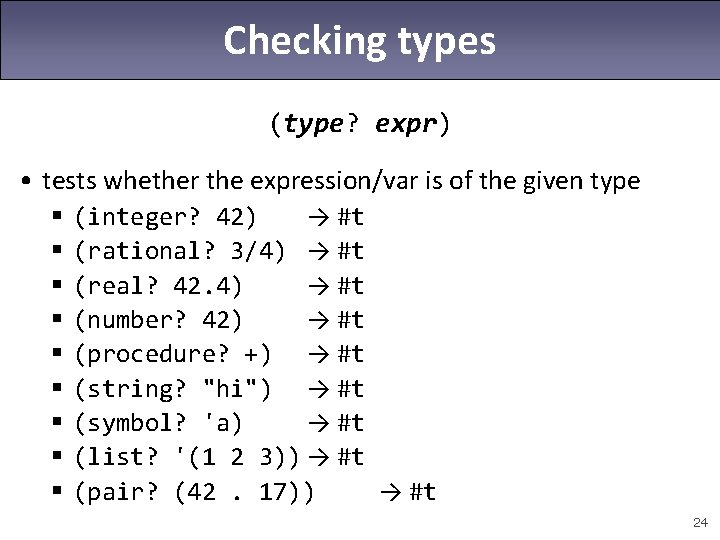
Checking types (type? expr) • tests whether the expression/var is of the given type § § § § § (integer? 42) → #t (rational? 3/4) → #t (real? 42. 4) → #t (number? 42) → #t (procedure? +) → #t (string? "hi") → #t (symbol? 'a) → #t (list? '(1 2 3)) → #t (pair? (42. 17)) → #t 24
String procedures (string-length str) (substring str start [end]) (string-append str [str 2 str 3. . . str. N]) (string->list str) (list->string char. List) (string<? str 1 str 2) ; also <=, =, > (string-ci<? str 1 str 2) ; case-insensitive (string-upcase str) (string-downcase str) (string-titlecase str) (string-upcase str) 25