
CSE 332 Data Abstractions Lecture 24 ReadersWriter Locks
CSE 332: Data Abstractions Lecture 24: Readers/Writer Locks and Condition Variables Tyler Robison Summer 2010 1
Concurrency: Where are we Done: � Programming with locks and critical sections � Key guidelines and trade-offs Now: More on facilitating concurrent access � Readers/writer � Specific type of lock that can allow for more efficient access � Condition � More 2 locks variables efficient access for producer/consumer relationships
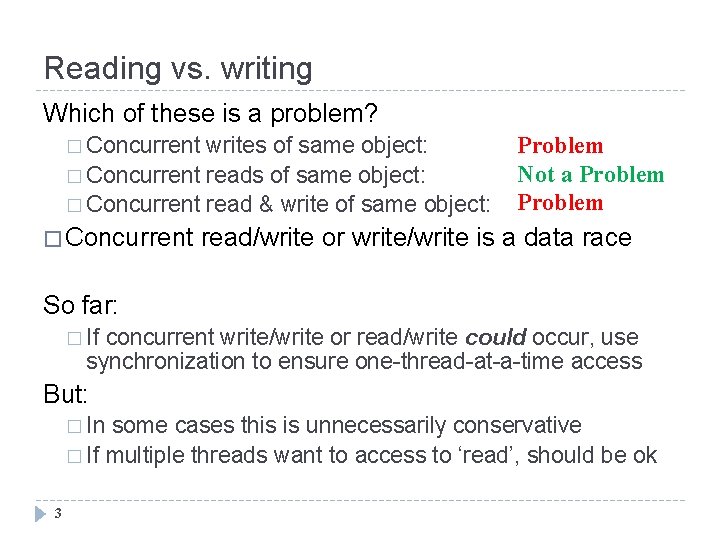
Reading vs. writing Which of these is a problem? � Concurrent writes of same object: � Concurrent read & write of same object: � Concurrent Problem Not a Problem read/write or write/write is a data race So far: � If concurrent write/write or read/write could occur, use synchronization to ensure one-thread-at-a-time access But: � In some cases this is unnecessarily conservative � If multiple threads want to access to ‘read’, should be ok 3
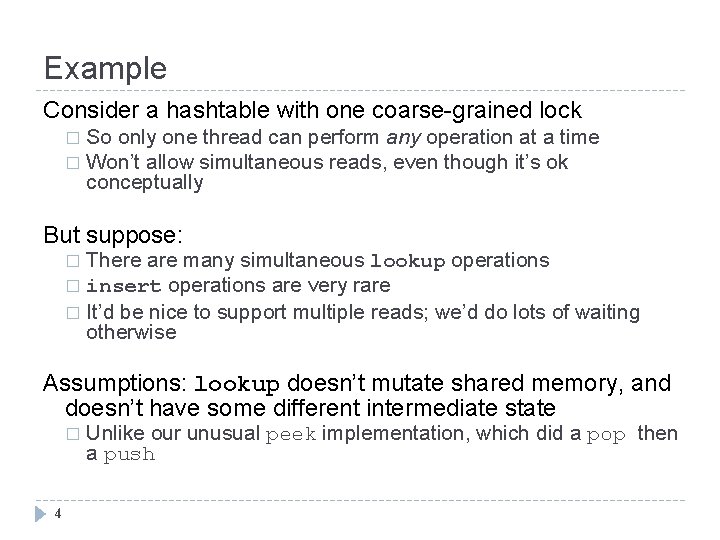
Example Consider a hashtable with one coarse-grained lock So only one thread can perform any operation at a time � Won’t allow simultaneous reads, even though it’s ok conceptually � But suppose: There are many simultaneous lookup operations � insert operations are very rare � It’d be nice to support multiple reads; we’d do lots of waiting otherwise � Assumptions: lookup doesn’t mutate shared memory, and doesn’t have some different intermediate state � 4 Unlike our unusual peek implementation, which did a pop then a push
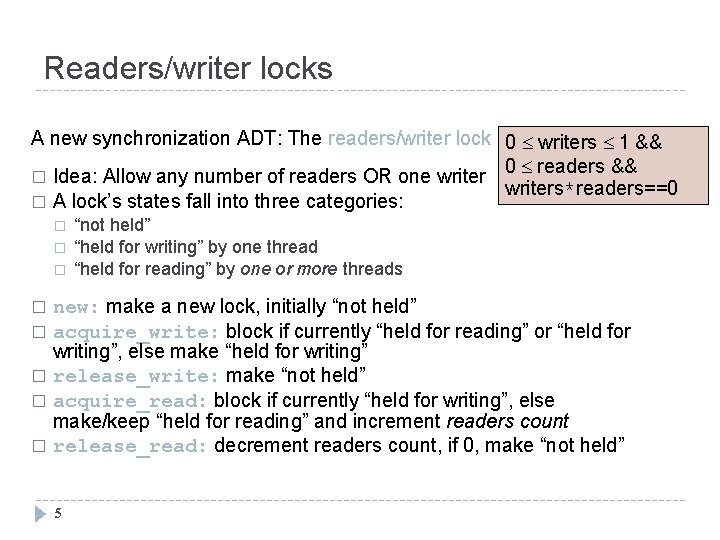
Readers/writer locks A new synchronization ADT: The readers/writer lock 0 writers 1 && 0 readers && � Idea: Allow any number of readers OR one writers*readers==0 � A lock’s states fall into three categories: � � � “not held” “held for writing” by one thread “held for reading” by one or more threads new: make a new lock, initially “not held” � acquire_write: block if currently “held for reading” or “held for writing”, else make “held for writing” � release_write: make “not held” � acquire_read: block if currently “held for writing”, else make/keep “held for reading” and increment readers count � release_read: decrement readers count, if 0, make “not held” � 5
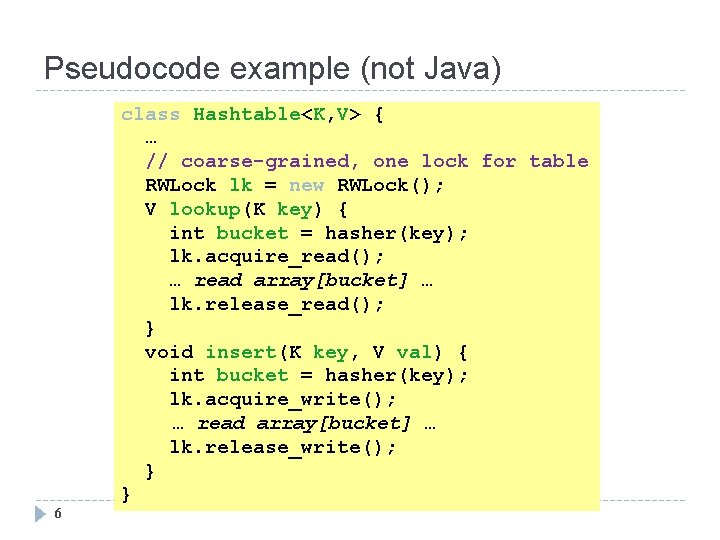
Pseudocode example (not Java) 6 class Hashtable<K, V> { … // coarse-grained, one lock for table RWLock lk = new RWLock(); V lookup(K key) { int bucket = hasher(key); lk. acquire_read(); … read array[bucket] … lk. release_read(); } void insert(K key, V val) { int bucket = hasher(key); lk. acquire_write(); … read array[bucket] … lk. release_write(); } }
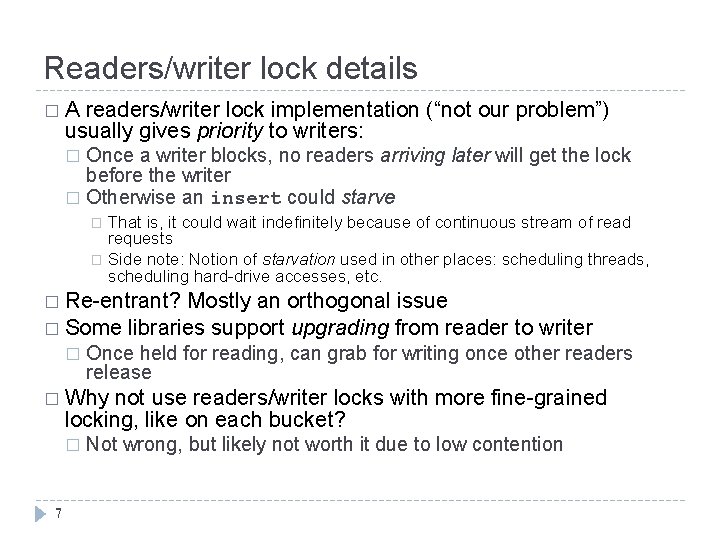
Readers/writer lock details �A readers/writer lock implementation (“not our problem”) usually gives priority to writers: Once a writer blocks, no readers arriving later will get the lock before the writer � Otherwise an insert could starve � That is, it could wait indefinitely because of continuous stream of read requests � Side note: Notion of starvation used in other places: scheduling threads, scheduling hard-drive accesses, etc. � � Re-entrant? Mostly an orthogonal issue � Some libraries support upgrading from reader to writer � Once held for reading, can grab for writing once other readers release � Why not use readers/writer locks with more fine-grained locking, like on each bucket? � 7 Not wrong, but likely not worth it due to low contention
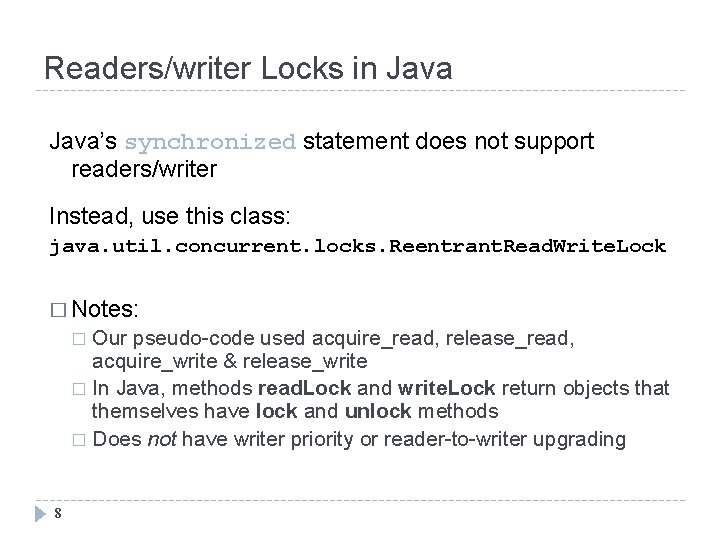
Readers/writer Locks in Java’s synchronized statement does not support readers/writer Instead, use this class: java. util. concurrent. locks. Reentrant. Read. Write. Lock � Notes: Our pseudo-code used acquire_read, release_read, acquire_write & release_write � In Java, methods read. Lock and write. Lock return objects that themselves have lock and unlock methods � Does not have writer priority or reader-to-writer upgrading � 8
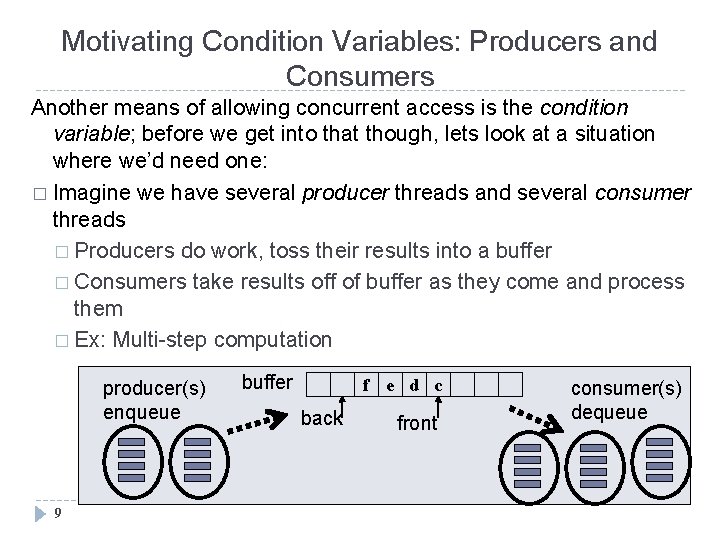
Motivating Condition Variables: Producers and Consumers Another means of allowing concurrent access is the condition variable; before we get into that though, lets look at a situation where we’d need one: � Imagine we have several producer threads and several consumer threads � Producers do work, toss their results into a buffer � Consumers take results off of buffer as they come and process them � Ex: Multi-step computation producer(s) enqueue 9 buffer f e d c back front consumer(s) dequeue
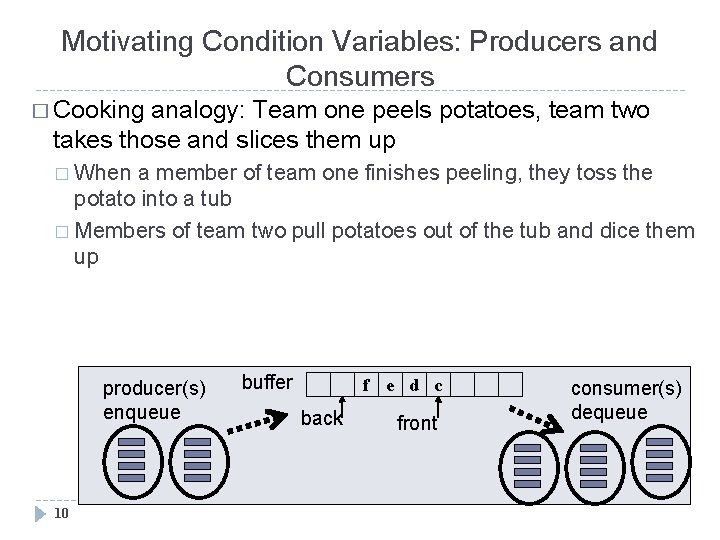
Motivating Condition Variables: Producers and Consumers � Cooking analogy: Team one peels potatoes, team two takes those and slices them up � When a member of team one finishes peeling, they toss the potato into a tub � Members of team two pull potatoes out of the tub and dice them up producer(s) enqueue 10 buffer f e d c back front consumer(s) dequeue
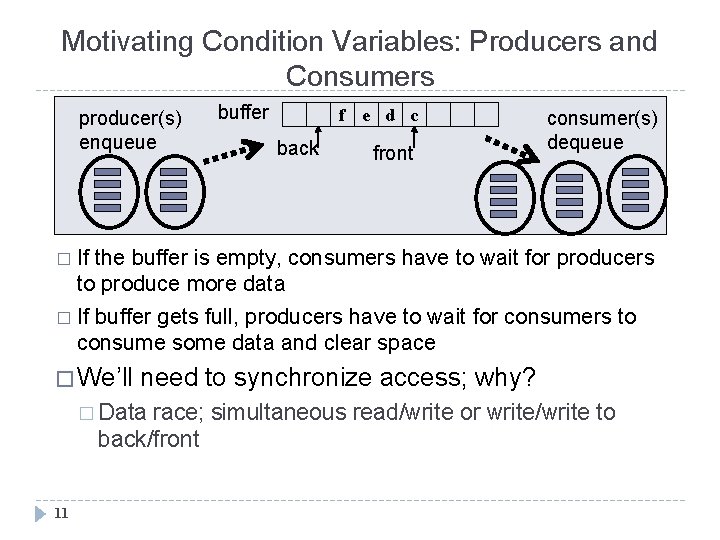
Motivating Condition Variables: Producers and Consumers producer(s) enqueue buffer f e d c back front consumer(s) dequeue � If the buffer is empty, consumers have to wait for producers to produce more data � If buffer gets full, producers have to wait for consumers to consume some data and clear space � We’ll need to synchronize access; why? � Data race; simultaneous read/write or write/write to back/front 11
![First attempt class Buffer<E> { E[] array = (E[])new Object[SIZE]; … // front, back](http://slidetodoc.com/presentation_image_h2/a99e5c6258fa451d47cb0bb854e9fb68/image-12.jpg "First attempt class Buffer<E> { E[] array = (E[])new Object[SIZE]; … // front, back")
First attempt class Buffer<E> { E[] array = (E[])new Object[SIZE]; … // front, back fields, is. Empty, is. Full methods synchronized void enqueue(E elt) { if(is. Full()) ? ? ? else … add to array and adjust back … } synchronized E dequeue() { if(is. Empty()) { ? ? ? else … take from array and adjust front … } } � One approach; if buffer is full on enqueue, or empty on dequeue, throw an exception Not what we want here; w/ multiple threads taking & giving, these will be common occurrences – should not handle like errors � Common, and only temporary; will only be empty/full briefly � Instead, we want threads to be pause until it can proceed � 12
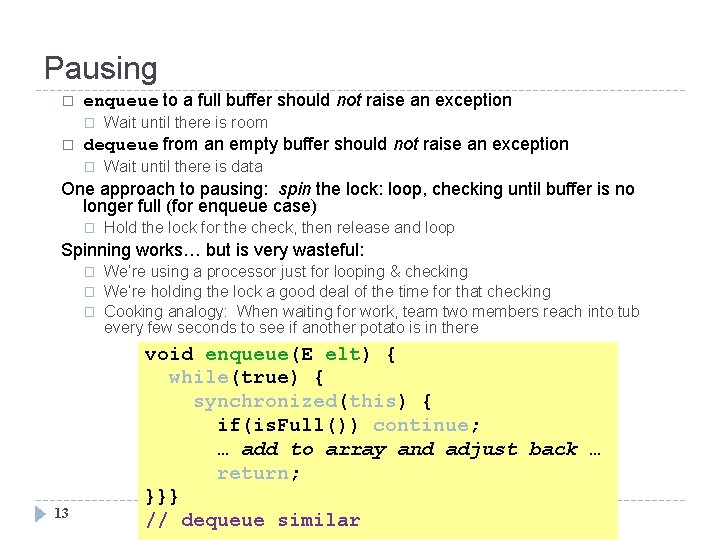
Pausing � enqueue to a full buffer should not raise an exception � � Wait until there is room dequeue from an empty buffer should not raise an exception � Wait until there is data One approach to pausing: spin the lock: loop, checking until buffer is no longer full (for enqueue case) � Hold the lock for the check, then release and loop Spinning works… but is very wasteful: � � � 13 We’re using a processor just for looping & checking We’re holding the lock a good deal of the time for that checking Cooking analogy: When waiting for work, team two members reach into tub every few seconds to see if another potato is in there void enqueue(E elt) { while(true) { synchronized(this) { if(is. Full()) continue; … add to array and adjust back … return; }}} // dequeue similar
What we want � Better would be for a thread to wait until it can proceed Be notified when it should try again � Thread suspended until then; in meantime, other threads run � While waiting, lock is released; will be re-acquired later by one notified thread � Upon being notified, thread just drops in to see what condition it’s condition is in � Team two members work on something else until they’re told more potatoes are ready � Less contention for lock, and time waiting spent more efficiently � 14
Condition Variables � Like locks & threads, not something you can implement on your own � Language � An or library gives it to you ADT that supports this: condition variable � Informs waiting thread(s) when the condition that causes it/them to wait has varied � Terminology with Java 15 not completely standard; will mostly stick
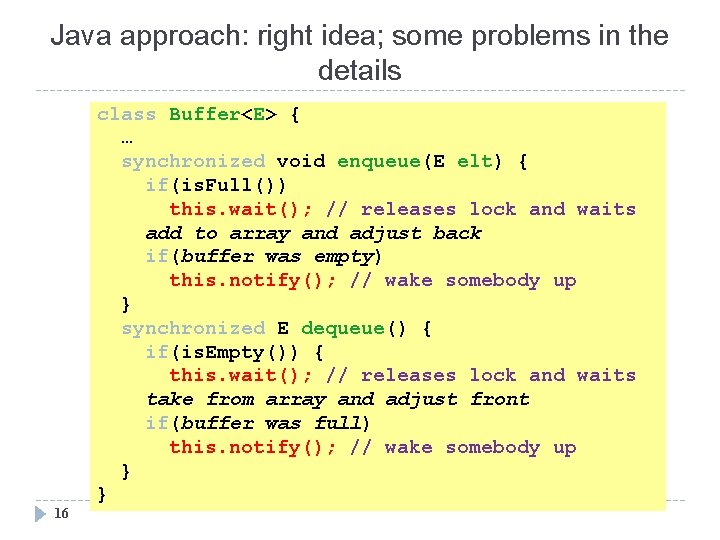
Java approach: right idea; some problems in the details 16 class Buffer<E> { … synchronized void enqueue(E elt) { if(is. Full()) this. wait(); // releases lock and waits add to array and adjust back if(buffer was empty) this. notify(); // wake somebody up } synchronized E dequeue() { if(is. Empty()) { this. wait(); // releases lock and waits take from array and adjust front if(buffer was full) this. notify(); // wake somebody up } }
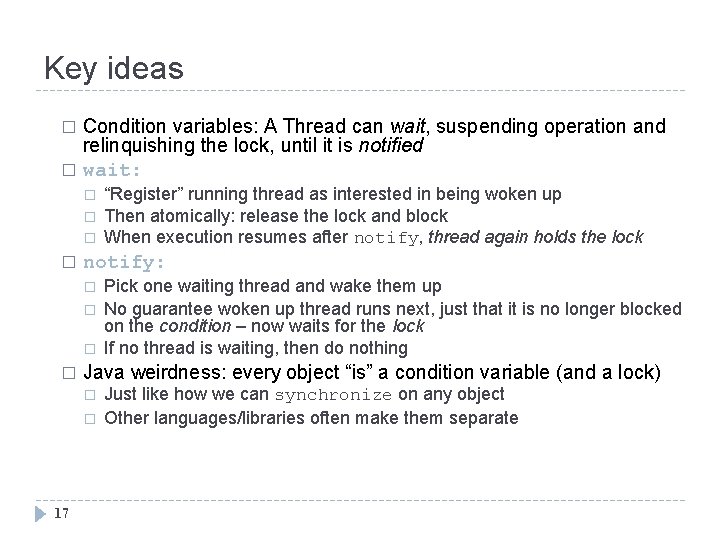
Key ideas Condition variables: A Thread can wait, suspending operation and relinquishing the lock, until it is notified � wait: � � � notify: � � Pick one waiting thread and wake them up No guarantee woken up thread runs next, just that it is no longer blocked on the condition – now waits for the lock If no thread is waiting, then do nothing Java weirdness: every object “is” a condition variable (and a lock) � � 17 “Register” running thread as interested in being woken up Then atomically: release the lock and block When execution resumes after notify, thread again holds the lock Just like how we can synchronize on any object Other languages/libraries often make them separate
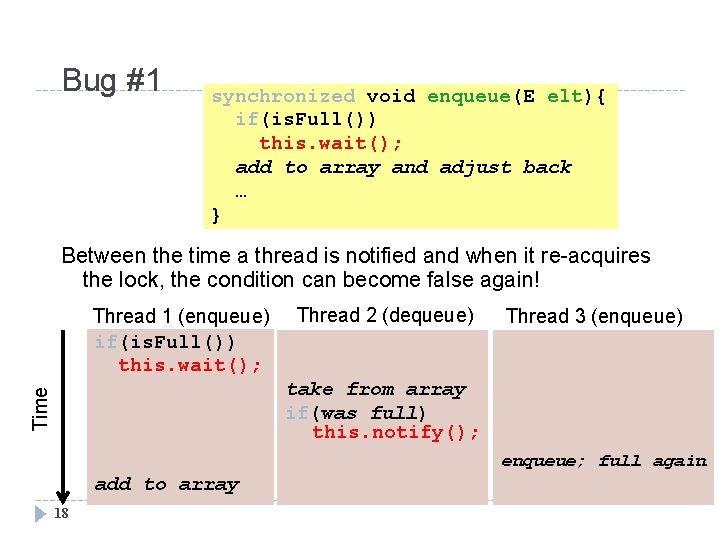
Bug #1 synchronized void enqueue(E elt){ if(is. Full()) this. wait(); add to array and adjust back … } Between the time a thread is notified and when it re-acquires the lock, the condition can become false again! Thread 1 (enqueue) if(is. Full()) this. wait(); Thread 2 (dequeue) Thread 3 (enqueue) Time take from array if(was full) this. notify(); enqueue; full again add to array 18
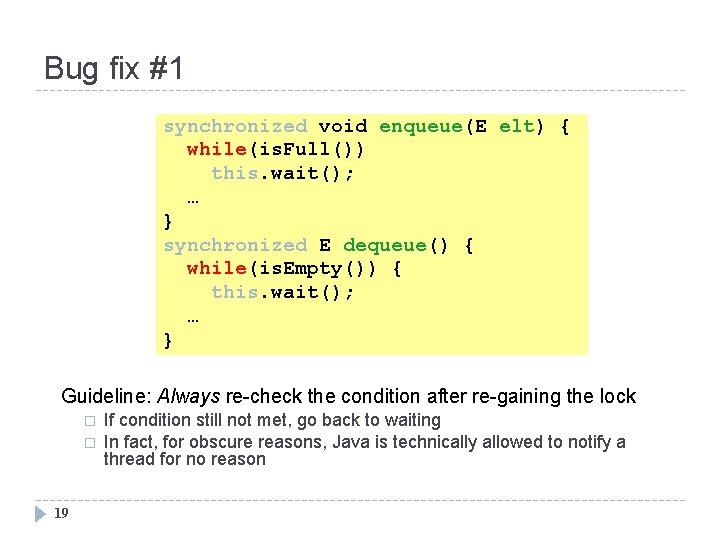
Bug fix #1 synchronized void enqueue(E elt) { while(is. Full()) this. wait(); … } synchronized E dequeue() { while(is. Empty()) { this. wait(); … } Guideline: Always re-check the condition after re-gaining the lock � � 19 If condition still not met, go back to waiting In fact, for obscure reasons, Java is technically allowed to notify a thread for no reason
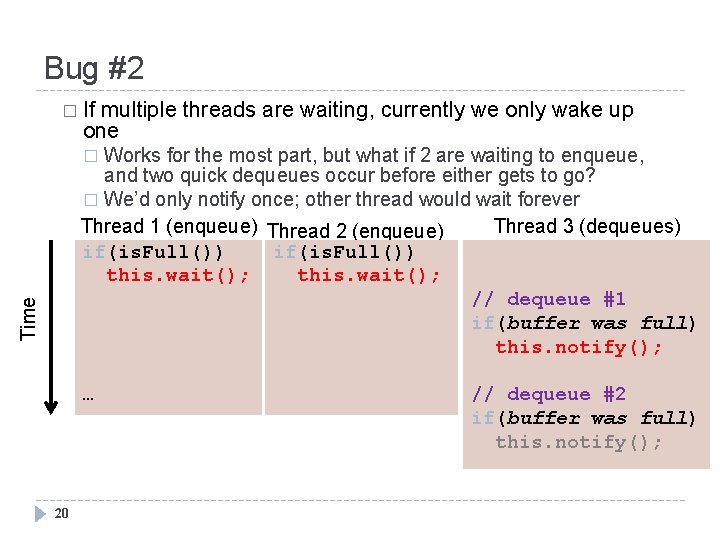
Bug #2 � If multiple threads are waiting, currently we only wake up one Works for the most part, but what if 2 are waiting to enqueue, and two quick dequeues occur before either gets to go? � We’d only notify once; other thread would wait forever Thread 1 (enqueue) Thread 2 (enqueue) Thread 3 (dequeues) if(is. Full()) this. wait(); // dequeue #1 if(buffer was full) this. notify(); Time � … 20 // dequeue #2 if(buffer was full) this. notify();
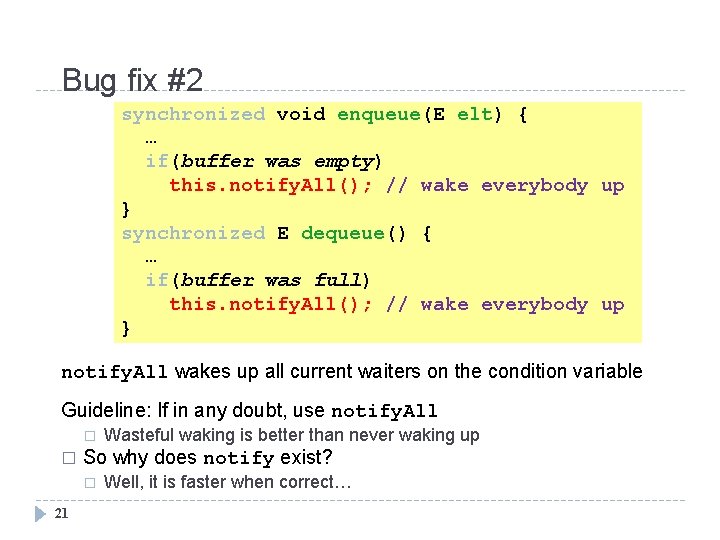
Bug fix #2 synchronized void enqueue(E elt) { … if(buffer was empty) this. notify. All(); // wake everybody up } synchronized E dequeue() { … if(buffer was full) this. notify. All(); // wake everybody up } notify. All wakes up all current waiters on the condition variable Guideline: If in any doubt, use notify. All � � So why does notify exist? � 21 Wasteful waking is better than never waking up Well, it is faster when correct…
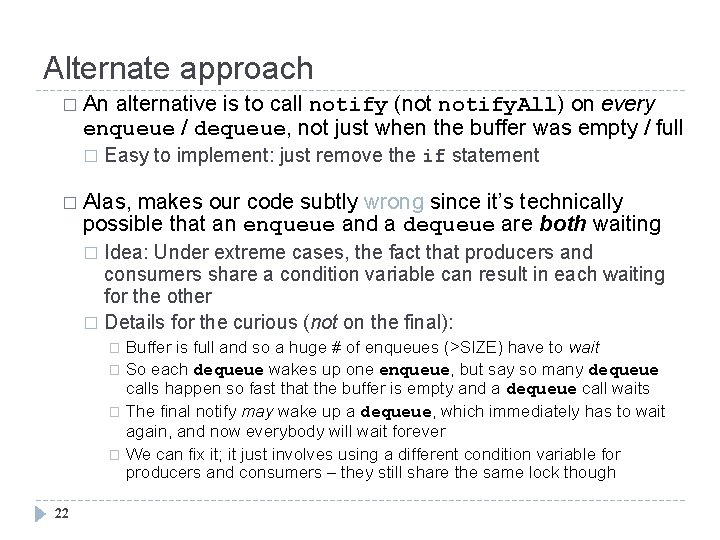
Alternate approach � An alternative is to call notify (not notify. All) on every enqueue / dequeue, not just when the buffer was empty / full � Easy to implement: just remove the if statement � Alas, makes our code subtly wrong since it’s technically possible that an enqueue and a dequeue are both waiting Idea: Under extreme cases, the fact that producers and consumers share a condition variable can result in each waiting for the other � Details for the curious (not on the final): � Buffer is full and so a huge # of enqueues (>SIZE) have to wait � So each dequeue wakes up one enqueue, but say so many dequeue calls happen so fast that the buffer is empty and a dequeue call waits � The final notify may wake up a dequeue, which immediately has to wait again, and now everybody will wait forever � We can fix it; it just involves using a different condition variable for producers and consumers – they still share the same lock though � 22
Last condition-variable comments � notify/notify. All � Condition often called signal/broadcast variables are subtle and harder to use than locks � Not as common as locks � But when you need them, you need them � Spinning and other work-arounds don’t work well � Fortunately, like most things in CSE 332, the common use -cases are already provided efficiently in libraries Example: java. util. concurrent. Array. Blocking. Queue<E> � All uses of condition variables hidden in the library; client just calls put and take � 23
- Slides: 23