
CSE 331 Reflection slides created by Marty Stepp
CSE 331 Reflection slides created by Marty Stepp based on materials by M. Ernst, S. Reges, D. Notkin, R. Mercer, Wikipedia http: //www. cs. washington. edu/331/ 1
Reflection • reflection: A process by which a program can examine its own types and structure at runtime. § sometimes called run-time type inference (RTTI) § import java. lang. reflect. *; • Using reflection, you can: § § Convert strings and others into classes and objects at runtime. Ask detailed questions in code about the abilities of a type. Dynamically compile, load, and add classes to a running program. Pass function pointers (via Method objects) • Reflection is used internally by many Java technologies including IDEs/compilers, debuggers, serialization, Java Beans, RMI, . . . 2
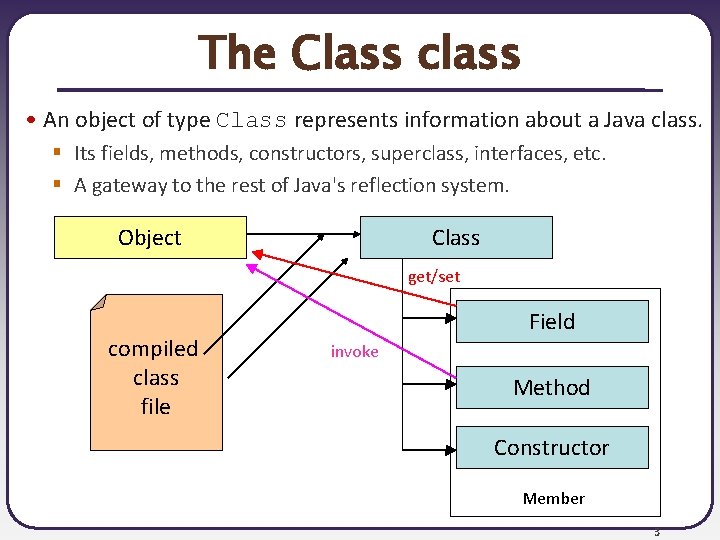
The Class class • An object of type Class represents information about a Java class. § Its fields, methods, constructors, superclass, interfaces, etc. § A gateway to the rest of Java's reflection system. Object Class get/set compiled class file Field invoke Method Constructor Member 3
Accessing a Class object • Ways to get a Class object: § If you have an object: Every object has a get. Class method to return the Class object that corresponds to that object's type. • Class<Point> point. Class = p. get. Class(); § If you don't have an object, but know the class's name at compile time: Every class has a static field named class storing its Class object. • Class<Point> point. Class = Point. class; § If you don't know the type until given its name as a string at runtime: The static method Class. for. Name(String) will return the Class object for a given type; pass it a full class name. • Class<? > clazz = Class. for. Name("java. awt. Point"); 4
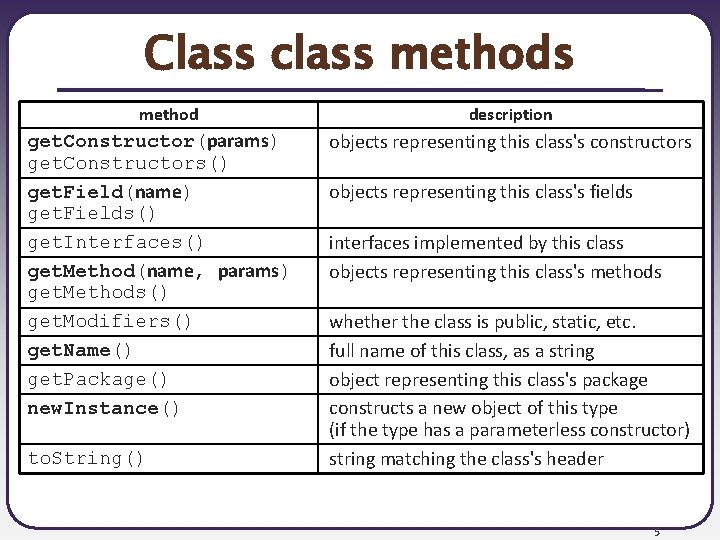
Class class method get. Constructor(params) get. Constructors() get. Field(name) get. Fields() get. Interfaces() get. Method(name, params) get. Methods() get. Modifiers() get. Name() get. Package() new. Instance() to. String() description objects representing this class's constructors objects representing this class's fields interfaces implemented by this class objects representing this class's methods whether the class is public, static, etc. full name of this class, as a string object representing this class's package constructs a new object of this type (if the type has a parameterless constructor) string matching the class's header 5
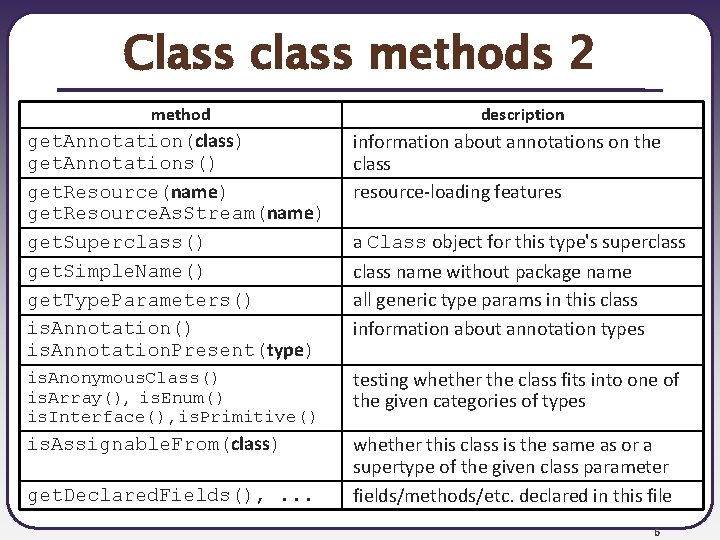
Class class methods 2 method description get. Annotation(class) get. Annotations() get. Resource(name) get. Resource. As. Stream(name) get. Superclass() get. Simple. Name() get. Type. Parameters() is. Annotation. Present(type) information about annotations on the class resource-loading features is. Anonymous. Class() is. Array(), is. Enum() is. Interface(), is. Primitive() testing whether the class fits into one of the given categories of types is. Assignable. From(class) whether this class is the same as or a supertype of the given class parameter fields/methods/etc. declared in this file get. Declared. Fields(), . . . a Class object for this type's superclass name without package name all generic type params in this class information about annotation types 6
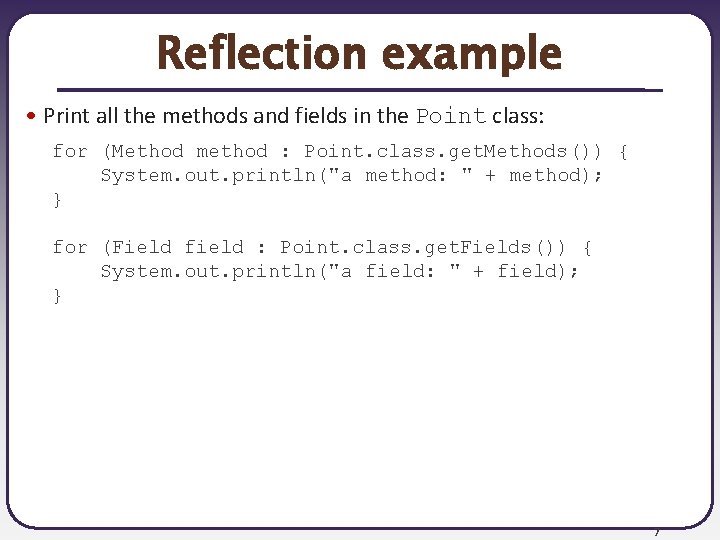
Reflection example • Print all the methods and fields in the Point class: for (Method method : Point. class. get. Methods()) { System. out. println("a method: " + method); } for (Field field : Point. class. get. Fields()) { System. out. println("a field: " + field); } 7
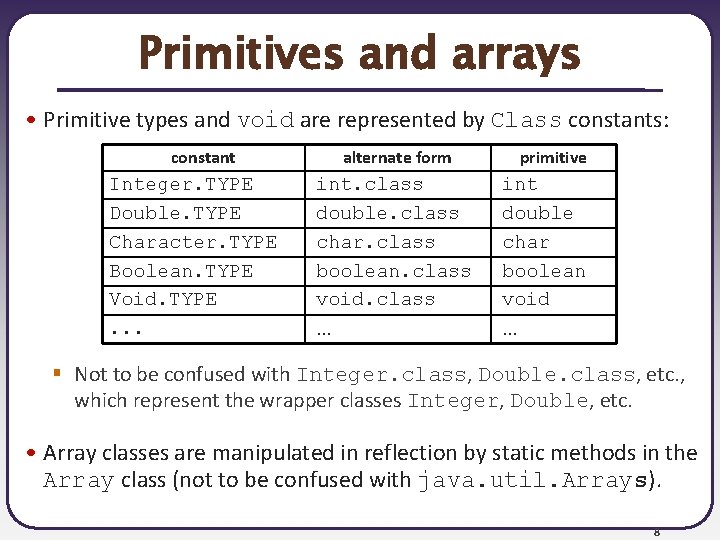
Primitives and arrays • Primitive types and void are represented by Class constants: constant Integer. TYPE Double. TYPE Character. TYPE Boolean. TYPE Void. TYPE. . . alternate form int. class double. class char. class boolean. class void. class. . . primitive int double char boolean void. . . § Not to be confused with Integer. class, Double. class, etc. , which represent the wrapper classes Integer, Double, etc. • Array classes are manipulated in reflection by static methods in the Array class (not to be confused with java. util. Arrays). 8
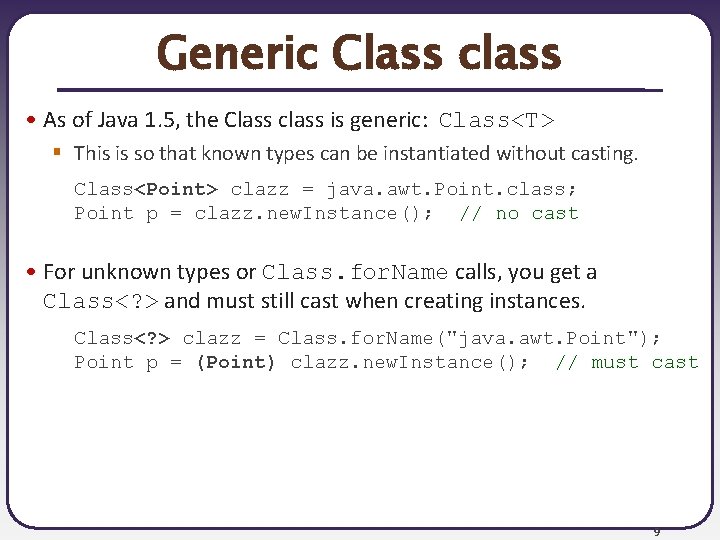
Generic Class class • As of Java 1. 5, the Class class is generic: Class<T> § This is so that known types can be instantiated without casting. Class<Point> clazz = java. awt. Point. class; Point p = clazz. new. Instance(); // no cast • For unknown types or Class. for. Name calls, you get a Class<? > and must still cast when creating instances. Class<? > clazz = Class. for. Name("java. awt. Point"); Point p = (Point) clazz. new. Instance(); // must cast 9
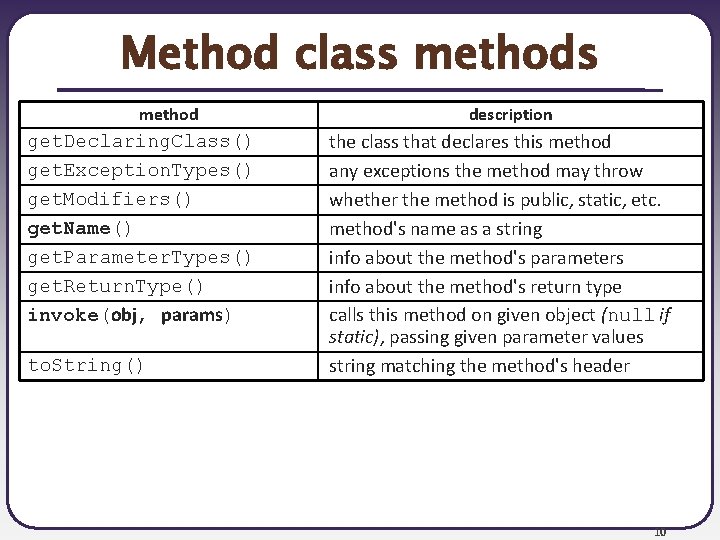
Method class method get. Declaring. Class() get. Exception. Types() get. Modifiers() get. Name() get. Parameter. Types() get. Return. Type() invoke(obj, params) to. String() description the class that declares this method any exceptions the method may throw whether the method is public, static, etc. method's name as a string info about the method's parameters info about the method's return type calls this method on given object (null if static), passing given parameter values string matching the method's header 10
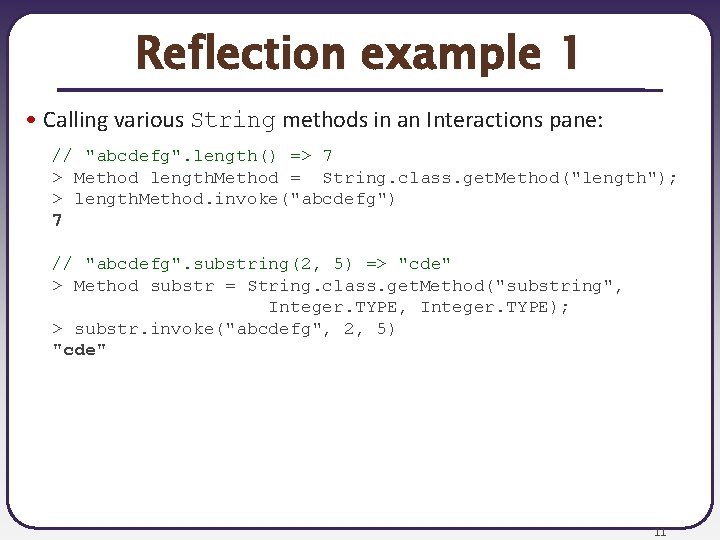
Reflection example 1 • Calling various String methods in an Interactions pane: // "abcdefg". length() => 7 > Method length. Method = String. class. get. Method("length"); > length. Method. invoke("abcdefg") 7 // "abcdefg". substring(2, 5) => "cde" > Method substr = String. class. get. Method("substring", Integer. TYPE); > substr. invoke("abcdefg", 2, 5) "cde" 11
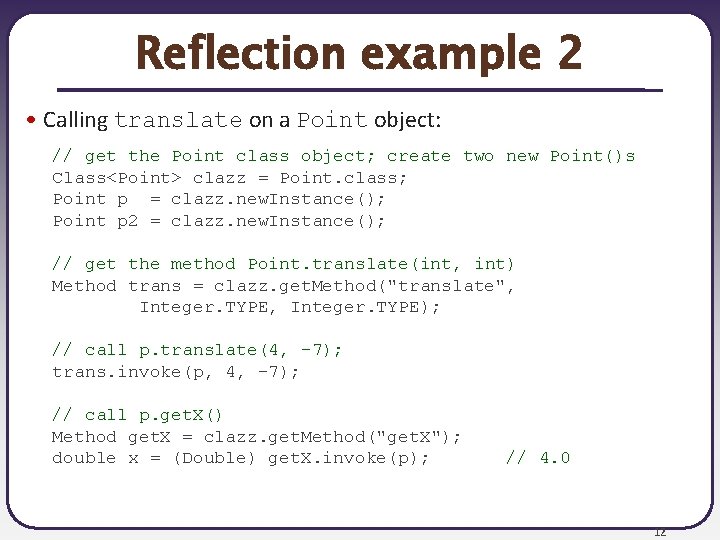
Reflection example 2 • Calling translate on a Point object: // get the Point class object; create two new Point()s Class<Point> clazz = Point. class; Point p = clazz. new. Instance(); Point p 2 = clazz. new. Instance(); // get the method Point. translate(int, int) Method trans = clazz. get. Method("translate", Integer. TYPE); // call p. translate(4, -7); trans. invoke(p, 4, -7); // call p. get. X() Method get. X = clazz. get. Method("get. X"); double x = (Double) get. X. invoke(p); // 4. 0 12
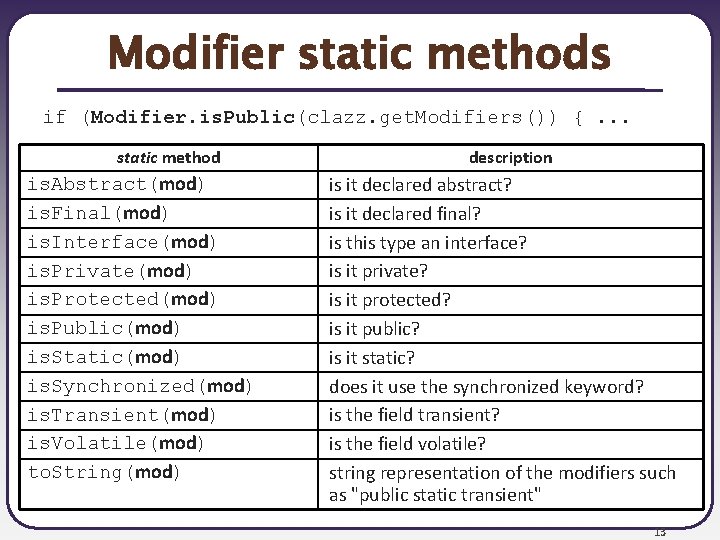
Modifier static methods if (Modifier. is. Public(clazz. get. Modifiers()) {. . . static method is. Abstract(mod) is. Final(mod) is. Interface(mod) is. Private(mod) is. Protected(mod) is. Public(mod) is. Static(mod) is. Synchronized(mod) is. Transient(mod) is. Volatile(mod) to. String(mod) description is it declared abstract? is it declared final? is this type an interface? is it private? is it protected? is it public? is it static? does it use the synchronized keyword? is the field transient? is the field volatile? string representation of the modifiers such as "public static transient" 13
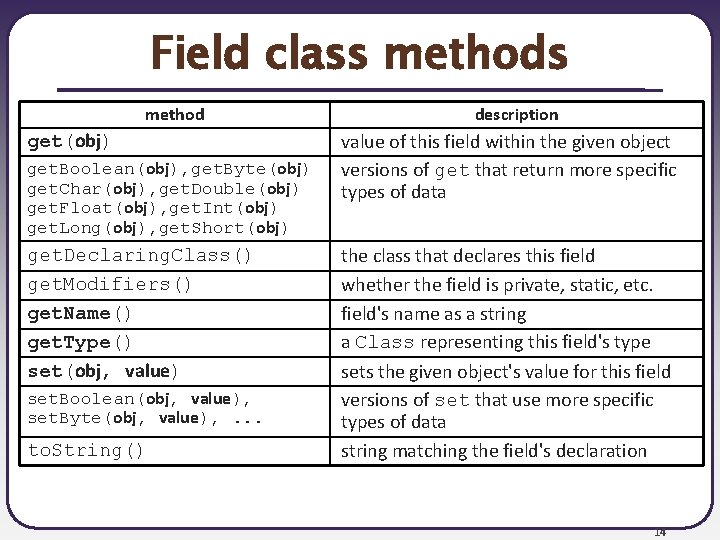
Field class method get(obj) get. Boolean(obj), get. Byte(obj) get. Char(obj), get. Double(obj) get. Float(obj), get. Int(obj) get. Long(obj), get. Short(obj) get. Declaring. Class() get. Modifiers() get. Name() get. Type() set(obj, value) set. Boolean(obj, value), set. Byte(obj, value), . . . to. String() description value of this field within the given object versions of get that return more specific types of data the class that declares this field whether the field is private, static, etc. field's name as a string a Class representing this field's type sets the given object's value for this field versions of set that use more specific types of data string matching the field's declaration 14
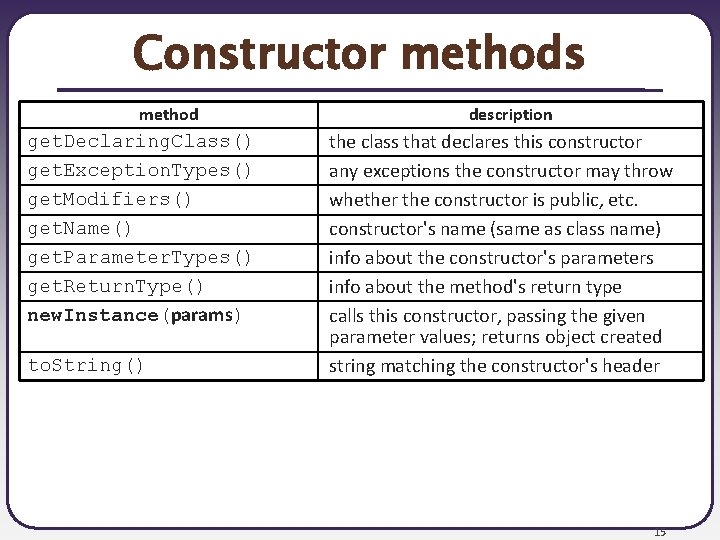
Constructor methods method get. Declaring. Class() get. Exception. Types() get. Modifiers() get. Name() get. Parameter. Types() get. Return. Type() new. Instance(params) to. String() description the class that declares this constructor any exceptions the constructor may throw whether the constructor is public, etc. constructor's name (same as class name) info about the constructor's parameters info about the method's return type calls this constructor, passing the given parameter values; returns object created string matching the constructor's header 15
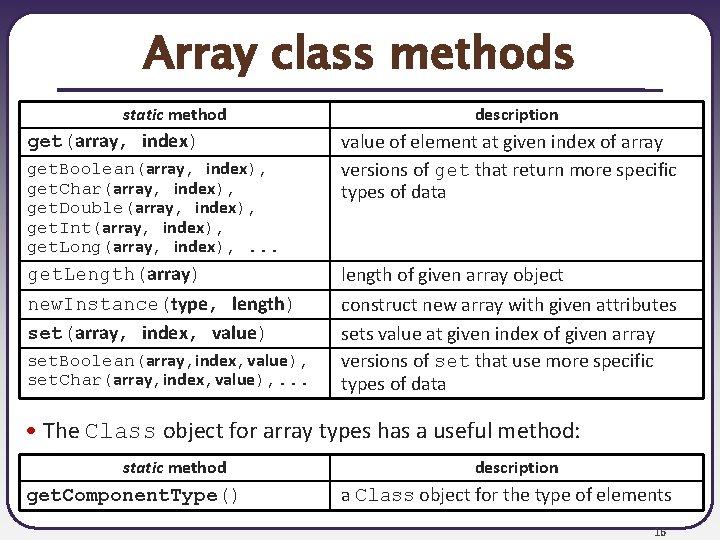
Array class methods static method get(array, index) get. Boolean(array, index), get. Char(array, index), get. Double(array, index), get. Int(array, index), get. Long(array, index), . . . get. Length(array) new. Instance(type, length) set(array, index, value) set. Boolean(array, index, value), set. Char(array, index, value), . . . description value of element at given index of array versions of get that return more specific types of data length of given array object construct new array with given attributes sets value at given index of given array versions of set that use more specific types of data • The Class object for array types has a useful method: static method get. Component. Type() description a Class object for the type of elements 16
Invocation exceptions • If something goes wrong during reflection, you get exceptions. § Almost all reflection calls must be wrapped in try/catch or throw. § Example: Class. Not. Found. Exception, No. Such. Method. Error • When you access a private field, you get an Illegal. Access. Exception. § Else reflection would break encapsulation. • When you call a method via reflection and it crashes, you will receive an Invocation. Target. Exception. § Inside this is a nested exception containing the actual exception thrown by the crashing code. § You can examine the nested exception by calling get. Cause() on the invocation target exception. 17
Misuse of reflection • Some programmers who learn reflection become overly enamored with it and use it in places where it wasn't intended. § Example: Passing a Method as a way to get a "function pointer. " § Example: Checking the Class of values as a way of testing types. § Reflection code is usually bulky, ugly, brittle, and hard to maintain. • Reflection is for certain specific situations only. § When you don't know what type to use until runtime. § When you want to be able to dynamically create or load classes while a program is running (example: CSE 14 x Practice-It tool). § When you want to check information about a particular type. § When you want to write testing/grading libraries like JUnit. 18
Reflection examples • The CSE 142 Critters simulator uses reflection to load all of the student's critter animal classes into the system. § Uses reflection to look for all classes with a superclass of Critter, constructs new instances of them, and adds them to the simulator. • The CSE 14 x Practice-It! tool uses reflection to dynamically compile, load, run, and test program code submitted by students. § § The student's code is injected into a randomly named new class. The class is written to disk, compiled, and loaded into the VM. By reflection, the methods/code in the class are executed and tested. Test results are gathered and shown to the student. 19
Reflection exercise • Write a JUnit test to help grade the internal correctness of a student's submitted program for a hypothetical assignment. § Make the tests fail if the class under test has any of the following: • more than 4 fields • any non-private fields • any fields of type Array. List • fewer than two private helper methods • any method that has a throws clause • any method that returns an int • missing a zero-argument constructor 20
- Slides: 20