
CSE 331 Annotations slides created by Marty Stepp
CSE 331 Annotations slides created by Marty Stepp based on materials by M. Ernst, S. Reges, D. Notkin, R. Mercer, Wikipedia http: //www. cs. washington. edu/331/ 1
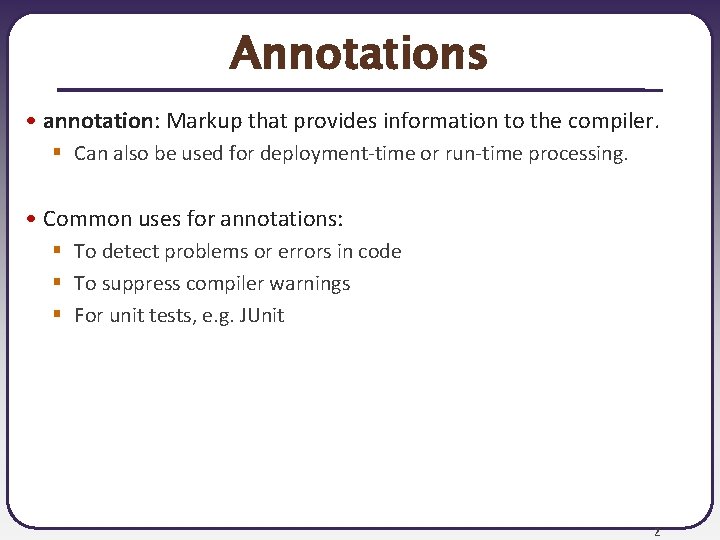
Annotations • annotation: Markup that provides information to the compiler. § Can also be used for deployment-time or run-time processing. • Common uses for annotations: § To detect problems or errors in code § To suppress compiler warnings § For unit tests, e. g. JUnit 2
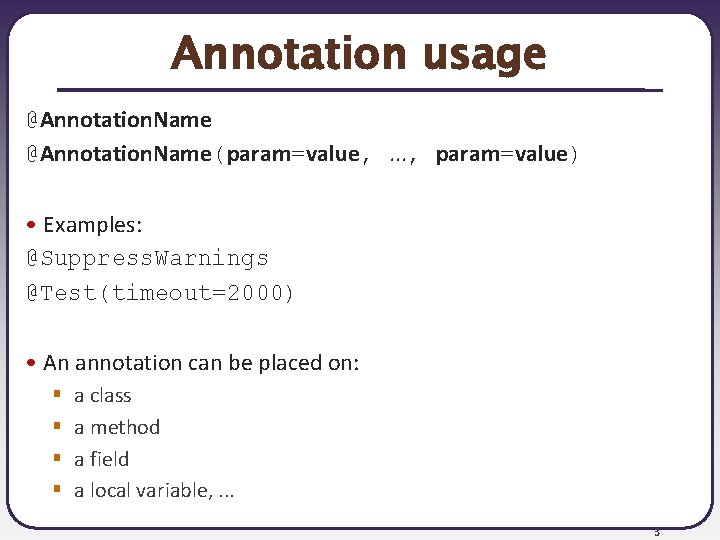
Annotation usage @Annotation. Name(param=value, . . . , param=value) • Examples: @Suppress. Warnings @Test(timeout=2000) • An annotation can be placed on: § § a class a method a field a local variable, . . . 3
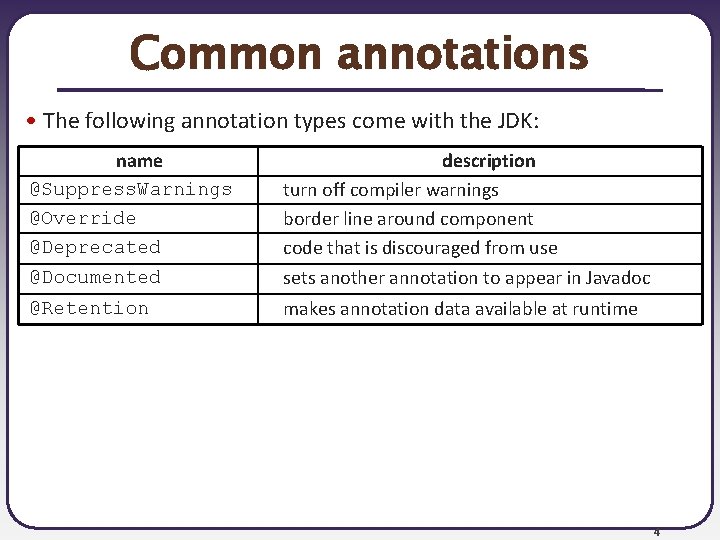
Common annotations • The following annotation types come with the JDK: name @Suppress. Warnings @Override @Deprecated description turn off compiler warnings border line around component code that is discouraged from use @Documented sets another annotation to appear in Javadoc @Retention makes annotation data available at runtime 4

Creating an annotation type public @interface Name {} Example: public @interface Grading. Script {}. . . @Grading. Script public class Test. Election {. . . } 5

An annotation with params public @interface Name { type name(); // parameters type name() default value; // optional } Example: public @interface Class. Preamble { String author(); String date(); int current. Revision() default 1; String last. Modified() default "N/A"; String[] reviewers(); } • Most programmers don't commonly need to create annotations. 6
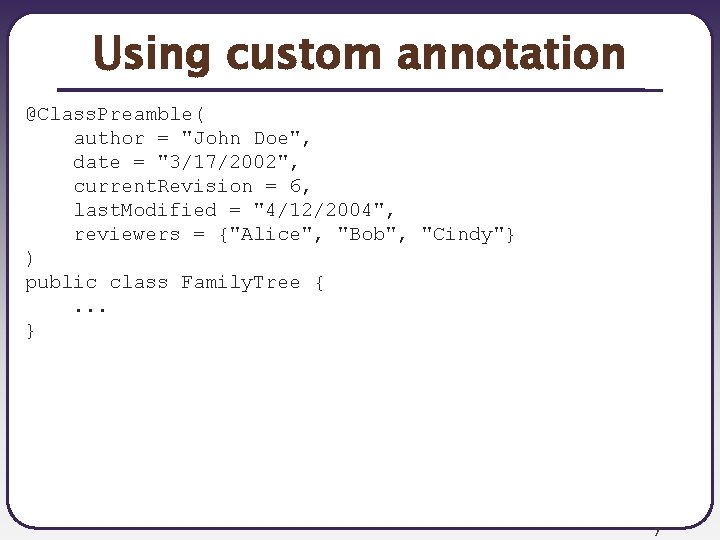
Using custom annotation @Class. Preamble( author = "John Doe", date = "3/17/2002", current. Revision = 6, last. Modified = "4/12/2004", reviewers = {"Alice", "Bob", "Cindy"} ) public class Family. Tree {. . . } 7
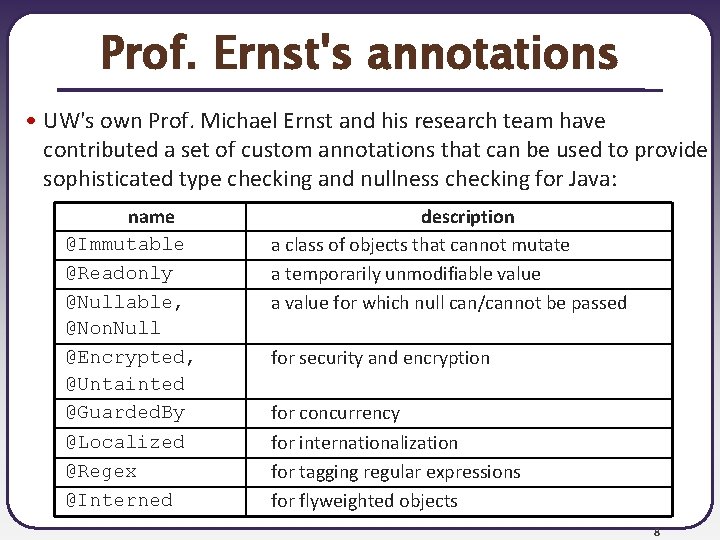
Prof. Ernst's annotations • UW's own Prof. Michael Ernst and his research team have contributed a set of custom annotations that can be used to provide sophisticated type checking and nullness checking for Java: name @Immutable @Readonly @Nullable, @Non. Null @Encrypted, @Untainted @Guarded. By @Localized @Regex @Interned description a class of objects that cannot mutate a temporarily unmodifiable value a value for which null can/cannot be passed for security and encryption for concurrency for internationalization for tagging regular expressions for flyweighted objects 8
- Slides: 8