
CSE 3302 Programming Languages Data Types Kelly Scott
![Arrays and Functions f: U → V index type component type • [0, …]](https://slidetodoc.com/presentation_image_h/2edc67ea8913f21690a29e9529a58add/image-32.jpg "Arrays and Functions f: U → V index type component type • [0, …]")
![C/C++ Allocated on stack, size statically specified. typedef int Ten. Int. Array [10]; typedef](https://slidetodoc.com/presentation_image_h/2edc67ea8913f21690a29e9529a58add/image-33.jpg "C/C++ Allocated on stack, size statically specified. typedef int Ten. Int. Array [10]; typedef")
![Multi-dimensional arrays • C/C++ int x[10][20]; • Java int [][] x = new int](https://slidetodoc.com/presentation_image_h/2edc67ea8913f21690a29e9529a58add/image-36.jpg "Multi-dimensional arrays • C/C++ int x[10][20]; • Java int [][] x = new int")
![Storage • row-major form x[1, -10], x[1, -9], …, x[1, 10], x[2, -10], …,](https://slidetodoc.com/presentation_image_h/2edc67ea8913f21690a29e9529a58add/image-37.jpg "Storage • row-major form x[1, -10], x[1, -9], …, x[1, 10], x[2, -10], …,")
- Slides: 37
CSE 3302 Programming Languages Data Types Kelly Scott French Spring 2017 Lecture 7 – Data Types, Spring 2017 CSE 3302 Programming Languages, UT-Arlington ©Chengkai Li, Weimin He, 2008 1
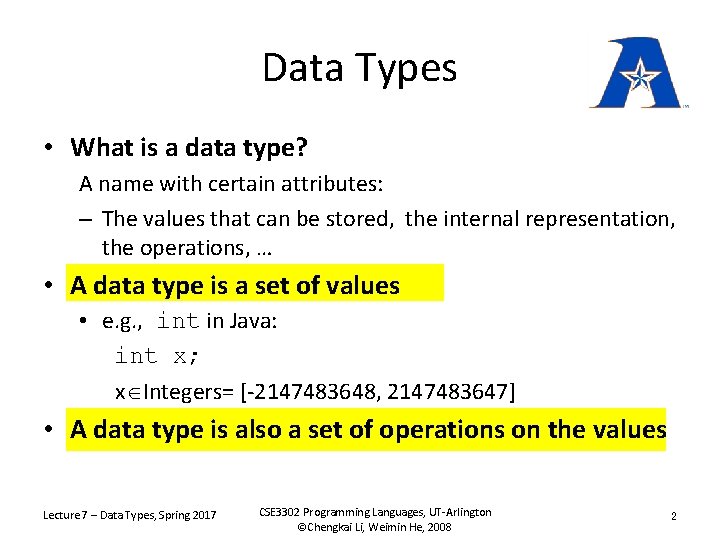
Data Types • What is a data type? A name with certain attributes: – The values that can be stored, the internal representation, the operations, … • A data type is a set of values • e. g. , int in Java: int x; x Integers= [-2147483648, 2147483647] • A data type is also a set of operations on the values Lecture 7 – Data Types, Spring 2017 CSE 3302 Programming Languages, UT-Arlington ©Chengkai Li, Weimin He, 2008 2
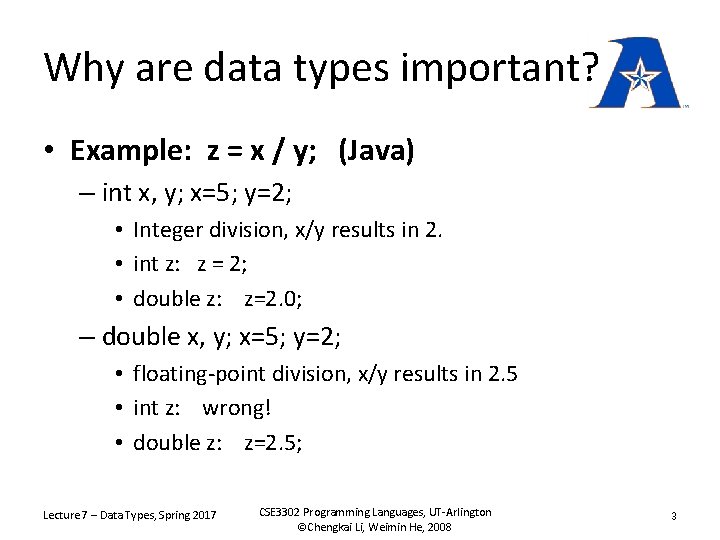
Why are data types important? • Example: z = x / y; (Java) – int x, y; x=5; y=2; • Integer division, x/y results in 2. • int z: z = 2; • double z: z=2. 0; – double x, y; x=5; y=2; • floating-point division, x/y results in 2. 5 • int z: wrong! • double z: z=2. 5; Lecture 7 – Data Types, Spring 2017 CSE 3302 Programming Languages, UT-Arlington ©Chengkai Li, Weimin He, 2008 3
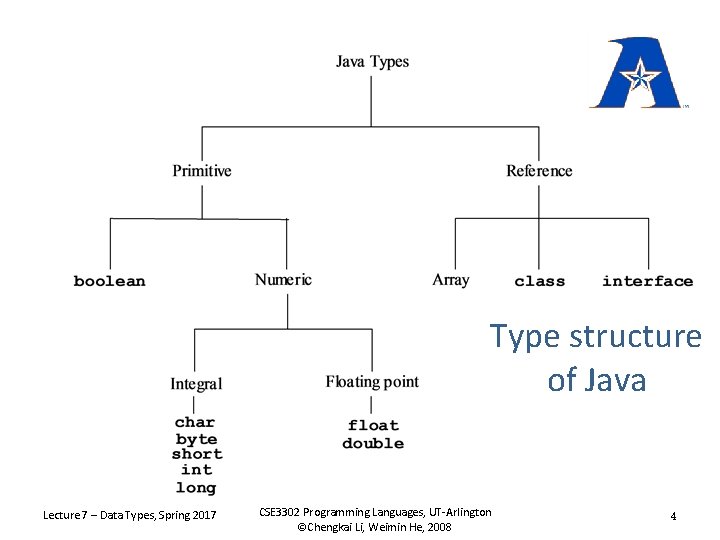
Type structure of Java Lecture 7 – Data Types, Spring 2017 CSE 3302 Programming Languages, UT-Arlington ©Chengkai Li, Weimin He, 2008 4
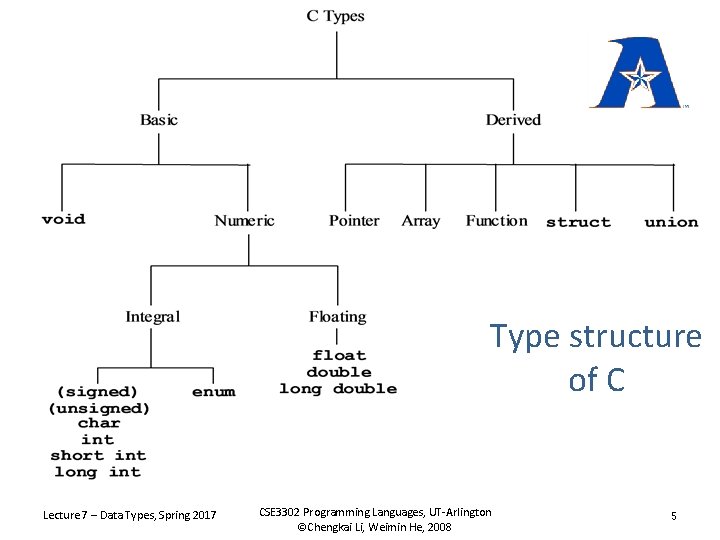
Type structure of C Lecture 7 – Data Types, Spring 2017 CSE 3302 Programming Languages, UT-Arlington ©Chengkai Li, Weimin He, 2008 5
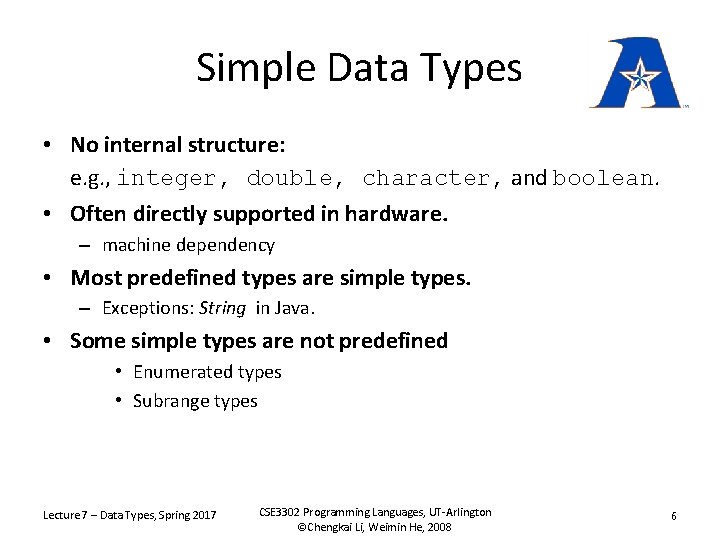
Simple Data Types • No internal structure: e. g. , integer, double, character, and boolean. • Often directly supported in hardware. – machine dependency • Most predefined types are simple types. – Exceptions: String in Java. • Some simple types are not predefined • Enumerated types • Subrange types Lecture 7 – Data Types, Spring 2017 CSE 3302 Programming Languages, UT-Arlington ©Chengkai Li, Weimin He, 2008 6
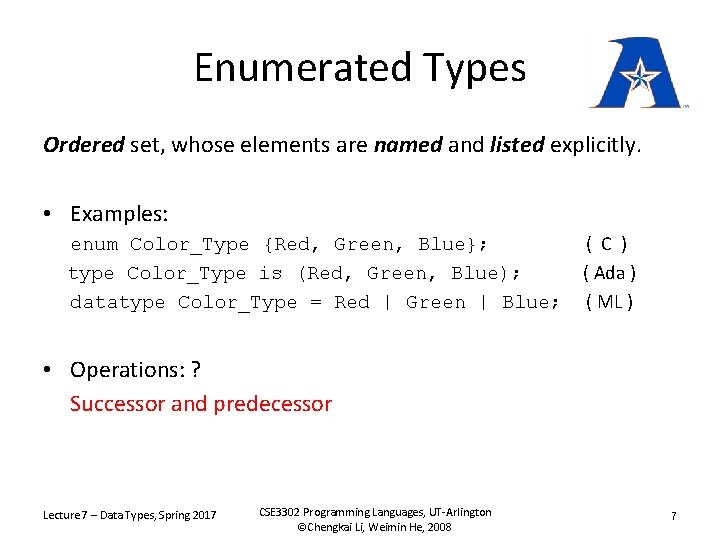
Enumerated Types Ordered set, whose elements are named and listed explicitly. • Examples: enum Color_Type {Red, Green, Blue}; type Color_Type is (Red, Green, Blue); datatype Color_Type = Red | Green | Blue; ( C ) ( Ada ) ( ML ) • Operations: ? Successor and predecessor Lecture 7 – Data Types, Spring 2017 CSE 3302 Programming Languages, UT-Arlington ©Chengkai Li, Weimin He, 2008 7
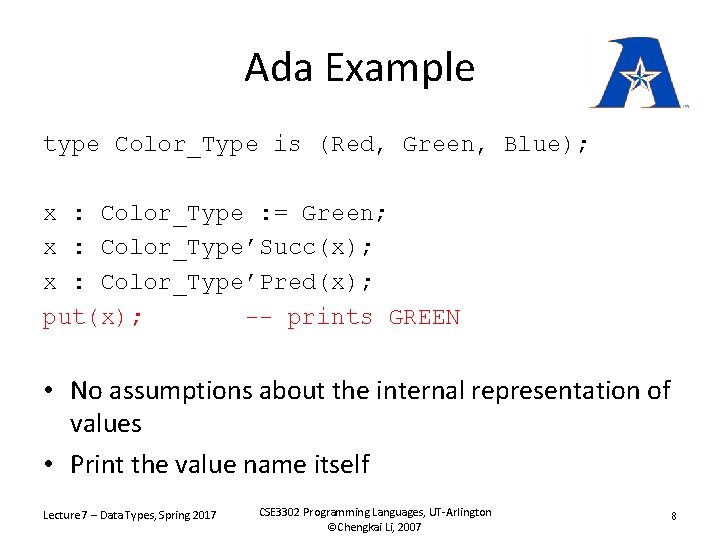
Ada Example type Color_Type is (Red, Green, Blue); x : Color_Type : = Green; x : Color_Type’Succ(x); x : Color_Type’Pred(x); put(x); -- prints GREEN • No assumptions about the internal representation of values • Print the value name itself Lecture 7 – Data Types, Spring 2017 CSE 3302 Programming Languages, UT-Arlington ©Chengkai Li, 2007 8
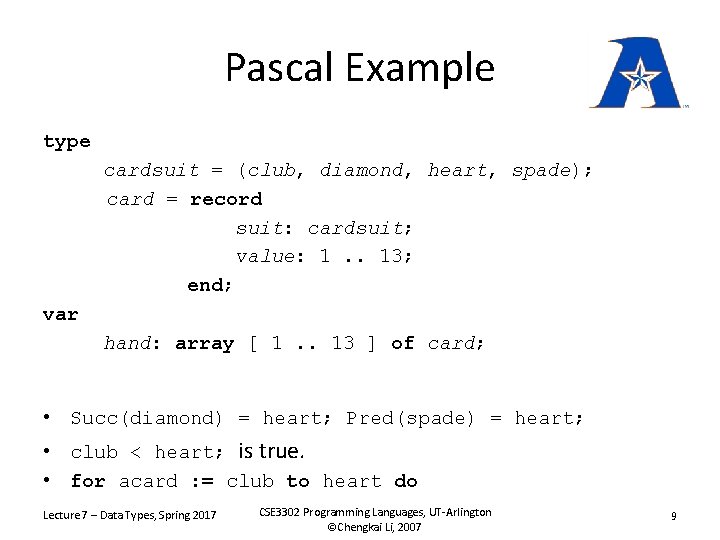
Pascal Example type cardsuit = (club, diamond, heart, spade); card = record suit: cardsuit; value: 1. . 13; end; var hand: array [ 1. . 13 ] of card; • Succ(diamond) = heart; Pred(spade) = heart; • club < heart; is true. • for acard : = club to heart do Lecture 7 – Data Types, Spring 2017 CSE 3302 Programming Languages, UT-Arlington ©Chengkai Li, 2007 9
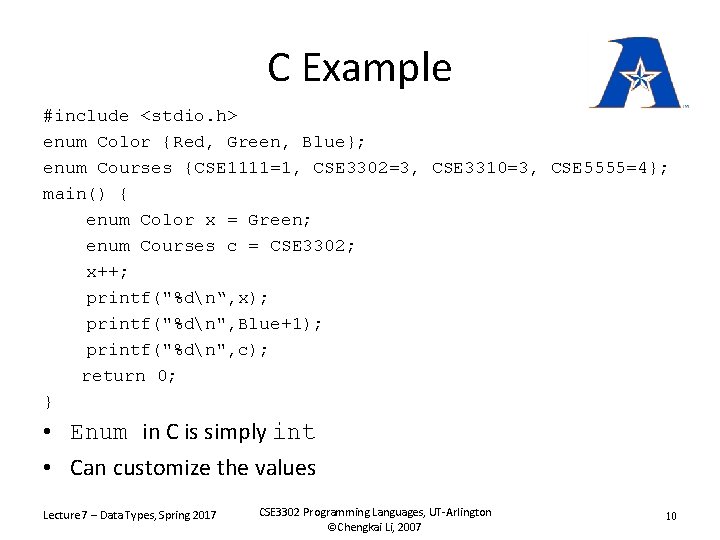
C Example #include <stdio. h> enum Color {Red, Green, Blue}; enum Courses {CSE 1111=1, CSE 3302=3, CSE 3310=3, CSE 5555=4}; main() { enum Color x = Green; enum Courses c = CSE 3302; x++; printf("%dn“, x); printf("%dn", Blue+1); printf("%dn", c); return 0; } • Enum in C is simply int • Can customize the values Lecture 7 – Data Types, Spring 2017 CSE 3302 Programming Languages, UT-Arlington ©Chengkai Li, 2007 10
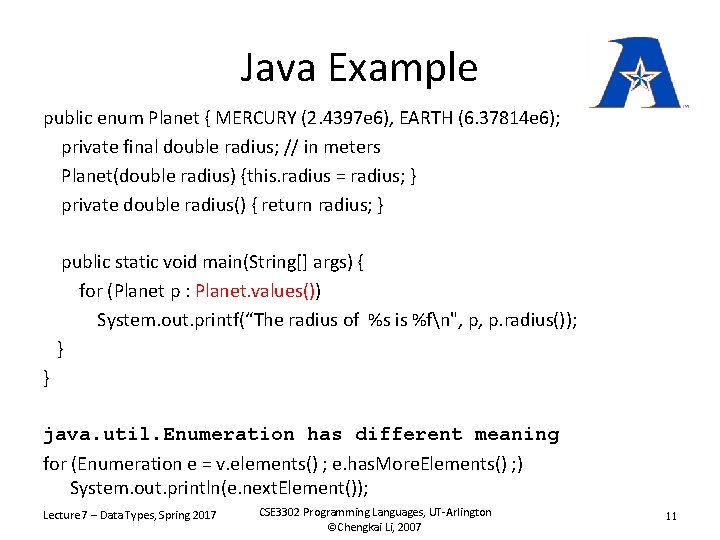
Java Example public enum Planet { MERCURY (2. 4397 e 6), EARTH (6. 37814 e 6); private final double radius; // in meters Planet(double radius) {this. radius = radius; } private double radius() { return radius; } public static void main(String[] args) { for (Planet p : Planet. values()) System. out. printf(“The radius of %s is %fn", p, p. radius()); } } java. util. Enumeration has different meaning for (Enumeration e = v. elements() ; e. has. More. Elements() ; ) System. out. println(e. next. Element()); Lecture 7 – Data Types, Spring 2017 CSE 3302 Programming Languages, UT-Arlington ©Chengkai Li, 2007 11
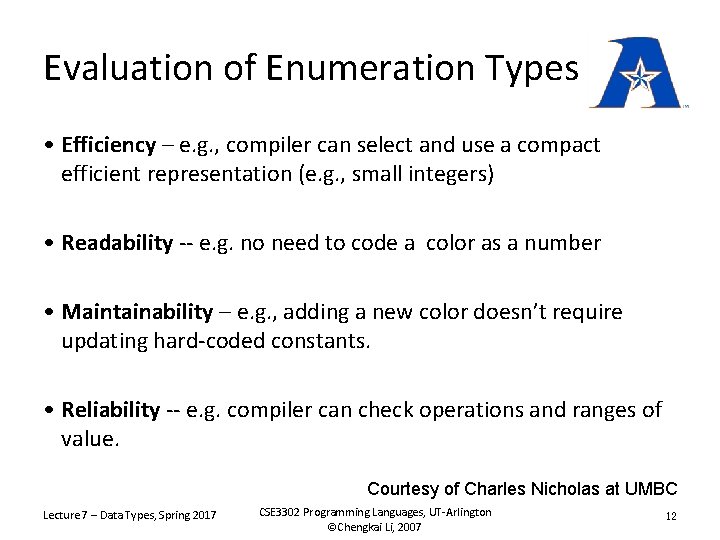
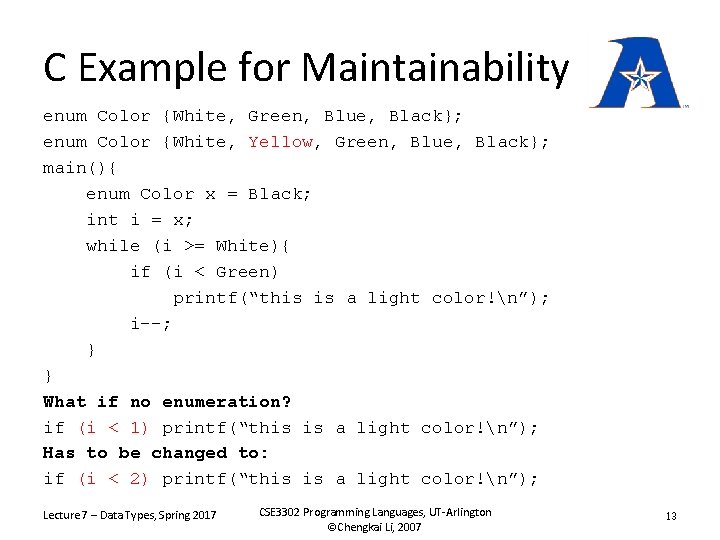
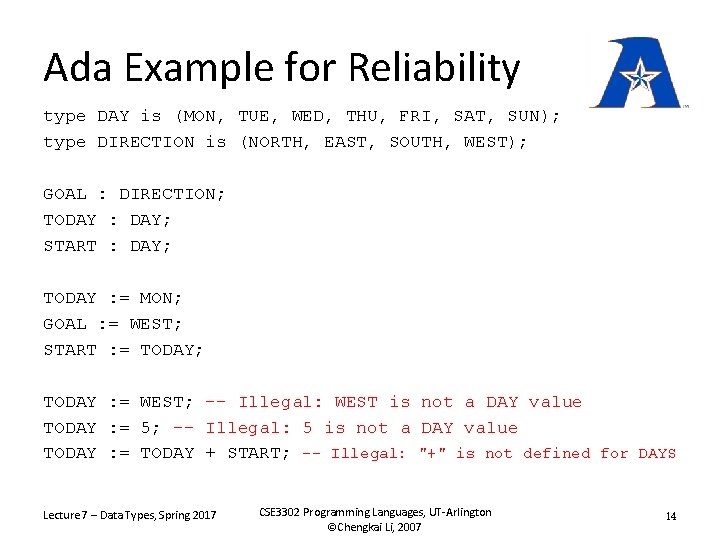
Evaluation of Enumeration Types • Efficiency – e. g. , compiler can select and use a compact efficient representation (e. g. , small integers) • Readability -- e. g. no need to code a color as a number • Maintainability – e. g. , adding a new color doesn’t require updating hard-coded constants. • Reliability -- e. g. compiler can check operations and ranges of value. Courtesy of Charles Nicholas at UMBC Lecture 7 – Data Types, Spring 2017 CSE 3302 Programming Languages, UT-Arlington ©Chengkai Li, 2007 12
C Example for Maintainability enum Color {White, Green, Blue, Black}; enum Color {White, Yellow, Green, Blue, Black}; main(){ enum Color x = Black; int i = x; while (i >= White){ if (i < Green) printf(“this is a light color!n”); i--; } } What if no enumeration? if (i < 1) printf(“this is a light color!n”); Has to be changed to: if (i < 2) printf(“this is a light color!n”); Lecture 7 – Data Types, Spring 2017 CSE 3302 Programming Languages, UT-Arlington ©Chengkai Li, 2007 13
Ada Example for Reliability type DAY is (MON, TUE, WED, THU, FRI, SAT, SUN); type DIRECTION is (NORTH, EAST, SOUTH, WEST); GOAL : DIRECTION; TODAY : DAY; START : DAY; TODAY : = MON; GOAL : = WEST; START : = TODAY; TODAY : = WEST; -- Illegal: WEST is not a DAY value TODAY : = 5; -- Illegal: 5 is not a DAY value TODAY : = TODAY + START; -- Illegal: "+" is not defined for DAYS Lecture 7 – Data Types, Spring 2017 CSE 3302 Programming Languages, UT-Arlington ©Chengkai Li, 2007 14
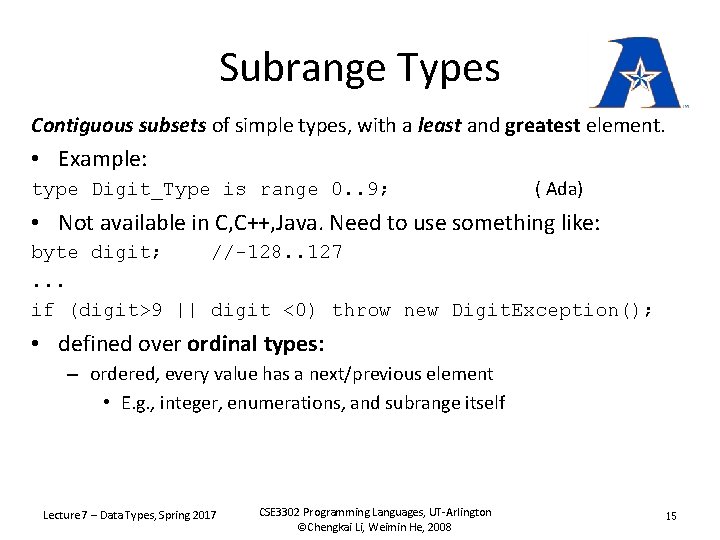
Subrange Types Contiguous subsets of simple types, with a least and greatest element. • Example: type Digit_Type is range 0. . 9; ( Ada) • Not available in C, C++, Java. Need to use something like: byte digit; //-128. . 127. . . if (digit>9 || digit <0) throw new Digit. Exception(); • defined over ordinal types: – ordered, every value has a next/previous element • E. g. , integer, enumerations, and subrange itself Lecture 7 – Data Types, Spring 2017 CSE 3302 Programming Languages, UT-Arlington ©Chengkai Li, Weimin He, 2008 15
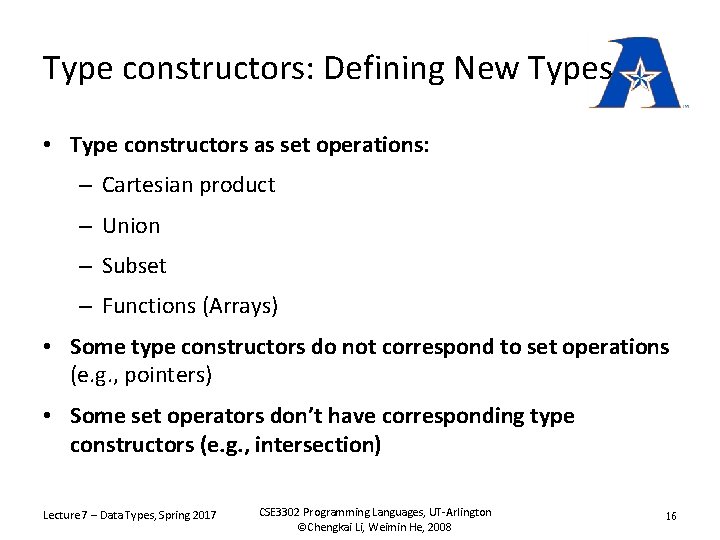
Type constructors: Defining New Types • Type constructors as set operations: – Cartesian product – Union – Subset – Functions (Arrays) • Some type constructors do not correspond to set operations (e. g. , pointers) • Some set operators don’t have corresponding type constructors (e. g. , intersection) Lecture 7 – Data Types, Spring 2017 CSE 3302 Programming Languages, UT-Arlington ©Chengkai Li, Weimin He, 2008 16
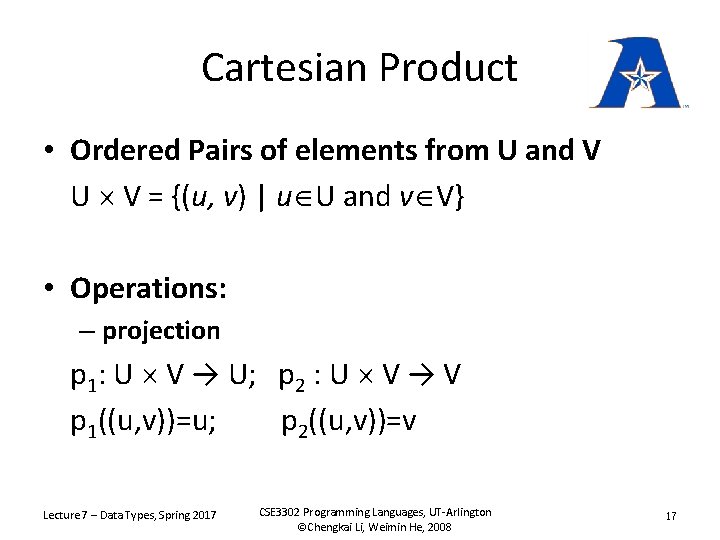
Cartesian Product • Ordered Pairs of elements from U and V U V = {(u, v) | u U and v V} • Operations: – projection p 1: U V → U; p 2 : U V → V p 1((u, v))=u; p 2((u, v))=v Lecture 7 – Data Types, Spring 2017 CSE 3302 Programming Languages, UT-Arlington ©Chengkai Li, Weimin He, 2008 17
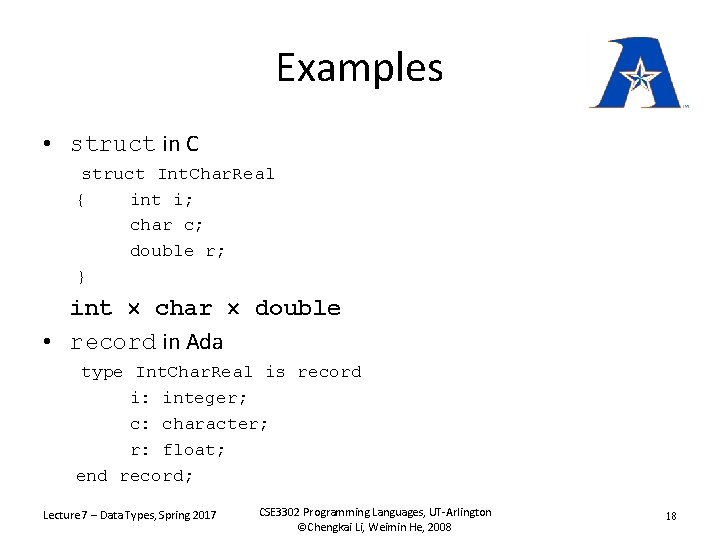
Examples • struct in C struct Int. Char. Real { int i; char c; double r; } int char double • record in Ada type Int. Char. Real is record i: integer; c: character; r: float; end record; Lecture 7 – Data Types, Spring 2017 CSE 3302 Programming Languages, UT-Arlington ©Chengkai Li, Weimin He, 2008 18
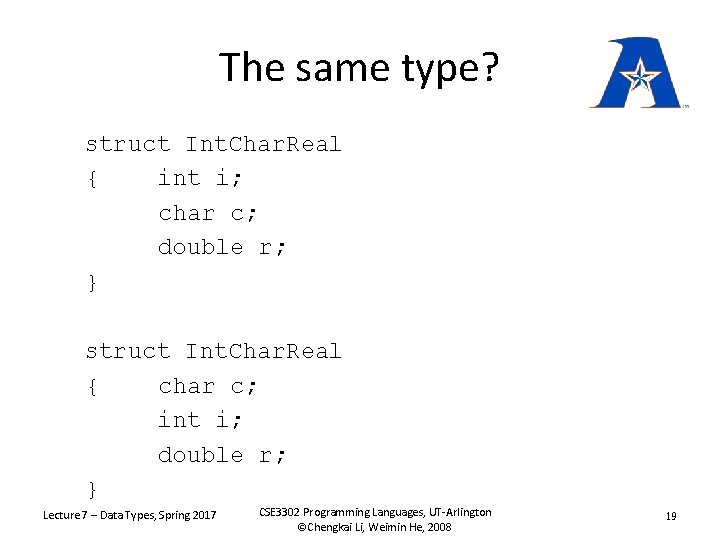
The same type? struct Int. Char. Real { int i; char c; double r; } struct Int. Char. Real { char c; int i; double r; } Lecture 7 – Data Types, Spring 2017 CSE 3302 Programming Languages, UT-Arlington ©Chengkai Li, Weimin He, 2008 19
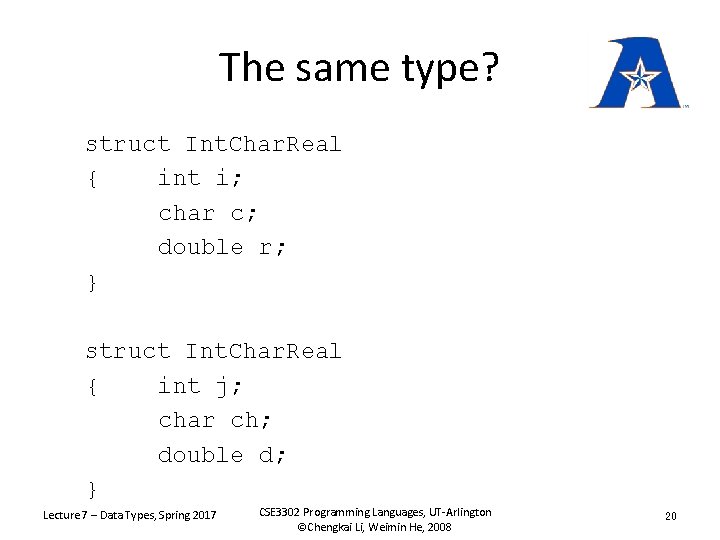
The same type? struct Int. Char. Real { int i; char c; double r; } struct Int. Char. Real { int j; char ch; double d; } Lecture 7 – Data Types, Spring 2017 CSE 3302 Programming Languages, UT-Arlington ©Chengkai Li, Weimin He, 2008 20
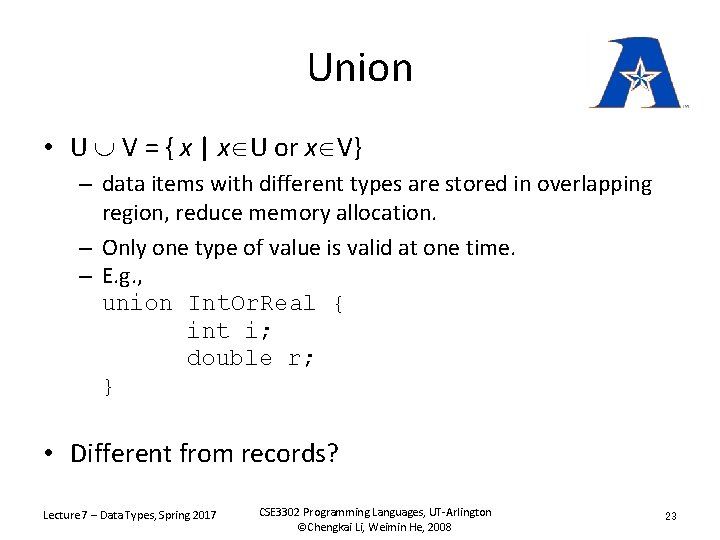
Union • U V = { x | x U or x V} – data items with different types are stored in overlapping region, reduce memory allocation. – Only one type of value is valid at one time. – E. g. , union Int. Or. Real { int i; double r; } • Different from records? Lecture 7 – Data Types, Spring 2017 CSE 3302 Programming Languages, UT-Arlington ©Chengkai Li, Weimin He, 2008 23
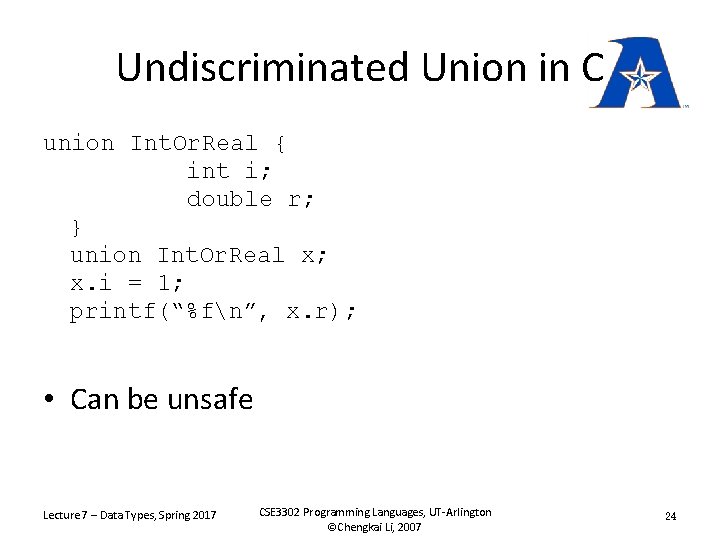
Undiscriminated Union in C union Int. Or. Real { int i; double r; } union Int. Or. Real x; x. i = 1; printf(“%fn”, x. r); • Can be unsafe Lecture 7 – Data Types, Spring 2017 CSE 3302 Programming Languages, UT-Arlington ©Chengkai Li, 2007 24
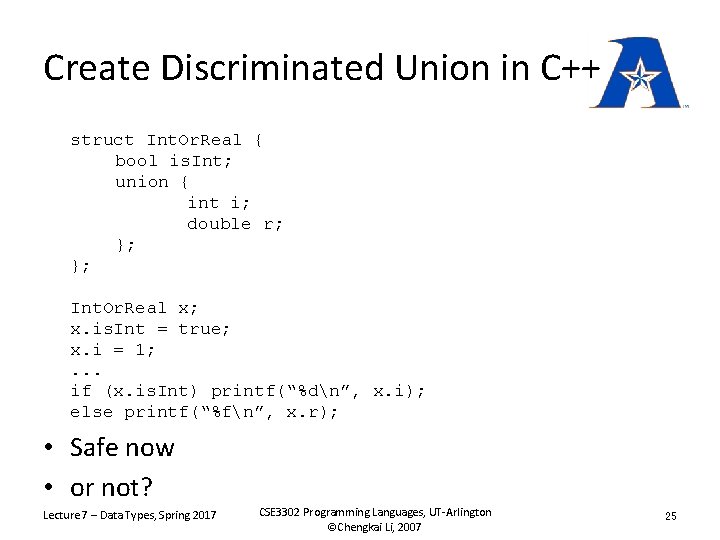
Create Discriminated Union in C++ struct Int. Or. Real { bool is. Int; union { int i; double r; }; }; Int. Or. Real x; x. is. Int = true; x. i = 1; . . . if (x. is. Int) printf(“%dn”, x. i); else printf(“%fn”, x. r); • Safe now • or not? Lecture 7 – Data Types, Spring 2017 CSE 3302 Programming Languages, UT-Arlington ©Chengkai Li, 2007 25
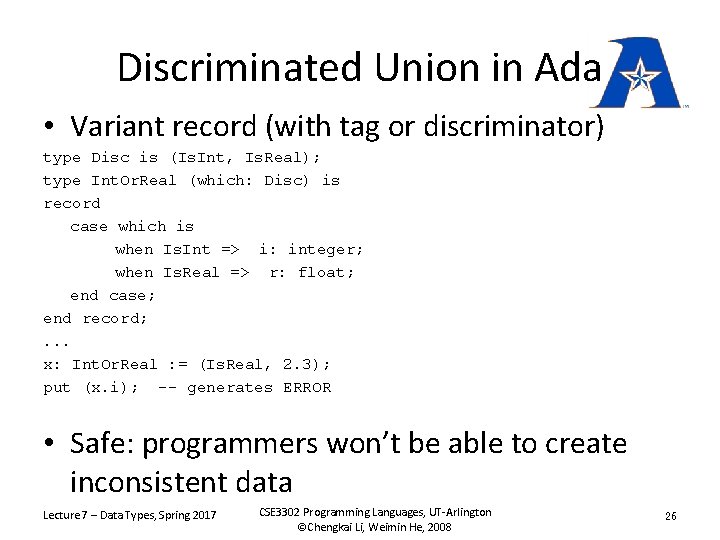
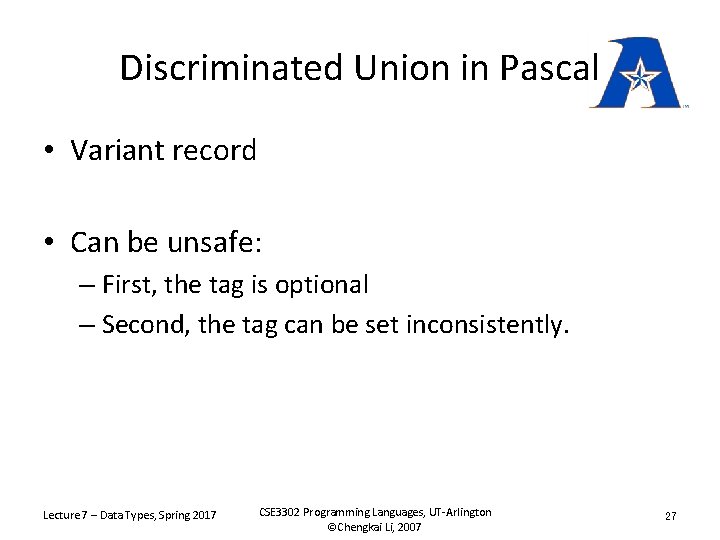
Discriminated Union in Ada • Variant record (with tag or discriminator) type Disc is (Is. Int, Is. Real); type Int. Or. Real (which: Disc) is record case which is when Is. Int => i: integer; when Is. Real => r: float; end case; end record; . . . x: Int. Or. Real : = (Is. Real, 2. 3); put (x. i); -- generates ERROR • Safe: programmers won’t be able to create inconsistent data Lecture 7 – Data Types, Spring 2017 CSE 3302 Programming Languages, UT-Arlington ©Chengkai Li, Weimin He, 2008 26
Discriminated Union in Pascal • Variant record • Can be unsafe: – First, the tag is optional – Second, the tag can be set inconsistently. Lecture 7 – Data Types, Spring 2017 CSE 3302 Programming Languages, UT-Arlington ©Chengkai Li, 2007 27
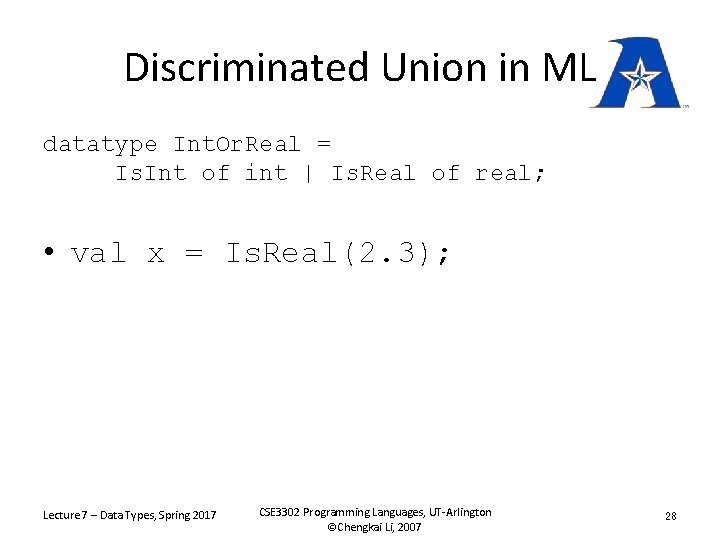
Discriminated Union in ML datatype Int. Or. Real = Is. Int of int | Is. Real of real; • val x = Is. Real(2. 3); Lecture 7 – Data Types, Spring 2017 CSE 3302 Programming Languages, UT-Arlington ©Chengkai Li, 2007 28
How about Java? • Is there record or union in java? Why? Lecture 7 – Data Types, Spring 2017 CSE 3302 Programming Languages, UT-Arlington ©Chengkai Li, 2007 29
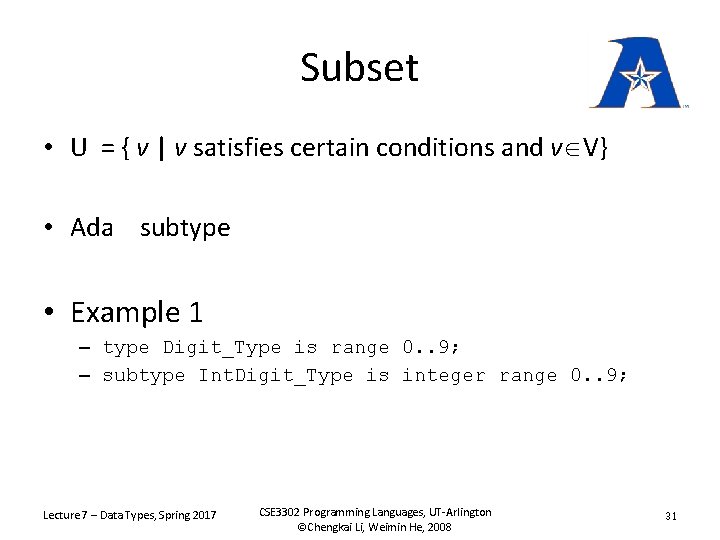
Subset • U = { v | v satisfies certain conditions and v V} • Ada subtype • Example 1 – type Digit_Type is range 0. . 9; – subtype Int. Digit_Type is integer range 0. . 9; Lecture 7 – Data Types, Spring 2017 CSE 3302 Programming Languages, UT-Arlington ©Chengkai Li, Weimin He, 2008 31
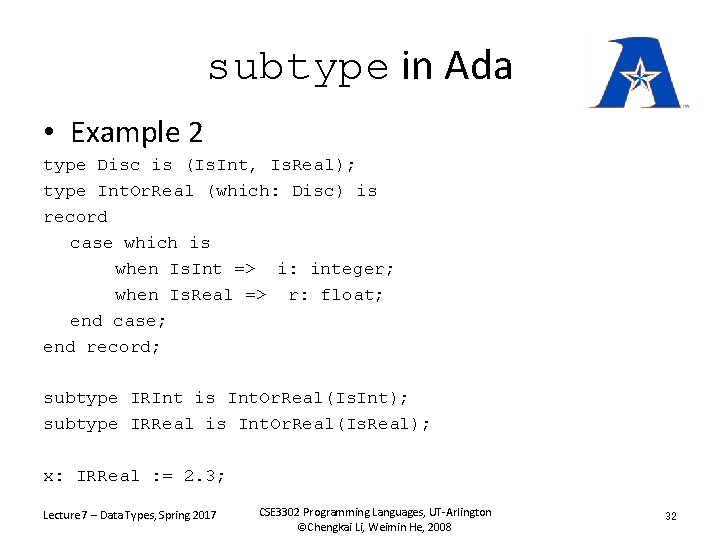
subtype in Ada • Example 2 type Disc is (Is. Int, Is. Real); type Int. Or. Real (which: Disc) is record case which is when Is. Int => i: integer; when Is. Real => r: float; end case; end record; subtype IRInt is Int. Or. Real(Is. Int); subtype IRReal is Int. Or. Real(Is. Real); x: IRReal : = 2. 3; Lecture 7 – Data Types, Spring 2017 CSE 3302 Programming Languages, UT-Arlington ©Chengkai Li, Weimin He, 2008 32
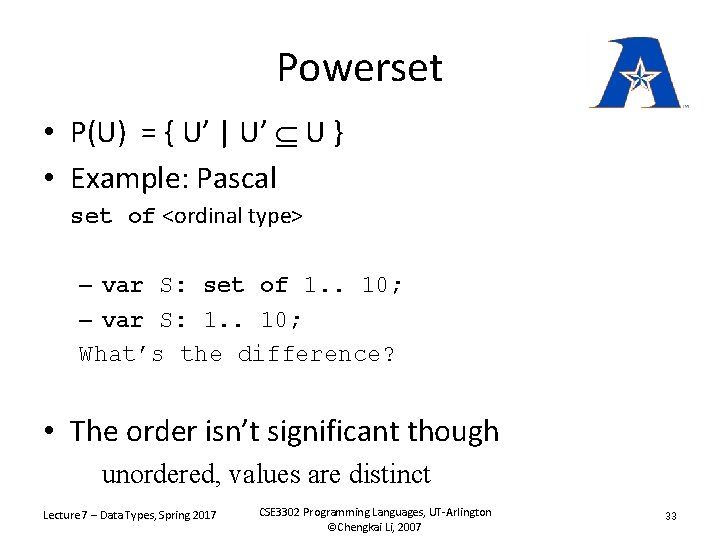
Powerset • P(U) = { U’ | U’ U } • Example: Pascal set of <ordinal type> – var S: set of 1. . 10; – var S: 1. . 10; What’s the difference? • The order isn’t significant though unordered, values are distinct Lecture 7 – Data Types, Spring 2017 CSE 3302 Programming Languages, UT-Arlington ©Chengkai Li, 2007 33
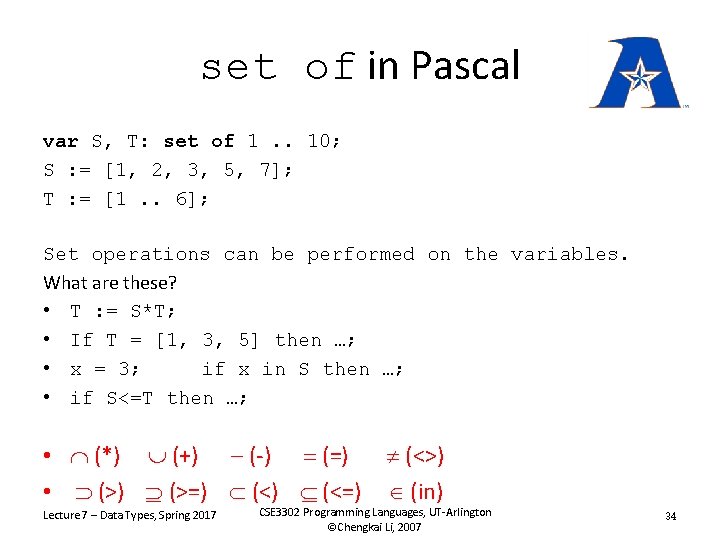
set of in Pascal var S, T: set of 1. . 10; S : = [1, 2, 3, 5, 7]; T : = [1. . 6]; Set operations can be performed on the variables. What are these? • T : = S*T; • If T = [1, 3, 5] then …; • x = 3; if x in S then …; • if S<=T then …; • (*) (+) (-) (=) • (>) (>=) (<=) Lecture 7 – Data Types, Spring 2017 (<>) (in) CSE 3302 Programming Languages, UT-Arlington ©Chengkai Li, 2007 34
Arrays and Functions f: U → V index type component type • [0, …] (C/C++/Java) • Ordinal type (Ada/Pascal) Lecture 7 – Data Types, Spring 2017 CSE 3302 Programming Languages, UT-Arlington ©Chengkai Li, Weimin He, 2008 35
C/C++ Allocated on stack, size statically specified. typedef int Ten. Int. Array [10]; typedef int Int. Array []; Ten. Int. Array x; int y[5]; int z[]={1, 2, 3, 4}; Int. Array w={1, 2}; Int. Array w; //illegal int n =. . . //from user input int a[n]; //illegal Lecture 7 – Data Types, Spring 2017 CSE 3302 Programming Languages, UT-Arlington ©Chengkai Li, Weimin He, 2008 36
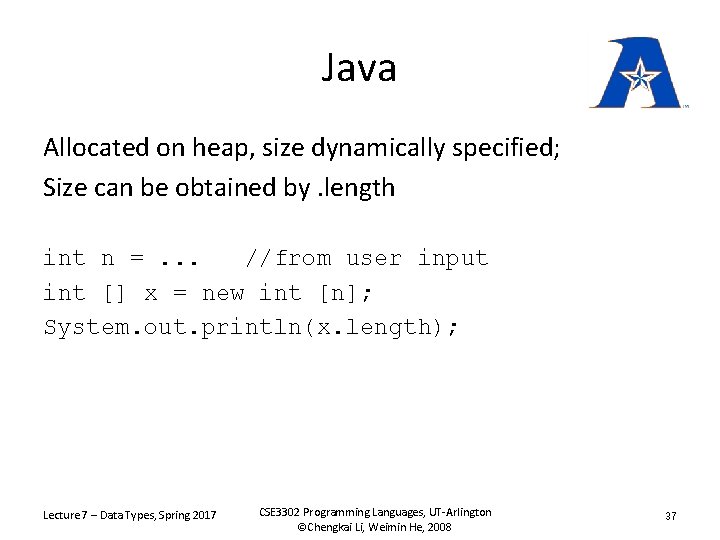
Java Allocated on heap, size dynamically specified; Size can be obtained by. length int n =. . . //from user input int [] x = new int [n]; System. out. println(x. length); Lecture 7 – Data Types, Spring 2017 CSE 3302 Programming Languages, UT-Arlington ©Chengkai Li, Weimin He, 2008 37
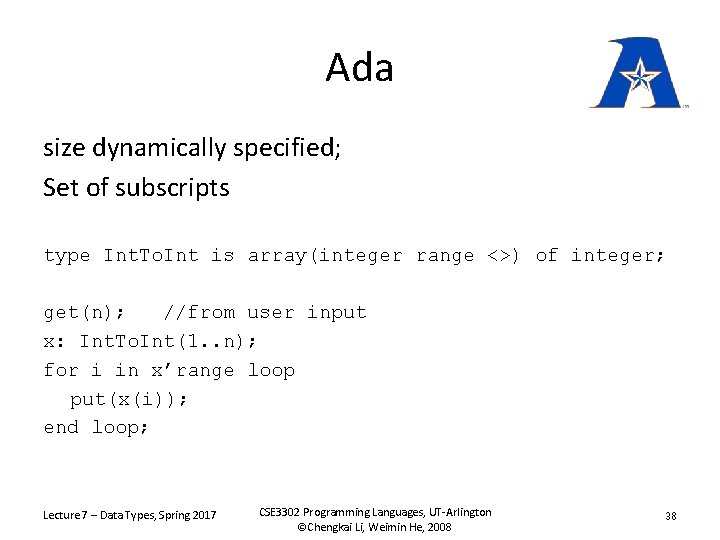
Ada size dynamically specified; Set of subscripts type Int. To. Int is array(integer range <>) of integer; get(n); //from user input x: Int. To. Int(1. . n); for i in x’range loop put(x(i)); end loop; Lecture 7 – Data Types, Spring 2017 CSE 3302 Programming Languages, UT-Arlington ©Chengkai Li, Weimin He, 2008 38
Multi-dimensional arrays • C/C++ int x[10][20]; • Java int [][] x = new int [10][20]; • Ada These two are different type Matric_Type is array(1. . 10, -10. . 10) of integer; x(i, j); type Matric_Type is array(1. . 10) of array (-10. . 10) of integer; x(i)(j); Lecture 7 – Data Types, Spring 2017 CSE 3302 Programming Languages, UT-Arlington ©Chengkai Li, Weimin He, 2008 39
Storage • row-major form x[1, -10], x[1, -9], …, x[1, 10], x[2, -10], …, x[2, 10], x[3, -10], … • column-major form x[1, -10], x[2, -10], …, x[10, -10], x[1, -9], …, x[10, -9], x[1, -8], … • C/C++ int array_max(int a[][20], int size) • Java int array_max(int [][][]a) Lecture 7 – Data Types, Spring 2017 CSE 3302 Programming Languages, UT-Arlington ©Chengkai Li, Weimin He, 2008 40