
CSE 321 Realtime and Embedded Systems 1 B
CSE 321: Realtime and Embedded Systems 1 B. RAMAMURTHY UNIVERSITY AT BUFFALO BINA@BUFFALO. EDU CSE 321 -2014 -1 11/28/2020
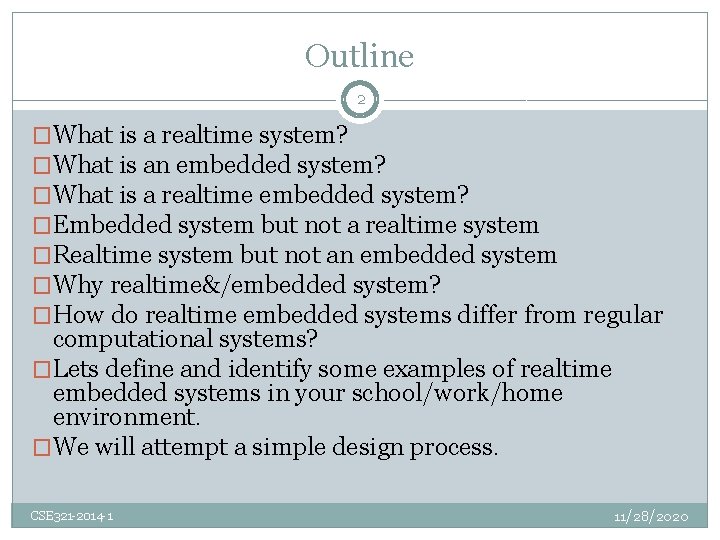
Outline 2 �What is a realtime system? �What is an embedded system? �What is a realtime embedded system? �Embedded system but not a realtime system �Realtime system but not an embedded system �Why realtime&/embedded system? �How do realtime embedded systems differ from regular computational systems? �Lets define and identify some examples of realtime embedded systems in your school/work/home environment. �We will attempt a simple design process. CSE 321 -2014 -1 11/28/2020
Defining RTOS 3 CSE 321 -2014 -1 11/28/2020
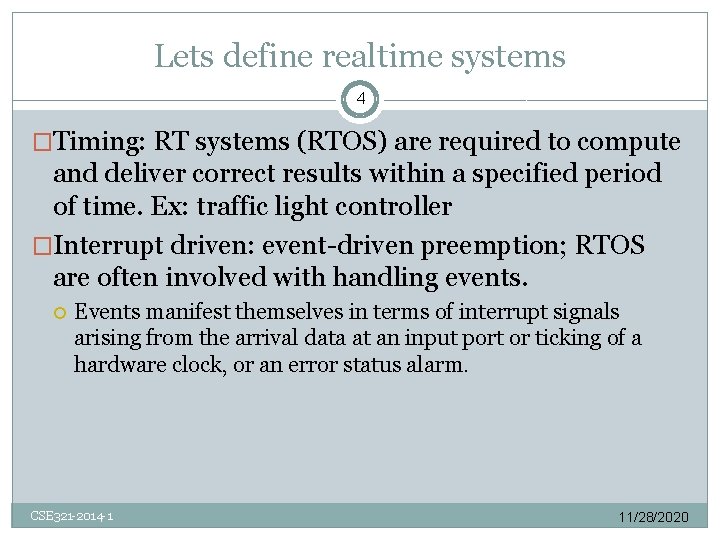
Lets define realtime systems 4 �Timing: RT systems (RTOS) are required to compute and deliver correct results within a specified period of time. Ex: traffic light controller �Interrupt driven: event-driven preemption; RTOS are often involved with handling events. Events manifest themselves in terms of interrupt signals arising from the arrival data at an input port or ticking of a hardware clock, or an error status alarm. CSE 321 -2014 -1 11/28/2020
RTOS Definition (contd. ) 5 � Low-level programming: RTOS often deal with devices; C language is still a favorite for writing device drivers for new hardware. � Specialized hardware: Most RTOS work within, or at least close beside, specialized electronic and mechanical devices. Often closed loop systems. � Volatile data IO: Variables that change their value from moment to moment. RTOS software must be structured to check for changes at the correct rate, so as not to miss a data update. CSE 321 -2014 -1 11/28/2020
RTOS Definition (contd. ) 6 � Multi-tasking: RTOS are often multitasking. Several processes cooperate to carry out the overall job. Divide RTOS problem into tasks as a design strategy. � Run-time scheduling: Separation of activities into tasks leads to question of task sequencing or scheduling. Moreover the external events and required response to these lead to run-time scheduling or dynamic scheduling. � Unpredictability in inputs/stimulus: Being event-driven, RTOS are at the mercy of unpredictable changes in their environment. � Predictability response requirement! � Life-critical code: failure to run correctly may result in death or at least injury to the user and/or others. Life-critical systems requires extra testing, documentation and acceptance trials. CSE 321 -2014 -1 11/28/2020
Types of RTOS 7 � Hard RTOS: tight limits on response time, so that a delayed result is a wrong result. Ex: jet fuel controller and camera shutter unit � Soft RTOS: need to meet only time-average performance target. As long as most results are available before deadline the system will run successfully. Ex: audio and video transmission, single frame skip is fine, but repeated loss is unacceptable � Firm RTOS: somewhere between the two. Ex: Space station solar panel unit CSE 321 -2014 -1 11/28/2020
Microprocessor 8 �Examples: vending machines, mobiles phones, alarm systems, washing machines, motor car engine controllers, heart monitors, microwave ovens all operate using embedded microcontrollers running dedicated software. �Microprocessors are the enabling hardware for realtime systems. CSE 321 -2014 -1 11/28/2020
Embedded Systems 9 �Dedicated functionally �Special purpose �Optimized for a certain operations �Small (typically) �Lower power consumption �Embedded within other large systems CSE 321 -2014 -1 11/28/2020
Embedded Systems 10 • Embedded systems are computing systems with • • • tightly coupled hardware and software integration. Designed to perform dedicated function Embedded means that the system is a integral part of a larger system Multiple embedded systems can co-exist in a single system. General purpose processor are typically not aware of the applications. An embedded processor is application-aware. CSE 321 -2014 -1 11/28/2020
Embedded Systems (contd. ) 11 • Hardware and software co-design: hardware and software for the embedded system are developed in parallel. • Cross-platform development: Both embedded system and its application use the cross-platform development method. – Software is developed on one platform but runs on another. • Software storage will have to be chosen to allow for upgradeability. • Of course, the So. C (system on a chip), Po. E (Power on Ethernet), etc. CSE 321 -2014 -1 11/28/2020
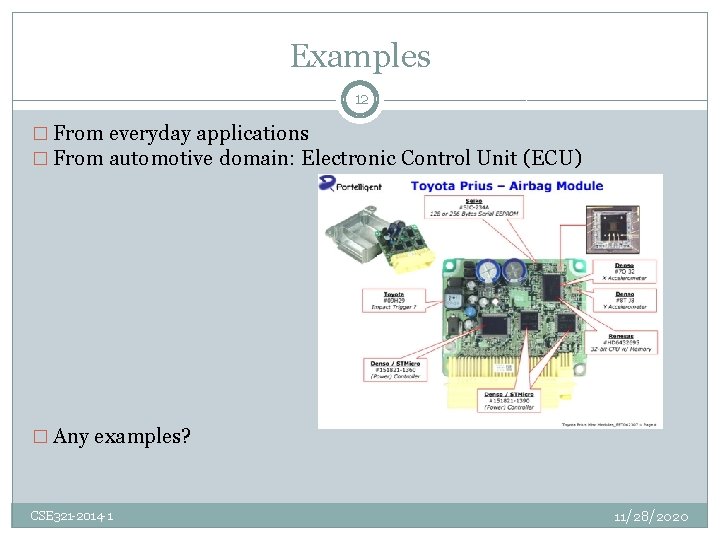
Examples 12 � From everyday applications � From automotive domain: Electronic Control Unit (ECU) � Any examples? CSE 321 -2014 -1 11/28/2020
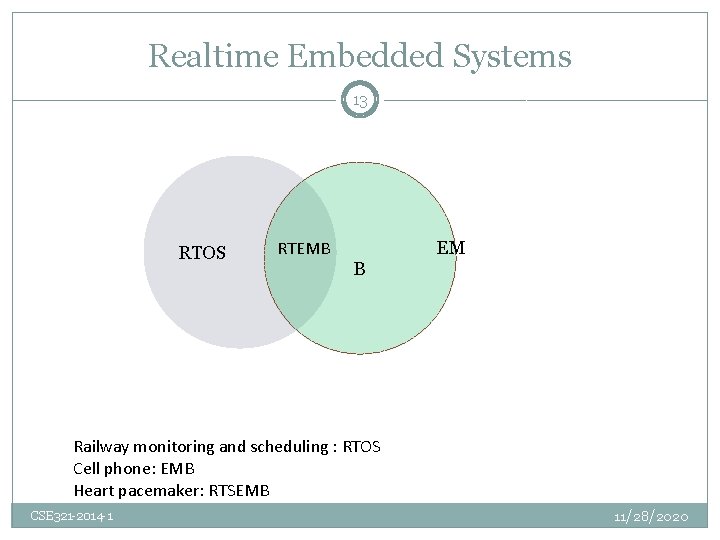
Realtime Embedded Systems 13 RTOS RTEMB EM B Railway monitoring and scheduling : RTOS Cell phone: EMB Heart pacemaker: RTSEMB CSE 321 -2014 -1 11/28/2020
Class work #1 14 � Lets identify 10 embedded systems, realtime systems and realtime/embedded system � I will begin with Arduino Uno Example CSE 321 -2014 -1 Type; justification 11/28/2020
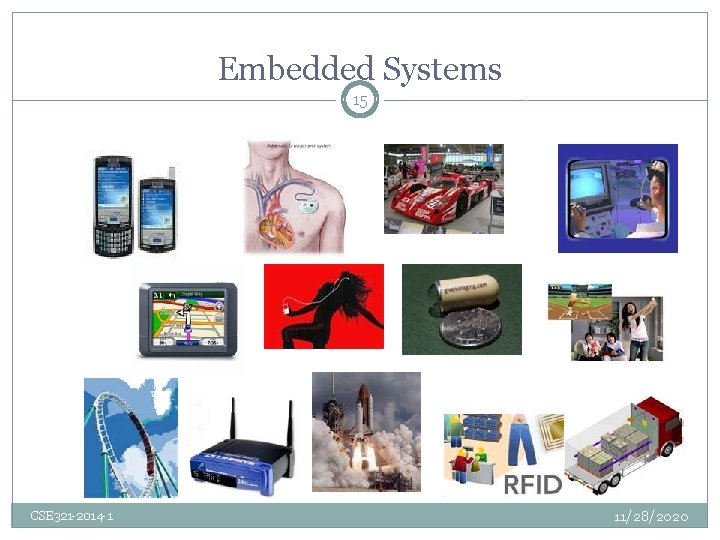
Embedded Systems 15 CSE 321 -2014 -1 11/28/2020
Designing RTOS 16 WHERE DO YOU BEGIN? ANS: REQUIREMENTS CSE 321 -2014 -1 11/28/2020
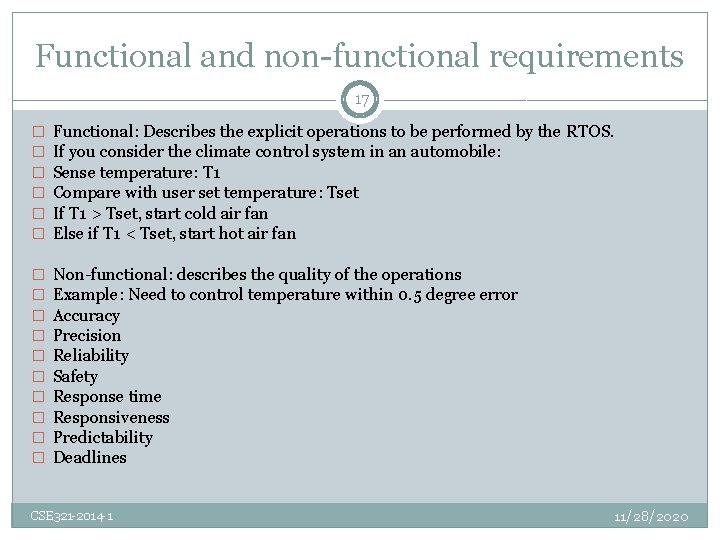
Functional and non-functional requirements 17 � � � Functional: Describes the explicit operations to be performed by the RTOS. If you consider the climate control system in an automobile: Sense temperature: T 1 Compare with user set temperature: Tset If T 1 > Tset, start cold air fan Else if T 1 < Tset, start hot air fan � � � � � Non-functional: describes the quality of the operations Example: Need to control temperature within 0. 5 degree error Accuracy Precision Reliability Safety Response time Responsiveness Predictability Deadlines CSE 321 -2014 -1 11/28/2020
Hardware Requirements 18 �Hardware support for functional requirements �Hardware support for non-functional requirements �Size of the device �Power of the processor �Power consumption �Speed of the device �Support for devices, interrupts �Electronic Control Units (ECU): typical modern automobile has 100’s of ECUs [Takada] CSE 321 -2014 -1 11/28/2020
Software requirements 19 �Software functions to implement the operations �Driver that dispatches calls to these operations �Interrupt handlers �Device drivers �Operating system �Typical modern automobile has millions of lines of software [Takada] �Reference [Takada]: http: //estc. dsr-company. com/images/b/b 5/Automotive-embedded-systems. pdf CSE 321 -2014 -1 11/28/2020
Software Quality Assurance 20 �QA is especially important to RTS since many of these are deployed in life critical environments / situations. �Consider a heart pace maker �Consider a rail signaling system CSE 321 -2014 -1 11/28/2020
Design Representation 21 �Today we will look at a finite state machine (FSM) for representing the design of a RTOS. �On to the design… CSE 321 -2014 -1 11/28/2020
Design Considerations 22 �Requirements Design representation �Design representation prototype �Prototype testing �Production system CSE 321 -2014 -1 11/28/2020
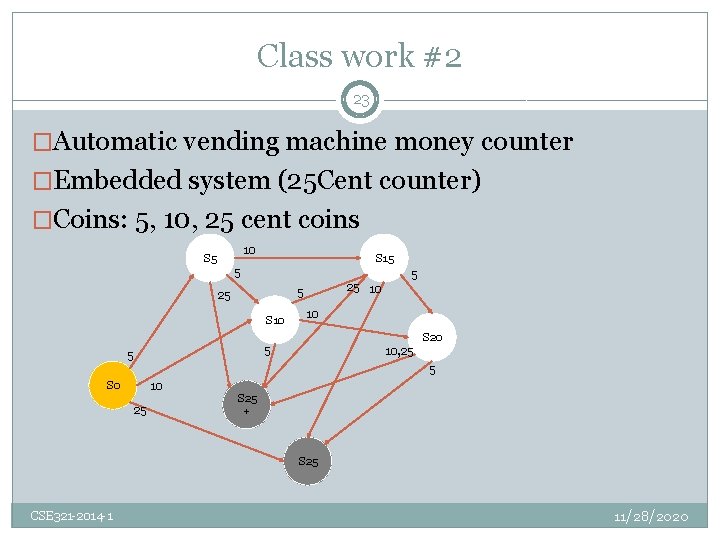
Class work #2 23 �Automatic vending machine money counter �Embedded system (25 Cent counter) �Coins: 5, 10, 25 cent coins 10 S 5 S 15 5 5 25 S 10 S 20 10, 25 5 10 5 5 S 0 25 10 S 25 + S 25 CSE 321 -2014 -1 11/28/2020
Finite State Machine (FSM) Page 24 �An FSM M = five tuple { S, i, T, Σ, δ } �S = set of states �i = initial state �T = terminal state (s) �Σ = events that bring about transitions �δ = transitions �Lets do this exercise for the avionics for a fighter aircraft/a drone CSE 321 -2014 -1 11/28/2020
Summary 25 �We studied the basic definitions of realtime and embedded system. �We studied key issues which make development of realtime software more challenging than desktop or traditional data processing applications. �Timing is very critical for RTOS input, output, computing and response. �UML state diagram is a useful tool for design representation. �We will study the design and implementation of RTOS system in detail later on. CSE 321 -2014 -1 11/28/2020
- Slides: 25