
CSE 314 Database Systems Lecture 1 Databases and
CSE 314 Database Systems Lecture 1 Databases and Database Users Doç. Dr. Mehmet Göktürk src: Elmasri & Navanthe 6 E Pearson Ed Slide Set
Course Information l l l Course Book: “Fundamentals of Database Systems, Elmasri & Navanthe 6 E” Grading: 35% midterm, 10%Hw, 50% final, 5% attendance Course files are available from internal file server Lecture supplementary videos (everyone should watch all) Very good online resource: http: //www. dbclass. org/ http: //nptel. iitm. ac. in/video. php? subject. Id=106106 093 © M. Gokturk 2
Chapter 1 Outline l l l l Introduction An Example Characteristics of the Database Approach Actors on the Scene Workers behind the Scene Advantages of Using the DBMS Approach A Brief History of Database Applications When Not to Use a DBMS © M. Gokturk 3
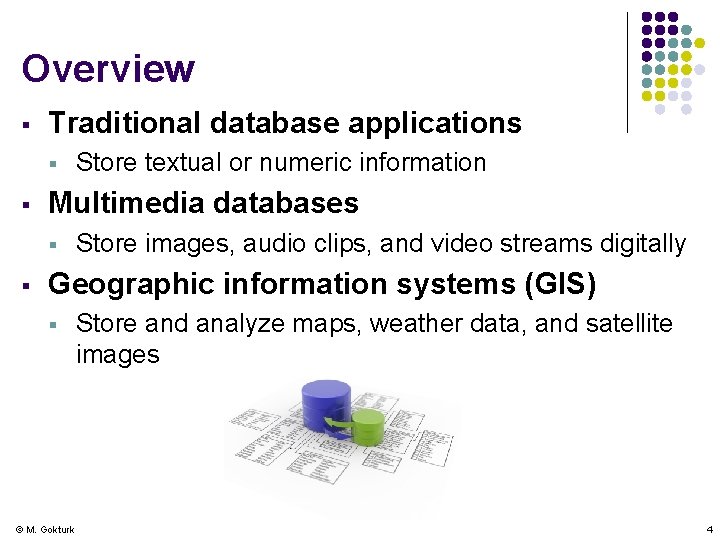
Overview § Traditional database applications § § Multimedia databases § § Store textual or numeric information Store images, audio clips, and video streams digitally Geographic information systems (GIS) § © M. Gokturk Store and analyze maps, weather data, and satellite images 4
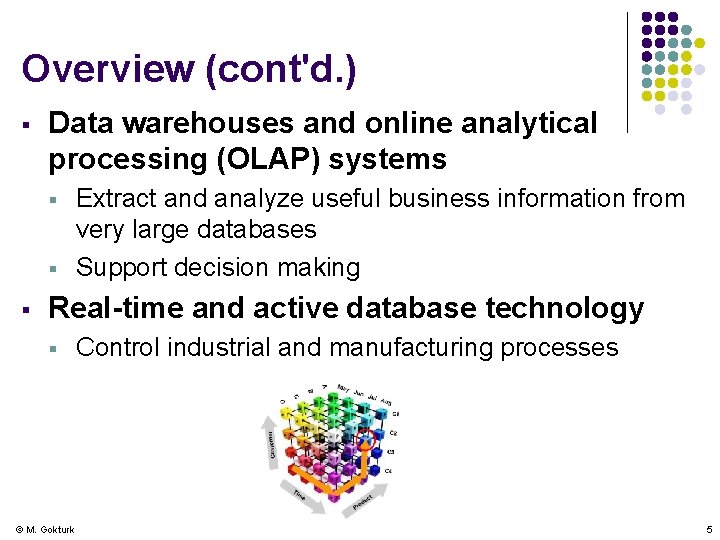
Overview (cont'd. ) § Data warehouses and online analytical processing (OLAP) systems § § § Extract and analyze useful business information from very large databases Support decision making Real-time and active database technology § © M. Gokturk Control industrial and manufacturing processes 5
Introduction § Database § § § © M. Gokturk Collection of related data Known facts that can be recorded and that have implicit meaning Miniworld or universe of discourse (Uo. D) Represents some aspect of the real world Logically coherent collection of data with inherent meaning Built for a specific purpose 6
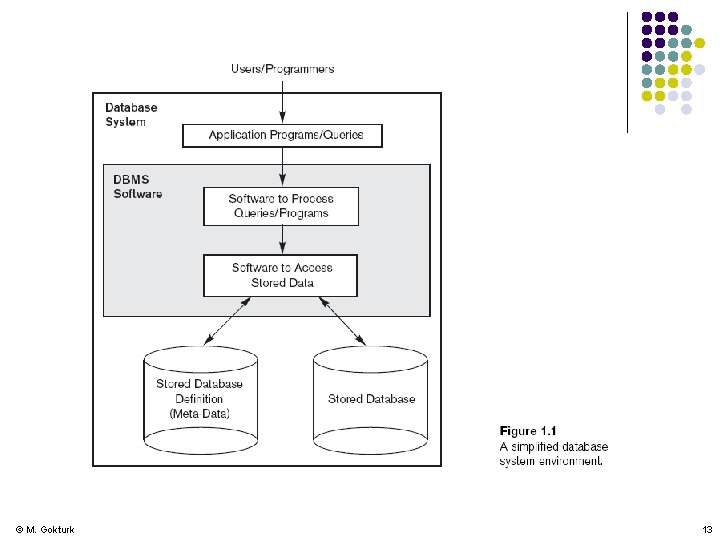
Introduction (cont'd. ) § Example of a large commercial database § § Database management system (DBMS) § § § Amazon. com Collection of programs Enables users to create and maintain a database Defining a database § © M. Gokturk Specify the data types, structures, and constraints of the data to be stored 7
Introduction (cont'd. ) § Meta-data § § § Database definition or descriptive information Stored by the DBMS in the form of a database catalog or dictionary Manipulating a database § § © M. Gokturk Query and update the database miniworld Generate reports 8
Introduction (cont'd. ) § Sharing a database § § Application program § § Allow multiple users and programs to access the database simultaneously Accesses database by sending queries to DBMS Query § © M. Gokturk Causes some data to be retrieved 9
Introduction (cont'd. ) § Transaction § § Protection includes: § § § May cause some data to be read and some data to be written into the database System protection Security protection Maintain the database system § © M. Gokturk Allow the system to evolve as requirements change over time 10
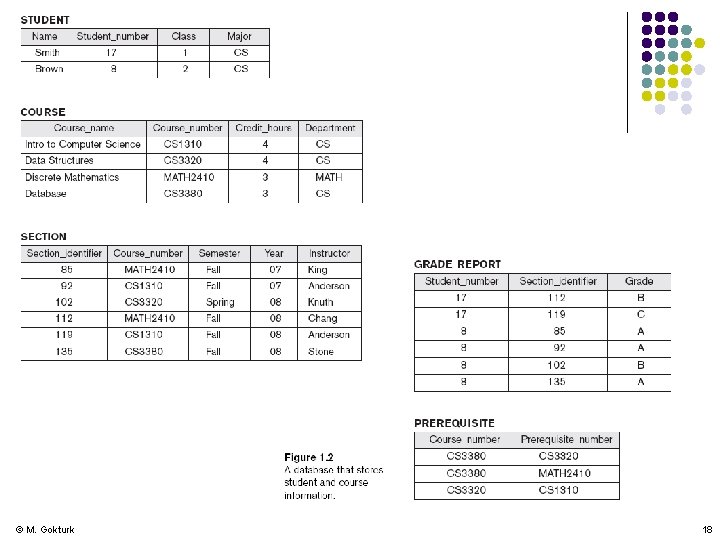
An Example § UNIVERSITY database § § Information concerning students, courses, and grades in a university environment Data records § § § © M. Gokturk STUDENT COURSE SECTION GRADE_REPORT PREREQUISITE 11
An Example (cont'd. ) § Specify structure of records of each file by specifying data type for each data element § § § © M. Gokturk String of alphabetic characters Integer Etc. 12
© M. Gokturk 13
An Example (cont'd. ) § Construct UNIVERSITY database § § § Store data to represent each student, course, section, grade report, and prerequisite as a record in appropriate file Relationships among the records Manipulation involves querying and updating © M. Gokturk 14
An Example (cont'd. ) § Examples of queries: § § § © M. Gokturk Retrieve the transcript List the names of students who took the section of the ‘Database’ course offered in fall 2008 and their grades in that section List the prerequisites of the ‘Database’ course 15
An Example (cont'd. ) § Examples of updates: § § § © M. Gokturk Change the class of ‘Smith’ to sophomore Create a new section for the ‘Database’ course for this semester Enter a grade of ‘A’ for ‘Smith’ in the ‘Database’ section of last semester 16
An Example (cont'd. ) § Phases for designing a database: § § © M. Gokturk Requirements specification and analysis Conceptual design Logical design Physical design 17
© M. Gokturk 18
Characteristics of the Database Approach § Traditional file processing § § Each user defines and implements the files needed for a specific software application Database approach § © M. Gokturk Single repository maintains data that is defined once and then accessed by various users 19
Characteristics of the Database Approach (cont'd. ) § Main characteristics of database approach § § © M. Gokturk Self-describing nature of a database system Insulation between programs and data, and data abstraction Support of multiple views of the data Sharing of data and multiuser transaction processing 20
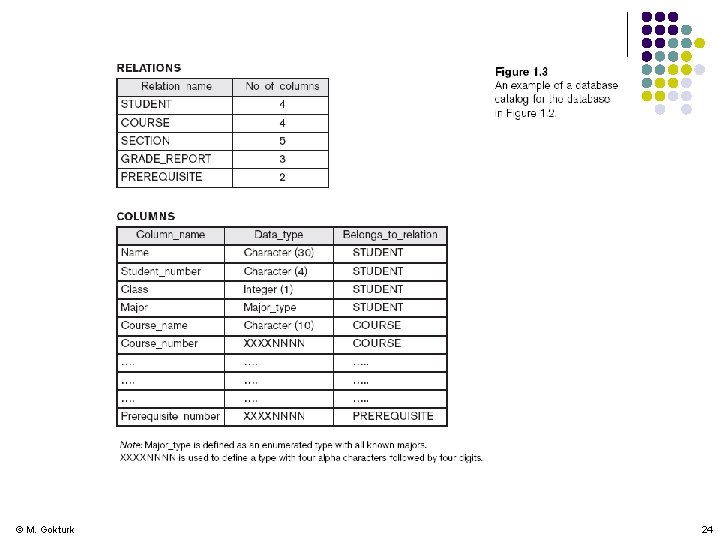
Self-Describing Nature of a Database System § § Database system contains complete definition of structure and constraints Meta-data § § Describes structure of the database Database catalog used by: § § © M. Gokturk DBMS software Database users who need information about database structure 21
Insulation Between Programs and Data § Program-data independence § § Structure of data files is stored in DBMS catalog separately from access programs Program-operation independence § Operations specified in two parts: • • © M. Gokturk Interface includes operation name and data types of its arguments Implementation can be changed without affecting the interface 22
Data Abstraction § Data abstraction § § Conceptual representation of data § § Allows program-data independence and programoperation independence Does not include details of how data is stored or how operations are implemented Data model § © M. Gokturk Type of data abstraction used to provide conceptual representation 23
© M. Gokturk 24
Support of Multiple Views of the Data § View § § § Subset of the database Contains virtual data derived from the database files but is not explicitly stored Multiuser DBMS § § © M. Gokturk Users have a variety of distinct applications Must provide facilities for defining multiple views 25
Sharing of Data and Multiuser Transaction Processing § § Allow multiple users to access the database at the same time Concurrency control software § Ensure that several users trying to update the same data do so in a controlled manner • § Result of the updates is correct Online transaction processing (OLTP) application © M. Gokturk 26
Transaction Processing (cont'd. ) § Transaction § § § Central to many database applications Executing program or process that includes one or more database Isolation property • § Atomicity property • © M. Gokturk Each transaction appears to execute in isolation from other transactions Either all the database operations in a transaction are executed or none are 27
Actors on the Scene § Database administrators (DBA) are responsible for: § § Authorizing access to the database Coordinating and monitoring its use Acquiring software and hardware resources Database designers are responsible for: § § © M. Gokturk Identifying the data to be stored Choosing appropriate structures to represent and store this data 28
Actors on the Scene (cont'd. ) § End users § § People whose jobs require access to the database Types • • © M. Gokturk Casual end users Naive or parametric end users Sophisticated end users Standalone users 29
Actors on the Scene (cont'd. ) § System analysts § § Determine requirements of end users Application programmers § © M. Gokturk Implement these specifications as programs 30
Workers behind the Scene § DBMS system designers and implementers § § Tool developers § § Design and implement the DBMS modules and interfaces as a software package Design and implement tools Operators and maintenance personnel § © M. Gokturk Responsible for running and maintenance of hardware and software environment for database system 31
Advantages of Using the DBMS Approach § Controlling redundancy § § Data normalization Denormalization • § Sometimes necessary to use controlled redundancy to improve the performance of queries Restricting unauthorized access § § © M. Gokturk Security and authorization subsystem Privileged software 32
Advantages of Using the DBMS Approach (cont'd. ) § Providing persistent storage for program objects § § Complex object in C++ can be stored permanently in an object-oriented DBMS Impedance mismatch problem • © M. Gokturk Object-oriented database systems typically offer data structure compatibility 33
Advantages of Using the DBMS Approach (cont'd. ) § Providing storage structures and search techniques for efficient query processing § § § © M. Gokturk Indexes Buffering and caching Query processing and optimization 34
Advantages of Using the DBMS Approach (cont'd. ) § Providing backup and recovery § § Providing multiple user interfaces § § Backup and recovery subsystem of the DBMS is responsible for recovery Graphical user interfaces (GUIs) Representing complex relationships among data § © M. Gokturk May include numerous varieties of data that are interrelated in many ways 35
Advantages of Using the DBMS Approach (cont'd. ) § Enforcing integrity constraints § Referential integrity constraint • § Key or uniqueness constraint • § § © M. Gokturk Every section record must be related to a course record Every course record must have a unique value for Course_number Business rules Inherent rules of the data model 36
Advantages of Using the DBMS Approach (cont'd. ) § Permitting inferencing and actions using rules § Deductive database systems • • § Trigger • § Rule activated by updates to the table Stored procedures • © M. Gokturk Provide capabilities for defining deduction rules Inferencing new information from the stored database facts More involved procedures to enforce rules 37
Advantages of Using the DBMS Approach (cont'd. ) § Additional implications of using the database approach § § © M. Gokturk Reduced application development time Flexibility Availability of up-to-date information Economies of scale 38
A Brief History of Database Applications § Early database applications using hierarchical and network systems § § Large numbers of records of similar structure Providing data abstraction and application flexibility with relational databases § § © M. Gokturk Separates physical storage of data from its conceptual representation Provides a mathematical foundation for data representation and querying 39
A Brief History of Database Applications (cont'd. ) § Object-oriented applications and the need for more complex databases § § Used in specialized applications: engineering design, multimedia publishing, and manufacturing systems Interchanging data on the Web for e-commerce using XML § © M. Gokturk Extended markup language (XML) primary standard for interchanging data among various types of databases and Web pages 40
A Brief History of Database Applications (cont'd. ) § Extending database capabilities for new applications § § Extensions to better support specialized requirements for applications Enterprise resource planning (ERP) Customer relationship management (CRM) Databases versus information retrieval § Information retrieval (IR) • © M. Gokturk Deals with books, manuscripts, and various forms of librarybased articles 41
When Not to Use a DBMS § More desirable to use regular files for: § § © M. Gokturk Simple, well-defined database applications not expected to change at all Stringent, real-time requirements that may not be met because of DBMS overhead Embedded systems with limited storage capacity No multiple-user access to data 42
Summary § Database § § DBMS § § § Collection of related data (recorded facts) Generalized software package for implementing and maintaining a computerized database Several categories of database users Database applications have evolved § © M. Gokturk Current trends: IR, Web 43
- Slides: 43