
CSE 310 Lecture 01 Algorithms Counting and Data
- Slides: 17
CSE 310 Lecture 01: Algorithms, Counting and Data Structures Guoliang (Larry) Xue Computer Science and Engineering CIDSE Arizona State University http: //optimization. asu. edu/~xue Guoliang. Xue@asu.
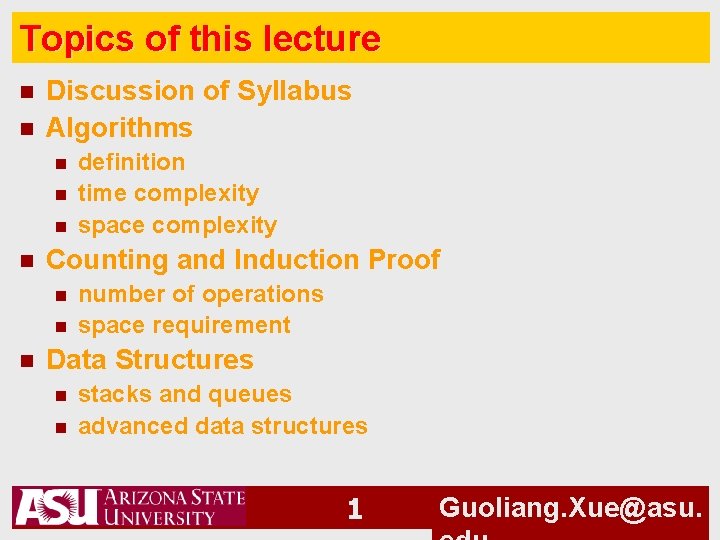
Topics of this lecture n n Discussion of Syllabus Algorithms n n Counting and Induction Proof n n n definition time complexity space complexity number of operations space requirement Data Structures n n stacks and queues advanced data structures 1 Guoliang. Xue@asu.
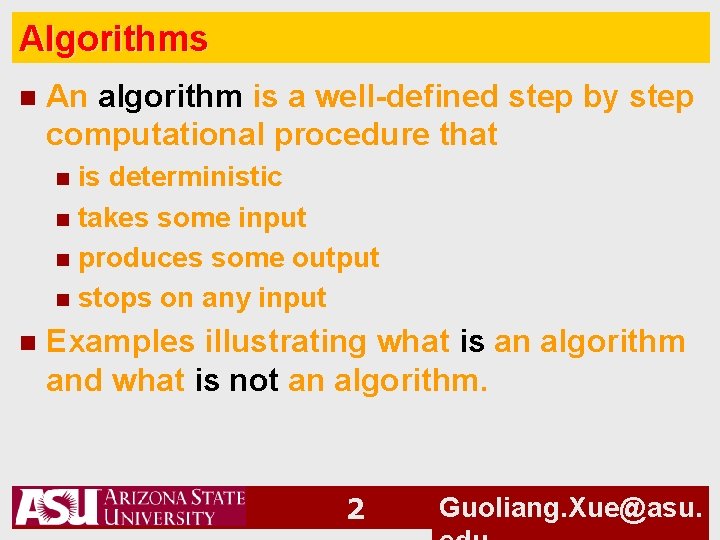
Algorithms n An algorithm is a well-defined step by step computational procedure that is deterministic n takes some input n produces some output n stops on any input n n Examples illustrating what is an algorithm and what is not an algorithm. 2 Guoliang. Xue@asu.
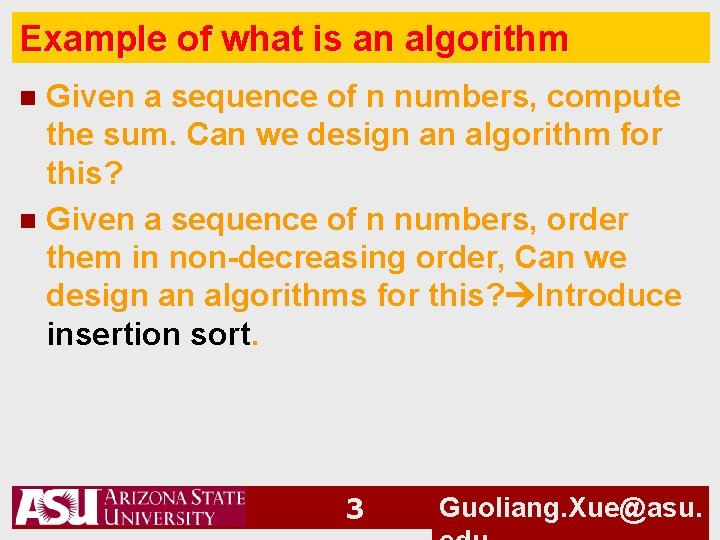
Example of what is an algorithm Given a sequence of n numbers, compute the sum. Can we design an algorithm for this? n Given a sequence of n numbers, order them in non-decreasing order, Can we design an algorithms for this? Introduce insertion sort. n 3 Guoliang. Xue@asu.
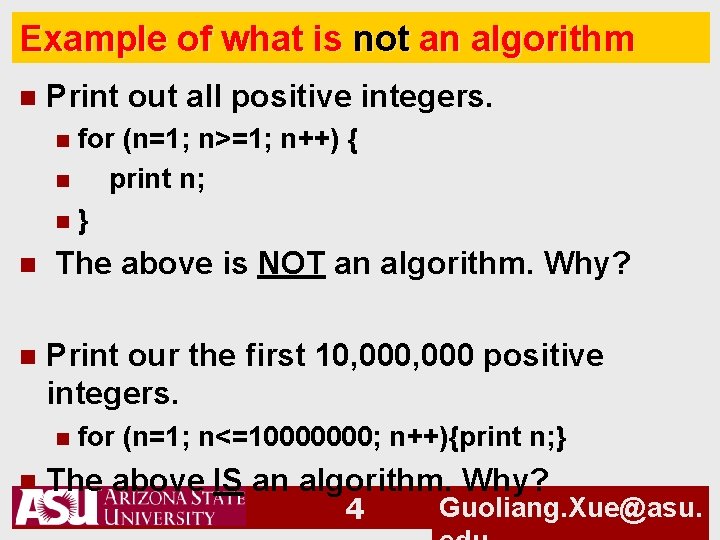
Example of what is not an algorithm n Print out all positive integers. for (n=1; n>=1; n++) { n print n; n} n n n The above is NOT an algorithm. Why? Print our the first 10, 000 positive integers. n n for (n=1; n<=10000000; n++){print n; } The above IS an algorithm. Why? 4 Guoliang. Xue@asu.
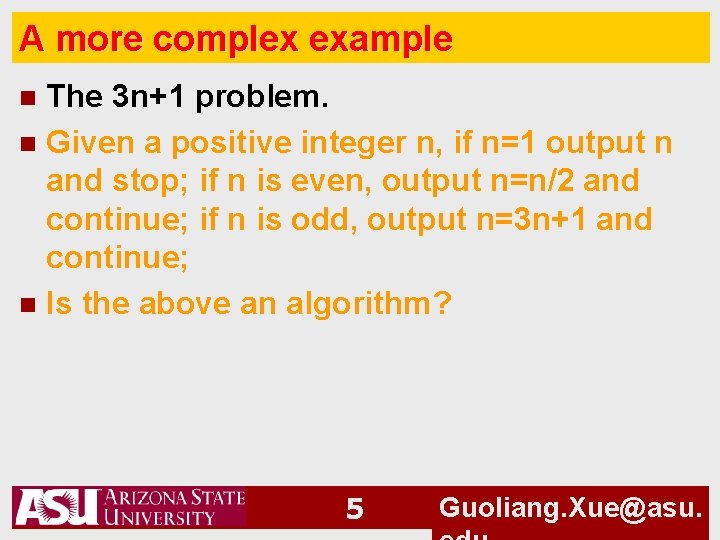
A more complex example The 3 n+1 problem. n Given a positive integer n, if n=1 output n and stop; if n is even, output n=n/2 and continue; if n is odd, output n=3 n+1 and continue; n Is the above an algorithm? n 5 Guoliang. Xue@asu.
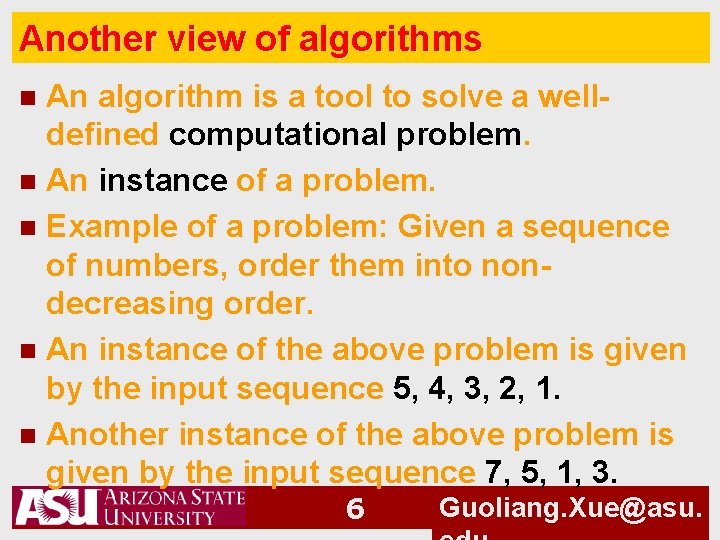
Another view of algorithms An algorithm is a tool to solve a welldefined computational problem. n An instance of a problem. n Example of a problem: Given a sequence of numbers, order them into nondecreasing order. n An instance of the above problem is given by the input sequence 5, 4, 3, 2, 1. n Another instance of the above problem is given by the input sequence 7, 5, 1, 3. n 6 Guoliang. Xue@asu.
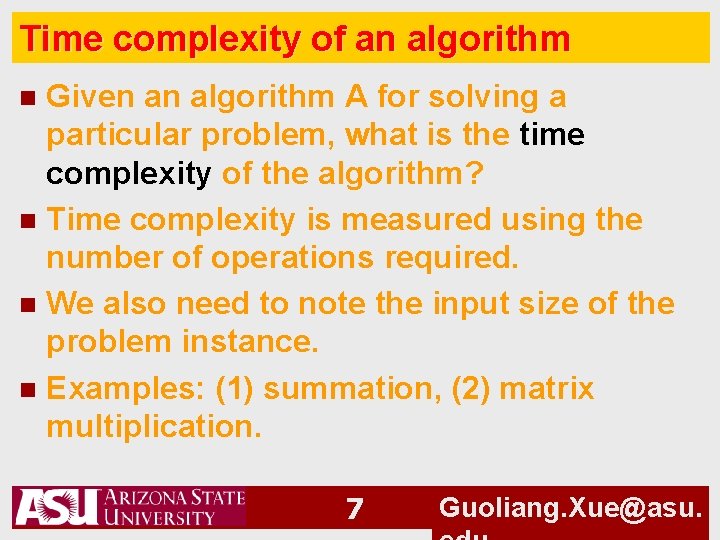
Time complexity of an algorithm Given an algorithm A for solving a particular problem, what is the time complexity of the algorithm? n Time complexity is measured using the number of operations required. n We also need to note the input size of the problem instance. n Examples: (1) summation, (2) matrix multiplication. n 7 Guoliang. Xue@asu.
Space complexity of an algorithm Given an algorithm A for solving a particular problem, what is the space complexity of the algorithm? n Space complexity is measured using the number of memory cells required. n We also need to note the input size of the problem instance. n Examples: (1) summation, (2) matrix multiplication. n 8 Guoliang. Xue@asu.
Complexity of an algorithm Best case analysis n Average case analysis n Worst case analysis n Amortized analysis n 9 Guoliang. Xue@asu.
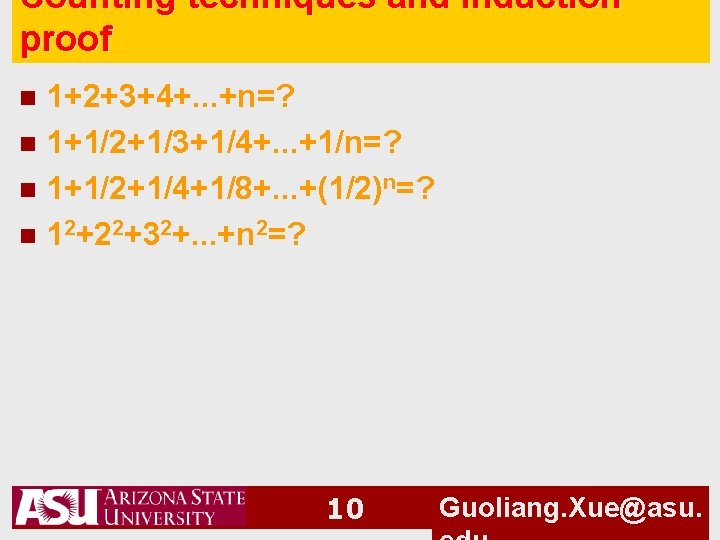
Counting techniques and induction proof 1+2+3+4+. . . +n=? n 1+1/2+1/3+1/4+. . . +1/n=? n 1+1/2+1/4+1/8+. . . +(1/2)n=? n 12+22+32+. . . +n 2=? n 10 Guoliang. Xue@asu.
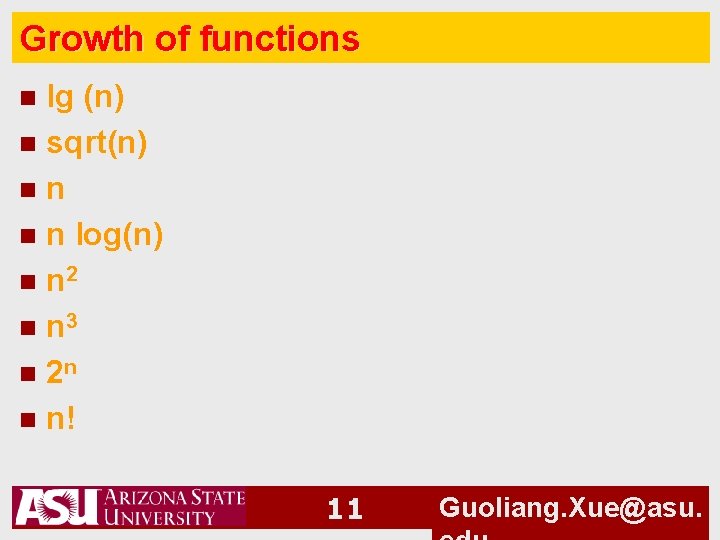
Growth of functions lg (n) n sqrt(n) nn n n log(n) n n 2 n n 3 n 2 n n n! n 11 Guoliang. Xue@asu.
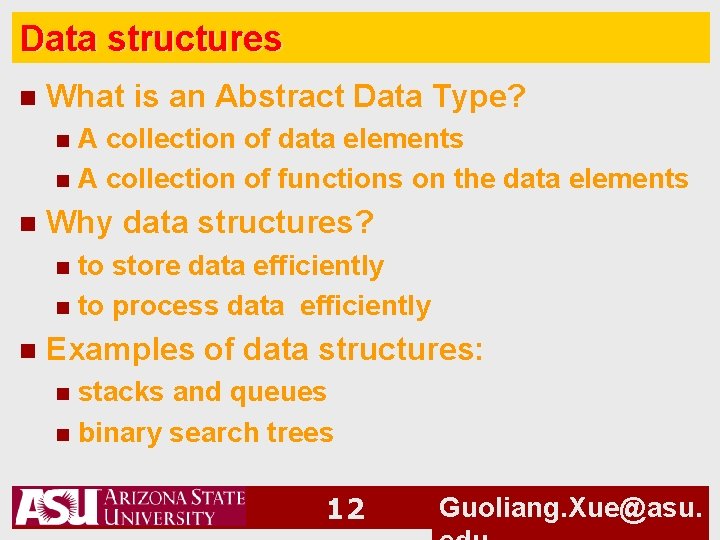
Data structures n What is an Abstract Data Type? A collection of data elements n A collection of functions on the data elements n n Why data structures? to store data efficiently n to process data efficiently n n Examples of data structures: stacks and queues n binary search trees n 12 Guoliang. Xue@asu.
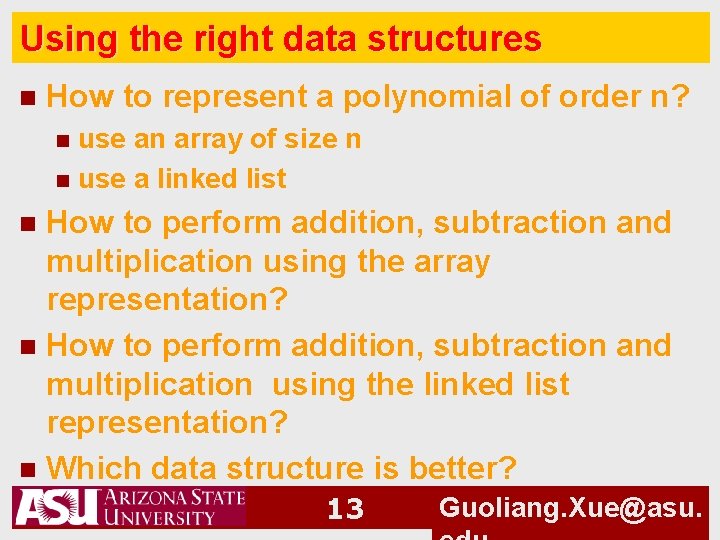
Using the right data structures n How to represent a polynomial of order n? use an array of size n n use a linked list n How to perform addition, subtraction and multiplication using the array representation? n How to perform addition, subtraction and multiplication using the linked list representation? n Which data structure is better? n 13 Guoliang. Xue@asu.
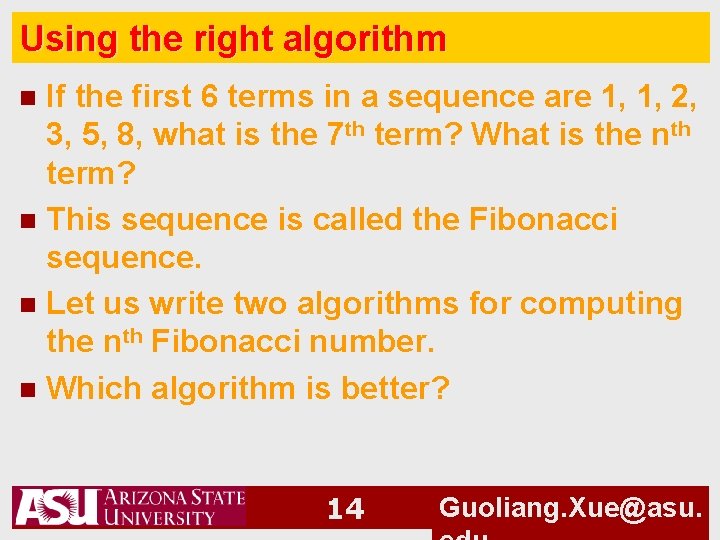
Using the right algorithm If the first 6 terms in a sequence are 1, 1, 2, 3, 5, 8, what is the 7 th term? What is the nth term? n This sequence is called the Fibonacci sequence. n Let us write two algorithms for computing the nth Fibonacci number. n Which algorithm is better? n 14 Guoliang. Xue@asu.
Summary What is an algorithm? n What is an ADT? n Counting. n Proof using mathematical induction. n Problems and instances. n Comparison of algorithms. n 15 Guoliang. Xue@asu.
Readings and Exercises Most materials covered in this lecture can be found in Section 1. 1, Section 1. 2, Section 2. 1 and 2. 2. n You should work on Exercises 1. 1 -1 through 1. 1 -5 (p. 11) and Problems 1 -1 (pp. 14 -15). n Lecture 02 will be on asymptotic notations. To preview, read Sections 3. 1 and 3. 2. n 16 Guoliang. Xue@asu.