
CSE 309 Computer Architecture and Organization Lecture 6





























- Slides: 55
CSE 309 Computer Architecture and Organization Lecture #6 CPU: Structure & Function Prepared & Presented by Asst. Prof. Dr. Samsun M. BAŞARICI
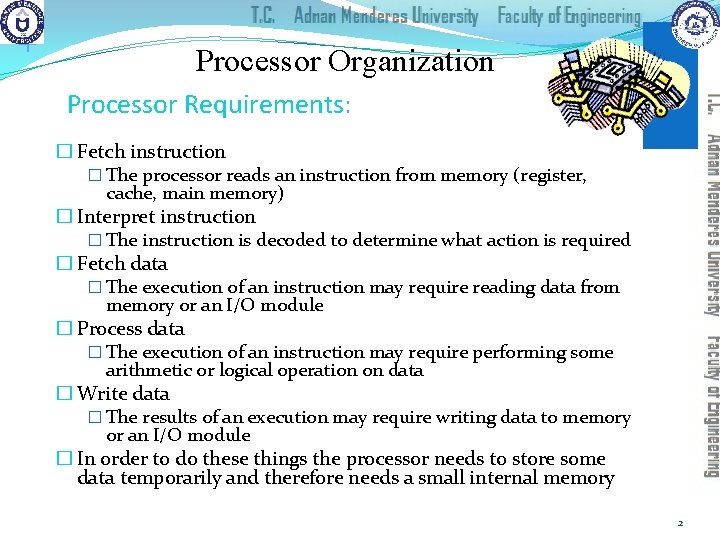
+ Processor Organization Processor Requirements: � Fetch instruction � The processor reads an instruction from memory (register, cache, main memory) � Interpret instruction � The instruction is decoded to determine what action is required � Fetch data � The execution of an instruction may require reading data from memory or an I/O module � Process data � The execution of an instruction may require performing some arithmetic or logical operation on data � Write data � The results of an execution may require writing data to memory or an I/O module � In order to do these things the processor needs to store some data temporarily and therefore needs a small internal memory 2
3
4
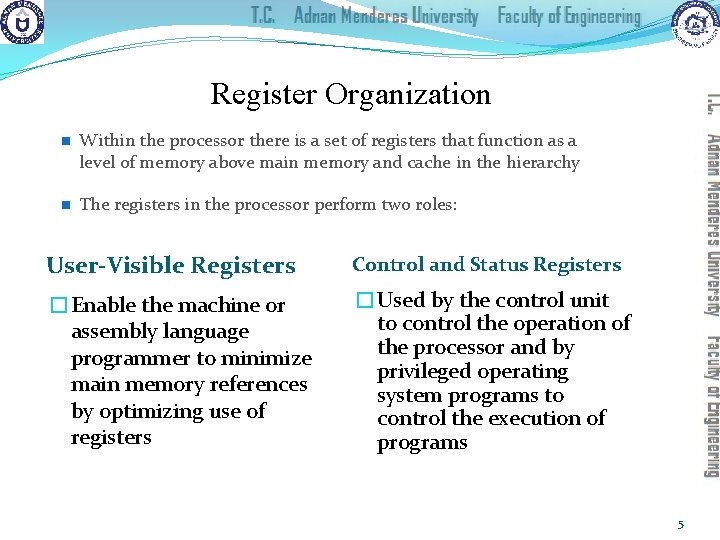
Register Organization n Within the processor there is a set of registers that function as a level of memory above main memory and cache in the hierarchy n The registers in the processor perform two roles: User-Visible Registers Control and Status Registers �Enable the machine or assembly language programmer to minimize main memory references by optimizing use of registers �Used by the control unit to control the operation of the processor and by privileged operating system programs to control the execution of programs 5
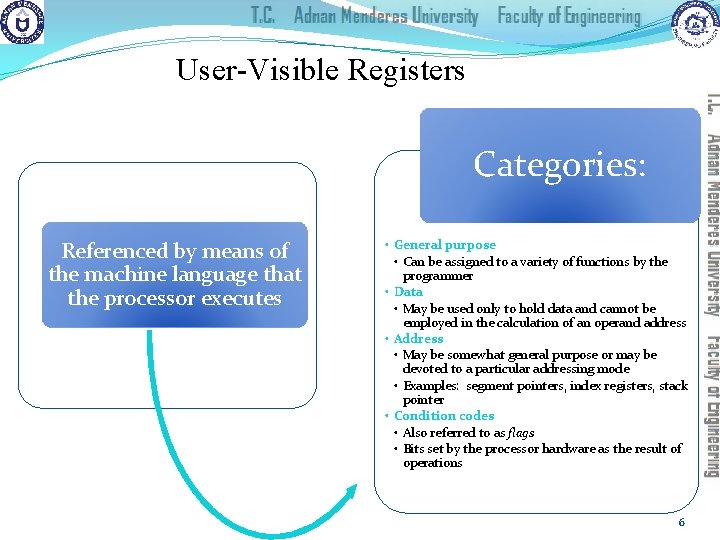
User-Visible Registers Categories: Referenced by means of the machine language that the processor executes • General purpose • Can be assigned to a variety of functions by the programmer • Data • May be used only to hold data and cannot be employed in the calculation of an operand address • Address • May be somewhat general purpose or may be devoted to a particular addressing mode • Examples: segment pointers, index registers, stack pointer • Condition codes • Also referred to as flags • Bits set by the processor hardware as the result of operations 6
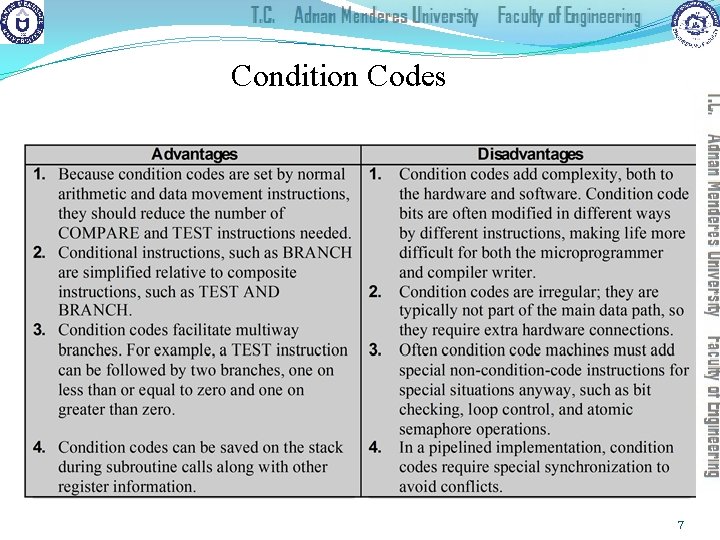
Condition Codes 7
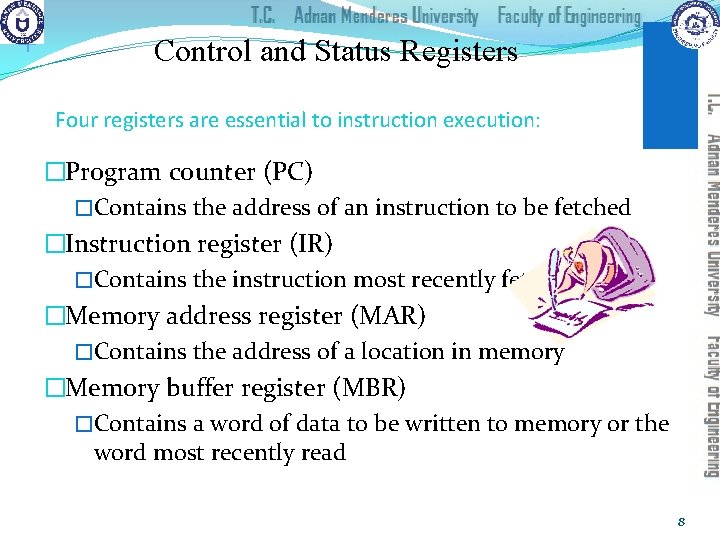
+ Control and Status Registers Four registers are essential to instruction execution: �Program counter (PC) �Contains the address of an instruction to be fetched �Instruction register (IR) �Contains the instruction most recently fetched �Memory address register (MAR) �Contains the address of a location in memory �Memory buffer register (MBR) �Contains a word of data to be written to memory or the word most recently read 8
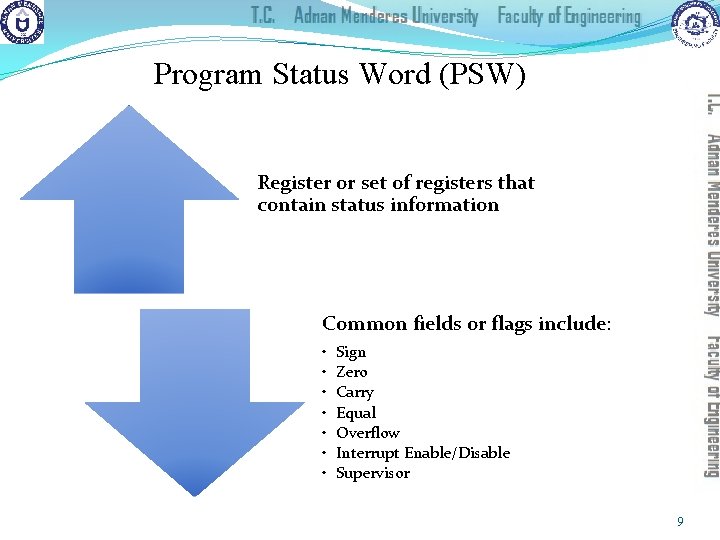
Program Status Word (PSW) Register or set of registers that contain status information Common fields or flags include: • • Sign Zero Carry Equal Overflow Interrupt Enable/Disable Supervisor 9
10
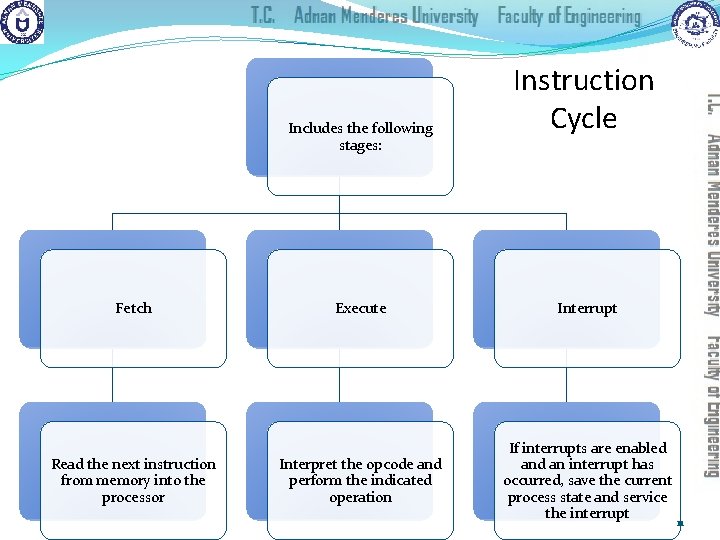
Includes the following stages: Fetch Read the next instruction from memory into the processor Instruction Cycle Execute Interrupt Interpret the opcode and perform the indicated operation If interrupts are enabled an interrupt has occurred, save the current process state and service the interrupt 11
12
13
14
15
16
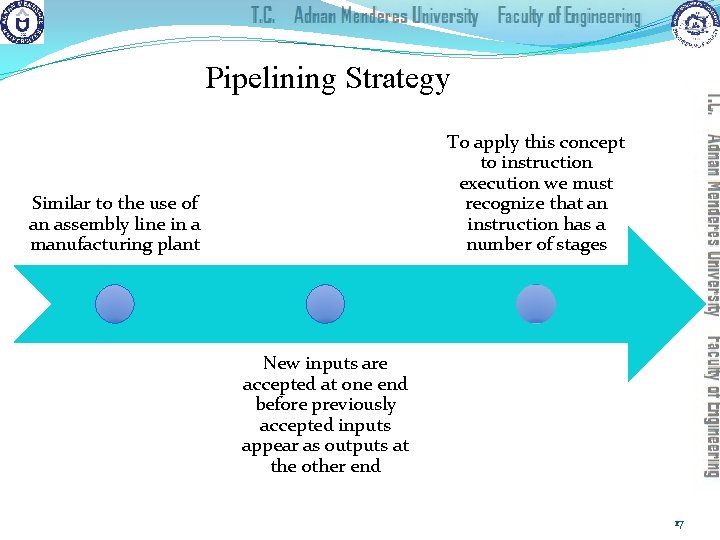
Pipelining Strategy To apply this concept to instruction execution we must recognize that an instruction has a number of stages Similar to the use of an assembly line in a manufacturing plant New inputs are accepted at one end before previously accepted inputs appear as outputs at the other end 17
18
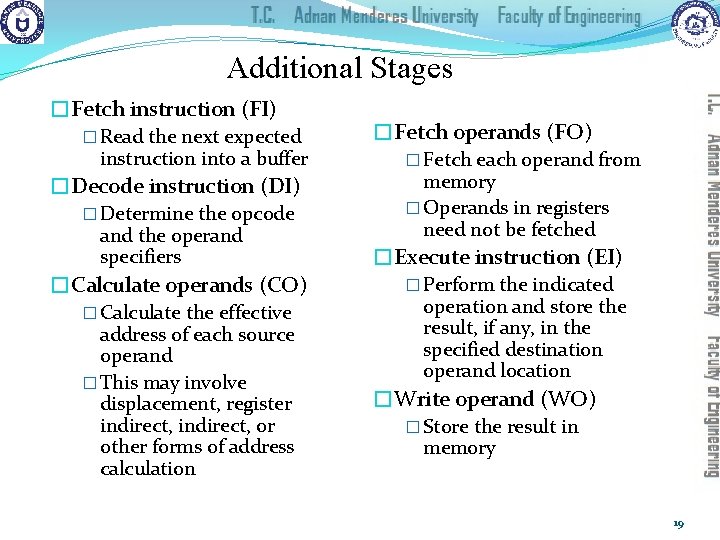
Additional Stages �Fetch instruction (FI) � Read the next expected instruction into a buffer �Decode instruction (DI) � Determine the opcode and the operand specifiers �Calculate operands (CO) � Calculate the effective address of each source operand � This may involve displacement, register indirect, or other forms of address calculation �Fetch operands (FO) � Fetch each operand from memory � Operands in registers need not be fetched �Execute instruction (EI) � Perform the indicated operation and store the result, if any, in the specified destination operand location �Write operand (WO) � Store the result in memory 19
20
21
22
23
24
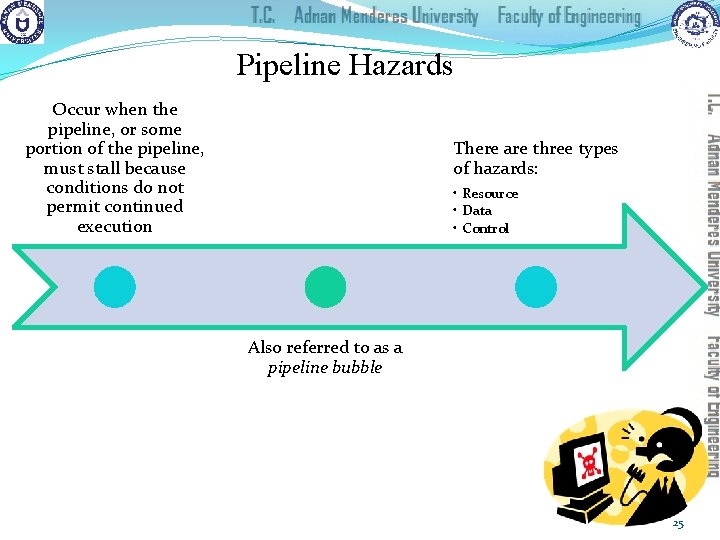
Pipeline Hazards Occur when the pipeline, or some portion of the pipeline, must stall because conditions do not permit continued execution There are three types of hazards: • Resource • Data • Control Also referred to as a pipeline bubble 25
26
27
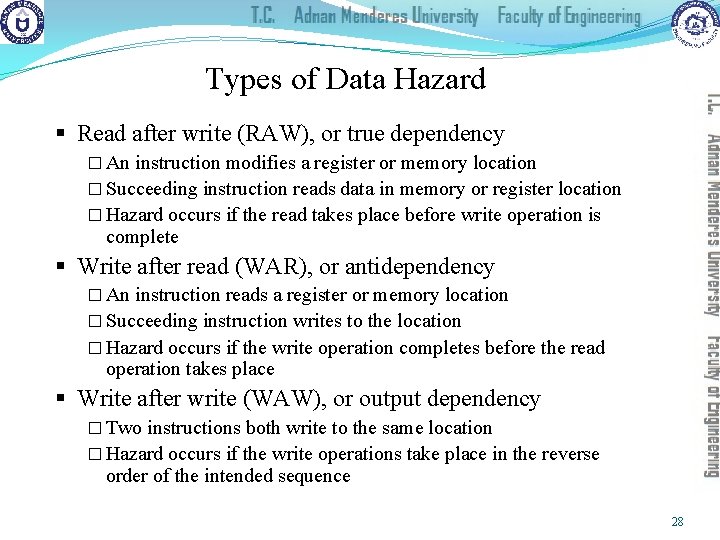
Types of Data Hazard § Read after write (RAW), or true dependency � An instruction modifies a register or memory location � Succeeding instruction reads data in memory or register location � Hazard occurs if the read takes place before write operation is complete § Write after read (WAR), or antidependency � An instruction reads a register or memory location � Succeeding instruction writes to the location � Hazard occurs if the write operation completes before the read operation takes place § Write after write (WAW), or output dependency � Two instructions both write to the same location � Hazard occurs if the write operations take place in the reverse order of the intended sequence 28
Control Hazard § Also known as a branch hazard § Occurs when the pipeline makes the wrong decision on a branch prediction § Brings instructions into the pipeline that must subsequently be discarded § Dealing with Branches: �Multiple streams �Prefetch branch target �Loop buffer �Branch prediction �Delayed branch 29
Multiple Streams A simple pipeline suffers a penalty for a branch instruction because it must choose one of two instructions to fetch next and may make the wrong choice A brute-force approach is to replicate the initial portions of the pipeline and allow the pipeline to fetch both instructions, making use of two streams Drawbacks: • With multiple pipelines there are contention delays for access to the registers and to memory • Additional branch instructions may enter the pipeline before the original branch decision is resolved 30
Prefetch Branch Target n When a conditional branch is recognized, the target of the branch is prefetched, in addition to the instruction following the branch n Target is then saved until the branch instruction is executed n If the branch is taken, the target has already been prefetched n IBM 360/91 uses this approach 31
Loop Buffer § Small, very-high speed memory maintained by the instruction fetch stage of the pipeline and containing the n most recently fetched instructions, in sequence § Benefits: �Instructions fetched in sequence will be available without the usual memory access time �If a branch occurs to a target just a few locations ahead of the address of the branch instruction, the target will already be in the buffer �This strategy is particularly well suited to dealing with loops � Similar in principle to a cache dedicated to instructions � Differences: � The loop buffer only retains instructions in sequence � Is much smaller in size and hence lower in cost 32
33
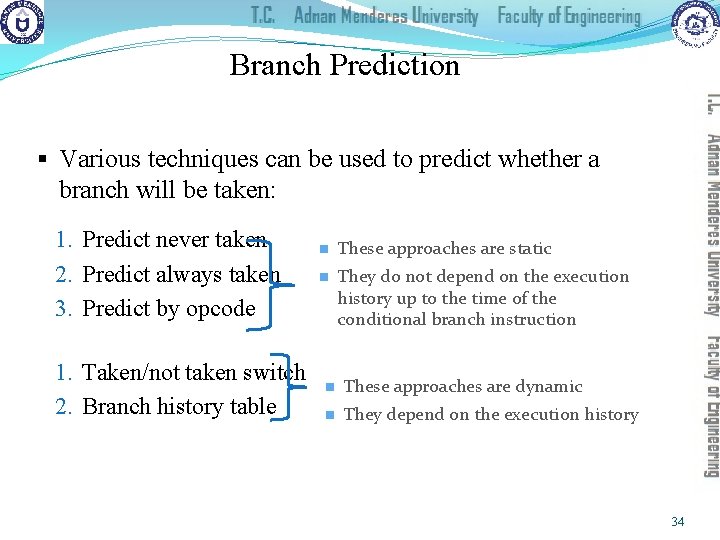
Branch Prediction § Various techniques can be used to predict whether a branch will be taken: 1. Predict never taken 2. Predict always taken 3. Predict by opcode 1. Taken/not taken switch 2. Branch history table n These approaches are static n They do not depend on the execution history up to the time of the conditional branch instruction n These approaches are dynamic n They depend on the execution history 34
35
36
37
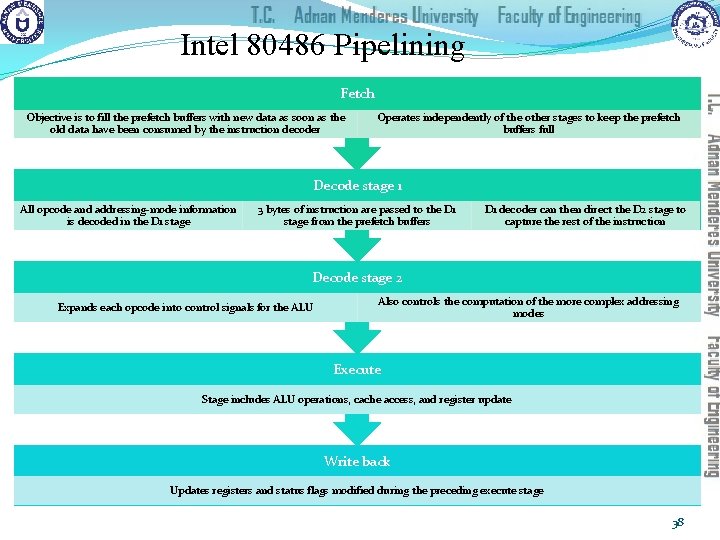
Intel 80486 Pipelining Fetch Objective is to fill the prefetch buffers with new data as soon as the old data have been consumed by the instruction decoder Operates independently of the other stages to keep the prefetch buffers full Decode stage 1 All opcode and addressing-mode information is decoded in the D 1 stage 3 bytes of instruction are passed to the D 1 stage from the prefetch buffers D 1 decoder can then direct the D 2 stage to capture the rest of the instruction Decode stage 2 Expands each opcode into control signals for the ALU Also controls the computation of the more complex addressing modes Execute Stage includes ALU operations, cache access, and register update Write back Updates registers and status flags modified during the preceding execute stage 38
39
x 86 Processor Registers 40
41
42
43
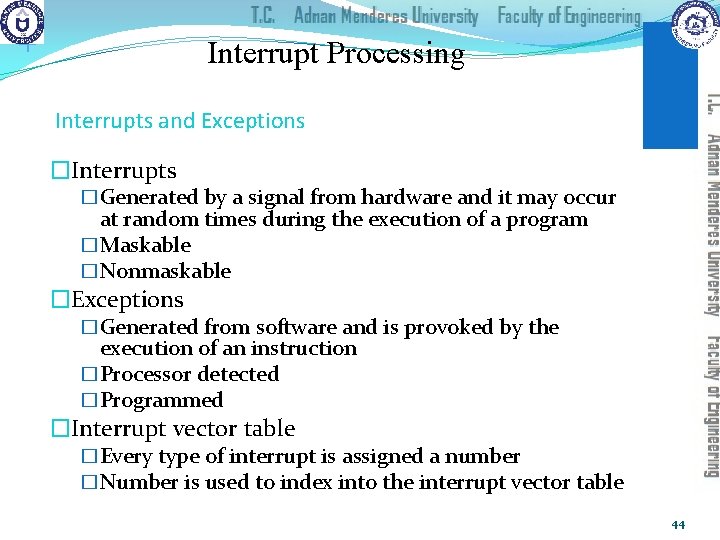
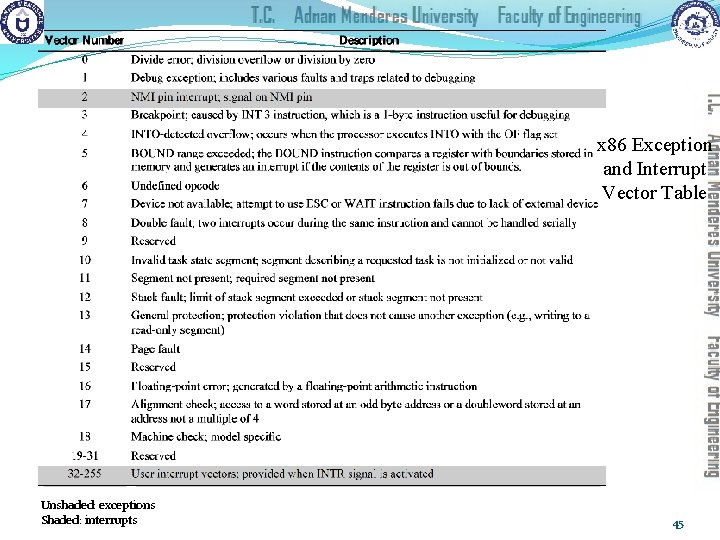
+ Interrupt Processing Interrupts and Exceptions �Interrupts �Generated by a signal from hardware and it may occur at random times during the execution of a program �Maskable �Nonmaskable �Exceptions �Generated from software and is provoked by the execution of an instruction �Processor detected �Programmed �Interrupt vector table �Every type of interrupt is assigned a number �Number is used to index into the interrupt vector table 44
x 86 Exception and Interrupt Vector Table Unshaded: exceptions Shaded: interrupts 45
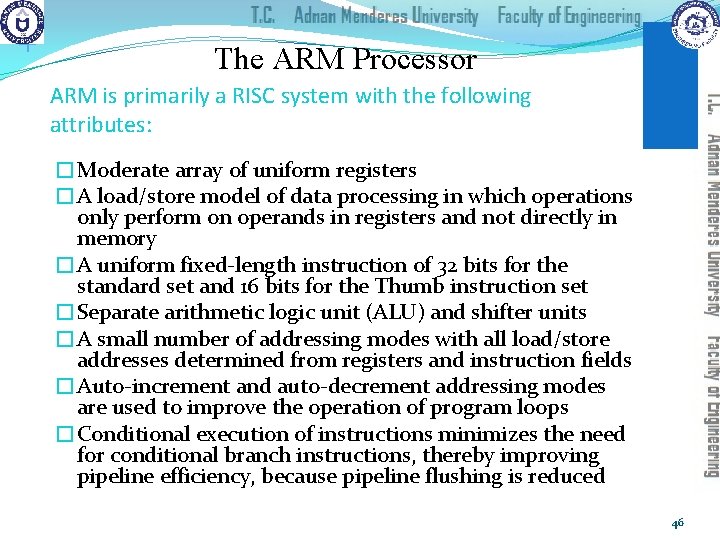
+ The ARM Processor ARM is primarily a RISC system with the following attributes: �Moderate array of uniform registers �A load/store model of data processing in which operations only perform on operands in registers and not directly in memory �A uniform fixed-length instruction of 32 bits for the standard set and 16 bits for the Thumb instruction set �Separate arithmetic logic unit (ALU) and shifter units �A small number of addressing modes with all load/store addresses determined from registers and instruction fields �Auto-increment and auto-decrement addressing modes are used to improve the operation of program loops �Conditional execution of instructions minimizes the need for conditional branch instructions, thereby improving pipeline efficiency, because pipeline flushing is reduced 46
47
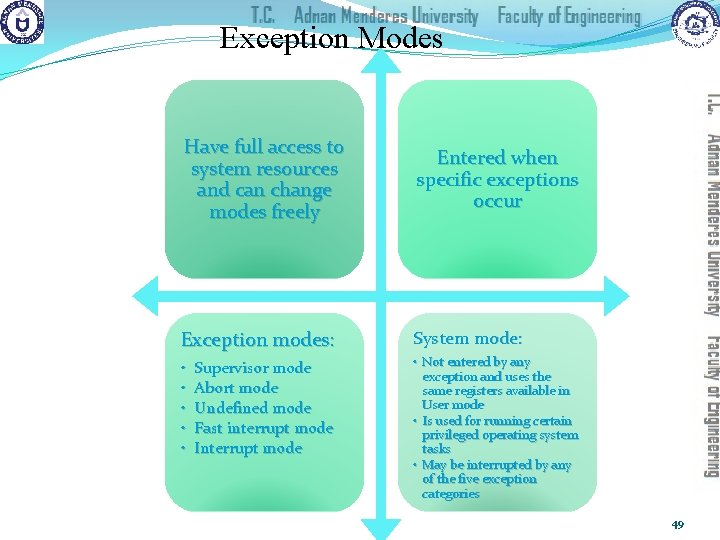
Processor Modes ARM architecture supports seven execution modes Remaining six execution modes are referred to as privileged modes • These modes are used to run system software Most application programs execute in user mode • While the processor is in user mode the program being executed is unable to access protected system resources or to change mode, other than by causing an exception to occur Advantages to defining so many different privileged modes • The OS can tailor the use of system software to a variety of circumstances • Certain registers are dedicated for use for each of the privileged modes, allows swifter changes in context 48
Exception Modes Have full access to system resources and can change modes freely Entered when specific exceptions occur Exception modes: System mode: • • • Not entered by any exception and uses the same registers available in User mode • Is used for running certain privileged operating system tasks • May be interrupted by any of the five exception categories Supervisor mode Abort mode Undefined mode Fast interrupt mode Interrupt mode 49
50
51
ARM Interrupt Vector 52
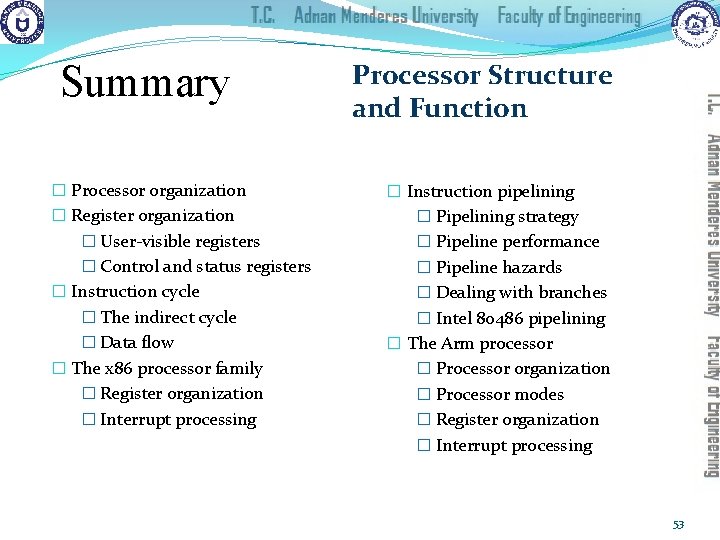
Summary � Processor organization � Register organization � User-visible registers � Control and status registers � Instruction cycle � The indirect cycle � Data flow � The x 86 processor family � Register organization � Interrupt processing Processor Structure and Function � Instruction pipelining � Pipelining strategy � Pipeline performance � Pipeline hazards � Dealing with branches � Intel 80486 pipelining � The Arm processor � Processor organization � Processor modes � Register organization � Interrupt processing 53
Next Lecture Control Unit 54
References § William Stallings; “Computer Organization and Architecture, Designing for Performance”, 10 th Global Ed. , Pearson, 2016. § Douglas E. Comer; “Essentials of Computer Architecture”, 2 nd Ed. , Taylor & Francis, 2017. § Computer Organization and Design, The Hardware/Software Interface, by David Patterson and John Hennessy, 4 th Edition, Morgan Kaufmann Publishers, 2011. 55