
CSE 303 Software Design and Architecture Revision Introduction

- Slides: 33
CSE 303 – Software Design and Architecture
Revision • Introduction to design • Importance of design
Outline • Design phase in SDLC – architecture and detailed design • Factors that affect design • Quality Models
Software Development Activities • Requirements Elicitation • Requirements Analysis (e. g. , Structured Analysis, OO Analysis) – analyzing requirements and working towards a conceptual model without taking the target implementation technology into account • Design – coming up with solution models taking the target implementation technology into account • Implementation • Testing
Software Design in SDLC • In SDLC (Software Development Life Cycle), Design phase is one of the most important phases. • In the software engineering context, design focuses on four major areas of concern: data, architecture, interfaces and components.
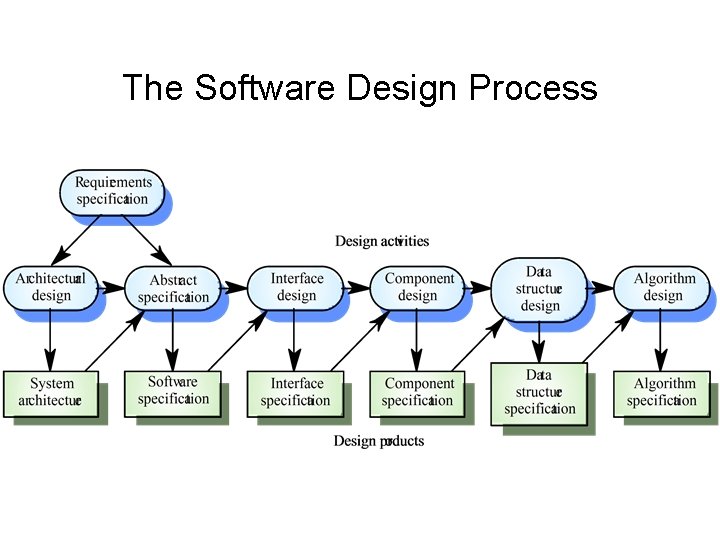
Design Process Activities • Architectural design – Modules, inter-relationships etc • Abstract specification – Services of each sub-system, constraints etc
• Interface design – Interface to other sub-system or outside enviornment • Component design – Services allocated to components and their interfaces designed • Data structure design • Algorithm design
The Software Design Process
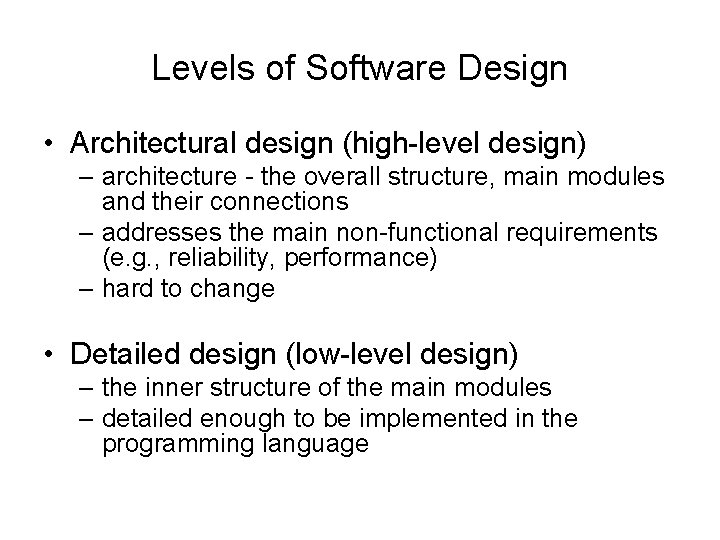
Levels of Software Design • Architectural design (high-level design) – architecture - the overall structure, main modules and their connections – addresses the main non-functional requirements (e. g. , reliability, performance) – hard to change • Detailed design (low-level design) – the inner structure of the main modules – detailed enough to be implemented in the programming language
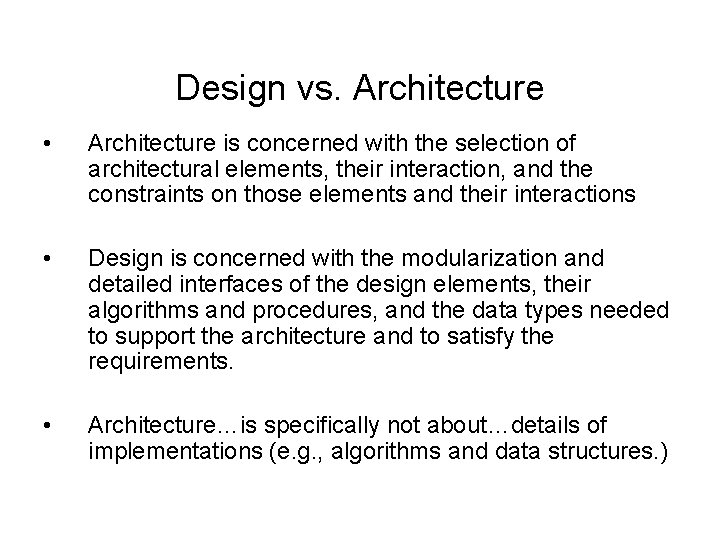
Design vs. Architecture • Architecture is concerned with the selection of architectural elements, their interaction, and the constraints on those elements and their interactions • Design is concerned with the modularization and detailed interfaces of the design elements, their algorithms and procedures, and the data types needed to support the architecture and to satisfy the requirements. • Architecture…is specifically not about…details of implementations (e. g. , algorithms and data structures. )
FACTORS THAT AFFECT DESIGN
THE FACTORS THAT AFFECT DESIGNS • There is a set of general laws of design that characterize the nature of design:
FACTORS THAT AFFECT DESIGNS • The Principle of Totality: – All design requirements are always interrelated and must always be treated as such throughout a design task • Requirement conflicts • Requirement prioritization • Design decisions
FACTORS THAT AFFECT DESIGNS • The Principle of Time: – The features and characteristics of all products change as time passes. • User friendliness • Resource intensive
FACTORS THAT AFFECT DESIGNS • The Principle of Value: – The characteristics of all products have different relative values depending upon the different circumstances and times in which they may be used. – Changes with time – Changes with circumstances – Adaptability for a wide range of user types should be considered.
FACTORS THAT AFFECT DESIGNS • The Principle of Resources: – The design, manufacture and life of all products and systems depend upon the materials, tools and skills upon which we can call. • • development tools, run time support systems, human resource application domain-specific tools and equipment,
FACTORS THAT AFFECT DESIGNS • The Principle of Synthesis: – All features of a product must combine to satisfy all the characteristics we expect it to possess with an acceptable relative importance for as long as we wish, bearing in mind the resources available to make and use it. • trade-offs between desirable features and functions
FACTORS THAT AFFECT DESIGNS • The Principle of Iteration: – Design requires processes of evaluation that begin with the first intentions to explore the need for a product or system. – designs have to be changed to correct errors and to improve quality.
FACTORS THAT AFFECT DESIGNS • The Principle of Change: – Design is a process of change, an activity undertaken not only to meet changing circumstance, but also to bring about changes to those circumstances by the nature of the product it creates. – The design of a software system must take into consideration how it changes the way that we will work and live as the consequence of using the system.
FACTORS THAT AFFECT DESIGNS • The Principle of Relationships: – Design work cannot be undertaken effectively without established working relationships with all stakeholders – Customers, Users, System administrator, Project managers, Developers, Requirements analysts, Designers, Programmers, Testers:
FACTORS THAT AFFECT DESIGNS • The Principle of Competence: – Design competence is the ability to create a synthesis of features that achieves all desired characteristics in terms of their required life and relative value, using available effective information – competence of the designer.
FACTORS THAT AFFECT DESIGNS • The Principle of Service: – Design must satisfy everybody, and not just those for whom its products are directly intended. – it must be easy to maintain, – easy to reuse, – easy to transport to other operation environments and to – be inter-operable to other software systems, etc.
SOFTWARE QUALITY MODELS
SOFTWARE QUALITY MODELS • Quality is the excellence of the product or service. – From a user’s point of view, quality is ‘fitness for purpose’. – The value-based view of quality is concerned with the ability to provide what the customer requires at a price that they can afford. – From the manufacturing point of view, the quality of a product is the conformance to specification. – the product view sees the quality of a product as tied to inherent characteristics of the product.
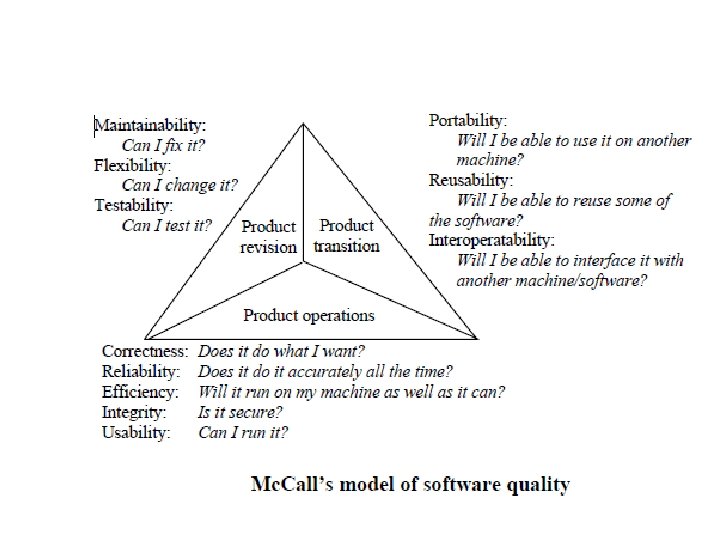
Hierarchical models • Mc. Call divided software quality attributes into 3 groups • Each group represents the quality with respect to one aspect of the software system while the attributes in the group contribute to that aspect. • Each quality attribute is defined by a question so that the quality of the software system can be assessed by answering the question.
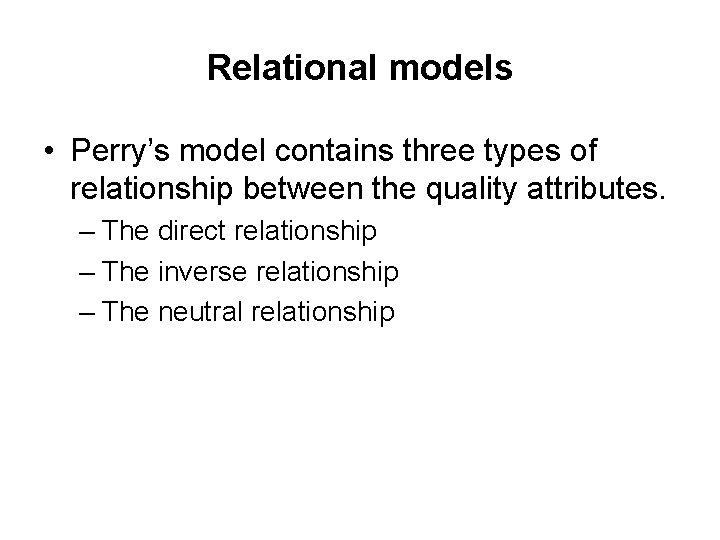
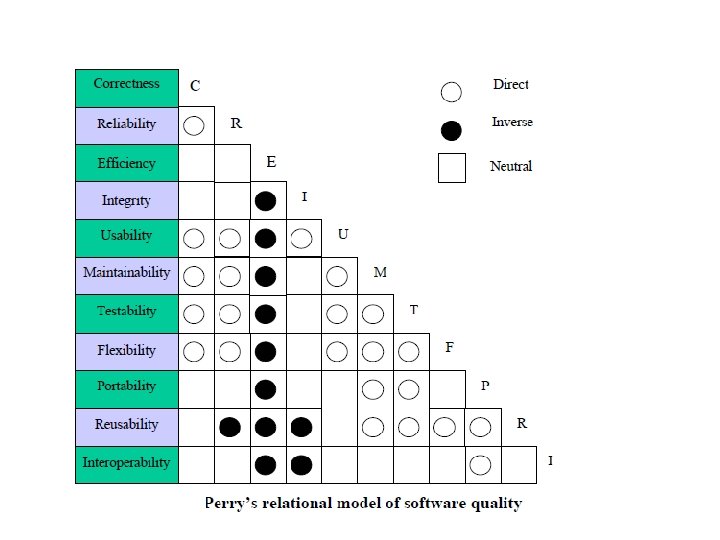
Relational models • Perry’s model contains three types of relationship between the quality attributes. – The direct relationship – The inverse relationship – The neutral relationship
Summary • Design phase in SDLC – architecture and detailed design • Factors that affect design • Quality Models
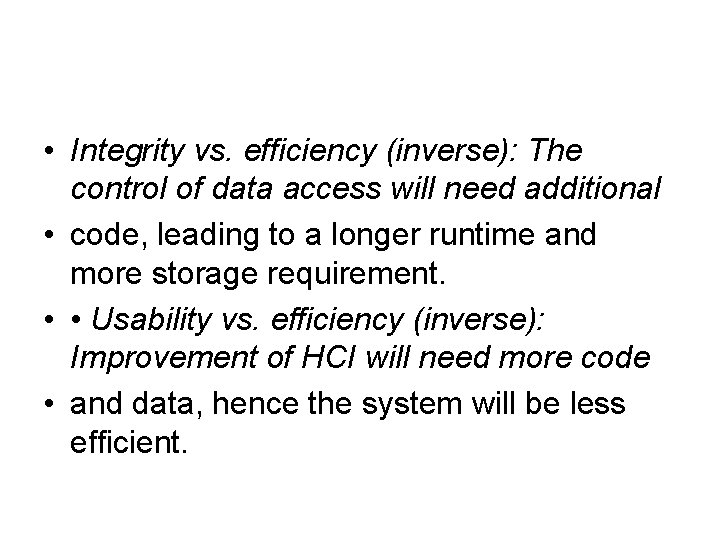
• Integrity vs. efficiency (inverse): The control of data access will need additional • code, leading to a longer runtime and more storage requirement. • • Usability vs. efficiency (inverse): Improvement of HCI will need more code • and data, hence the system will be less efficient.
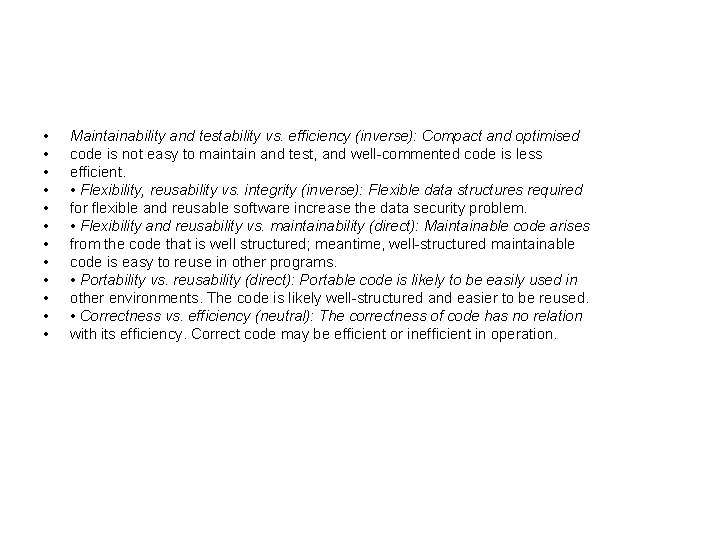
• • • Maintainability and testability vs. efficiency (inverse): Compact and optimised code is not easy to maintain and test, and well-commented code is less efficient. • Flexibility, reusability vs. integrity (inverse): Flexible data structures required for flexible and reusable software increase the data security problem. • Flexibility and reusability vs. maintainability (direct): Maintainable code arises from the code that is well structured; meantime, well-structured maintainable code is easy to reuse in other programs. • Portability vs. reusability (direct): Portable code is likely to be easily used in other environments. The code is likely well-structured and easier to be reused. • Correctness vs. efficiency (neutral): The correctness of code has no relation with its efficiency. Correct code may be efficient or inefficient in operation.