
CSE 291 D234 Data Systems for Machine Learning


- Slides: 56
CSE 291 D/234 Data Systems for Machine Learning Arun Kumar Topic 3: Feature Engineering and Model Selection Systems DL book; Chapters 8. 2 and 8. 3 of MLSys book 1
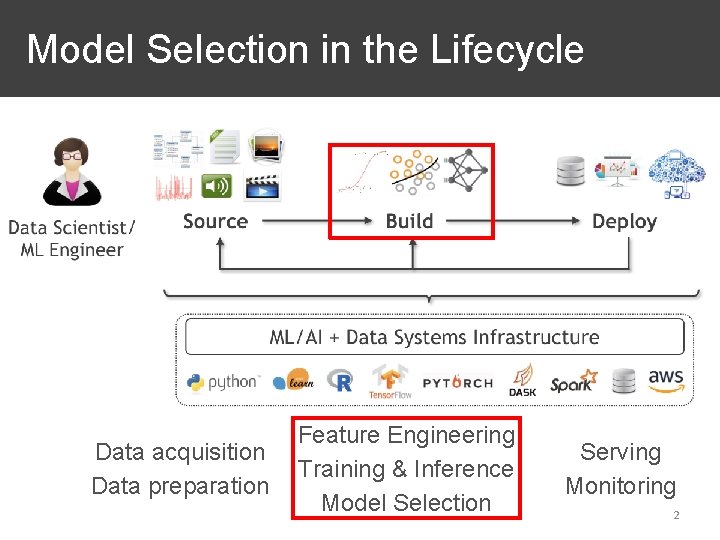
Model Selection in the Lifecycle Data acquisition Data preparation Feature Engineering Training & Inference Model Selection Serving Monitoring 2
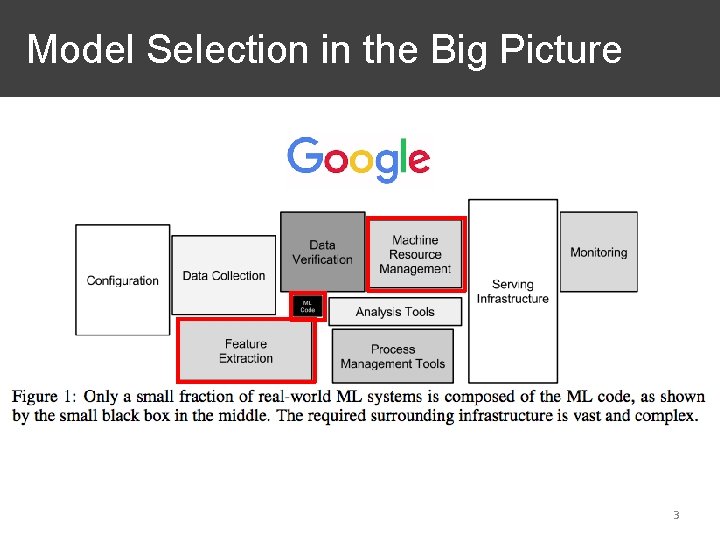
Model Selection in the Big Picture 3
Outline ❖ Recap: Bias-Variance-Noise. Decomposition ❖ The Model Selection Triple ❖ Feature Engineering ❖ Hyperparameter Tuning ❖ Algorithm/Architecture Selection ❖ Model Selection Systems ❖ Feature Engineering Systems ❖ Advanced Model Selection Systems Issues 4
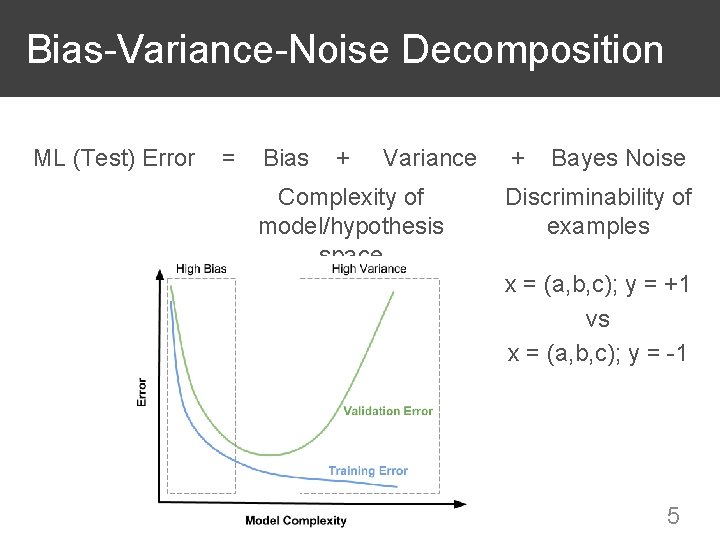
Bias-Variance-Noise Decomposition ML (Test) Error = Bias + Variance Complexity of model/hypothesis space + Bayes Noise Discriminability of examples x = (a, b, c); y = +1 vs x = (a, b, c); y = -1 5
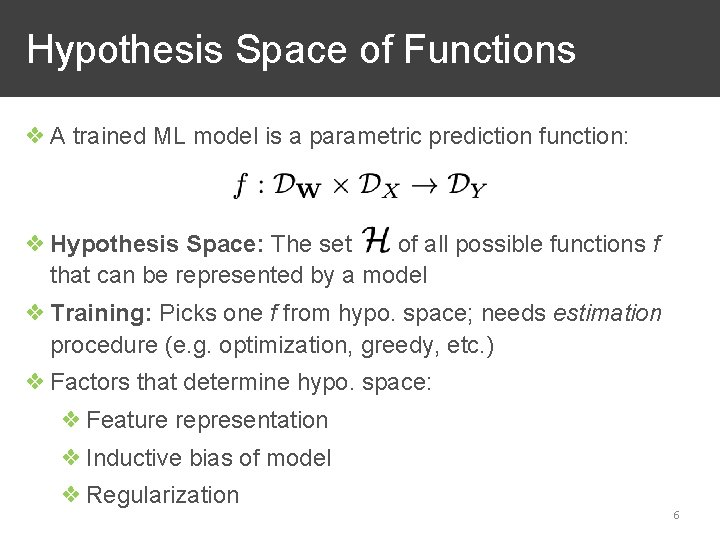
Hypothesis Space of Functions ❖ A trained ML model is a parametric prediction function: ❖ Hypothesis Space: The set of all possible functions f that can be represented by a model ❖ Training: Picks one f from hypo. space; needs estimation procedure (e. g. optimization, greedy, etc. ) ❖ Factors that determine hypo. space: ❖ Feature representation ❖ Inductive bias of model ❖ Regularization 6
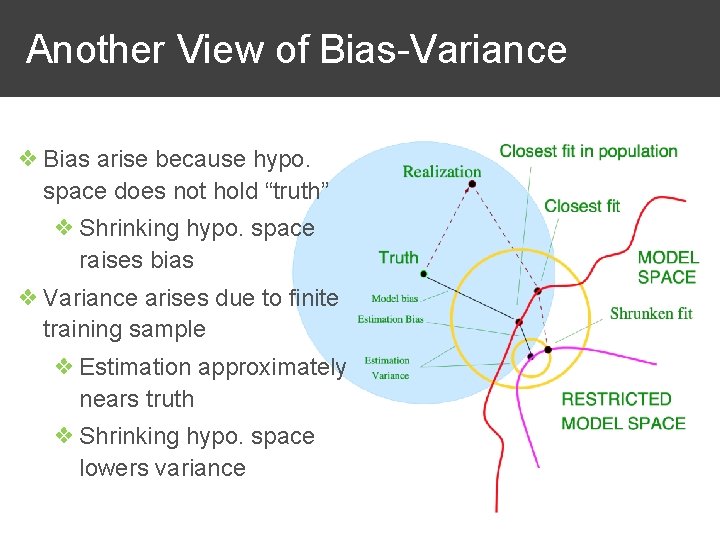
Another View of Bias-Variance ❖ Bias arise because hypo. space does not hold “truth” ❖ Shrinking hypo. space raises bias ❖ Variance arises due to finite training sample ❖ Estimation approximately nears truth ❖ Shrinking hypo. space lowers variance 7
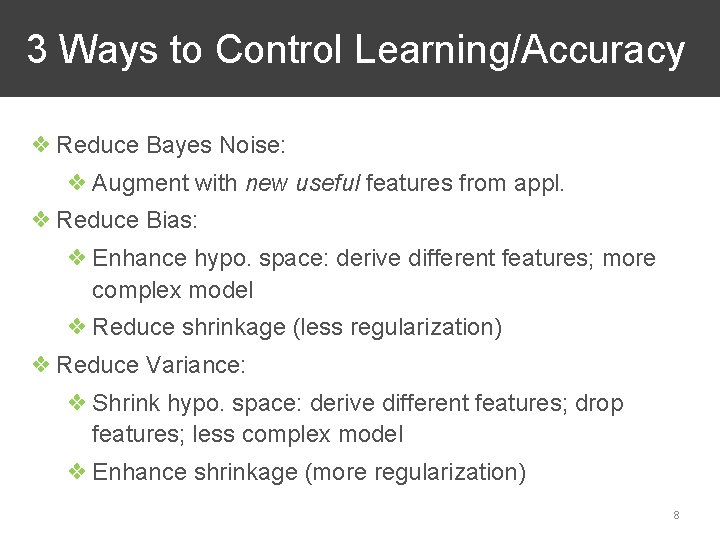
3 Ways to Control Learning/Accuracy ❖ Reduce Bayes Noise: ❖ Augment with new useful features from appl. ❖ Reduce Bias: ❖ Enhance hypo. space: derive different features; more complex model ❖ Reduce shrinkage (less regularization) ❖ Reduce Variance: ❖ Shrink hypo. space: derive different features; drop features; less complex model ❖ Enhance shrinkage (more regularization) 8
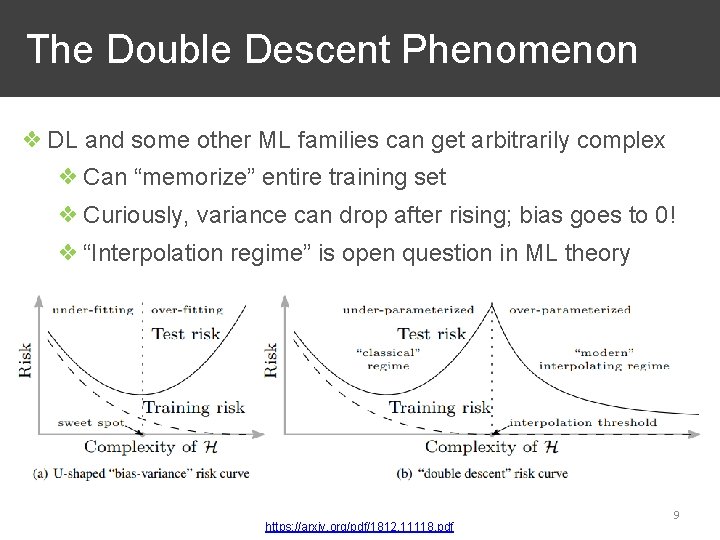
The Double Descent Phenomenon ❖ DL and some other ML families can get arbitrarily complex ❖ Can “memorize” entire training set ❖ Curiously, variance can drop after rising; bias goes to 0! ❖ “Interpolation regime” is open question in ML theory https: //arxiv. org/pdf/1812. 11118. pdf 9
Outline ❖ Recap: Bias-Variance-Noise. Decomposition ❖ The Model Selection Triple ❖ Feature Engineering ❖ Hyperparameter Tuning ❖ Algorithm/Architecture Selection ❖ Model Selection Systems ❖ Feature Engineering Systems ❖ Advanced Model Selection Systems Issues 10
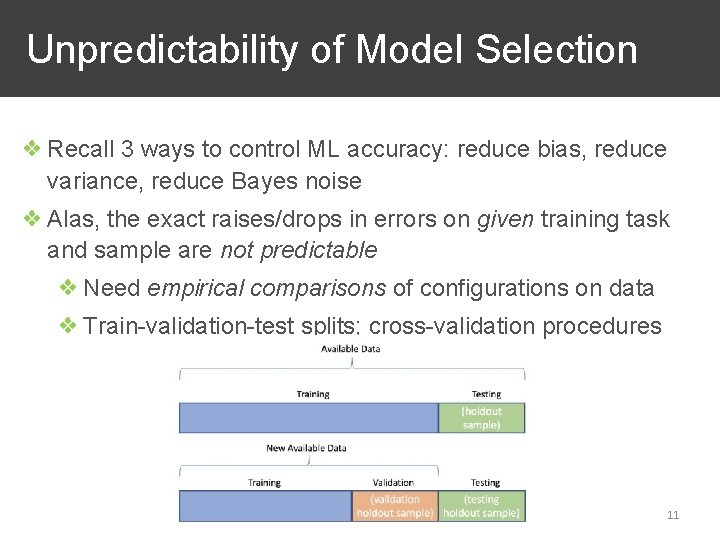
Unpredictability of Model Selection ❖ Recall 3 ways to control ML accuracy: reduce bias, reduce variance, reduce Bayes noise ❖ Alas, the exact raises/drops in errors on given training task and sample are not predictable ❖ Need empirical comparisons of configurations on data ❖ Train-validation-test splits; cross-validation procedures 11
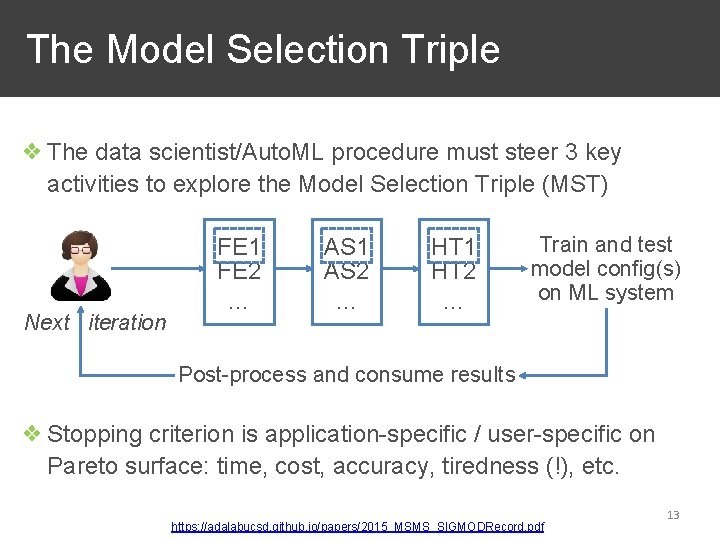
The Model Selection Triple ❖ The data scientist/Auto. ML procedure must steer 3 key activities to alter the Model Selection Triple (MST): 1. Feature Engineering (FE): What is/are the domain(s) of the hypo. space(s) to consider? 2. Algorithm/Architecture Selection (AS): What exact hypo. space to use (model type/ANN architecture)? 3. Hyper-parameter Tuning (HT): How to configure hypo. space shrinkage and estimation procedure approx. ? https: //adalabucsd. github. io/papers/2015_MSMS_SIGMODRecord. pdf 12
The Model Selection Triple ❖ The data scientist/Auto. ML procedure must steer 3 key activities to explore the Model Selection Triple (MST) Next iteration FE 1 FE 2 … AS 1 AS 2 … HT 1 HT 2 … Train and test model config(s) on ML system Post-process and consume results ❖ Stopping criterion is application-specific / user-specific on Pareto surface: time, cost, accuracy, tiredness (!), etc. https: //adalabucsd. github. io/papers/2015_MSMS_SIGMODRecord. pdf 13
Outline ❖ Recap: Bias-Variance-Noise. Decomposition ❖ The Model Selection Triple ❖ Feature Engineering ❖ Hyperparameter Tuning ❖ Algorithm/Architecture Selection ❖ Model Selection Systems ❖ Feature Engineering Systems ❖ Advanced Model Selection Systems Issues 14
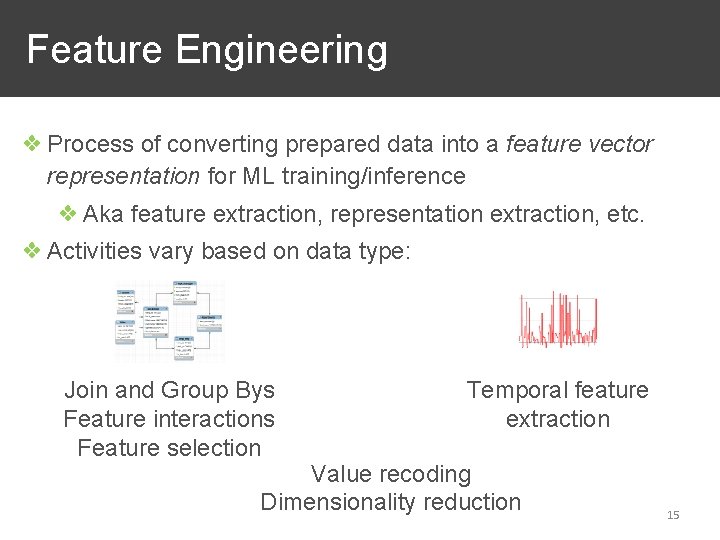
Feature Engineering ❖ Process of converting prepared data into a feature vector representation for ML training/inference ❖ Aka feature extraction, representation extraction, etc. ❖ Activities vary based on data type: Join and Group Bys Feature interactions Feature selection Temporal feature extraction Value recoding Dimensionality reduction 15
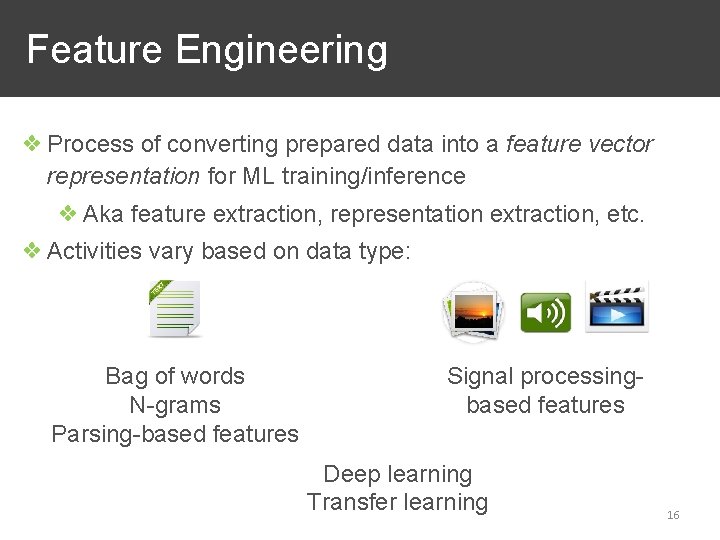
Feature Engineering ❖ Process of converting prepared data into a feature vector representation for ML training/inference ❖ Aka feature extraction, representation extraction, etc. ❖ Activities vary based on data type: Bag of words N-grams Parsing-based features Signal processingbased features Deep learning Transfer learning 16
Outline ❖ Recap: Bias-Variance-Noise. Decomposition ❖ The Model Selection Triple ❖ Feature Engineering ❖ Hyperparameter Tuning ❖ Algorithm/Architecture Selection ❖ Model Selection Systems ❖ Feature Engineering Systems ❖ Advanced Model Selection Systems Issues 17
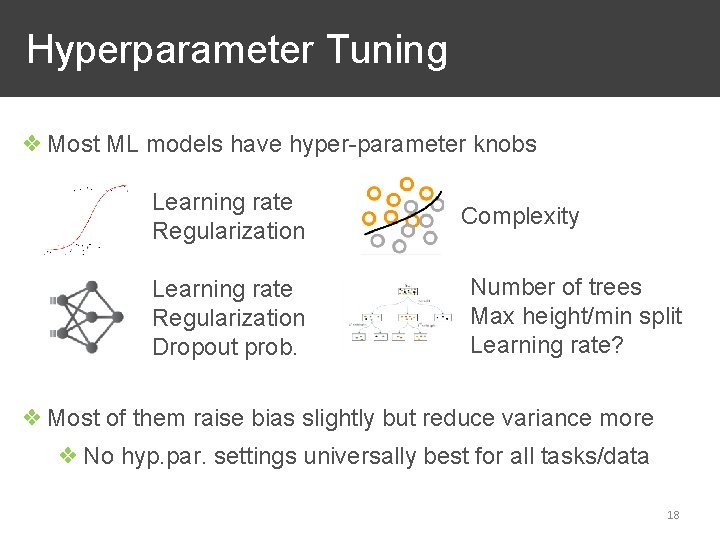
Hyperparameter Tuning ❖ Most ML models have hyper-parameter knobs Learning rate Regularization Dropout prob. Complexity Number of trees Max height/min split Learning rate? ❖ Most of them raise bias slightly but reduce variance more ❖ No hyp. par. settings universally best for all tasks/data 18
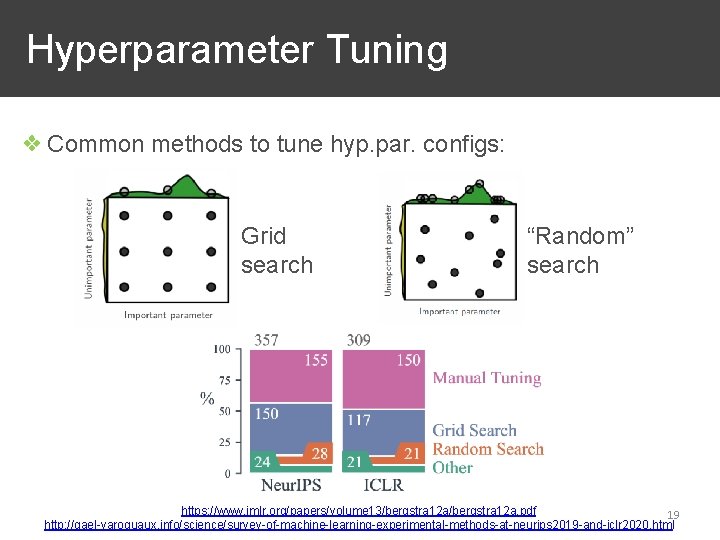
Hyperparameter Tuning ❖ Common methods to tune hyp. par. configs: Grid search “Random” search https: //www. jmlr. org/papers/volume 13/bergstra 12 a. pdf 19 http: //gael-varoquaux. info/science/survey-of-machine-learning-experimental-methods-at-neurips 2019 -and-iclr 2020. html
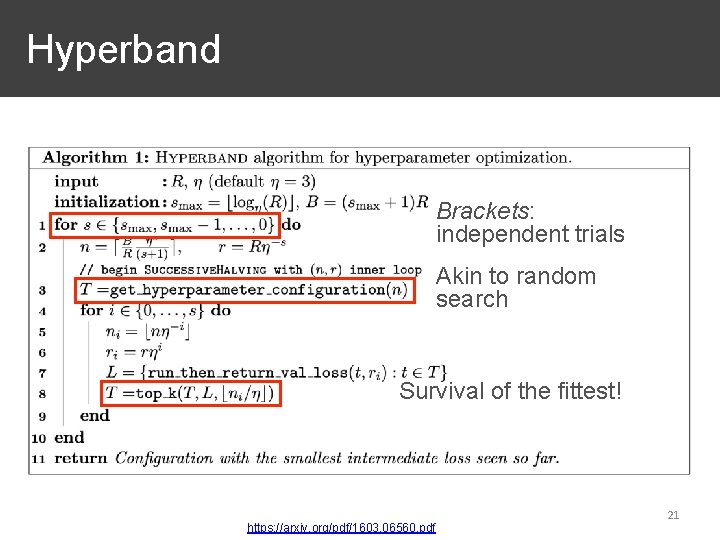
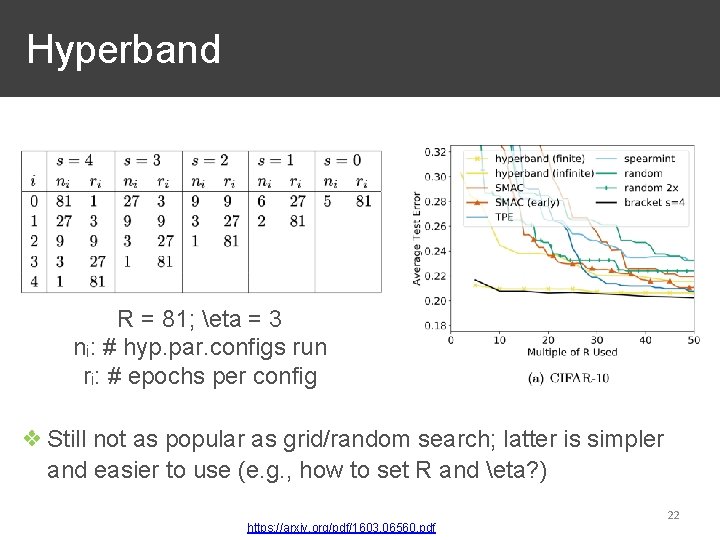
Hyperband ❖ An automated ML (Auto. ML) procedure for tuning hyp. par. ❖ Basic Idea: For iterative procedures (e. g. , SGD), stop nonpromising hyp. par. configs at earlier epochs ❖ Based on multi-armed bandit idea from gambling/RL ❖ Benefits: ❖ Reapportioning resources with early stopping may help reach better overall accuracy sooner ❖ Total resource use may be lower vs grid/random search ❖ 2 knobs as input: ❖ R: Max budget per config (e. g. , # SGD epochs) ❖ eta: Stop rate for configs https: //arxiv. org/pdf/1603. 06560. pdf 20
Hyperband Brackets: independent trials Akin to random search Survival of the fittest! https: //arxiv. org/pdf/1603. 06560. pdf 21
Hyperband R = 81; eta = 3 ni: # hyp. par. configs run ri: # epochs per config ❖ Still not as popular as grid/random search; latter is simpler and easier to use (e. g. , how to set R and eta? ) https: //arxiv. org/pdf/1603. 06560. pdf 22
Review Zoom Poll 23
Outline ❖ Recap: Bias-Variance-Noise. Decomposition ❖ The Model Selection Triple ❖ Feature Engineering ❖ Hyperparameter Tuning ❖ Algorithm/Architecture Selection ❖ Model Selection Systems ❖ Feature Engineering Systems ❖ Advanced Model Selection Systems Issues 24
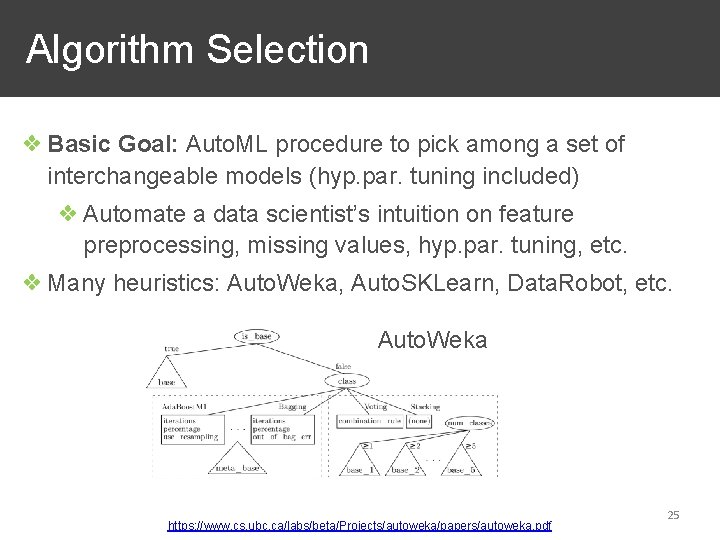
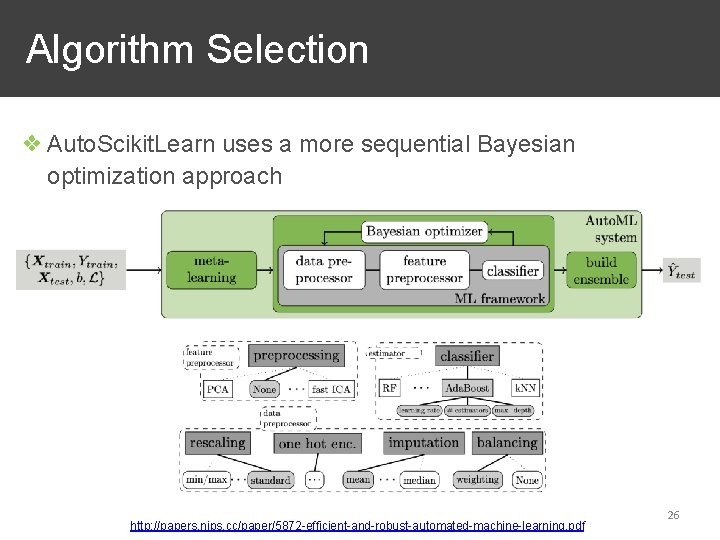
Algorithm Selection ❖ Basic Goal: Auto. ML procedure to pick among a set of interchangeable models (hyp. par. tuning included) ❖ Automate a data scientist’s intuition on feature preprocessing, missing values, hyp. par. tuning, etc. ❖ Many heuristics: Auto. Weka, Auto. SKLearn, Data. Robot, etc. Auto. Weka https: //www. cs. ubc. ca/labs/beta/Projects/autoweka/papers/autoweka. pdf 25
Algorithm Selection ❖ Auto. Scikit. Learn uses a more sequential Bayesian optimization approach http: //papers. nips. cc/paper/5872 -efficient-and-robust-automated-machine-learning. pdf 26
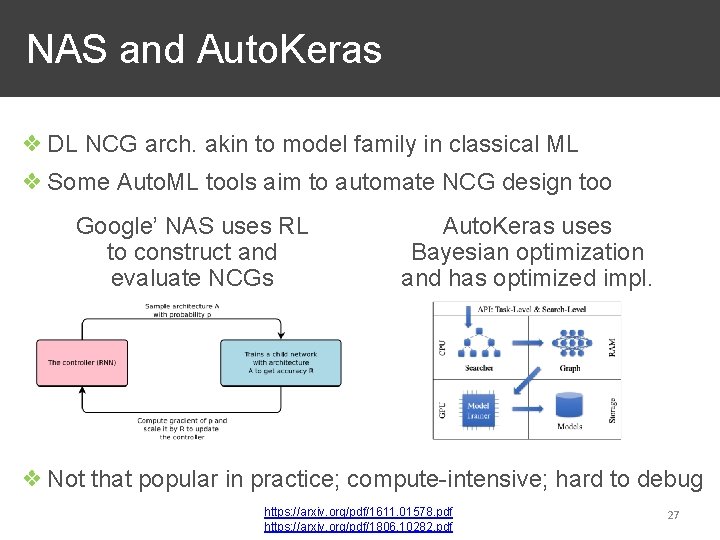
NAS and Auto. Keras ❖ DL NCG arch. akin to model family in classical ML ❖ Some Auto. ML tools aim to automate NCG design too Google’ NAS uses RL to construct and evaluate NCGs Auto. Keras uses Bayesian optimization and has optimized impl. ❖ Not that popular in practice; compute-intensive; hard to debug https: //arxiv. org/pdf/1611. 01578. pdf https: //arxiv. org/pdf/1806. 10282. pdf 27
Outline ❖ Recap: Bias-Variance-Noise. Decomposition ❖ The Model Selection Triple ❖ Feature Engineering ❖ Hyperparameter Tuning ❖ Algorithm/Architecture Selection ❖ Model Selection Systems ❖ Feature Engineering Systems ❖ Advanced Model Selection Systems Issues 28
Systems Aspects of Model Selection ❖ ML/data mining folks have studied model selection from an algorithmic automation/accuracy standpoint ❖ But its resource efficiency is a pressing ML systems issue: ❖ Long running times; need lots of CPUs/GPUs ❖ Cost and energy footprints non-trivial ❖ If user is in the loop, latency matters too ❖ Need to raise throughput of exploring training configs with minimal resource expenses 29
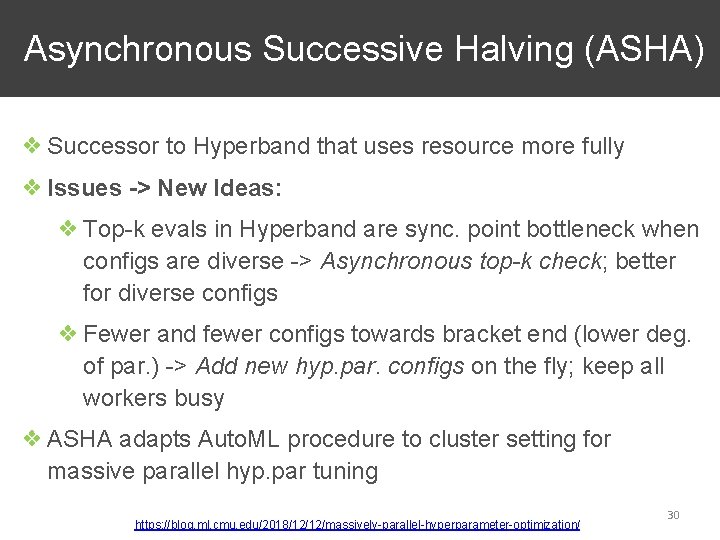
Asynchronous Successive Halving (ASHA) ❖ Successor to Hyperband that uses resource more fully ❖ Issues -> New Ideas: ❖ Top-k evals in Hyperband are sync. point bottleneck when configs are diverse -> Asynchronous top-k check; better for diverse configs ❖ Fewer and fewer configs towards bracket end (lower deg. of par. ) -> Add new hyp. par. configs on the fly; keep all workers busy ❖ ASHA adapts Auto. ML procedure to cluster setting for massive parallel hyp. par tuning https: //blog. ml. cmu. edu/2018/12/12/massively-parallel-hyperparameter-optimization/ 30
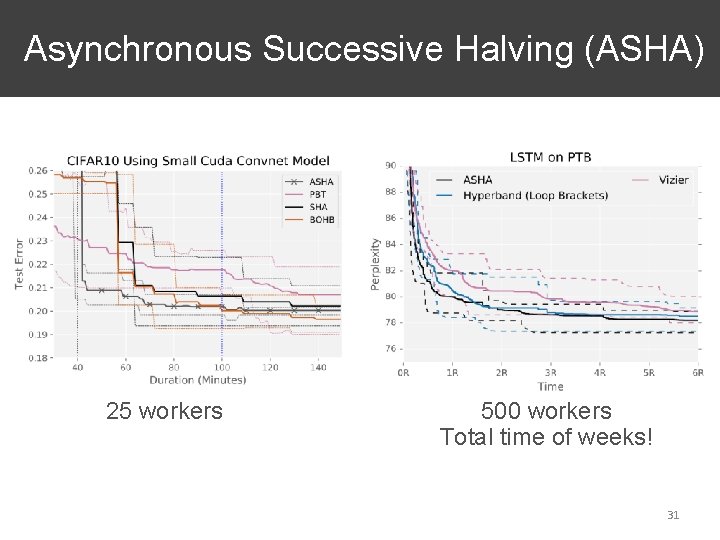
Asynchronous Successive Halving (ASHA) 25 workers 500 workers Total time of weeks! 31
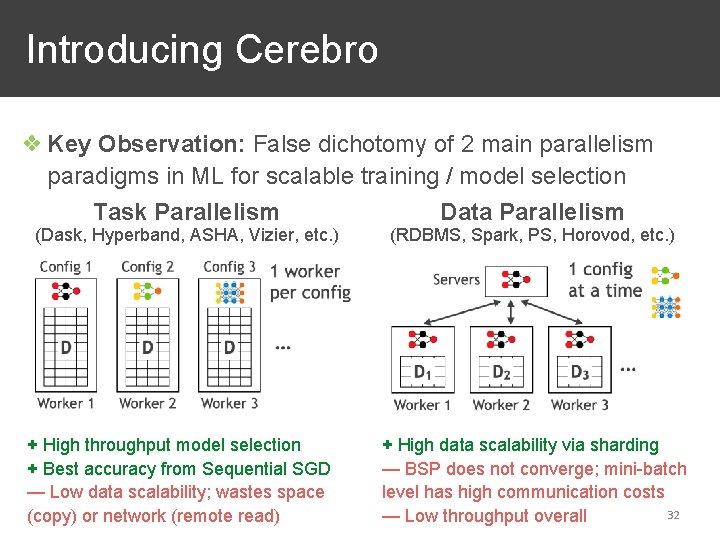
Introducing Cerebro ❖ Key Observation: False dichotomy of 2 main parallelism paradigms in ML for scalable training / model selection Task Parallelism Data Parallelism (Dask, Hyperband, ASHA, Vizier, etc. ) + High throughput model selection + Best accuracy from Sequential SGD — Low data scalability; wastes space (copy) or network (remote read) (RDBMS, Spark, PS, Horovod, etc. ) + High data scalability via sharding — BSP does not converge; mini-batch level has high communication costs 32 — Low throughput overall
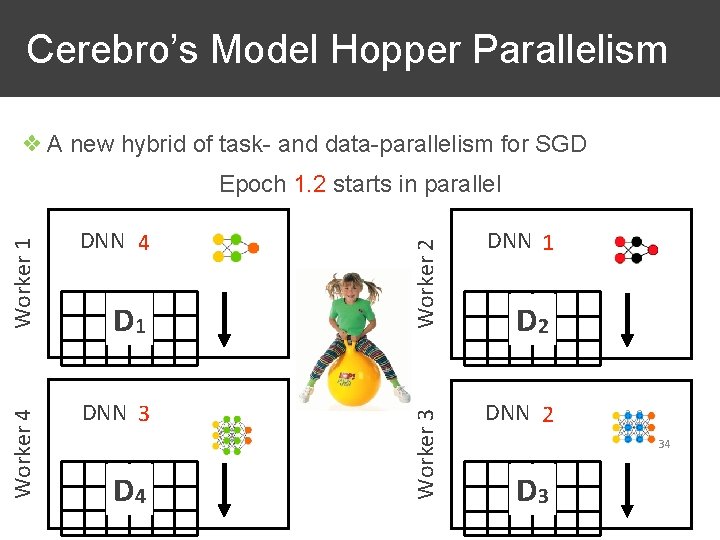
Q: Can we get the best of both worlds? 33
Cerebro’s Model Hopper Parallelism ❖ A new hybrid of task- and data-parallelism for SGD D 1 DNN 43 D 4 Worker 2 DNN 14 Worker 3 Worker 4 Worker 1 Epoch 1. 2 1. 1 starts in parallel DNN 21 D 2 DNN 32 34 D 3
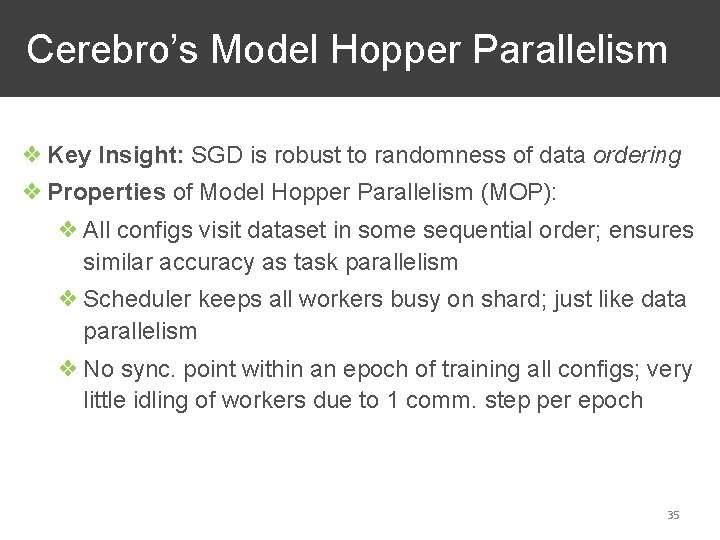
Cerebro’s Model Hopper Parallelism ❖ Key Insight: SGD is robust to randomness of data ordering ❖ Properties of Model Hopper Parallelism (MOP): ❖ All configs visit dataset in some sequential order; ensures similar accuracy as task parallelism ❖ Scheduler keeps all workers busy on shard; just like data parallelism ❖ No sync. point within an epoch of training all configs; very little idling of workers due to 1 comm. step per epoch 35
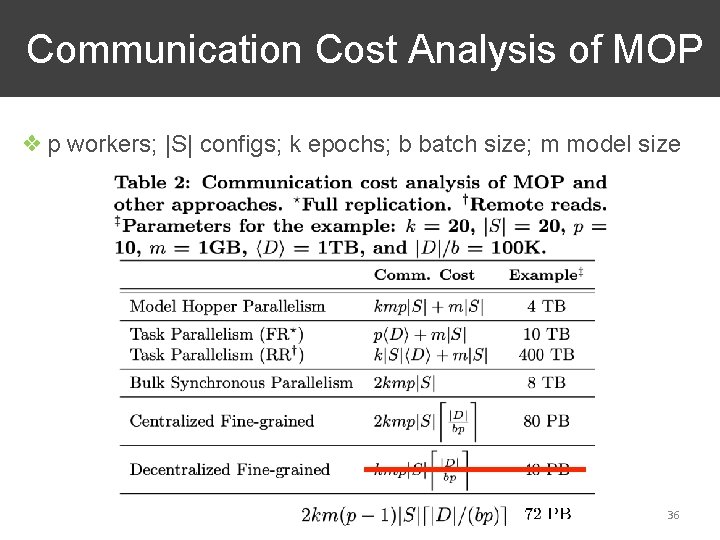
Communication Cost Analysis of MOP ❖ p workers; |S| configs; k epochs; b batch size; m model size 36
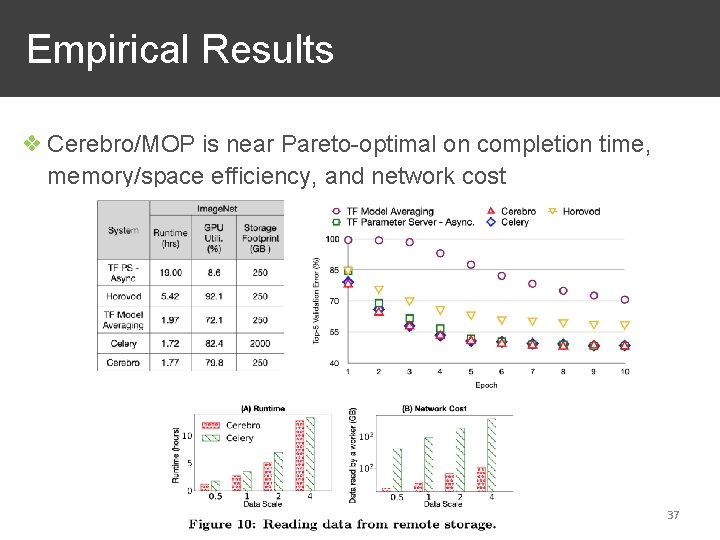
Empirical Results ❖ Cerebro/MOP is near Pareto-optimal on completion time, memory/space efficiency, and network cost 37
Discussion on Cerebro paper 38
Vision of Cerebro Platform 39
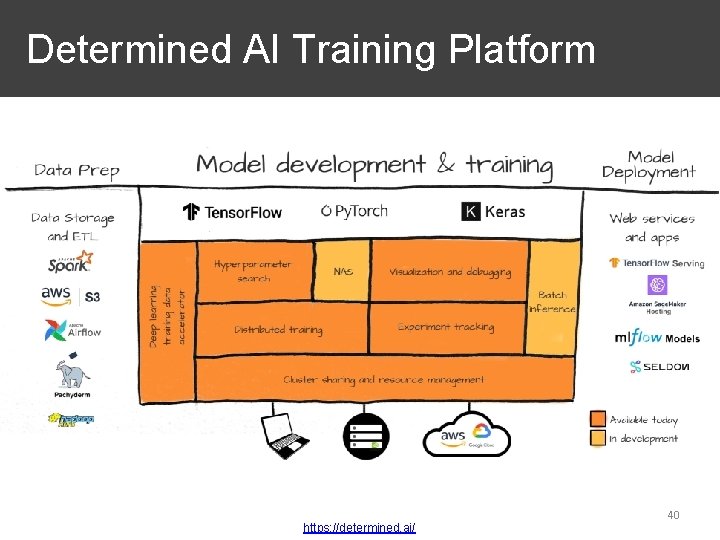
Determined AI Training Platform https: //determined. ai/ 40
Outline ❖ Recap: Bias-Variance-Noise. Decomposition ❖ The Model Selection Triple ❖ Feature Engineering ❖ Hyperparameter Tuning ❖ Algorithm/Architecture Selection ❖ Model Selection Systems ❖ Feature Engineering Systems ❖ Advanced Model Selection Systems Issues 41
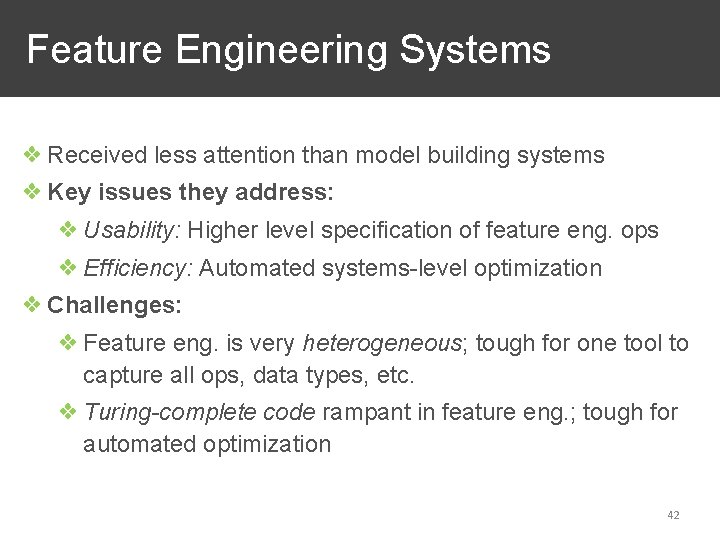
Feature Engineering Systems ❖ Received less attention than model building systems ❖ Key issues they address: ❖ Usability: Higher level specification of feature eng. ops ❖ Efficiency: Automated systems-level optimization ❖ Challenges: ❖ Feature eng. is very heterogeneous; tough for one tool to capture all ops, data types, etc. ❖ Turing-complete code rampant in feature eng. ; tough for automated optimization 42
Feature Engineering Systems ❖ Sample of feature engineering systems: Joins Feature interactions Feature selection Columbus Textual / signal proc. features Deep transfer learning Keystone. ML Vista 43
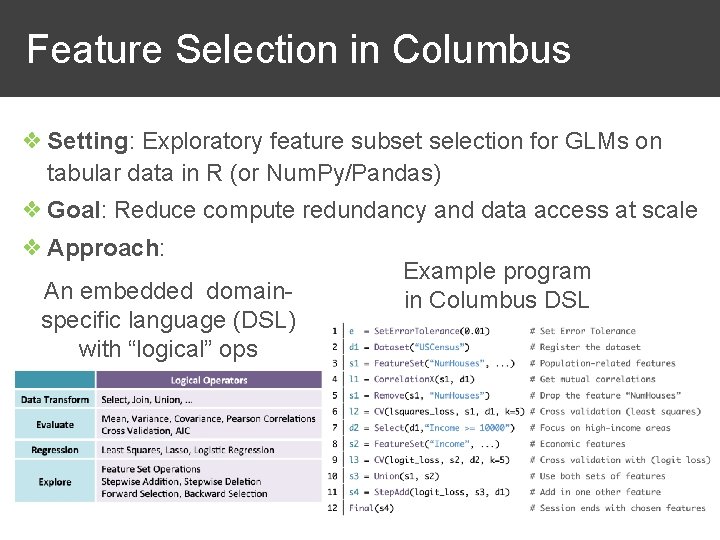
Feature Selection in Columbus ❖ Setting: Exploratory feature subset selection for GLMs on tabular data in R (or Num. Py/Pandas) ❖ Goal: Reduce compute redundancy and data access at scale ❖ Approach: An embedded domainspecific language (DSL) with “logical” ops Example program in Columbus DSL 44
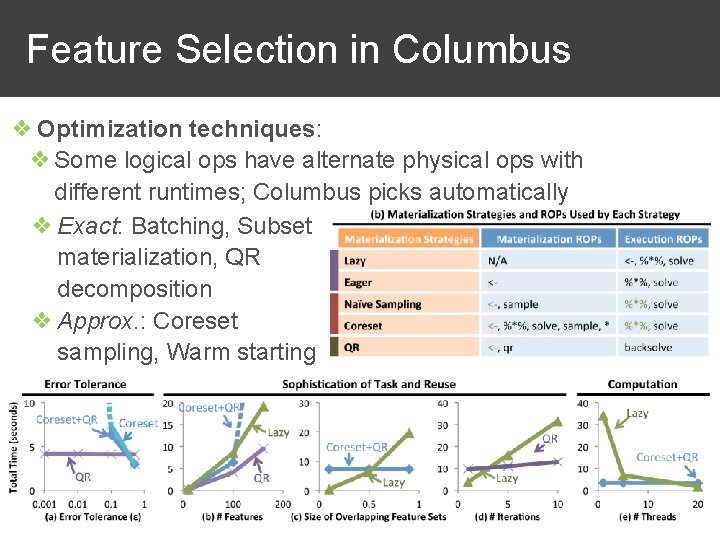
Feature Selection in Columbus ❖ Optimization techniques: ❖ Some logical ops have alternate physical ops with different runtimes; Columbus picks automatically ❖ Exact: Batching, Subset materialization, QR decomposition ❖ Approx. : Coreset sampling, Warm starting 45
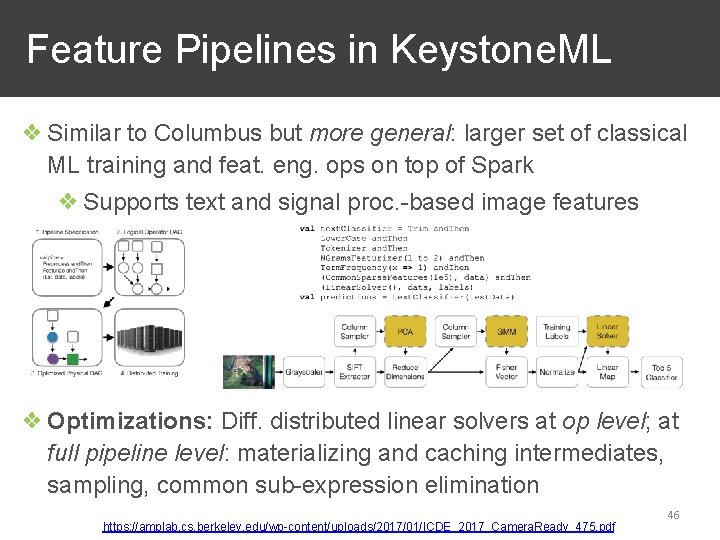
Feature Pipelines in Keystone. ML ❖ Similar to Columbus but more general: larger set of classical ML training and feat. eng. ops on top of Spark ❖ Supports text and signal proc. -based image features ❖ Optimizations: Diff. distributed linear solvers at op level; at full pipeline level: materializing and caching intermediates, sampling, common sub-expression elimination https: //amplab. cs. berkeley. edu/wp-content/uploads/2017/01/ICDE_2017_Camera. Ready_475. pdf 46
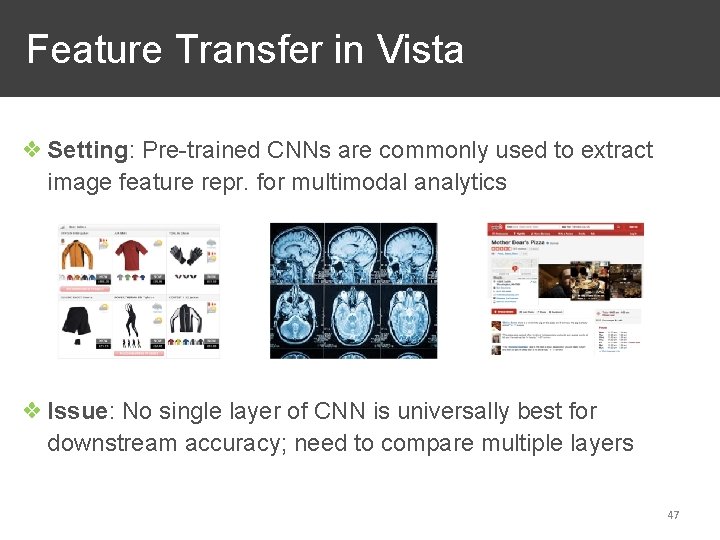
Feature Transfer in Vista ❖ Setting: Pre-trained CNNs are commonly used to extract image feature repr. for multimodal analytics ❖ Issue: No single layer of CNN is universally best for downstream accuracy; need to compare multiple layers 47
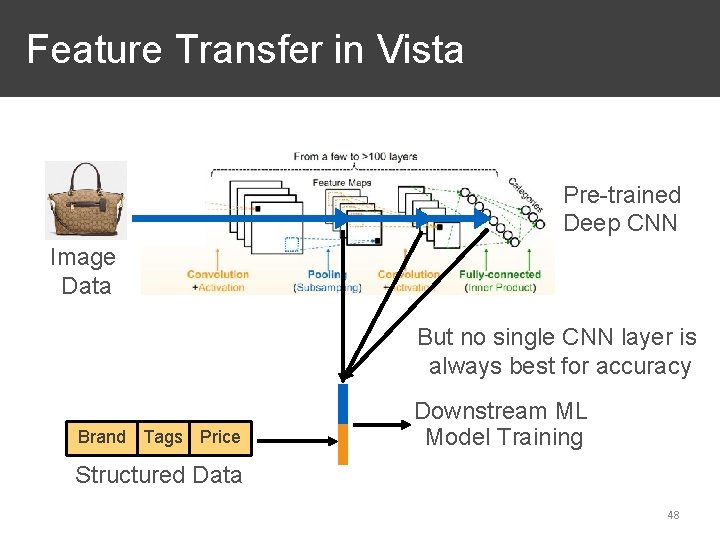
Feature Transfer in Vista Pre-trained Deep CNN Image Data But no single CNN layer is always best for accuracy Brand Tags Price Downstream ML Model Training Structured Data 48
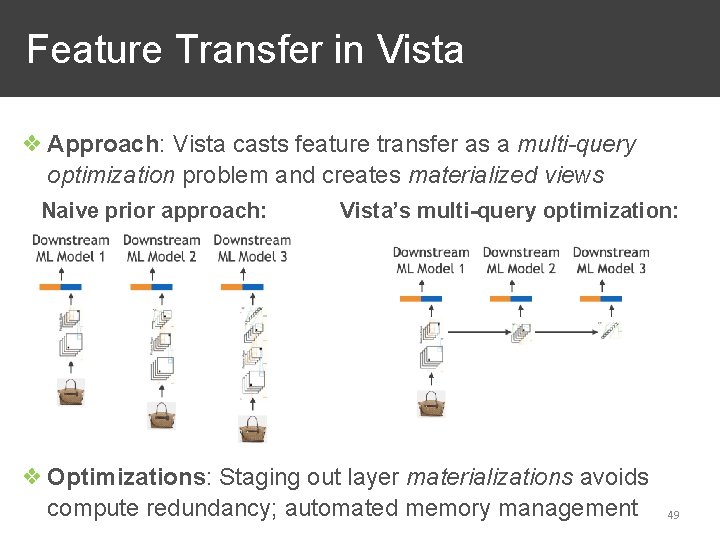
Feature Transfer in Vista ❖ Approach: Vista casts feature transfer as a multi-query optimization problem and creates materialized views Naive prior approach: Vista’s multi-query optimization: ❖ Optimizations: Staging out layer materializations avoids compute redundancy; automated memory management 49
Tradeoffs of Feature Eng. Systems ❖ Pros: ❖ High level ops may help improve ML user productivity ❖ Automated resource optimization reduces costs ❖ Cons: ❖ Lack of sufficient generality ❖ ML user needs to (re)learn new APIs; may be complex ❖ Extra dependencies and maintenance issues ❖ Some companies now have in-house custom APIs/tools or general code/notebook orchestration for feat. eng. pipelines (not really optimized). More on “feature stores” in Topic 6. 50
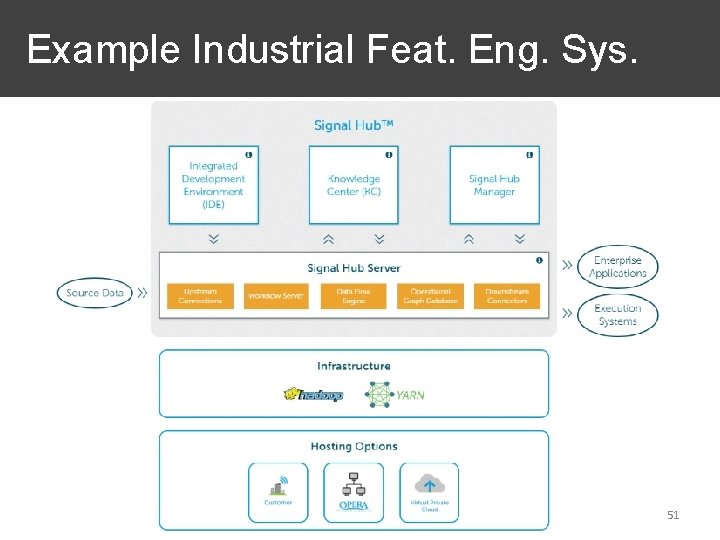
Example Industrial Feat. Eng. Sys. 51
Outline ❖ Recap: Bias-Variance-Noise. Decomposition ❖ The Model Selection Triple ❖ Feature Engineering ❖ Hyperparameter Tuning ❖ Algorithm/Architecture Selection ❖ Model Selection Systems ❖ Feature Engineering Systems ❖ Advanced Model Selection Systems Issues 52
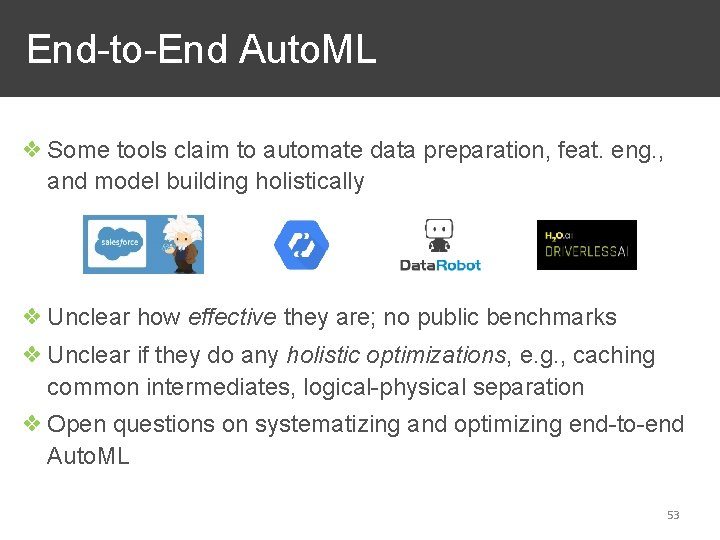
End-to-End Auto. ML ❖ Some tools claim to automate data preparation, feat. eng. , and model building holistically ❖ Unclear how effective they are; no public benchmarks ❖ Unclear if they do any holistic optimizations, e. g. , caching common intermediates, logical-physical separation ❖ Open questions on systematizing and optimizing end-to-end Auto. ML 53
Cloud-Native Model Selection ❖ ML resource availability is now flexible and heterogenous ❖ Local machine -> on-premise cluster -> cloud ❖ Cloud-native offers new opportunities/challenges: ❖ Elasticity: upscale/downscale compute/RAM as needed ❖ Cheap decoupled storage (e. g. , S 3) ❖ Cheap ephemeral compute (e. g. , Spot, Serverless) ❖ Need to redesign model sel. sys. to be cloud-native: ❖ Open questions on optimizing resource efficiency vs runtimes vs total cost 54
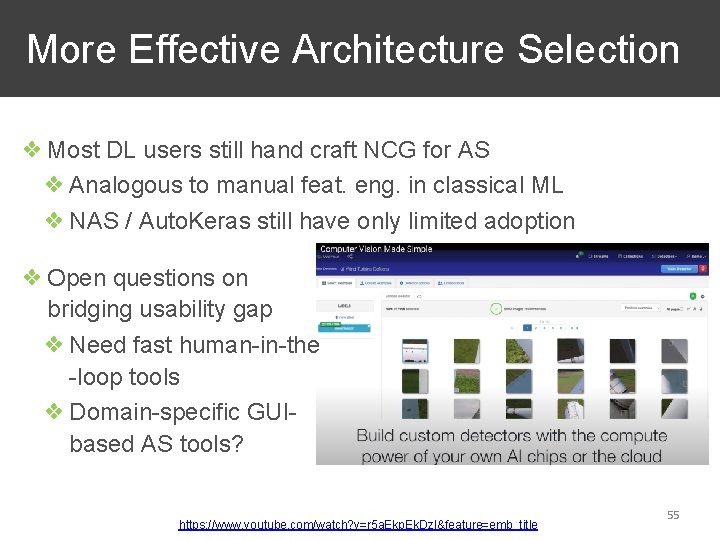
More Effective Architecture Selection ❖ Most DL users still hand craft NCG for AS ❖ Analogous to manual feat. eng. in classical ML ❖ NAS / Auto. Keras still have only limited adoption ❖ Open questions on bridging usability gap ❖ Need fast human-in-the -loop tools ❖ Domain-specific GUIbased AS tools? https: //www. youtube. com/watch? v=r 5 a. Ekp. Ek. Dz. I&feature=emb_title 55
Review Questions ❖ Name 3 model sel. systems/approaches for SGD-based ML discussed in class whose communication complexity is independent of SGD batch size. ❖ Briefly explain 2 cons of building separate feat. eng. systems. ❖ Briefly explain one common systems-level optimization seen in many feat. eng. systems. ❖ Why bother redesigning model sel. systems for the cloud? 56