
CSE 260 Introduction to Parallel Computation Larry Carter



- Slides: 22
CSE 260 – Introduction to Parallel Computation • Larry Carter • carter@cs. ucsd. edu • Office Hours: AP&M 4101 • MW 10: 00 -11 or by appointment 9/20/2001 CSE 260, class 1
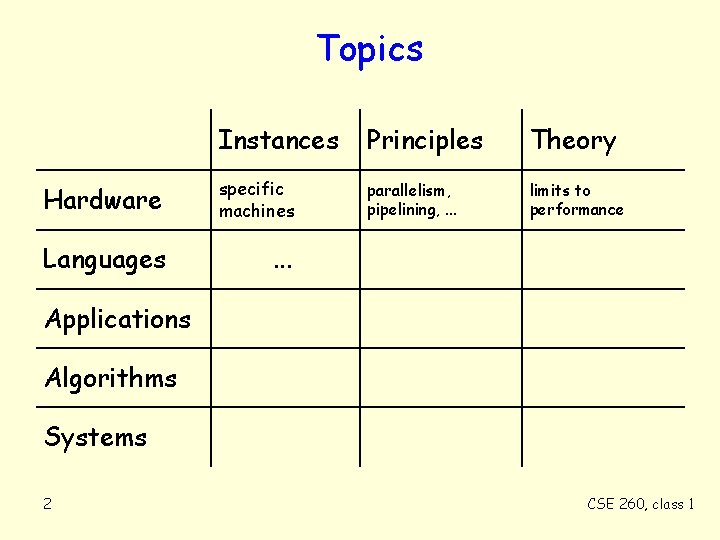
Topics Instances Principles Theory Hardware specific machines parallelism, pipelining, . . . limits to performance Languages . . . Applications Algorithms Systems 2 CSE 260, class 1
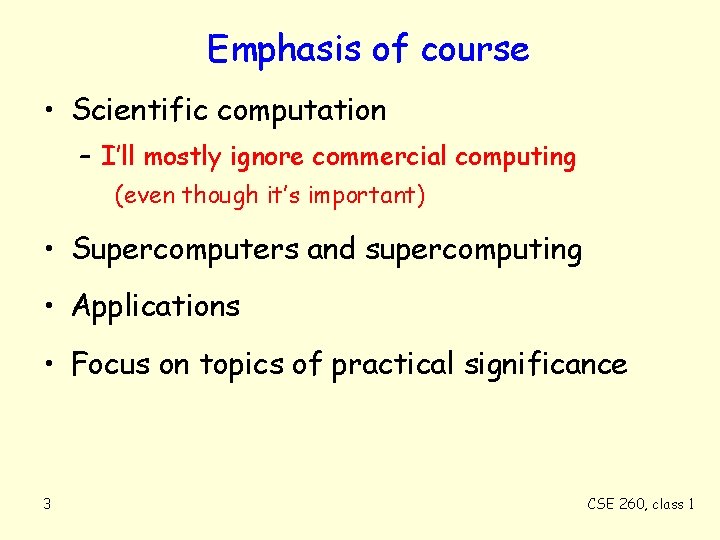
Emphasis of course • Scientific computation – I’ll mostly ignore commercial computing (even though it’s important) • Supercomputers and supercomputing • Applications • Focus on topics of practical significance 3 CSE 260, class 1
This is a graduate course. . . • If you want to shift emphasis, let’s talk! – E. g. you might want to do a different project • Surprise me! – Do something extra occasionally (write mini-studies) • Question authority! – Questions and discussions are encouraged – I’m opinionated and sometimes wrong • Listen to your classmates! – They have insights from different perspectives 4 CSE 260, class 1
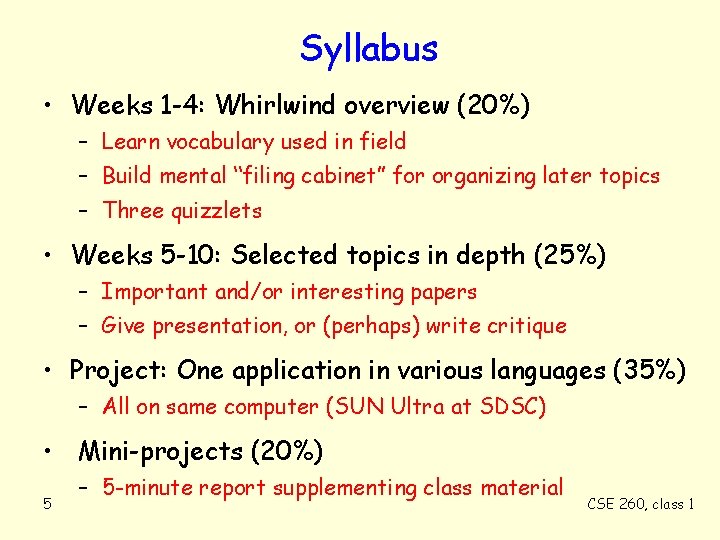
Syllabus • Weeks 1 -4: Whirlwind overview (20%) – Learn vocabulary used in field – Build mental “filing cabinet” for organizing later topics – Three quizzlets • Weeks 5 -10: Selected topics in depth (25%) – Important and/or interesting papers – Give presentation, or (perhaps) write critique • Project: One application in various languages (35%) – All on same computer (SUN Ultra at SDSC) • Mini-projects (20%) 5 – 5 -minute report supplementing class material CSE 260, class 1
Vocabulary (1 st three weeks) • Know terms that are underlined* – Should be in your passive vocabulary (i. e. if someone uses the term, you should have a reasonably good idea what it means) – Not necessarily in your active vocabulary (i. e. , I don’t expect you to be able to list all the terms). Quizzlets* will be multiple choice or fill-in-theblanks, not essays. * unfortunately, Power. Point may underline misspellings. 6 CSE 260, class 1
Any Administrative Questions? 7 CSE 260, class 1
Class 1: Parallel Architectures Interesting reading: – Chapter 9 of Patterson & Hennessy’s undergrad text (second edition). [Or Chapter 10 of Hennessy & Patterson’s graduate text]. Parallel computer: – Almasi + Gottlieb: “a large collection of processing elements that can communicate and cooperate to solve large problems fast. ” – Many “processing elements” cooperating on a single problem. – Multiprocessor server? Not large enough. Networks of workstations and internet-connected computers when working together? Sure. Supercomputer: 8 A computer costing $3, 000 or more. CSE 260, class 1
Why bother? Gene Amdahl - 1967(!): “For over a decade, prophets have voiced the contention that the organization of a single computer has reached its limit. ” – he went on to argue that the single processor approach to large -scale computing was still viable. Parallel computing is expensive – Higher cost per cycle – Greater programming effort – Less convenient access 9 CSE 260, class 1
Possible answers. . . • Answers today are more valuable than answers tomorrow – weather prediction – conference submissions – product design (airplanes, drugs, . . . ) • Some problem requires huge memories – Once you have a huge memory, it’s more economical to have multiple processors. 10 CSE 260, class 1
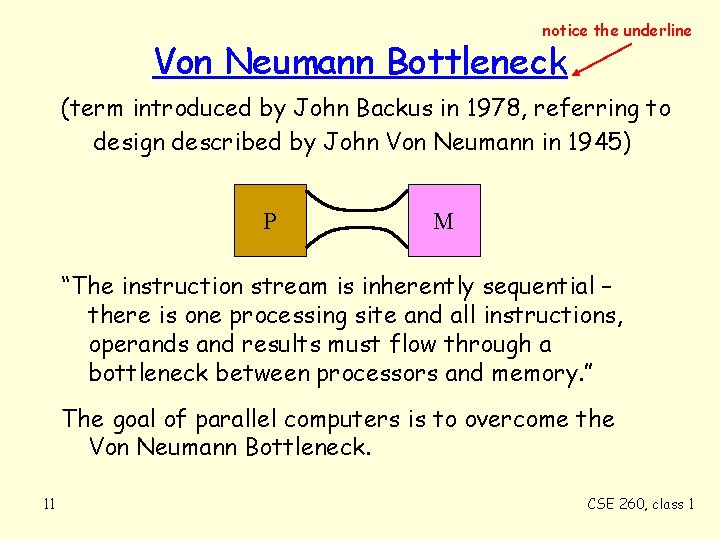
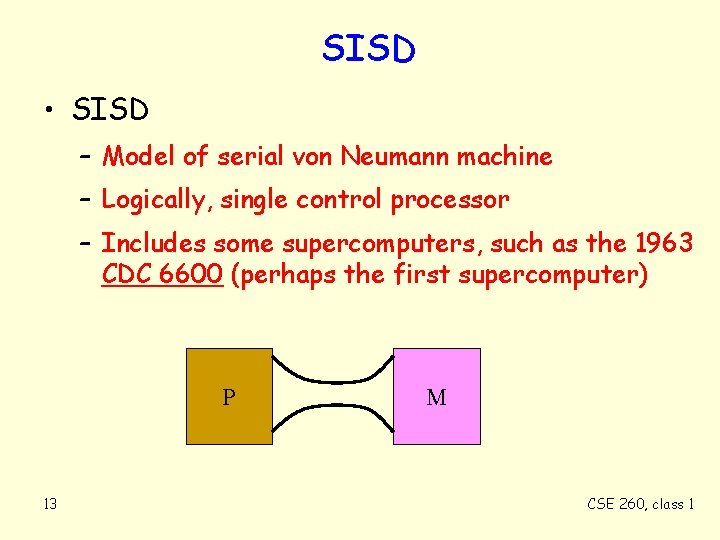
notice the underline Von Neumann Bottleneck (term introduced by John Backus in 1978, referring to design described by John Von Neumann in 1945) P M “The instruction stream is inherently sequential – there is one processing site and all instructions, operands and results must flow through a bottleneck between processors and memory. ” The goal of parallel computers is to overcome the Von Neumann Bottleneck. 11 CSE 260, class 1
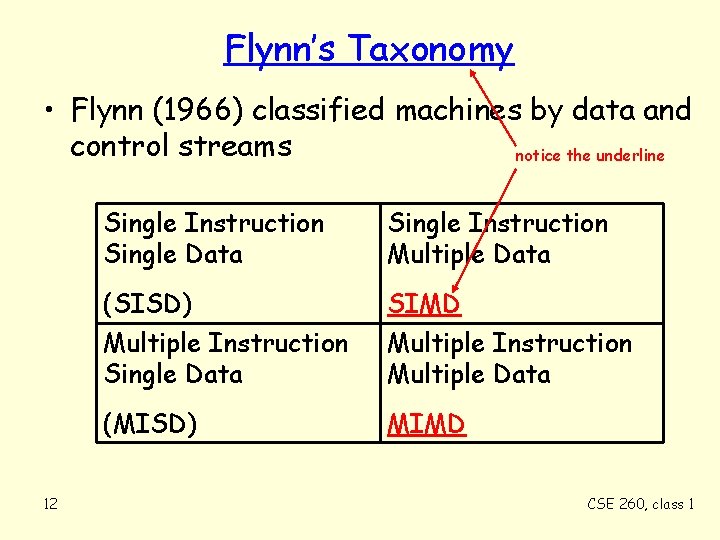
Flynn’s Taxonomy • Flynn (1966) classified machines by data and control streams notice the underline 12 Single Instruction Single Data Single Instruction Multiple Data (SISD) Multiple Instruction Single Data SIMD Multiple Instruction Multiple Data (MISD) MIMD CSE 260, class 1
SISD • SISD – Model of serial von Neumann machine – Logically, single control processor – Includes some supercomputers, such as the 1963 CDC 6600 (perhaps the first supercomputer) P 13 M CSE 260, class 1
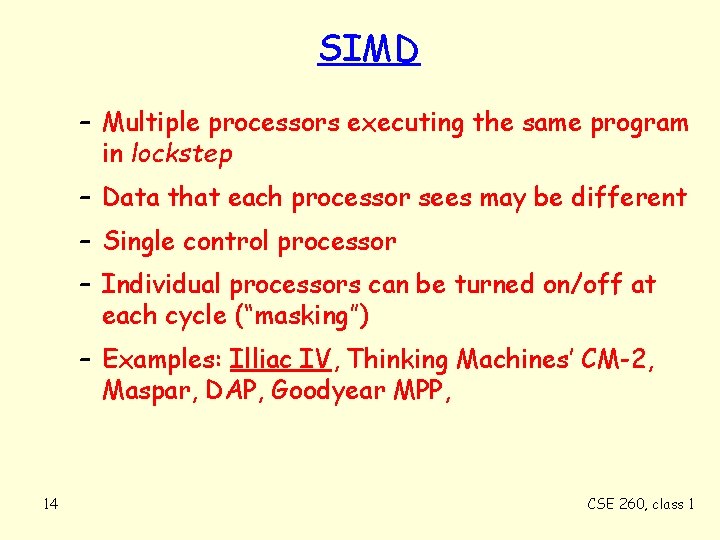
SIMD – Multiple processors executing the same program in lockstep – Data that each processor sees may be different – Single control processor – Individual processors can be turned on/off at each cycle (“masking”) – Examples: Illiac IV, Thinking Machines’ CM-2, Maspar, DAP, Goodyear MPP, 14 CSE 260, class 1
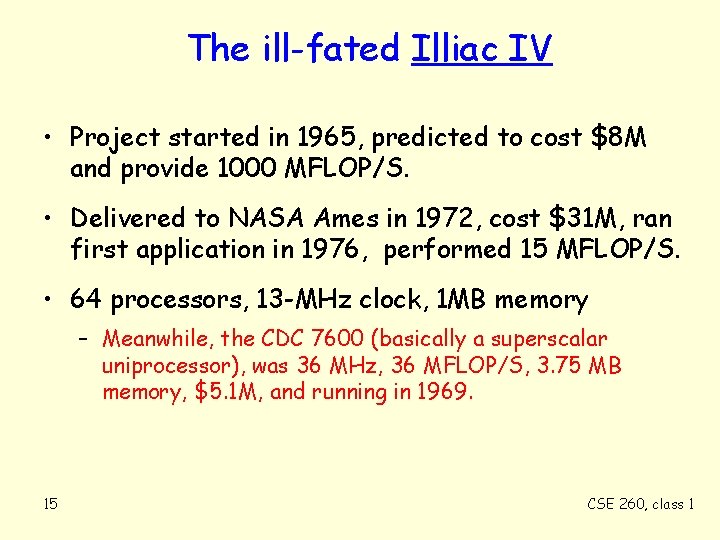
The ill-fated Illiac IV • Project started in 1965, predicted to cost $8 M and provide 1000 MFLOP/S. • Delivered to NASA Ames in 1972, cost $31 M, ran first application in 1976, performed 15 MFLOP/S. • 64 processors, 13 -MHz clock, 1 MB memory – Meanwhile, the CDC 7600 (basically a superscalar uniprocessor), was 36 MHz, 36 MFLOP/S, 3. 75 MB memory, $5. 1 M, and running in 1969. 15 CSE 260, class 1
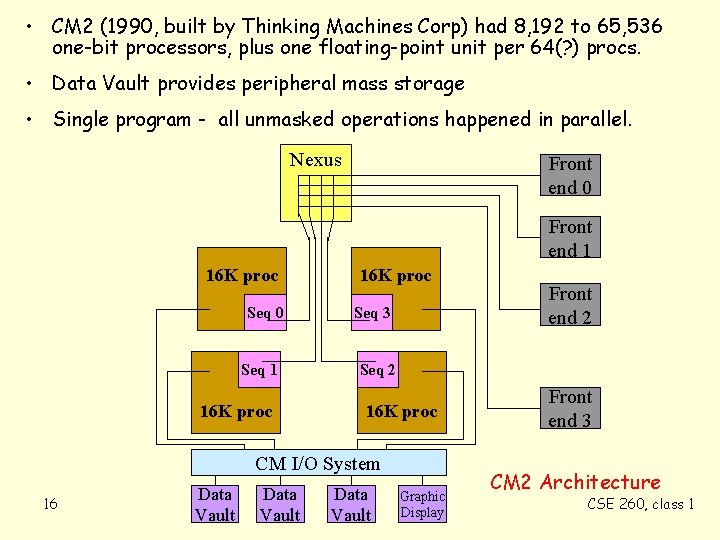
• CM 2 (1990, built by Thinking Machines Corp) had 8, 192 to 65, 536 one-bit processors, plus one floating-point unit per 64(? ) procs. • Data Vault provides peripheral mass storage • Single program - all unmasked operations happened in parallel. Nexus Front end 0 Front end 1 16 K proc Seq 0 Seq 1 16 K proc Seq 3 Seq 2 16 K proc CM I/O System 16 Data Vault Front end 2 Data Vault Graphic Display Front end 3 CM 2 Architecture CSE 260, class 1
Vector Computers • Hybrid SISD/SIMD – has ordinary “scalar” operations and “vector operations”, which operate on up to (say) 256 independent sets of operands (utilizing “vector registers”) in fast pipeline mode. • Examples: Cray supercomputers (X-MP, Y-MP, C 90, T 90, SV 1, . . . ), Fujitsu (VPPxxx), NEC, Hitachi. – many of these have multiple vector processors, but typically the separate processors are used for separate jobs. • 4 or 8 -way SIMD also used in graphics & multimedia accelerators, video game machines. 17 CSE 260, class 1
MIMD • All processors execute their own set of instructions • Processors operate on separate data streams • May have separate clocks • IBM SP’s, TMC’s CM-5, Cray T 3 D & T 3 E, SGI Origin, Tera MTA, Clusters, etc. 18 CSE 260, class 1
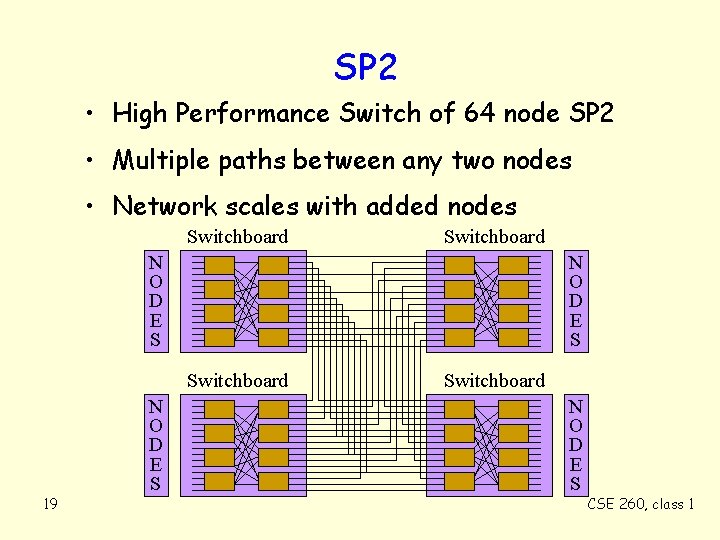
SP 2 • High Performance Switch of 64 node SP 2 • Multiple paths between any two nodes • Network scales with added nodes Switchboard N O D E S Switchboard 19 N O D E S Switchboard N O D E S CSE 260, class 1
Some more MIMD computers • Cluster: computers connected over highbandwidth local area network (usually Ethernet or Myrinet), used as a parallel computer. • NOW (Network Of Workstations): homogeneous cluster (all computers on network are same model). • “The Grid”: computers connected over wide area network 20 CSE 260, class 1
Larry’s conjecture • SIMD is used on early machines in a given generation; it gives way to MIMD. – When space is scarce, you can save by having only one control unit – As components shrink and memory becomes cheaper, the flexibility of MIMD prevails (Conceivable mini-project: find evidence for or against Larry’s conjecture) 21 CSE 260, class 1
What about MISD? • Multiple Instruction Single Data No underline • The term isn’t used (except when discussing the Flynn taxonomy). • Perhaps applies to pipelined computation, e. g. sonar data passing through sequence of special-purpose signal processors. 22 CSE 260, class 1