
CSE 232 A Graduate Database Systems Arun Kumar
CSE 232 A Graduate Database Systems Arun Kumar Topic 7: Parallel RDBMSs and Dataflow Systems Chapters 22 of Cow Book 1
Outline ❖ Parallel RDBMSs and Cloud-Native RDBMSs ❖ Beyond RDBMSs: A Brief History ❖ “Big Data” Systems 2
Parallel DBMSs: Motivation ❖ Scalability: Database is too large for a single node’s disk ❖ Performance: Exploit multiple cores/disks/nodes ❖ … while maintaining almost all other benefits of (R)DBMSs! 3
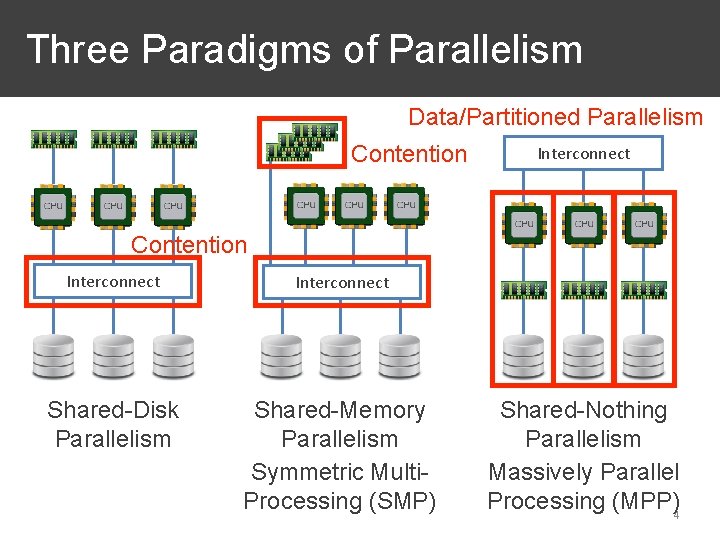
Three Paradigms of Parallelism Data/Partitioned Parallelism Contention Interconnect Shared-Disk Parallelism Shared-Memory Parallelism Symmetric Multi. Processing (SMP) Shared-Nothing Parallelism Massively Parallel Processing (MPP)4
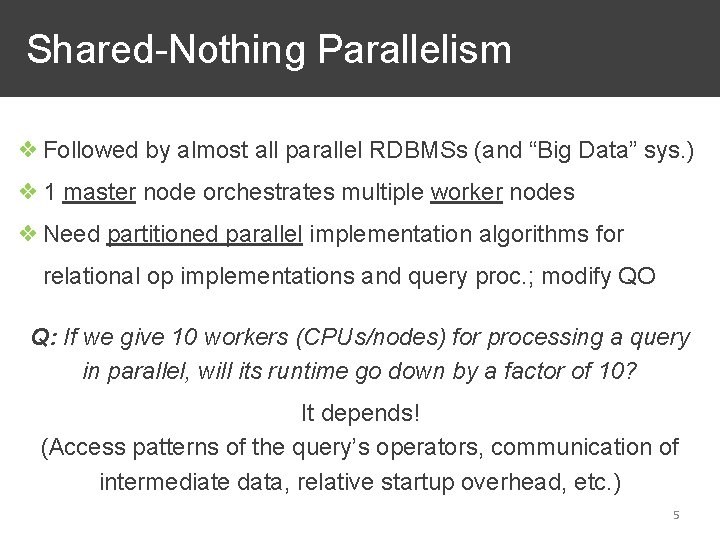
Shared-Nothing Parallelism ❖ Followed by almost all parallel RDBMSs (and “Big Data” sys. ) ❖ 1 master node orchestrates multiple worker nodes ❖ Need partitioned parallel implementation algorithms for relational op implementations and query proc. ; modify QO Q: If we give 10 workers (CPUs/nodes) for processing a query in parallel, will its runtime go down by a factor of 10? It depends! (Access patterns of the query’s operators, communication of intermediate data, relative startup overhead, etc. ) 5
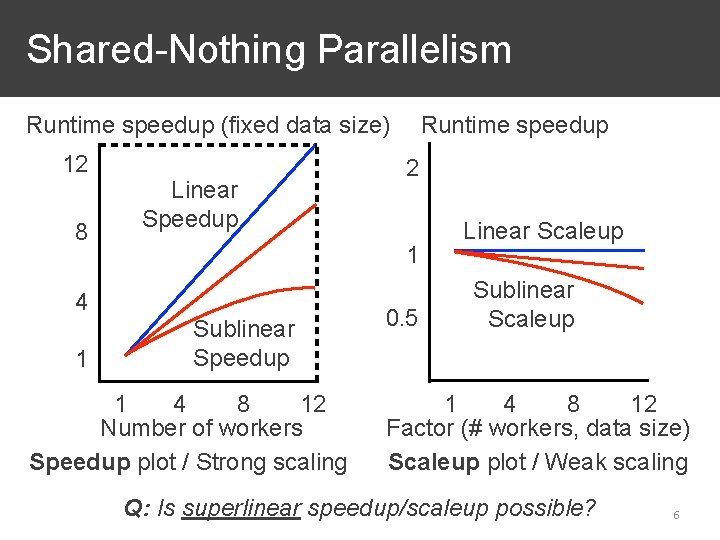
Shared-Nothing Parallelism Runtime speedup (fixed data size) 12 8 Linear Speedup 2 1 4 1 Runtime speedup Sublinear Speedup 1 4 8 12 Number of workers Speedup plot / Strong scaling 0. 5 Linear Scaleup Sublinear Scaleup 1 4 8 12 Factor (# workers, data size) Scaleup plot / Weak scaling Q: Is superlinear speedup/scaleup possible? 6
Shared-Nothing Parallelism: Outline ❖ Data Partitioning ❖ Parallel Operator Implementations ❖ Parallel Query Optimization ❖ Parallel vs “Distributed” DBMSs 7
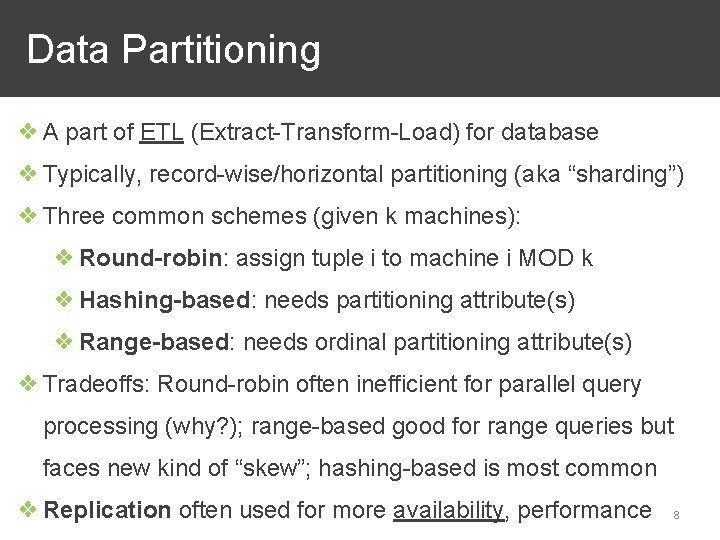
Data Partitioning ❖ A part of ETL (Extract-Transform-Load) for database ❖ Typically, record-wise/horizontal partitioning (aka “sharding”) ❖ Three common schemes (given k machines): ❖ Round-robin: assign tuple i to machine i MOD k ❖ Hashing-based: needs partitioning attribute(s) ❖ Range-based: needs ordinal partitioning attribute(s) ❖ Tradeoffs: Round-robin often inefficient for parallel query processing (why? ); range-based good for range queries but faces new kind of “skew”; hashing-based is most common ❖ Replication often used for more availability, performance 8
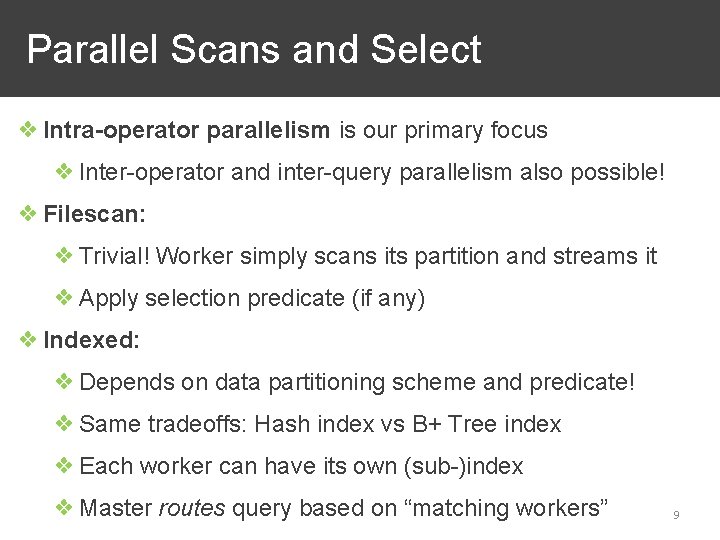
Parallel Scans and Select ❖ Intra-operator parallelism is our primary focus ❖ Inter-operator and inter-query parallelism also possible! ❖ Filescan: ❖ Trivial! Worker simply scans its partition and streams it ❖ Apply selection predicate (if any) ❖ Indexed: ❖ Depends on data partitioning scheme and predicate! ❖ Same tradeoffs: Hash index vs B+ Tree index ❖ Each worker can have its own (sub-)index ❖ Master routes query based on “matching workers” 9
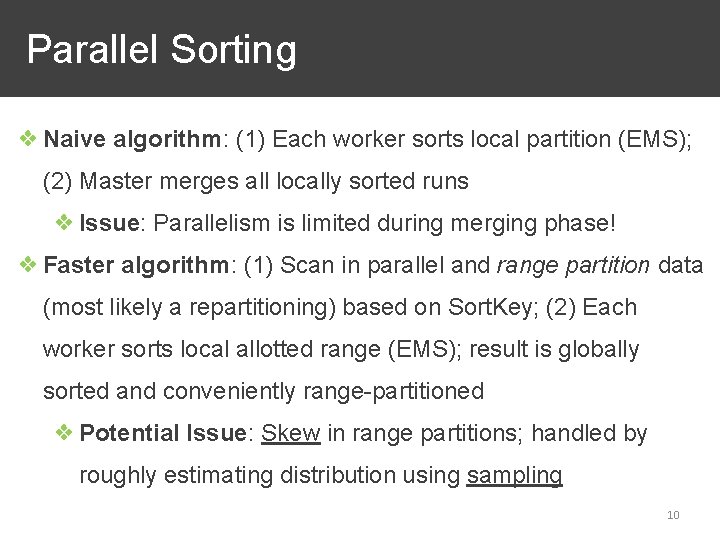
Parallel Sorting ❖ Naive algorithm: (1) Each worker sorts local partition (EMS); (2) Master merges all locally sorted runs ❖ Issue: Parallelism is limited during merging phase! ❖ Faster algorithm: (1) Scan in parallel and range partition data (most likely a repartitioning) based on Sort. Key; (2) Each worker sorts local allotted range (EMS); result is globally sorted and conveniently range-partitioned ❖ Potential Issue: Skew in range partitions; handled by roughly estimating distribution using sampling 10
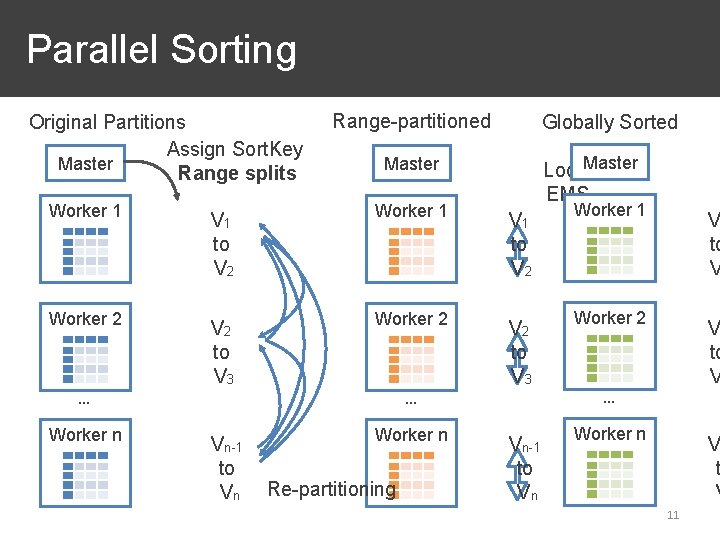
Parallel Sorting Original Partitions Assign Sort. Key Master Range splits Range-partitioned Globally Sorted Local. Master EMS Master Worker 1 V 1 to V 2 Worker 2 V 2 to V 3 Vn-1 to Vn Worker n … Re-partitioning Vn-1 to Vn Worker 1 V to V Worker 2 V to V … Worker n V t V 11
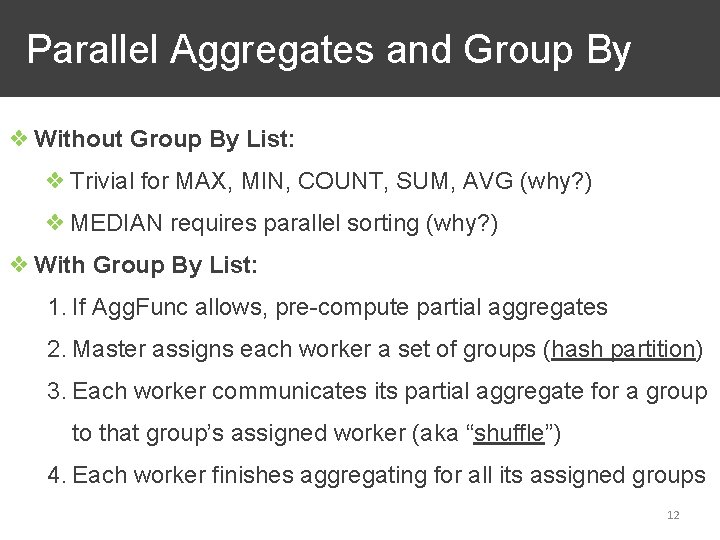
Parallel Aggregates and Group By ❖ Without Group By List: ❖ Trivial for MAX, MIN, COUNT, SUM, AVG (why? ) ❖ MEDIAN requires parallel sorting (why? ) ❖ With Group By List: 1. If Agg. Func allows, pre-compute partial aggregates 2. Master assigns each worker a set of groups (hash partition) 3. Each worker communicates its partial aggregate for a group to that group’s assigned worker (aka “shuffle”) 4. Each worker finishes aggregating for all its assigned groups 12
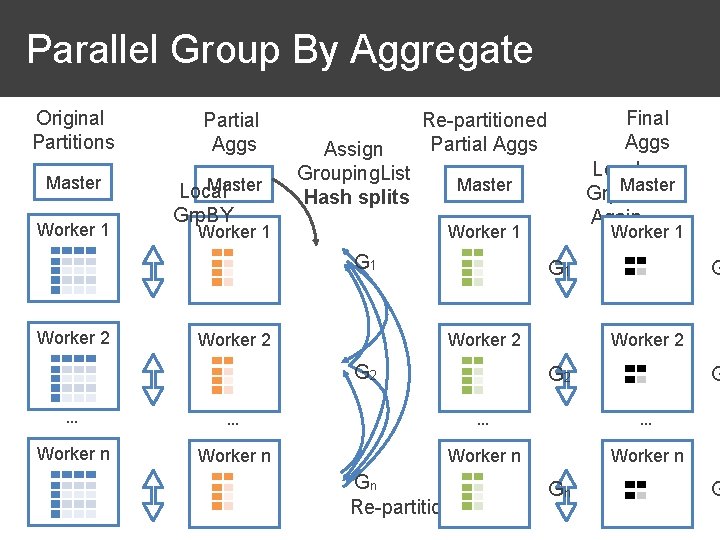
Parallel Group By Aggregate Original Partitions Master Worker 1 Partial Aggs Master Local Grp. BY Assign Grouping. List Hash splits Master Worker 1 G 1 Worker 2 Final Aggs Local Master Grp. BY Again Re-partitioned Partial Aggs Worker 1 G 1 Worker 2 G 2 G Worker 2 G … … Worker n Gn Re-partitioning Gn G 13
Parallel Project ❖ Non-deduplicating Project: ❖ Trivial! Pipelined with Scans/Select ❖ Deduplicating Project: ❖ Each worker deduplicates its partition on Projection. List ❖ If estimated output size is small (catalog? ), workers communicate their results to master to finish dedup. ❖ If estimated output size is too large for master’s disk, similar algorithm as Parallel Aggregate with Group By, except, there is no Agg. Func computation 14
Parallel Nested Loops Join ❖ Given two tables A and B and Join. Attribute for equi-join 1. Master assigns range/hash splits on Join. Attribute to workers 2. Repartitioning of A and B separately using same splits on Join. Attribute (unless pre-partitioned on it!) 3. Worker i applies BNLJ locally on its partitions Ai and Bi 4. Overall join output is just collection of all n worker outputs ❖ If join is not equi-join, there might be a lot of communication between workers; worst-case: all-to-all for cross-product! 15
Parallel “Split” and “Merge” for Joins ❖ Repartitioning quite common for parallel (equi-)joins ❖ Functionality abstracted as two new physical operators: ❖ Split: each worker sends a subset of its partition to another worker based on master’s command (hash/range) ❖ Merge: each worker unions subsets sent to it by others and constructs its assigned (re)partitioned subset ❖ Useful for parallel BNLJ, Sort-Merge Join, and Hash Join 16
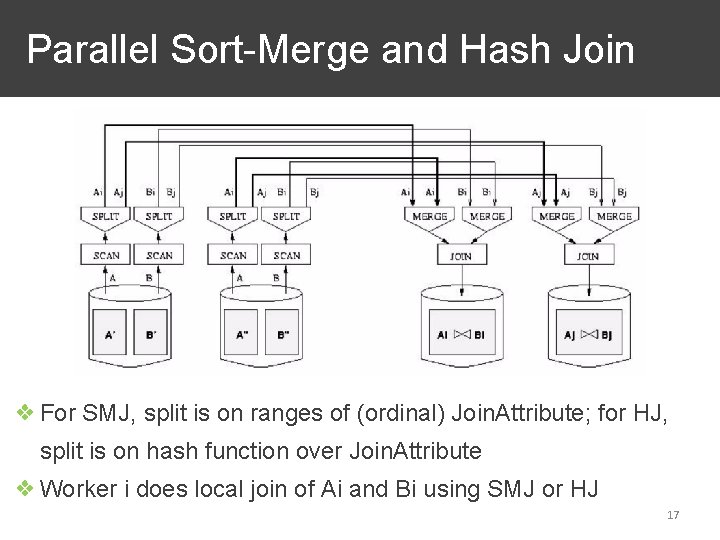
Parallel Sort-Merge and Hash Join ❖ For SMJ, split is on ranges of (ordinal) Join. Attribute; for HJ, split is on hash function over Join. Attribute ❖ Worker i does local join of Ai and Bi using SMJ or HJ 17
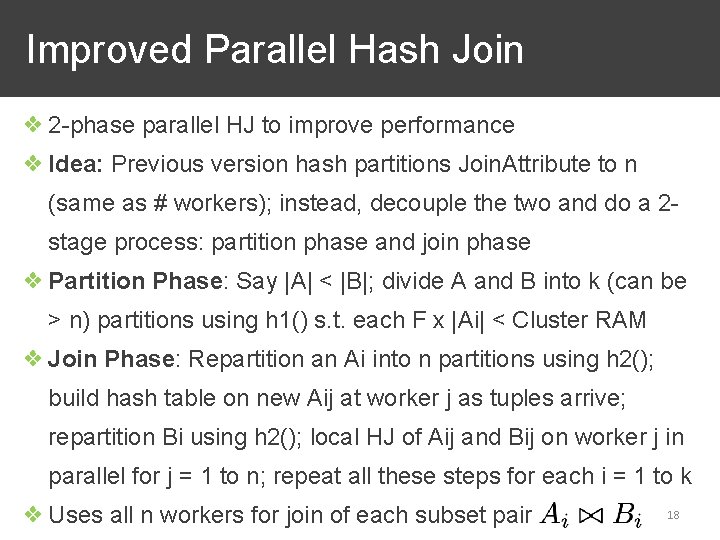
Improved Parallel Hash Join ❖ 2 -phase parallel HJ to improve performance ❖ Idea: Previous version hash partitions Join. Attribute to n (same as # workers); instead, decouple the two and do a 2 stage process: partition phase and join phase ❖ Partition Phase: Say |A| < |B|; divide A and B into k (can be > n) partitions using h 1() s. t. each F x |Ai| < Cluster RAM ❖ Join Phase: Repartition an Ai into n partitions using h 2(); build hash table on new Aij at worker j as tuples arrive; repartition Bi using h 2(); local HJ of Aij and Bij on worker j in parallel for j = 1 to n; repeat all these steps for each i = 1 to k ❖ Uses all n workers for join of each subset pair 18
Parallel Query Optimization ❖ Far more complex than single-node QO! ❖ I/O cost, CPU cost, and communication cost for each phy. op. ❖ Space of PQPs explodes: each node can have its own different local sub-plan (e. g. , filescan v indexed) ❖ Pipeline parallelism and partitioned parallelism can be interleaved in complex ways! ❖ Join order enumeration affected: bushy trees can be good! ❖ … (we will skip more details) 19
Parallel vs “Distributed” RDBMSs ❖ A parallel RDBMS layers distribution atop the file system ❖ Can handle dozens of nodes (Gamma, Teradata, etc. ) ❖ Raghu’s “distributed”: collection of “independent” DBMSs ❖ Quirk of terminology; “federated” more accurate term ❖ Each base RDBMS can be at a different location! ❖ Each RDBMS might host a subset of the database files ❖ Might need to ship entire files for distributed QP ❖ … (we will skip more details) ❖ These days: “Polystores, ” federated DBMSs on steroids! 20
Cloud Computing ❖ Compute, storage, memory, networking are virtualized and exist on remote servers; rented by application users ❖ Manageability: Managing hardware is not user's problem! ❖ Pay-as-you-go: Fine-grained pricing economics based on actual usage (granularity: seconds to years!) ❖ Elasticity: Can dynamically add or reduce capacity based on actual workload’s demand ❖ Infrastructure-as-a-Service (Iaa. S); Platform-as-a-Service (Paa. S); Software-as-a-Service (Saa. S) 21
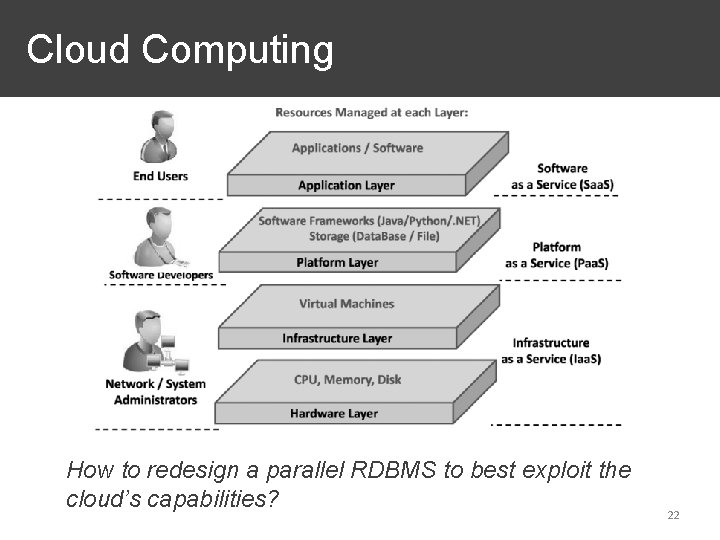
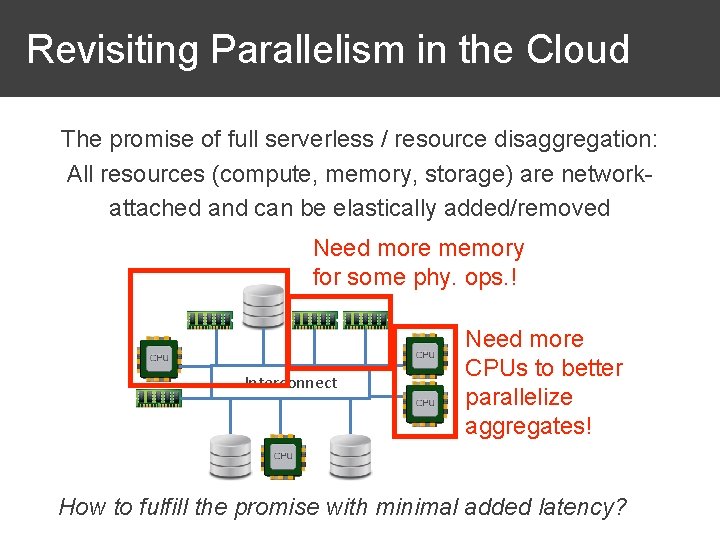
Cloud Computing How to redesign a parallel RDBMS to best exploit the cloud’s capabilities? 22
Evolution of Cloud Infrastructure ❖ Data Center: Physical space from which a cloud is operated ❖ 3 generations of data centers/clouds: ❖ Cloud 1. 0 (Past): Networked servers; user rents/timesliced access to servers needed for data/software ❖ Cloud 2. 0 (Current): “Virtualization” of networked servers; user rents amount of resource capacity; cloud provider has a lot more flexibility on provisioning (multi-tenancy, load balancing, more elasticity, etc. ) ❖ Cloud 3. 0 (Ongoing Research): “Serverless” and disaggregated resources all connected to fast networks 23
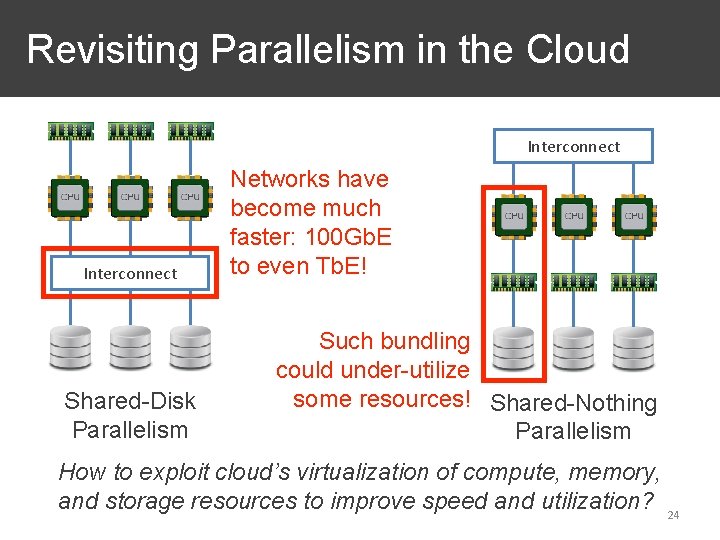
Revisiting Parallelism in the Cloud Interconnect Shared-Disk Parallelism Networks have become much faster: 100 Gb. E to even Tb. E! Such bundling could under-utilize some resources! Shared-Nothing Parallelism How to exploit cloud’s virtualization of compute, memory, and storage resources to improve speed and utilization? 24
Revisiting Parallelism in the Cloud The promise of full serverless / resource disaggregation: All resources (compute, memory, storage) are networkattached and can be elastically added/removed Need more memory for some phy. ops. ! Interconnect Need more CPUs to better parallelize aggregates! How to fulfill the promise with minimal added latency?
Cloud-Native Parallel RDBMSs ❖ Not just running a regular parallel RDBMS on Iaa. S! ❖ Need to revisit, redesign, and reimplemented storage subsystem, memory management, query processing and optimization, transaction management, and more! ❖ Higher levels (data model, SQL, parser, etc. ) preserved ❖ Cloud providers, traditional database companies, startups 26
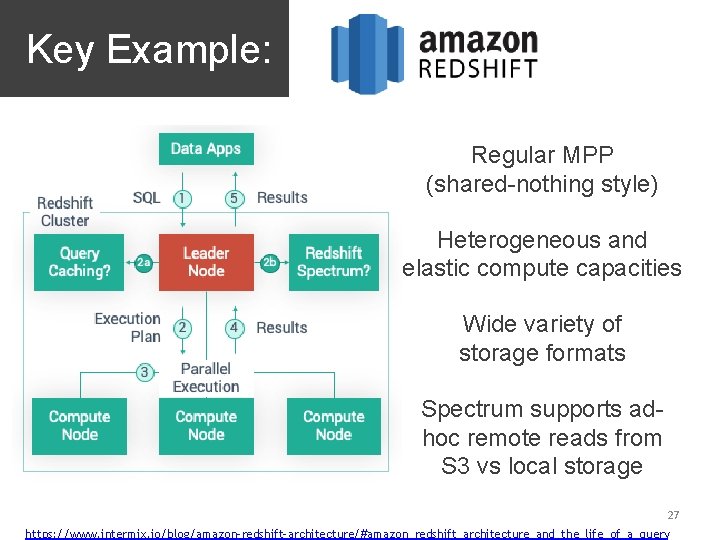
Key Example: Regular MPP (shared-nothing style) Heterogeneous and elastic compute capacities Wide variety of storage formats Spectrum supports adhoc remote reads from S 3 vs local storage 27 https: //www. intermix. io/blog/amazon-redshift-architecture/#amazon_redshift_architecture_and_the_life_of_a_query
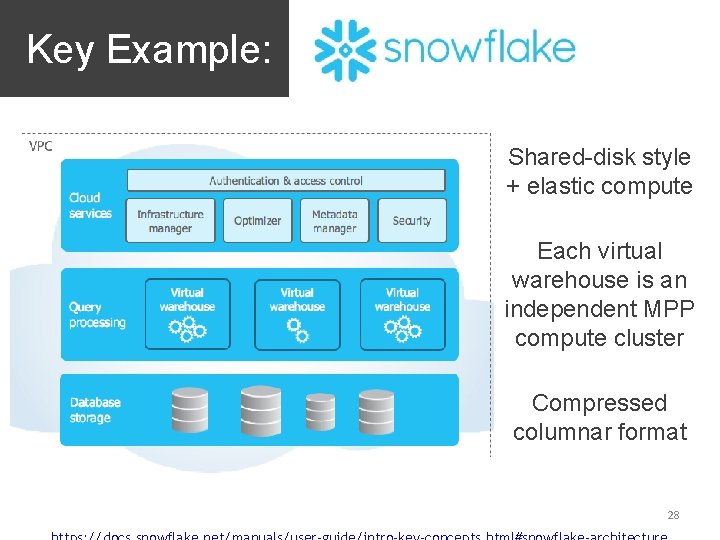
Key Example: Shared-disk style + elastic compute Each virtual warehouse is an independent MPP compute cluster Compressed columnar format 28
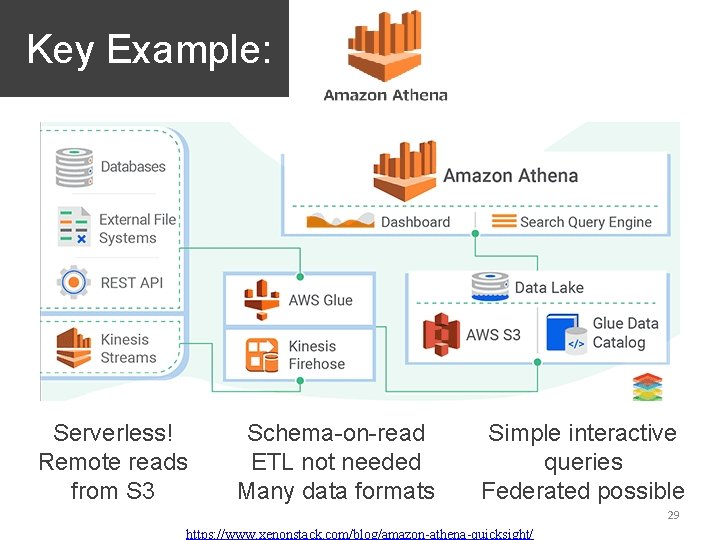
Key Example: Serverless! Remote reads from S 3 Schema-on-read ETL not needed Many data formats Simple interactive queries Federated possible 29 https: //www. xenonstack. com/blog/amazon-athena-quicksight/
Outline ❖ Parallel RDBMSs and Cloud-Native RDBMSs ❖ Beyond RDBMSs: A Brief History ❖ “Big Data” Systems 30
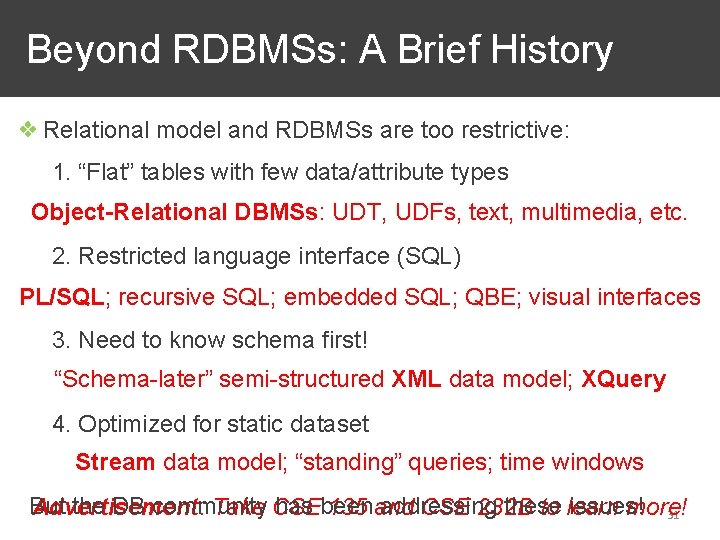
Beyond RDBMSs: A Brief History ❖ Relational model and RDBMSs are too restrictive: 1. “Flat” tables with few data/attribute types Object-Relational DBMSs: UDT, UDFs, text, multimedia, etc. 2. Restricted language interface (SQL) PL/SQL; recursive SQL; embedded SQL; QBE; visual interfaces 3. Need to know schema first! “Schema-later” semi-structured XML data model; XQuery 4. Optimized for static dataset Stream data model; “standing” queries; time windows But the DB community has been addressing these issues! Advertisement: Take CSE 135 and CSE 232 B to learn more! 31
So, why did people still need to look beyond RDBMSs? 32
Beyond RDBMSs: A Brief History The DB community got blindsided by the unstoppable rise of the Web/Internet giants! ❖ DB folks underappreciated 4 key concerns of Web folks: Developability Fault Tolerance Elasticity Cost/Politics! 33
DB/Enterprise vs. Web Dichotomy ❖ DB folks underappreciated 4 key concerns of Web folks: Developability: RDBMS extensibility mechanisms (UDTs, UDFs, etc. ) are too painful to use for programmers! DB companies: we write the software and sell to our customers, viz. , enterprise companies (banks, retail, etc. ) Web companies: we will hire an army of software engineers to build own in-house software systems! Need simpler APIs and DBMSs that scale custom programs 34
DB/Enterprise vs. Web Dichotomy ❖ DB folks underappreciated 4 key concerns of Web folks: Fault Tolerance: What if we run on 100 Ks of machines? ! DB companies: our customers do not need more than a few dozen machines to store and analyze their data! Web companies: we need hundreds of thousands of machines for planetary-scale Web services! If a machine fails, user should not have to rerun entire query! DBMS should take care of fault tolerance, not user/appl. (Cloud-native RDBMSs now offer fault tolerance by design)35
DB/Enterprise vs. Web Dichotomy ❖ DB folks underappreciated 4 key concerns of Web folks: Elasticity: Resources should adapt to “query” workload DB companies: our customers have “fairly predictably” sized datasets and workloads; can fix their clusters! Web companies: our workloads could vary widely and the datasets they need vary widely! Need to be able to upsize and downsize clusters easily on-the-fly, based on current query workload 36
DB/Enterprise vs. Web Dichotomy ❖ DB folks underappreciated 4 key concerns of Web folks: Cost/Politics: Commercial RDBMS licenses too costly! DB companies: our customers have $$$! ☺ Web companies: our products are mostly free (ads? ); why pay so much $$$ if we can build our own DBMSs? Many started with My. SQL (!) but then built their own DBMSs New tools were free & open source; led to viral adoption! 37
Cool, so, these new systems jolted the DB folks from being smug and complacent! But what is “Big Data”? 38
“Big Data” ❖ Marketing term; think “Big” as in “Big Oil”, not “big building” ❖ Wikipedia says: “Data that is so large and complex that existing toolkits [read RDBMSs!] are not adequate [hah!]” ❖ Typical characterization by 3 Vs: ❖ Volume: larger-than-RAM; >= TBs, even Exabytes! ❖ Variety: relations, webpages, docs, tweets, multimedia, etc. ❖ Velocity: high generation rate, e. g. , sensors, surveillance, etc. 39
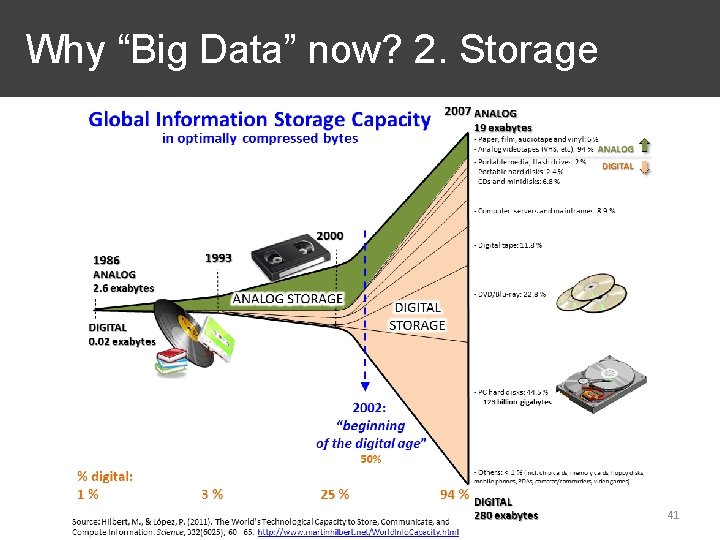
Why “Big Data” now? 1. Applications ❖ New “data-driven mentality” in almost all applications: ❖ Web: search, e-commerce, e-mails, social media ❖ Science: satellite imagery, CERN’s LHC, document corpora ❖ Medicine: pharmacogenomics, precision medicine ❖ Logistics: sensors, GPS, “Internet of Things” ❖ Finance: high-throughput trading, monitoring ❖ Humanities: digitized books/literature, social media ❖ Governance: e-voting, targeted campaigns, NSA ☺ ❖… 40
Why “Big Data” now? 2. Storage 41
Outline ❖ Parallel RDBMSs and Cloud-Native RDBMSs ❖ Beyond RDBMSs: A Brief History ❖ “Big Data” Systems ❖ The Map. Reduce/Hadoop Craze ❖ Spark and Other Dataflow Systems ❖ Key-Value No. SQL Systems ❖ Graph Processing Systems ❖ Advanced Analytics/ML Systems 42
The Map. Reduce/Hadoop Craze ❖ Blame Google! ❖ “Simple” problem: index, store, and search the Web! ☺ ❖ Who were their major systems hires? Jeff Dean and Sanjay Ghemawat (Systems, not DB or IR) ❖ Why did they not use RDBMSs? (Haha. ) Developability, data model, fault tolerance, scale, cost, … Engineers started with My. SQL; abandoned it! 43
What is Map. Reduce? Map. Reduce: Simplified Data Processing on Large Clusters. In OSDI 2004. ❖ Programming model for writing data-parallel programs + distributed system architecture for processing large data ❖ Map and Reduce are terms/ideas from functional PL ❖ Engineer only implements the “logic” of Map and Reduce ❖ Libraries in Java, C++, etc. handle orchestration of data distribution, parallelization, etc. “under the covers” Was radically easier for engineers to write programs with! 44
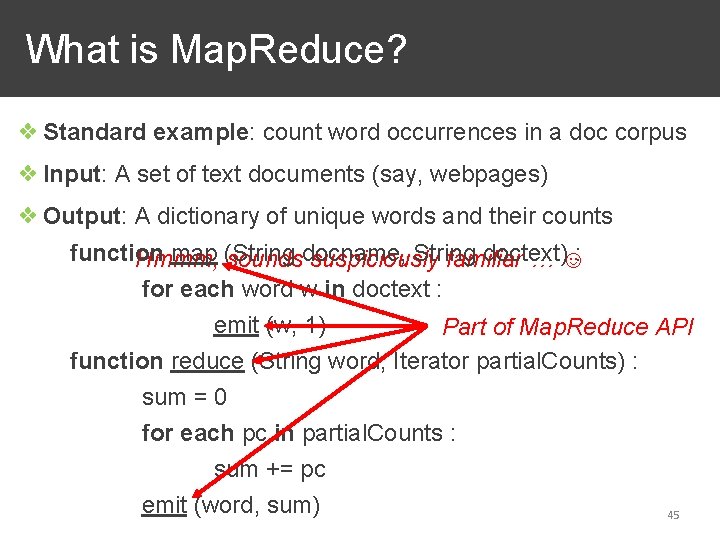
What is Map. Reduce? ❖ Standard example: count word occurrences in a doc corpus ❖ Input: A set of text documents (say, webpages) ❖ Output: A dictionary of unique words and their counts function map (String doctext) Hmmm, soundsdocname, suspiciously familiar … ☺: for each word w in doctext : emit (w, 1) Part of Map. Reduce API function reduce (String word, Iterator partial. Counts) : sum = 0 for each pc in partial. Counts : sum += pc emit (word, sum) 45
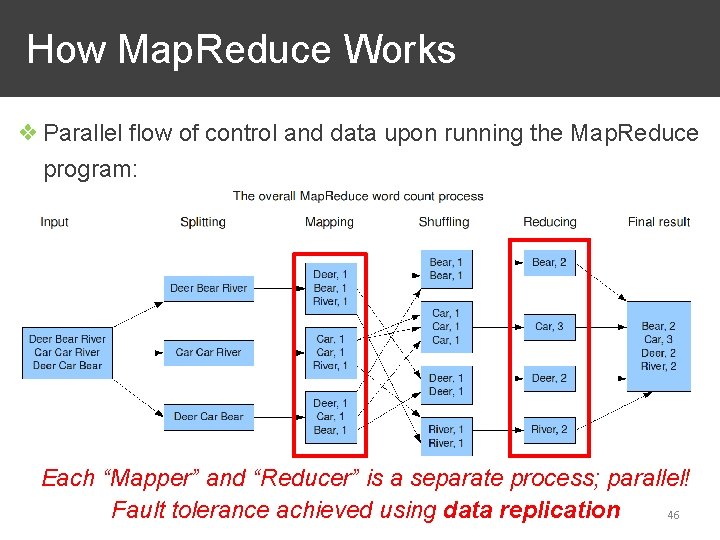
How Map. Reduce Works ❖ Parallel flow of control and data upon running the Map. Reduce program: Each “Mapper” and “Reducer” is a separate process; parallel! Fault tolerance achieved using data replication 46
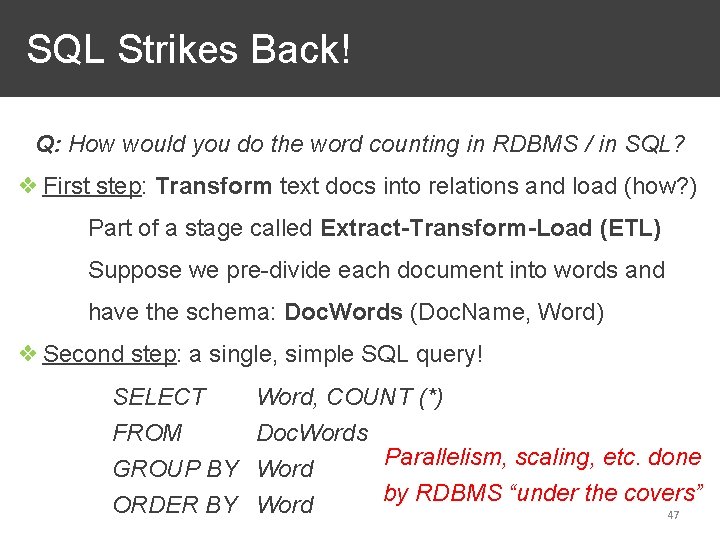
SQL Strikes Back! Q: How would you do the word counting in RDBMS / in SQL? ❖ First step: Transform text docs into relations and load (how? ) Part of a stage called Extract-Transform-Load (ETL) Suppose we pre-divide each document into words and have the schema: Doc. Words (Doc. Name, Word) ❖ Second step: a single, simple SQL query! SELECT FROM GROUP BY ORDER BY Word, COUNT (*) Doc. Words Parallelism, scaling, etc. done Word by RDBMS “under the covers” Word 47
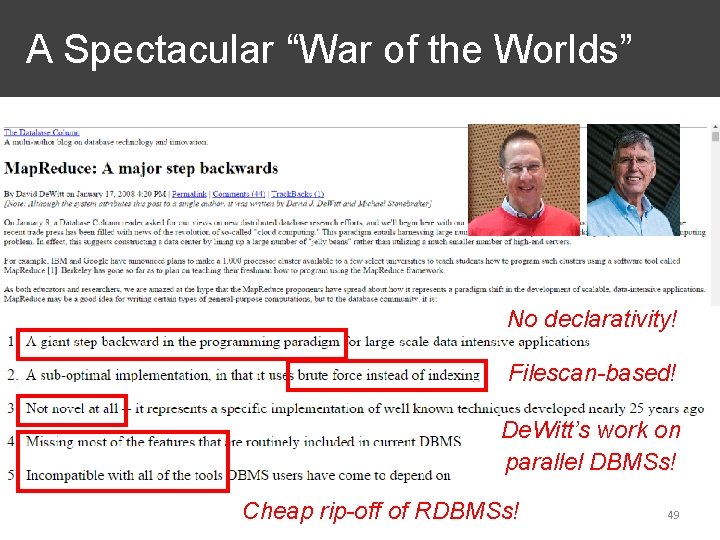
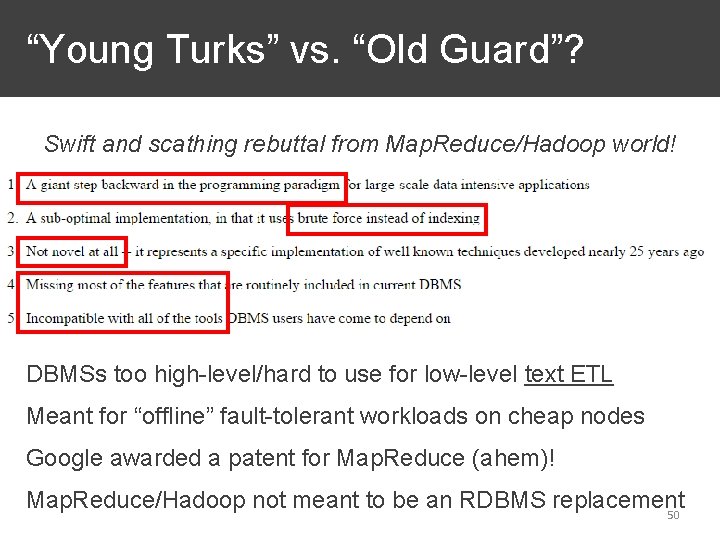
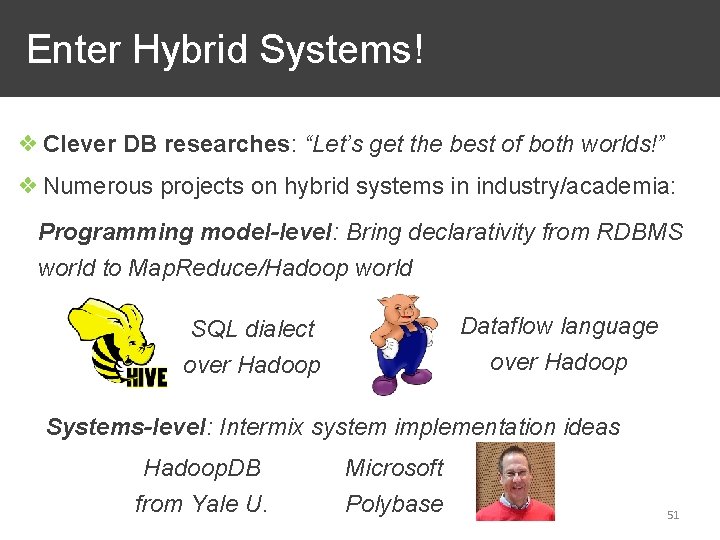
What is Hadoop then? ❖ Open-source impl. Of Google’s ideas; includes Map. Reduce model and a distributed file system (HDFS) ❖ Summary: User writes logic of Map and Reduce functions in API; input splitting, data distribution, shuffling, fault tolerance, etc. all handled by the Hadoop library “under the covers” ❖ Exploded in popularity! 100 s of papers, 10 s of products! A real “revolution” in scalable data processing that took the DB community by surprise! 48
A Spectacular “War of the Worlds” No declarativity! Filescan-based! De. Witt’s work on parallel DBMSs! Cheap rip-off of RDBMSs! 49
“Young Turks” vs. “Old Guard”? Swift and scathing rebuttal from Map. Reduce/Hadoop world! DBMSs too high-level/hard to use for low-level text ETL Meant for “offline” fault-tolerant workloads on cheap nodes Google awarded a patent for Map. Reduce (ahem)! Map. Reduce/Hadoop not meant to be an RDBMS replacement 50
Enter Hybrid Systems! ❖ Clever DB researches: “Let’s get the best of both worlds!” ❖ Numerous projects on hybrid systems in industry/academia: Programming model-level: Bring declarativity from RDBMS world to Map. Reduce/Hadoop world Dataflow language over Hadoop SQL dialect over Hadoop Systems-level: Intermix system implementation ideas Hadoop. DB from Yale U. Microsoft Polybase 51
“Big Data” Systems ❖ Parallel RDBMSs and Cloud-Native RDBMSs ❖ Beyond RDBMSs: A Brief History ❖ “Big Data” Systems ❖ The Map. Reduce/Hadoop Craze ❖ Spark and Other Dataflow Systems ❖ Key-Value No. SQL Systems ❖ Graph Processing Systems ❖ Advanced Analytics/ML Systems 52
Spark from UC Berkeley ❖ Extended dataflow programming model (subsumes most of RA; Map. Reduce); system (re)designed from ground up ❖ Agenda: Unified system to handle relations, text, etc. ; support more general distributed data processing ❖ Tons of sponsors, gazillion bucks, unbelievable hype! ❖ Key idea: exploit distributed memory to cache data ❖ Key novelty: lineage-based fault tolerance, not replication ❖ Open-sourced to Apache; commercialized as Databricks 53
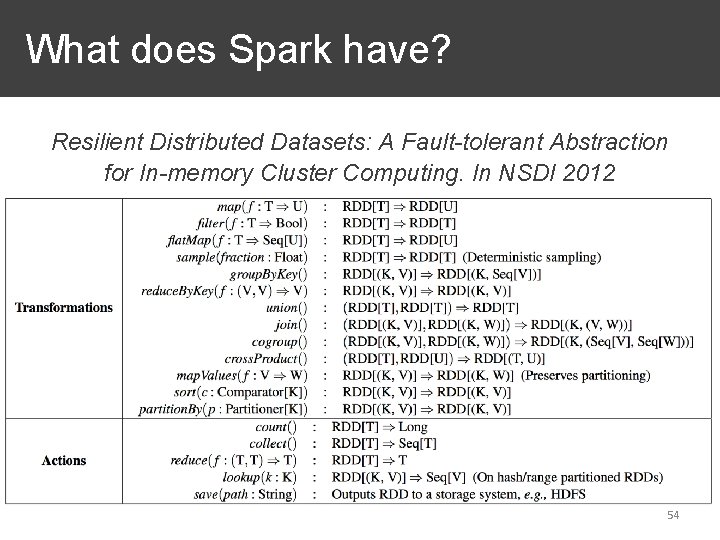
What does Spark have? Resilient Distributed Datasets: A Fault-tolerant Abstraction for In-memory Cluster Computing. In NSDI 2012 54
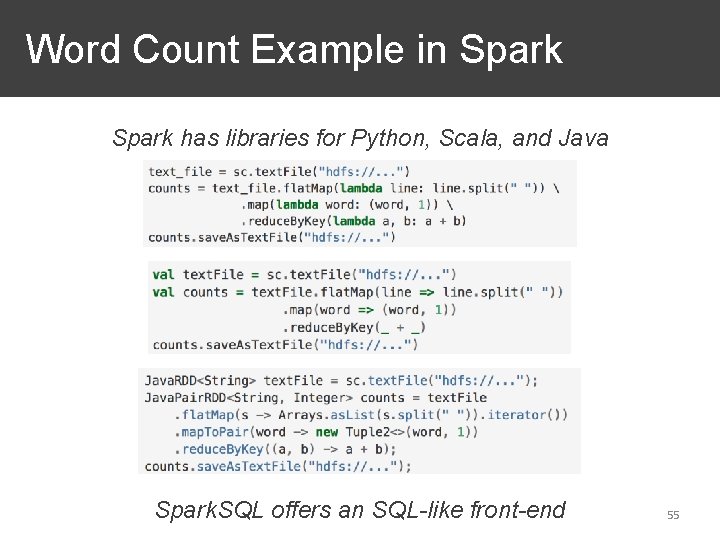
Word Count Example in Spark has libraries for Python, Scala, and Java Spark. SQL offers an SQL-like front-end 55
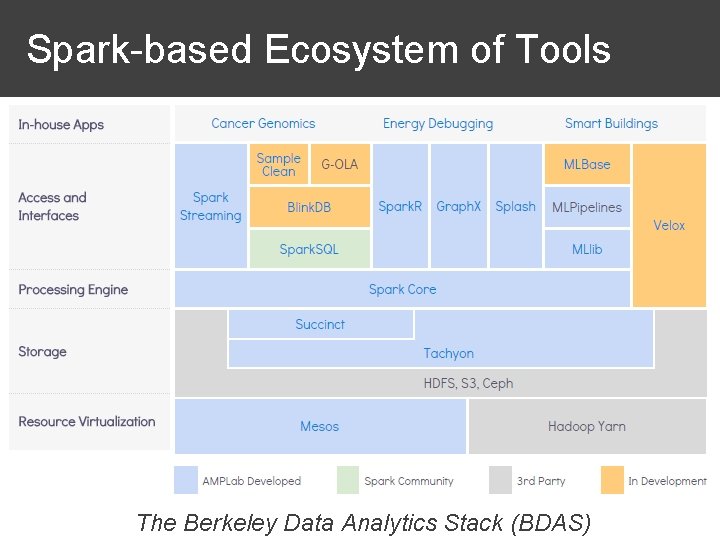
Spark-based Ecosystem of Tools The Berkeley Data Analytics Stack (BDAS) 56
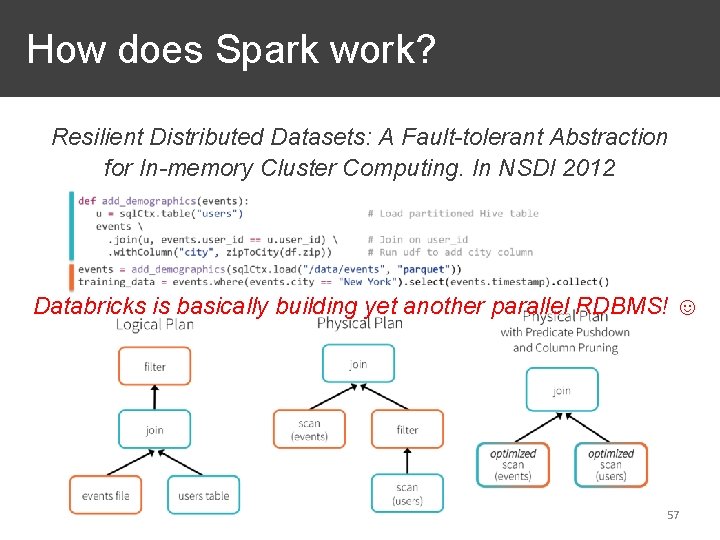
How does Spark work? Resilient Distributed Datasets: A Fault-tolerant Abstraction for In-memory Cluster Computing. In NSDI 2012 Databricks is basically building yet another parallel RDBMS! ☺ 57
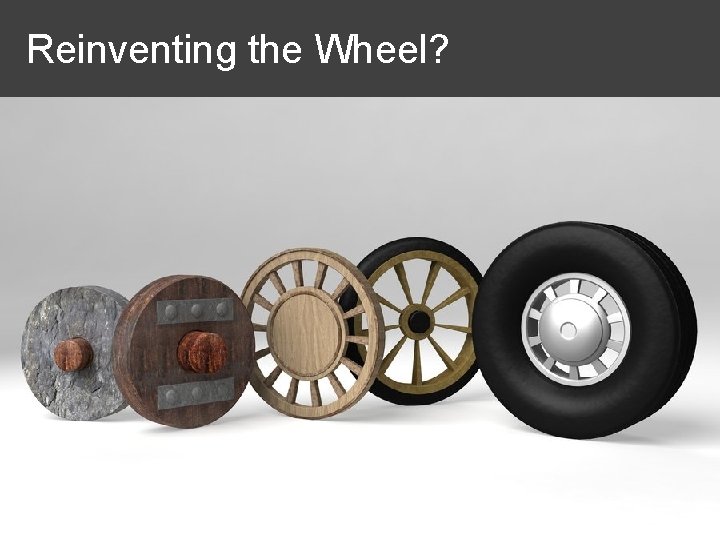
Reinventing the Wheel? 58
Other Dataflow Systems ❖ Stratosphere/Apache Flink from TU Berlin ❖ Myria from U Washington ❖ Asterix. DB from UC Irvine ❖ Azure Data Lakes from Microsoft ❖… Building such “Big Data” systems is (was? ) one of the hottest topics in both industry and academia My bias: Lot of system building; not sure of “research novelty” 59
References and More Material ❖ Map. Reduce/Hadoop: ❖ Map. Reduce: Simplified Data Processing on Large Clusters. Jeffrey Dean and Sanjay Ghemawat. In OSDI 2004. ❖ More Examples: http: //bit. ly/2 rl 86 b. G, http: //bit. ly/2 rk. SRj 8 ❖ Online Tutorial: http: //bit. ly/2 r. S 2 B 5 j ❖ Spark: ❖ Resilient Distributed Datasets: A Fault-tolerant Abstraction for In-memory Cluster Computing. Matei Zaharia and others. In NSDI 2012. ❖ More Examples: http: //bit. ly/2 rhkh. Ep, http: //bit. ly/2 rk. T 8 Tc 60 ❖ Online Tutorial: http: //bit. ly/2 r 8 l. W 0 S
Outline ❖ Parallel RDBMSs and Cloud-Native RDBMSs ❖ Beyond RDBMSs: A Brief History ❖ “Big Data” Systems ❖ The Map. Reduce/Hadoop Craze ❖ Spark and Other Dataflow Systems ❖ Key-Value No. SQL Systems ❖ Graph Processing Systems ❖ Advanced Analytics/ML Systems 61
Key-Value No. SQL Systems ❖ Simple API: get and put unique records very quickly! ❖ Records usually uniquely identified by a “key”; information in record is the “value” (could be general JSON object) ❖ Used extensively by Web companies: get user profile or product record quickly and update info, Facebook status, etc. ❖ High availability, high scalability, “eventual” consistency ❖ Idea: Discard ACID and 30+ years of DB lessons; use “BASE” (Basically Available, Soft state, and Eventually consistent) ❖ The new RDBMS-hating “movement” was christened “No. SQL” 62
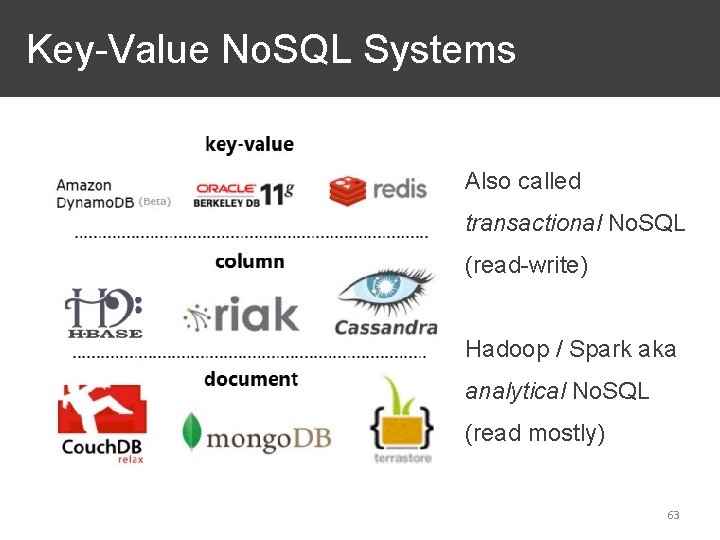
Key-Value No. SQL Systems Also called transactional No. SQL (read-write) Hadoop / Spark aka analytical No. SQL (read mostly) 63
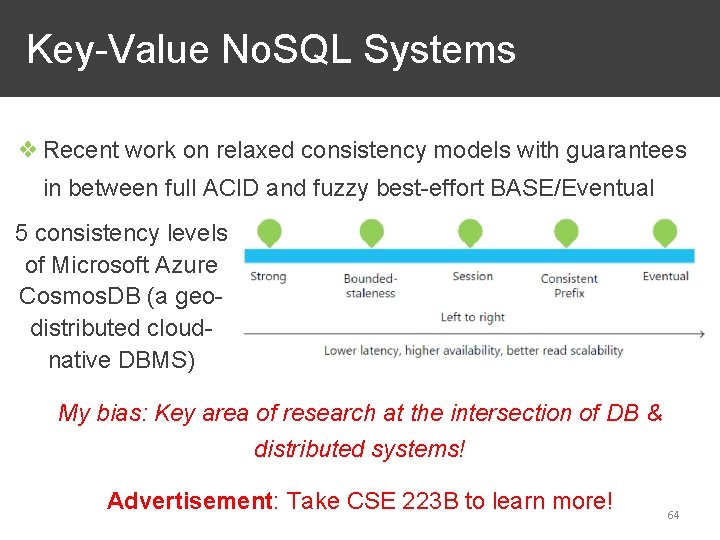
Key-Value No. SQL Systems ❖ Recent work on relaxed consistency models with guarantees in between full ACID and fuzzy best-effort BASE/Eventual 5 consistency levels of Microsoft Azure Cosmos. DB (a geodistributed cloudnative DBMS) My bias: Key area of research at the intersection of DB & distributed systems! Advertisement: Take CSE 223 B to learn more! 64
Outline ❖ Parallel RDBMSs and Cloud-Native RDBMSs ❖ Beyond RDBMSs: A Brief History ❖ “Big Data” Systems ❖ The Map. Reduce/Hadoop Craze ❖ Spark and Other Dataflow Systems ❖ Key-Value No. SQL Systems ❖ Graph Processing Systems ❖ Advanced Analytics/ML Systems 65
Graph Processing Systems ❖ Not a workload DB folks used to care much about ❖ Specialized graph systems have been around for years (Neo 4 j), but more popular now (Facebook, Linked. In, etc. ) ❖ Data Model: set of nodes, and set of (multi-)edges ❖ Ops/queries: nearest neighbors, shortest path, connectivity, density, cliques, etc. 66
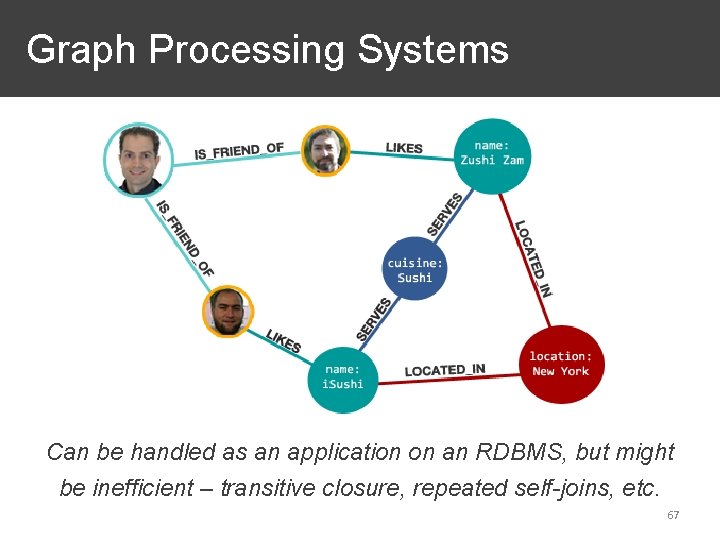
Graph Processing Systems Can be handled as an application on an RDBMS, but might be inefficient – transitive closure, repeated self-joins, etc. 67
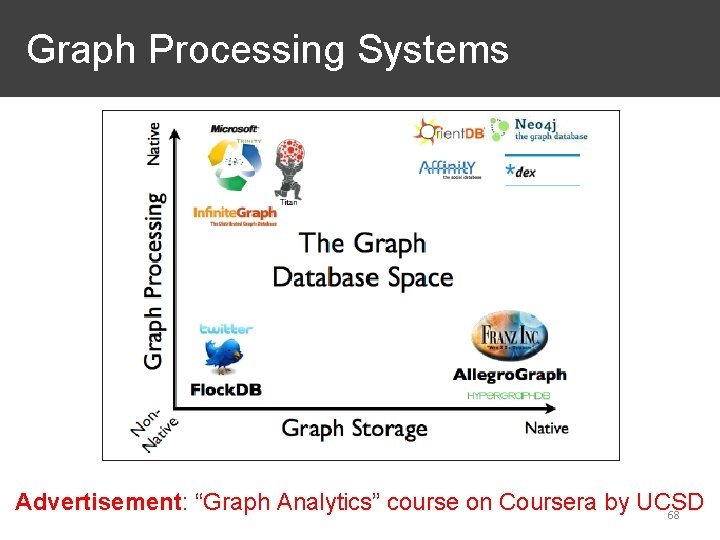
Graph Processing Systems Advertisement: “Graph Analytics” course on Coursera by UCSD 68
- Slides: 68