
CSE 232 A Database System Principles More Concurrency
CSE 232 A: Database System Principles More Concurrency Control and Transaction Processing 1
Validation Transactions have 3 phases: (1) Read – all DB values read – writes to temporary storage – no locking (2) Validate – check if schedule so far is serializable (3) Write – if validate ok, write to DB 2
Key idea • Make validation atomic • If T 1, T 2, T 3, … is validation order, then resulting schedule will be conflict equivalent to Ss = T 1 T 2 T 3. . . 3
To implement validation, system keeps two sets: • FIN = transactions that have finished phase 3 (and are all done) • VAL = transactions that have successfully finished phase 2 (validation) 4
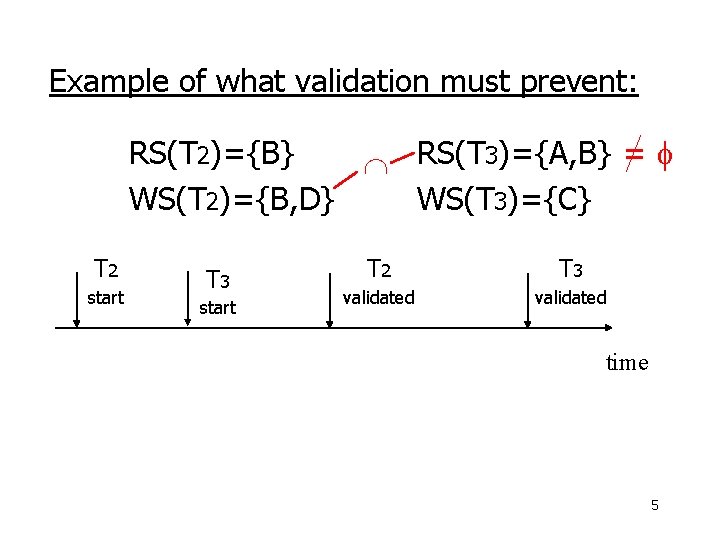
Example of what validation must prevent: RS(T 2)={B} RS(T 3)={A, B} = WS(T 2)={B, D} WS(T 3)={C} T 2 start T 3 start T 2 T 3 validated time 5
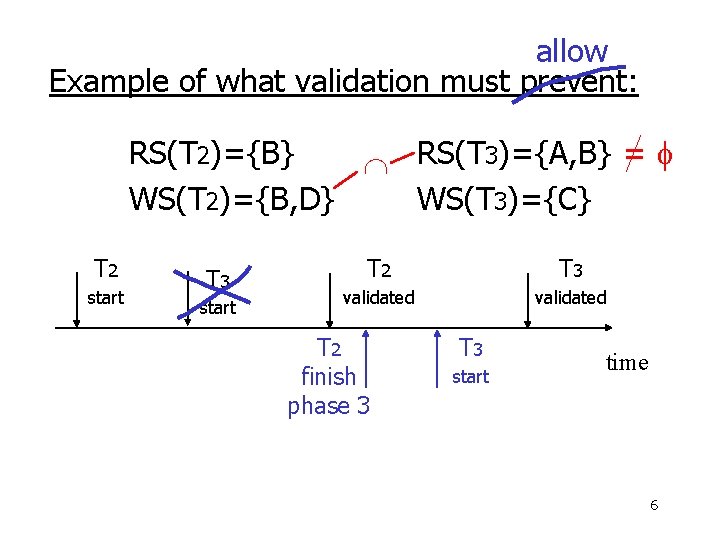
allow Example of what validation must prevent: RS(T 2)={B} RS(T 3)={A, B} = WS(T 2)={B, D} WS(T 3)={C} T 2 start T 3 start T 2 T 3 validated T 2 finish phase 3 T 3 start time 6
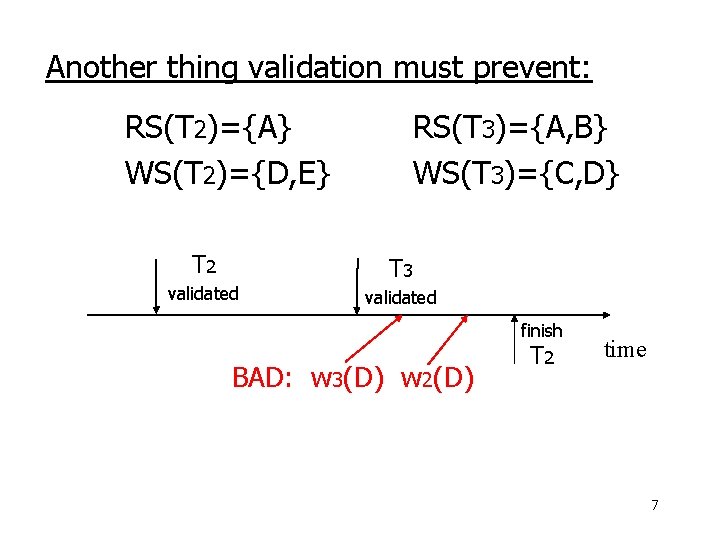
Another thing validation must prevent: RS(T 2)={A} WS(T 2)={D, E} T 2 validated RS(T 3)={A, B} WS(T 3)={C, D} T 3 validated finish BAD: w 3(D) w 2(D) T 2 time 7
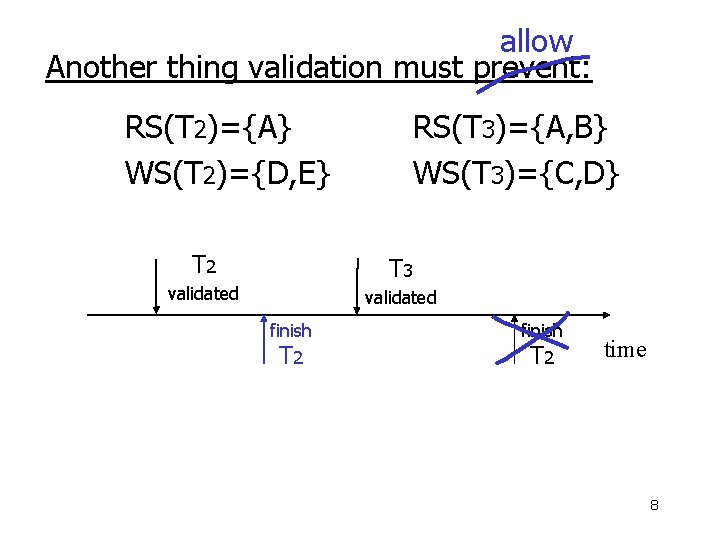
allow Another thing validation must prevent: RS(T 2)={A} WS(T 2)={D, E} T 2 RS(T 3)={A, B} WS(T 3)={C, D} T 3 validated finish T 2 time 8
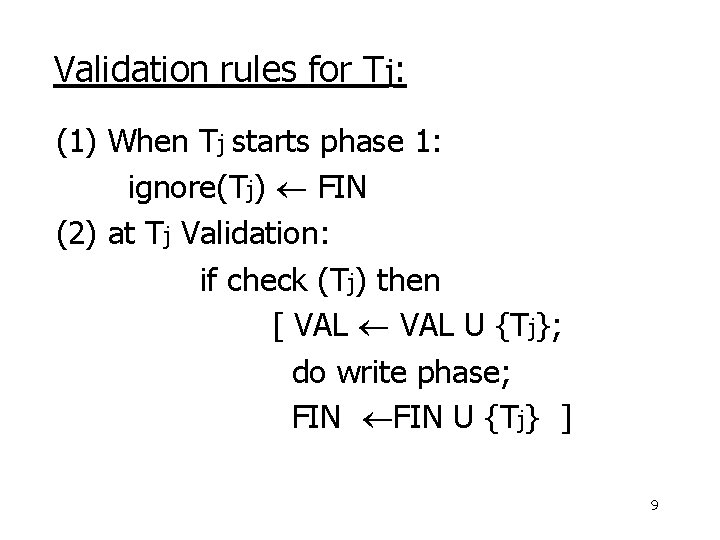
Validation rules for Tj: (1) When Tj starts phase 1: ignore(Tj) FIN (2) at Tj Validation: if check (Tj) then [ VAL U {Tj}; do write phase; FIN U {Tj} ] 9
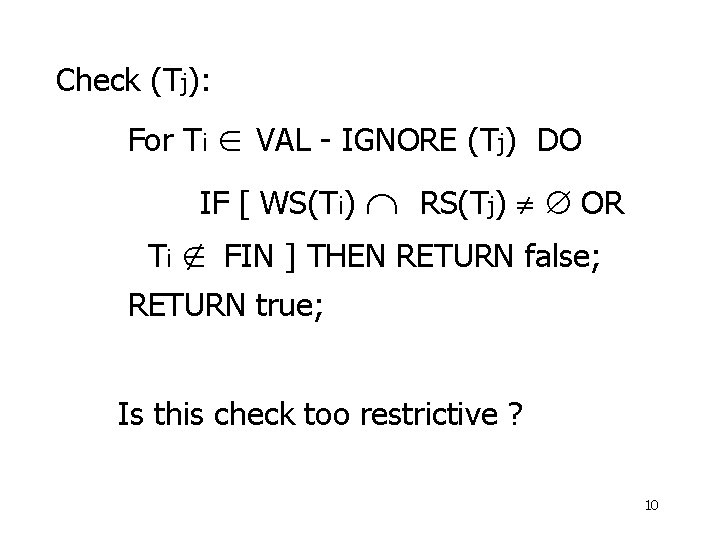
Check (Tj): For Ti VAL - IGNORE (Tj) DO IF [ WS(Ti) RS(Tj) OR Ti FIN ] THEN RETURN false; RETURN true; Is this check too restrictive ? 10
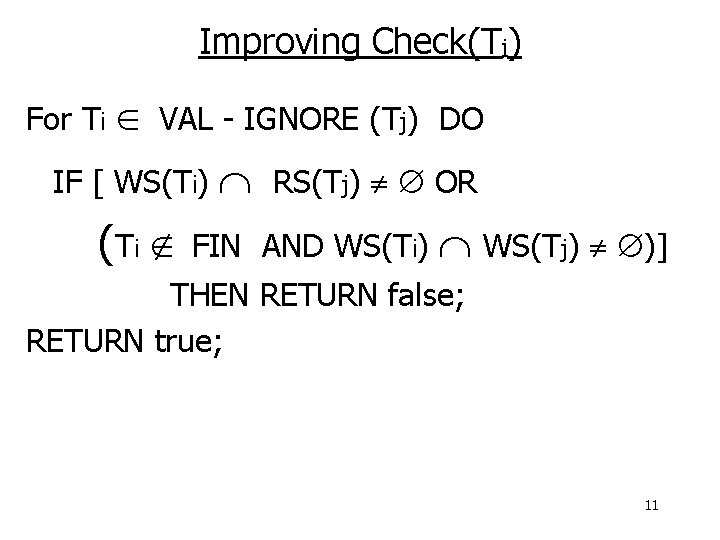
Improving Check(Tj) For Ti VAL - IGNORE (Tj) DO IF [ WS(Ti) (Ti RS(Tj) OR FIN AND WS(Ti) WS(Tj) )] THEN RETURN false; RETURN true; 11
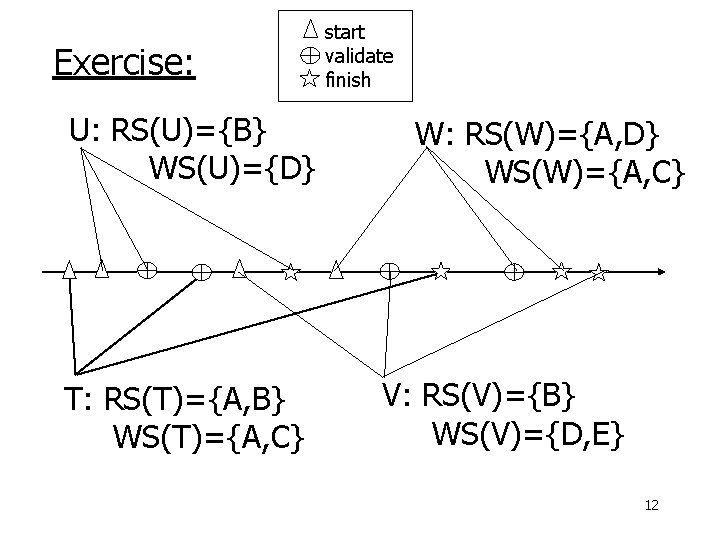
Exercise: U: RS(U)={B} WS(U)={D} T: RS(T)={A, B} WS(T)={A, C} start validate finish W: RS(W)={A, D} WS(W)={A, C} V: RS(V)={B} WS(V)={D, E} 12
Validation (also called optimistic concurrency control) is useful in some cases: - Conflicts rare - System resources plentiful - Have real time constraints 13
Summary Have studied C. C. mechanisms used in practice - 2 PL - Multiple granularity - Tree (index) protocols - Validation 14
Chapter 10 More on transaction processing Topics (which I doubt we’ll get to all of them): • Cascading rollback, recoverable schedule • Deadlocks – Prevention – Detection • View serializability • Long transactions (nested, compensation) 15
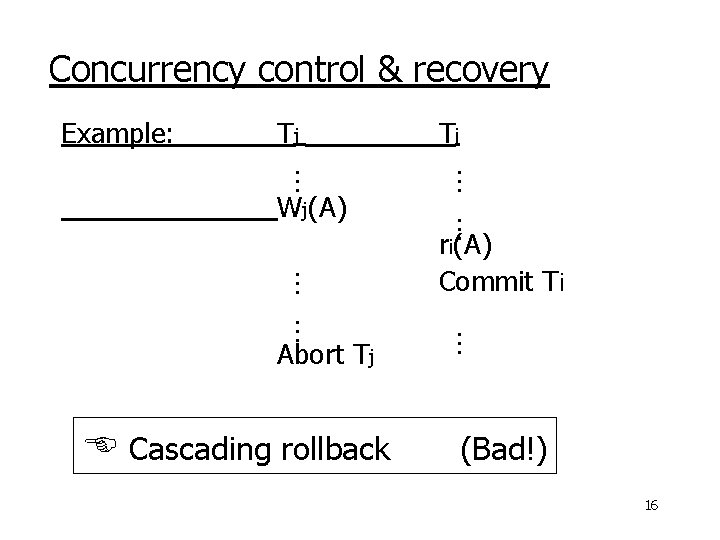
Tj Ti … … Wj(A) Abort Tj Cascading rollback ri(A) Commit Ti … Example: … Concurrency control & recovery (Bad!) 16
• Schedule is conflict serializable • Tj Ti • But not recoverable 17
• Need to make “final’ decision for each transaction: – commit decision - system guarantees transaction will or has completed, no matter what – abort decision - system guarantees transaction will or has been rolled back (has no effect) 18
To model this, two new actions: • Ci - transaction Ti commits • Ai - transaction Ti aborts 19
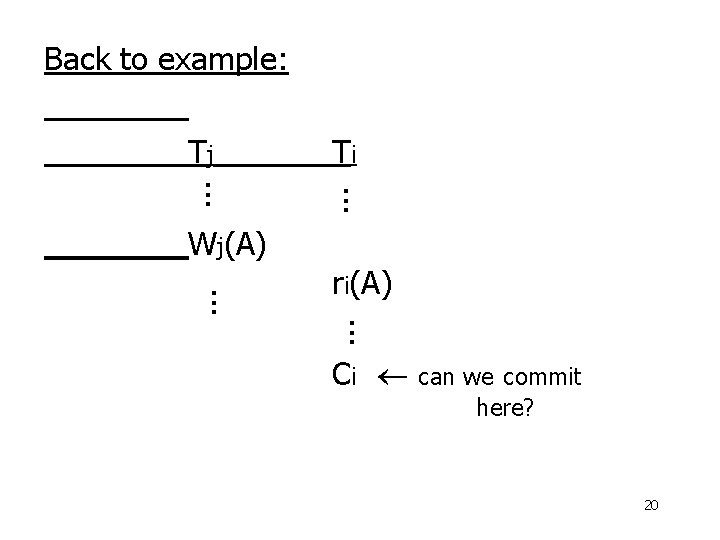
Tj Ti . . . Back to example: ri(A). . . Wj(A) Ci can we commit here? 20
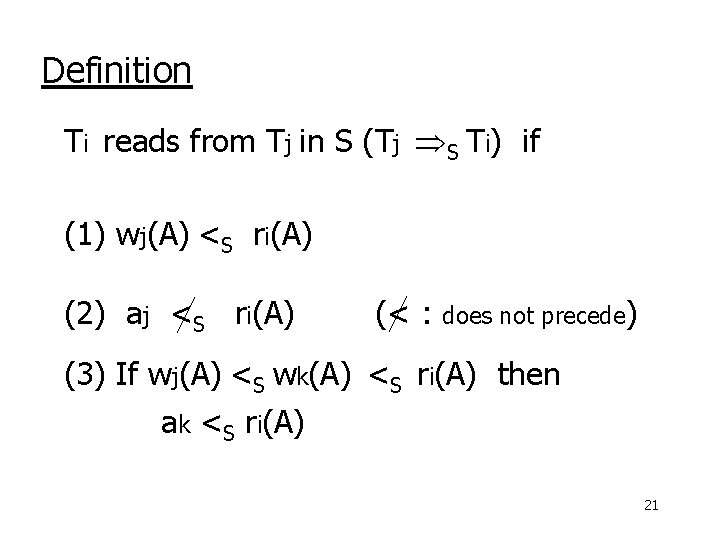
Definition Ti reads from Tj in S (Tj S Ti) if (1) wj(A) <S ri(A) (2) aj <S ri(A) (< : does not precede) (3) If wj(A) <S wk(A) <S ri(A) then ak <S ri(A) 21
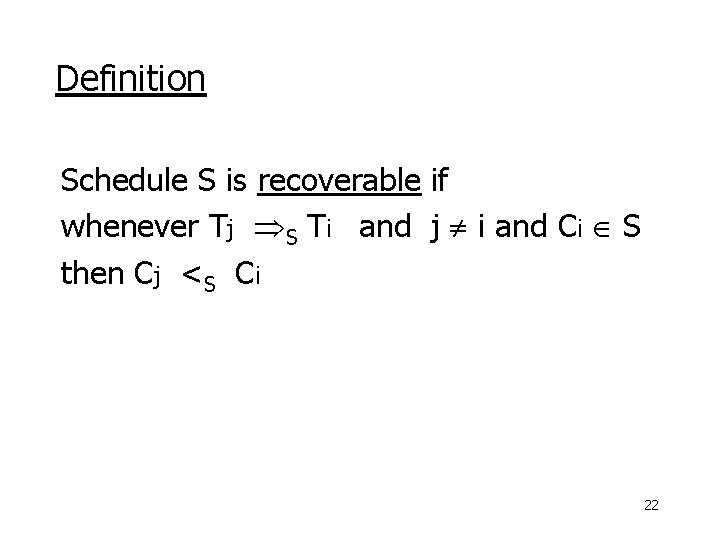
Definition Schedule S is recoverable if whenever Tj S Ti and j i and Ci S then Cj <S Ci 22
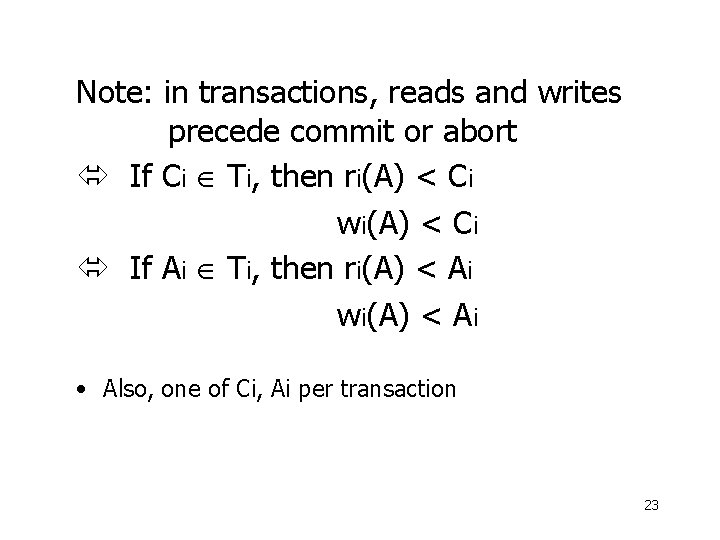
Note: in transactions, reads and writes precede commit or abort If Ci Ti, then ri(A) < Ci wi(A) < Ci If Ai Ti, then ri(A) < Ai wi(A) < Ai • Also, one of Ci, Ai per transaction 23
How to achieve recoverable schedules? 24
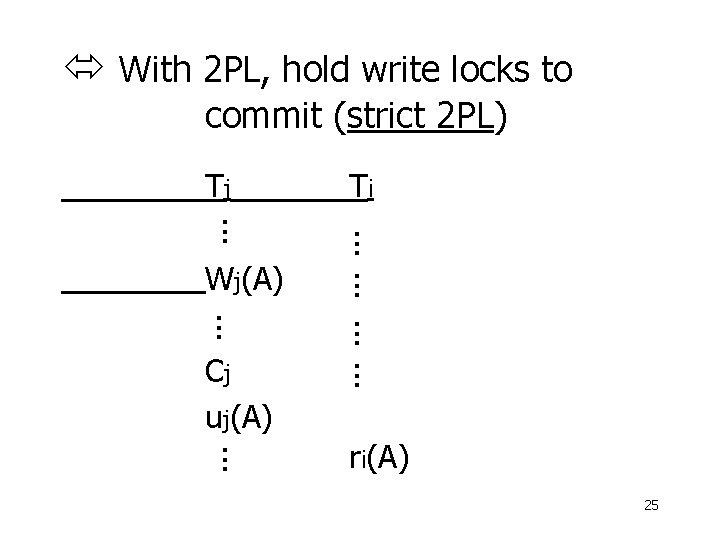
With 2 PL, hold write locks to Tj Ti . . . . commit (strict 2 PL) . . . Wj(A) . . . Cj uj(A) ri(A) 25
With validation, no change! 26
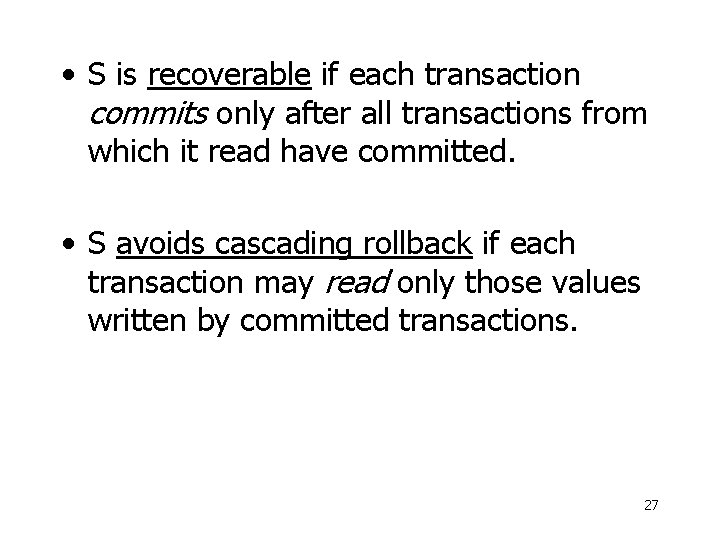
• S is recoverable if each transaction commits only after all transactions from which it read have committed. • S avoids cascading rollback if each transaction may read only those values written by committed transactions. 27
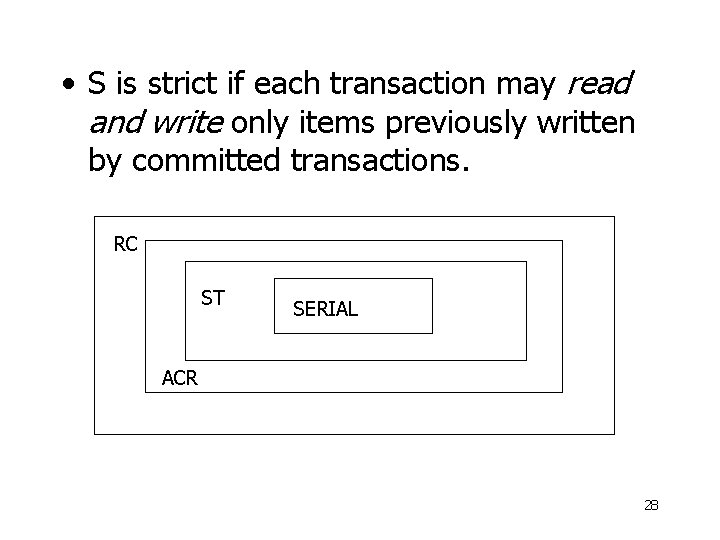
• S is strict if each transaction may read and write only items previously written by committed transactions. RC ST Avoids SERIAL cascading rollback ACR 28
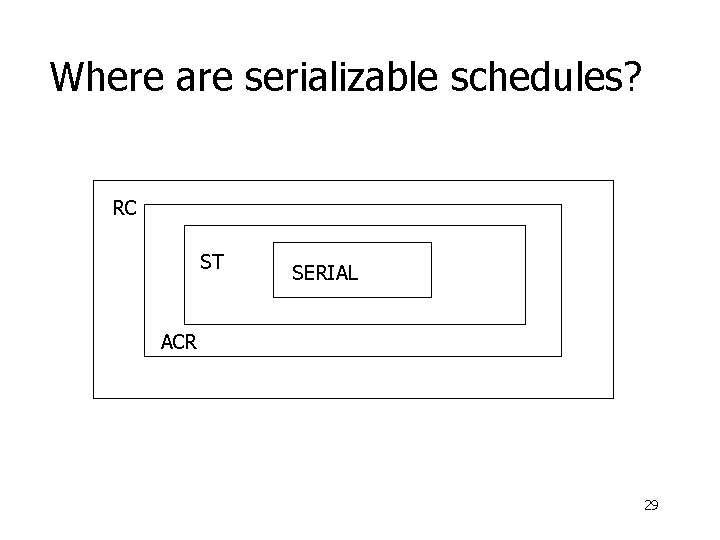
Where are serializable schedules? RC ST Avoids SERIAL cascading rollback ACR 29
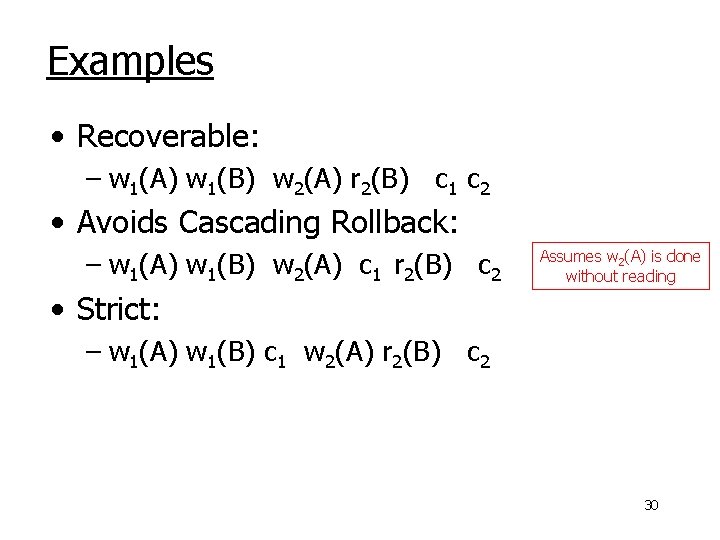
Examples • Recoverable: – w 1(A) w 1(B) w 2(A) r 2(B) c 1 c 2 • Avoids Cascading Rollback: – w 1(A) w 1(B) w 2(A) c 1 r 2(B) c 2 Assumes w 2(A) is done without reading • Strict: – w 1(A) w 1(B) c 1 w 2(A) r 2(B) c 2 30
Deadlocks • Detection – Wait-for graph • Prevention – Resource ordering – Timeout – Wait-die – Wound-wait 31
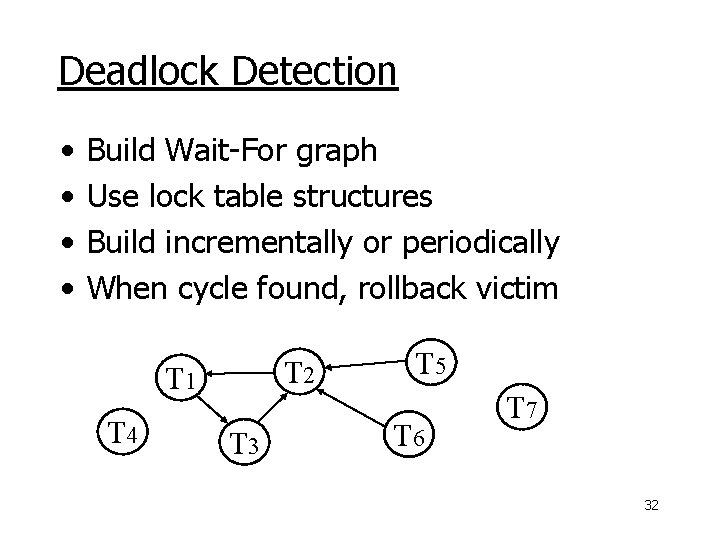
Deadlock Detection • • Build Wait-For graph Use lock table structures Build incrementally or periodically When cycle found, rollback victim T 2 T 1 T 4 T 3 T 5 T 6 T 7 32
Resource Ordering • Order all elements A 1, A 2, …, An • A transaction T can lock Ai after Aj only if i > j Problem : Ordered lock requests not realistic in most cases 33
Timeout • If transaction waits more than L sec. , roll it back! • Simple scheme • Hard to select L 34
Wait-die • Transactions given a timestamp when they arrive …. ts(Ti) • Ti can only wait for Tj if ts(Ti)< ts(Tj). . . else die 35
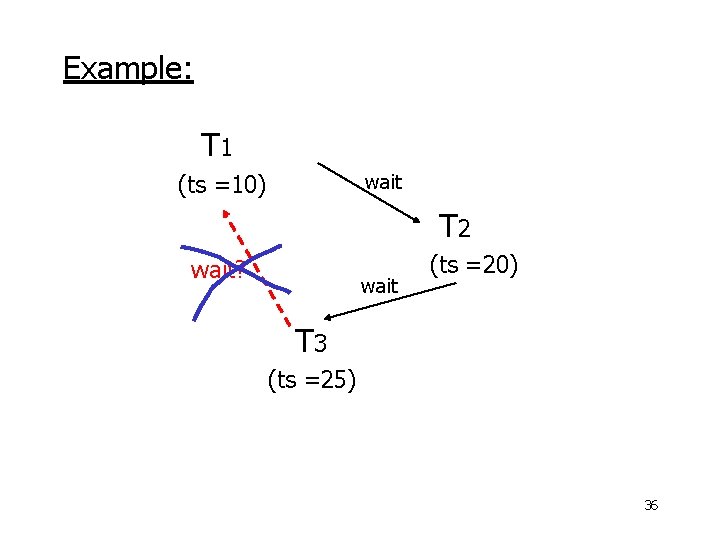
Example: T 1 wait (ts =10) T 2 wait? wait (ts =20) T 3 (ts =25) 36
Wound-wait • Transactions given a timestamp when they arrive … ts(Ti) • Ti wounds Tj if ts(Ti)< ts(Tj) else Ti waits “Wound”: Tj rolls back and gives lock to Ti 37
User/Program commands Lots of variations, but in general • Begin_work • Commit_work • Abort_work 38
Nested transactions. . . User program: . . . Begin_work; If results_ok, then commit work else abort_work 39
Nested transactions. . . User program: Begin_work; . . . If results_ok, then commit work else {abort_work; try something else…} If results_ok, then commit work else abort_work 40
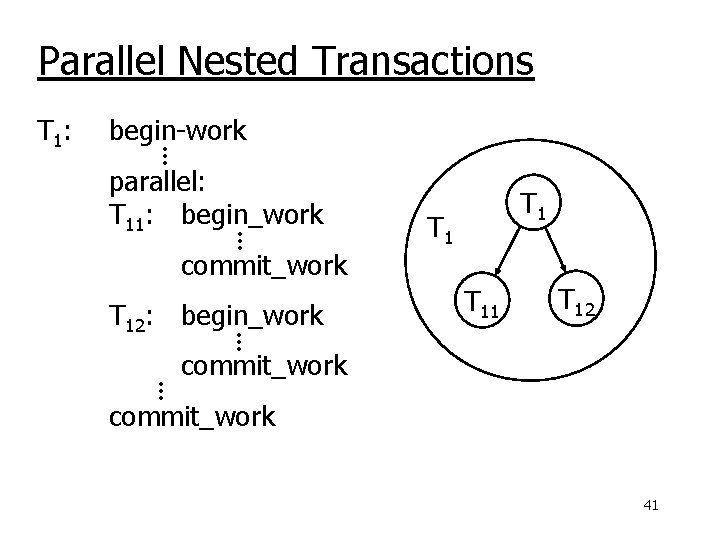
Parallel Nested Transactions. . . begin-work . . . parallel: T 11: begin_work commit_work T 1 T 11 T 12 . . . T 12: begin_work. . . T 1: commit_work 41
Locking What are we really locking? 42
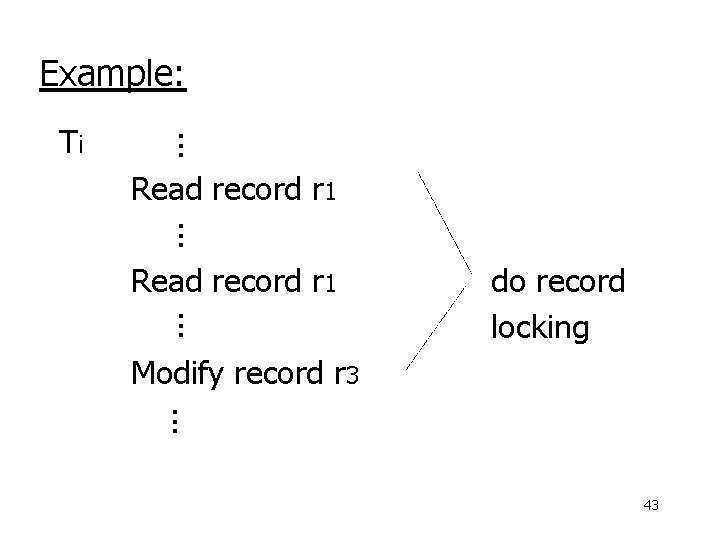
. . . Read record r 1 do record locking Modify record r 3. . . Ti . . . Example: 43
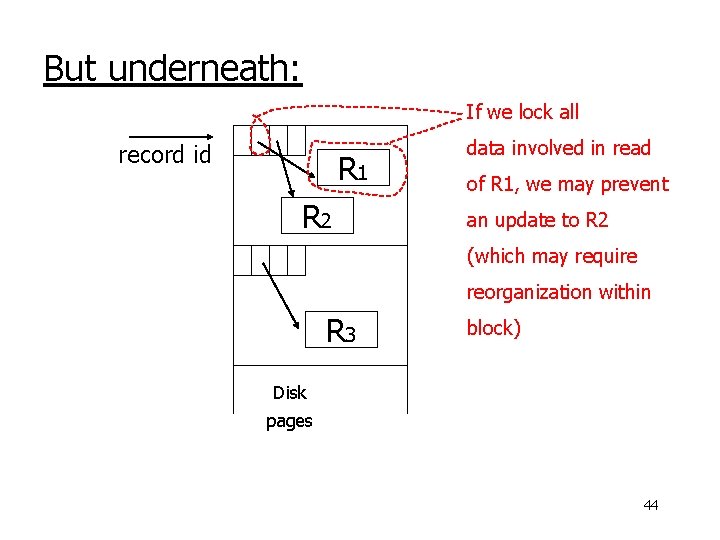
But underneath: If we lock all record id R 1 R 2 data involved in read of R 1, we may prevent an update to R 2 (which may require reorganization within R 3 block) Disk pages 44
Solution: view DB at two levels Top level: record actions record locks undo/redo actions — logical e. g. , Insert record(X, Y, Z) Redo: insert(X, Y, Z) Undo: delete 45
Low level: deal with physical details latch page during action (release at end of action) 46
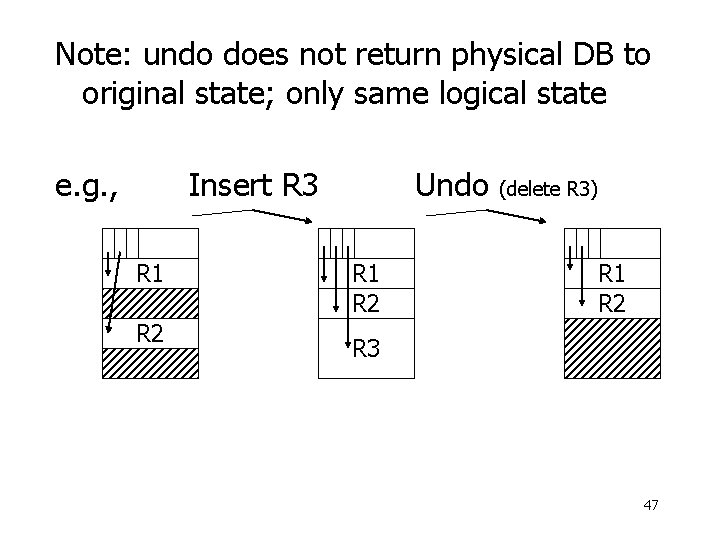
Note: undo does not return physical DB to original state; only same logical state e. g. , Insert R 3 R 1 R 2 Undo R 1 R 2 (delete R 3) R 1 R 2 R 3 47
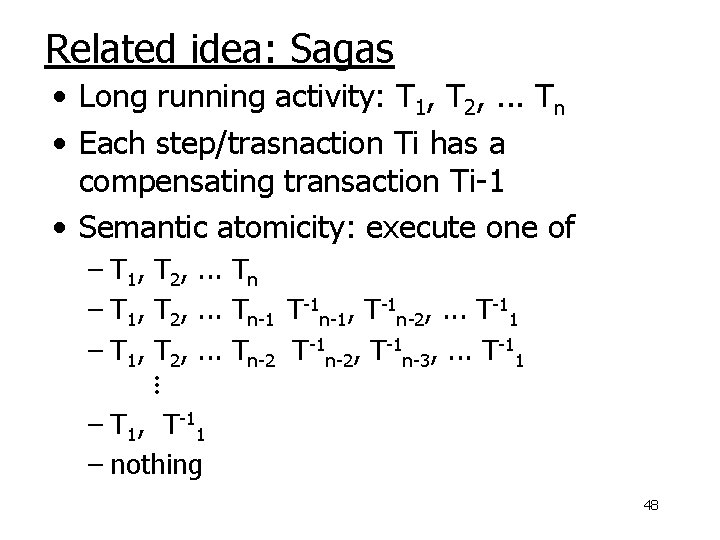
Related idea: Sagas • Long running activity: T 1, T 2, . . . Tn • Each step/trasnaction Ti has a compensating transaction Ti-1 • Semantic atomicity: execute one of . . . – T 1, T 2, . . . Tn-1 T-1 n-1, T-1 n-2, . . . T-11 – T 1, T 2, . . . Tn-2 T-1 n-2, T-1 n-3, . . . T-11 – T 1, T-11 – nothing 48
Summary • Cascading rollback Recoverable schedule • Deadlock – Prevention – Detectoin • Nested transactions • Multi-level view 49
- Slides: 49