
CSE 20 Lecture 7 Boolean Algebra CK Cheng
CSE 20: Lecture 7 Boolean Algebra CK Cheng 1
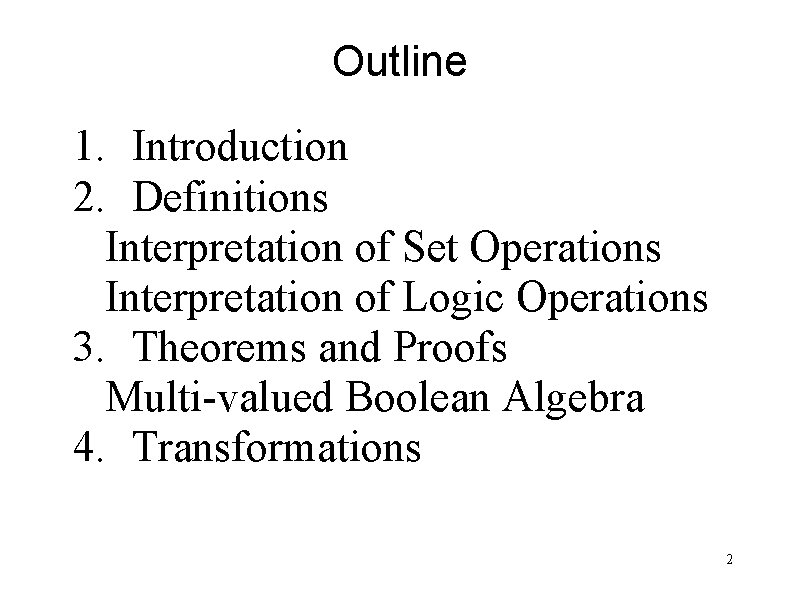
Outline 1. Introduction 2. Definitions Interpretation of Set Operations Interpretation of Logic Operations 3. Theorems and Proofs Multi-valued Boolean Algebra 4. Transformations 2
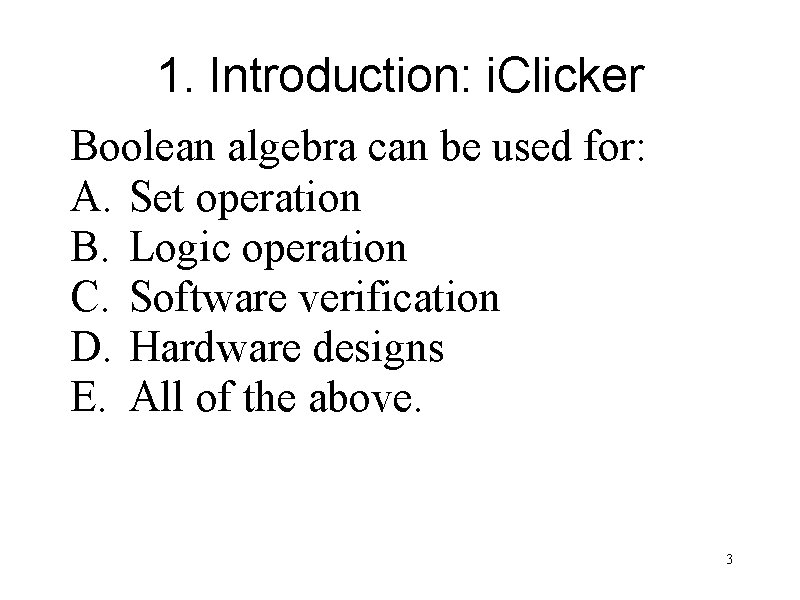
1. Introduction: i. Clicker Boolean algebra can be used for: A. Set operation B. Logic operation C. Software verification D. Hardware designs E. All of the above. 3
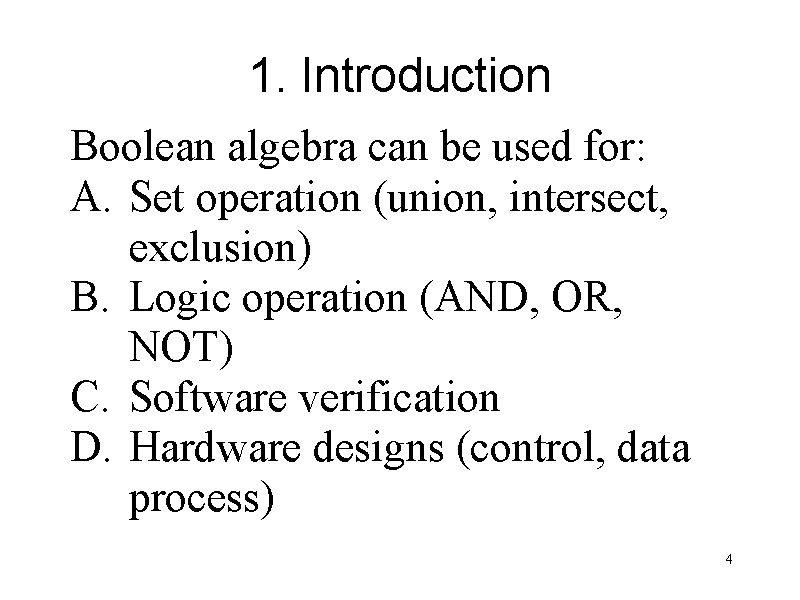
1. Introduction Boolean algebra can be used for: A. Set operation (union, intersect, exclusion) B. Logic operation (AND, OR, NOT) C. Software verification D. Hardware designs (control, data process) 4
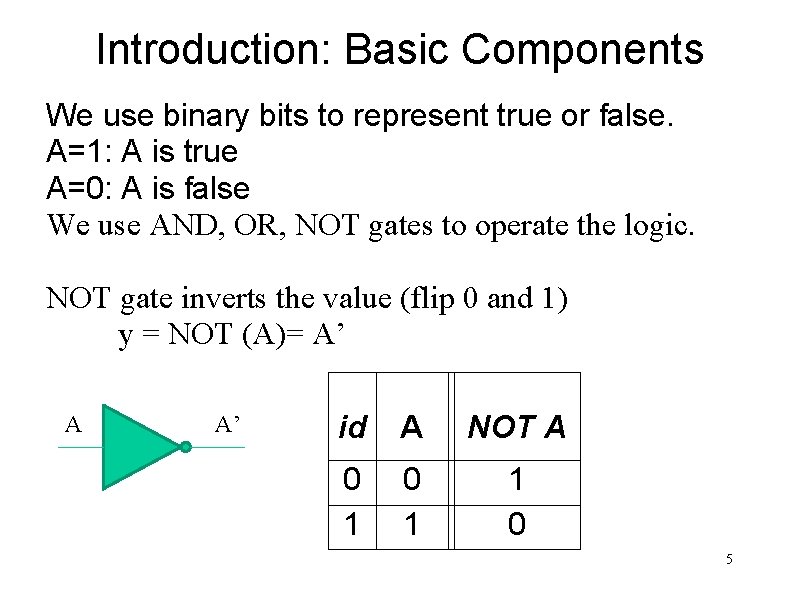
Introduction: Basic Components We use binary bits to represent true or false. A=1: A is true A=0: A is false We use AND, OR, NOT gates to operate the logic. NOT gate inverts the value (flip 0 and 1) y = NOT (A)= A’ A A’ id A NOT A 0 1 1 0 5
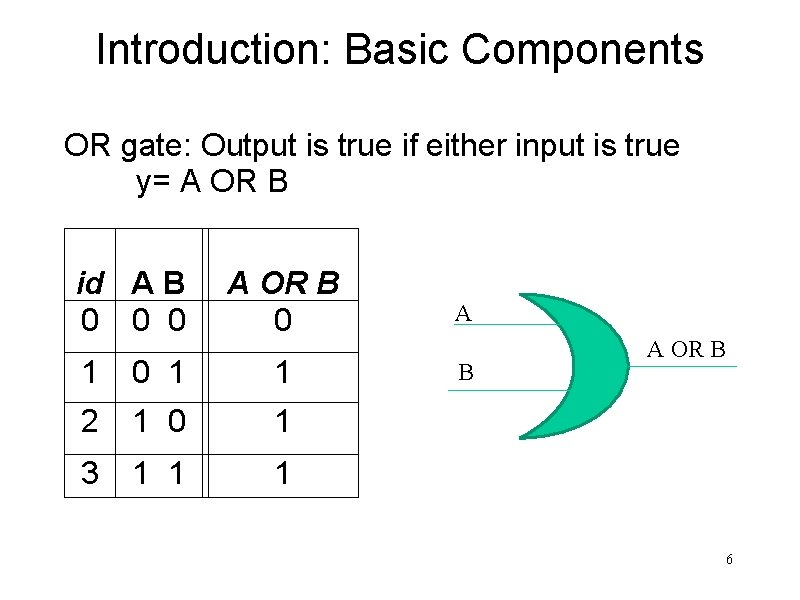
Introduction: Basic Components OR gate: Output is true if either input is true y= A OR B id A B 0 0 0 A OR B 0 A B 1 0 1 1 2 1 0 1 3 1 1 1 A OR B 6
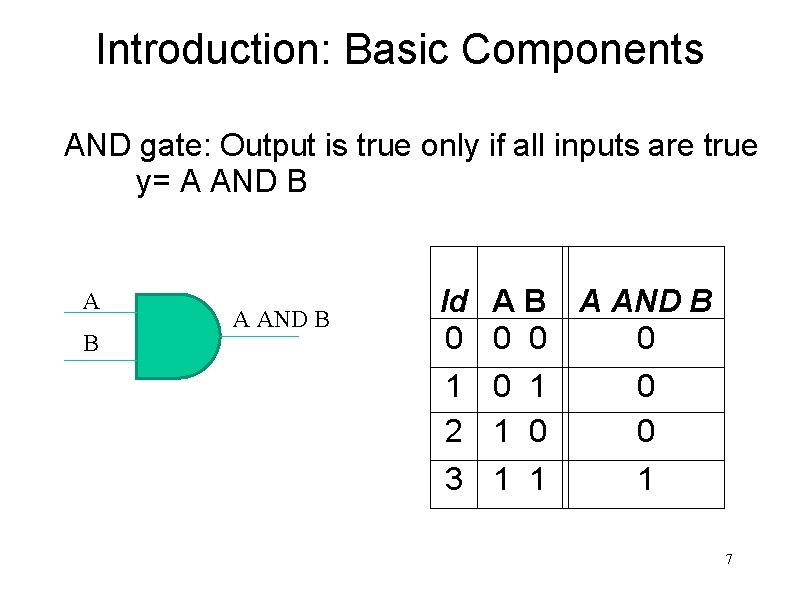
Introduction: Basic Components AND gate: Output is true only if all inputs are true y= A AND B Id A B 0 0 0 A AND B 0 1 2 1 0 0 0 3 1 1 1 7
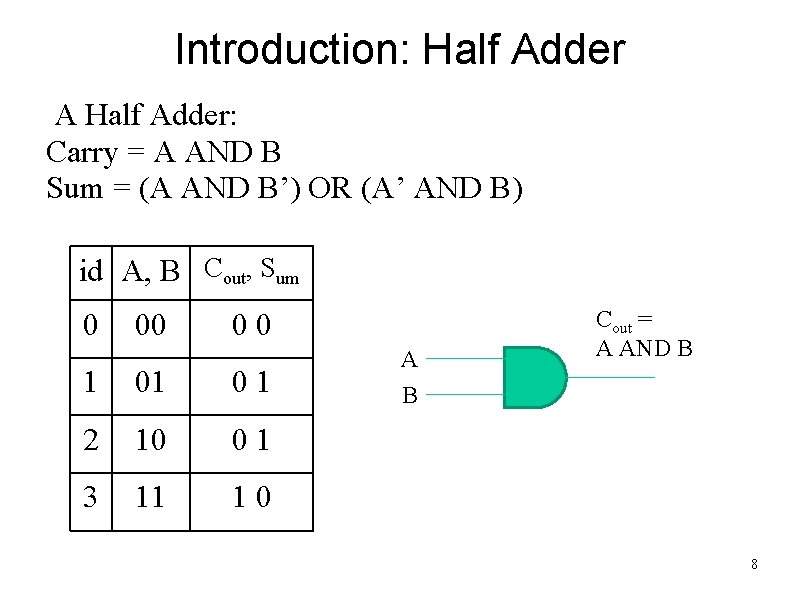
Introduction: Half Adder A Half Adder: Carry = A AND B Sum = (A AND B’) OR (A’ AND B) id A, B Cout, Sum 0 00 00 1 01 01 2 10 01 3 11 10 A B Cout = A AND B 8
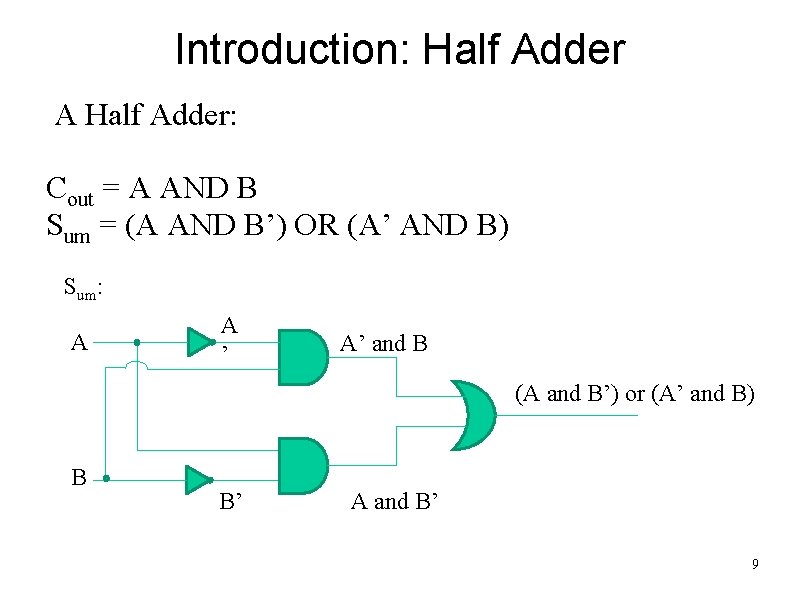
Introduction: Half Adder A Half Adder: Cout = A AND B Sum = (A AND B’) OR (A’ AND B) Sum: A A ’ A’ and B (A and B’) or (A’ and B) B B’ A and B’ 9
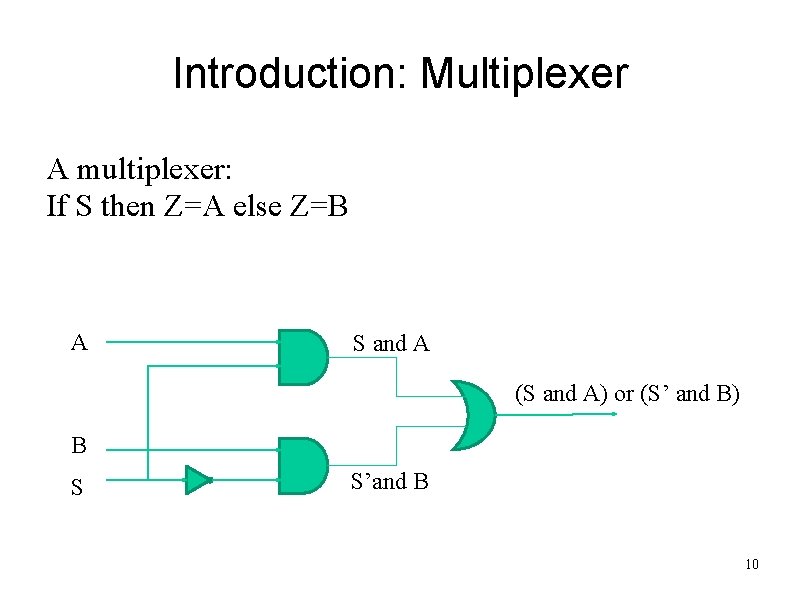
Introduction: Multiplexer A multiplexer: If S then Z=A else Z=B A S and A (S and A) or (S’ and B) B S S’and B 10
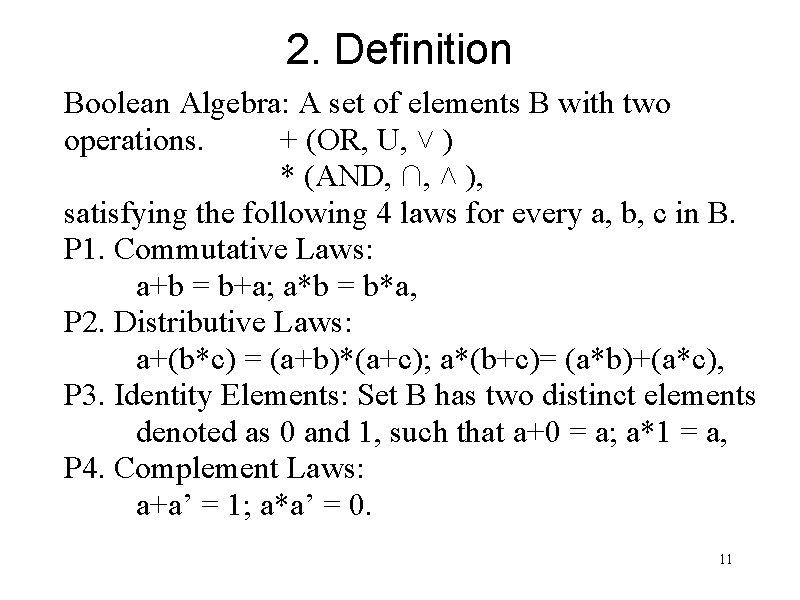
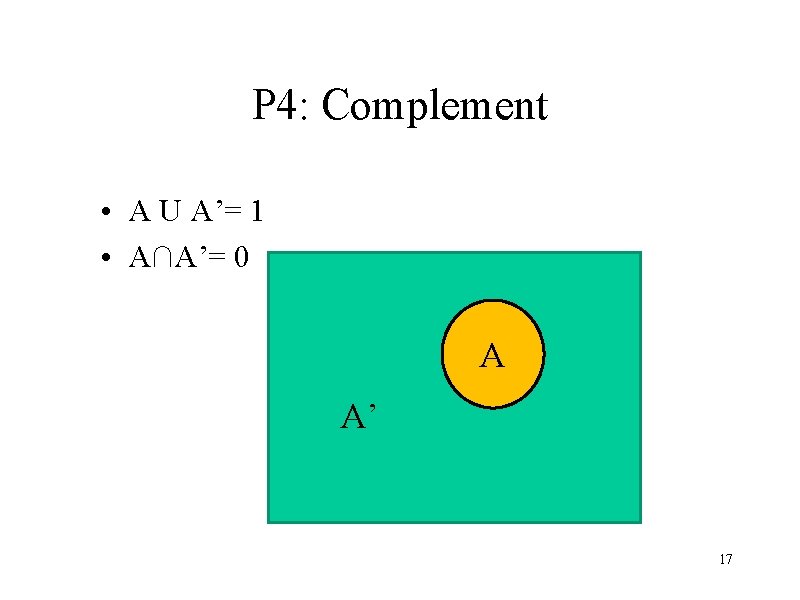
2. Definition Boolean Algebra: A set of elements B with two operations. + (OR, U, ˅ ) * (AND, ∩, ˄ ), satisfying the following 4 laws for every a, b, c in B. P 1. Commutative Laws: a+b = b+a; a*b = b*a, P 2. Distributive Laws: a+(b*c) = (a+b)*(a+c); a*(b+c)= (a*b)+(a*c), P 3. Identity Elements: Set B has two distinct elements denoted as 0 and 1, such that a+0 = a; a*1 = a, P 4. Complement Laws: a+a’ = 1; a*a’ = 0. 11
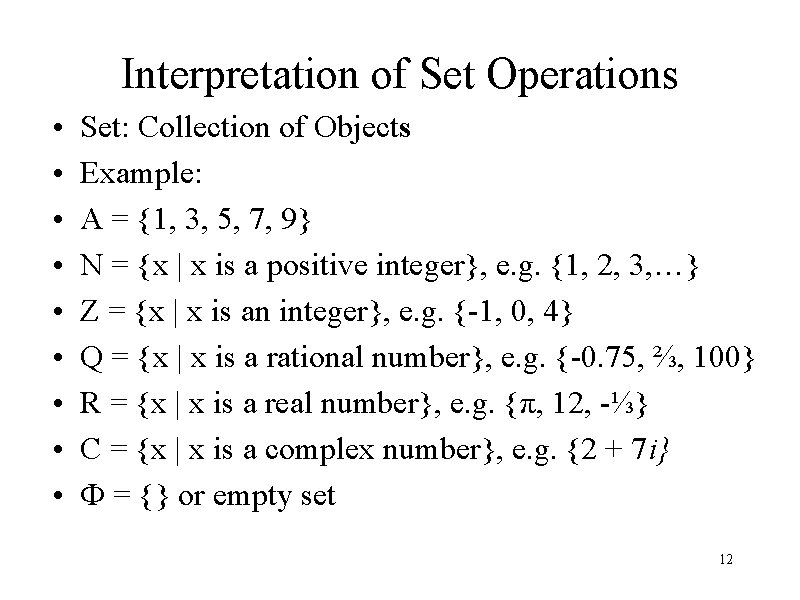
Interpretation of Set Operations • • • Set: Collection of Objects Example: A = {1, 3, 5, 7, 9} N = {x | x is a positive integer}, e. g. {1, 2, 3, …} Z = {x | x is an integer}, e. g. {-1, 0, 4} Q = {x | x is a rational number}, e. g. {-0. 75, ⅔, 100} R = {x | x is a real number}, e. g. {π, 12, -⅓} C = {x | x is a complex number}, e. g. {2 + 7 i} Ф = {} or empty set 12
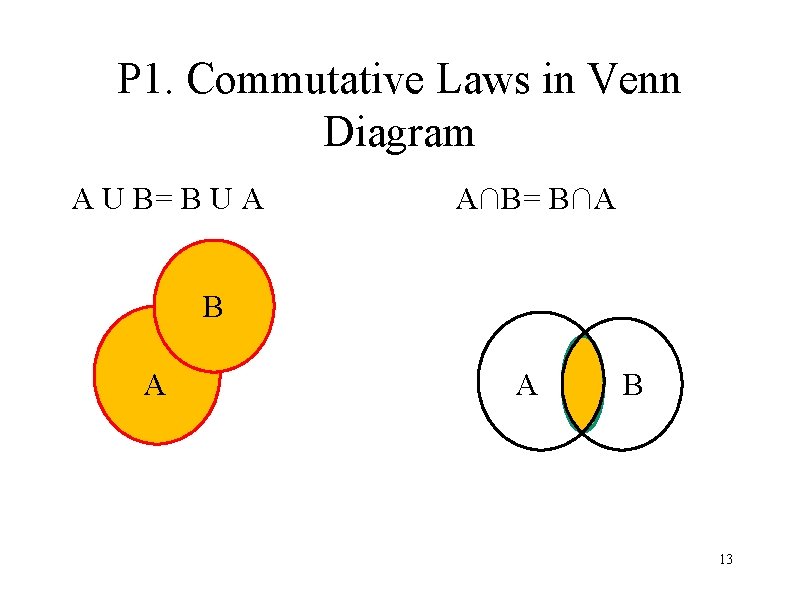
P 1. Commutative Laws in Venn Diagram A U B= B U A A∩B= B∩A B A A B 13
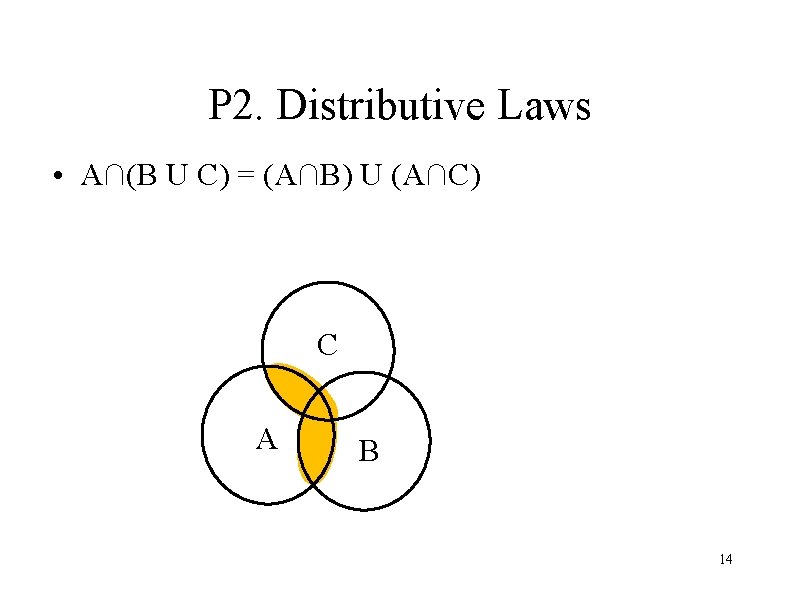
P 2. Distributive Laws • A∩(B U C) = (A∩B) U (A∩C) C A B 14
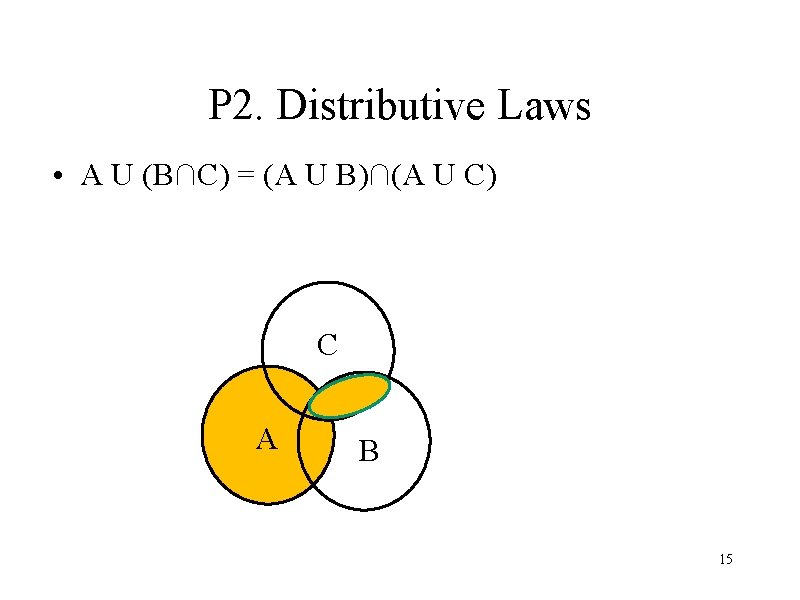
P 2. Distributive Laws • A U (B∩C) = (A U B)∩(A U C) C A B 15
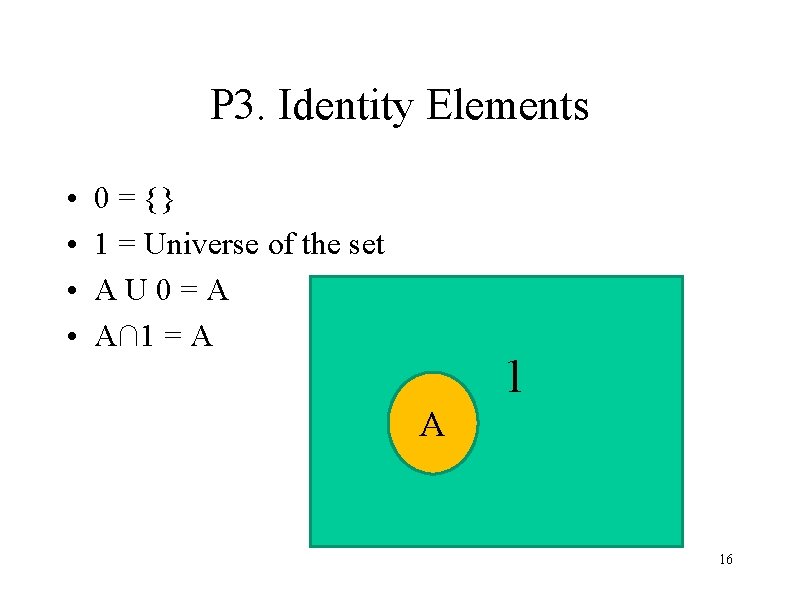
P 3. Identity Elements • • 0 = {} 1 = Universe of the set AU 0=A A∩ 1 = A 16
P 4: Complement • A U A’= 1 • A∩A’= 0 A A’ 17
- Slides: 17