
CSE 20 Discrete Mathematics for Computer Science Prof
- Slides: 26
CSE 20: Discrete Mathematics for Computer Science Prof. Shachar Lovett
2 Today’s Topics: 1. Mathematical Induction Proof Examples
3 1. Mathematical Induction
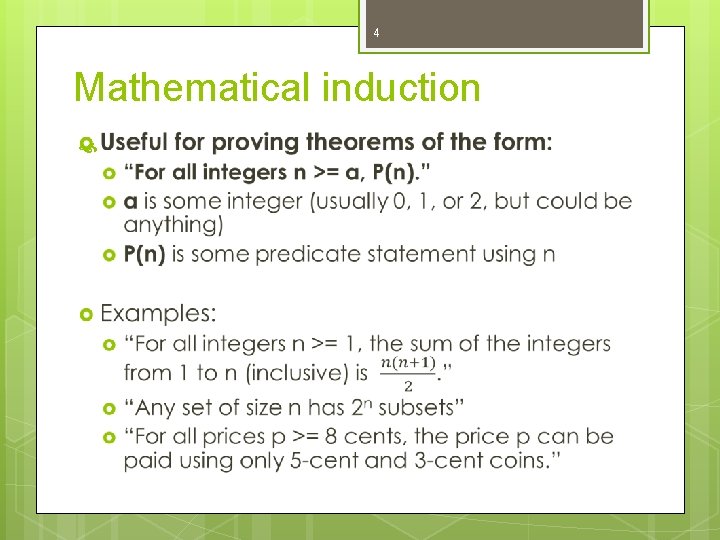
4 Mathematical induction
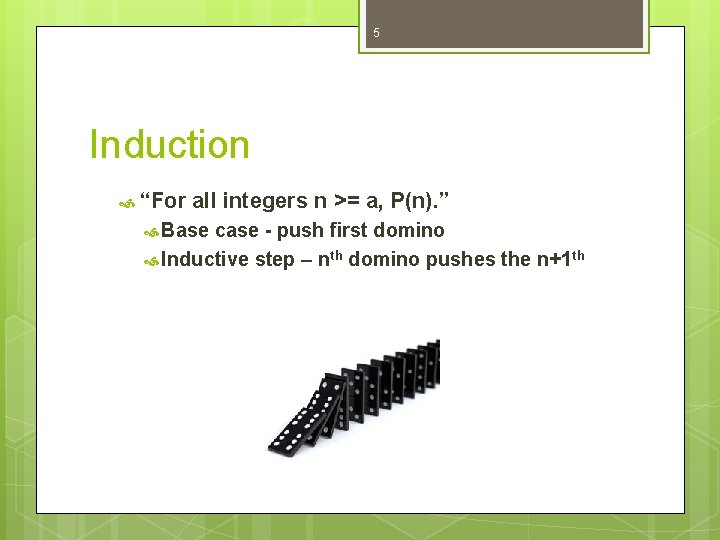
5 Induction “For all integers n >= a, P(n). ” Base case - push first domino Inductive step – nth domino pushes the n+1 th
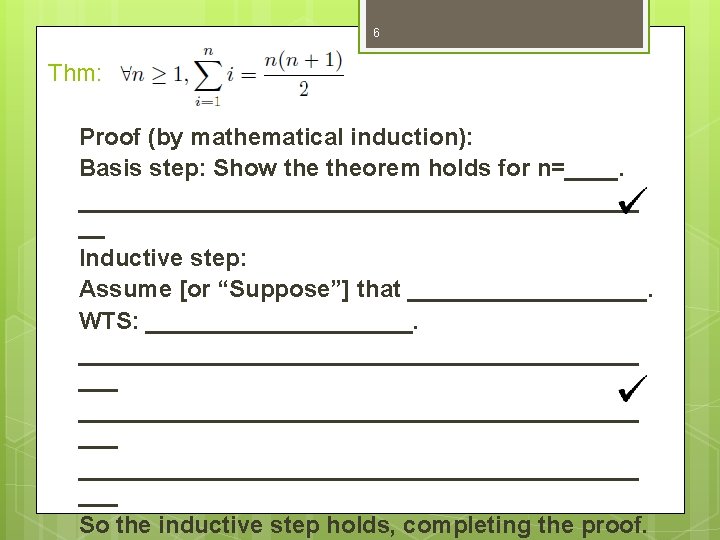
6 Thm: Proof (by mathematical induction): Basis step: Show theorem holds for n=_____________________ __ Inductive step: Assume [or “Suppose”] that _________. WTS: __________________________________________ ___ So the inductive step holds, completing the proof.
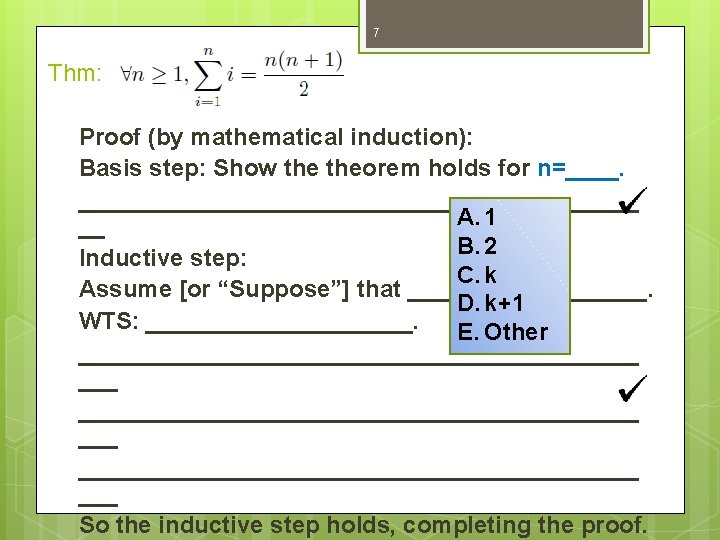
7 Thm: Proof (by mathematical induction): Basis step: Show theorem holds for n=_____________________ A. 1 __ B. 2 Inductive step: C. k Assume [or “Suppose”] that _________. D. k+1 WTS: __________. E. Other __________________________________________ ___ So the inductive step holds, completing the proof.
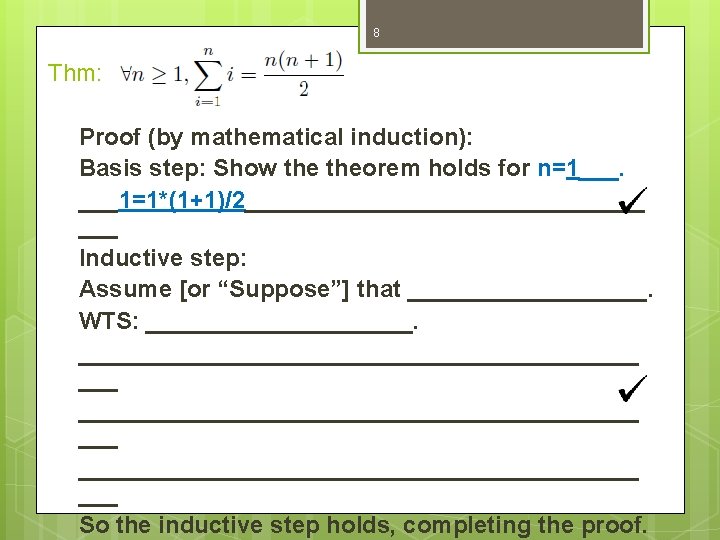
8 Thm: Proof (by mathematical induction): Basis step: Show theorem holds for n=1___. ___1=1*(1+1)/2_______________ ___ Inductive step: Assume [or “Suppose”] that _________. WTS: __________________________________________ ___ So the inductive step holds, completing the proof.
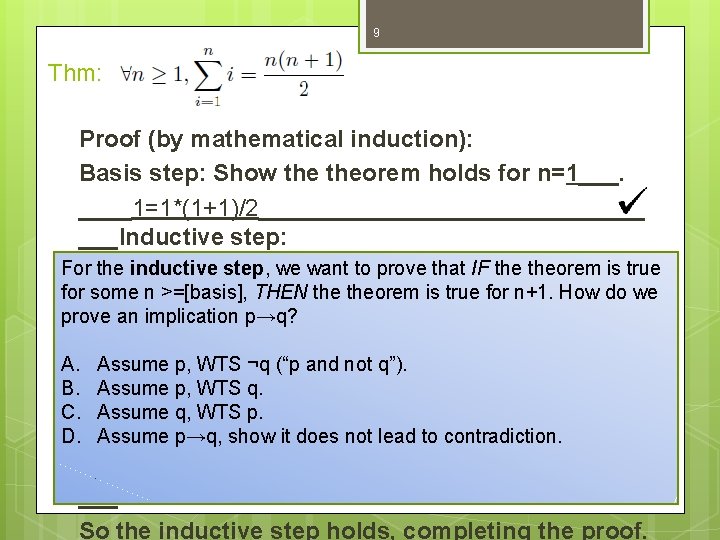
9 Thm: Proof (by mathematical induction): Basis step: Show theorem holds for n=1___. ____1=1*(1+1)/2_______________ ___Inductive step: For the inductive step, we want to prove that IF theorem is true Assume [or “Suppose”] that _________. for some n >=[basis], THEN theorem is true for n+1. How do we WTS: __________. prove an implication p→q? _____________________ Assume p, WTS ¬q (“p and not q”). B. Assume p, WTS q. C. _____________________ Assume q, WTS p. D. ___ Assume p→q, show it does not lead to contradiction. _____________________ ___ So the inductive step holds, completing the proof.
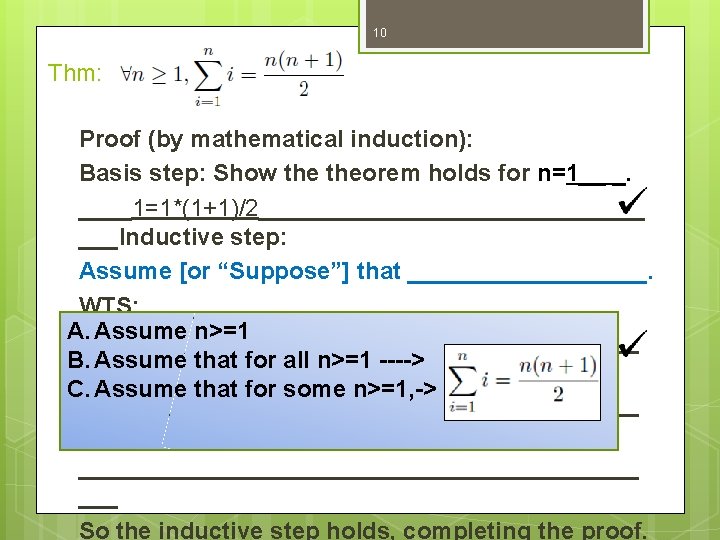
10 Thm: Proof (by mathematical induction): Basis step: Show theorem holds for n=1__ _. ____1=1*(1+1)/2_______________ ___Inductive step: Assume [or “Suppose”] that _________. WTS: __________. A. Assume n>=1 _____________________ B. Assume that for all n>=1 ----> ___ C. Assume that for some n>=1, -> __________________________________________ ___ So the inductive step holds, completing the proof.
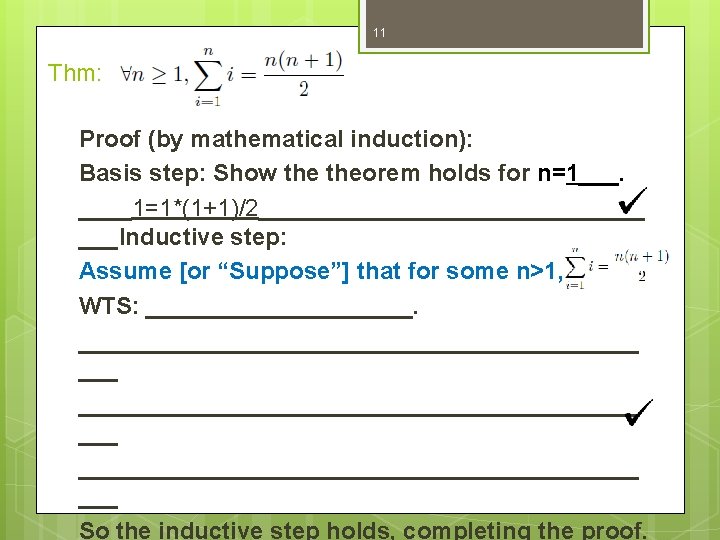
11 Thm: Proof (by mathematical induction): Basis step: Show theorem holds for n=1___. ____1=1*(1+1)/2_______________ ___Inductive step: Assume [or “Suppose”] that for some n>1, WTS: __________________________________________ ___ So the inductive step holds, completing the proof.
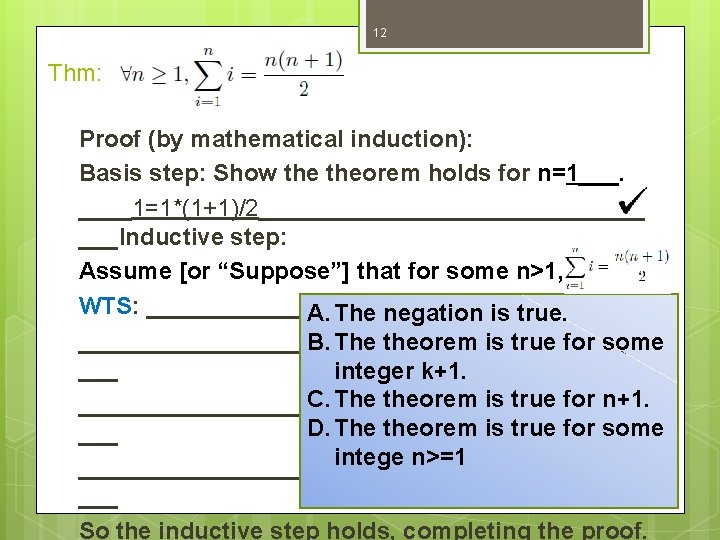
12 Thm: Proof (by mathematical induction): Basis step: Show theorem holds for n=1___. ____1=1*(1+1)/2_______________ ___Inductive step: Assume [or “Suppose”] that for some n>1, WTS: __________. A. The negation is true. _____________________ B. The theorem is true for some ___ integer k+1. C. The theorem is true for n+1. _____________________ D. The theorem is true for some ___ intege n>=1 _____________________ ___ So the inductive step holds, completing the proof.
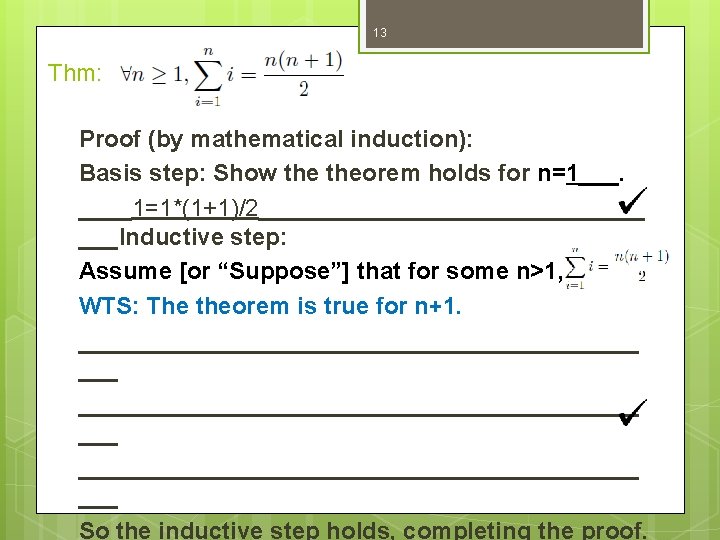
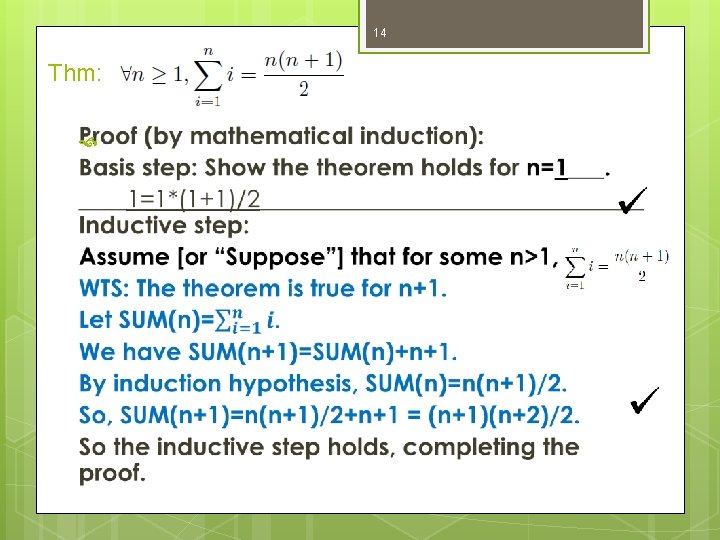
13 Thm: Proof (by mathematical induction): Basis step: Show theorem holds for n=1___. ____1=1*(1+1)/2_______________ ___Inductive step: Assume [or “Suppose”] that for some n>1, WTS: The theorem is true for n+1. __________________________________________ ___ So the inductive step holds, completing the proof.
14 Thm:
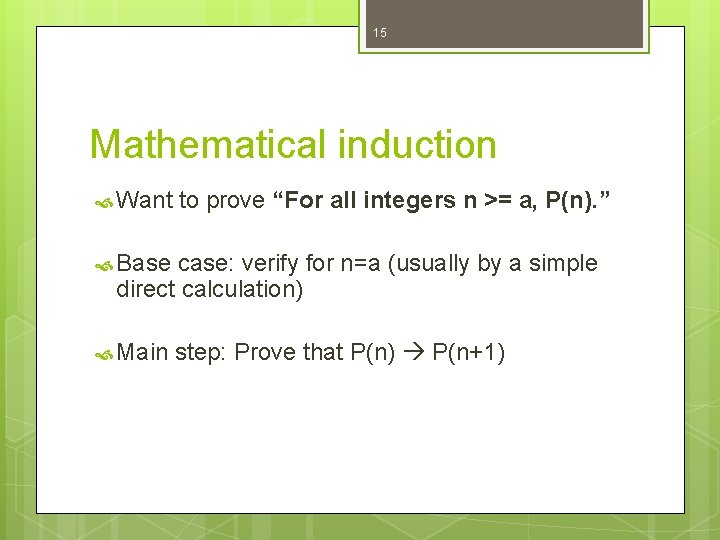
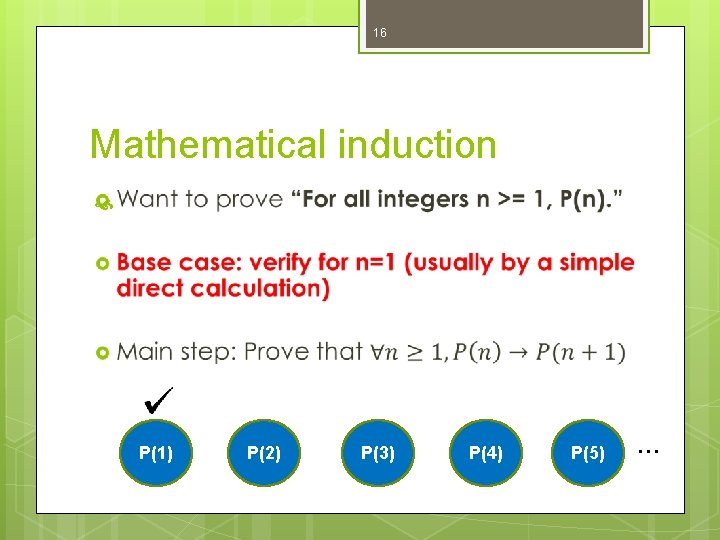
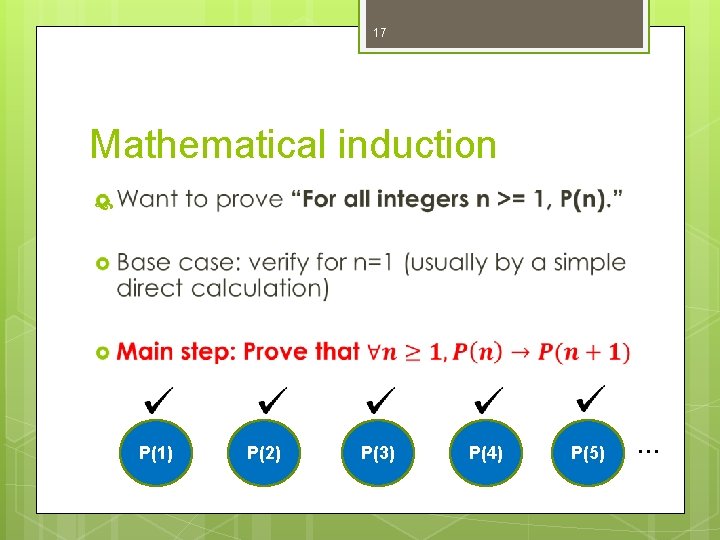
15 Mathematical induction Want to prove “For all integers n >= a, P(n). ” Base case: verify for n=a (usually by a simple direct calculation) Main step: Prove that P(n) P(n+1)
16 Mathematical induction P(1) P(2) P(3) P(4) P(5) …
17 Mathematical induction P(1) P(2) P(3) P(4) P(5) …
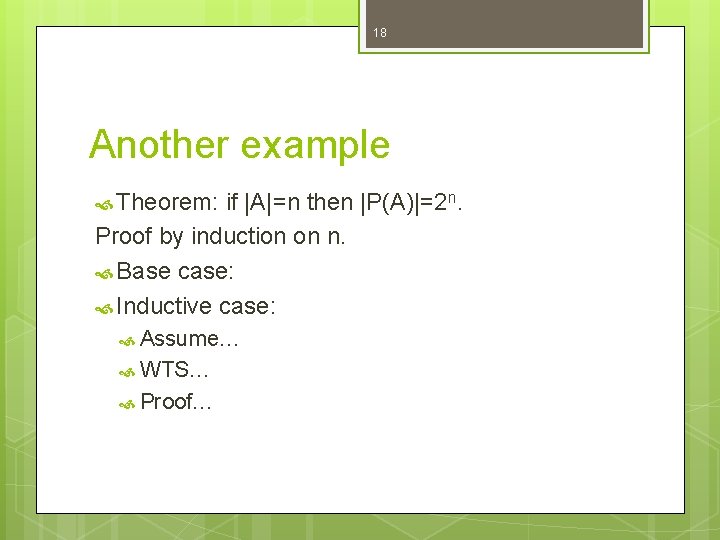
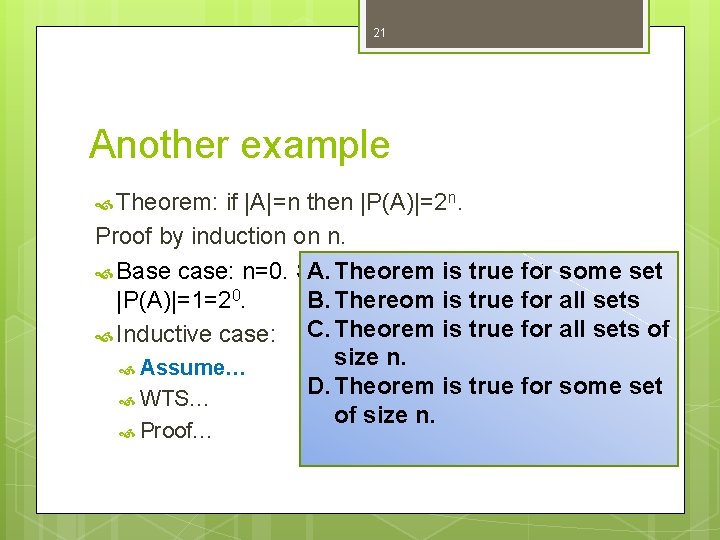
18 Another example Theorem: if |A|=n then |P(A)|=2 n. Proof by induction on n. Base case: Inductive case: Assume… WTS… Proof…
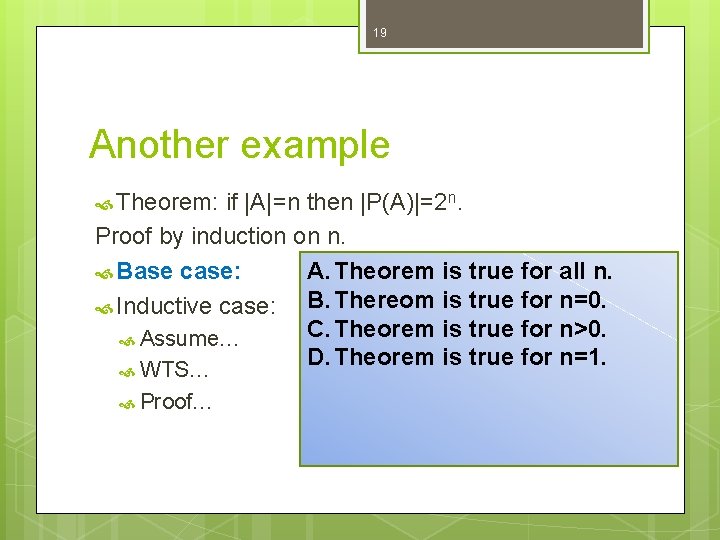
19 Another example Theorem: if |A|=n then |P(A)|=2 n. Proof by induction on n. A. Theorem is true for all n. Base case: B. Thereom is true for n=0. Inductive case: C. Theorem is true for n>0. Assume… D. Theorem is true for n=1. WTS… Proof…
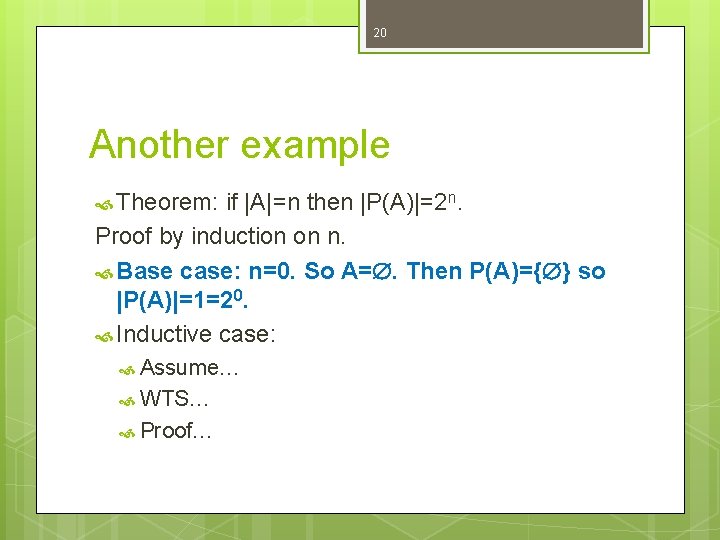
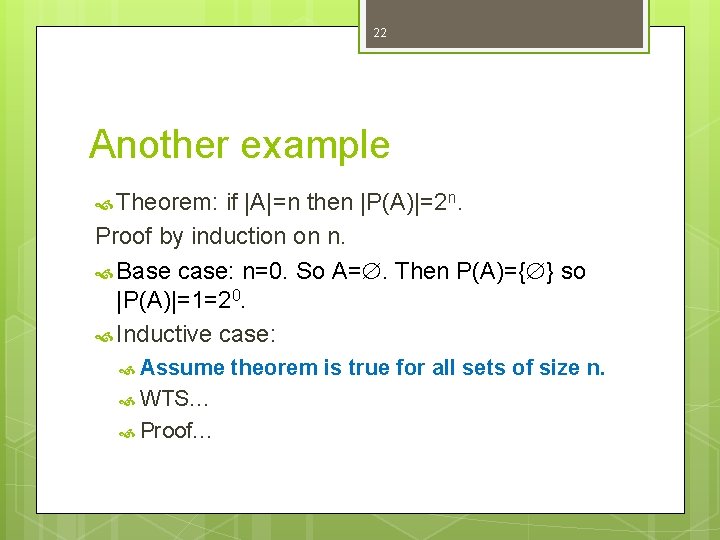
20 Another example Theorem: if |A|=n then |P(A)|=2 n. Proof by induction on n. Base case: n=0. So A=. Then P(A)={ } so |P(A)|=1=20. Inductive case: Assume… WTS… Proof…
21 Another example Theorem: if |A|=n then |P(A)|=2 n. Proof by induction on n. A. Theorem is true for some set Base case: n=0. So A=. Then P(A)={ } so B. Thereom is true for all sets |P(A)|=1=20. C. Theorem is true for all sets of Inductive case: size n. Assume… D. Theorem is true for some set WTS… of size n. Proof…
22 Another example Theorem: if |A|=n then |P(A)|=2 n. Proof by induction on n. Base case: n=0. So A=. Then P(A)={ } so |P(A)|=1=20. Inductive case: Assume WTS… Proof… theorem is true for all sets of size n.
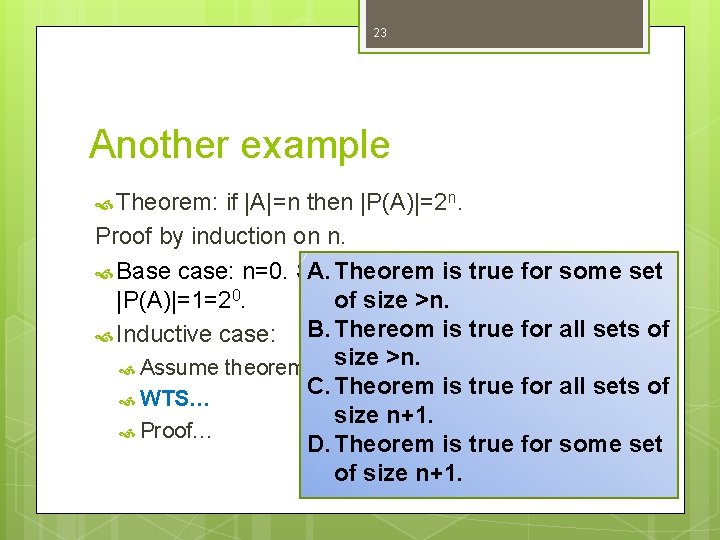
23 Another example Theorem: if |A|=n then |P(A)|=2 n. Proof by induction on n. A. Theorem is true for some set Base case: n=0. So A=. Then P(A)={ } so of size >n. |P(A)|=1=20. B. Thereom is true for all sets of Inductive case: size >n. Assume theorem is true for all sets of size n. C. Theorem is true for all sets of WTS… size n+1. Proof… D. Theorem is true for some set of size n+1.
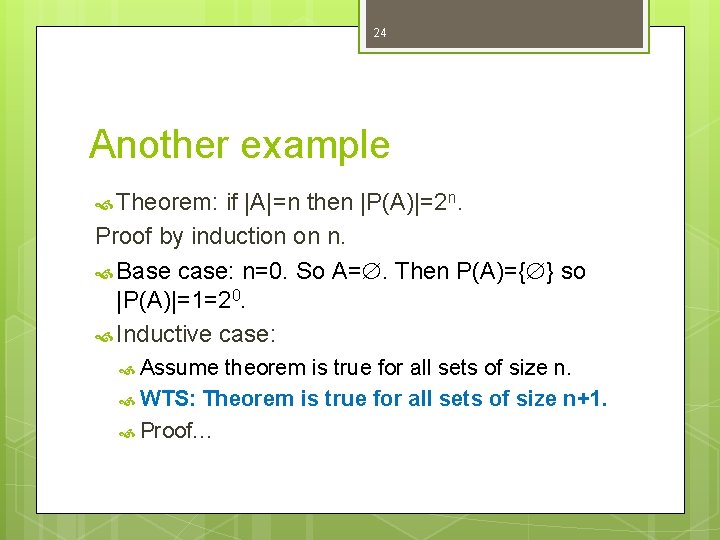
24 Another example Theorem: if |A|=n then |P(A)|=2 n. Proof by induction on n. Base case: n=0. So A=. Then P(A)={ } so |P(A)|=1=20. Inductive case: Assume theorem is true for all sets of size n. WTS: Theorem is true for all sets of size n+1. Proof…
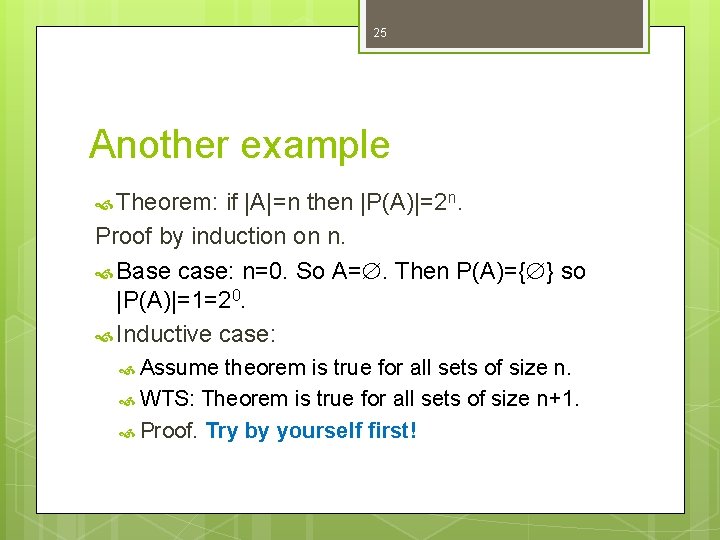
25 Another example Theorem: if |A|=n then |P(A)|=2 n. Proof by induction on n. Base case: n=0. So A=. Then P(A)={ } so |P(A)|=1=20. Inductive case: Assume theorem is true for all sets of size n. WTS: Theorem is true for all sets of size n+1. Proof. Try by yourself first!
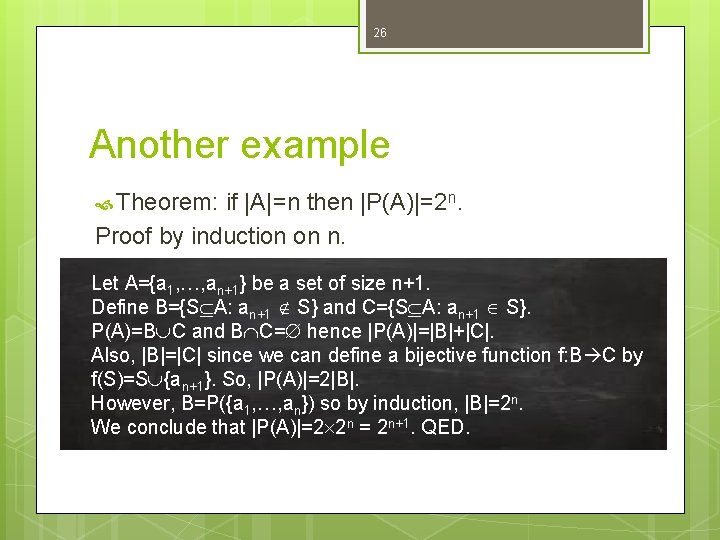
26 Another example Theorem: if |A|=n then |P(A)|=2 n. Proof by induction on n. Base case: n=0. So A=. Then P(A)={ } so Let A={a 1, …, an+1} be a set of size n+1. |P(A)|=1=20. n+1 S} and C={S A: an+1 S}. Define B={S A: a P(A)=B C and B C= hence |P(A)|=|B|+|C|. Inductive case: Also, |B|=|C| since we can define a bijective function f: B C by Assume theorem is true for all sets of size n. f(S)=S {an+1}. So, |P(A)|=2|B|. n WTS: Theorem is true for all sets of size n+1. However, B=P({a 1, …, an}) so by induction, |B|=2. n = 2 n+1. QED. We conclude that |P(A)|=2 2 Proof…