
CSE 20 DISCRETE MATH Prof Shachar Lovett http
- Slides: 18
CSE 20 DISCRETE MATH Prof. Shachar Lovett http: //cseweb. ucsd. edu/classes/wi 15/cse 20 -a/ Clicker frequency: CA
Todays topics • Direct proofs • Section 3. 5 in Jenkyns, Stephenson
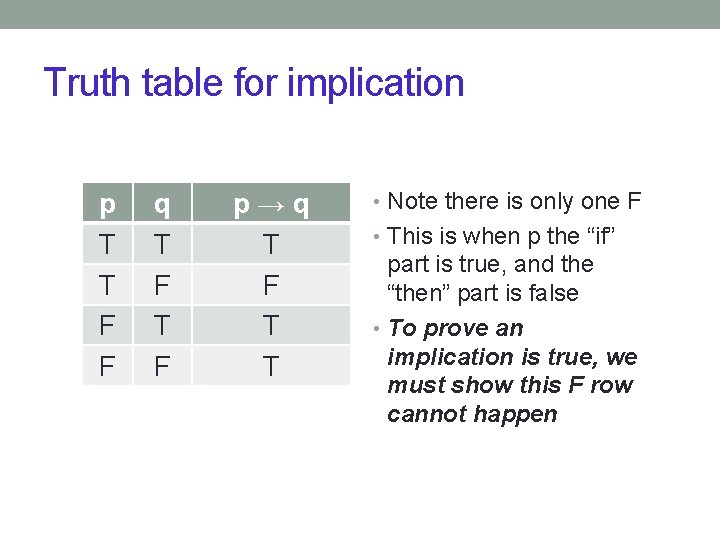
Truth table for implication p T T F F q T F p→q T F T T • Note there is only one F • This is when p the “if” part is true, and the “then” part is false • To prove an implication is true, we must show this F row cannot happen
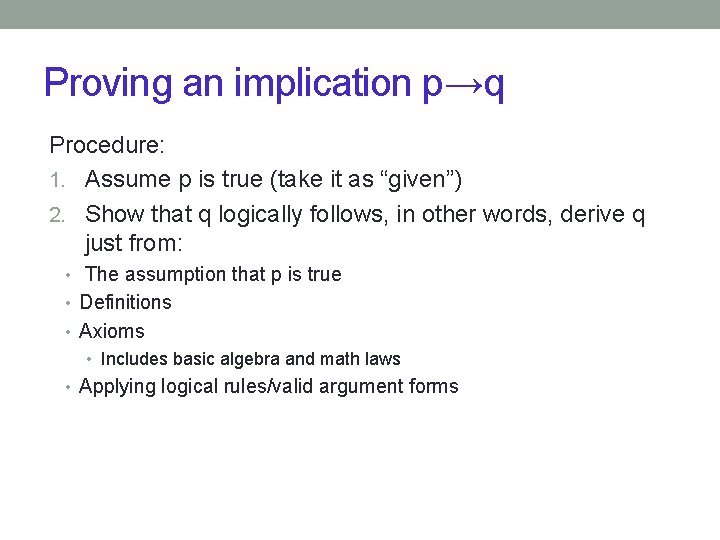
Proving an implication p→q Procedure: 1. Assume p is true (take it as “given”) 2. Show that q logically follows, in other words, derive q just from: • The assumption that p is true • Definitions • Axioms • Includes basic algebra and math laws • Applying logical rules/valid argument forms
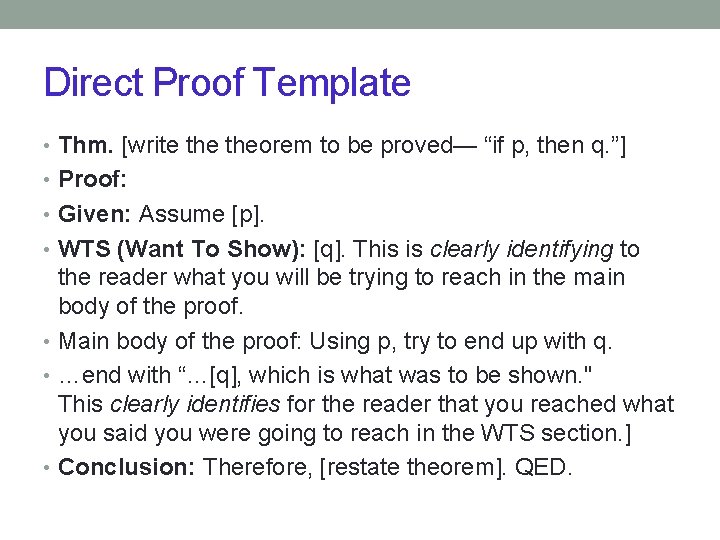
Direct Proof Template • Thm. [write theorem to be proved— “if p, then q. ”] • Proof: • Given: Assume [p]. • WTS (Want To Show): [q]. This is clearly identifying to the reader what you will be trying to reach in the main body of the proof. • Main body of the proof: Using p, try to end up with q. • …end with “…[q], which is what was to be shown. " This clearly identifies for the reader that you reached what you said you were going to reach in the WTS section. ] • Conclusion: Therefore, [restate theorem]. QED.
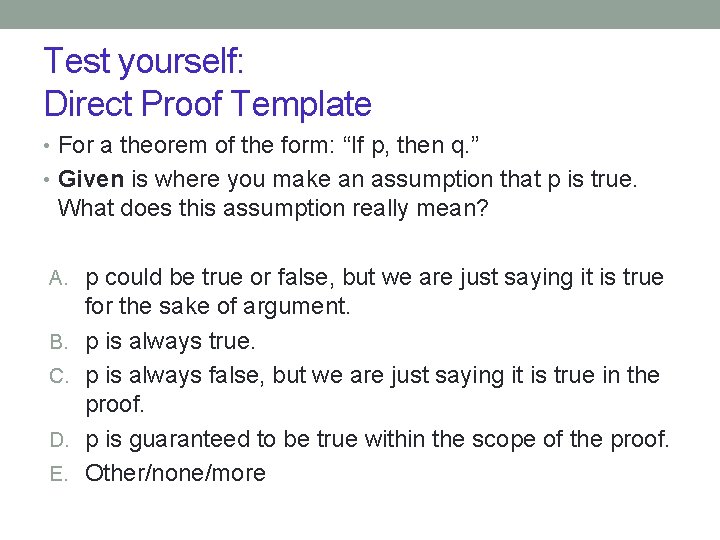
Test yourself: Direct Proof Template • For a theorem of the form: “If p, then q. ” • Given is where you make an assumption that p is true. What does this assumption really mean? A. p could be true or false, but we are just saying it is true B. C. D. E. for the sake of argument. p is always true. p is always false, but we are just saying it is true in the proof. p is guaranteed to be true within the scope of the proof. Other/none/more
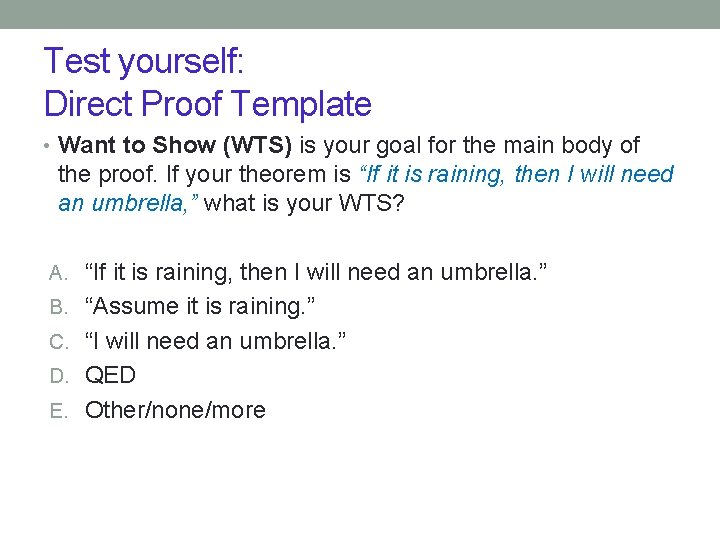
Test yourself: Direct Proof Template • Want to Show (WTS) is your goal for the main body of the proof. If your theorem is “If it is raining, then I will need an umbrella, ” what is your WTS? A. “If it is raining, then I will need an umbrella. ” B. “Assume it is raining. ” C. “I will need an umbrella. ” D. QED E. Other/none/more
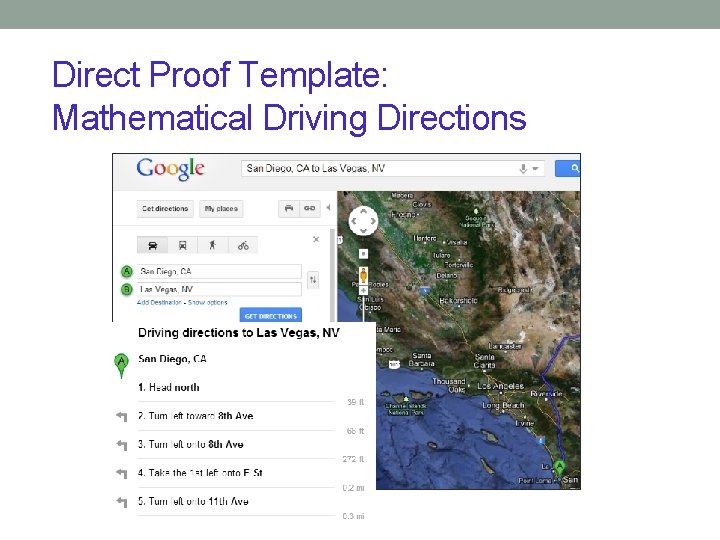
Direct Proof Template: Mathematical Driving Directions
Without a plan…
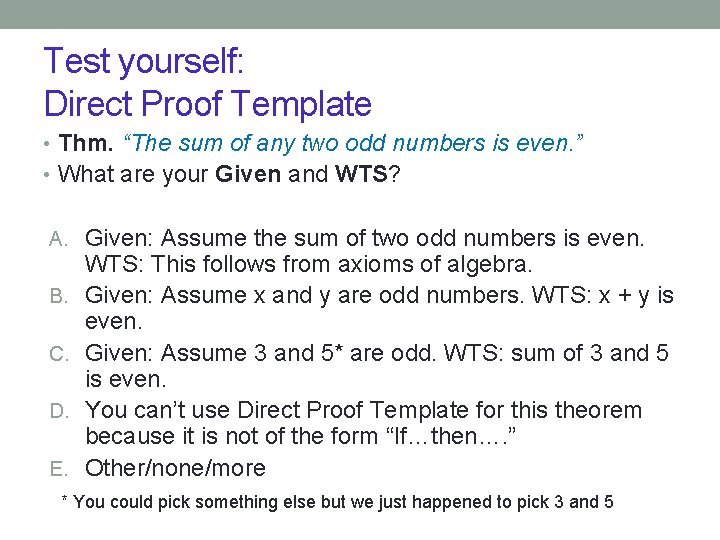
Test yourself: Direct Proof Template • Thm. “The sum of any two odd numbers is even. ” • What are your Given and WTS? A. Given: Assume the sum of two odd numbers is even. B. C. D. E. WTS: This follows from axioms of algebra. Given: Assume x and y are odd numbers. WTS: x + y is even. Given: Assume 3 and 5* are odd. WTS: sum of 3 and 5 is even. You can’t use Direct Proof Template for this theorem because it is not of the form “If…then…. ” Other/none/more * You could pick something else but we just happened to pick 3 and 5
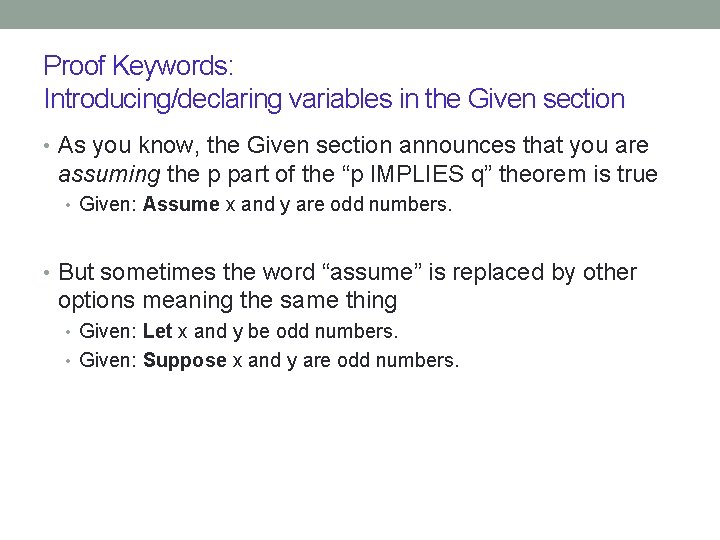
Proof Keywords: Introducing/declaring variables in the Given section • As you know, the Given section announces that you are assuming the p part of the “p IMPLIES q” theorem is true • Given: Assume x and y are odd numbers. • But sometimes the word “assume” is replaced by other options meaning the same thing • Given: Let x and y be odd numbers. • Given: Suppose x and y are odd numbers.
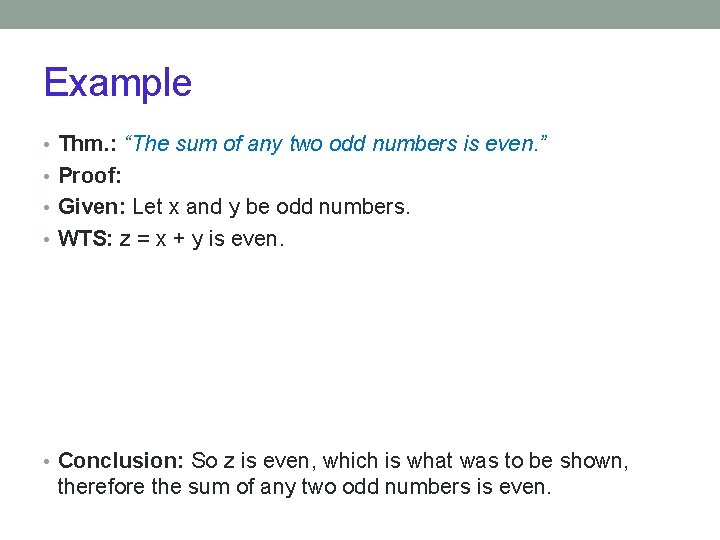
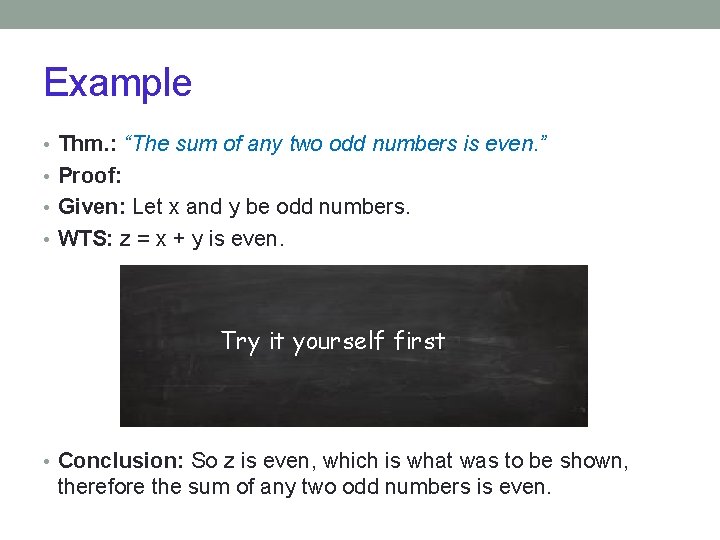
Example • Thm. : “The sum of any two odd numbers is even. ” • Proof: • Given: Let x and y be odd numbers. • WTS: z = x + y is even. • Conclusion: So z is even, which is what was to be shown, therefore the sum of any two odd numbers is even.
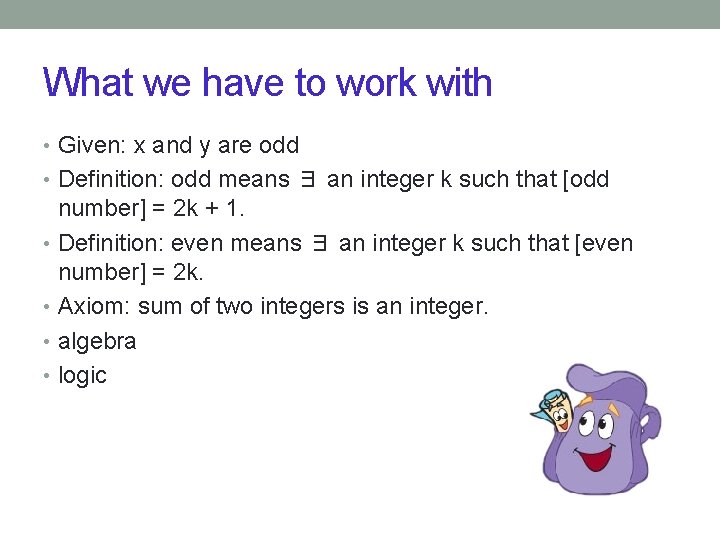
What we have to work with • Given: x and y are odd • Definition: odd means ∃ an integer k such that [odd number] = 2 k + 1. • Definition: even means ∃ an integer k such that [even number] = 2 k. • Axiom: sum of two integers is an integer. • algebra • logic
Example • Thm. : “The sum of any two odd numbers is even. ” • Proof: • Given: Let x and y be odd numbers. • WTS: z = x + y is even. Try it yourself first • Conclusion: So z is even, which is what was to be shown, therefore the sum of any two odd numbers is even.
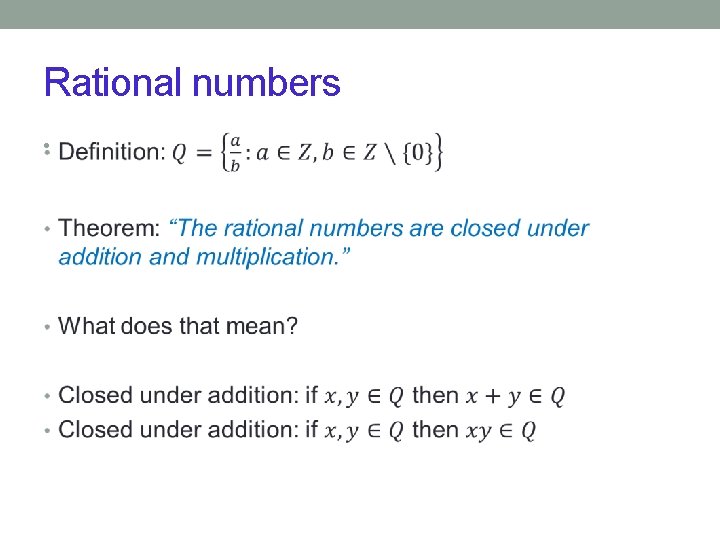
Rational numbers •
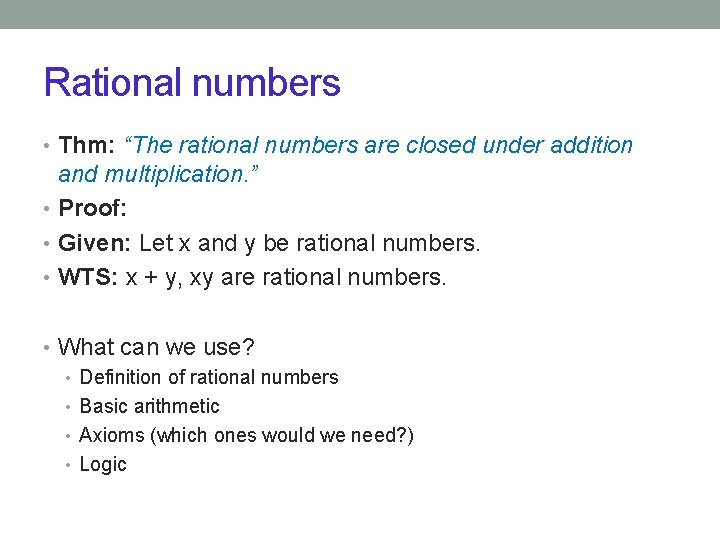
Rational numbers • Thm: “The rational numbers are closed under addition and multiplication. ” • Proof: • Given: Let x and y be rational numbers. • WTS: x + y, xy are rational numbers. • What can we use? • Definition of rational numbers • Basic arithmetic • Axioms (which ones would we need? ) • Logic
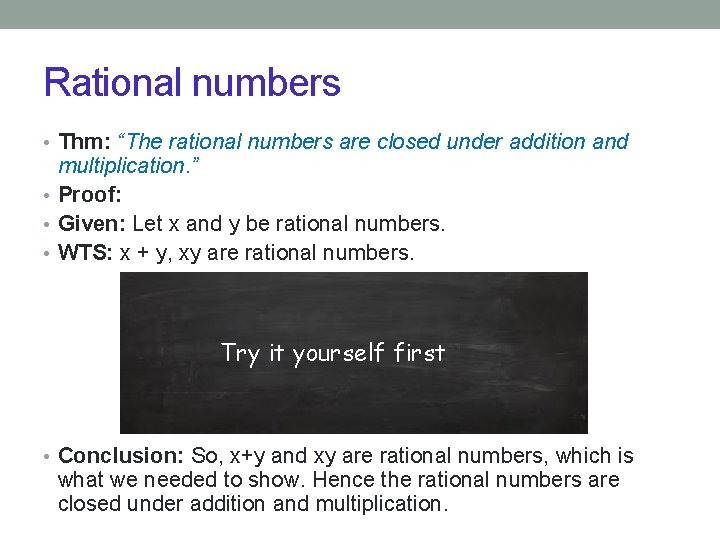
Rational numbers • Thm: “The rational numbers are closed under addition and multiplication. ” • Proof: • Given: Let x and y be rational numbers. • WTS: x + y, xy are rational numbers. Try it yourself first • Conclusion: So, x+y and xy are rational numbers, which is what we needed to show. Hence the rational numbers are closed under addition and multiplication.
Next class • More direct proof techniques • Read section 3. 5 in Jenkyns, Stephenson