
CSE 20 DISCRETE MATH Fall 2020 http cseweb
CSE 20 DISCRETE MATH Fall 2020 http: //cseweb. ucsd. edu/classes/fa 20/cse 20 -a/
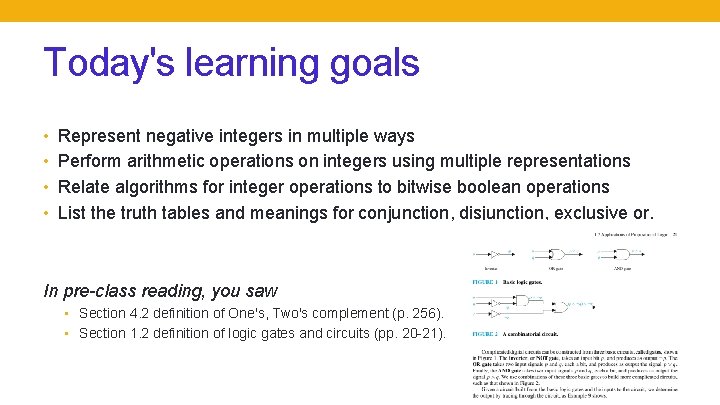
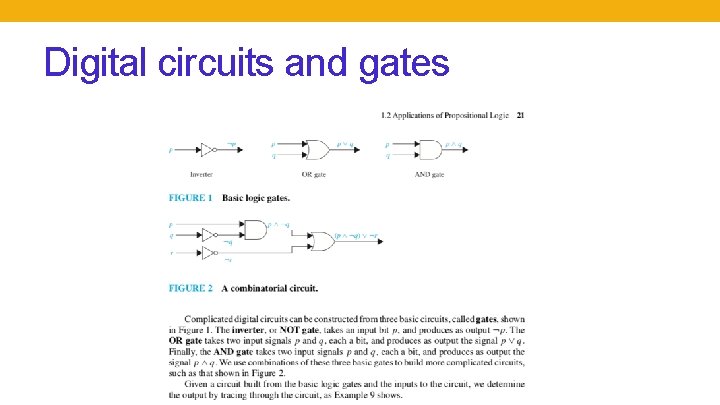
Today's learning goals • Represent negative integers in multiple ways • Perform arithmetic operations on integers using multiple representations • Relate algorithms for integer operations to bitwise boolean operations • List the truth tables and meanings for conjunction, disjunction, exclusive or. In pre-class reading, you saw • Section 4. 2 definition of One's, Two's complement (p. 256). • Section 1. 2 definition of logic gates and circuits (pp. 20 -21).
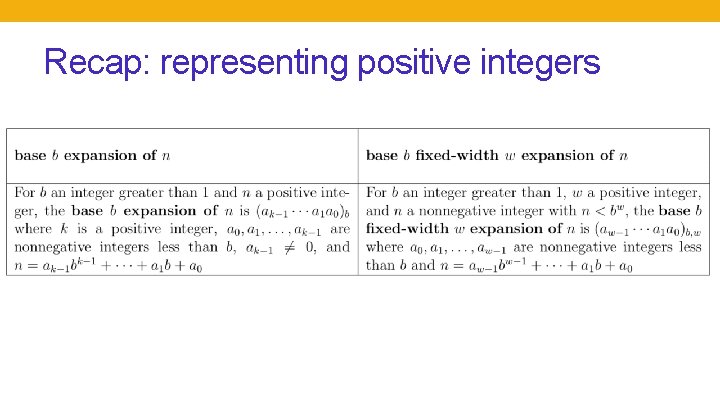
Recap: representing positive integers
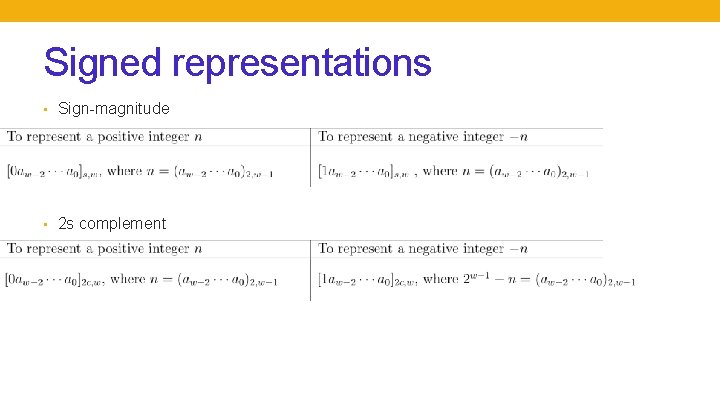
Signed representations • Sign-magnitude • 2 s complement
![Signed representations • Sign-magnitude • 2 s complement 17 = [ ] s, 7](http://slidetodoc.com/presentation_image_h2/8ac49fe4ca9bbfad5c763212ff95df3a/image-5.jpg "Signed representations • Sign-magnitude • 2 s complement 17 = [ ] s, 7")
Signed representations • Sign-magnitude • 2 s complement 17 = [ ] s, 7 -17 = [ ] s, 7 17 = [ ] 2 c, 7 -17 = [ ] 2 c, 7

Tips for calculating 2 s complement To represent –n in 2 s complement with width w • Calculate 2 w-1 -n, convert to binary fixed-width w-1, pad with leading 1 • Express –n as a sum of powers of 2, where leftmost (2 w-1) is negative weight • Convert n to fixed-width w binary, flip bits, add 1 (ignore overflow) Bonus: use definitions to explain why all these approaches work!
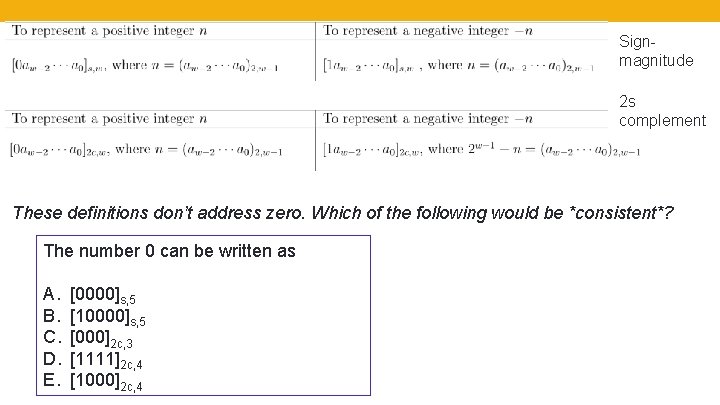
Signmagnitude 2 s complement These definitions don’t address zero. Which of the following would be *consistent*? The number 0 can be written as A. B. C. D. E. [0000]s, 5 [10000]s, 5 [000]2 c, 3 [1111]2 c, 4 [1000]2 c, 4
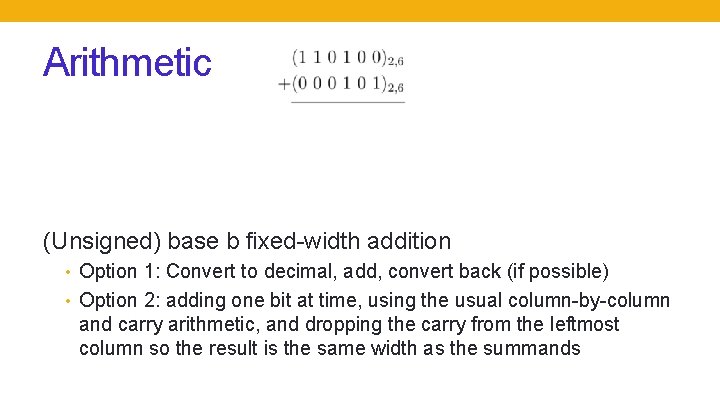
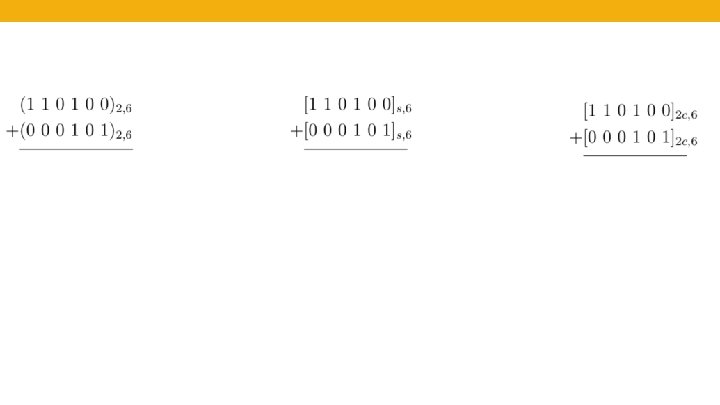
Arithmetic (Unsigned) base b fixed-width addition • Option 1: Convert to decimal, add, convert back (if possible) • Option 2: adding one bit at time, using the usual column-by-column and carry arithmetic, and dropping the carry from the leftmost column so the result is the same width as the summands
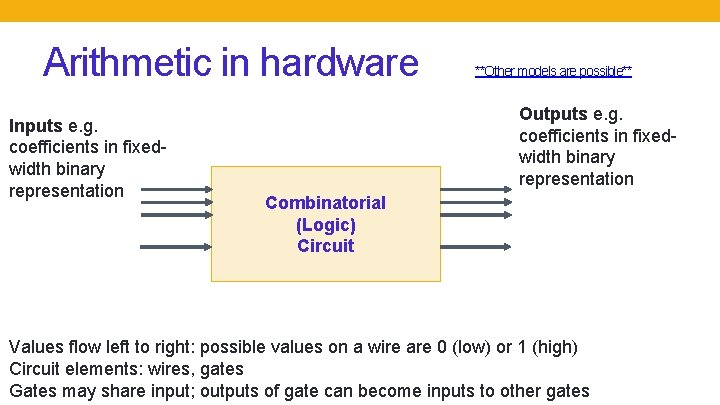
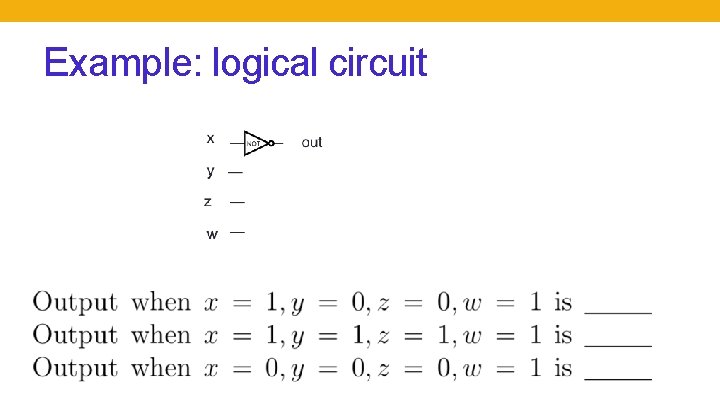
Arithmetic in hardware Inputs e. g. coefficients in fixedwidth binary representation **Other models are possible** Outputs e. g. coefficients in fixedwidth binary representation Combinatorial (Logic) Circuit Values flow left to right: possible values on a wire are 0 (low) or 1 (high) Circuit elements: wires, gates Gates may share input; outputs of gate can become inputs to other gates
Digital circuits and gates
Example: logical circuit
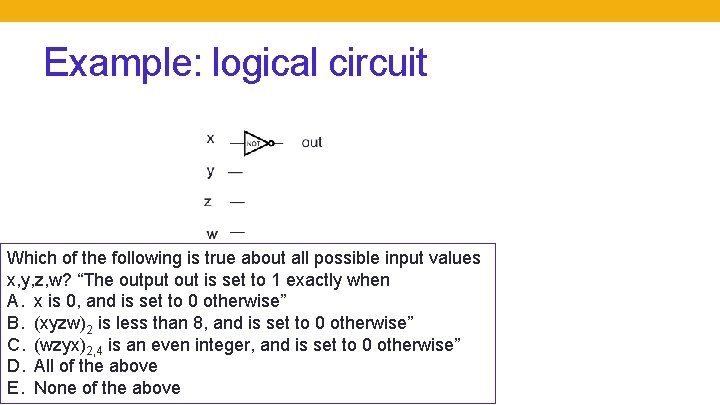
Example: logical circuit Which of the following is true about all possible input values x, y, z, w? “The output out is set to 1 exactly when A. x is 0, and is set to 0 otherwise” B. (xyzw)2 is less than 8, and is set to 0 otherwise” C. (wzyx)2, 4 is an even integer, and is set to 0 otherwise” D. All of the above E. None of the above
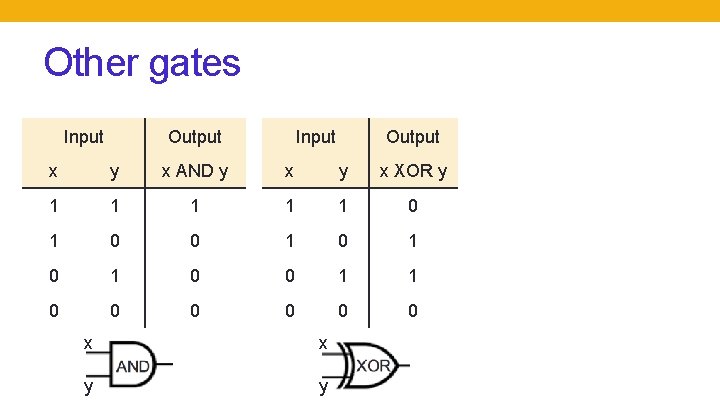
Other gates Input Output x y x AND y x XOR y 1 1 1 0 0 1 0 1 0 0 1 1 0 0 0 x x y y
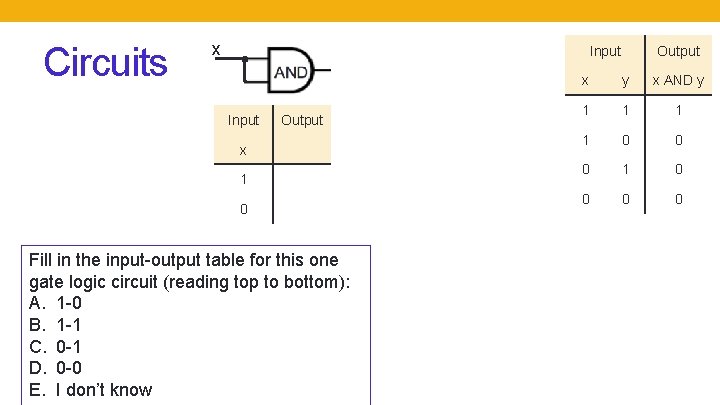
Circuits x Input Output x 1 0 Fill in the input-output table for this one gate logic circuit (reading top to bottom): A. 1 -0 B. 1 -1 C. 0 -1 D. 0 -0 E. I don’t know Output x y x AND y 1 1 0 0 0 1 0 0
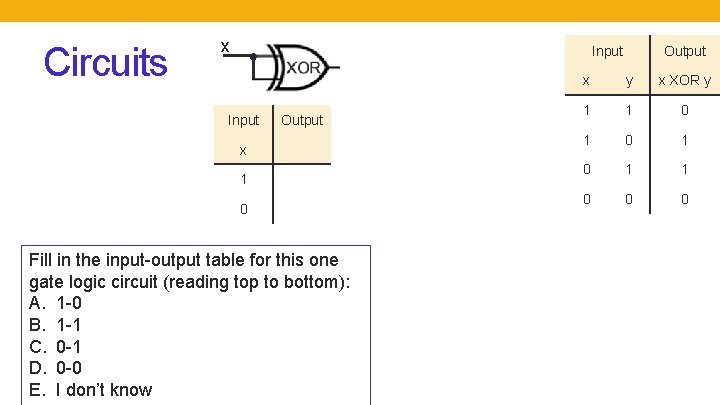
Circuits x Input Output x 1 0 Fill in the input-output table for this one gate logic circuit (reading top to bottom): A. 1 -0 B. 1 -1 C. 0 -1 D. 0 -0 E. I don’t know Output x y x XOR y 1 1 0 1 0 1 1 0 0 0
For next time • Read website carefully http: //cseweb. ucsd. edu/classes/fa 20/cse 20 -a/ • Next pre-class reading: • Section 1. 1 definition of truth table and Tables 1 -5 (pp. 4 -6).
- Slides: 17